
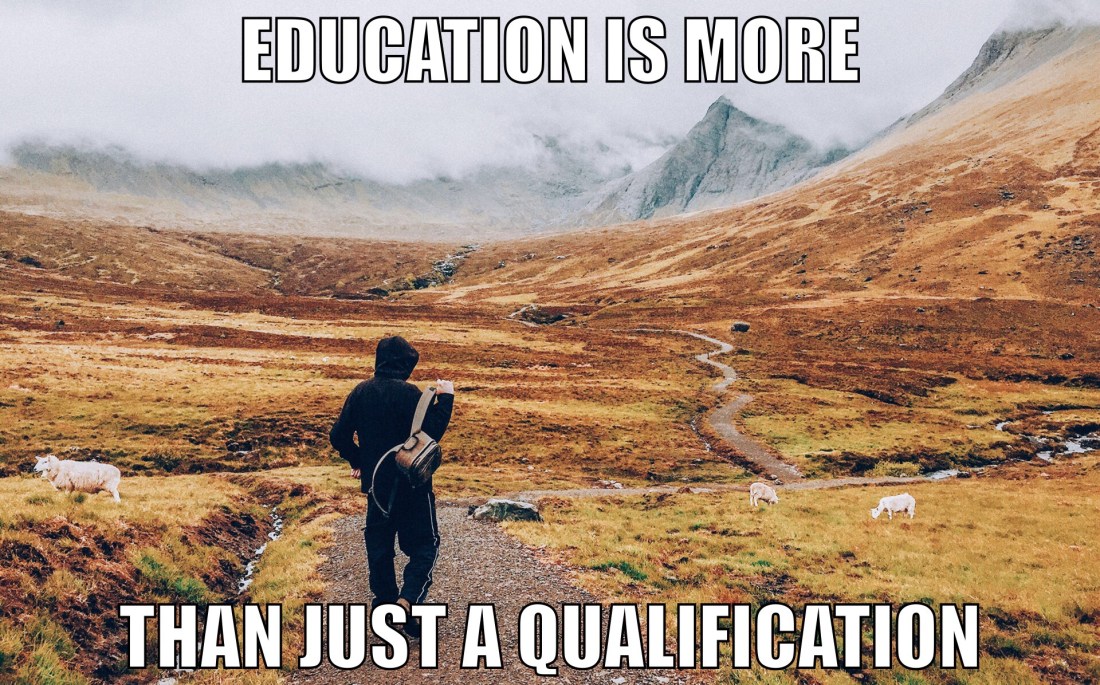
The travesty of Tuition Fees was the commercialisation of education, the myth of qualification-related Social Mobility and the creation of lifetime debt for those who can least afford it

img_1723


Somewhere, there was a cheer last week. Quieter than the Government was expecting. Bringing noises that didn’t sound quite as expected.

Yes, the dropping of Tuition Fees does sound good. But the question we should all be asking – just as we should have when they were first brought into being is ‘at what cost?’.

Living in the age of political idealism made manifest as we currently do, it is all too easy to get distracted by the noise from the media as new public policies are launched.

We fail to look beyond and see the true consequences of what the Government of the day is doing with our money, and what the legacy – and yes, what the fallout will actually be from everything they do.

The creation of Tuition Fees was one of the biggest travesties of them all, simply because it all sounded so good, whilst the negative impact and knock on effects across so many different areas of policy were simply too-far reaching to justify anything about it which was tangibly good.

The UK’s Education System has been failing us all for a long while anyway. But the impact from Tuition Fees was never going to deliver much that really helped anyone in the way that the genuine concept of equality in education for all really should.

That so many former, existing and future students are now destined to have a lifetime of debt must surely now be a given.

Yet it is through the accompanying shift of emphasis from quality of teaching to fee-generation and profit alone within the Further and Higher Education Sectors which has secured the Blair era one of its darkest, yet most unrecognisable legacies as the true cost of ‘degrees for everyone’ becomes manifest and begins to become widely known.

It should come as little surprise that the leaders of the Institutions in these Sectors are now worried that a restriction on Fees may begin a process where ‘struggling’ universities are set to close.

That is the true price of making education a business, where money should never have been the target of a reprioritisation of direction. And certainly not in a place where the benefit to the student, our industries and the National interest itself are so very closely entwined.

Beware the siren calls and suggestion of this being an attack on Social Mobilty too. Academic qualifications have only ever been a very small part of what it takes to get any one person through the perceptual barriers which hold so many people back. Whether they be school-age students, young people, graduates, career changers, returners or retirees, we all have a part to play in everyone else’s future too.

The reality is that the State should pay for everyone’s education. But in doing so, we must be practical and realistic about how access to education is applied and how much benefit is derived to us all from the provision of each and every course.

We must recognise that there is just as much value to be gained by opening up truly vocational opportunities for the less-academically-inclined at the age of 14.

And that as a result of doing so, not only would we release many young people from the painful and unnecessary realities of being in debt, we can also exploit the opportunity to create a parallel track of time-served and experienced trainees to support all of our businesses in a way that the obsession with degree level education has all but denied.

It would be far more sensible to begin this process of change now, accepting that neither the student nor the Nation itself can afford the process of awarding superfluous and non-beneficial degrees. And help the Sector to change through reform, rather than through a process brought on by necessity, which is what is currently sure to happen, if Politicians continue to think that money is the only benchmark by which the future of education can and should be defined.


Cheltenham & Boots Corner: When things don’t add up, questions need to be asked

BCWith the Boots corner closure remaining firmly in local minds, the Council attempts to write the concern off as nothing more than the views of a ‘vociferous minority’.

Regrettably, this is how Local Government glosses over disquiet in the UK today and hitting the spot when it comes to overturning undemocratic decisions is a very hard thing to do, as the whole culture has evolved to protect itself.

In reality, even elected Councillors that do have their local communities and constituents at the heart of what they do, can find it an almost impossible task to get the right questions answered, as the system is geared to allow the close-down of unwelcome debate.

That said, persistence is the greatest ally in achieving worthy aims in Government, and if you keep asking questions, and then the questions which then follow any answers that you might get, the right result is far from being impossible – even if it doesn’t arrive within a timescale that you might find comfortable or like.

If I were representing people in Cheltenham right now, there are a number of questions that I would immediately ask. I would anticipate having many more, depending upon the answers I received or found. They would be as follows:-

Why has Boots Corner been closed?

Whilst it sounds like the answer should be obvious, it isn’t. BUT it is in the interests of the Council and/or whoever benefits from the closure for members of the Public to think that it is. Be sure not to fall into the trap of reading or listening to opinion, such as the article in last Sunday’s Observer, which framed the whole issue as being about pollution. That is just a useful excuse that takes the debate in a very different direction and is designed to make the real issues subservient to those that are in vogue.

Who or what is the driving force behind the change?

Is it the whole Council? Is it one of the Political Groups? Is it Officers? Were there Consultants involved? If there were Consultants involved, who paid the bill and what was the Brief?

What is their reasoning and motivation for the change?

Why now? What do the changes to Boots Corner really achieve? Is the reasoning given the full story, or is there more that we should know?

Who are the real beneficiaries?

Who stands to benefit from the changes at Boots Corner? What will those benefits be? What evidence was used to suggest that these results would be achieved? What modeling was used? What real-life examples were used and how do they relate to the very idiosyncratic nature of Cheltenham’s Road Plan?

What else is happening which is related?

There’s no such thing as coincidence. What else is happening on the same timeline as the changes to Boots Corner? What bigger Strategy is at work?

How did the Council reach the conclusion that the change was necessary?

What was the process within the Council that led to the decision to make the changes at Boots Corner? What is the chronology and timeline of the events that led to it? Who was involved in the process? What influence did each of the Parties involved have?

What evidence or tests being met will confirm the change as permanent?

The changes have been portrayed as being temporary or as a trial. What evidence will be used to decide if the changes at Boots Corner should become permanent? How have those levels been defined? Who has defined them? Who will write up the final Report, Conclusions and table the Proposal for the Council to decide?

What has been used as the basis of those tests?

Where did the ideas or methods come from which have been used to define these tests?

What has changed?

What has changed since the last time the Council and/or other Local Authorities considered closing Boots Corner and decided not to?

What is the long term Strategy?

 Is the closure of Boots Corner part of a much bigger plan? Does the Council intend to pedestrianise the whole of the High Street and Centre of Cheltenham? Is there something on the horizon that isn’t Publicly known?

What consultation with the Public has taken place?

Did a Public Consultation take place? If so, how was it carried out? What questions were asked? Who took part? How many people took part? What were their responses? What questions were raised? How were those questions answered?

What consultation with local businesses has taken place?

Did a Consultation with businesses take part? If so, how was it carried out? What questions were asked? Who took part? How many businesses took part? What were their responses? What questions were raised? How were these questions answered?

What consultation with Developers and Landlords has taken place?

Were Developers and Landlords consulted? What role did they play? What influence did hey have?

What influence has the arrival of the John Lewis store had on Boots Corner and other changes to the Town Centre Traffic system?

Has the arrival of the John Lewis store and its opening this Autumn had any influence on the Council’s decision making? If so, how?

Who designed the current plan?

Who designed the revised traffic and/or road plan to facilitate the Boots Corner closure? What modeling did they use? Why was that modeling considered appropriate as the basis for the changes?

What work was undertaken on traffic displacement modeling?

What work was undertaken on traffic displacement modeling? (Literally, what were the recognisable alternatives for drivers?) Where are the plans and figures showing where the traffic would go when Boots Corner was closed? How do the Council know what alternatives people who used to drive through Boots Corner to access the North of the Town Centre and beyond would use?

What steps were taken in response to the traffic displacement modeling before Boots Corner was closed on 28th June 2018?

What steps were taken to address the impact of the traffic re-routing which was going to take place after the Boots Corner closure BEFORE it actually took place in late June?

All of this information should be available in the Public Realm, but it is far from an exhaustive list of questions, and I am sure that many more would arise as you go along.

The primary sources of information should be the Minutes of the Meetings of the Full Council and also any of the Council’s Committees which have been working on or ‘overseeing’ the Boots Corner changes.

This is where all of the decision making, the reasoning and the evidence that supported it should be open to Public view.

If not, Freedom of Information Requests (FOI) should enable access to anything else that isn’t disclosed because it has taken place outside of Public Meetings.

Please Remember: The Boots Corner Closure is a matter of everyday Public concern. As such, legitimate questions should always be answered when asked or presented appropriately. If the Council and any party involved has been fair, balanced and done everything properly to ensure that the best interests of local people, businesses and anyone it has a duty of care to are served, they will have nothing to hide and everyone working on their behalf will be as open and helpful as they can be. They certainly wouldn’t need to rely on or have reason to resort to ridicule or any other form of personal attack as part of their response – whatever the medium.