

Hello, I’m Adam. I’ve been writing here for many years – blogs, essays, and the occasional book – all shaped by the things I’ve seen, the people I’ve worked with, and the systems I’ve lived inside.
My background isn’t straightforward. I grew up with very little, left school at sixteen, worked on farms and in practical jobs, and found my way back into education at twenty. Since then I’ve spent time in local government, charities, business, and community work – often in roles where the decisions were real and the consequences mattered. All of that experience shapes how I think and what I write about.
These days I’m focused on how we make sense of the world as it is, and how we might build something better from where we stand. I’m interested in the gap between how systems are supposed to work and how they actually behave, and in the choices people make when they’re navigating that space.
If you’re here to explore ideas, understand patterns, or make sense of the world around you, you’re in the right place.

Adam lives in Cheltenham, Gloucestershire.
He spends his time writing, researching, volunteering, following Gloucester Rugby, and walking his dogs Betty and Bea through the landscapes he’s lucky to call home – near Cheltenham, Gloucester and the Cotswold Hills.
Adam Tugwell Agriculture AI Basic Living Standard British Politics Community Community Resilience Contribution Culture Cost of Living Crisis Democracy Economic Inequality Economic Reform Economics economy Farming finance Food Food Security Food Security UK Future of Work Governance LEGS Life Local Economy Local Economy & Governance System Local Food Systems Money news Personal Sovereignty philosophy Political Economy Political Reform Politics Public Policy Social Change Social Justice social mobility Sustainability Sustainable Agriculture Systemic Change Systems Thinking Technology The Future UK Economy UK Politics
-
What Leadership Means When the System is Failing | Why Britain’s crisis requires neither better managers nor stronger personalities, but a different understanding of leadership itself.

Britain’s crisis isn’t just about poor management or weak personalities – it’s about a system whose assumptions no longer match reality. What Leadership Means When the System is Failing explores how true leadership demands more than competence or control. It calls for the courage to question the machinery itself, to see beyond the metrics and…
-
Civilisation: The Cumulative Pathway to Enlightenment
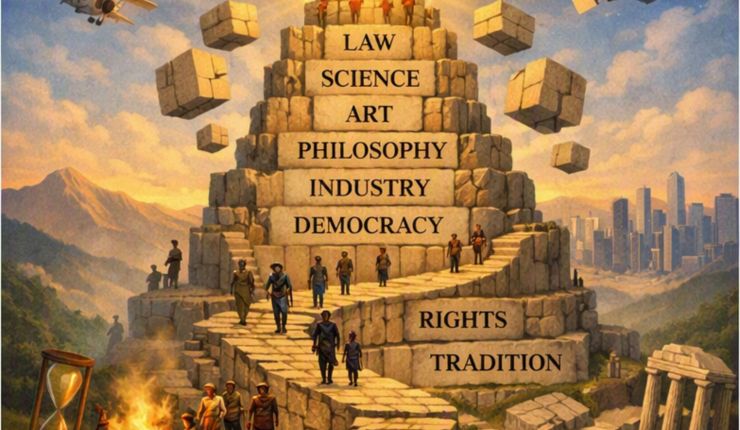
Civilisation is not a design project – it’s the cumulative pathway to enlightenment, built brick by brick through centuries of human experience. Each triumph, mistake, and moral awakening forms the structure we stand on today. Yet in our pursuit of progress, we risk forgetting the foundations that made it possible. This essay explores how civilisation…
-
Why High Streets Are Really Failing

High streets aren’t failing because people stopped caring about them – they’re failing because the economic system that once made them possible has shifted into something entirely different. A financialised, digitalised model now pulls spending outward instead of circulating it locally, leaving towns vulnerable and disconnected. This piece explains how that shift happened, why the…
-
The Independence Threshold | A New Definition of Poverty for A Modern Economy

The Independence Threshold Definition of Poverty redefines how we understand economic independence in a modern society. Rather than measuring poverty solely by income, this framework explores the point at which individuals and households achieve genuine autonomy – the ability to sustain themselves without dependency on external support. This concept challenges traditional metrics and invites a…
-
The Two‑Edged Sword of Social Mobility: Why Our System Elevates Narratives, Not Capability

Social mobility is often framed as a simple moral mission – remove barriers, widen opportunity, and help people rise. But the way we currently pursue it contains a structural flaw that quietly undermines the very idea of fairness. We have blurred the line between help and a hand‑up. Help empowers people to grow their capability;…
-
How Would You Feel If It Were You?

How Would You Feel is a powerful exploration of the pressures shaping modern life – and the uncomfortable truth that the system enriching a few is the same system impoverishing many. Through clear analysis and human‑centred storytelling, Adam Tugwell invites readers to step into the shoes of those living under relentless strain, not to judge…
-
The Young People Who Didn’t Fail – And the System That Keeps Pretending They Did

Every few years, the government announces it is “reviewing the NEET problem,” and every time the country sighs – because we’ve been here before. The truth is that the issue was never solved because it was never understood. Young people aren’t disengaging out of apathy; they’re responding rationally to a system that no longer works.…
-
The Establishment Is Not What You Think It Is

Everyone talks about “the Establishment” – politicians rail against it, commentators blame it, voters distrust it. But what if the Establishment isn’t a secret cabal at all? What if “they” are not people behind closed doors, but the shared assumptions that shape how we all think, work, and govern? In The Establishment Is Not What…
-
Young People, Politics, and the System That is Failing All of Us | Why youth disengagement is not apathy, but a rational response to distant, hollowed-out governance – and why rebuilding democracy must begin locally.

Young people aren’t disengaged from politics – they’re disillusioned by a system that no longer works for anyone. Westminster has become a theatre of distance and detachment, where decisions are made without consequence and experience is replaced by performance. The solution isn’t to “get young people interested” – it’s to build a system worth being…
-
Awareness of Foods We Can Trust is important Today, so that We can All Eat them Tomorrow

In Awareness of Foods We Can Trust is important Today, Adam Tugwell explores why our relationship with food has become increasingly distorted -and why reclaiming it is essential for our health, autonomy, and future. Tugwell argues that the human body is “a brilliant, natural machine that can only work at its very best when we…
-
The Myth Catcher – A quiet guide to discovering clarity in an age of noise | Full Text

There are moments when the world feels louder than it should. Not in volume, but in insistence – a constant pressure to understand, to decide, to take a position before the truth has even had time to breathe. In those moments, something quiet begins to happen. People start searching. Not always consciously, and not always…
-
Rejoin. Stay Out. Stay Still.* | Why Britain’s New Argument About Europe May Lead to the Same Place
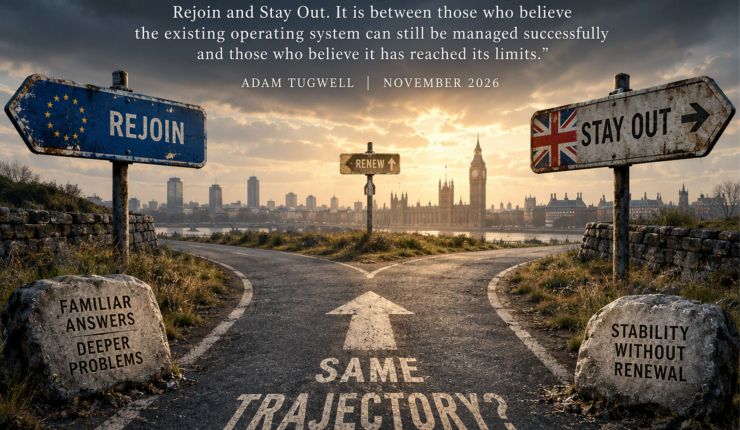
Britain’s debate about Europe is returning. One side argues for rejoining. The other insists Britain must stay out. But what if both sides are asking the wrong question? This essay explores why the deepest divide in British politics may no longer be between Rejoin and Stay Out, but between those who believe the existing operating…
-
The Phoenix Paradox | Executive Summary

The Phoenix Paradox: Executive Summary Why do genuine problems survive repeated attempts to solve them? The Phoenix Paradox explores how the appearance of renewal can sometimes become the greatest obstacle to genuine change. When inadequate solutions are presented as definitive cures, their failure can undermine confidence in future reform while leaving the original problem intact.…
-
The Phoenix Paradox | Why the Appearance of Renewal Can Prevent Genuine Change: Understanding Failed Reform, Paradigm Blindness, and the Political Utility of Failure

The Phoenix Paradox explores why genuine problems often survive repeated attempts to solve them. Introducing concepts such as the Phoenix Trap, False Cure Effect, Charlatan’s Legacy, and Straw Remedy, it examines how the appearance of renewal can sometimes become the greatest obstacle to genuine change. By connecting systems thinking, political incentives, institutional behaviour, and paradigm…

