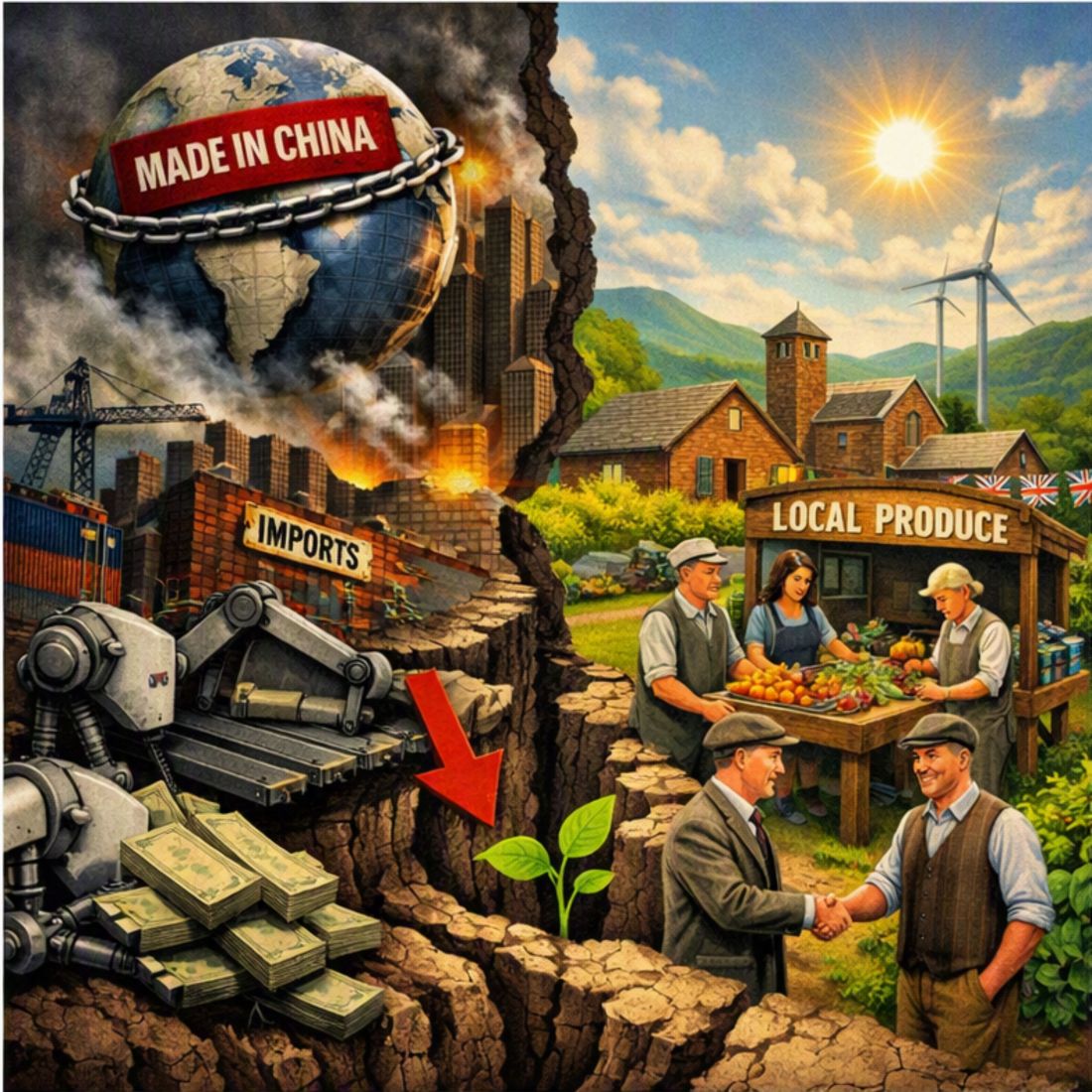
Most people experience modern economic life through symptoms.
Prices rise.
Wages struggle to keep pace.
Housing becomes increasingly difficult to afford.
Public services deteriorate.
Businesses fail.
Infrastructure declines.
Debt grows.
Governments borrow.
Communities feel under pressure.
Each issue is typically discussed as a separate problem, with separate causes and separate solutions.
The left may focus on inequality.
The right may focus on government failure.
Economists may focus on productivity.
Businesses may focus on costs.
Households may focus on bills.
All may be seeing something real.
The argument of The Money Illusion is that these issues are not isolated. They are interconnected consequences of a system whose parts are widely discussed but whose whole is rarely examined.
The book does not claim that a secret group deliberately controls events. Nor does it suggest that every politician, banker, regulator, investor or business leader fully understands the consequences of the system in which they operate.
Instead, it argues that a set of accepted financial, political and legal arrangements have evolved over time and produced outcomes that few people ever learned to see as part of the same story.
The First Illusion: What Money Really Is
Most people grow up with a simple understanding of money.
Money is earned.
Money is saved.
Banks lend existing money.
Investors invest existing money.
Governments spend taxes.
Economic life appears to operate within the limits of money already in existence.
The modern monetary system works differently.
In contemporary banking systems, most money enters circulation through credit creation. When commercial banks make loans, they typically create new bank deposits at the same time.
This does not mean lending is unlimited.
Banks remain constrained by regulation, capital requirements, profitability, collateral, market conditions and monetary policy.
The important point is not that banks can create money without restriction.
The important point is that much of the purchasing power used throughout the economy did not exist before being created through lending.
That reality fundamentally changes how ownership, investment and economic power develop.
The Second Illusion: Access Is Not Equal
Understanding money creation is only the beginning.
The deeper question is:
Who receives access to newly created purchasing power?
The book argues that this is where the most important misunderstanding begins.
Workers normally earn before they spend.
Savers accumulate before they invest.
Households must demonstrate income before gaining access to mortgages.
Yet large borrowers with sufficient collateral, scale or institutional access can command purchasing power vastly greater than the cash they already possess.
The advantage is not that repayment disappears.
The advantage is that purchasing power can be brought forward in time.
This distinction transforms the nature of economic competition.
If all acquisition depended upon previously accumulated savings, ownership would still concentrate over time.
But it would do so differently.
Many acquisitions would have been smaller.
Many purchases would have taken longer.
Many ownership structures would have evolved differently.
The book’s central claim is therefore not simply that money is created.
It is that unequal access to created purchasing power changes who acquires ownership of the world around us.
The Ownership Revolution Nobody Saw
This leads to the central revelation of the book.
Credit creation did not merely expand economic activity.
It expanded the ability to acquire existing economic assets.
Homes.
Land.
Retail chains.
Utilities.
Infrastructure.
Care providers.
Transport systems.
Public assets.
Across modern economies, vast amounts of ownership have changed hands through structures made possible by large-scale credit creation.
This does not automatically make such ownership illegitimate.
Nor does it make every acquisition harmful.
The argument is more precise.
Without access to created purchasing power on this scale, many ownership concentrations could not have occurred in the form, at the speed, or to the extent that they ultimately did.
Created purchasing power became legal ownership of real assets.
Ownership generated income.
Income generated further acquisition capacity.
The cycle reinforced itself.
The result was not merely financial growth.
It was a transformation in ownership itself.
The Hidden Mechanisms
Most people encounter terms such as:
leveraged buyout
restructuring
recapitalisation
debt loading
special dividend
refinancing
These concepts often appear technical, obscure or distant from everyday life.
The book strips away this complexity.
It demonstrates how, in some acquisition structures, debt incurred to finance a purchase can be transferred onto the acquired business itself.
The buyer gains ownership.
The acquired company gains repayment obligations.
If extraction follows, the acquired business may become weaker while returns are already realised elsewhere.
The significance of these mechanisms extends beyond isolated transactions.
The same patterns appear repeatedly across multiple sectors of the economy.
What often appears as unrelated decline may share common underlying financial drivers.
Legal Does Not Mean Neutral
One of the most important clarifications made throughout the book is that legality and legitimacy are not the same thing.
The argument does not depend on widespread illegality.
In fact, many of the mechanisms described operate entirely within accepted legal frameworks.
Banking law.
Company law.
Insolvency law.
Tax law.
Regulation.
Fiscal policy.
Successive governments and legislatures helped create, maintain and adapt these frameworks over many decades.
The concern raised by the book is therefore not:
“Was the law broken?”
It is:
“What happens when lawful systems create outcomes that most citizens never understood, never consented to and were rarely invited to examine as a whole?”
Legality provides permission.
It does not automatically establish fairness, wisdom or democratic legitimacy.
Financialisation and the Expansion of Market Logic
As finance increasingly shapes ownership, financial logic begins shaping life itself.
The book describes this process as financialisation.
Originally, finance existed to serve economic activity.
Over time, economic activity increasingly became organised around finance.
Housing became a financial asset.
Infrastructure became a revenue stream.
Public services became investment opportunities.
Communities became markets.
People became economic units.
Financial outcomes increasingly became the primary mechanism through which value was judged.
As this occurred, monetary considerations moved from being one factor among many to becoming the dominant lens through which decisions were evaluated.
When Money Becomes a Value System
The book argues that money gradually ceased being treated as merely a tool.
Instead, it increasingly became a system for measuring worth.
Questions about people became questions about economics.
Can they afford something?
Are they creditworthy?
Are they productive?
Are they profitable?
Are they financially viable?
These measures serve useful functions within financial systems.
The concern arises when financial measurement becomes the dominant method through which human value itself is assessed.
Once this occurs, the monetary system no longer merely facilitates exchange.
It begins shaping social priorities.
Public Debt, GDP and the Expansion of Measurement
The book then turns toward public borrowing and economic measurement.
Debt itself is not presented as inherently harmful.
Nor is GDP dismissed as meaningless.
Both serve practical purposes.
The issue lies in how these measurements influence decision-making.
Public debt is commonly assessed relative to GDP.
This is reasonable in principle.
A larger economy can support a larger debt burden.
However, once debt sustainability becomes politically tied to GDP growth, growth begins serving a second role.
It ceases to be merely desirable.
It becomes necessary.
This creates powerful incentives.
Activities that generate measurable output become increasingly important.
Activities that are difficult to monetise become easier to overlook.
The danger is not that GDP measures nothing useful.
The danger is that what GDP does not measure can gradually appear less valuable.
Care.
Community.
Relationships.
Trust.
Belonging.
Social cohesion.
Environmental stewardship.
Human flourishing.
These things continue to matter profoundly.
Yet systems increasingly organised around monetary measurement struggle to represent them adequately.
The Human Consequence
The book ultimately shifts from economics toward people.
Many individuals followed the rules they were taught.
Work hard.
Save diligently.
Spend responsibly.
Plan carefully.
Remain financially prudent.
Yet increasing numbers found themselves struggling despite doing precisely what they believed was expected of them.
The standard explanation often focuses on individual shortcomings.
The book asks a different question.
What if many people were not failing?
What if the system itself had changed?
What if the rules people thought governed economic life no longer reflected its actual operation?
This does not eliminate personal responsibility.
It expands the context in which responsibility is understood.
Why the System Persists
If the system produces strain, why does it continue?
The book argues that systems sustain themselves through multiple reinforcing layers:
belief
institutions
regulation
politics
incentives
narrative
dependency
habit
Most participants only see a small part of the wider structure.
The system therefore reproduces itself without requiring anyone to understand the entirety of its consequences.
This is not necessarily the product of conspiracy.
Complexity alone can produce blindness.
People understand their own role exceptionally well while remaining unable to see how the larger system functions.
A Model Reaching Its Limits
The book does not predict collapse.
Nor does it advocate revolution.
Its final argument is simpler.
Every system depends upon foundations.
Households.
Communities.
Services.
Infrastructure.
Trust.
Social cohesion.
A system can extract value from those foundations for a long time.
But it cannot do so indefinitely.
Eventually limits appear.
Households cannot absorb rising costs forever.
Services cannot endure endless reductions.
Communities cannot withstand perpetual pressure.
Infrastructure cannot deteriorate without consequence.
Growth cannot compensate indefinitely for weakening foundations.
The book argues that many contemporary pressures may indicate that these limits are becoming increasingly visible.
The Central Insight
The entire argument can be reduced to a single sequence:
Credit creation generated purchasing power.
Purchasing power enabled ownership.
Ownership generated power.
Power influenced institutions.
Institutions shaped incentives.
Incentives shaped the society we now experience.
The purpose of The Money Illusion is not to persuade readers toward a particular ideology.
It is not a manifesto.
It is not a political programme.
It is not a conspiracy theory.
It is an attempt to make visible a set of connections that are usually examined separately.
Its central message is simple:
Money is not merely a thing. It is a system of permissions, claims, obligations, measurement, ownership and power.
Once those connections become visible, the economic, political and social realities of modern life can begin to look very different.
“Created purchasing power became real title over real things, in a system whose rules changed without consent and were never equal, leaving people punished by terms they never chose.”
This is not a book about a secret group controlling everything, nor an argument that every investor, banker, regulator or politician acts with the same knowledge or intent. It is about a system whose parts are widely discussed but whose whole is rarely seen: how money is created, how credit changes ownership, how debt can transfer risk, how incentives shape institutions, and how the consequences reach ordinary life.
The central claim is not that money is imaginary. Money is real in its effects because we accept it, price with it, owe it and organise life around it. The illusion lies in mistaking it for a fixed substance rather than a social and legal system of claims, promises and credit-and in assuming that everyone enters that system on equal terms.
Some examples in these pages describe possibilities; others describe recurring patterns. Intent differs from case to case. A mechanism can produce harm without every participant intending that harm, and ignorance does not erase responsibility. Where facts can be established, they should be established. Where motives cannot, the argument rests on incentives, structures and outcomes rather than mind-reading.
You do not need to arrive from any particular political direction. You may recognise state failure, market failure, inequality, excessive debt, weak regulation, lost local ownership or something else entirely. Each may be part of the picture. The purpose here is to connect the fragments, slowly enough that the reader can test each step.
Most public arguments begin with a symptom. Prices are rising. Wages are not keeping pace. Housing is out of reach. Services cost more and deliver less. Businesses that appeared viable fail. Governments change, budgets change and promises change, yet many of the pressures remain.
Every group sees part of the problem. The left sees inequality. The right sees state failure. Economists see debt and productivity. Businesses see costs. Households see bills. Journalists see crises. Each may be looking at something real. The difficulty is that a partial truth can still conceal the whole.
Modern finance is divided into specialties. One person understands monetary policy, another acquisition finance, another public borrowing, another regulation, another electoral politics. Expertise makes complex systems possible, but it can also create system blindness: people may understand their part exceptionally well while relying on inherited assumptions about everything around it.
This book follows the connections. It begins with ordinary experience, then moves through money creation, ownership, debt, extraction, institutional incentives and human cost. It does not ask you to accept the conclusion in advance. It asks you to keep looking as each layer is added.
Let’s begin where you are.
You’ve lived your whole life believing money is real. You work for it. You save it. You worry about it. You plan around it. You measure your security by it.
You’ve watched prices rise. You’ve watched wages stall. You’ve watched bills grow heavier. You’ve watched the cost of simply existing climb year after year.
And you’ve probably thought:
“Everything is getting more expensive.”
“Life is harder than it used to be.”
“I’m doing everything right – why does it still feel like I’m falling behind.”
You’re not imagining it. You’re not failing. You’re not alone.
Something has been happening – quietly, steadily, and without your consent.
You’ve seen your high street change. Shops you knew for years disappear. New ones arrive, then vanish. Whole chains collapse overnight.
You’ve seen homes in your area bought up in bulk. You’ve seen rents rise faster than wages. You’ve seen people priced out of the places they grew up in.
You’ve seen utilities sold, resold, and sold again. You’ve seen services decline while costs increase. You’ve seen infrastructure crumble while profits soar.
You’ve seen all of this. You’ve lived through all of this. But few people ever connected the reasons in a way that explained the whole.
And that’s where this conversation begins.
Not with jargon. Not with blame. Not with economics.
But with the simple truth that what you’ve been experiencing is not random, not wholly accidental, and not inevitable.
It is the result of a system that changed – quietly, profoundly – while you were busy living your life.
And the change begins with one idea:
The money used to buy the world around you was never a fixed substance in the way you were taught to imagine it.
But before we open that door fully, we need to walk through the world you did know – the world you trusted – and show how it was reshaped.
You believed banks lent out savings. You believed companies grew by reinvesting profits. You believed investors used their own wealth. You believed governments spent taxes. You believed markets reflected value.
None of these beliefs were foolish. They were taught to you. They were reinforced everywhere. They were the foundation of your understanding of life.
And for a long time, they were true enough.
But then the system changed.
Quietly. Technically. Mostly beyond public debate. Rarely met with meaningful public consent.
And the rules you were taught stopped being the rules that mattered.
In the modern system, much of the money used for major purchases enters circulation as bank credit before the income needed to repay it has been earned.
When a major investor wants to buy:
a chain of shops
a utility
a housing portfolio
a stretch of land
a transport network
a piece of national infrastructure
they may not rely primarily on accumulated savings, retained profits or existing wealth.
They arrange credit through banks and other lenders. When a commercial bank makes a loan, it normally creates a matching deposit: new spendable money appears within the banking system, paired with a debt that must be serviced and repaid.
And because everyone agrees to treat it as real, it becomes real.
This is the moment where the world you thought you lived in diverges from the world you actually live in.
Because while you were earning money through labour, others were gaining access to newly created purchasing power through credit.
While you were saving for a deposit, others were using large credit facilities to buy whole housing portfolios.
While you were budgeting for bills, others could borrow at scale to buy the companies that send those bills.
While you were trying to keep up, others were using credit-created purchasing power to reshape ownership around you.
There is a deeper implication in what you have just read. It is not simply that commercial banks create most new money when they lend. It is that much of the purchasing power used to buy the existing world did not have to be earned, saved or accumulated before it was deployed.
That changes the possible scale of ownership. If every acquisition had depended principally on savings already set aside, retained profits already made or wealth already realised, the pool available for buying companies, homes, land and infrastructure would have been smaller. Deals would still have happened. Wealth would still have concentrated. But not with the same speed, reach or leverage.
Credit creation did not merely finance a larger economy. It enlarged the power to acquire the economy that already existed.
A worker normally spends after being paid. A saver invests after accumulating. A household proves it can service a mortgage from income. Large borrowers also face tests, prices and limits, but those with acceptable collateral, scale and institutional access can command purchasing power far beyond the cash they already hold. The bank does not hand them value without an obligation; it creates a deposit and a matching debt. Yet the deposit can purchase a real asset now, while repayment is pushed into the future.
This distinction matters. Bank lending is not literally limitless, costless or consequence-free. It is constrained by regulation, capital, liquidity, profitability, collateral, borrower demand and monetary policy. Loans can fail and money is destroyed when bank debt is repaid. But within those constraints, access is profoundly unequal. The decisive privilege is not freedom from repayment. It is the ability to bring forward large amounts of purchasing power and decide what becomes owned before most people have had any comparable chance to earn or save.
This is the golden thread running through the book: without credit creation on this scale, many concentrations of ownership could not have developed in the form, at the speed or to the extent that they did. Homes could not have been bid away from wages so rapidly. Companies could not have been acquired with obligations placed on their own future cash flows so extensively. Public assets and essential services could not have been drawn into such large financial structures so easily.
Created purchasing power became real title over real things.
None of this sits outside the law. Banking licences, company law, insolvency rules, security over assets, tax treatment, acquisition structures, fiscal rules and regulatory permissions make it possible.
That legality is not incidental. Successive governments and parliaments have maintained, revised or extended the framework across generations, often because each part appeared defensible on its own: more lending, deeper markets, easier transactions, private investment, economic growth.
The shocking point is therefore not that law was broken. It is that lawful processes could combine to produce outcomes most citizens were never invited to understand as a whole.
Legality can establish permission. It cannot, by itself, establish fairness, wisdom or democratic consent.
Politicians did not have to design every consequence or understand every mechanism to carry responsibility. Those who seek high office inherit a duty to understand the monetary, fiscal and legal architecture they govern. Ignorance may be widespread and sincere. At that level, it is still consequential.
People hear financial terms all the time – “leveraged buyout,” “loading a company with debt,” “special dividend,” “restructuring,” “credit event” – and they assume it’s specialist jargon.
They assume it’s complicated. They assume it’s legitimate. They assume it’s something “finance people” understand.
That assumption helps keep the mechanism out of ordinary view.
The jargon can act like a curtain. Behind it, the basic mechanism can be simple-and, in some cases, devastating.
Let’s walk through one of the most important ones.
Imagine a chain of shops you’ve known all your life. It’s part of the fabric of everyday life.
A large investment group decides to buy it.
People assume:
they must be wealthy
they must have huge reserves
they must be using money from investors
Often, that is not the whole story.
They can use large amounts of borrowed money, some of it created through bank lending.
Now here is the part many people never encounter:
The buyer doesn’t take on the debt – the chain does.
The debt is placed on the company being acquired, not on the people doing the acquiring.
So the chain-the shops, the staff and the supply network-can emerge carrying debt incurred to finance its own acquisition.
The buyer walks away owning the chain. The chain walks away owing the debt.
It’s like buying a house and making the house itself take out the mortgage.
Then the buyer pays themselves a “special dividend” – real money – taken from the debt they just put on the chain.
The buyer gets richer. The chain gets weaker.
Then the chain:
cuts staff
cuts wages
cuts maintenance
cuts stock quality
closes stores
People see the decline and think:
“The chain must be struggling.”
“Competition must be too strong.”
“Times must be changing.”
Competition or changing markets may play a part. But where acquisition debt and extraction have weakened the business, those financial decisions can be decisive.
It may have been hollowed out from the inside.
If it later collapses, the buyer may already have recovered fees, dividends or other returns while workers, suppliers, creditors and communities carry much of the loss.
For some buyers, collapse does not erase the returns already extracted. Whether intended or not, the incentives can reward decisions that leave the company less able to survive.
Variations of this pattern-credit creation, leveraged purchase, debt loading and extraction-can be found across:
high street shops
utilities
housing
transport
infrastructure
care homes
nurseries
supermarkets
energy networks
Everyday people see the symptoms:
rising prices
declining services
collapsing chains
disappearing shops
unaffordable housing
failing infrastructure
But the underlying mechanisms are rarely presented together.
Because the mechanism is hidden behind jargon.
And because most discussion still treats money as a neutral thing rather than a system of relationships, permissions and obligations.
6. The Moral Dimension: When Money Becomes the Value System of Life
The same architecture that expands ownership also shapes valuation. Once access to created credit determines who can buy, finance ceases to be only a means of exchange. It becomes a gatekeeper: deciding which projects are fundable, which assets are desirable and which lives appear secure enough to deserve further credit.
The financial institutions that extend credit and shape ownership also help construct the systems through which the public is assessed.
They run:
credit scoring
affordability checks
risk assessments
debt recovery
financial compliance
They decide who is “responsible.” They decide who is “risky.” They decide who is “worthy.”
They therefore exercise power inside a system whose rules they have helped to define.
Because money has become a central value system of life, these judgements can influence:
whether someone can rent a home
whether someone can borrow and on what terms
whether someone can obtain essential services without paying in advance
whether someone can access financial products and opportunities
whether someone can survive a crisis
These systems have power over:
mental health
family stability
physical wellbeing
dignity
hope
life trajectories
In extreme cases, they have power over life and death.
And yet the system can still appear fair because the public is rarely shown how differently access to money and credit is distributed.
7. The Human Cost: People Punished by Rules They Never Knew Changed
Think of the people who saved all their lives. Who worked hard. Who lived carefully. Who believed they were safe.
They thought standing still was enough.
But the system was always moving – always extracting – always pulling value upward.
People weren’t standing still. They were being dragged backwards.
And when they struggled, the system blamed them.
“You didn’t save enough.” “You didn’t work hard enough.” “You didn’t plan well enough.” “You didn’t keep up.”
But how could they keep up with a system where:
new credit purchasing power is accessible to some on far greater terms
repayment burdens and losses fall on others
assets move upward
costs move downward
responsibility is individual
power is centralised
They couldn’t. Against those unequal terms, keeping up may be impossible however responsibly someone behaves.
8. The Truth about Money Today: You Were Never Told the Whole Story
People aren’t stupid. They aren’t lazy. They aren’t irresponsible.
They were simply never told the rules.
They were taught:
money is real
debt is dangerous
saving is noble
hard work pays off
markets are fair
politicians protect them
None of those ideas was wholly foolish; each was incomplete, and some became less reliable as the system changed.
The rules changed. The system changed. The incentives changed.
But the public was rarely shown how the changes connected.
And because nobody told them, they kept playing a game that no longer existed.
This argument does not require a hidden command centre. It does not claim that every debt is harmful, every market is false, every company is predatory, every investor is malicious, every regulator is captured or every politician is corrupt.
It argues that incentives matter; that systems evolve; that complexity hides consequences; and that harm can be reproduced by people who each see only part of what they are sustaining.
Complexity does not merely confuse the public. It fragments understanding among experts. Institutions train people to solve the problems directly in front of them, reward them for fitting accepted models and give them little reason to question the assumptions beneath those models. A banker may understand credit but not community loss. A regulator may understand compliance but not ownership extraction. A politician may understand a budget but not the full monetary structure within which it operates. None needs to be foolish or dishonest for the whole to remain unseen.
Responsibility still remains. People who seek power over public money, regulation, ownership or essential services have a duty to understand the systems they shape. Not knowing may explain a decision; it does not make its consequences disappear. The moral question is therefore larger than blame: what should people in positions of power be expected to know, and what should they do when the system rewards them for not looking too far?
Understanding usually arrives in stages. First, life feels harder. Then the reader sees that prices, wages, housing and services are connected. Next comes the role of credit: new purchasing power can enter through debt before it is earned through production. Then comes ownership: access to credit can outrun access to wages. Finally comes the institutional question: how can so many people participate in a system whose combined effects so few are positioned to see? Each step matters. None requires the reader to surrender judgement.
Why the illusion doesn’t break – and why ordinary people keep the system alive without realising it
By now, you’ve seen how the system works. You’ve seen how bank deposits can be created through lending. You’ve seen how assets are bought. You’ve seen how debt can be used as an instrument of control or extraction. You’ve seen how value is extracted. You’ve seen how collapse can be engineered or made more likely by financial decisions. You’ve seen how ordinary people carry the cost.
And naturally, a question rises:
“If this is how the system works, why hasn’t it fallen apart?”“Why doesn’t anyone stop it?”“Why do people keep voting for the same thing?”
The answer is not simple – but it is clear.
The system sustains itself through layers. Layers of belief. Layers of pressure. Layers of narrative. Layers of power.
The system’s legitimacy depends partly on people treating every pound as though it reached every holder through the same kind of effort and access.
They believe:
banks lend savings
investors use wealth
companies grow through profit
markets reflect value
debt is dangerous
collapse is accidental
These beliefs act like glue.
They hold the illusion together.
If people understood that bank lending creates new deposits, that access to this purchasing power is unequal, and that financial decisions can make collapse and extraction more likely, the system’s legitimacy would face much harder questions.
So the system depends on belief.
Belief is the foundation. Belief is the shield. Belief is the fuel.
Elected governments are accountable to citizens, but in practice they must also respond to financial markets, lenders, institutions and the expectations built around them.
Markets react instantly. Citizens react slowly.
Markets can react within minutes. Citizens usually respond through slower political processes and often absorb the consequences in the meantime.
Markets demand stability. Citizens demand hope.
So politicians:
deregulate finance
privatise assets
protect capital flows
avoid policies that upset investors
present political choices as if financial scarcity alone determined them
reinforce the belief that access to money reflects earned value alone
This does not require conspiracy. It can arise from aligned incentives, inherited assumptions and constrained choices.
And because the architecture is rarely explained as a whole, elections are usually fought over budgets and personalities rather than the monetary and ownership system beneath them.
The system convinces people that their struggles are their fault.
“You didn’t save enough.” “You didn’t work hard enough.” “You didn’t plan well enough.” “You didn’t keep up.” “You made bad choices.” “You should have known better.”
Blame keeps people quiet. Blame keeps people ashamed. Blame keeps people isolated.
Blame prevents people from seeing the truth:
They were punished by rules they never knew changed.
By now, you’ve seen how the system works. You’ve seen how bank deposits can be created through lending. You’ve seen how assets are bought. You’ve seen how debt can be used as an instrument of control or extraction. You’ve seen how value is extracted. You’ve seen how collapse can be engineered or made more likely by financial decisions. You’ve seen how ordinary people carry the cost. You’ve seen how belief, politics, institutions, narratives, and pressure keep the system alive.
But there’s one more truth – one that matters more than any other:
The present model is reaching limits because it has taken too much from the foundations on which it depends.
Not because people rose up. Not because governments changed direction. Not because regulators intervened. Not because markets became moral.
It is straining because extraction has advanced further than wages, services, infrastructure and communities can indefinitely absorb.
Public debt is commonly expressed as a percentage of gross domestic product. There is a practical reason: the same cash debt can be easier or harder to carry depending on the size and income of the economy supporting it. The ratio helps compare an obligation with the economic base from which taxes and repayments may come.
But once stability, borrowing capacity and political credibility are narrated through that ratio, growth in GDP becomes more than a desirable outcome. It becomes a way of keeping debt looking supportable. A larger denominator can make a larger stock of debt appear more manageable. This does not mean governments can borrow without limit, or that GDP statistics conceal the cash amount. It means the political story of sustainability becomes tied to continued measured expansion.
GDP then begins to act not only as a measure but as a governing pressure. Activities that produce priced transactions count readily. Selling care counts; unpaid care usually does not. Rebuilding after damage can add to output even when the damage itself represents a loss. Higher rents can enlarge measured activity while making households less secure. A forest may sit only partially inside the national accounts until it is cut, sold or converted into a priced asset.
GDP was not designed to measure the whole of human progress, and official statisticians increasingly publish measures beyond it. The danger comes when a measure of marketed production is treated as if it were a complete account of value. What cannot be priced becomes easier to neglect. What can be monetised becomes easier to justify.
This is how the logic spreads. Debt calls for growth. Growth calls for more measurable activity. Measurement rewards monetisation. Monetisation reaches into care, housing, education, health, nature, attention and time. Things once valued because they sustained life are recast as resources, services, assets and revenue streams.
The deepest distortion is not that GDP measures nothing useful. It is that what it cannot adequately measure can begin to look as though it has no value.
Because if the penny has dropped – if you have truly seen the system for what it is – that is enough for now.
Understanding is already a profound act. It is already a form of change.
So let’s reflect for a moment about the reality we are living through.
We live in a world where:
money has become a central value system of life
more decisions are filtered through cost, price, profit and affordability
public services are judged by financial metrics
human needs are reframed as financial burdens
communities are treated as markets
people are treated as units of productivity
wellbeing is treated as an economic output
This did not arise from one decision or one group. It is the cumulative result of decades of financialisation: life increasingly reshaped around monetary measures rather than human ends.
And we have all taken part.
Not maliciously. Not knowingly. Not deliberately.
But through:
accepting the rules we were taught
believing the stories we were told
trusting the systems we grew up with
fearing exclusion
needing security
wanting stability
trying to survive
Many people sensed something was wrong. They felt the pressure. They saw the cracks. They noticed the contradictions.
But instead of speaking out, they stayed quiet. Not because they didn’t care – but because the system made them feel powerless.
“Take part or be excluded.” “Play the game or fall behind.” “Adapt or suffer.”
And when enough people accept a system – even reluctantly – the system becomes normal.
That’s how we arrived here.
The pressure is reinforced by what the country chooses to count. If national success is repeatedly reduced to growth in priced activity, then more borrowing, more transactions and more extraction can appear as progress even when security, care, belonging and ecological resilience are deteriorating.
The measure does not cause every decision. It helps decide which consequences remain visible.
A world where:
reliance on benefits has grown
food banks have become normal
mental distress is widely reported
debt is a constant companion
insecurity is widespread
social pressures accumulate
communities feel hollowed out
people feel alone even when surrounded by others
These are not isolated issues. They are symptoms of a deeper truth:
Life has been financialised, stripped, hollowed out, and reshaped around money – under the guise of being reshaped around need.
But most of what we call “need” today is actually “want” – wants created by a system that profits from insecurity, aspiration, and fear.
And while people chase wants, their basic needs – the simple, essential foundations of life – have become harder and harder to meet.
Growing numbers can no longer meet those needs without:
benefits
charity
debt
That is the reality we are living through.
And seeing it clearly is the beginning of something important.
12. The Necessary Turn: The Reality We Need to Embrace
Now let’s turn – slowly, softly – toward the reality we need to embrace.
Not a list of actions. Not a call to arms. Not a set of instructions.
Just a direction. A shift in understanding. A different way of seeing life.
Because once you see that money has become the central value system of everything, you can also see that it doesn’t have to be.
Human beings did not evolve to live money-centric lives.
We evolved to live people-centric lives.
Lives built around:
relationships
community
shared responsibility
mutual support
contribution
meaning
dignity
purpose
care
Money was meant to be a tool. A way to organise exchange. A way to coordinate effort. A way to support life.
But somewhere along the way, money stopped being a tool and became the measure of everything.
It became:
the measure of worth
the measure of success
the measure of security
the measure of identity
the measure of possibility
the measure of morality
And when money becomes the measure of everything, people become measured by money.
That is the world we have been living in.
But it is not the world we have to continue living in.
Because the present model is reaching visible limits.
Not because people fought it. Not because governments changed direction. Not because regulators intervened.
It is under strain because it consumed too much and left too little behind.
It is reaching those limits because:
people cannot absorb more extraction
governments face political and practical limits on raising revenue
services cannot withstand more cuts
companies cannot survive more debt
communities cannot endure more pressure
markets cannot hide more instability
public belief becomes harder to sustain
It is approaching the practical limits of what people, institutions and the living world can sustain.
And that means something important:
The future cannot remain money-centric. It will have to become people-centric again.
Not overnight. Not through revolution. Not through ideology.
But through necessity.
Through the simple truth that life cannot continue on the terms set by a system that has already hollowed itself out.
People-centric living is not necessarily utopian. Cooperation, care and relationship have always been essential to human survival. It is the way communities survive. It is the way societies endure. It is the way people thrive.
And as the money-centric system strains, cracks, and falters, people will begin – slowly, quietly, naturally – to rediscover what it means to live in ways that are:
grounded
human
relational
communal
meaningful
sustainable
The argument for this book ends without a programme or a roadmap. Its purpose is more basic: to make the structure visible, so that whatever comes next begins from a clearer account of the world as it is.
The penny dropping is enough.
Because once someone sees these connections clearly, they are difficult to ignore. And once they become difficult to ignore, people begin-in their own way, in their own time-to shift towards a different way of living.
A way of living that is not built around money. But built around people.
And that is the beginning of everything that comes next.
This book has not asked you to choose a tribe. It has asked you to notice connections: between credit and ownership, ownership and power, power and narrative, narrative and the judgements made about ordinary lives.
The point is not that one explanation replaces every other explanation. It is that no budget, election or policy can be understood fully while the monetary and ownership system beneath it remains invisible.
Before anything different can be built, people have to understand what they are standing inside. That does not guarantee agreement. It does make a more honest disagreement possible.
Ask people why small businesses are struggling today and you’ll hear a long list of familiar answers. Taxes. Business rates. Parking. VAT rules. Tourist exemptions. Energy costs. rent. The price of labour. The price of everything. And for the people dealing with those pressures, each one feels painfully real.
But none of them explain what’s really going on.
Because the truth is that the crisis facing small businesses today didn’t begin in July 2024. It didn’t begin with the current government. It didn’t begin with the last one either. What’s happening now is the result of decades of structural change – slow at first, then accelerating, then suddenly impossible to ignore.
And the hardest part to accept is this: the system we live in wasn’t built to support small businesses. It was built to extract from them.
That’s why every “fix” people argue about feels too small. That’s why every debate feels circular. That’s why every solution seems to miss the point. Because the point is buried much deeper than the symptoms we see on the surface.
The long hollowing‑out
For more than forty years, the UK economy has been reshaped around one central idea: that money should move freely, markets should dominate, and growth should come from scale. It sounds modern. Efficient. Sensible. But underneath, it created a system where value flows upward and responsibility flows downward.
Big corporations gained access to cheap credit, global supply chains, and financial backing that allowed them to expand at a pace no local business could ever match.
They could open stores at a loss, undercut prices, buy land, buy competitors, and buy market share. They could operate in ways that looked like “success” but were really just the product of financial engineering.
Small businesses, meanwhile, were increasingly left to survive on margins so thin they could barely absorb a bad month, let alone a bad year.
Communities changed too. As wages stagnated and housing costs soared, people had less time, less money, and less stability. They shopped for convenience, not connection. They chose the cheapest option because they had no choice. And slowly, the conditions that once made local businesses possible began to disappear.
This is why high streets are failing. Not because people suddenly stopped caring about them, but because the system changed what people could afford, how people lived, and where value flowed.
Corporate capture and the illusion of choice
The rise of supermarkets and chains is the clearest example. They used financialised expansion to wipe out local shops, then returned years later with “express” stores – selling back the convenience they had taken, but at a premium.
They didn’t win because they were better. They won because they were backed by a system that gave them every advantage.
Online platforms did the same. They centralised choice, centralised supply, centralised power – and left local businesses competing not with each other, but with global corporations that could dictate prices, terms, and margins.
This wasn’t a market. It was a takeover.
And it happened slowly enough that most people didn’t notice until the damage was already done.
The role of money – and why this part matters most
Underneath all of this sits the part people rarely talk about: the role of money itself.
For decades, the economy has been fuelled by created money – credit, liquidity, financial instruments, and investment flows that allowed large corporations to grow in ways no small business ever could.
This wasn’t organic growth. It was engineered growth. Growth built on debt, speculation, and financial leverage.
Small businesses don’t have access to that world. They operate in the real economy – the one where money has to be earned before it can be spent, where margins matter, where cashflow is survival, where a bad quarter can end everything.
The system didn’t just favour big business. It was designed around them.
Covid didn’t break the system – it exposed who the system really serves
On 20 March 2020, three days before the first lockdown, I wrote that the only humane response to what was coming was simple: pause the bills, freeze the interest, and make sure people had enough to eat and stay clean. Not loans. Not subsidies. Not grants. Just a temporary halt to the machinery so ordinary people and small businesses could survive the shock.
It wasn’t complicated. It wasn’t radical. It was practical.
But that kind of solution was never going to happen – not because it was impossible, but because it would have required government to prioritise people over markets. And that is the one thing the system cannot do.
The idea of pausing the system was treated as unrealistic, not because the logic was flawed, but because the narrative we all live inside teaches us something very specific:
The system cannot be stopped. The system rules. The system must be protected at all costs.
And the cost has been enormous.
Government could have paused the machinery. It could have frozen the costs. It could have protected households and small businesses long enough for everyone to survive the shock.
But it didn’t – because government doesn’t face the public. Government faces the markets.
When crisis hits, the priorities are not communities, not workers, not small businesses – but the financial architecture that sits above them. That is who government answers to. That is who government fears. That is who government protects.
Covid didn’t break the system. It revealed it.
It showed that the system has no built‑in mechanism for protecting ordinary people. It showed that the political class either doesn’t understand the structural reality or is too constrained by it to act differently.
It showed that the real economy – the one made of people, communities, and small businesses – is treated as collateral damage.
Covid wasn’t a stress test. It was a moment of truth.
And what was written on 20 March 2020 captured that truth clearly: government could have protected people, but the system it serves meant it wouldn’t.
Why people think the problem is political
Most people believe the crisis today began with the government elected in 2024 because politics is the part they can see.
They see the headlines, the rhetoric, the decisions being made right now. They see the tax changes, the budgets, the announcements. They see the chaos.
What they don’t see are the decades of structural change underneath:
the financialisation of everything
the consolidation of supply chains
the rise of monopoly power
the dependence on low wages
the hollowing out of communities
the shift from value creation to value extraction
So they blame the nearest political actor. They assume the crisis is recent. They assume it can be reversed with an election.
But the truth is that every government since the 1980s has been operating inside the same model. Some accelerated it. Some managed it. None reversed it. And now the model is reaching the point where it can no longer hide its consequences.
That’s why tax has become the obsession. It’s the only lever left. Everything else has been handed over to the market.
Why some small businesses don’t recognise this immediately
Not every small business owner sees themselves in this story. Some are still doing well. They have loyal customers. They have strong reputations. They operate in niches that haven’t been swallowed by centralised models. They serve communities that value them. They offer things that can’t easily be scaled, automated, or replicated.
Their success is real. But it is also fragile.
Even they can feel the shift:
footfall is different
customers are more cautious
costs rise faster than prices
competition feels less local and more corporate
the old stability has gone
They may not be collapsing – but they know the “glory days” are over. They can sense that something deeper has changed, even if they don’t yet have the language for it.
The honest conclusion
Small businesses are not struggling because they’re doing anything wrong. Workers are not struggling because they’re lazy or entitled. Taxpayers are not angry because they’re cruel.
Everyone is struggling because the system we live in was designed to extract value from the bottom and middle to feed the top – and it has been doing so for decades.
Covid exposed it. 2024 accelerated it. But the roots go much deeper.
Until people understand that, they will keep looking in the wrong direction for answers – and blaming the wrong people for the consequences.
The truth isn’t comfortable. But it is necessary. Because once people see what’s really happening, they can finally stop blaming themselves – and start recognising the system that has been shaping their lives for far too long.
Further Reading
If you want to explore the deeper forces behind the struggle facing small businesses today, the following pieces offer a clear path through the last six years of economic and political change.
Each one captures a different part of the story – from the moment the system was exposed in 2020, to the pressures that intensified in the years that followed, to the structural realities now shaping life in 2026.
Together, they show how we arrived here, and why the problems we face today run far deeper than anything that began in July 2024.
1. “We need bills & interest put on hold…” (20 March 2020)
Summary: Written three days before the first lockdown began, this piece argues that the only humane response to the coming crisis was to pause the financial machinery – bills, interest, and basic costs – so people could survive.
It explains why loans and subsidies were never going to protect the real economy, and why government decisions during Covid revealed who the system truly serves. This is the moment where the deeper structural truth becomes visible.
2. “Small business cannot afford escalating wage growth…” (20 September 2021)
Summary: This piece explores the widening gap between wage expectations and the financial reality facing small businesses. It shows how government‑fuelled wage inflation collided with a system already funnelling money upward, leaving small businesses unable to raise pay without collapsing.
It highlights the early signs of the financial crisis that would later become unavoidable.
3. “Why high streets are really failing” (19 August 2026)
Summary: A clear explanation of why high streets are collapsing – not because people stopped caring, but because the conditions that once made local retail possible have been dismantled.
This piece connects wage stagnation, housing costs, corporate expansion, and community hollowing to the disappearance of local choice. It shows how the high street’s decline is a symptom of a much deeper structural shift.
4. “When tax is the only tool they have left” (22 September 2026)
Summary: This piece explains why modern governments increasingly rely on tax changes as their primary response to economic problems.
It argues that tax has become the only lever left because most other tools – wages, prices, supply chains, investment, land, energy – have been absorbed into a market model government no longer controls.
It shows why political decisions today feel disconnected from real‑world needs.
Why these pieces matter
Read together, these articles trace the journey from the moment the system was exposed in 2020, through the pressures that intensified in the years that followed, to the structural realities now shaping life in 2026.
They show that the crisis facing small businesses is not recent, not political in the narrow sense, and not caused by the issues people argue about most loudly.
They reveal the deeper truth: this is a systemic problem decades in the making – and understanding it is the first step toward changing it.
When I first wrote about Royal Mail privatisation back in 2013 and 2014, I wasn’t trying to be prophetic. I wasn’t waving a flag or trying to score political points. I was simply describing what I’d seen in my own working life: that some services only work because they’re treated as services that should always be accessible for everyone, not as markets. And that once you start pulling at the threads that hold them together, the whole thing begins to unravel.
Those early pieces were written at the moment the Government was pushing ahead with privatisation. I remember thinking then – and writing openly – that the people making these decisions didn’t understand the mechanics of the thing they were dismantling. They didn’t understand how universal access works. They didn’t understand cross‑subsidy. They didn’t understand what happens when you take a service built on obligation and drop it into a world built on profit.
A decade later, Royal Mail has become the perfect example of what happens when you ignore all of that.
The moment you replace obligation with profit, the service changes
A universal postal service is one of the simplest ideas we have: everyone gets a delivery, wherever they live.
It’s not complicated. It’s not ideological. It’s not even particularly political. It’s just a basic commitment to treat everyone equally.
But once Royal Mail was privatised, that commitment became something else. It became a cost. A burden. A legacy obligation that had to be managed rather than honoured. And when you start looking at a hilltop village or a remote farm through the lens of profitability, they stop being communities and start being problems.
This isn’t about blaming Royal Mail’s leadership or its workforce. It’s about recognising that with privatisation, the logic changed – and once it changed, everything else followed.
Competition didn’t modernise Royal Mail – it carved it up
With privatisation came the ‘promise of competition’. Competition was sold as a way to “open up the market” and “drive innovation”. But competition only ever appeared where profit existed: bulk mail, parcels, urban logistics. It never appeared in the places universalism actually lives: rural routes, remote communities, low‑volume areas.
So what happened?
Private operators took the profitable parts. Royal Mail was left with the expensive ones, or supporting other companies that were taking a cut.
That’s not a failure of the market. That’s the market doing exactly what markets do.
The failure was political – applying competition to a sector where competition cannot function without destroying universality.
Royal Mail didn’t fall because of one thing – it fell because of three kinds of capture
This is the part people rarely talk about, but it’s central to the story.
Royal Mail didn’t just suffer from privatisation. It suffered from three different forms of capture, each pulling it away from its purpose.
Corporate capture
Once privatised, Royal Mail’s priorities shifted. Not because anyone was malicious, but because that’s what happens when shareholders enter the room. The universal service obligation became something to minimise, not something to uphold.
Union capture
Before privatisation, Royal Mail had the opposite problem: union leverage that made modernisation difficult, protected inefficiencies, and often put internal priorities ahead of public need. Again, not malicious – just another form of self‑interest shaping a service that was supposed to serve everyone.
Centralised political capture
And then there was the political layer: competition policy that hollowed out the profitable core, privatisation that removed public purpose, regulation that slowly retreated from protecting universality.
Each form of capture distorted the organisation in a different way. Royal Mail had all three pulling at it, one after another.
That’s why the decline feels so deep. It wasn’t caused by one decision – it was caused by a sequence of decisions that all pointed in the same direction.
Regulators didn’t protect the service – they managed its decline
Ofcom didn’t set out to weaken Royal Mail. But once the organisation was privatised and competition was introduced, the regulator’s job changed.
Instead of protecting universal access, Ofcom became responsible for keeping the privatised operator afloat. That meant relaxing standards, reducing delivery days, tolerating higher prices, and approving structural shrinkage.
Regulation became decline management.
This is exactly what happens when you try to regulate a universal service as if it were a competitive market.
The hollowing‑out wasn’t an accident – it was the destination
The redundancies, the rising stamp prices, the slower deliveries – none of this is accidental. It’s the logical end point of a sector redesigned around competition, shareholder value, and centralised political decisions.
Royal Mail didn’t “fail”. It was reshaped.
And what it has become – a parcel company with a legacy obligation – is exactly what the policy framework was always going to produce.
This is why I’ve been writing about these issues for so long
Over the years, I’ve written about local governance, contribution culture, basic living standards, and people‑first thinking.
Those pieces weren’t about Royal Mail specifically, but they were about the same underlying problem:
Essential services fail when they’re designed around power, profit, or central control rather than people, place, and purpose.
Royal Mail is the proof. It’s the example that shows:
why centralisation erodes identity
why privatisation erodes universality
why union capture erodes accountability
why competition erodes economic viability
why regulators cannot protect universalism in a market framework
It’s not about mail. It’s about how we organise essential services – and what happens when we get it wrong.
What we should take from the Royal Mail example
Three things stand out:
Universal access cannot survive under market logic
Essential services cannot be treated as markets
Capture – corporate, union, or political – always distorts purpose
These aren’t abstract ideas. They’re lived consequences. And they’re playing out exactly as expected.
Royal Mail isn’t the Only Warning – It’s Just the One We Can’t Ignore
And the thing is, Royal Mail isn’t some strange outlier. It’s not a one‑off collapse or a freak accident of bad management. It’s part of a pattern that’s been unfolding across every essential service we rely on.
If you look at water, energy, transport – even the basic infrastructure that keeps daily life ticking over – you’ll see the same hollowing‑out happening in different ways and at different speeds.
Water companies that treat rivers and coastlines like drains because investment eats into dividends. Energy networks that talk about resilience while whole regions face outages. Transport systems that cost more every year but deliver less, leaving communities cut off and commuters exhausted.
Different sectors, same story.
Once the goalposts were moved through privatisation, the markets became the master. And once money became the priority, people inevitably became the cost.
A service can prioritise people or money – never both. And the moment we pretended it could do both, we set ourselves up for exactly what we’re living through now: rising bills, falling standards, shrinking access, and a growing sense that the basics of daily life are becoming harder, not easier.
Some people look at all this and say, “Well, renationalise it then.” And on the surface, that sounds like the obvious fix. But nationalisation on its own doesn’t solve the problem, because it keeps the centralisation that caused half the issues in the first place. It puts everything back under political control – distant, slow, often out of touch – and it opens the door straight back to union capture, where the threat of strikes becomes a permanent bargaining chip.
You end up with a service that’s still vulnerable, still distorted, still not centred on the people it’s supposed to serve.
And the unions aren’t wrong when they say management is out of touch. How could it not be? When decisions are made hundreds of miles away by people who never experience the consequences, of course they’re out of touch.
That argument disappears when stewardship sits with the people who rely on the service every day.
When communities – everyone in them – are responsible for the essential services they depend on, the dynamic changes completely. There’s no distant management. No corporate boardroom. No union hierarchy negotiating with people who don’t live there. Just local responsibility, local accountability, and local understanding.
Royal Mail shows us what happens when essential services are designed around profit, power, and distance. Water shows us what happens when environmental responsibility becomes secondary to shareholder returns. Energy shows us what happens when resilience is treated as a cost rather than a duty. Transport shows us what happens when access is treated as a commodity rather than a lifeline.
Different sectors, same lesson.
This isn’t just a story about mail. It’s a story about how we treat the things that hold our lives together. And it’s a story about what happens when we forget who those services are supposed to be for.
Further Reading
If the Royal Mail story resonates with you – not just as a postal issue, but as a sign of how essential services can be reshaped in ways that quietly undermine the people they’re supposed to serve when they are privatised and controlled by the markets – you may find the following pieces helpful.
They track this pattern over time, across different sectors, and from different angles. Some were written more than a decade ago, long before the consequences became visible. Others explore the deeper dynamics that sit behind the hollowing‑out we’re now seeing everywhere from mail to water to energy.
Together, they form a kind of timeline: how we got here, what we missed, and what these examples reveal when you look at them closely.
1. Royal Mail Privatisation: It’s Called Privatisation for a Good Reason
A clear, early warning about what happens when a universal service is handed over to private ownership.
This piece explains why privately owned organisations inevitably prioritise shareholders over the public, and why the universal service obligation becomes a burden rather than a mission once profit enters the equation.
It’s striking now because everything it warned about has since played out.
2. Royal Mail Privatisation: The Coalition Might Be Wise to Reconsider Reinventing the Wheel
Written even earlier, this piece lays out the basic mechanics of universal access – cross‑subsidy, obligation, and the simple truth that some routes will always cost more than they earn.
It explains why competition in essential services doesn’t create efficiency; it creates fragmentation.
This work steps back from Royal Mail and looks at the wider question of how everything essential to us all should be governed.
It explains why centralisation creates distance, why nationalisation alone doesn’t fix the problem, and why local stewardship – with proper guardrails – is the only way to keep essential services aligned with the people they serve.
A deeper look at how work, responsibility, and service can be organised around contribution rather than extraction.
This piece helps explain why union capture and corporate capture both distort essential services – and why neither model can deliver universality or accountability on their own.
This piece sets out the idea of a guaranteed baseline of essentials – not as a political slogan, but as a practical foundation for fairness and resilience.
It connects directly to the Royal Mail story by showing how universal access should work when it’s designed around people rather than profit or centralised control.
A powerful parallel to the Royal Mail example. This essay shows how water – another essential service – has been hollowed out by the same mix of market logic, distant decision‑making, and the prioritisation of money over people.
It’s a case study in how environmental responsibility collapses when profit becomes the organising principle, and why communities end up paying the price.
The debate over tariffs on Chinese electric vehicles has been bubbling across social media, and what’s striking is not the policy detail but the discomfort it creates among the market‑orientated commentariat.
These are people who have spent decades insisting that globalisation is the only sensible economic model, that markets should always set the rules, and that any interference – especially by governments – is a step backwards.
Now, faced with the reality that the UK may need to work with EU partners to protect domestic manufacturers, they are being forced into intellectual contortions that reveal just how brittle their worldview has become.
The friction here is not really about cars. It is about the deeper assumption that the economic model we have – a model built on global supply chains, financial expansion, and the relentless pursuit of growth – is the only one that makes sense.
That assumption rests on a one‑directional pull toward opening trade as far as conceivably possible, because that’s supposedly where growth will be found. And growth, in this worldview, is not about people becoming better off. It is about the creation of yet more money, usually through debt, which pushes up GDP and keeps the financial system ticking over.
This obsession with growth hides a fundamental truth: the growth that markets obsess over is not the same growth that most people experience.
GDP can rise while living standards fall. Productivity can increase while wages stagnate. Asset values can soar while home ownership collapses.
Many people still cling to the myth that political growth will make things better – or at least return life to how it used to be – but the numbers have been going up for years while the lived reality has been going down.
To understand why protectionism now makes sense, we have to understand the money system that made globalisation seem inevitable.
The Money System Behind the Illusion
Modern economies run on fiat money – money created not from physical value but from government authority and, crucially, from debt. When banks issue loans, they create new money. When governments borrow, they expand the money supply. Growth, in the political sense, is simply the expansion of this created money.
For decades, this system worked because the newly created money was tied to expanding production. Factories were built. Goods were made. Jobs were created. Communities thrived. The money had something real behind it.
But once production was moved overseas, the link between money creation and real economic activity broke. We kept creating money – but we no longer created the goods, jobs, or value that once justified it. Instead, the West became dependent on consumption funded by debt, while production was concentrated in China and a handful of other countries.
This is where extraction enters the story.
Extraction: The Hidden Cost of Globalisation
Globalisation didn’t just move factories abroad. It extracted value from every part of Western society:
Extraction of jobs – manufacturing, engineering, logistics, and skilled trades hollowed out.
Extraction of wages – pay stagnated while costs rose.
Extraction of communities – towns built around industry lost their purpose.
Extraction of environmental stability – long supply chains increased emissions and resource depletion.
Extraction of political agency – decisions moved from local hands to global markets.
Extraction of national wealth – profits and production flowed outward, not inward.
Above all, globalisation extracted economic power from people and transferred it to corporations, financial markets, and foreign production hubs.
This wasn’t accidental. It was the design. Globalisation was sold as efficiency, but it functioned as a massive wealth transfer mechanism.
Wealth Transfer: The Real Story
The wealth transfer happened in several layers:
1. From wages to profits
When production moved abroad, labour costs collapsed. The savings didn’t go to consumers – they went to corporations and financial markets.
2. From communities to global supply chains
Local businesses couldn’t compete with imported goods. Wealth drained outward.
3. From national economies to China
The West consumed; China produced. The money followed the production.
4. From real economy to financial economy
As production declined, financial speculation replaced industry as the main driver of “growth.”
5. From future generations to the present
Debt expanded to maintain consumption levels that wages could no longer support.
This is why the system feels hollow: because it is.
The Illusion of Efficiency
Globalisation was sold as efficient. But efficiency is fragile.
Efficiency removes redundancy. Redundancy is what makes systems resilient.
Here, redundancy doesn’t mean job losses. It means resilience. In systems terms, redundancy is the spare capacity, backup options, and local alternatives that keep things functioning when something goes wrong. A resilient economy has multiple sources of essential goods, local production alongside imports, and enough slack in its supply chains to absorb shocks. Globalisation removed this kind of redundancy – not by cutting jobs, but by stripping away the buffers that once protected communities, industries, and national security.
Local supply chains, local production, and local skills were once buffers against shocks. Globalisation removed those buffers. It replaced resilience with fragility, and called it progress.
When shocks hit – a pandemic, a war, an energy crisis – the system broke exactly where it had been hollowed out.
The Curious Love Affair With China
This is where the love affair that politicians, industry aficionados and financial players have with China becomes so curious. They praise China’s industrial might, its manufacturing efficiency, and its ability to produce goods at scale and at speed. But they are blind to the realities underpinning the Chinese powerhouse – just as they are blind to how things really work economically here at home.
China’s industrial strength is real, but its economic model is fragile. It is heavily dependent on exports, deeply entangled in debt, and centrally managed in ways that hide structural weaknesses. The property sector has been in crisis for years. Domestic consumption is too weak to sustain growth. And the country’s manufacturing dominance relies on a global system that assumes stability, cheap energy, and constant demand – none of which can be taken for granted.
Yet Western economies outsourced their industrial base to China under the assumption that globalisation was permanent, stable, and mutually beneficial. They believed that moving production overseas would always be cheaper, always be efficient, and always be safe. But globalisation was never a natural law. It was a confidence game – a system that works only as long as everyone believes it will continue working.
Calling globalisation a Ponzi scheme might be too simple, but calling it a worldwide confidence trick is not far off. It requires constant expansion. It depends on trust rather than resilience. It shifts production far from consumption. And it leaves countries vulnerable if supply chains break, energy prices spike, or geopolitical tensions rise.
The truth that must be reckoned with is this: transferring every conceivable part of industrial production to the other side of the world leaves a serious question hanging in the air. What happens here – and what happens there – when the money system that is the lifeblood of this one-directional process comes to a grinding halt?
AI: The Final Blow to the Globalised Model
If globalisation hollowed out production, AI is now hollowing out what is left of the wage‑earning capacity that once kept the system going.
For decades, the global model relied on a simple loop:
The West consumed goods made abroad.
People earned wages to buy those goods.
Governments and banks created money to keep consumption rising.
China produced the goods that consumption demanded.
But AI breaks this loop. It displaces jobs across sectors – not just manufacturing, which was already offshored, but services, administration, logistics, design, media, and even parts of professional work. The very wage base that kept the consumption‑debt cycle alive is eroding.
We now face a situation where:
We no longer produce the goods.
We no longer earn the wages.
We still create the money – but it has nothing real to attach to.
This is the point where the global system begins to fail. You cannot sustain a consumption‑driven economy when the capacity to earn wages is collapsing. You cannot sustain a debt‑driven money system when the underlying productive base has been hollowed out. And you cannot sustain globalisation when the domestic economy no longer has the means to participate in it.
AI is not the cause of the crisis – it is the accelerant that exposes how fragile the system already was.
The Collapse of Demand
The global system requires:
constant production
constant consumption
constant money creation
constant debt expansion
But:
production moved abroad
wages stagnated
AI reduces earning power
debt has reached saturation
demand is collapsing
Once demand collapses, the entire global system fails – and protectionism becomes not ideological, but practical.
EVs: A Redirection, Not a Solution
EVs are being sold as a technological fix, but they are built on the same flawed logic: extract resources, extract labour, extract wealth, and hope the system holds.
The deeper issue is not the fuel that vehicles use. It is the assumption that we need so many vehicles in the first place – an assumption created by an economic system built around long‑distance commuting, centralised employment, fragmented supply chains, and consumer lifestyles that depend on mobility rather than locality.
EVs change the technology but not the underlying logic.
The System Is Failing – And Protectionism Is Becoming Necessary
We cannot continue like this. Soon we will not be able to.
The system that pointed everything toward China, foreign production, and EVs is falling to its knees. The question is whether we wake up in time to address the real issues while we still have a choice – or whether events will push everything we know straight to the floor.
In this context, protectionism not only makes sense – it becomes essential. Not just for cars, but for everything people genuinely need each and every day.
Media discussions about “upsetting China” are irrelevant compared to the question of more pressing matters such as whether everyone can continue to eat during a prolonged crisis.
Like so many other forms of essential production and supply we have hollowed out the UK’s ability to feed itself. Politicians may say we produce around 60% of our own food, but that figure is misleading. Much of that production depends on imported inputs: fertiliser, feed, energy, machinery, labour. If borders fully closed, the real amount of food ready to go directly to the table is closer to 11%.
That means in a real, ongoing crisis, we could feed roughly one in ten people. And this would potentially be the baseline for as long as it would take to change, develop and reestablish UK systems to produce enough food to meet everyone’s basic and essential needs.
To call this situation stupid would be an understatement. It is a growing structural vulnerability that has been ignored for decades because it was easier to believe that global supply chains were permanent and that crises only ever happened somewhere else.
The Only Viable Path Forward
Locality, localism, and an entirely different system – one that puts people first rather than money first – is now the only answer. And it’s the same for everyone else too.
Protectionism, in this context, is not about nationalism or nostalgia. It is about resilience. It is about ensuring that essential goods are produced close to where they are consumed. It is about rebuilding the capacity to feed, clothe, transport, and sustain ourselves without relying on fragile global systems.
This does not mean closing borders or rejecting trade. It means recognising that trade should complement domestic capability, not replace it. It means building systems that can withstand shocks rather than collapse under them. It means prioritising the basics – food, energy, manufacturing, infrastructure – over abstract financial growth.
The globalised model didn’t fail because of ideology. It failed because it extracted too much, transferred too much, hollowed out too much, and left too little behind.
Protectionism isn’t a political choice. It’s a survival strategy.
Further Reading
Understanding why protectionism now makes sense requires stepping back and seeing the wider system that shaped our economy, our politics, and our everyday lives.
The following pieces explore the deeper mechanics behind growth, money creation, economic fragility, AI disruption, and the urgent need for localism.
Each article expands on themes raised in the essay and offers a clearer view of how we reached this point – and how we can move forward.
1. Understanding the Growth Illusion
Why Politicians Obsess Over Growth – And Why It Has Nothing To Do With You
A clear explanation of why political “growth” is not the same as real‑world improvement. This piece shows how GDP has become a political performance metric rather than a measure of public wellbeing, and why the obsession with growth continues even when life gets harder for ordinary people.
The Harmful Truths That Are Hidden Behind Political Growth
This piece exposes the hidden mechanics of an economy that works against normal life. It explains how wage stagnation, rising costs, and the collapse of local industry were engineered by a system designed to extract value rather than support people.
Why Britain Feels Like We Are Being Priced Out of Everyday Life
An explanation of why everyday life has become unaffordable. It challenges the mainstream narratives about inflation and cost‑of‑living pressures, showing how the real causes lie in decades of economic policy that hollowed out domestic resilience.
A guide to understanding economic and political turbulence without falling into panic or misinformation. It helps readers see the structural issues clearly and avoid the fear‑driven narratives that often dominate public debate.
3. Fragility, AI, and the Collapse of the Old Model
The Age of Circular Fragility – Why AI and the World Economy May Now Rise and Fall Together
A crucial exploration of how AI accelerates the fragility already built into the global economy. It explains why job displacement, collapsing demand, and global supply chain dependence form a circular system where shocks amplify each other.
A foundational piece outlining what a people‑first economic system would look like. It explains how money, governance, and local production can be redesigned to serve communities rather than financial markets.
A practical framework for how local economies can be structured, governed, and sustained. It shows how localism can replace global fragility with community‑level resilience and democratic control.
A clear explanation of a baseline living standard that ensures everyone has access to essentials. It connects economic design with human dignity and outlines how a fair, sustainable system can be built from the ground up.