
Understanding Human‑Scale Leadership, The Revaluation, and LEGS – and Why They Matter to All of Us
Most people can feel that something in society isn’t working anymore. Life feels harder, institutions feel distant, and the systems we rely on seem to be creaking under their own weight.
We sense the symptoms every day – rising costs, failing services, political frustration, and a growing feeling that ordinary people have less and less control over their own lives.
But what if these problems aren’t random?
What if they all come from the same root cause?
And what if there is a coherent, practical alternative?
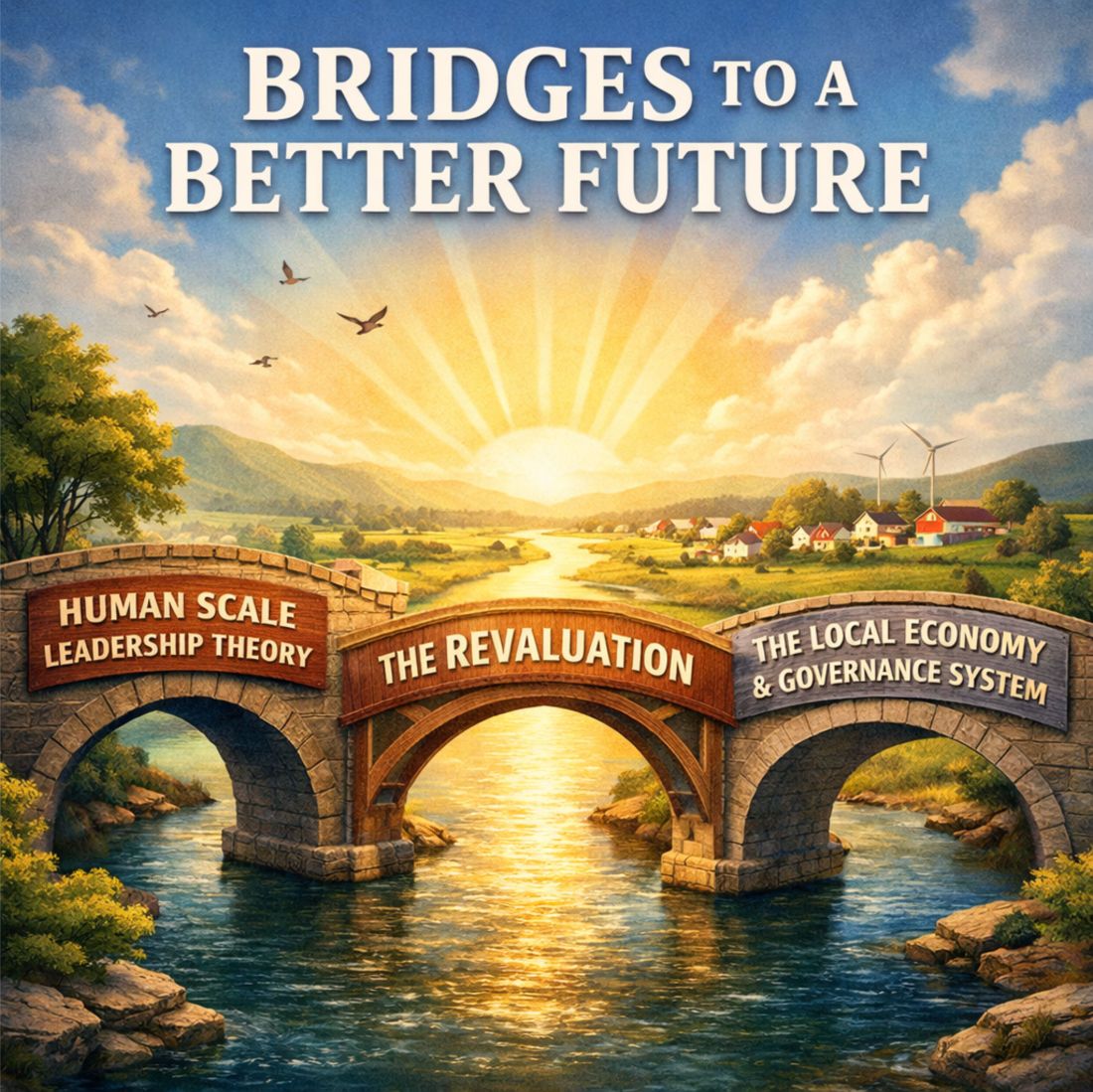
This document introduces three connected ideas that together offer a new way forward:
- Human‑Scale Leadership Theory – why leadership has disappeared
- The Revaluation – how society transitions from the old world to the new
- The Local Economy & Governance System (LEGS) – a practical model for a fair, local, people‑centred society
You don’t need to know anything about these ideas beforehand.
This is your starting point.
1. Why the World Feels Like It’s Falling Apart
Most of us can sense that the systems we live under – political, economic, and social – no longer work the way they should.
We see:
- leaders who don’t seem to lead
- decisions that feel disconnected from real life
- communities losing their identity
- an economy that benefits a few while leaving many behind
- public services that feel stretched, distant, or broken
These aren’t isolated issues.
They’re symptoms of a deeper structural problem.
Over time, our systems have grown:
- too large
- too centralised
- too complex
- too focused on money
- too disconnected from everyday people
When systems grow beyond human scale, something vital is lost: leadership.
2. Human‑Scale Leadership Theory: Why Leadership Has Disappeared
Human‑Scale Leadership Theory begins with a simple truth:
Leadership is a human relationship – and it only works at human scale.
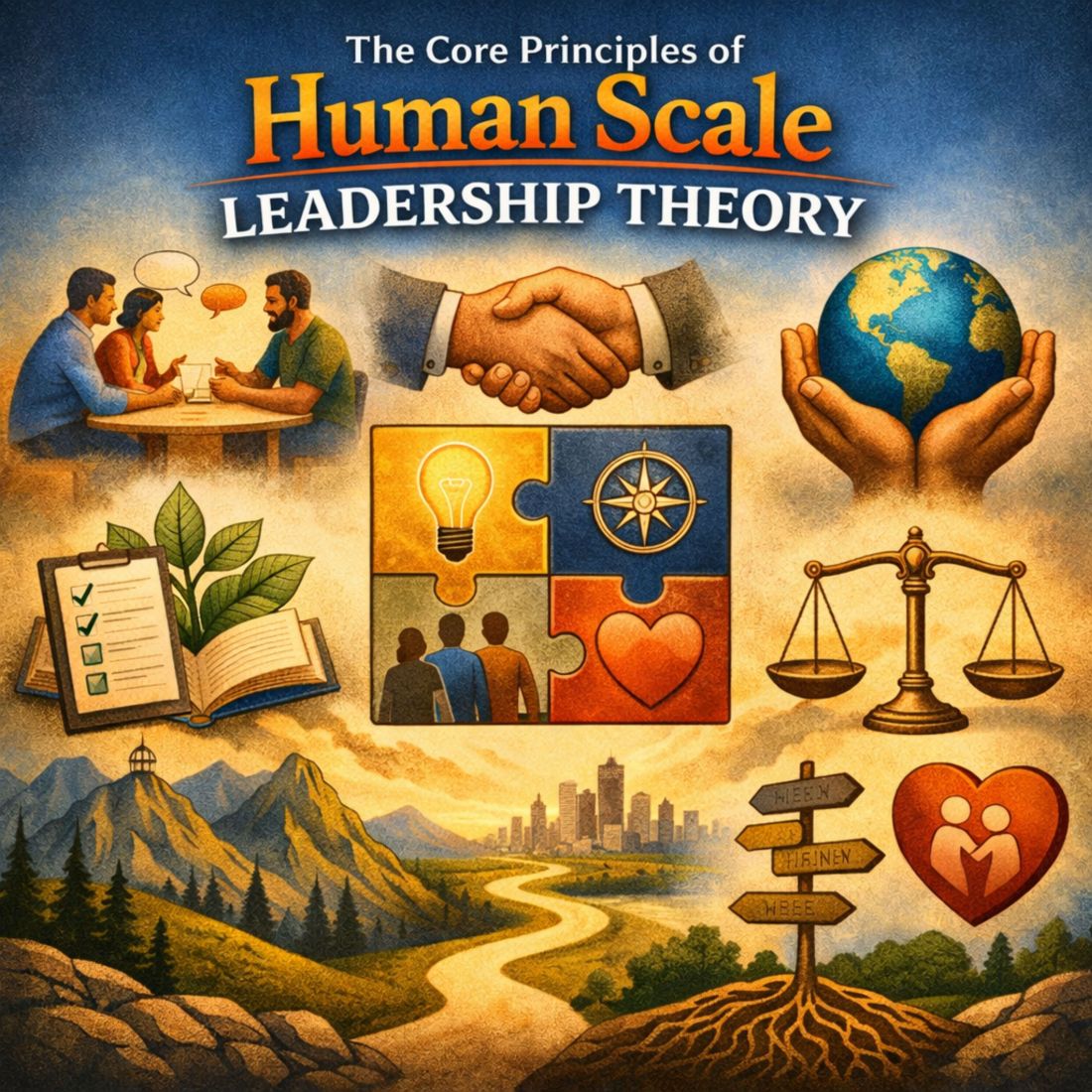
Real leadership requires:
- knowing the people you serve
- understanding their lives
- seeing the impact of your decisions
- being accountable to them directly
- acting with courage and responsibility
But in modern systems, leaders are:
- distant
- insulated
- surrounded by bureaucracy
- rewarded for compliance, not courage
- disconnected from the people they represent
This isn’t because people today are worse.
It’s because the system makes leadership impossible.
When systems become too big, they don’t produce leaders – they produce managers.
People who maintain the system rather than serve the people.
Human‑Scale Leadership Theory explains why this happens and why leadership cannot return unless systems are redesigned around human beings.
3. The Revaluation: The Transition We’re Already Living Through
If Human‑Scale Leadership Theory explains the problem, The Revaluation explains the transition.
The Revaluation is the period – already underway – where society begins to reassess what truly matters.
It’s the shift from a world built around money, hierarchy, and centralisation to one built around people, community, and the environment.
It happens because the old system is failing in ways we can no longer ignore:
- money no longer guarantees security
- global systems are fragile
- public trust is collapsing
- inequality is widening
- communities feel hollowed out
- people feel powerless
The Revaluation is the moment when society collectively realises:
- money is not value
- growth is not progress
- centralisation is not stability
- and leadership cannot be manufactured
It is the psychological and cultural reset that makes a new system possible.
4. LEGS: A Practical System for a Better Future
If Human‑Scale Leadership Theory explains why we need change, and The Revaluation explains how we transition, then LEGS explains what comes next.
LEGS – The Local Economy & Governance System – is a complete model for a society built around:
- People
- Community
- The Environment
It is not abstract.
It is not utopian.
It is practical, local, and grounded in lived experience.
What LEGS provides
A new kind of governance
- local
- democratic
- transparent
- accountable
- rooted in community
- free from distant hierarchy
A new kind of economy
- local circular economies
- community‑issued currency
- barter and exchange
- time‑limited money to prevent hoarding
- social businesses for essential services
- a Basic Living Standard for all
A new kind of society
- flat hierarchy
- personal sovereignty
- shared responsibility
- community contribution
- local decision‑making through the Circumpunct
LEGS is the practical expression of Human‑Scale Leadership Theory.
It creates the conditions where real leadership can re‑emerge.
5. How These Three Ideas Fit Together
These three works are not separate.
They are three parts of one coherent whole.
Human‑Scale Leadership Theory
Explains why leadership has collapsed and why centralised systems fail.
The Revaluation
Explains the transition – the cultural and economic shift we must go through.
LEGS
Provides the practical system that replaces the failing structures.
Together, they form a complete arc:
Why → How → What
Philosophy → Transition → System
Understanding → Transformation → Implementation
This is the full architecture of a better future.
6. Why This Matters to You
You don’t need to be a political theorist.
You don’t need to be an economist.
You don’t need to be an activist.
If you’ve ever felt:
- that life is harder than it should be
- that leaders don’t listen
- that communities feel disconnected
- that the economy doesn’t work for ordinary people
- that the world is changing in ways that don’t make sense
…then this work is for you.
It offers:
- a clear explanation of what’s gone wrong
- a practical model for what can replace it
- a pathway from the world we have to the world we need
Most importantly, it offers hope – not as a slogan, but as a system.
7. Where to Go Next
If this document has given you a sense of clarity, curiosity, or possibility, the next steps are simple:
- explore Human‑Scale Leadership Theory to understand the root causes
- dive into LEGS to see how a better system actually works
Each piece deepens the picture.
Together, they offer a complete, humane, and practical alternative to the failing systems of today.