A New Way Forward

Understanding Human‑Scale Leadership, The Revaluation, and LEGS – and Why They Matter to All of Us

Most people can feel that something in society isn’t working anymore. Life feels harder, institutions feel distant, and the systems we rely on seem to be creaking under their own weight.

We sense the symptoms every day – rising costs, failing services, political frustration, and a growing feeling that ordinary people have less and less control over their own lives.

But what if these problems aren’t random?

What if they all come from the same root cause?

And what if there is a coherent, practical alternative?

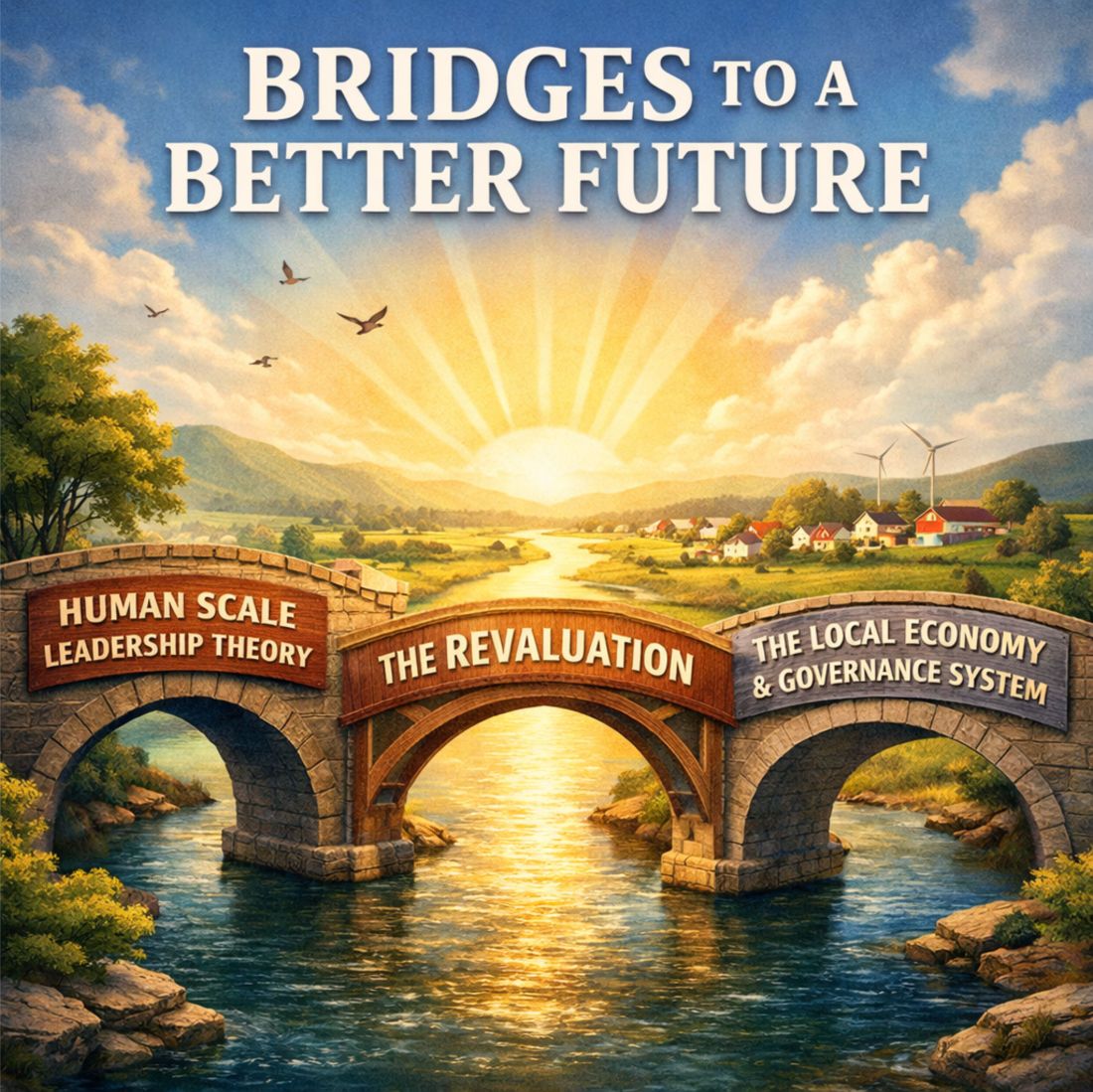
This document introduces three connected ideas that together offer a new way forward:

  • Human‑Scale Leadership Theory – why leadership has disappeared
  • The Revaluation – how society transitions from the old world to the new
  • The Local Economy & Governance System (LEGS) – a practical model for a fair, local, people‑centred society

You don’t need to know anything about these ideas beforehand.

This is your starting point.

1. Why the World Feels Like It’s Falling Apart

Most of us can sense that the systems we live under – political, economic, and social – no longer work the way they should.

We see:

  • leaders who don’t seem to lead
  • decisions that feel disconnected from real life
  • communities losing their identity
  • an economy that benefits a few while leaving many behind
  • public services that feel stretched, distant, or broken

These aren’t isolated issues.

They’re symptoms of a deeper structural problem.

Over time, our systems have grown:

  • too large
  • too centralised
  • too complex
  • too focused on money
  • too disconnected from everyday people

When systems grow beyond human scale, something vital is lost: leadership.

2. Human‑Scale Leadership Theory: Why Leadership Has Disappeared

Human‑Scale Leadership Theory begins with a simple truth:

Leadership is a human relationship – and it only works at human scale.

Real leadership requires:

  • knowing the people you serve
  • understanding their lives
  • seeing the impact of your decisions
  • being accountable to them directly
  • acting with courage and responsibility

But in modern systems, leaders are:

  • distant
  • insulated
  • surrounded by bureaucracy
  • rewarded for compliance, not courage
  • disconnected from the people they represent

This isn’t because people today are worse.

It’s because the system makes leadership impossible.

When systems become too big, they don’t produce leaders – they produce managers.
People who maintain the system rather than serve the people.

Human‑Scale Leadership Theory explains why this happens and why leadership cannot return unless systems are redesigned around human beings.

3. The Revaluation: The Transition We’re Already Living Through

If Human‑Scale Leadership Theory explains the problem, The Revaluation explains the transition.

The Revaluation is the period – already underway – where society begins to reassess what truly matters.

It’s the shift from a world built around money, hierarchy, and centralisation to one built around people, community, and the environment.

It happens because the old system is failing in ways we can no longer ignore:

  • money no longer guarantees security
  • global systems are fragile
  • public trust is collapsing
  • inequality is widening
  • communities feel hollowed out
  • people feel powerless

The Revaluation is the moment when society collectively realises:

  • money is not value
  • growth is not progress
  • centralisation is not stability
  • and leadership cannot be manufactured

It is the psychological and cultural reset that makes a new system possible.

4. LEGS: A Practical System for a Better Future

If Human‑Scale Leadership Theory explains why we need change, and The Revaluation explains how we transition, then LEGS explains what comes next.

LEGS – The Local Economy & Governance System – is a complete model for a society built around:

  • People
  • Community
  • The Environment

It is not abstract.

It is not utopian.

It is practical, local, and grounded in lived experience.

What LEGS provides

A new kind of governance

  • local
  • democratic
  • transparent
  • accountable
  • rooted in community
  • free from distant hierarchy

A new kind of economy

  • local circular economies
  • community‑issued currency
  • barter and exchange
  • time‑limited money to prevent hoarding
  • social businesses for essential services
  • a Basic Living Standard for all

A new kind of society

  • flat hierarchy
  • personal sovereignty
  • shared responsibility
  • community contribution
  • local decision‑making through the Circumpunct

LEGS is the practical expression of Human‑Scale Leadership Theory.

It creates the conditions where real leadership can re‑emerge.

5. How These Three Ideas Fit Together

These three works are not separate.

They are three parts of one coherent whole.

Human‑Scale Leadership Theory

Explains why leadership has collapsed and why centralised systems fail.

The Revaluation

Explains the transition – the cultural and economic shift we must go through.

LEGS

Provides the practical system that replaces the failing structures.

Together, they form a complete arc:

Why → How → What

Philosophy → Transition → System

Understanding → Transformation → Implementation

This is the full architecture of a better future.

6. Why This Matters to You

You don’t need to be a political theorist.

You don’t need to be an economist.

You don’t need to be an activist.

If you’ve ever felt:

  • that life is harder than it should be
  • that leaders don’t listen
  • that communities feel disconnected
  • that the economy doesn’t work for ordinary people
  • that the world is changing in ways that don’t make sense

…then this work is for you.

It offers:

  • a clear explanation of what’s gone wrong
  • a practical model for what can replace it
  • a pathway from the world we have to the world we need

Most importantly, it offers hope – not as a slogan, but as a system.

7. Where to Go Next

If this document has given you a sense of clarity, curiosity, or possibility, the next steps are simple:

  • explore Human‑Scale Leadership Theory to understand the root causes
  • dive into LEGS to see how a better system actually works

Each piece deepens the picture.

Together, they offer a complete, humane, and practical alternative to the failing systems of today.
LEGS: The Human Economy – A Blueprint for Transformation

Introduction

In a world increasingly shaped by the pursuit of economic growth and the dominance of monetary values, our understanding of what truly matters has become distorted.

The language of economics, once intended to serve human wellbeing, now often justifies systems that place money above all other forms of value.

This Local Economy & Governance System (LEGS) challenges the prevailing money-centred worldview, exposing the myths that underpin it and the consequences for individuals and society.

By re-examining the purpose of the economy and redefining value at the level of the individual, we offer a blueprint for transformation – one that places human needs, freedom, and wellbeing at the heart of economic life.

The following pages invite you to reconsider what it means to live well, to recognise the moral costs of excess, and to envision an economy built on natural abundance, justice, and personal sovereignty.

The Rise of a Money‑Centred Worldview

Over time, the words economy, economics, economic policy, and economic theory have been shaped by a money centred worldview.

They became part of a language and narrative designed to justify systems that placed money above all other forms of value.

This worldview gradually embedded itself into culture, until money was positioned at the centre of almost every aspect of life and treated as the primary measure of worth.

How Policy Reinforced the Myth of Economic Growth

Governments, politicians, and established institutions reinforced this belief by placing the economy at the heart of public policy.

They encouraged the idea that a good life was only possible if the economy was considered healthy and growing.

Measures such as GDP were promoted as the ultimate indicators of national wellbeing, and people were led to believe – often without explanation – that their personal success was somehow tied to the financial success of the economy itself.

Reducing Human Value to Economic Data

By turning everything of tangible value into something economic, measurable, and defined only in relation to the economy, society gradually stripped away the inherent value of each person.

Individuals became reduced to data points – digits on a screen – an effect amplified by digital tracking and the rapid development of AI.

The Hidden Myth of External Power

The central myth that upheld this money centric system was not only the false belief that money is inherently valuable.

The deeper, more powerful myth was the idea – never openly stated but widely accepted – that real power lies outside the individual.

Because money appears external to us, it became easy to believe that our worth and our agency also exist outside ourselves.

The Illusion of Money as Value

In truth, money has no intrinsic value. It is simply a tool for exchange.

The belief that money is value created the foundation for many of society’s problems.

The FIAT System and the Concentration of Power

This belief was further exploited through the rise of the modern FIAT monetary system, which used complexity, misplaced trust, and practices that would otherwise be considered unethical or criminal to shift wealth – and therefore power – from the many to the few.

All of this was presented as progress. As the natural direction of a modern world.

The Moral Cost of Excess

Yet in any genuinely civilised society, there is no moral justification for one person to hold more than they need when that excess comes at the expense of others.

When someone accumulates far beyond their needs, someone else – often someone they will never meet – is forced to go without the essentials required for a life free from deprivation.

How Scarcity Is Manufactured

Taking more than we need, in any form, inevitably creates shortage elsewhere.

Possession alone does not justify allowing others to suffer lack.

No individual has the fundamental right to hold more than they require when doing so directly or indirectly harms others.

Economics as a Tool of Justification

In this way, the language of economics became a tool to legitimise imbalance and injustice.

It normalised greed and elevated the pursuit of material wealth and power to something admirable – something to be celebrated above all else.

The Local Economy & Governance System: Defining the Economy and Economics for a Humane Existence and Way of Life

Real value does not exist within money itself, nor within the material possessions that money – despite having no intrinsic substance – can be used to persuade others to “buy or sell.”

True value can only be defined at the level of the individual. It arises from the meaning and importance a person attributes to something from within themselves, not from any external price tag or monetary label.

Money is simply a practical tool. Its purpose is to make the exchange of value easier when direct barter or exchange – trading goods, services, or labour – is not possible or convenient.

Money is a facilitator. Not the source of value itself.

In reality, people are the economy.

People are the reason the economy exists, the purpose behind it, and the driving force within it.

Every meaningful economic activity begins and ends with human needs, human choices, and human wellbeing.

With this understanding, the LEGS interpretation of economy can be defined as follows:

Economy is the collective presence, activity, and contribution of people working together to provide and supply all the goods, services, and forms of support that are essential for every individual within a community to live well.

Its purpose is to ensure that no person experiences need or scarcity severe enough to undermine the natural state of abundance – a condition in which all basic and essential needs are reliably met.

In this state of abundance, individuals are freed from the pressures of deprivation or want, allowing them to experience a form of personal freedom that is not compromised by the struggle to secure the necessities of life.

Thus, the economy is not merely a system of production and exchange, but a shared human effort to sustain the conditions that make genuine freedom, well‑being and the experience of Personal Sovereignty possible for all.

Summary

These pages challenge the prevailing money-centred worldview, revealing how economic language and policy have often placed monetary value above human wellbeing.

They expose the myths that underpin this system – especially the illusion that real power and value exist outside the individual – and highlight the moral costs of excess and manufactured scarcity.

The Local Economy & Governance System (LEGS) offers a transformative blueprint: it redefines the economy as a collective human effort, focused on meeting essential needs and fostering abundance, justice, and personal sovereignty.

True value, as argued here, arises from within each person – not from external price tags or monetary labels.

Money is a facilitator, not the source of value itself.

By placing human needs, freedom, and wellbeing at the heart of economic life, The Local Economy & Governance System envisions an economy where no individual suffers deprivation, and everyone is empowered to live well.

The path forward is one of re-examining our assumptions, recognising the moral imperative to share resources fairly, and building systems that sustain genuine freedom and wellbeing for all.