
Taking it Back
Reclaiming Food means taking it back – not just what we eat, but everything food really is.
Food is nutrition, health, energy, power, independence, and the flavour of life. It’s the foundation of our existence and the thread that ties us to land, community, and each other.
Over time, all of that has been replaced by substitutes that answer shallow questions of cost, convenience, and speed, while quietly stripping away the deeper value we still assume is there.
We feel the loss instinctively – the sums don’t add up – and when we look closer, we see how our modern health crises began the moment food stopped being food and became a consumer product.
There’s a strange thing happening in the world today. We talk about food all the time – what we like, what we don’t, what’s healthy, what’s cheap, what’s convenient – yet very few of us ever stop to ask the most basic question of all: what is food, really?
It sounds almost ridiculous to ask. Food is food, isn’t it? It’s what we eat. It’s what fills the shelves. It’s what keeps us alive.
But if you sit with that thought for even a moment, you start to realise that the word “food” has been stretched so far that it no longer tells us anything useful. It’s used to describe a carrot pulled from the ground and a fluorescent, ultra‑processed edible product that contains ingredients you’d never recognise. It’s used to describe something nourishing and something harmful. Something grown and something engineered. Something that supports life and something that slowly undermines it.
We’ve allowed one word to cover two completely different realities. And that confusion isn’t harmless. It’s shaping our health, our communities, our economy, and our future in ways most people never see.
This essay is about reclaiming that word – not inventing a new one, not moralising, not lecturing, but simply restoring clarity to something that should never have been allowed to become so muddled.
Because once you understand what food really is, everything else begins to make sense.
The moment the meaning slipped
For most of human history, food was simple. It came from the land, the sea, the seasons, and the hands of people who understood how to grow, raise, catch, preserve, and prepare it.
Food was local because it had to be. It was recognisable because it couldn’t be anything else. It nourished because that was its purpose – to sustain life, vitality, and community.
Then, slowly at first and then all at once, food became something else.
It became a product.
A commodity.
A brand.
A profit centre.
A tool of influence.
A vehicle for additives, preservatives, enhancers, stabilisers, colourings, and chemicals that no home kitchen has ever needed.
And as this shift happened, the meaning of the word “food” didn’t change – but the reality behind it did.
We still call everything “food,” even when much of what fills our supermarkets and our diets no longer behaves like food at all.
It doesn’t nourish.
It doesn’t support health.
It doesn’t come from a transparent or resilient supply chain.
It doesn’t strengthen communities.
It doesn’t resemble its original form.
It doesn’t even need to be grown in the traditional sense.
Yet it sits on the same shelves, carries the same labels, and is spoken about in the same breath as the things that do.
That’s where the trouble begins.
Why the meaning matters more than we think
When governments talk about food security, they often mean something very narrow: if people can eat something – anything – then the job is done.
It doesn’t matter where it comes from.
It doesn’t matter what’s in it.
It doesn’t matter whether it’s nourishing or harmful.
It doesn’t matter whether the supply chain is fragile or resilient.
It doesn’t matter whether the ingredients have crossed ten borders or been through five factories.
If the shelves aren’t empty, the system is considered to be working.
But this definition hides more than it reveals.
It hides the fact that the UK relies on overseas imports for a huge proportion of what we eat.
It hides the fact that much of the food produced in the UK isn’t actually edible in its raw form and must be processed elsewhere before it returns to us.
It hides the fact that if the borders closed tomorrow, we would have only days before shortages became unavoidable.
It hides the fact that millions of people can only access food that is cheap because it is ultra‑processed, not because it is nutritious or sustainable.
And it hides the most uncomfortable truth of all: that a population can be fed without being nourished, supplied without being secure, and full without being healthy.
When the meaning of food collapses, everything built on top of it becomes unstable.
The system behind the confusion
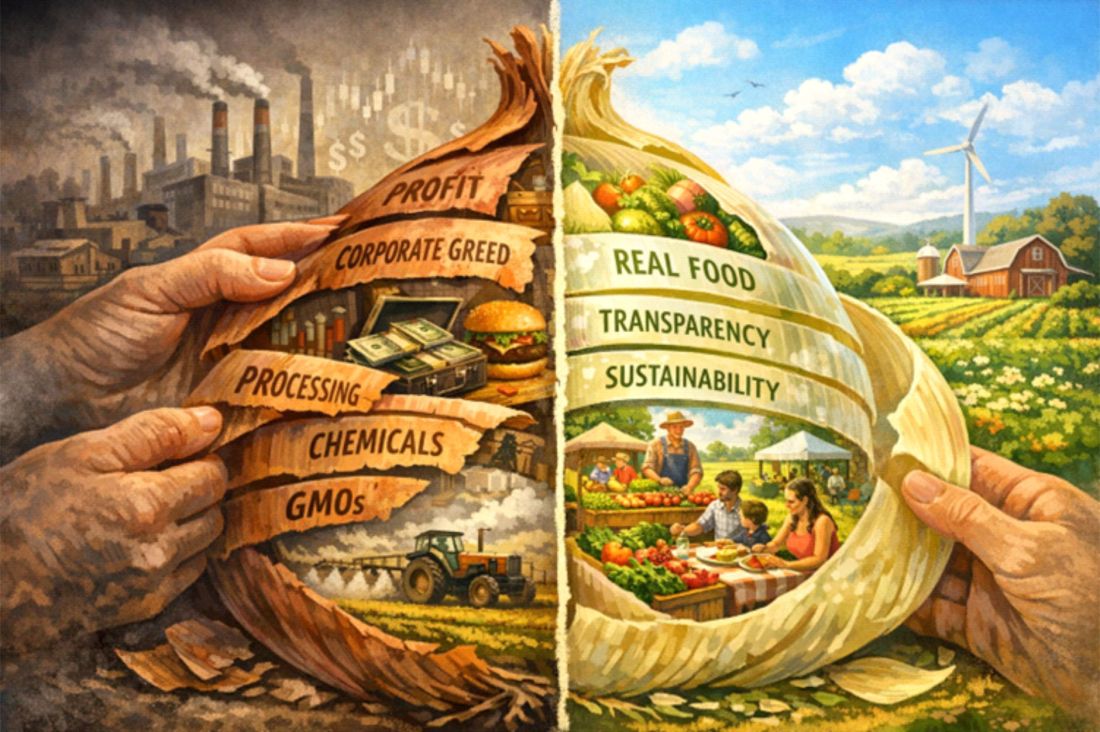
If you peel back the layers of the modern food system – and there are many – you find something that looks less like a chain and more like an onion. Each layer has its own priorities, its own incentives, and its own version of the truth.
Consumers sit at one end, often unaware of how little influence they actually have.
Farmers sit at the other, squeezed by contracts, pricing structures, and data‑driven demands that leave many earning less than the minimum wage.
Between them sit supermarkets, processors, manufacturers, financiers, corporations, lobbyists, and policymakers – each shaping what food becomes long before it reaches a plate.
The deeper you go, the clearer it becomes that the system isn’t designed around nourishment or resilience. It’s designed around profit, efficiency, and control. It rewards scale, not quality. It rewards processing, not simplicity. It rewards long supply chains, not local ones. It rewards products that can be standardised, preserved, transported, and marketed, not foods that come from soil, seasons, and skilled hands.
And because the system is so complex, so opaque, and so normalised, most people never question it. They assume that what’s available must be what’s best. They assume that if something is on a shelf, it must be safe. They assume that if it’s cheap, it must be efficient. They assume that if it’s everywhere, it must be food.
But assumptions are exactly what this system depends on.
A clearer way to understand what we eat
To reclaim the meaning of food, we need a way to talk about it that reflects reality rather than marketing. We need a simple, honest framework that anyone can understand – something that cuts through the confusion without judging or shaming.
Here is that framework.
1. Food
Food is something grown, raised, caught, or harvested. It resembles its original form when you eat it. It can be prepared in a home kitchen without needing industrial processes. It nourishes because it contains the nutrients nature intended. It comes from supply chains that can, in principle, be local, transparent, and accountable.
Food is vegetables, fruits, grains, pulses, fish, meat, eggs, milk, herbs, and the things made from them using traditional or minimally mechanised methods. It is bread made from flour, water, yeast, and salt. It is cheese made from milk and cultures. It is butter churned from cream. It is food that your great‑grandparents would recognise.
Food is the foundation of health, resilience, and vitality.
2. Food Products
Food products begin as food but go through processing that changes their form while still keeping them recognisable. They are the things that make everyday life easier: pasta, tinned tomatoes, yoghurt, cured meats, jams, pickles, and many baked goods.
They are processed, but in ways that could be done by hand, even if machines now do the work. They are not inherently harmful. They are part of a balanced, practical diet. They sit in the middle ground – not raw, not engineered, but still fundamentally food.
3. Edible Products
Edible products are not food in any meaningful sense, even though they are sold as if they are. They are engineered combinations of extracted ingredients, additives, preservatives, colourings, stabilisers, and chemicals that have been broken down, reassembled, and enhanced to create something that tastes good, lasts long, and maximises profit.
They are designed for shelf life, not health. For convenience, not nourishment. For addiction, not wellbeing.
They are the products that dominate the modern diet not because they are better, but because they are more profitable.
Once you see the difference between these three categories, you can’t unsee it. And once you understand it, you begin to understand why so many of the problems we face – from chronic disease to supply chain fragility – make perfect sense.
How edible products replaced food
This shift didn’t happen overnight. It happened slowly, through a series of small, seemingly harmless changes.
Supermarkets began to dominate the food landscape, offering convenience and choice while quietly reshaping the entire supply chain.
Processors and manufacturers expanded their influence, turning raw ingredients into products that could travel further and last longer.
Globalisation made it possible to source ingredients from anywhere, often at the expense of local producers.
Marketing convinced us that convenience was the same as value.
And as prices were squeezed, farmers were pushed into contracts that left them with little control over what they grew or how they grew it.
At the same time, the rise of ultra‑processing introduced a new kind of “food” – one that didn’t need seasons, soil, or skilled hands. One that could be made anywhere, from anything, as long as the final product tasted good and cost little.
The result is a food system where the most profitable products are the least nourishing, and the most nourishing foods are often the hardest to access.
This isn’t a conspiracy. It’s a consequence of incentives. But the effect is the same: edible products have crowded out food, and most people haven’t noticed.
The consequences we can no longer ignore
When a population eats mostly edible products, the consequences show up everywhere.
They show up in rising rates of obesity, diabetes, heart disease, inflammation, and chronic illness.
They show up in the strain on the NHS.
They show up in the loss of local farms, the decline of rural communities, and the erosion of food skills.
They show up in the fragility of supply chains that depend on global stability in a world that is anything but stable.
They show up in the growing number of people who rely on foodbanks, not because they mismanage money, but because wages no longer match the cost of living.
And they show up in the quiet, creeping loss of control over something as fundamental as what we eat – and therefore over our health, our independence, and our future.
A country that cannot feed itself is not secure.
A population that cannot access nourishing food is not healthy.
A society that cannot distinguish food from edible products is not informed.
And a system that treats food as a commodity rather than a necessity is not sustainable.
These are not abstract concerns. They are immediate, personal, and deeply human.
Reclaiming food: where change begins
Reclaiming food doesn’t mean rejecting modern life or romanticising the past. It means restoring clarity to a word that has been stretched beyond recognition. It means understanding the difference between food, food products, and edible products so that we can make informed choices. It means supporting local producers not out of nostalgia, but because they are essential to resilience. It means recognising that food security is not just about calories, but about nourishment, access, affordability, and independence.
It means asking better questions.
Where did this come from?
Who made it?
Could I make it myself?
Does it resemble its original form?
Is it nourishing?
Is it part of a resilient system, or a fragile one?
And it means accepting that the power to change the food system doesn’t lie only with governments or corporations.
It lies with communities, with growers, with families, with individuals who choose to understand what they are eating and why.
Reclaiming food is not a campaign. It’s a shift in perspective. Once you see the difference, you can’t go back.
The future we choose
We don’t need a new word for good food. We need to reclaim the word “food” and stop using it to describe edible products that undermine our health, our communities, and our future.
Food should mean nourishment.
Food should mean trust.
Food should mean resilience.
Food should mean independence.
Food should mean the flavour of life.
Once we reclaim the meaning, everything else becomes possible.


