

From Kingsholm to Cardiff: Belief, Revival and a Warning for England

Saturday may not prove easy for England.

Wales earned their victory over New Zealand and deserved every moment of it. The All Blacks may be rugby’s perennial pace-setters, but no team owns that position by right. It has to be renewed every time they step onto a field, just as Wales renewed their own belief in Cardiff last weekend.

For Gloucester Rugby supporters, the result carried an extra layer of significance. Four Wales internationals who now call Kingsholm home have helped drive a Premiership resurgence that, only a few months ago, felt almost mythical in terms of possibilities. What seemed impossible suddenly became reality, and with it came that rare feeling in sport when success arrives wrapped in disbelief.

Rugby, however, has never been about individuals alone. With fifteen players on the field, it is tempting to explain success and failure through the performances of one or two stars, or to assume that a squad packed with international talent will inevitably flourish. Yet the game repeatedly teaches the opposite lesson.

The difference is rarely found in individual brilliance. It is found in fifteen players becoming one team.

Every Premiership player operates at or near the highest level of the sport. The real challenge is creating an environment where talent works collectively, where players commit themselves to each other and to the moment rather than chasing personal glory. Success in rugby is not built solely by the player who scores the try. It is built by those who make the try possible.

That is what feels different at Gloucester today.

The influence of players such as Dewi Lake and Jac Morgan extends beyond their own performances. They have become part of a wider culture that appears to have united an entire squad behind a common purpose. The individuals matter, but the collective matters more.

Seen through that lens, Wales’ victory over New Zealand becomes even more fascinating.

The same players who have helped Gloucester rediscover its identity returned home to join a Welsh side that suddenly seems to have found its own rhythm on the pitch. Given the uncertainty that has surrounded Welsh rugby in recent years, and the challenges that still exist within the WRU, there was something remarkable about seeing everything click into place on such a stage.

The catalyst, both at Gloucester and within Wales, appears to be belief.

Not blind optimism. Not hype. Genuine belief.

Belief that good players can become something greater together. Belief that momentum can be real. Belief that history does not dictate the next result.

And when that belief takes hold, strange things happen.

With seven minutes remaining and the scale of what Wales were about to achieve becoming clear, my thoughts drifted to a school friend born in Cardiff. He followed Welsh rugby with a devotion that survived every disappointment and every joke the rest of us threw his way. His birthday would have fallen on Friday. It has been several years since he left us.

As Wales edged closer to victory, I found myself hoping he was somewhere above, watching from a Red-Dragon-flag-draped cloud, enjoying the moment Welsh supporters have waited so long for and preparing to give a little of that relentless rugby banter back at last.

That is the thing about sport that statistics can never fully explain.

The match itself felt special from the outset. When the lights dimmed for the haka, the All Blacks stood beneath the sort of spotlight that normally belongs in cinema rather than rugby. Yet there was also something about the atmosphere surrounding Wales that suggested the script might not follow expectation. The red glow from the backlighting, the dry ice mist, the anticipation, the sense of occasion all seemed to point towards the possibility of something extraordinary.

The famous pedestal occupied by New Zealand is not imaginary. It has been earned through generations of excellence and remains worthy of immense respect. The same applies to South Africa and to any side that defines an era.

But rugby offers no permanent titles.

Respect is inherited. Dominance is not.

That is why it was disappointing to hear suggestions in some quarters that Wales’ triumph somehow amounted to a “pity win”. Such descriptions diminish a team that was simply the better side on the day. Wales earned their victory, just as France earned theirs twenty-four hours earlier.

As an England supporter, all of this brings me to Saturday.

There is a danger that England fans look at recent results and conclude that Wales have merely exposed a weakness in New Zealand. There is a temptation to view the Welsh victory as a low benchmark and assume England should comfortably clear it.

That would be to misunderstand both Wales’ achievement and the nature of rugby itself.

The Wales win was not about New Zealand underperforming. It was about a team discovering what it could become when every part worked in harmony.

England undoubtedly possess the talent to beat the All Blacks. They also have Gloucester players capable of playing major roles in any success. Yet talent alone will not be enough against a New Zealand side that will arrive wounded, motivated and desperate to respond.

What Wales demonstrated was not merely a route to victory. They demonstrated the standard required to achieve it.

If England can find that same collective purpose, if they can play as one and see every action as connected to those around them, then they may discover the same belief that carried Wales through.

Because the lesson from Cardiff was never really about Wales or New Zealand.

It was about what becomes possible when a team stops thinking about itself as fifteen players and starts believing it is something greater.
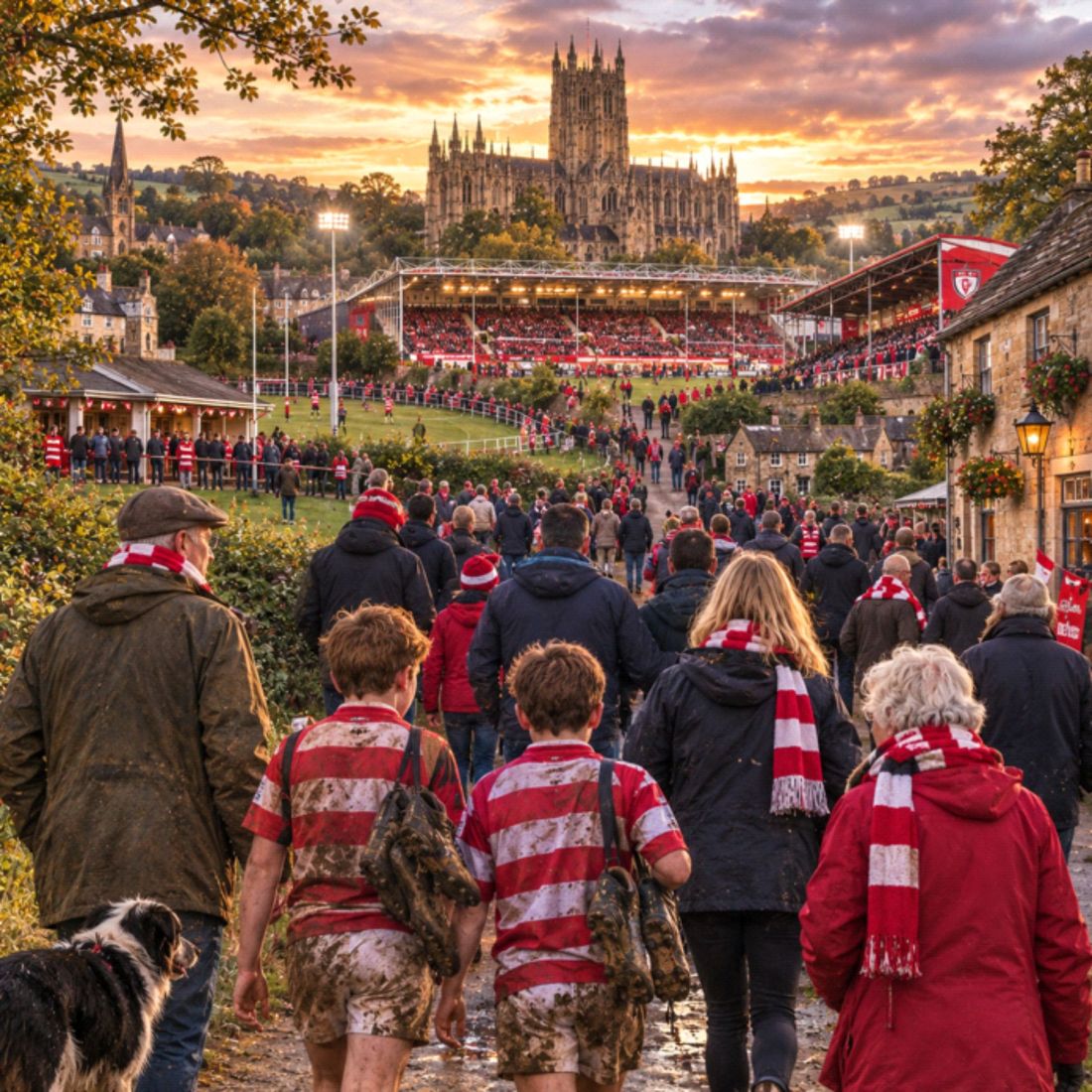
Gloucester Rugby: More Than a City, a Community

Every now and then a debate emerges about whether Gloucester is really a rugby city. Usually the discussion centres on attendance figures, demographics or where supporters travel from on a matchday. It’s an interesting conversation, but I think it risks missing something more important.

As someone who has supported Gloucester Rugby all my life, yet has never actually lived in Gloucester itself, I understand why the question gets asked. I was born in Cheltenham and live there today. I grew up in Churchdown, between Cheltenham and Gloucester, alongside countless others whose connection to Gloucester Rugby has always been every bit as strong as someone with a Gloucester postcode.

And perhaps that’s the point.

The idea that Gloucester Rugby’s identity can be measured only by where most of the supporters live or travel from misunderstands what rugby has always been in this part of the world.

Gloucester Rugby was founded in 1873. Long before professionalism arrived, long before academies and salary caps, the club sat at the centre of a rugby ecosystem that stretched throughout Gloucestershire and beyond.

Players emerged through local clubs, local schools and local communities. They were not full-time athletes from their teenage years. They were teachers, farmers, builders, tradesmen, engineers and office workers who happened to be exceptional rugby players.

Many who grew up during the amateur era still believe there was something very special about that time.

The people playing the game often lived alongside the people supporting it. Coaches volunteered their evenings because they loved rugby. Club officials gave up countless hours because they believed in what their clubs meant to local communities. Young players learned not only skills and tactics but also the values that made rugby and the community that surrounds it distinctive.

That culture was never confined to Gloucester itself.

The story of Gloucester Rugby cannot be separated from the story of the clubs spread across the county. Longlevens, Cinderford, Drybrook, Tewkesbury, Cheltenham, Lydney, Matson, Old Patesians and many others have all contributed to a rich rugby heritage that continues today. These clubs remain hugely important community institutions, providing opportunities for young people to participate, develop friendships and find a sense of belonging at a time when those opportunities are arguably more important than ever.

The same can be said of the county’s schools.

When I attended Chosen Hill School during the 1980s, rugby formed a significant part of school life. We were fortunate to have teachers and coaches who lived and breathed the game. Adrian Turton, our Games Master, and Dave Protheroe, who helped teach many of us the basics of rugby while coaching Moseley outside school hours, were typical of a generation that gave far more to the sport than they ever received back financially.

Chosen Hill was not unique.

Across Gloucestershire and the surrounding area, schools produced generations of players who understood rugby as something more than a Saturday afternoon pastime. There was a shared culture, a collective understanding and a pathway that connected school rugby, club rugby and Kingsholm in a way that is difficult to describe to those who did not experience it.

The local connections were real and visible.

Growing up in Churchdown, Gloucester Rugby never felt remote. Dave Sims lived around the corner from us when we first moved there. He would go on to captain Gloucester, become the club’s first professional player and represent England. Paul Holford attended the same school as I did and followed his own path into Gloucester Rugby.

Yet what I remember most is not seeing these men as distant sporting figures. My last conversation with Paul was not at Kingsholm at all, but out walking on his family farm while he was repairing a broken fence. Even my last conversation with Mike Teague, one of Gloucester Rugby’s greatest sons and an icon of English rugby, was not about rugby. It was in his pub while I was serving as a local councillor and he needed some help navigating a council matter.

That, to me, says something important about rugby in Gloucestershire.

The players who became heroes on a Saturday were often the same people you would bump into during the week. They remained part of the communities that produced them. They coached local youngsters, ran businesses, worked the land, supported local causes and got on with life much like everyone else. The line between community rugby and Gloucester Rugby was often far thinner than it is in modern professional sport.

That connection still exists today.

Former captain Lewis Ludlow has become a powerful example of the club’s continuing relationship with its community, remaining actively involved in charitable and community initiatives alongside his playing career. Likewise, George Barton demonstrates how closely interconnected the professional and grassroots games remain. A product of Longlevens Rugby’s youth system himself, he has returned to the club as a backs and skills coach, bringing experience gained at Kingsholm back into the environment where his own rugby journey began.

These relationships matter.

The strongest Gloucester sides have often appeared to understand that they represent something far more than a professional rugby club. They represent generations of volunteers, coaches, teachers, parents and supporters who have sustained rugby throughout the county for over a century.

Perhaps that is why the atmosphere at Kingsholm feels different.

For those who have only ever watched Gloucester on television, The Shed can look and sound intimidating. It appears loud, tribal and uncompromising. In truth, it can be all of those things. It is one of the most passionate stands in British rugby.

Yet it is also one of the friendliest.

One of the great joys of a matchday at Kingsholm has always been the social side of rugby. Visiting supporters are not treated as enemies. They are guests. Before the match, supporters share stories and predictions. During the game there is banter, passion and plenty of noise. Afterwards, everyone talks about the rugby.

That is one of the qualities that has always set rugby apart.

Of course we want Gloucester to win. That is the whole point of supporting a team. But rugby supporters also appreciate great rugby wherever it comes from. A brilliant try is a brilliant try. A courageous defensive effort is worthy of admiration regardless of the colour of the shirt. Good rugby is good for everyone who loves the game.

That spirit of welcome is every bit as much a part of Gloucester Rugby’s identity as The Shed itself.

Perhaps that is why I felt compelled to write this piece.

Not because I disagree with anybody in particular. Not because I wanted to challenge anyone’s view. Rather, because discussions about whether Gloucester is a rugby city sometimes overlook the things that truly matter.

Rugby in Gloucestershire has never simply been about geography. It is about the network of clubs that give young people a place to belong. It is about schools that pass traditions from one generation to the next. It is about builders, farmers, teachers, tradesmen and volunteers who helped shape the sport long before professionalism arrived. It is about players who understand the communities they represent and who continue to give back to those communities.

Above all, it is about the sense of belonging that exists when thousands of people converge on Kingsholm from across Gloucester, Cheltenham, Churchdown, the Forest of Dean, Stroud, Tewkesbury, Cirencester and countless villages in between.

Gloucester is a rugby city because Kingsholm stands in Gloucester.

The famous cathedral backdrop is Gloucester.

The club’s history is Gloucester.

But the community that gives life to Gloucester Rugby has always extended far beyond the city boundary.

The fact that so many of us travel there is not evidence against Gloucester being a rugby city.

It is evidence of just how important a rugby city Gloucester has become.