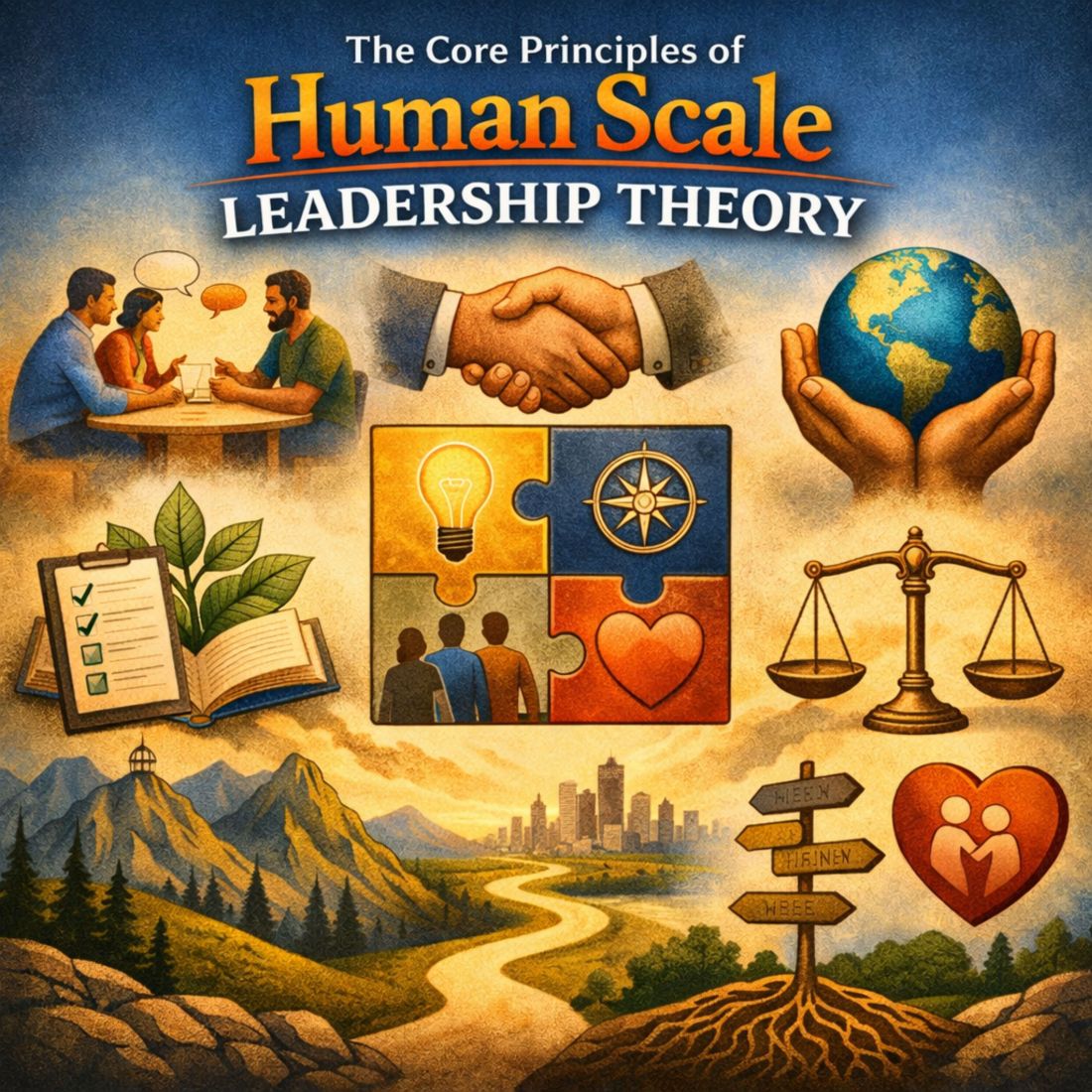
The Core Principles of Human‑Scale Leadership Theory

1. Leadership is a Human Phenomenon, Not a Structural Role

Leadership arises from human qualities – empathy, courage, responsibility, and service – not from titles, hierarchy, or authority.

A system cannot manufacture leaders; it can only create positions.

Leadership exists only where human relationships and accountability are real.

2. Systems Shape Behaviour More Than Individuals Do

People behave according to the incentives, pressures, and structures around them.

When a system rewards compliance, it produces compliant people.

When a system punishes leadership, it eliminates leaders.

The behaviour of those in power is a reflection of the system, not their personal morality.

3. Centralised Systems Inevitably Produce Managers, Not Leaders

As systems grow in size and complexity, decision‑makers become distant from the people affected by their actions.

This distance forces them to rely on rules, processes, and abstractions – the tools of management.

Leadership becomes impossible at this scale because it requires proximity, understanding, and direct accountability.

4. Real Leadership Can Only Function at Human Scale

Human scale means environments where people know one another, consequences are visible, and accountability is direct.

Leadership thrives where relationships are real, not abstract.

When systems exceed human scale, leadership collapses and managerialism fills the void.

5. The Political Party System Manufactures Non‑Leaders

Parties pre‑select candidates long before voters see them, filtering for malleability, compliance, and predictability.

Insecure non‑leaders then select even weaker successors, creating a downward spiral of capability.

This ensures that those who rise to positions requiring leadership are the least equipped to lead.

6. Managerialism Is Self‑Reinforcing and Self‑Protecting

Once managers dominate a system, they reshape it to reward their own traits: caution, conformity, and self‑interest.

They use rules, procedures, and centralised control to avoid responsibility and suppress challenge.

The system becomes designed to preserve itself, not to serve the public.

7. Wealth and Centralised Power Form a Symbiotic Relationship

Centralised political systems depend on wealth for influence, stability, and survival.

Wealth depends on centralised systems to maintain access and control.

This alliance shapes priorities, incentives, and behaviour – and excludes genuine leadership, which threatens both sides.

8. The Public Has Forgotten What Leadership Looks Like

Because managerialism has replaced leadership for generations, people now mistake authority for leadership, hierarchy for competence, and compliance for responsibility.

The absence of real leadership has normalised dysfunction and lowered expectations of public life.

9. Decentralisation Is Essential for Restoring Leadership

Leadership cannot be imposed from above; it must emerge from below.

Decentralised, community‑rooted systems restore proximity, accountability, and human connection – the conditions leadership requires.

Power must return to the smallest viable unit where real relationships exist.

10. The Purpose of Governance Is Service, Not Control

Governance should enable communities to thrive, not manage them into compliance.

Systems must be designed around human needs, not institutional preservation.

Leadership is the act of serving others; managerialism is the act of preserving the system.

What These Principles Achieve

Together, these principles:

  • explain why leadership has collapsed
  • show how systems produce behaviour
  • reveal why centralisation fails
  • expose the mechanics of the party system
  • define the conditions leadership requires
  • offer a path toward renewal through decentralisation

They form a complete philosophical foundation – coherent, original, and deeply aligned with the essay you’ve developed.

Human‑Scale Leadership Theory: A Framework

Introduction: The Crisis of Leadership

Modern societies face a profound leadership crisis. Public institutions struggle to act decisively, political systems fail to solve problems, and communities feel increasingly disconnected from the decisions that shape their lives.

This crisis is not caused by a lack of talented individuals, nor by a decline in public virtue. It is caused by systems that elevate managers instead of leaders.

Human‑Scale Leadership Theory offers a different understanding of how leadership works, why it has collapsed, and how it can be restored.

It argues that leadership is a human phenomenon that can only function at human scale – and that centralised, managerial systems make genuine leadership impossible.

Part I: Understanding Leadership

1. Leadership as a Human Act

Leadership is the act of taking responsibility for the wellbeing and direction of others. It is grounded in service, courage, empathy, and accountability.

Leadership is not created by titles or hierarchy; it emerges through action and is recognised by those who benefit from it.

A leader is someone who:

  • accepts responsibility rather than avoiding it
  • acts in the interests of others rather than themselves
  • provides direction rather than merely maintaining the status quo
  • builds trust through consistent, visible behaviour

Leadership is relational. It requires proximity, understanding, and direct accountability.

2. What Leadership Is Not

Leadership is often mistaken for:

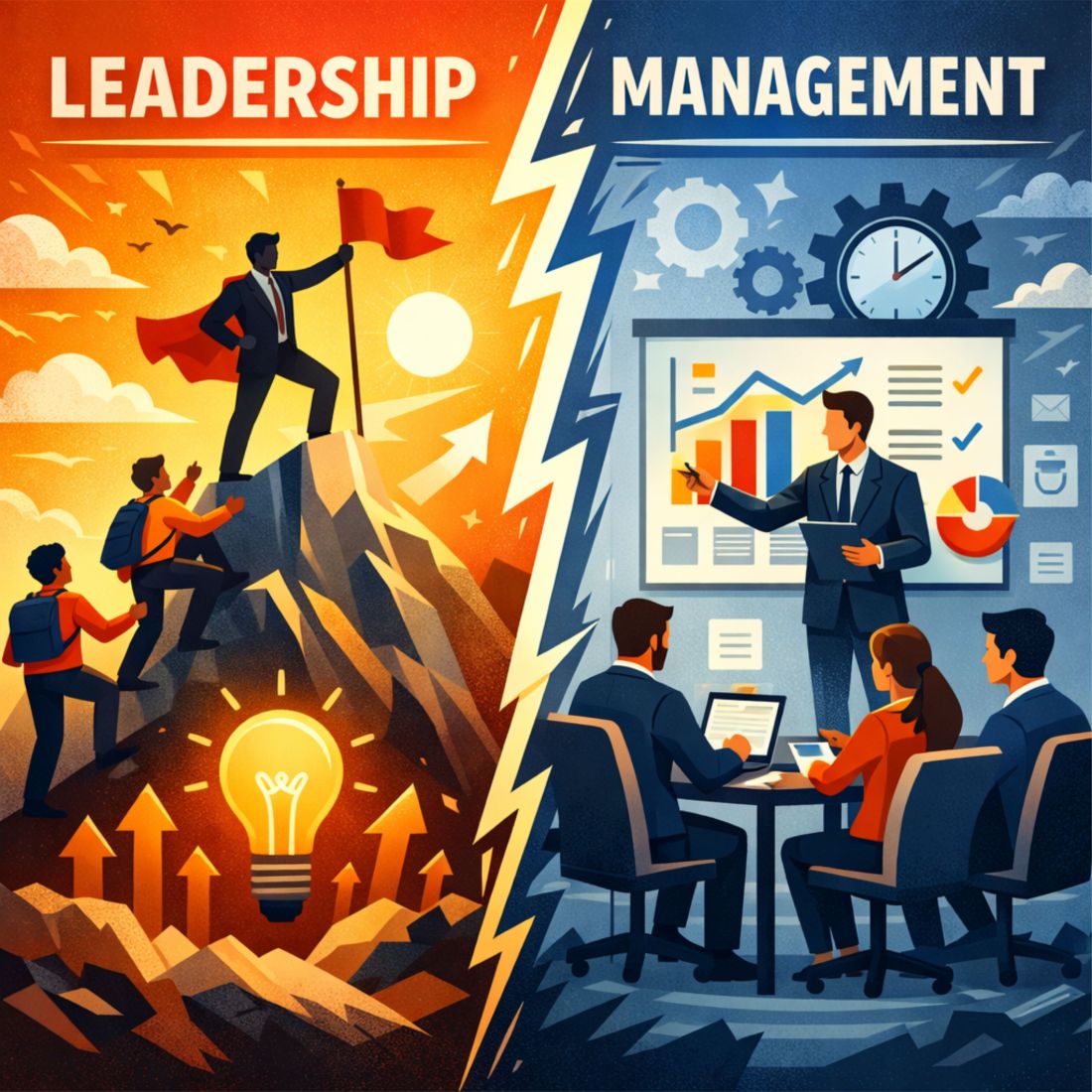
  • management (maintaining systems)
  • authority (holding power)
  • charisma (attracting attention)
  • expertise (possessing knowledge)
  • hierarchy (occupying a senior role)

These qualities may support leadership, but they do not constitute it.

When systems confuse these traits with leadership, they elevate individuals who lack the capacity to lead.

Part II: Why Leadership Has Collapsed

3. Systems Shape Behaviour

People behave according to the incentives and pressures around them.

When systems reward compliance, they produce compliant individuals.

When systems punish courage, they eliminate leaders.

The failures of public life are not personal accidents; they are structural outcomes.

4. Centralisation Makes Leadership Impossible

As systems grow in size and complexity:

  • decision‑makers become distant from the people affected
  • consequences become abstract
  • accountability becomes diffused
  • processes replace judgement
  • risk‑avoidance becomes rational
  • self‑preservation becomes necessary

These conditions force individuals into managerial behaviour.

Leadership cannot survive in environments where proximity, visibility, and accountability are absent.

5. The Political Party System Manufactures Non‑Leaders

Political parties pre‑select candidates long before voters see them.

They filter for:

  • malleability
  • predictability
  • loyalty to the party
  • willingness to comply
  • lack of threat to existing power

Insecure non‑leaders then select even weaker successors, creating a downward spiral of capability.

Those who rise to positions requiring leadership are those least able to lead.

6. The Alliance Between Wealth and Centralised Power

Centralised political systems depend on wealth for influence and stability. Wealth depends on centralised systems for access and control.

This alliance shapes priorities and behaviour, reinforcing managerialism and excluding genuine leadership, which threatens both sides.

Part III: The Principles of Human‑Scale Leadership Theory

Human‑Scale Leadership Theory rests on the following principles:

  1. Leadership is a human act, not a structural role.
  2. Systems shape behaviour more than individuals do.
  3. Centralised systems inevitably produce managers, not leaders.
  4. Real leadership can only function at human scale.
  5. The political party system manufactures non‑leaders.
  6. Managerialism is self‑reinforcing and self‑protecting.
  7. Wealth and centralised power form a symbiotic relationship.
  8. The public has forgotten what leadership looks like.
  9. Decentralisation is essential for restoring leadership.
  10. The purpose of governance is service, not control.

These principles form a coherent explanation of why leadership has collapsed and how it can be restored.

Part IV: How Leadership Emerges at Human Scale

7. Leadership Requires Human Scale

Human scale refers to environments where:

  • people know one another
  • consequences are visible
  • accountability is direct
  • relationships are real
  • trust can form
  • responsibility cannot be avoided

Leadership thrives only in such environments.

When systems exceed human scale, leadership collapses and managerialism fills the void.

8. Communities as the Natural Home of Leadership

Leadership emerges naturally in communities facing real challenges. It arises when someone steps forward to take responsibility and others recognise the authenticity of that act.

This process cannot be manufactured by institutions or imposed from above.

Leadership is:

  • recognised, not declared
  • earned, not granted
  • sustained by trust, not enforced by rules

9. Decentralisation as the Path to Renewal

To restore leadership, power must return to the smallest viable unit where human relationships exist.

Decentralised, community‑rooted governance reconnects decision‑makers with the people they serve. It replaces abstraction with understanding and managerialism with responsibility.

Part V: A Vision for Human‑Scale Governance

10. Governance Designed Around People

Human‑scale governance is built on:

  • local decision‑making
  • direct accountability
  • transparent consequences
  • community participation
  • leadership emerging from service

It does not reject organisation or coordination; it rejects centralisation that removes decision‑making from real life.

11. The Role of Larger Structures

Larger structures still exist, but they serve communities rather than control them. Their purpose is to support, coordinate, and enable – not to dictate, manage, or centralise power.

12. A Society Built on Leadership

A society grounded in human‑scale leadership is one where:

  • people are empowered
  • communities are resilient
  • public life is grounded in responsibility
  • leadership is visible and real
  • systems serve people, not the other way around

Reclaiming Leadership

Human‑Scale Leadership Theory offers a clear explanation for the leadership crisis of modern society and a coherent path toward renewal. It argues that leadership is a human act that can only exist at human scale – and that centralised, managerial systems make leadership impossible.

By returning power to communities and designing governance around human needs and human limits, leadership can be restored, and public life can be rebuilt on a foundation of responsibility, trust, and service.

The Absence of Leadership in a System Built for Managers and Nothing More

Modern society is experiencing a profound leadership crisis – not because leaders have disappeared, but because the systems that govern public life have been constructed to elevate managers instead.

This distinction is not superficial. It is the difference between a society capable of solving problems and one that merely contains them; between a political culture that serves people and one that serves itself.

The consequences of this shift are visible everywhere: in institutions that cannot act decisively, in political classes that avoid accountability, and in communities that feel increasingly disconnected from the decisions that shape their lives.

To understand how this happened, we must examine the mechanics of the system itself – especially the political party structures that determine who can rise, who cannot, and why leadership has been systematically replaced by management.

I. Why Poor Leaders Manage Instead of Lead

Poor leaders cannot lead, so they manage their way out of problems. When confronted with issues that require courage, empathy, or direct engagement – particularly when those issues involve people who are unhappy with them – they retreat into managerial behaviour. Management becomes a shield: a way to avoid conflict, responsibility, and the discomfort of facing those they have failed.

Instead of addressing the root cause of discontent, they impose restrictions and requirements on those who are more compliant. It is easier to control people who want to remain in favour than to confront those who challenge them.

This behaviour is not incidental; it is the predictable outcome of individuals who think primarily of themselves and the benefits they can extract.

Whether their aim is personal enrichment or the accumulation of power they do not know how to use, the result is the same: managerial elites respond to every problem by creating new burdens for the very people they were entrusted to serve.

II. How the System Rewards Management and Punishes Leadership

To understand why poor leaders rise, we must understand the incentives of the system itself.

Modern political and institutional structures reward:

• compliance over courage

• predictability over principle

• loyalty to the system over loyalty to the public

• risk‑avoidance over responsibility

Real leadership – which challenges assumptions, questions processes, and prioritises people – is treated as a threat.

Leaders disrupt. Leaders expose flaws. Leaders force change.

Systems built on self‑preservation cannot tolerate this.

As a result:

• those who comply rise

• those who question are sidelined

• those who serve others are punished

• those who serve themselves are rewarded

This is why genuine leaders do not seek leadership roles for their own sake.

Leadership is a natural disposition, not a career path. Yet the system has been engineered to reward ambition, self‑interest, and conformity.

III. How the Party System Manufactures Non‑Leaders

The political party system is one of the most powerful mechanisms driving the leadership crisis. It creates the illusion of democratic choice while tightly controlling who the public is allowed to choose from.

1. Voters believe they choose candidates – but parties choose them first

When voters enter the ballot box, they see a list of names and assume they are choosing between individuals. In reality, those individuals have already been chosen by party organisations long before the public ever sees them.

Unless a candidate is independent – and independents at parliamentary level have virtually no chance of being elected unless they are sensationalised – the choice has already been made by the party machine.

2. Parties select candidates for malleability, not leadership

Parties do not want independent thinkers. They want:

• reliable votes

• predictable behaviour

• people who will not challenge the hierarchy

• individuals who will not threaten the careers of those above them

This means the selection process filters out leadership qualities and filters in compliance.

3. Insecure non‑leaders select even weaker successors

Those who rise through this system are typically insecure. They know they lack leadership ability, so they avoid appointing or approving anyone who might outshine them.

Instead, they choose people who are even weaker, even more compliant, even more dependent on the system.

This creates a downward spiral:

Weak leaders → choose weaker deputies → who choose even weaker candidates → who eventually inherit roles requiring real leadership.

4. Eventually, these “yes‑people” reach roles that require real leadership

And when they do, they fail – not because they are malicious, but because they were selected precisely for their inability to lead.

This explains:

• why crises escalate

• why decisions are delayed

• why problems are managed, not solved

• why public trust collapses

It also explains why the system cannot self‑correct:

The people in charge are the least capable of recognising or addressing the problem.

IV. The Emergence of the Management Class

Over time, these incentives create a distinct group: a management class.

This class is not defined by competence or wisdom, but by its alignment with the system’s priorities.

It may include clever, knowledgeable, even impressive individuals, but they are not leaders. They are driven by ideas, power, and wealth that ultimately revolve around themselves.

The management class consolidates power by:

• controlling access to political advancement

• shaping the rules of participation

• defining what “leadership” means in system‑friendly terms

• eliminating those who cannot be relied upon

Ambition for wealth and ambition for power lead to the same destination, even when they begin innocently.

Pursuing personal gain at the expense of others always ends in harm.

V. The Symbiosis Between Political Power and Wealth

Within this structure, a strange but highly effective symbiotic relationship forms between the power‑hungry who enter politics and those who pursue wealth above all else.

For politicians, this relationship begins with awe. Wealth appears to offer solutions, influence, and security. Over time, awe becomes dependence, and dependence becomes sycophancy. As they move deeper into the system, politicians come to understand what wealth – and the power attached to it – truly means within this environment.

This dynamic eliminates real leadership because:

• wealth rewards compliance

• wealth punishes independence

• wealth shapes political priorities

• wealth becomes the gatekeeper of influence

A small number of individuals enter politics believing, naively, that it is a system built around leadership.

Those who possess genuine leadership qualities attempt to lead, but they face a relentless tide.

VI. The Dual System That Conditions People to Serve Themselves

The system operates on two levels:

1. The visible system – elections, parties, public debate, official processes.

2. The invisible system – incentives, pressures, dependencies, and unwritten rules.

Together, these form a dual system that conditions people to serve themselves.

Those who are not already self‑serving are taught to be. Those who resist are marginalised. Those who comply are rewarded.

To outsiders, the system can appear to be run by a conspiracy. But this perception is itself a convenient tool. It discredits those who sense that something is wrong but do not fully understand how the mechanics of the system operate.

Real leaders have no place in this environment. Their presence is accidental, not intentional.

VII. The Systemic Erasure of Real Leadership

The centralised, control‑heavy structure relies on law and regulation to remove problems by targeting those who comply, rather than addressing the root causes of the issues the system itself created.

These root causes alienate people and provoke them to speak out or act against the system – the same system that discourages anyone from actively attempting to do so.

Over time, the system redefines leadership as:

• management

• compliance

• authority

• hierarchy

• status

We have forgotten what leadership truly is because we cannot see it, hear it, or experience it first‑hand. The system does not allow it.

VIII. What Leadership Really Is (and Why the System Cannot Produce It)

Leadership does not come from position, wealth, education, or any of the classifications the system uses to select and reward those who serve its needs.

Leadership is selfless and always oriented toward the greater good.

Real leadership requires:

• empathy

• courage

• responsibility

• service

• humility

• a commitment to people, community, and environment

These qualities cannot be manufactured by a system built on self‑interest. They cannot be incentivised by structures that reward compliance. They cannot be nurtured in environments where power is centralised and accountability is diffused.

This is why centralised systems cannot produce real leaders. They can only produce managers.

IX. The Path Forward: Local, Human‑Scale Systems

If leadership cannot emerge from the system, it must emerge from outside it.

Local systems – real systems – untouched by the digital parallel world – are the only way genuine leadership can be restored.

Leadership emerges naturally in human‑scale environments where:

• people know one another

• decisions have visible consequences

• accountability is direct

• community needs are clear

• power is shared, not hoarded

The current system cannot and will not provide this, even when it pays lip service to the idea or appears to take action.

Once real power is returned to where it belongs, people will quickly see the system for what it is and recognise the true quality – or lack of it – in those who currently drive it.

X. Reclaiming Leadership

The crisis of leadership is not a crisis of individuals. It is a crisis of systems.

We are governed by managers because the system rewards management and punishes leadership.

Real leaders cannot rise within structures designed to preserve themselves rather than serve the public.

Restoring leadership requires genuine decentralisation, community‑level decision‑making, and a renewed understanding of leadership as service rather than status.

Only then can society reclaim the agency it has lost and rebuild systems that reflect the needs and values of real people.