

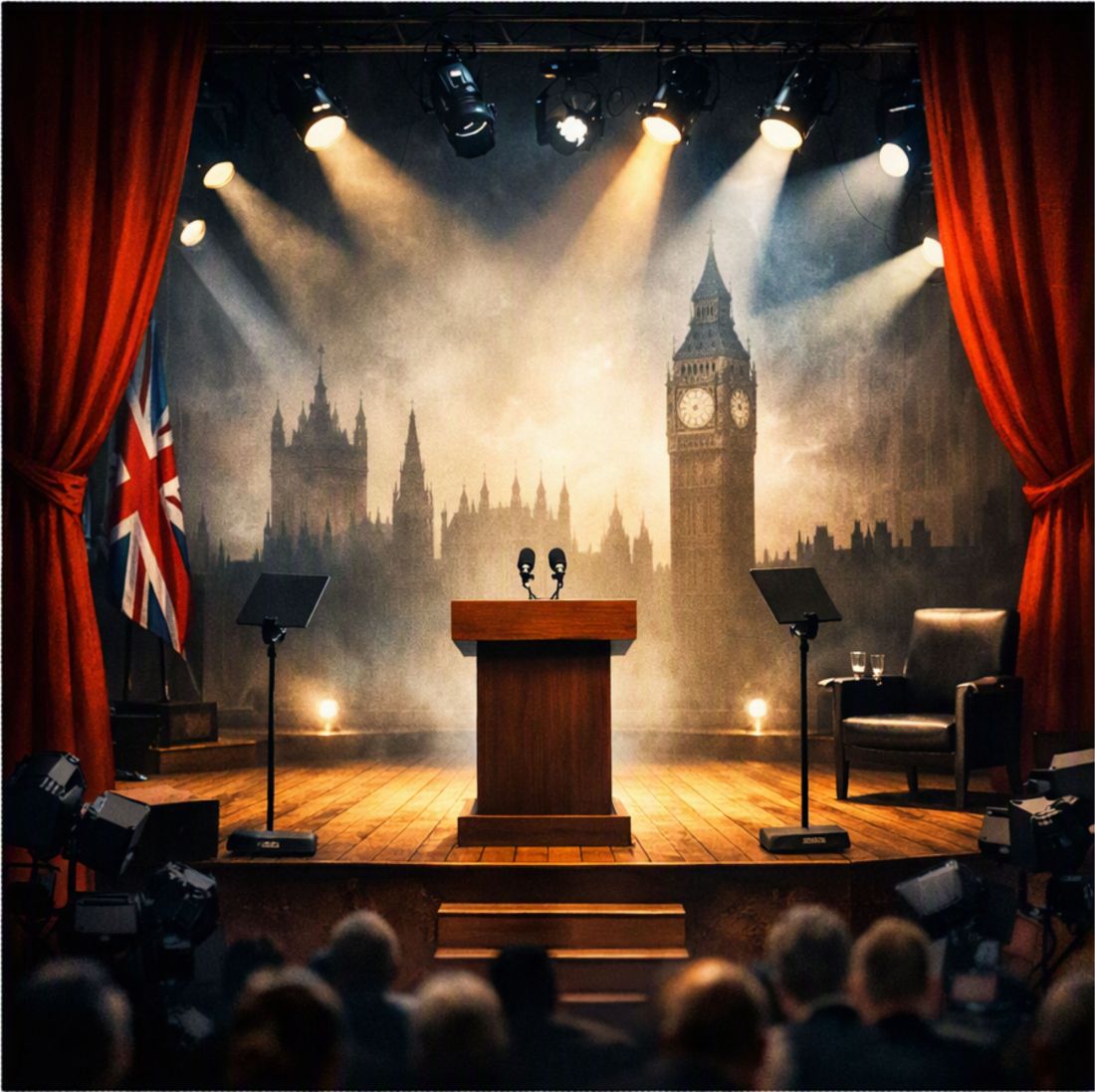
Andy Burnham’s first Labour conference speech as Prime Minister was delivered with confidence and clarity. It was well paced, well received, and immediately treated by the media as a set of current, immediate, and actionable policy commitments.
But many of the policies Burnham discussed were explicitly framed for the next Parliament. Yet the media analysed them as if they were decisions the government was preparing to implement now.
This is not optimism. It is not enthusiasm. It is not a sense of renewal.
It is blindness to timelines, and more importantly, blindness to the structural reality of the political class now running the country.
Because Burnham is not operating as a recognisably traditional Prime Minister. He is operating as part of the performance class – the management class that has replaced leadership with messaging, replaced agency with choreography, and replaced decision‑making with the careful maintenance of a system that no longer works.
This blindness is not universal across history. There was a time when Prime Ministers and Chancellors understood the machinery they were responsible for. But today’s political class does not.
Only weeks ago, it was reported that both the Chancellor and the Prime Minister were unaware of the true state of the public finances until they were formally briefed – a stark reminder that the people at the top are not steering the system, but being carried by it.
Burnham’s speech must be understood within this reality.
1. The Management Class Behind the Door
Every incoming Prime Minister now arrives in Downing Street believing they can change everything. They imagine renewal, reform, transformation.
Then the briefings begin.
They discover that:
- the previous government was not incompetent – it was constrained
- the crisis is not a collection of separate issues – it is one systemic failure
- growth is not optional – it is required to justify borrowing
- public services are not underfunded by accident – they are structurally underfunded
- and the levers of government are not tools – they are obligations
They learn that the system is already failing, and that their job is not to fix it but to manage its decline.
This is the defining feature of the modern political class: they are managers of a failing system, not leaders of a functioning one.
Burnham is now inside that reality. His speech was shaped by it.
2. Why Long‑Term Policies Are Being Treated as Current
Burnham’s speech contained policies framed for the next Parliament. Yet the media treated them as if they were part of the government’s present agenda.
This is not because the media see renewal. It is because they still report politics as if the system is functioning normally.
They treated long‑term commitments as if:
- the government had the capacity to act on them now
- the system were stable enough to absorb them
- timelines were flexible
- and the future would resemble the past
This is paradigm blindness – the belief that the same tools that created the crisis can solve it, and that the system still works in the way it once did.
Burnham’s announcements were not real policies. They were signals – narrative devices designed to buy time, reassure the public, and avoid revealing the constraints of the system.
The media missed this almost entirely.
3. The Triple Lock: Abolished – Then Abruptly Pulled Into This Parliament
Burnham is not protecting the triple lock. He is abolishing it.
Originally, he announced that this would happen after the next election – a future‑facing commitment that:
- costs nothing today
- changes nothing today
- risks nothing today
- and avoids confronting the structural reality the triple lock was designed to hide
But within days, the position shifted again.
Burnham has now indicated that the triple lock may be dealt with during this Parliament after all.
This rapid adjustment is not a sign of decisiveness. It is a sign of the management class responding to pressures it does not control.
The timing of the abolition – first distant, then immediate – is not the story. The story is that the political class is improvising inside a system that no longer behaves predictably.
The reversal does not change the structural argument; it confirms it.
It shows how performance politics works:
- future promises
- present narratives
- sudden pivots
- and commitments that change before the public has even absorbed them
The triple lock was never a generous policy. It was a stabiliser – a mechanism designed to hide the widening gap between what people need and what the economy can deliver.
Its abolition is not reform. It is an admission that the stabiliser can no longer be maintained.
But the way the policy has already shifted – from future to present – reveals the deeper truth:
The political class is not governing. It is reacting. It is improvising. It is performing.
4. Proportional Representation: A Future‑Facing Distraction
Proportional representation was treated the same way.
Commentators discussed PR as if Burnham were preparing to legislate for it now. But PR is not a current policy. It is a distant, abstract reform that only matters in a functioning system.
It is attractive precisely because it is irrelevant to the immediate crisis.
It is safe. It is distant. It is a distraction. It is a promise for a future that may never arrive.
Burnham’s use of PR in his speech was not a commitment. It was a signal – a way of appearing bold without touching the real crisis.
The media treated it as a current policy. It is not.
5. Burnham’s New Statement: Campaigning to Rejoin the EU
Burnham has now said he may campaign to rejoin the EU as part of Labour’s manifesto for the next election.
This is another example of the same pattern:
- a future‑facing promise
- framed for the next Parliament
- treated by the media as if it were a current policy
- and used to signal direction without committing to action
It fits perfectly within the suspended state the UK already occupies.
As one analysis of Brexit puts it:
“Instead, the UK occupies a space that feels suspended – as if the decision was made, but the destination never materialised.”
Burnham’s suggestion of rejoining the EU does not resolve this suspended state. It extends it.
It is another performance of direction in a system that cannot move forward or back. It is another promise for a future that may never arrive. It is another example of political actors reaching for familiar structures because they cannot imagine rebuilding capacity at home.
The media treated Burnham’s comment as if it were a real‑time strategic shift. It is not.
It is the same pattern repeated: future promises treated as present commitments, because performance is all the system has left.
6. The Media’s Blindness: Reporting Theatre as Reality
The most alarming part of the reaction to Burnham’s speech was not enthusiasm – it was misinterpretation.
The media treated:
- long‑term reforms
- distant commitments
- structural promises
- and future‑facing narratives
as if they were current, immediate, and actionable.
This is not optimism. It is blindness to the timelines and blindness to the structural crisis.
Britain has reached a point where the traditional toolbox of government – borrowing, cuts, privatisation, growth – has worn out. Taxation is now the only lever that still moves.
Everything else is performance.
Yet the media continues to report policy as if the old levers still exist. As if governments still have meaningful choices. As if the system is not already hollowed out.
Their failure to recognise the structural crisis is itself part of the crisis.
7. Leadership at the End of a System
Burnham’s speech was not dishonest. It was not incompetent. It was not unusual.
It was exactly what any Prime Minister from the management class would deliver at this moment in history.
Because performance is all that remains.
Britain’s crisis is not a crisis of personalities or competence. It is a crisis of the model itself.
Leaders are trapped between:
- paradigm‑blind managers who understand the machinery but cannot imagine a future beyond it
- institutional romantics who believe power is simply a matter of will
Burnham’s speech was shaped by the first group. The media’s reaction was shaped by the second.
Neither group is prepared for what comes next.
8. The Real Travesty
The tragedy is not that politicians cannot lead. It is that they still believe they are operating within a system that can be led.
They have not yet accepted that:
- the decisions they make today have real‑time consequences
- the crisis is accelerating
- the public needs honesty, not performance
- and the weeks and months ahead may require seismic decisions
Honesty would be catastrophic for any leader unwilling to govern in real time. But honesty is now the only responsible choice.
People, communities, and businesses need to prepare.
Instead, the political class is playing for time.
9. Burnham’s Speech Was a Mirror, Not a Map
Burnham’s first conference speech did not tell the country what the government will do.
It told the country what the government cannot do.
It revealed:
- a system at the end of its life
- a political class performing competence
- a media still trapped in the old story
- and a public being prepared for narratives, not realities
It showed that unless leadership emerges that can see beyond the machinery, the machinery itself will decide what happens next.
Burnham’s speech was not a plan. It was a reflection of a system that can no longer produce one.
Further Reading
1. The Contemporary Politicians’ Dilemma
Explains why modern politicians cannot act meaningfully once in office, and how systemic constraints shape every decision they make.
Link: https://adamtugwell.blog/2024/12/05/the-contemporary-politicians-dilemma/
2. Why We Keep Looking for Answers in the Direction That Created the Problem
Examines paradigm blindness – the tendency of political actors to rely on the same failing tools and assumptions that caused the crisis.
3. When Tax Is the Only Tool They Have Left
Shows how Britain’s economic model has exhausted all traditional levers, leaving taxation as the only remaining mechanism for stabilisation.
Link: https://adamtugwell.blog/2026/09/22/when-tax-is-the-only-tool-they-have-left/
4. The Triple Lock and the Structural Crisis of the British Economy
Explains how the triple lock masks deeper structural failures in the economy and why its political protection – and now its delayed abolition – signal fear rather than reform.
Link: https://adamtugwell.blog/2026/04/07/the-triple-lock-and-structural-crisis-of-the-british-economy/
5. Proportional Representation: The Wrong Answer to the Right Frustrations
Argues that PR is a distraction – appealing but irrelevant to the immediate crisis – and risks deepening systemic instability.
6. What Leadership Means When the System Is Failing
Defines real leadership in a failing system and contrasts it with the performance‑based politics dominating Westminster.
Link: https://adamtugwell.blog/2026/09/08/what-leadership-means-when-the-system-is-failing/
7. The Time for Performance Is Over
A call for leaders to abandon narrative‑driven politics and confront the structural crisis directly.
Link: https://adamtugwell.blog/2026/08/29/the-time-for-performance-is-over/
8. The Next Election Cannot Really Be Won – And Why What Follows Matters Even More
Explains why electoral politics can no longer deliver meaningful change and why the post‑election period will define Britain’s future.
9. Brexit and the Halfway House: Why Britain Cannot Move Forward or Back
A structural explanation of why the UK is trapped between two systems – no longer buffered by the EU, not yet capable of genuine independence. Includes the line:
“Instead, the UK occupies a space that feels suspended – as if the decision was made, but the destination never materialised.”
This essay provides the deeper model behind the suspended state Burnham’s EU‑rejoin comments now reinforce.

