
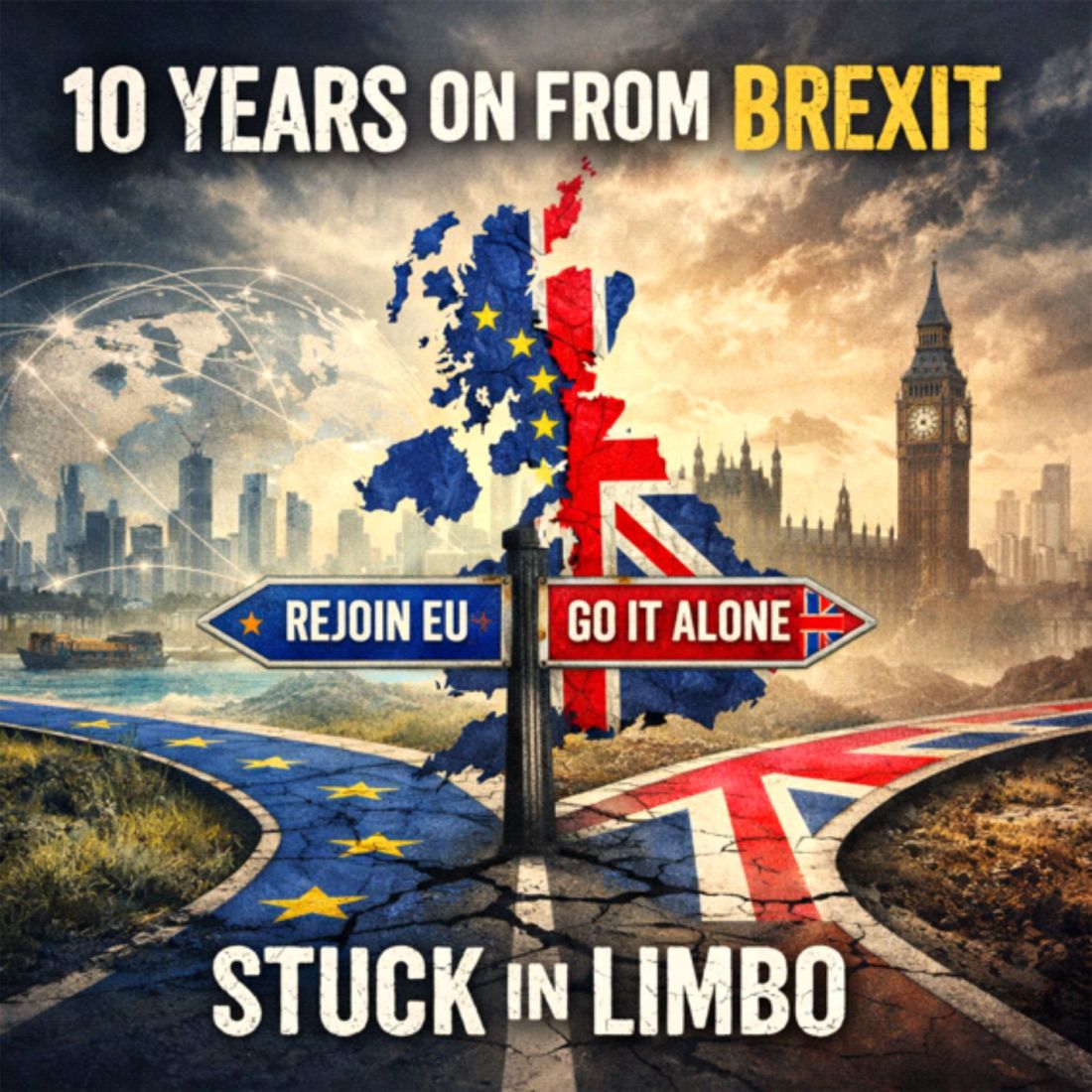
Ten years after the Brexit vote, Britain should be clearer about where it stands. Instead, the country remains stuck in a political and economic halfway house: no longer fully inside the European Union, not meaningfully outside the global system the EU represents, and still without a national strategy for either path.
The problem was never simply Brexit.
The deeper problem is that Brexit exposed forces that had been shaping Britain for decades, and our political class treated the referendum as an end point rather than the beginning of a serious national reckoning.
The EU Was Never the Whole Story
Much of today’s debate still treats the EU as if it were either a guaranteed route to financial prosperity or the root cause of Britain’s problems.
However, the EU has always been something larger in disguise: globalisation with a regional structure and a political language of rules, markets, mobility, and managed integration.
By globalisation, I do not simply mean trade with other countries. I mean a money-centric and increasingly extractive system in which capital moves more freely than people, production is shifted wherever costs are lowest, assets are financialised, and national governments are pressured to organise their economies around global markets, investor confidence, and regulatory alignment rather than the long-term needs of their own citizens.
The EU is one expression of that model. It gives globalisation a regional form: rules-based, legally embedded, and institutionally durable. It can protect some standards, but it also limits the space in which national electorates can demand a fundamentally different economic settlement.
The pressures on public services, the loss of local industry, the dependence on imported labour and goods, the rise of unaccountable governance, the hollowing out of productive capacity, and the sense that politics no longer answers to voters are all symptoms of this wider settlement. They were not created by membership of a single regional bloc, even if EU membership helped give them shape.
Brexit didn’t create these problems.
It accelerated our collision with them.
Once outside the EU, Britain could no longer pretend that Brussels alone was the thing holding it back. We had to face a harder truth: the UK had no coherent plan, no institutional structure, and no leadership prepared to build a post-globalisation nation-state rooted in productive capacity, democratic accountability, and national resilience.
And a decade later, we still don’t.
Rejoining Wouldn’t Take Britain Back – It Would Take Britain Further In
Calls from some Labour figures and pro-European commentators to “rejoin” often imagine a return to the EU Britain voted on in 2016. But that EU no longer exists in the same form.
Over the past decade, the EU has moved further toward deeper integration: fiscal, political, regulatory, and strategic. Its direction of travel is toward more centralisation, not less.
Rejoining today would not mean stepping back into the old argument. It would mean entering a more integrated project, from a weaker position, after having surrendered the leverage Britain once had as a member.
Rejoining now would mean:
• paying to enter a more integrated EU;
• accepting rules Britain no longer helped to shape;
• and accelerating the same direction of travel our own halfway-house politics has already pushed us further into.
In reality, rejoining would not reverse Britain’s drift.
It would simply mean paying to arrive faster at the place Britain is already drifting towards.
The Right Is Fighting Over Something None of Them Can Reach
Meanwhile, the Conservative Party, Reform UK, and Restore are locked in a struggle over the language of “taking back control”. But none has yet shown how that control can be restored while Britain remains embedded in the same globalised framework that weakened it in the first place.
They are fighting over a steering wheel that no longer controls the direction of travel.
You cannot deliver meaningful sovereignty inside a globalised framework unless you are willing to break with the assumptions of that framework: cheap labour over national cohesion, financial flows over productive industry, managed decline over strategic renewal, and international approval over democratic consent.
So far, none of them has been willing to say that clearly.
So the Right fights each other.
Labour dreams of rejoining.
And the country stays stuck.
The Real Difficulty of This Anniversary
The difficulty isn’t Brexit.
The difficulty is that Britain still has not accepted what Brexit revealed:
• The EU wasn’t the root cause of our problems.
• The deeper cause was globalisation: financialised, extractive, and hostile to genuine national decision-making.
• Brexit gave us a chance to rethink everything.
• We voted for it.
• But we didn’t take it.
• And now we’re paying the price for standing still.
Ten years on, the choice is no longer Leave vs Remain.
It is this:
• Finish the job of becoming a self-governing country by rebuilding domestic industry, restoring democratic control over economic choices, reducing dependence on fragile global systems, and placing national resilience above global approval;
or
• pay to rejoin a system that is heading exactly where Britain’s own political drift has already taken it.
The halfway house is the one place Britain cannot stay. It cannot govern itself properly from there, and it cannot re-enter the old world because that world has moved on.
Ten years after Brexit, the question is no longer whether Britain was right to leave. The question is whether it still has the courage, imagination, and seriousness to become something more than a country permanently suspended between dependence and sovereignty.
Further Reading
These two earlier pieces develop the argument behind this anniversary essay. Together, they explain why Britain’s post-Brexit position is not simply a question of Leave or Remain, but part of a wider crisis of sovereignty, political purpose, and national direction.
Brexit & the Halfway House: Why Britain Cannot Move Forward or Back
This article sets out the original halfway-house argument: that Britain has left the institutional structure of the EU without building the national capacity, political confidence, or strategic direction needed to operate as a genuinely independent country. It explains why simply drifting, rejoining, or pretending Brexit is complete all fail to answer the deeper problem.
What Is the Right Really For? Why Britain’s Conservatives, Reform UK, and Restore Are Fighting Over Something None of Them Can Reach
This companion piece examines the struggle on the British Right over sovereignty, control, and political identity. It argues that parties can promise to “take back control”, but unless they confront the globalised economic settlement itself, they remain trapped inside the very system they claim to oppose.
 Adam Tugwell