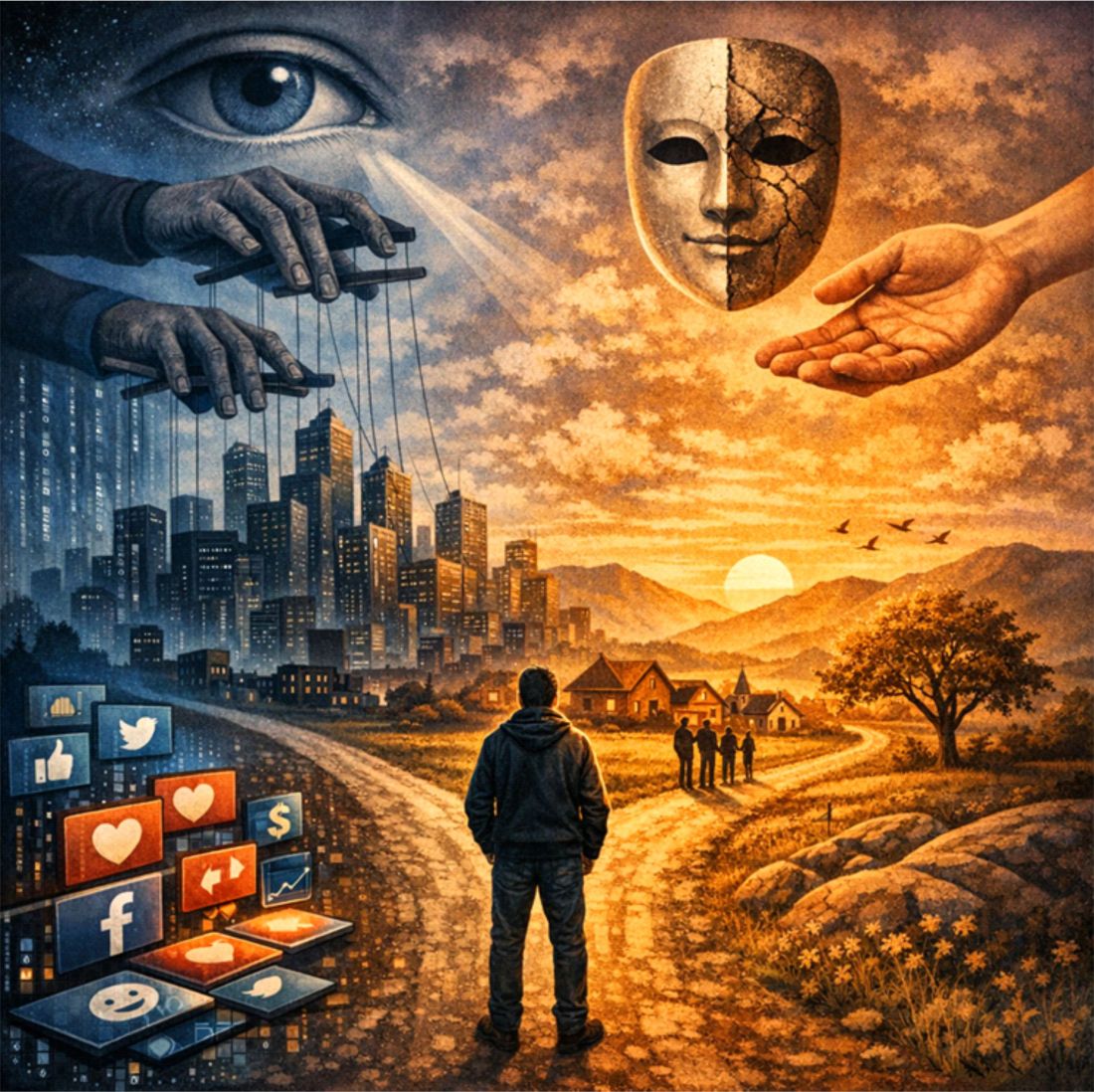


We are living in a society that increasingly treats the first thing it sees as the whole truth.
A single image, a few seconds of video, or a headline stripped of context now carries more authority than the full story ever will.
The Golders Green incident this week is a vivid example – not because of the event itself, but because of how quickly and confidently people decided what it meant.
This isn’t just a media problem. It’s a cultural shift in how people think.
The Image That Became the Truth
The photograph that circulated online appeared to show police officers kicking a man in the head as he lay face‑down on the ground. Millions saw it. Millions reacted. And millions did so without knowing anything about what happened before, after, or outside the frame.
This is the defining feature of our moment:
The image becomes the truth long before the truth has a chance to speak.
But what can be seen is rarely the full story.
A single frame – or even a full video – can only ever capture the visible surface of an event.
It cannot show the threat the officers believed they were facing. It cannot show what was said, what was seen, or what was feared in the seconds before the recording began. It cannot show the weapon reportedly being shielded, or the possibility of explosives, or the split‑second calculations that people make when they believe lives may be at risk – whilst they may be knowingly risking their own.
Even the clearest footage is still a narrow window onto a much wider reality. It tells us what happened in front of the camera – not what happened in the minds of the people involved, nor the dangers that may have been invisible to the viewer but obvious to those on the ground.
And yet, in a first‑glance culture, the fragment becomes the whole. The snapshot becomes the story. The surface becomes the conclusion.
Why We React This Way: The Deeper Forces at Work
To understand the problem, we have to go deeper than “people jump to conclusions.”
That’s the surface. The real drivers sit underneath.
1. The collapse of attention
People no longer consume information in minutes or hours – they consume it in seconds. The brain adapts. Depth becomes uncomfortable. Nuance feels like friction.
The first impression becomes the only impression because people no longer have the cognitive patience for the second one.
2. The emotional economy
Social media rewards emotional reactions – anger, fear, moral outrage – because they spread faster.
Platforms are built to amplify the content that triggers the strongest feelings, not the most accurate understanding.
The most inflammatory interpretation becomes the dominant one.
3. The outsourcing of judgement
People increasingly rely on influencers, commentators and politicians to tell them what to think.
When a public figure reacts instantly, it validates the public’s instinct to do the same. The cycle reinforces itself.
4. The erosion of trust
When trust in institutions declines, people rely more heavily on what they can see with their own eyes – even if what they see is only a fragment of the truth.
A single image feels more trustworthy than an official explanation.
5. The speed of modern politics
Political incentives now reward immediacy. Leaders feel compelled to react instantly, not thoughtfully.
The public expects it. Social media demands it. Elections punish hesitation more than they punish error.
These forces combine to create a society where certainty arrives long before understanding.
The Golders Green Reaction: A Case Study in First‑Glance Thinking
Green Party leader Zac Polanski reacted immediately, condemning the officers involved.
He did so without waiting for facts, without asking questions, and without acknowledging that the image represented a single frozen moment in a complex and dangerous situation.
His reaction wasn’t unusual. It was predictable – because political incentives now reward speed, not accuracy.
Polanski later apologised. But apologies rarely travel as far or as fast as outrage.
By the time the fuller picture emerged – including reports that the man on the ground was shielding a weapon and may have been carrying explosives – the narrative had already hardened.
This is the deeper issue:
Political reactions are increasingly shaped by optics rather than understanding.
The Broader Problem: A Society That No Longer Looks Beneath the Surface
The Golders Green incident is not an isolated example. It is a symptom of a much wider cultural shift:
We increasingly treat complex issues as if they have simple, surface‑level explanations.
This affects almost every major topic in public life:
- how money works
- how globalisation works
- how benefits work
- why people rely on benefits
- why the military is underfunded
- why immigration policy seems paralysed
- why healthy food is unaffordable
- why “growth” is treated as a universal good
- why student loans cost so much
- why housing demand keeps rising
- why politicians talk about global governance
- why food banks are now normalised
Each of these issues is layered, structural and interconnected. Yet public debate often reduces them to a single narrative – usually one that blames the visible and protects the powerful.
This is the real danger:
When society stops looking beneath the surface, the people in power stop doing it too.
The Consequences: When First‑Glance Thinking Becomes Policy
When leaders respond to optics rather than substance, we end up with:
- policies designed for headlines, not outcomes
- debates shaped by emotion, not evidence
- blame directed at the visible, not the responsible
- solutions that fix appearances, not problems
This is how a country drifts into dysfunction while believing it is simply reacting to events.
The Golders Green Incident as a Warning
The incident is not just a story about policing or politics. It is a warning about what happens when a society loses its ability – or its willingness – to think beyond the first glance.
A single image can now:
- distort public understanding
- shape political behaviour
- inflame division
- overshadow truth
- and ultimately influence policy
All before the facts are known.
We Need to Relearn the Habit of Depth
If we want better leaders, better decisions and a better understanding of the challenges we face, we must start by resisting the instinct to judge instantly.
Depth is not a luxury. It is a civic responsibility.
Slow down.
Ask questions.
Look beyond the frame.
Because the truth almost always lives outside the snapshot.