
Poverty is often described as a lack of money. Governments measure it through income thresholds, commentators discuss it in terms of affordability, and public debate frequently focuses on individual expenses such as housing, food, or energy. While these measures and discussions capture important aspects of economic hardship, they often fail to identify the underlying condition that poverty represents.
The fundamental issue is not simply a shortage of income. It is the loss of independence.
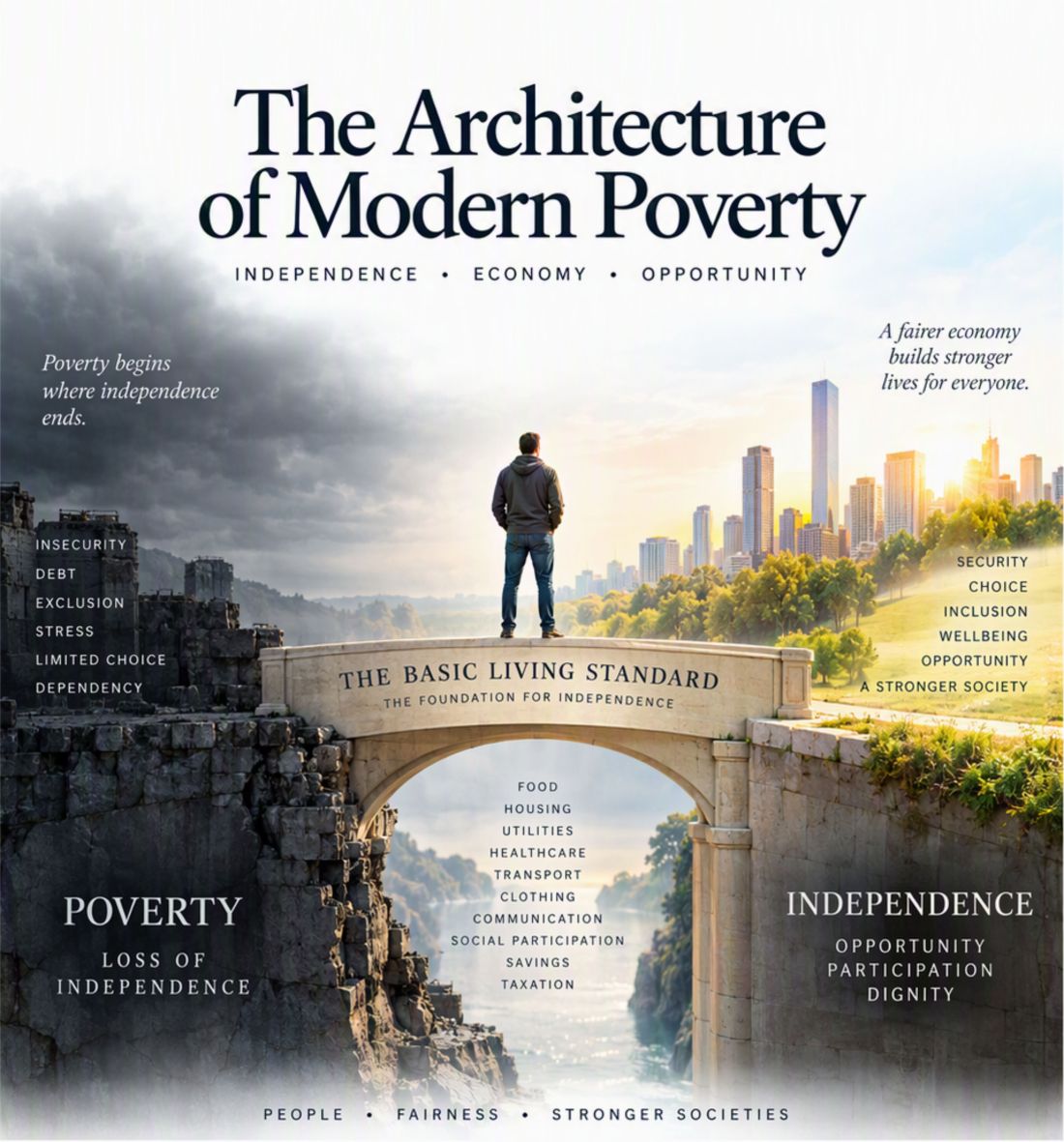
In a modern economy, poverty begins when a person can no longer meet their essential needs through their own resources and must rely on external support to maintain a basic standard of living.
The inability to sustain oneself independently marks the boundary between economic security and economic vulnerability. This point may be described as the Independence Threshold.
Understanding poverty through independence shifts attention away from arbitrary income figures and towards a more meaningful question: can an individual meet the essential requirements of life without falling into debt, relying on welfare, or depending on charity?
If the answer is no, poverty has already begun.
Poverty as the Loss of Independence
Independence is often taken for granted. It is expressed through ordinary activities: paying rent, buying food, travelling to work, heating a home, replacing worn clothing, maintaining communication, and managing unexpected expenses.
These activities appear routine because they are routine for those whose incomes allow them to participate fully in economic life. Yet all depend upon a continuing ability to convert income into essential goods and services.
When that ability is lost, independence begins to erode.
A person who cannot afford housing without assistance is not fully independent. A person who must regularly choose between heating and eating is not fully independent. A person who requires continual borrowing to meet ordinary living costs is not fully independent.
The common feature in each case is not low income itself, but an inability to sustain essential needs through one’s own means.
Poverty is therefore better understood as a condition of dependency rather than simply a condition of low earnings.
Independence Exists Within an Economic Context
No individual becomes independent in isolation. Independence is shaped by the economy in which a person lives.
The resources required to maintain a basic life differ between countries, regions, and periods of history. Modern life carries obligations that did not exist for previous generations and costs that vary considerably between locations.
Housing, transport, energy, communication, healthcare, taxation, childcare, and access to employment all influence the resources required for independent living.
As these costs rise, the income necessary to maintain independence rises with them.
This has important implications for how poverty is understood.
A level of income that provides security in one economy may produce hardship in another. Likewise, an income that supported independence ten years ago may no longer be sufficient today if essential costs have increased.
Poverty cannot therefore be understood solely through absolute measures. It must be understood relative to the economic conditions in which people actually live.
The question is not simply how much money a person has.
The question is whether that money is sufficient to maintain independence within the economic environment that surrounds them.
The Consequences of Falling Below the Threshold
The loss of independence has consequences that extend far beyond finances.
When people cannot reliably meet their essential needs, uncertainty becomes a constant feature of daily life. Long-term planning becomes difficult. Financial shocks become crises. Opportunities are declined because the risks are too great. Immediate necessities take precedence over future ambitions.
Over time, this creates a pattern of exclusion.
Participation in social activities may decline because they can no longer be afforded. Educational opportunities may be deferred. Career progression may be limited by transport costs, childcare costs, or insecure housing. Physical and mental wellbeing may deteriorate as financial pressures intensify.
Poverty therefore affects more than material possessions. It constrains choices, limits participation, and reduces personal agency.
The defining characteristic of poverty is not merely what people lack. It is what they are no longer free to do.
The Limits of Traditional Poverty Measures
Most poverty measures focus primarily on income.
While income remains important, income alone does not determine whether a person is independent.
Two households with identical earnings may experience very different levels of security depending upon their circumstances. Housing costs, debt obligations, family responsibilities, regional price differences, disability-related expenses, transport requirements, and many other factors influence whether income is sufficient to meet essential needs.
As a result, many people who sit above official poverty lines still struggle to maintain independence. They may appear financially secure according to statistical measures while relying on borrowing, family support, charitable assistance, or the continual postponement of essential spending.
Such individuals may not be recognised by conventional poverty measures, yet their independence remains fragile.
A more meaningful understanding of poverty requires identifying the point at which independence becomes unsustainable, rather than merely measuring income against a predetermined percentage or average.
Defining the Requirements of Independence
If poverty begins when independence ends, a practical question emerges.
What is required to remain independent?
The answer cannot be limited to survival alone.
Independence in a modern society requires more than the bare minimum needed to stay alive. It requires access to the goods and services necessary for participation in ordinary economic and social life.
This includes adequate food, secure housing, utilities, transport, healthcare, clothing, communication, and the ability to absorb unexpected expenses. It also requires a modest capacity to participate in society and contribute to the wider community through taxation and civic engagement.
Together, these elements form the basis of a Basic Living Standard.
The Basic Living Standard represents the minimum set of resources required for a person to live independently within a modern economy. It is not a measure of comfort, luxury, or affluence. Nor is it a subsistence model concerned only with physical survival.
Instead, it identifies the economic foundation necessary for stability, dignity, and participation.
The Relationship Between the Independence Threshold and the Basic Living Standard
The Independence Threshold and the Basic Living Standard represent two parts of the same framework.
The Independence Threshold defines the condition of poverty. It identifies the point at which an individual loses the ability to meet essential needs without external support.
The Basic Living Standard defines the resources required to avoid that condition. It establishes the minimum economic foundation necessary to sustain independence.
One identifies the boundary.
The other identifies where that boundary lies.
Together, they provide both a definition and a measurement.
If an individual’s earned income is sufficient to achieve the Basic Living Standard, independence is maintained. If it is insufficient, independence becomes compromised, and poverty emerges.
This relationship transforms poverty from an abstract social concern into a measurable economic reality.
A New Foundation for Economic Policy
Viewing poverty through the lens of independence creates a different basis for public policy.
The central question becomes whether the structures of the economy allow people to maintain independent lives through their own efforts.
Wages, housing policy, taxation, transport infrastructure, energy markets, healthcare provision, and social support systems can all be assessed according to their effect on independence.
A minimum wage, for example, cannot be considered adequate simply because it exists. Its adequacy depends upon whether it enables a worker to achieve the Basic Living Standard without requiring continual supplementation from debt, welfare, or charity.
Similarly, economic growth cannot be evaluated solely through national statistics if increasing living costs simultaneously undermine the independence of large sections of the population.
An economy succeeds not merely when it generates wealth, but when it allows ordinary people to sustain independent lives within it.
Conclusion
Poverty is often treated as a problem of insufficient income. In reality, it is more accurately understood as a loss of independence.
The ability to meet essential needs through one’s own resources represents the foundation of economic security, personal agency, and meaningful participation in society. When that ability is lost, poverty begins, regardless of how it is measured statistically.
The Independence Threshold identifies this critical boundary. The Basic Living Standard identifies the resources required to remain above it.
Together, they provide a framework for understanding poverty that is rooted not in abstract financial measures, but in the practical realities of everyday life. They shift the focus from income alone to the broader question of whether people possess the means to sustain themselves with dignity, stability, and autonomy.
In doing so, they offer a foundation for a more coherent understanding of poverty and a clearer means of addressing it.
Further Reading
The ideas presented in this essay are explored in greater depth across a series of related works. Together, these pieces trace the development of the Basic Living Standard and the Independence Threshold, from the practical question of what people need to live independently, through to a broader philosophy of freedom, autonomy, and economic participation.
1. The Basic Living Standard: Full Text
Foundational Framework
This is the foundational statement of the Basic Living Standard. It sets out the principle that anyone working full time at the lowest legal wage should be able to meet all essential living costs without debt, welfare dependency, or charity.
The article defines the components of a basic but dignified life and establishes the standard as a practical benchmark for wages, public policy, and economic justice.
2. The Basic Living Standard Explained
A Practical Introduction
This accessible introduction explains the purpose and mechanics of the Basic Living Standard. It explores why traditional measures such as minimum wage and poverty thresholds often fail to reflect lived reality and demonstrates how a living standard based on genuine economic independence can provide a clearer and more meaningful benchmark.
3. The Basic Living Standard: Freedom to Think, Freedom to Do, Freedom to Be
The Philosophy of Economic Independence
Moving beyond economics, this essay explores the deeper human implications of financial security. It argues that economic independence creates the conditions for genuine freedom: the freedom to think without constant anxiety, to act with agency and purpose, and to develop one’s identity without the constraints imposed by persistent insecurity.
The piece examines the relationship between personal sovereignty, dignity, wellbeing, and social stability.
4. The Independence Threshold: A New Definition of Poverty for a Modern Economy
Redefining Poverty Through Independence
This work develops a new definition of poverty based on the concept of independence rather than income alone. It argues that poverty begins at the point where a person can no longer meet their essential needs without external support.
The article introduces the Independence Threshold as a framework for understanding poverty within modern economies and explains its relationship to exclusion, participation, and economic resilience.