
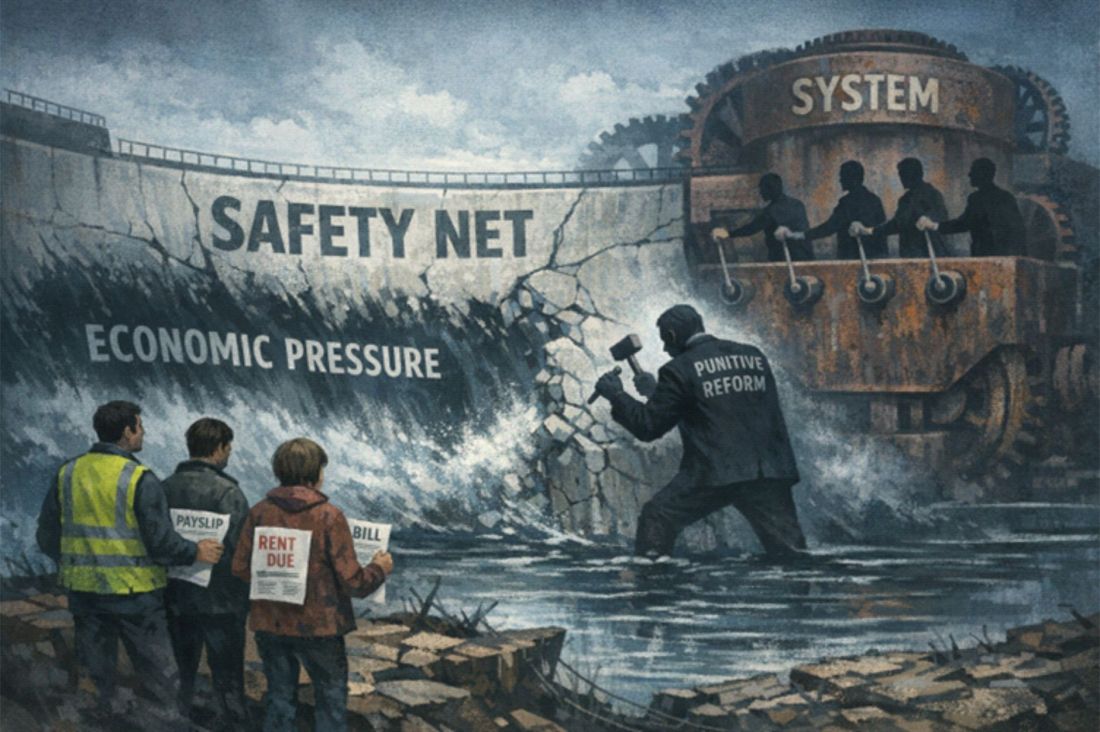
There is a growing danger in British politics today, and it doesn’t come from any one party, personality, or ideology. It comes from something deeper: system‑locked politics – a form of governance where every political actor, no matter how sincere or radical they believe themselves to be, is trapped within the architecture of a system that cannot produce the outcomes people need.
This isn’t about attacking any party, politician, or ideological camp. The point is simpler: most political actors, no matter how sincere or radical they believe themselves to be, are trying to solve structural problems using tools that were designed by the very system that created those problems in the first place.
The problem is not the people. The problem is the system.
And nowhere is this clearer than in the renewed rhetoric around “benefits culture.”
The headline problem: a simple story for a complex reality
Recent headlines have amplified claims suggesting that the only real divide in the UK is “between those who work and those who don’t.” Commentators have asked whether a future government could “end benefits culture.”
But the term ‘benefits culture’ itself reveals the misunderstanding at the heart of system‑locked politics. It reflects a belief – shared by many politicians and much of the public – that poverty is primarily a behavioural issue, not a structural one. It assumes that people on benefits are choosing not to work, and that the minimum wage is enough to live on.
Both assumptions are wrong.
And both assumptions are symptoms of a political class that has become system‑locked – unable to see the economic reality that millions live in because the system itself blinds them to it.
The minimum wage myth: a benchmark that never matched reality
The minimum wage is treated as if it were a scientifically calculated threshold for the cost of living. The quiet assumption is that if the government sets the rate, it must reflect what a person needs to survive independently.
But this is a myth.
The minimum wage has never been tied to actual living costs. It has always been a political number, not an economic one.
And in a system where:
• rents rise faster than wages
• inflation erodes purchasing power
• essential goods outpace income
• insecure work is widespread
• and regional inequality is entrenched
the minimum wage becomes a symbol, not a solution.
This is why millions of people in work still rely on benefits. Not because they refuse to work – but because the system makes full independence impossible for many, even when they do everything “right.”
The extractive system: why poverty persists even when people work
The UK’s economic model is fundamentally extractive.
It relies on:
• the continual devaluation of currency
• the upward transfer of wealth
• the erosion of real wages
• and the normalisation of financial insecurity
People are encouraged to believe that this erosion is natural – that they must work harder, earn more, and accumulate endlessly just to stay in place.
This is not a moral failing. It is a structural design.
And because the system is designed this way, benefits are not a sign of laziness – they are a pressure valve for a system that would collapse without them.
Successive governments have quietly tolerated rising benefit dependency because confronting the real cause – the system itself – would require a level of political courage that system‑locked politics cannot produce.
Why people don’t “just get a job”
For many people, taking a minimum‑wage job does not remove the need for benefits. Unless they work close to the maximum legal hours, they remain dependent on the state. And even then, many still fall short.
The incentives are broken:
• A minimum‑wage job may not cover rent.
• Working more hours may reduce benefits without increasing net income.
• The transition from benefits to work is often financially punishing.
• The jobs available may be insecure, temporary, or vanishing.
And this is happening at a time when:
• companies are closing
• better‑paid work is disappearing
• AI is replacing roles for profitability, not necessity
• global instability threatens economic shocks
Even if every barrier were removed, there may simply not be enough jobs for everyone who needs one.
This is not a behavioural issue. It is a structural one.
Why system‑locked politics misdiagnoses the problem
Politicians across the spectrum – new and old – fall into the same trap. They treat poverty as a matter of personal responsibility because the system encourages them to.
It is easier, safer, and more politically rewarding to blame individuals than to confront the architecture of the economy.
This is why the idea of a “benefits culture” is so convenient:
• It shifts blame downward.
• It hides the failures of the system.
• It creates division between people who are victims of the same forces.
• It allows politicians to appear decisive without addressing root causes.
This is system‑locked politics in action: a politics that treats symptoms because it cannot reach causes.
The danger of punitive welfare reform in a fragile economy
If a future government – any government – were to withdraw benefits from those labelled as “refusing to work,” the consequences could be severe.
The UK could see:
• rising homelessness
• tent encampments
• slum‑like conditions
• widespread destitution
• social fragmentation
• and a collapse in public trust
These are not exaggerations. They are the predictable outcomes of removing support without fixing the causes of need.
The safety net is already thin. Pulling it away without structural reform would be like breaching a dam that has been holding back a flood.
Why new and upcoming political parties won’t escape the trap
Many people are now turning to newer or smaller political movements with the genuine hope that the next government will finally “get it right.”
But system‑locked politics means that once in power:
• the incentives change
• the constraints tighten
• the system asserts itself
• and the same patterns repeat
What looks radical in opposition becomes impossible in government.
This is not necessarily because politicians are weak or dishonest. It is because the system they inherit is stronger than the people who enter it.
Real change requires a paradigm shift – not a new political party
The problems we face cannot be solved within the current framework.
They require:
• a shift away from money‑centrism
• a people‑first approach to policy
• a rethinking of value, productivity, and wellbeing
• and a willingness to confront the extractive nature of the system itself
This is not something system‑locked politics can deliver. It will only happen when the system reaches a point where it can no longer sustain itself – and we may be closer to that point than many realise.
Removing millions from benefits could accelerate that collapse. So could global shocks. So could economic contraction.
The question is not whether the system will change, but how.
Conclusion: the real divide is not between workers and non‑workers
The real divide is between:
• those who understand that the system is already failing
• and those who still believe it can be fixed from within
The political views currently shaping public discourse, like many before them, reflect a system‑locked view of society – one that misdiagnoses the problem and risks making it worse.
Ending “benefits culture” without addressing the structural causes of need will not create a stronger country. It will create a more fragile one.
And unless we confront the system itself, every party – old or new – will remain locked inside it.
 Adam Tugwell