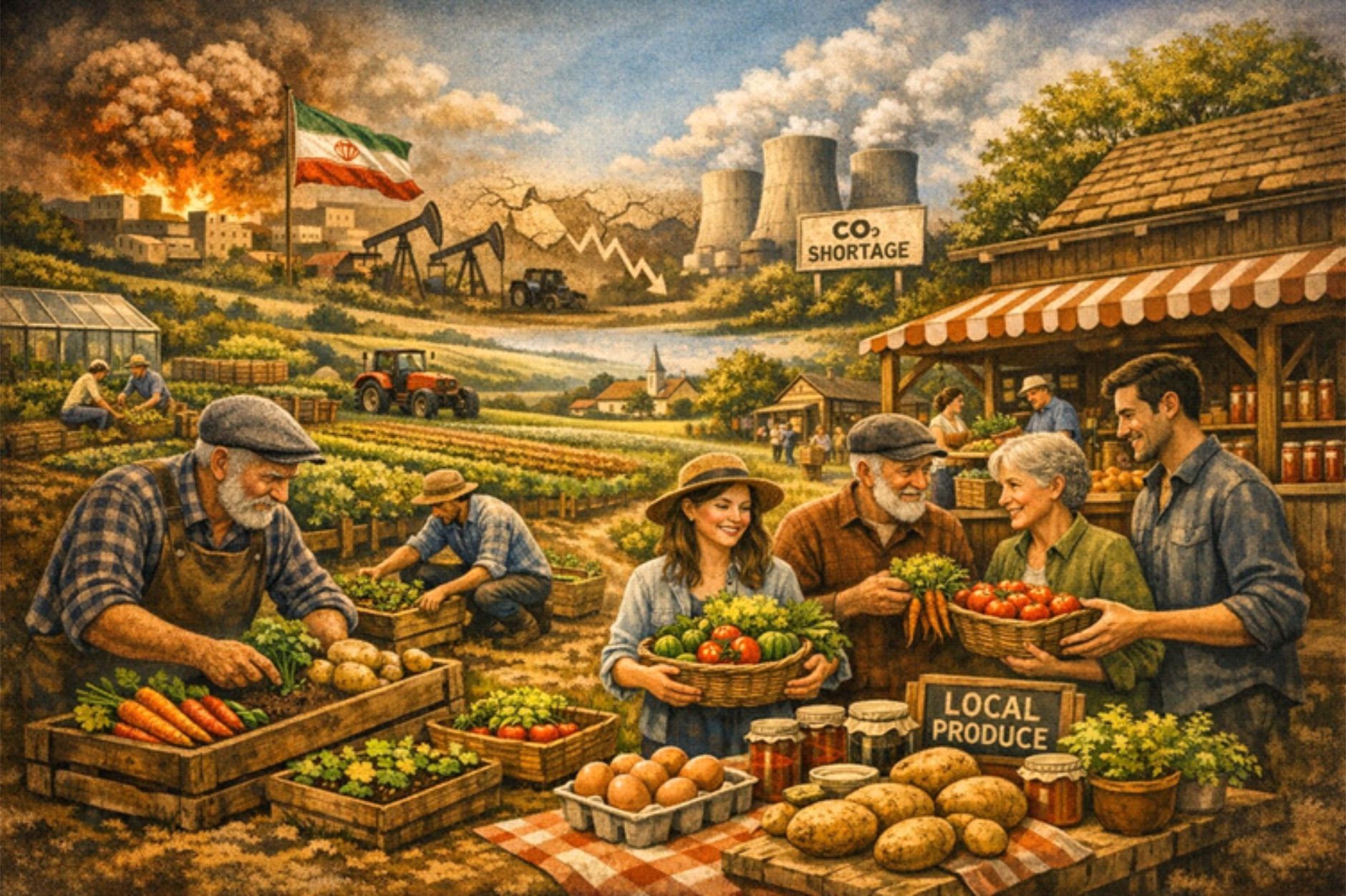

We woke up today to headlines warning that the UK could face shortages of chicken and pork this summer because of a carbon dioxide shortage – a shortage being linked, in part, to the wider economic shockwaves created by the war in Iran.
It’s the kind of story that instantly triggers anxiety, because we’ve all become used to the idea that when something goes wrong, the government will somehow step in and keep the music playing.
But the truth is more complicated.
Yes, government has a role in managing disruption. Yet the assumption that shortages will be “temporary”, that “temporary” means weeks rather than years, and that everything will eventually return to the version of “normal” we’ve known for decades – that assumption is part of the problem.
To understand why, we need to look more closely at what is actually in short supply. In this case, it isn’t food itself. It’s carbon dioxide – a gas used throughout the modern food chain for processing, packaging, preserving, and even carbonating drinks.
The anticipated shortages being discussed relate not to the food we need, but to the industrial processes we’ve grown used to relying on to make food look, feel, and behave the way we’ve been taught to expect.
This distinction matters. It shows how fragile our food system has become – not because we lack the ability to grow food, but because we’ve built a system that depends on layers of technology, chemicals, and global logistics to deliver food in a particular form.
As I’ve explored in What Is Food Security?, this dependence is not accidental. It is the result of decades of centralisation, consolidation, and the steady removal of local, traditional, and small‑scale ways of producing and supplying food.
Over time, the UK’s food chain has been reshaped to serve global supply networks rather than local communities. Regulations, business models, and infrastructure have all pushed in the same direction: away from local autonomy and towards a system where a handful of large processors, distributors, and retailers sit between the farmer and the consumer.
In Foods We Can Trust and Food From Farms Guaranteed, I’ve written about how this shift has made the system appear “cheap” while hiding the real costs – costs we are now beginning to see in full colour.
Moving away from systems that sustained human life for millennia was never progress, no matter how persuasive the narratives or financial incentives may have been. The money‑centric philosophies that shaped this shift – from neoliberalism to the more extractive forms of capitalism – have encouraged us to believe that the flow of goods and money is endless, that convenience is the same as security, and that problems don’t exist as long as we keep consuming.
At the individual level, those who can’t keep up with this system are blamed for their own exclusion. At the community level, small businesses, farmers, and local producers have been pushed out. And at the national level, countries have been slotted into global roles that only work as long as every part of the system behaves exactly as expected.
The war in Iran has exposed just how brittle that arrangement really is – not just in terms of oil supply, but in the monetary and economic turbulence that follows.
This turbulence isn’t temporary. It was built into the system from the start. The conflict has simply accelerated a collapse that was already underway, as I’ve discussed in An Economy for the Common Good and The Local Economy & Governance System.
Food is the first and most visible casualty because it is the one thing we all need, even though we’ve been encouraged to treat it as something we merely want.
Government figures often claim the UK produces 50–60% of the food we eat. But this headline number is not even the real net figure and it hides the reality that much of what we produce is exported or processed into global supply chains, never reaching UK consumers in anything like its original form.
When you strip away the spin, the amount of food grown here that actually ends up on UK plates directly is closer to 11% – roughly enough for one in ten people.
In The Need for a Collaborative Approach to the UK Farming and Food Security Problem, I’ve explained why this gap matters and why it leaves us dangerously exposed if global supply chains falter.
We must be honest: the UK cannot transform its food system overnight. The local infrastructures, skills, and supply chains that once fed this country have been dismantled over decades.
But change can happen quickly if we ask the right questions, listen to the right people, and remove the barriers that stop farmers and growers from doing what they do best.
The UK must become self‑sufficient in producing the foods we need – not the fashionable, processed, or ultra‑convenient products we’ve been conditioned to want, but the basic, nutritious staples that sustain life.
In Foods We Can Farm, Catch, Harvest and Grow Locally, I’ve outlined exactly what those foods are and how achievable this shift could be.
Our Farmers are some of the most creative and entrepreneurial people in the country. They don’t need micromanagement from government or direction from advocacy and membership organisations whose priorities are tied to centralised policy rather than local reality. They need freedom – freedom to grow food for local people, to supply it fresh, and to rebuild short, simple supply chains that keep food close to where it is produced.
This is the essence of a contribution‑based, community‑driven system, something I’ve explored in The Contribution Culture.
But farmers cannot do it alone. Even with the best rationing system, shortages will be unavoidable unless people also begin to grow food themselves. Gardens, allotments, grow bags, window boxes – all of these can make a difference. In Grow Your Own and Rationing & Health, I’ve shown how home growing not only boosts resilience but improves health and reconnects people with the food they eat.
This is where we are. The situation we are facing is serious. But it is not hopeless.
If we think differently – if we rebuild local systems, trust farmers, grow what we can, and focus on what we truly need – we can create a food system that is resilient, fair, and rooted in community rather than global fragility.
The shortages being discussed today are a warning. But they are also an opportunity.
Ask the farmers. Go local. And start rebuilding the food security we should never have allowed ourselves to lose.


3 thoughts on “Iran and the Prospect of Food Shortages: Ask the Farmers – Go Local”