The Triple Lock and Structural Crisis of the British Economy

The debate over the future of the State Pension triple lock is often framed as a simple question of fairness: should pensions rise each year by the highest of inflation, wage growth or 2.5%? But the timing of Reform UK’s recent pledge to retain the policy – announced immediately after the party removed its housing spokesperson over comments about the Grenfell tragedy – highlights something more political than economic. The announcement reflected the sensitivity of the moment, not a deeper understanding of what the triple lock represents within the wider economic system.

The triple lock itself, introduced in 2010 by the Conservative–Liberal Democrat coalition and applied since 2011, was designed to ensure the State Pension kept pace with living costs. On paper, it is a straightforward mechanism. In practice, it has become a symbol of intergenerational tension and a lightning rod for wider anxieties about the sustainability of the welfare state.

Yet much of the public debate rests on a misunderstanding – not of the triple lock, but of the system that surrounds it.

The National Insurance Illusion

A significant part of the resentment directed at pensioners – and at benefit claimants more broadly – stems from a widespread belief that National Insurance functions like a personal contribution scheme. The idea is simple: pay in during working life, draw out later if needed. It is a reassuring narrative, and one that shapes how people judge who is “deserving” of support.

But it is not how the system works.

National Insurance is, in practice, another form of taxation. It creates the impression of a ring‑fenced fund, but the money is not stored or invested on behalf of contributors. It flows into the wider fiscal system, supporting pensions, disability benefits, the NHS and more. The distinction between NI and income tax is largely psychological – a way of obscuring the true scale of the tax burden.

This misunderstanding fuels the belief that some groups are “taking out” more than they “put in”.

Pensioners are portrayed as receiving disproportionate benefits, while claimants are accused of drawing on funds they have not earned. Yet both groups are navigating a system shaped not by individual choices, but by structural economic forces that have made independent living increasingly difficult.

Few pensioners enjoy the “gold‑plated” incomes often imagined. And for many, the wealth tied up in property is not liquid wealth at all – it is simply the roof over their heads.

A Safety Valve in a Distorted Economy

The official justification for the triple lock is to protect pensioners from falling living standards. But its deeper purpose is more systemic.

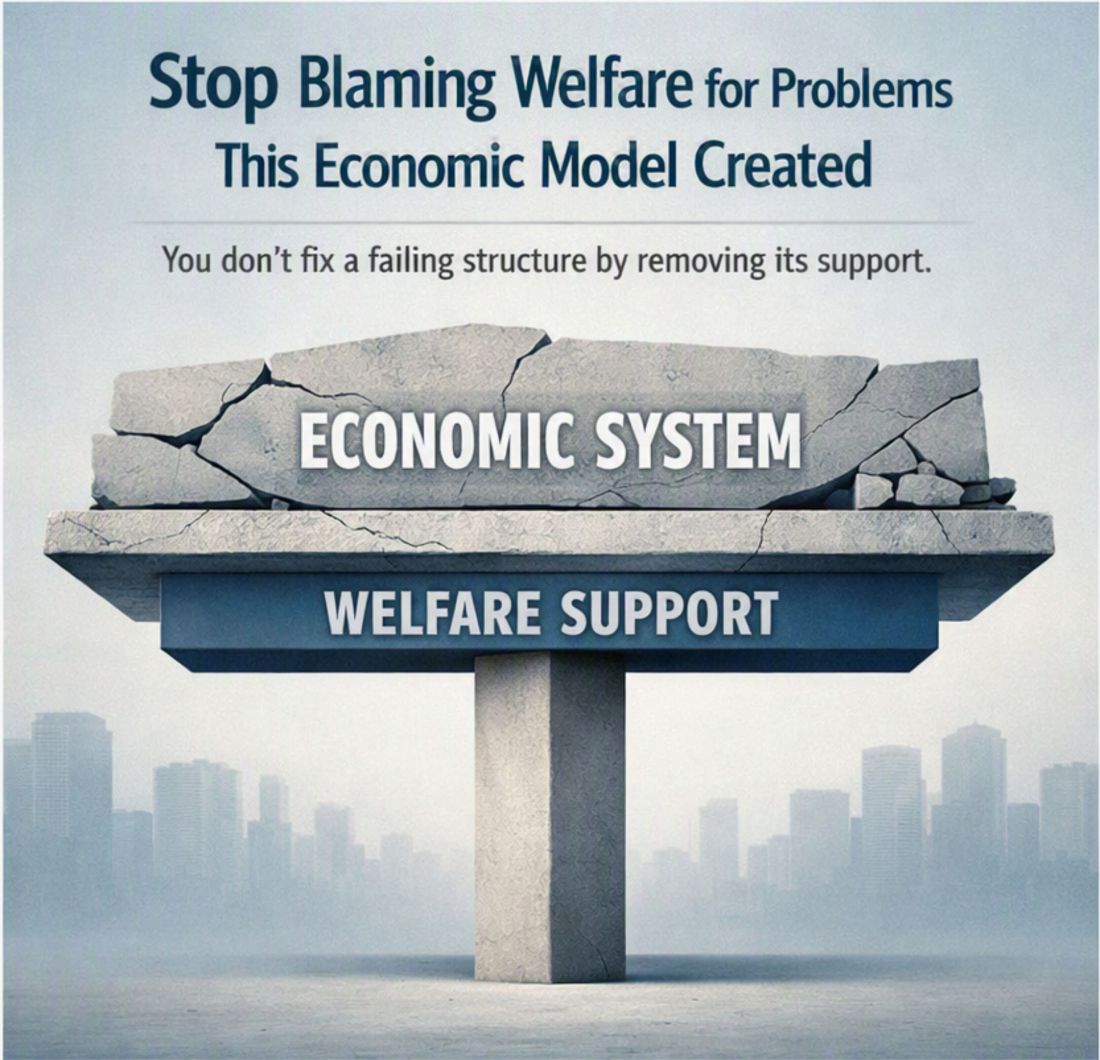
It acts as a safety valve in an economy where wages have failed to keep pace with the cost of living for years, and where millions rely on top‑up benefits simply to survive.

Recent calculations suggest that the real minimum income required for independent living is around £14.92 per hour for a full‑time worker – far above the statutory minimum wage. In this context, the triple lock is not generosity. It is a stabiliser in an economy where the fundamentals no longer align with the lived reality of ordinary people.

The triple lock attracts scrutiny precisely because it exposes this gap: the distance between what the economy delivers and what people need to live.

The Extractive System Behind the Debate

To understand why the triple lock is under pressure, it is necessary to look at the broader economic model. Since the financial crisis of 2007–08 – when the Labour government bailed out the banks on the grounds that they were “too big to fail” – the UK has relied increasingly on debt‑fuelled growth. Public money, or rather public borrowing, was used to stabilise a financial system whose own excesses had caused the crash.

The result was an acceleration of an extractive economic system: one that draws value out of industry, infrastructure and natural resources faster than it replaces them.

Over time, this leaves the state with fewer productive assets and greater reliance on financial engineering to keep the system afloat.

The Covid‑19 pandemic and the war in Ukraine intensified these pressures. Government spending surged, supply chains fractured, and inflation returned with a force not seen in decades.

In such an environment, policies like the triple lock become both more expensive and more politically contentious – even as they become more essential for those who rely on them.

Reform UK and the Politics of Constraint

Reform UK’s pledge to retain the triple lock, while simultaneously promising deep cuts to welfare, illustrates the bind facing all political parties.

The party argues that reducing benefits will free up resources to protect pensioners. But most people receiving benefits are not living comfortably; they are surviving on the margins of a system that no longer delivers affordable housing, adequate wages or predictable costs.

The irony is that many of the people who would be affected by such cuts were encouraged to come to the UK in the first place to sustain a model that depends on population growth and consumer spending to generate GDP. The same pounds circulate through the economy, creating the appearance of growth even when underlying productivity is stagnant.

Reform’s position is not unique. Every major party faces the same structural constraints. None can deliver the full range of promises they make without confronting the underlying economic model – something no mainstream political actor has yet been willing to do.

There is, ultimately, no way to rob Peter to pay Paul when both are already struggling.

A System at Its Limits

The triple lock debate is therefore not really about pensioners. It is about a system approaching the limits of what can be sustained through borrowing, population growth and statistical measures of economic activity.

When the government can no longer create enough debt to paper over the cracks, policies like the triple lock become flashpoints.

The question is not whether the triple lock is fair. It is whether the economic model that makes it necessary can continue in its current form.

Conclusion

The triple lock has become a symbol of a deeper truth: Britain’s cost‑of‑living crisis is not a temporary shock but a structural feature of an economy that no longer aligns with the needs of its people.

Pensioners are not the cause of this problem, nor are benefit claimants. They are simply the most visible participants in a system that has been stretched to breaking point.

The debate over the triple lock is, in the end, a debate about the future of the UK’s economic model – and whether any political party is prepared to confront the realities that underpin it.

Why a People-Centric Future Must Begin Here: The Basic Living Standard

This essay is not a policy proposal, nor a prediction. It is an attempt to describe the direction our systems are moving in, to examine why that direction is increasingly unstable, and to outline the minimum foundation required if we are to avoid recreating the same failures under new labels. It is an exploration of what it would mean to build a future around people rather than money – before events force that reckoning upon us.

It is nearly four years since I published Levelling Level, written at a time when “levelling up” dominated public debate. The purpose of that book was not to analyse the policy itself, but to expose how political narratives are used to obscure reality. “Levelling up” was a perfect example: a phrase so elastic it meant something different to everyone, and therefore meant nothing at all.

The Conservatives used it to imply people would be lifted up through public action – a promise that was, at best, disingenuous. Labour and the left, meanwhile, often approached inequality through a lens that effectively levels down. Ironically, these opposing approaches tend toward the same destination: a system in which people have less control over their own lives while centralised authority grows stronger. That is why successive governments have found it so easy to adopt and repurpose the term. Its vagueness is not a flaw; it is a tool.

Levelling Level was my attempt to show how narratives like this mask what is happening beneath the surface. What I did not anticipate was that it would become the starting point for a much larger inquiry: understanding where our system is heading, why it is heading there, and what a future genuinely built around people – not money – might require.

My confidence in the need for change comes from lived experience: a childhood shaped by poverty; early work in farming; later training in management; years spent in corporate services, charities, not‑for‑profits, and my own businesses; alongside time volunteering and serving as a frontline politician. These experiences offered a broad view of how the current system functions – and why its trajectory is increasingly unsustainable.

When our systems are examined honestly, their flaws point toward profound structural change. Ideally, such change would come by choice. In reality, it is more likely to be triggered by events arising from a money‑centric system that has been out of balance with the needs of people, communities, and the environment from its inception.

A system built on extraction and exploitation can only persist for so long before it exhausts the mechanisms designed to sustain it. Eventually, the myths fail, the smokescreens thin, and the underlying mechanics become visible.

It is tempting to explain this moment through conspiracies or shadowy coordination. And while the behaviour of certain global institutions may provide circumstantial evidence that fuels such beliefs, I do not accept that our predicament is the result of a single, unified plot.

The explanation is both simpler and more human: greed, self‑interest, and the misuse of power by those with sufficient influence to shape outcomes – and insufficient moral restraint to stop themselves.

The money‑centric system now sits on a knife edge. Not because of any one leader or institution, but because it was never designed to endure indefinitely. It was always a question of which pressure point would give way first, and what chain reaction would follow.

This system – encompassing globalism, neoliberalism, fiat money, modern monetary theory, centralisation, and the gradual drift toward supranational governance – rests on a single organising principle: the concentration of power, freedom, wealth, and resources in the hands of the few at the expense of the many.

Greed and selfishness are not new. What is new is the extent to which ordinary people are losing the freedom to shape their own lives. The natural lessons that arise from genuine choice – including the freedom to fail – have been replaced by frameworks that quietly dictate outcomes. Often, this happens without people fully realising it.

When decisions made by distant others constrain our ability to live freely and to make the choices that determine our own direction – for better or worse – fundamental natural laws are broken.

To say the system is out of balance is an understatement. Human life was never meant to revolve around the accumulation of material wealth or the pursuit of externally imposed values. Yet this is precisely what the money‑centric world demands.

As the old system falters, another dynamic is emerging – one that must be addressed with equal clarity.

People and groups are already forming new “bubbles”, each convinced they have found the answer: political movements, spiritual communities, ideological tribes, eco‑centric visions, decentralisation evangelists, and countless others. Many of these arise from genuine care and real harm. They offer belonging, meaning, and direction at a time of uncertainty.

The problem is not intent. It is structure.

These bubbles present themselves as new beginnings, but they often become new routes back to the same value system.

Any framework that requires qualification – whether political, religious, spiritual, environmental, or ideological – inevitably recreates hierarchy. It divides people into those who belong and those who do not. It rewards conformity and punishes difference. It produces insiders and outsiders. Once this happens, the conditions are in place for power to concentrate again, for value to be externally measured again, and for the money‑centric mindset to re‑emerge under a different name.

This is why the Basic Living Standard matters so profoundly.

The Basic Living Standard is not compatible with a money‑centric system.

They cannot coexist without one undermining the other.

One is built on extraction, hierarchy, and conditional value.

The other is built on universality, integrity, and unconditional human worth.

In practical terms, the Basic Living Standard means that no person’s survival, dignity, or basic participation in society is conditional on productivity, compliance, belief, or alignment. It is the floor beneath which no one can fall – not as charity, not as reward, but as a structural guarantee embedded in how the system operates.

But the BLS is also incompatible with agenda‑driven futures that seek to define the world in their own image.

It requires no qualification.

It does not ask you to be spiritual, religious, political, green, or ideologically aligned.

It does not demand belief, membership, or adherence to a worldview.

The only qualification is that you are a human being.

That universality is not an abstract ideal. It is the integrity upon which any future system must rest if it is to avoid manipulation, coercion, and the slow drift back into the very structures we claim to be leaving behind.

A people‑centric world cannot be built on agendas, however well‑intentioned.

It cannot be built on tribes, identities, or movements that claim to speak for everyone.

It cannot be built on frameworks that elevate some while excluding others.

It must be built on a foundation that treats every person the same – not rhetorically, not aspirationally, but in the actual mechanics of how the system functions.

The Basic Living Standard is that foundation.

It is the pivot that prevents the future from being bent to the will of the few.

It is the safeguard against the return of the money‑centric mindset.

It is the universal benchmark that keeps the system grounded in people, not agendas.

We are approaching a point where the old system can no longer hide its failures. Change is becoming unavoidable. That is why we must think clearly now – before events dictate the terms for us.

If we can let go of inherited assumptions, follow the implications of a people‑centric system to their full conclusion, and imagine life beyond the money‑centric lens, we may begin to see what the Basic Living Standard truly offers.

Not agreement.

Not conformity.

But a future in which no one’s humanity is conditional.

A world built around people, not money.

The Power of Local Communities

Introduction

We are living through a moment where the world feels louder, faster, and more uncertain than at any point in living memory. People can sense that something fundamental is shifting, even if they cannot yet name it.

Systems that once felt solid now feel fragile. Institutions that once felt dependable now feel distant. And the idea that “someone else” will fix things no longer carries the comfort it once did.

Yet beneath the noise, something important is happening – something quieter, more human, and far more powerful than the headlines ever acknowledge.

People are beginning to look closer to home.

Not because they have given up on the wider world, but because they are rediscovering something that was always there:

The strength, capability, and resilience of their own communities.

For decades, we were encouraged to believe that real power lived elsewhere – in governments, corporations, global markets, and distant decision‑makers.

We were taught to outsource responsibility, to trust systems we could not see, and to measure our lives through structures we did not control.

Over time, this created a quiet but profound belief that ordinary people were too small to shape their own future.

But that belief was never true.

Local communities have always been the foundation of human life. They are where we eat, where we work, where we raise our children, where we experience joy and hardship, and where we feel the consequences of every decision made in our name.

They are the scale at which trust is built, where relationships form, and where real change becomes possible.

And now, as the old world strains under its own weight, the importance of local communities is becoming impossible to ignore.

This document is a bridge – a way of helping people move from the feeling that “everything is falling apart” to the understanding that we already have the tools, the people, and the capacity to build something better.

Not in theory. Not in the distant future. But right here, in the places we live, with the people we know.

It is not a call to revolution. It is a call to remember.

To remember that power does not only flow from the top down.

To remember that resilience grows from the ground up.

To remember that the future will not be saved by distant institutions, but shaped by connected communities.

The world is changing.

But that change does not have to be frightening.

It can be the beginning of something profoundly human – a return to locality, to capability, to shared responsibility, and to the simple truth that we are strongest when we act together.

This is the power of local communities.

And this is where the future begins.

1. Where Communities Begin

When this document talks about community, it does not mean a whole town agreeing on a plan, a village turning up to a meeting, or a critical mass of people getting on board before anything can begin.

In its most literal sense, a community can be very small.

It might be a street.

It might be a handful of households.

It might be two or three people who know each other and decide to act together.

Community does not begin at scale.

It begins with connection.

The mistake many people make is assuming that community has to be complete before it can work – that everyone needs to be involved, aligned, or committed before anything meaningful can happen. That assumption quietly prevents people from starting at all.

This document takes the opposite view.

Community is not something you assemble in advance.

It is something that grows.

It grows through small, visible acts of cooperation.

It grows as trust builds.

It grows as people see that things can be done locally, without permission.

The direction of travel matters more than the starting size.

What begins as a few people helping each other becomes shared capability.

Shared capability reduces dependency.

Reduced dependency creates resilience.

Over time – if allowed to grow naturally – that resilience becomes economic.

Not in the abstract sense of markets or money, but in the practical sense of meeting needs, circulating value, and supporting life locally.

When a community can feed itself, repair what it owns, share skills, organise care, and solve problems together, an economy already exists – whether or not anyone has named it yet.

This is why starting small is not a limitation.

It is the condition that makes healthy growth possible.

You do not need everyone.

You do not need agreement.

You do not need scale.

You only need enough connection for momentum to begin.

Everything else emerges from there.

2. The Forgotten Power of Local Communities

For most of human history, the community was the centre of life. Not as a romantic ideal, but as a practical reality. People lived, worked, learned, created, and solved problems together because there was no alternative.

The community was the economy. The community was the safety net. The community was the governance system. The community was the source of identity, meaning, and resilience.

Then, slowly and quietly, that changed.

As systems centralised, communities were encouraged to hand over responsibility to distant institutions.

Decisions that once belonged to neighbours were transferred to offices, agencies, and organisations that most people would never meet.

Skills that once lived in households and villages were replaced by services delivered by strangers.

And the natural interdependence that once held communities together was replaced by a culture of individualism, consumption, and dependency.

This shift didn’t happen overnight. It happened through thousands of small changes – each one seemingly harmless, each one making life feel a little more convenient, a little more efficient, a little more modern.

But convenience came with a cost: the quiet erosion of local capability.

Over time, people forgot what their communities were capable of.

They forgot that they once grew food together.

They forgot that they once repaired what they owned.

They forgot that they once shared tools, skills, and knowledge.

They forgot that they once made decisions collectively.

They forgot that they once solved problems without waiting for permission.

They forgot that they once had power.

And in that forgetting, something else took root:

The belief that ordinary people are too small to shape their own future.

This belief is one of the greatest illusions of the modern world.

Because even today – even after decades of centralisation – the truth is unchanged:

Communities still hold the greatest power of all: the power to act directly, immediately, and together.

A community does not need approval from a government department to support a neighbour.

It does not need a corporate strategy to grow food locally.

It does not need a national policy to repair, reuse, or share resources.

It does not need a global supply chain to build resilience.

It does not need permission to organise, collaborate, or create.

The power of a community is not theoretical. It is practical, human, and already present.

What has been lost is not capability – it is confidence.

People have been conditioned to believe that real solutions must come from somewhere else. That expertise only exists in institutions. That authority only exists in hierarchy. That progress only comes from scale. That value only comes from money.

But when you strip away the narratives, the branding, and the noise, the truth becomes clear:

Everything that truly matters in life still happens locally.

Everything that keeps us alive still depends on people.

Everything that makes us human still grows from community.

The world is beginning to remember this. And as the old systems strain under their own weight, that memory is returning faster than anyone expected.

The forgotten power of local communities is not gone.

It is simply waiting to be reclaimed.

3. The Myth of Powerlessness

If there is one belief that has quietly shaped modern life more than any other, it is this:

“I can’t change anything.”

Most people don’t say it out loud.

They don’t even consciously think it.

But it sits beneath the surface of their decisions, their expectations, and their sense of what is possible.

It is the belief that keeps people waiting for someone else to act.

It is the belief that convinces communities to tolerate systems that no longer serve them.

It is the belief that turns capable individuals into passive observers of their own future.

And it is a myth.

A myth created by decades of centralisation.

A myth reinforced by institutions that benefit from dependency.

A myth strengthened by a culture that celebrates individual success but quietly discourages collective action.

A myth amplified by media that focuses on crisis, conflict, and catastrophe — but rarely on the quiet power of ordinary people working together.

The myth of powerlessness is not a reflection of reality. It is a psychological consequence of distance.

When decisions are made far away, people feel far away from decisions.

When systems grow larger, individuals feel smaller.

When responsibility is outsourced, capability atrophies.

When life becomes abstract, agency becomes invisible.

But here is the truth that modern life has obscured:

People are not powerless.

They are disconnected from their power.

And disconnection is not the same as absence.

You can see this clearly in moments of disruption.

When systems falter – even briefly – people instinctively turn to each other.

  • Neighbours check in.
  • Communities organise.
  • Strangers help strangers.
  • Skills reappear.
  • Initiative returns.
  • Capability resurfaces.

The power was always there.

It was simply dormant.

The myth of powerlessness survives only when people feel isolated.

Isolation magnifies fear.

Fear magnifies dependency.

Dependency magnifies the belief that “someone else” must act first.

But the moment people reconnect – even slightly – the illusion begins to break.

  • A conversation with a neighbour.
  • A shared tool.
  • A small local project.
  • A community meeting.
  • A repaired item instead of a replaced one.
  • A garden bed planted together.
  • A local food network forming.
  • A skill exchanged.
  • A problem solved without waiting for permission.

These small acts are not symbolic.

They are transformative.

They remind people that capability is not something granted by institutions – it is something that already exists within them.

They remind communities that resilience is not a service delivered from above – it is a relationship built from within.

They remind everyone involved that the future is not something to be endured – it is something to be shaped.

The myth of powerlessness dissolves the moment people experience their own agency.

And once that happens, something profound shifts:

People stop asking, “Who will fix this?” And start asking, “What can we do together?”

That shift – quiet, human, and deeply local – is the beginning of real change.

It is the moment where fear gives way to clarity.

Where isolation gives way to connection.

Where dependency gives way to sovereignty.

Where communities begin to remember who they are.

The myth of powerlessness is only powerful when it goes unchallenged. Once people see through it, the entire landscape of possibility changes.

And that is where the real story of local communities begins.

4. The Moment We’re In

We are living through a period of transition that most people can feel, even if they cannot yet explain it.

Something about the world no longer fits. The systems we grew up trusting don’t behave the way they used to. The promises that once felt solid now feel thin. And the sense of stability that defined the last few decades has quietly begun to fade.

This is not imagination.

It is not pessimism.

It is not a temporary phase.

It is the natural consequence of a world built on foundations that are no longer holding.

For years, the signs were subtle – rising costs, stretched services, supply chain delays, political volatility, environmental strain, and a growing sense that life was becoming harder for ordinary people no matter how hard they worked.

But recently, those subtle signs have become visible in everyday life.

People feel it in their shopping baskets.

They feel it in their energy bills.

They feel it in their work.

They feel it in their communities.

They feel it in the pace of change.

They feel it in the tone of public conversation.

They feel it in the quiet anxiety that sits beneath the surface of normal life.

The world is not collapsing.

But it is shifting.

And the systems that once held everything together – global supply chains, centralised governance, industrial agriculture, financial markets, and the oil‑driven economy – are showing their age.

These systems were built for a different era:

A world of cheap energy, predictable politics, stable climate, and unquestioned globalisation.

That world no longer exists.

Today, the complexity that once made life convenient now makes it fragile.

The distance that once made systems efficient now makes them vulnerable.

The scale that once made things affordable now makes them uncontrollable.

This is why disruptions feel sharper than they used to.

  • Why small shocks ripple faster.
  • Why uncertainty spreads more quickly.
  • Why people feel more anxious even when nothing dramatic is happening.

We are not experiencing a single crisis.

We are experiencing the strain of a system reaching the limits of its design.

And in moments like this, people instinctively look for something solid – something human, something close, something real.

That “something” is community.

Not as a nostalgic idea, but as a practical necessity.

Because when global systems wobble, it is local systems that keep people grounded.

When supply chains falter, it is local networks that fill the gaps.

When institutions feel distant, it is neighbours who step forward.

When uncertainty rises, it is relationships that create stability.

When people feel powerless, it is connection that restores agency.

The moment we’re in is not defined by collapse.

It is defined by relocalisation – the quiet, steady return of responsibility, capability, and resilience to the places where people actually live.

This shift is not optional.

It is already happening.

Communities are rediscovering skills.

People are reconnecting with each other.

Local networks are forming.

Small initiatives are growing.

New forms of governance are emerging.

Local economies are beginning to take shape.

And the idea that “we can do this ourselves” is returning.

The moment we’re in is not the end of something. It is the beginning of something else – a transition from a world built on distance to a world built on proximity, from dependency to capability, from isolation to connection, from centralisation to locality.

This is the moment where communities begin to matter again. Not because the old world has failed, but because the new world cannot be built without them.

5. What Local Communities Can Do That Central Systems Can’t

One of the most important realisations of our time is also one of the simplest:

Local communities can do things that central systems will never be able to do.

Not because communities are perfect.

Not because they have more resources.

Not because they have more authority.

But because they have something central systems cannot replicate:

Proximity, trust, visibility, and shared experience.

Central systems operate at scale.

Communities operate at human level.

And the difference between those two scales is the difference between fragility and resilience.

Here’s what that means in practice.

1. Communities Respond Faster

Central systems are slow by design.

They require processes, approvals, budgets, and layers of decision‑making.

By the time a problem reaches the top, the moment to act has often passed.

Communities don’t have that problem.

If a neighbour needs help, someone knocks on their door.

If a local issue arises, people gather and solve it.

If something breaks, someone fixes it.

If a gap appears, someone fills it.

Speed is not a luxury – it is a natural consequence of being close to the problem.

2. Communities See What Central Systems Cannot

Central systems rely on data, reports, and assumptions.

Communities rely on lived experience.

A community knows:

  • who is struggling
  • who is isolated
  • who has skills
  • who needs support
  • what resources exist
  • what problems are real
  • what solutions will actually work

This visibility is priceless.

It is also impossible to centralise.

You cannot govern what you cannot see.

Communities see everything.

3. Communities Build Trust – Central Systems Manage Compliance

Trust is the foundation of resilience.

But trust cannot be manufactured at scale.

Central systems rely on rules, enforcement, and incentives.

Communities rely on relationships.

People trust those they know.

They trust those who show up.

They trust those who share their reality.

They trust those who have something at stake in the outcome.

Trust turns cooperation into instinct.

And cooperation is the engine of resilience.

4. Communities Make Ethical Decisions in Real Time

Central systems make decisions based on:

  • Budgets
  • Targets
  • Politics
  • public perception
  • risk management
  • institutional priorities

Communities make decisions based on:

  • Need
  • Fairness
  • Relationships
  • Context
  • shared values
  • common sense

Ethics is not a policy.

It is a lived experience.

Communities live with the consequences of their decisions.

That alone makes them more ethical than any distant institution.

5. Communities Create Resilience Through Diversity

Central systems depend on uniformity.

Communities thrive on diversity.

  • Different people bring different skills.
  • Different households bring different strengths.
  • Different groups bring different perspectives.

This diversity creates adaptability – the single most important ingredient in resilience.

  • When one part of a community struggles, another part steps in.
  • When one solution fails, another emerges.
  • When one resource runs low, alternatives appear.

Resilience is not built through scale.

It is built through variety.

6. Communities Strengthen Identity and Belonging

Central systems treat people as users, customers, or data points.

Communities treat people as neighbours.

Belonging is not sentimental. It is functional.

People who feel connected:

  • share more
  • support more
  • care more
  • take responsibility
  • look out for each other
  • act with integrity
  • think long‑term

Belonging is the invisible infrastructure of a healthy society.

7. Communities Reduce Dependency

Central systems create dependency by design.

Communities reduce dependency by rediscovering capability.

When people:

  • grow food
  • repair items
  • share tools
  • exchange skills
  • organise locally
  • support each other
  • solve problems together

…they become less reliant on distant systems that are increasingly unstable.

Dependency creates fragility.

Capability creates freedom.

8. Communities Turn Problems into Participation

Central systems turn problems into paperwork.

Communities turn problems into action.

A broken fence becomes a shared project.

A shortage becomes a network.

A challenge becomes a conversation.

A need becomes an opportunity to contribute.

Participation is not a burden. It is the antidote to helplessness.

9. Communities Make the Future Real

Central systems talk about change.

Communities create it.

Every local initiative – no matter how small – is a piece of the future being built in real time.

  • A community garden.
  • A repair hub.
  • A shared transport scheme.
  • A local food network.
  • A neighbourhood meeting.
  • A skills exchange.
  • A local marketplace.
  • A community news platform.

These are not side projects.

They are the early architecture of a new world.

A world where people, not systems, are the centre of life.

6. The First Signs of Local Power Returning

If you look closely, you can already see it happening.

Long before governments acknowledge it, long before institutions adapt, long before the old systems admit they are struggling, ordinary people begin to rebuild the foundations of a different kind of world.

Not through grand declarations.

Not through political movements.

Not through sweeping reforms.

But through small, human acts of reconnection.

These early signs are easy to overlook because they don’t arrive with fanfare. They don’t trend on social media. They don’t appear in headlines. They grow quietly, like roots beneath the surface – unnoticed until the ground begins to shift.

Yet they are everywhere.

And once you know what to look for, you start to see them in your own community.

1. People Are Turning Back to Local Food

Farm shops that once felt niche are becoming essential.

Community gardens are appearing in unused spaces.

Neighbours are sharing surplus produce.

Local growers are forming networks.

People are asking where their food comes from – and who they can trust.

This is not a trend.

It is a return to sovereignty.

2. Repair, Reuse, and “Make Do” Are Quietly Returning

Repair cafés.

Tool libraries.

Clothing menders.

Bike workshops.

Upcycling groups.

People learning skills their grandparents took for granted.

  • Every repaired item is a small act of independence.
  • Every shared tool is a small act of community.
  • Every skill regained is a small act of resilience.

3. Community Transport Is Reappearing

  • Shared cars.
  • Bike‑lending hubs.
  • Neighbour lifts.
  • Local minibus groups.
  • Informal networks that fill the gaps left by strained public services.

Mobility is becoming communal again – not because people are forced to, but because it simply makes sense.

4. Local News Is Being Reborn

Small newsletters.

Community blogs.

Local podcasts.

Neighbourhood WhatsApp groups.

People sharing what’s happening around them instead of waiting for distant media to interpret it.

Information is becoming local again – and with it, trust.

5. People Are Reconnecting Through Skills and Contribution

Workshops.

Skill swaps.

Neighbourhood teaching.

People offering what they know, not for money, but because it helps.

  • Cooking.
  • Gardening.
  • Sewing.
  • DIY.
  • Tech help.
  • Childcare.
  • First aid.
  • Local history.
  • Practical knowledge.

Communities are rediscovering that everyone has something to offer.

6. Small Groups Are Beginning to Self‑Organise

Street‑level WhatsApp groups.

  • Local resilience circles.
  • Community meetings.
  • Neighbourhood planning sessions.
  • Informal gatherings to solve shared problems.

These are not political movements.

They are human movements.

People are remembering that they don’t need permission to organise.

7. Local Economies Are Quietly Forming

  • Pop‑up markets.
  • Local makers.
  • Neighbourhood exchanges.
  • Barter systems.
  • Community marketplaces.

People choosing local because it feels right – not because they were told to.

Value is beginning to circulate within communities again.

8. People Are Looking Out for Each Other

  • Checking on elderly neighbours.
  • Sharing food.
  • Offering lifts.
  • Helping with childcare.
  • Supporting those who are struggling.
  • Not as charity – but as community.

This is the oldest form of resilience.

And it is returning.

9. The Tone of Conversation Is Changing

People are asking different questions:

“What can we do here?”

“Who do we know who can help?”

“Can we organise something ourselves?”

“Why are we waiting for someone else?”

“Who else feels the same way?”

This shift in mindset is the real beginning of change.

10. The Desire for Local Control Is Growing

People want decisions made closer to home.

  • They want transparency.
  • They want accountability.
  • They want to know the people who shape their lives.
  • They want governance that feels human again.

This is not nostalgia.

It is evolution.

These signs may seem small, but they are not.

They are the early architecture of a new world – one built from the ground up, not the top down.

  • Every local initiative is a seed.
  • Every act of reconnection is a foundation.
  • Every shared skill is a building block.
  • Every community conversation is a blueprint.

The power of local communities is not returning someday.

It is returning now.

And the people who notice it first are the ones who will shape what comes next.

7. The Shift in Identity

Every meaningful change in history begins long before structures shift, systems evolve, or new models take shape. It begins inside people – in the quiet, personal moment where identity changes.

The transition from a centralised world to a local one is not just political or economic.

It is psychological.

It is emotional.

It is personal.

It requires people to see themselves differently.

For decades, society has conditioned individuals to think of themselves as consumers, clients, taxpayers, users, or recipients of services.

These identities are passive by design. They position people as dependants of systems rather than contributors to communities.

But as the old world strains, something remarkable is happening:

People are beginning to remember who they really are.

Not consumers – contributors

Not isolated individuals – community members.

Not powerless – capable.

Not dependent – sovereign.

Not passive – participatory.

This shift is subtle at first. It begins with a feeling rather than a decision.

  • A sense that something isn’t right.
  • A sense that things could be different.
  • A sense that waiting for someone else no longer makes sense.
  • A sense that “we” might matter more than “me.”
  • A sense that capability is returning.

And then, slowly, identity begins to change.

1. From Consumer to Contributor

A consumer waits for solutions.
A contributor creates them.

A consumer asks, “What can I get?”
A contributor asks, “What can I offer?”

A consumer depends on systems.
A contributor strengthens community.

This shift is not about sacrifice.

It is about rediscovering meaning.

People feel more alive when they contribute.

  • They feel more connected.
  • They feel more valued.
  • They feel more human.

Contribution is the antidote to helplessness.

2. From Isolated Individual to Community Member

Modern life has taught people to see themselves as separate – separate households, separate struggles, separate futures.

But humans were never meant to live in isolation.

The moment people reconnect – even briefly – something changes.

  • A conversation with a neighbour.
  • A shared task.
  • A local project.
  • A moment of mutual support.

These small interactions remind people that belonging is not sentimental – it is functional.

  • It is how humans stay resilient.
  • It is how communities stay strong.
  • It is how futures are built.

Belonging is not a luxury.

It is a necessity.

3. From Powerless to Capable

People often underestimate their own abilities because they have spent years outsourcing them.

But capability returns quickly.

The first time someone grows food, repairs something, helps a neighbour, organises a small group, or solves a local problem, they feel something shift inside them.

A quiet voice says:

“I can do this.”

“We can do this.”

“We don’t need to wait.”

That voice is the beginning of sovereignty.

4. From Dependent to Sovereign

Sovereignty is not about control.

It is about responsibility.

It is the understanding that:

“I am part of the solution.”

“My actions matter.”

“My choices shape my community.”

“My community shapes my future.”

Sovereignty is not loud.

It is not aggressive.

It is not ideological.

It is calm, grounded, and deeply human.

It is the recognition that freedom is not given – it is lived.

5. From Passive to Participatory

Participation is not a political act. It is a human one.

It is the moment someone chooses to show up.

  • To speak.
  • To listen.
  • To help.
  • To organise.
  • To take responsibility for the space they live in.

Participation is the heartbeat of community.

  • It is how local systems form.
  • It is how resilience grows.
  • It is how the future takes shape.

6. The Identity Shift Is Already Happening

You can see it in the way people talk.

  • In the way they organise.
  • In the way they support each other.
  • In the way they question old assumptions.
  • In the way they rediscover skills.
  • In the way they choose local over distant.
  • In the way they begin to trust themselves again.

This shift is not theoretical.

It is happening in real time.

And once identity changes, behaviour follows.

Once behaviour changes, community strengthens.

Once community strengthens, systems evolve.

Once systems evolve, the future becomes possible.

The shift in identity is the quiet revolution beneath everything else.

It is the moment where people stop waiting for change – and start becoming it.

8. The First Steps for Any Community

When people begin to feel their own capability again, the natural question that follows is simple:

“Where do we start?”

Not with a grand plan.

Not with a committee.

Not with a manifesto.

Not with a perfect structure.

Real change begins with the smallest possible step – the kind that feels almost too simple to matter.

But these small steps are powerful because they do something essential:

  • They reconnect people.
  • They build trust.
  • They create momentum.
  • They make the future feel real.

Here are the first steps any community can take – steps that require no funding, no permission, and no expertise. Only willingness.

1. Start by Looking Around You

Before doing anything, notice what already exists.

Who lives nearby?

What skills are present?

What spaces are available?

What problems are shared?

What strengths are hidden?

What is already working?

What is missing but possible?

Communities don’t begin with action. They begin with awareness.

2. Talk to People – Genuinely, Simply, Humanly

A conversation is the smallest unit of community.

  • Knock on a door.
  • Say hello.
  • Ask how someone is doing.
  • Share a thought.
  • Listen.
  • Be curious.
  • Be open.

Most people are waiting for someone else to start the conversation.

Be the one who starts.

3. Find the First Two or Three People Who Feel the Same

You don’t need a crowd.

You don’t need a movement.

You don’t need a committee.

You need two or three people who say:

“Yes, I feel this too.”

“Yes, I want to do something.”

“Yes, let’s start small.”

Every meaningful community initiative in history began with a handful of people who cared.

4. Choose One Small, Visible Action

Not a big project.

Not a long-term plan.

Not something that requires funding or permission.

Something small enough to complete quickly, but visible enough to build confidence.

Examples:

  • A shared tool.
  • A repaired bench.
  • A litter pick.
  • A seed swap.
  • A small gathering.
  • A shared meal.
  • A WhatsApp group.
  • A noticeboard.
  • A neighbour check-in.
  • A simple skills exchange.

The goal is not the action itself.

The goal is the connection it creates.

5. Build Trust Before Structure

Most failed community projects collapse because they try to build structure before trust.

Trust is the foundation. Structure is the scaffolding.

Trust grows through:

  • showing up
  • keeping promises
  • listening
  • being consistent
  • being human
  • being honest
  • being present

Once trust exists, structure becomes easy.

Without trust, structure becomes conflict.

6. Keep Everything Local and Human

If something requires:

  • a grant
  • a committee
  • a formal process
  • a distant authority
  • a complex plan
  • a long timeline

…it’s too big for the first steps.

Start with what you can touch.

Start with who you can talk to.

Start with what you can see.

Locality is not a restriction.

It is the source of strength.

7. Let the Community Shape Itself

Communities are living systems.

They grow organically when given space.

  • Avoid trying to control the direction.
  • Avoid trying to predict the outcome.
  • Avoid trying to design everything in advance.

Instead:

  • Follow energy.
  • Follow interest.
  • Follow need.
  • Follow capability.
  • Follow what feels natural.

Communities don’t need leaders.

They need participants.

Leadership emerges naturally when the moment requires it – and dissolves when it doesn’t.

8. Celebrate Small Wins

  • A repaired item.
  • A shared meal.
  • A new connection.
  • A small project completed.
  • A neighbour helped.
  • A conversation that mattered.

These are not trivial.

They are the building blocks of resilience.

Every small win strengthens identity.

Every small win builds confidence.

Every small win invites others in.

9. Keep It Open, Simple, and Welcoming

The moment a community becomes exclusive, complicated, or formal, it loses momentum.

Keep the door open.

Keep the tone warm.

Keep the structure light.

Keep the purpose human.

Keep the focus local.

People join what feels safe, simple, and meaningful.

10. Don’t Wait for the Perfect Moment

There is no perfect moment.

There is only now.

Communities don’t begin when conditions are ideal.

They begin when someone decides to begin.

The first steps are not about building a system. They are about building connection.

Once connection exists, everything else becomes possible.

9. The Future Local Communities Can Build

If you follow the threads of everything happening today – the reconnection, the small initiatives, the rediscovery of capability, the shift in identity – they all lead to the same place:

A future built from the ground up, not the top down.

  • A future where communities are not the last line of defence, but the first line of possibility.
  • A future where resilience is normal, not exceptional.
  • A future where people feel connected, capable, and secure.
  • A future where the essentials of life are shaped by the people who depend on them.
  • A future where the systems we rely on are human, local, and trustworthy.

This future is not theoretical.

It is not utopian.

It is not distant.

It is the natural outcome of communities remembering their power.

Here is what that future looks like – not in abstract terms, but in lived reality.

1. A Future Where Essential Needs Are Met Locally

Food grown close to home.

Energy generated within the community.

Goods repaired, reused, and shared.

Local markets replacing distant supply chains.

Local producers replacing anonymous corporations.

This isn’t about rejecting the wider world. It’s about ensuring that the basics of life are never out of reach.

Locality creates security.

Security creates freedom.

2. A Future Where Governance Is Human Again

Decisions made by people who know each other.

Meetings where every voice can be heard.

Leadership that emerges naturally, not through hierarchy.

Transparency that comes from proximity, not policy.

Accountability that comes from relationship, not regulation.

This is governance as it was always meant to be –

authentic, participatory, and rooted in community.

3. A Future Where Money Is a Tool, Not a Master

Local economies that circulate value instead of extracting it.

Community enterprises that exist for the public good.

Work that is meaningful, not transactional.

Contribution recognised as value.

Basic essentials guaranteed through shared responsibility.

In this future, money loses its power to distort. People regain their power to live.

4. A Future Where Work Has Purpose

Work that strengthens community.

Work that meets real needs.

Work that builds skills and capability.

Work that contributes to shared wellbeing.

Work that feels human.

No one is left behind.

No one is disposable.

No one is forced into meaningless labour just to survive.

Work becomes contribution.

Contribution becomes identity.

Identity becomes community.

5. A Future Where Technology Serves People

Technology used to support local capability, not replace it.

Tools that enhance human skill, not undermine it.

Digital systems that strengthen connection, not isolate people.

AI used ethically, transparently, and with community oversight.

Technology becomes a servant, not a master.

6. A Future Where Communities Are Resilient by Design

Local food networks.

Local energy systems.

Local governance.

Local skills.

Local support.

Local decision‑making.

Resilience stops being a reaction to crisis. It becomes the natural state of community life.

7. A Future Where People Feel They Belong

Shared purpose.

Shared responsibility.

Shared identity.

Shared success.

Shared humanity.

Belonging is not a sentimental idea. It is the foundation of a healthy society.

When people belong, they care.

When people care, they act.

When people act, communities thrive.

8. A Future That Feels Calm, Capable, and Connected

Imagine a world where:

  • People know their neighbours.
  • Communities solve their own problems.
  • Local food is normal.
  • Repair is normal.
  • Sharing is normal.
  • Contribution is normal.
  • Governance is local.
  • Support is mutual.
  • Life feels grounded.
  • Life feels human.
  • Life feels possible.

This is not a fantasy.

It is the direction we are already moving in.

9. The Future Is Not Something We Wait For – It’s Something We Build

The old world is fading.

The new world is forming.

And the bridge between them is local community.

Not as a fallback.

Not as a safety net.

Not as a nostalgic idea.

But as the foundation of a fair, resilient, and human future.

A future where people, community, and the environment are not slogans – they are the organising principles of life.

A future where sovereignty is shared.

Where capability is normal.

Where connection is natural.

Where resilience is built in.

Where humanity is restored.

This is the future local communities can build. And the first steps are already being taken.

10. The Invitation

Every generation reaches a moment where it must decide what kind of world it will leave behind.

Not through ideology.

Not through politics.

Not through force.

But through the quiet, human choices that shape daily life.

We are living in such a moment now.

The old systems are straining.

The old assumptions are fading.

The old promises no longer hold.

And the old idea that “someone else will fix it” has run its course.

But this is not a moment for despair. It is a moment for remembering.

  • Remembering that communities once held the power we now outsource.
  • Remembering that capability is not something we lost – only something we stopped using.
  • Remembering that resilience grows from connection, not consumption.
  • Remembering that the future is not built by institutions, but by people.
  • Remembering that the most powerful changes begin close to home.

This document is not a blueprint.

It is not a programme.

It is not a set of instructions.

It is an invitation.

An invitation to look around you with new eyes.

  • To see the people who share your streets, your challenges, your hopes, and your future.
  • To recognise the quiet strength that already exists in your community.
  • To take the smallest possible step toward connection.
  • To rediscover the capability that has always been yours.
  • To become part of something grounded, human, and real.

You do not need permission.

You do not need expertise.

You do not need a perfect plan.

You do not need to wait.

You only need to begin.

Because the future we need will not arrive from above.

It will grow from the grass roots – from conversations, from relationships, from shared effort, from local action, from people who choose to care.

The power of local communities is not a theory.

It is a truth that has been waiting beneath the surface of modern life, ready to return the moment we remember it.

And now, as the world shifts, that moment has come.

The invitation is simple:

Step forward.

Connect.

Contribute.

Begin.

The future is not something we watch happen. It is something we build – together, here, now, in the places we call home.

Welcome to the next chapter.

Welcome to the return of community.

Welcome to the future we create with our own hands.

The Paradox of Control: How the Things That Could Free Us Are Being Used to Shape Our Dependence

There is a deep irony shaping our world today: the very same ideas, technologies, and lifestyle changes that could genuinely liberate us are being deployed by the system in ways that make them feel threatening, manipulative, and coercive.

The problem is not the ideas themselves. It is the quiet, unspoken understanding that these ideas are being used as tools of control – and it is this instinctive recognition of control that triggers resistance in us all.

Many people sense that something is fundamentally wrong with the world we live in yet remain mentally tied to a money‑centric paradigm that shapes every part of life. We have been conditioned to believe that our security, identity, and worth depend on participating in a world where money is the organising principle of everything.

This conditioning is so deep that even when new ways of living could benefit us, we instinctively reject them because they appear to threaten the familiar structures we rely on.

This is the paradox:

We resist the very things that could free us, because the system is attempting to impose them through mechanisms of control.

The Conditioning That Keeps Us Trapped

Most of us have grown up believing that a “normal” or “successful” life requires an endless list of possessions, achievements, and external validations.

It’s not just the material things – it’s the psychological architecture that sits behind them. We have been conditioned to measure our worth through metrics that have nothing to do with who we really are.

We are told we need:

• A car for every adult

• A house for everyone

• The latest phone

• A giant TV

• Multiple streaming services

• Fast fashion

• Constant entertainment

• Takeaways delivered on demand

• Endless consumption to prove we are “keeping up”

But the conditioning goes much deeper than consumer goods. It extends into the very way we judge ourselves and others:

• The highest possible salary

• The most prestigious job title

• Promotions as proof of personal value

• The biggest house in the best postcode

• The most likes, followers, and subscribers

• The most impressive CV

• The most enviable holidays

• The most “productive” lifestyle

• The most polished online persona

• The appearance of success, even when it’s hollow

• The pressure to “achieve” constantly

• The fear of falling behind peers

• The belief that our worth is defined by external approval

These are not natural human needs. They are manufactured reference points – a system of external markers designed to keep us striving, comparing, competing, and consuming.

They ensure that our sense of identity is always tied to something outside of ourselves.

This is the real trap:

We have surrendered our internal compass to an external world that profits from our insecurity.

We judge ourselves – consciously or unconsciously – by how well we fit into a money‑centric system that was never designed to serve us. And because our sense of worth is tied to these external markers, any suggestion that we might not need them feels like a threat to our identity, not just our lifestyle.

This is why people resist change so fiercely.

Not because the change is bad, but because it challenges the framework through which they have been taught to measure their own value.

Why People Resist Changes That Could Actually Help Them

Try telling someone who has just woken up to the unfairness of the system that:

• We don’t all need to own cars

• We don’t all need to own property

• We don’t need constant consumption

• We don’t need to live isolated, individualised lives

• We don’t need to measure everything in money

They will likely resist – fiercely.

Not because these ideas are wrong, but because they have been weaponised by the system.

It may feel counterintuitive, but concepts like:

• Reduced car use

• Localised living

• Sustainable consumption

• Community‑based economies

• Reduced working hours

• Degrowth

• Circular economies

• Shared resources

• Public transport expansion

…could all be part of a healthier, more human‑centred future if they emerged organically and voluntarily.

But when these ideas are pushed top‑down, wrapped in surveillance, monitoring, behavioural nudging, and centralised control, people instinctively reject them – even when the underlying idea might be beneficial.

The system has taken potentially positive concepts and fused them with mechanisms of power.

So, people aren’t reacting to the ideas themselves. They’re reacting to the control embedded within them.

The Perfect Example: Artificial Intelligence

Artificial intelligence is perhaps the clearest example of this paradox.

AI could be one of the greatest tools humanity has ever created – a way to enhance human capability, reduce unnecessary labour, and support human flourishing.

Used wisely, it could:

• Free people from repetitive work

• Support creativity

• Improve decision‑making

• Strengthen communities

• Expand access to knowledge

• Reduce inequality

But that is not the direction we are currently heading.

Instead, AI is being developed and deployed in ways that:

• Replace human workers

• Concentrate power

• Increase dependency

• Reduce human agency

• Expand surveillance

• Amplify profit for a tiny minority

• Accelerate social fragmentation

The “AI takeover” is not a natural or inevitable outcome. It is a choice – a choice made by those who stand to gain from redundancy, dependency, and control.

The technology itself is not the threat.

The threat is the intention behind its use.

The Race for Control

As more human roles are automated and more decisions are handed to machines, human agency is being eroded.

Every day, more of our lives are mediated by systems we did not design, do not control, and cannot meaningfully influence.

This creates a sense of urgency for those who manage the system. If society is heading toward collapse – economically, socially, environmentally – then maintaining stability becomes their highest priority.

And the fastest way to maintain stability is to:

• Reduce personal independence

• Limit mobility

• Centralise decision‑making

• Monitor behaviour

• Shape public opinion

• Restrict dissent

• Manage consumption

• Control access to resources

This is why so many policies that could be positive are being implemented in ways that feel coercive. The system is not trying to build a better world. It is trying to preserve itself in a world that is rapidly becoming ungovernable.

The Return to Personal Sovereignty: Freedom Through Self‑Awareness and People‑Centric Living

If the conditioning of the current model traps us by tying our identity to external markers, then the antidote – the path back to genuine freedom – lies in reclaiming our internal point of reference.

Personal sovereignty is not a political slogan or a lifestyle trend. It is the natural state of a human being who no longer depends on external systems to define their worth, purpose, or direction.

Sovereignty begins the moment we stop measuring ourselves through the lens of money, status, or approval, and start recognising that our value is inherent, not earned. It grows when we reconnect with the things that make us human: relationships, contribution, community, creativity, purpose, and the physical experience of life itself.

A people‑centric way of living – one built around human needs rather than economic demands – naturally restores this sovereignty.

When life is organised around people instead of profit, several things begin to happen:

1. We rediscover intrinsic value

Worth is no longer tied to salary, job title, or social metrics. It comes from being human.

2. We stop outsourcing our identity

Decisions become grounded in personal truth rather than social expectation.

3. We regain agency over our lives

People become active participants in shaping their own lives and environments.

4. We reconnect with community

Support, collaboration, and shared purpose replace competition and comparison.

5. We experience freedom through simplicity

The absence of excess creates space for meaning.

6. We develop genuine self‑awareness

Without the noise of constant external validation, people begin to understand themselves more deeply.

7. We become resilient

Sovereign individuals and communities can adapt, create, and thrive even in times of crisis.

8. We stop being controlled by fear

When people no longer rely on external systems for identity or security, they become far harder to manipulate.

Why Sovereignty Feels So Threatening to the System

A population that is sovereign, self‑aware, and community‑rooted is a population that cannot be easily controlled.

They do not respond to fear‑based messaging. They do not depend on centralised systems. They do not measure their worth through consumption. They do not need constant management.

This is why the current model promotes versions of change that maintain dependency rather than reduce it.

It prefers:

• monitored communities, not empowered ones

• digital identities, not personal identities

• managed behaviour, not self‑direction

• controlled mobility, not voluntary simplicity

• AI‑driven oversight, not AI‑supported autonomy

• economic compliance, not human flourishing

The system fears the very thing that would heal society: people who no longer need it.

The Paradox Resolved

The future that looks threatening today – local living, reduced consumption, community‑based systems, shared resources, human‑centred technology – becomes liberating when it emerges from sovereignty rather than control.

The difference is simple but profound:

• Forced change removes freedom.

• Voluntary change restores it.

When people choose a simpler, more connected, more human way of living, they do not experience loss. They experience relief. They experience meaning. They experience themselves.

This is the future that is waiting beneath the collapse of the old system – a future built not on money, metrics, or manipulation, but on human beings rediscovering who they are when the noise of the external world finally fades.

Further Reading

If These Ideas Resonated, Here’s Where to Go Next

The Paradox of Control is part of a much wider conversation about how we’ve organised society – and why so many well‑intended changes now feel threatening instead of freeing.

If this piece struck a chord, the articles below explore the same themes from different angles. They move from questioning the role of money itself, through practical alternatives at a community level, and into the challenge of preserving human sovereignty in a world shaped by AI and automation.

You don’t need to read them all at once – they’re designed to be explored at your own pace.

We Can’t Fix Society Because We Won’t Question Money

🔗 https://adamtugwell.blog/2026/01/22/we-cant-fix-society-because-we-wont-question-money/

This piece goes right to the root of the problem. Rather than blaming politics, culture, or technology, it asks a simpler but more uncomfortable question: what if money itself is shaping far more of our behaviour than we realise?

It explores how money quietly defines success, security, and self‑worth – and why real change remains impossible as long as money is treated as untouchable or neutral.

The Local Economy Governance System

🔗 https://adamtugwell.blog/2025/11/21/the-local-economy-governance-system-online-text/

If money isn’t the best organising principle for human life, what could replace it?

This article explores a practical alternative: local, people‑centred systems designed around real needs rather than profit. It looks at how communities could organise work, contribution, resources, and care in ways that feel human, grounded, and meaningful – without relying on distant institutions or centralised control.

A Future of Communities: Building the New World Without Oil, Manipulated Money, and Centralised Control

🔗 https://adamtugwell.blog/2026/03/27/a-future-of-communities-building-the-new-world-without-oil-manipulated-money-and-centralised-control-full-text/

This is a wider, more expansive look at where all of this could lead.

Rather than predicting collapse or offering a glossy utopia, this article explores how communities might naturally evolve as old systems become less viable.

It focuses on resilience, adaptability, and human connection – and what becomes possible when people stop trying to preserve systems that no longer serve them.

The Human Sovereignty Charter for Artificial Intelligence

Artificial intelligence sits at the heart of today’s control paradox.

This piece tackles the fear directly – not by rejecting AI, but by asking who it is really being built for.

It outlines a sovereignty‑based approach to AI governance, arguing that technology should strengthen human agency, not replace it or quietly manage behaviour behind the scenes.

A Practical Guide to Surviving and Thriving Through Uncertain Times: Staying Calm, Prepared and Connected

Disclaimer

This guide is not produced by a government, official body, or professional organisation. It is offered in the spirit of community, mutual support, and a belief in putting people first. Its purpose is to encourage calm thinking, shared responsibility, and a more grounded approach to uncertainty.

Nothing in this guide should be taken as instruction, direction, or authority. These are suggestions, reflections, and practical ideas intended to help people think differently about how we respond to disruption – individually and together.

You are encouraged to use your own judgement, to talk to the people around you, and to make decisions that fit your circumstances. This guide is simply one contribution to a wider conversation about resilience, community, and the common good.

Preface

The world feels louder than it used to. News travels faster, opinions spread quicker, and uncertainty can ripple into everyday life with surprising speed. In moments like these, people naturally look for clarity, reassurance, or simply a calmer way to make sense of what they’re seeing.

This guide was written in that spirit.

It isn’t an official document. It isn’t a prediction. It isn’t a warning. It’s a contribution – one voice among many – offering a steadier, more grounded way to think about disruption, behaviour, and community.

Most of the challenges people face during shortages or delays aren’t caused by systems failing. They’re caused by how people react when they feel unsure. A little understanding, a little preparation, and a little connection can make those moments far easier to navigate.

This guide is for anyone who wants to stay steady when life gets noisy. It’s for people who care about their community, who want to act responsibly, and who believe that calm behaviour spreads just as quickly as panic – if someone chooses to start it.

If this guide helps you think differently, feel steadier, or support someone else, then it has done its job.

How to Use This Guide

This guide is designed to be simple, calm, and practical. You don’t need to read it all at once, and you don’t need to follow it in order. Think of it as a collection of ideas you can dip into whenever you need clarity.

Here’s how to get the most from it:

  • Start where you are.
    If you’re feeling anxious, begin with the sections on behaviour and information.
    If you want to prepare calmly, go to the practical chapters.
  • Use what’s relevant.
    Not every suggestion will apply to every household. Take what fits your life and leave the rest.
  • Share it with others.
    Calm thinking spreads through conversation. If something here helps you, it may help someone else too.
  • Remember the spirit of the guide.
    This is not about fear, prediction, or authority. It’s about staying steady, connected, and thoughtful when the world feels noisy.

Use this guide as a companion, not a rulebook. It’s here to support you, not instruct you.

1. The Moment Before the Panic

A calm introduction for a world that feels suddenly unsteady

Right now, the world feels tense. You can see it in the headlines, you can hear it in conversations, and you can feel it in the way people are watching the news a little more closely than usual.

Events in the Gulf and the wider region may feel far away, but global systems are tightly connected. What happens in one place can ripple into everyday life somewhere else much faster than most people expect.

When something big shifts in the world, the first impact isn’t usually physical shortages. It’s behaviour.

People don’t panic because shelves are empty.

Shelves become empty because people panic.

That’s the moment this guide is for – the moment when uncertainty becomes visible, when people start to wonder what might happen next, and when small, sensible steps can make a big difference.

This isn’t a guide for preppers. It’s not about bunkers, stockpiles, or imagining the worst. It’s about staying steady when things get wobbly. It’s about understanding how people behave under pressure, and how you can avoid being swept up in fear, rumour, or the emotional noise that spreads faster than any real disruption.

Most people today have grown up in a world where shelves are always full, deliveries always arrive, and money is the key to everything. When that sense of certainty cracks – even slightly – the reaction can be sudden and irrational. People grab more than they need. They buy things they won’t use. They act from fear, not from thought. And in doing so, they create the very shortages they were afraid of.

This guide is here to help you avoid that trap.

It will show you how to prepare calmly and proportionately. How to think clearly when others are reacting emotionally. How to make decisions based on real information, not noise. And how to stay connected to the people around you – because community, not panic, is what gets people through difficult moments.

You don’t need to be afraid. You just need to be ready to act with clarity, responsibility and common sense. That’s what this guide is for.

2. Understanding What’s Actually Happening

Why global events ripple into everyday life – and why behaviour matters more than headlines

When something major happens in the world – conflict, political tension, economic shock – it’s natural to wonder how it might affect your day‑to‑day life.

Most people don’t think about supply chains until something goes wrong. That’s not a criticism; it’s simply how modern life has conditioned us to live. Everything arrives on time, everything is available, and everything feels automatic.

But the truth is that the systems we rely on are far more interconnected, and far more fragile, than they appear.

You don’t need to be an expert to understand this. You just need a clear picture of how things fit together.

How Supply Chains Actually Work (in simple terms)

Every item you buy – food, fuel, medicine, clothing, parts, packaging – depends on a chain of steps:

  • raw materials
  • processing
  • manufacturing
  • transport
  • storage
  • distribution
  • retail

If any one of those steps slows down, the whole chain slows down. If more than one step is disrupted at the same time, the chain can cough, stall, or temporarily break.

This doesn’t necessarily mean collapse.

It means delay.

And delay is enough to make people nervous.

Why Global Events Affect Local Shelves

Events in the Gulf, the Red Sea, or any major shipping route can:

  • reroute cargo ships
  • increase transport times
  • raise fuel costs
  • reduce availability of certain imports
  • create bottlenecks at ports
  • increase prices for businesses

These effects don’t always show up immediately. Sometimes they take days. Sometimes weeks. Sometimes they appear suddenly because businesses try to absorb the pressure quietly until they can’t.

This is why disruptions often feel like they “come out of nowhere” – even though the causes have been building for some time.

Why Perception Hits Harder Than Reality

Here’s the uncomfortable truth:

A small disruption becomes a big disruption when people react emotionally.

If a supermarket receives 10% less stock, that’s manageable.

If customers buy 50% more than usual because they’re worried, shelves empty overnight.

This is why behaviour matters more than logistics.

The system is built for normal patterns of buying.

It is not built for fear-driven spikes.

Temporary Disruption vs Systemic Collapse

It’s important to understand the difference:

Temporary disruption

  • Slower deliveries
  • Patchy availability
  • Higher prices
  • Occasional rationing
  • Short-term inconvenience

Systemic collapse

  • Widespread, long-term shortages
  • Breakdown of essential services
  • Structural failure of supply networks

What we are talking about here – and what this guide prepares you for – is temporary disruption, not collapse.

Temporary disruption is uncomfortable, but manageable.

Collapse is a different conversation entirely.

This guide is about staying steady, not imagining the worst.

Why Your Behaviour Matters More Than You Think

When people feel uncertain, they often act in ways that unintentionally make things worse:

  • buying more than they need
  • rushing to shops “just in case”
  • sharing dramatic posts online
  • reacting to rumours
  • assuming the worst

These behaviours create real shortages where none needed to exist.

But the opposite is also true:

  • calm buying
  • sharing accurate information
  • talking to real people
  • thinking before acting
  • helping neighbours

These behaviours stabilise the situation.

This is why your actions matter.

Not just for you – but for everyone around you.

The Goal of This Guide

Not to scare you.

Not to predict outcomes.

Not to tell you what to think.

The goal is simple:

To help you stay calm, think clearly, and act responsibly if the world around you becomes noisy or uncertain.

You don’t need fear.

You need understanding.

And once you understand what’s happening, everything else becomes easier to manage.

3. The Psychology of Panic (and How to Avoid It)

Understanding why people react the way they do – and how you can stay steady when others don’t

When the world feels uncertain, people don’t suddenly become irrational. They become human.

Fear is a natural response to uncertainty, and uncertainty is exactly what moments like this create.

The problem isn’t fear itself – it’s what fear can push people to do when they don’t understand what’s happening or don’t feel in control.

If you can understand the psychology behind panic, you can avoid being pulled into it. More importantly, you can help others stay calm too.

Why Panic Happens

Panic isn’t about danger.

It’s about perceived danger.

When people feel:

  • unsure
  • uninformed
  • powerless
  • overwhelmed
  • isolated

…their brains look for the fastest way to regain a sense of control. In a modern consumer society, that often means buying things.

Buying feels like action.

Action feels like control.

Control feels like safety.

This is why people grab more than they need. It’s not greed. It’s fear wearing the mask of practicality.

How Panic Spreads

Panic spreads through groups faster than facts ever can. It only takes a few triggers:

  • someone posting a photo of an empty shelf
  • a rumour shared in a WhatsApp group
  • a dramatic headline
  • a friend saying “I heard…”
  • seeing other people buying more than usual

Humans are social creatures. When we see others behaving in a certain way, we assume they know something we don’t. So we copy them. And they copy us. And the cycle accelerates.

This is how a small disruption becomes a big one.

Why Panic Feels Logical in the Moment

When people panic, they don’t think they’re panicking. They think they’re being sensible.

Fear narrows focus.

It makes long-term thinking difficult.

It pushes people into “just in case” behaviour.

This is why it’s so important to pause before acting. A moment of reflection can prevent a chain reaction.

How to Stay Grounded When Others Aren’t

Here are simple, practical ways to keep your head clear:

1. Slow down your reactions

If something makes you feel urgent, pause.

Urgency is rarely a sign of truth – it’s a sign of emotion.

2. Look at what’s actually in front of you

Not what someone online says.

Not what a headline implies.

Not what a rumour suggests.

What can you see?

What can you verify?

What do you know?

3. Talk to real people

Fear grows in isolation.

Calm grows in conversation.

Speak to people you trust.

Share concerns without drama.

Make sense of things together.

4. Remember that shortages are often created by behaviour

If you buy proportionately, you help stabilise the situation.

If you buy excessively, you unintentionally contribute to the problem.

5. Keep your focus on what you can control

You can’t control global events.

You can’t control the news cycle.

You can’t control other people’s reactions.

But you can control:

  • your choices
  • your pace
  • your information sources
  • your conversations
  • your behaviour

That’s where your power is.

A Calm Mind Helps Everyone

When you stay steady, you don’t just help yourself. You help your family, your neighbours, and your community. Calm behaviour spreads just as quickly as panic – it just needs someone to start it.

You don’t need to be a leader to make a difference.

You just need to be someone who thinks before reacting.

That alone can change the outcome for a lot of people.

4. Staying Smart With Information

How to think clearly when the world gets noisy

When global events escalate, the information environment changes long before the real‑world situation does.

Headlines become sharper. Social media becomes louder. Rumours spread faster. People start sharing things “just in case.” And fear – even mild fear – makes everything feel more urgent than it really is.

In moments like this, the quality of the information you rely on matters just as much as the choices you make.

Staying smart with information isn’t about distrust. It’s about not letting emotion make decisions for you.

The Information Environment Gets Noisy When People Get Nervous

When people feel uncertain, they talk more. They post more. They speculate more. They fill the gaps in their understanding with guesses, assumptions, and recycled content from past crises.

This isn’t because people are malicious. It’s because they’re human.

But the result is the same:

  • more noise
  • less clarity
  • more emotion
  • less truth

If you don’t manage the information you take in, you can end up reacting to someone else’s fear instead of your own judgement.

Use Critical Thinking, Not Emotional Thinking

A simple rule:

If something makes you feel panicked, angry, or urgent – pause.

Emotion is not evidence.

Before you act on anything, ask yourself:

  • Who is saying this?
  • How do they know?
  • Are they informing me or provoking me?
  • Is this new information or recycled fear?
  • Does this match what I can see in real life?

These questions slow your thinking down – and slowing down is how you stay in control.

Beware of Excitable Voices

Some people online:

  • mirror your fear
  • amplify your anxiety
  • speak with confidence they haven’t earned
  • present opinions as facts
  • encourage impulsive behaviour (“stock up now!”, “get what you can!”)

They often sound certain.

But certainty is not accuracy.

A calm voice with limited information is more useful than a loud voice with none.

Headlines Are Designed to Grab You, Not Guide You

Modern media – mainstream and social – rewards:

  • speed
  • emotion
  • engagement

Not accuracy, nuance, or calm.

A headline can be technically true but framed to provoke a reaction.

Always read beyond the headline.

Always look for context.

Look for Signals, Not Noise

Signals are things that actually matter:

  • official announcements
  • changes in availability
  • price shifts
  • supply updates from businesses
  • what you can see in your own community

Noise is everything else:

  • speculation
  • predictions
  • dramatic commentary
  • viral posts
  • anonymous “insider” claims

Signals help you act wisely.

Noise pushes you into panic.

Talk to Real People – Not Just Online Voices

When the world feels uncertain, it’s easy to get pulled into the noise of social media, dramatic commentary, and strangers online who sound confident but don’t actually know any more than anyone else.

That noise can make anyone feel isolated, anxious, or overwhelmed.

The antidote is simple:

Look to the people you know.

Talk to the people you trust.

Make sense of things together.

Real conversations with real people are grounding in a way that online voices never can be. You can hear tone. You can ask questions. You can sense intention. You can calm each other down instead of winding each other up.

Your own community – family, friends, neighbours, colleagues – is a far more reliable source of perspective than any feed or algorithm.

A Community Route puts it clearly:

“Use the people you can interact with, without barriers, as your reference points. Always trust what you can see and access in real life before you even put your faith in anything else.”

This mindset helps you stay steady when the world feels noisy.

Fear grows in isolation.

Calm grows in community.

Anger and Hate Don’t Solve Problems

When people feel overwhelmed, anger can feel like control.

It isn’t. It’s fuel – and it burns through good judgement quickly.

“If you are focusing on punishment and blame, you are missing the point.”

Anger doesn’t fix shortages.

Hate doesn’t make anyone safer.

Both can create new problems very quickly.

Staying calm protects you.

Staying human protects everyone.

The Best Decisions Are Made When You’re Calm

If you stay steady:

  • you buy proportionately
  • you avoid hoarding
  • you think clearly
  • you help others stay calm
  • you reduce the risk of behaviour‑driven shortages

This is the heart of the guide:

Your behaviour and response matters more than the disruption itself.

5. Digital Calm: Managing Information in Uncertain Times

When the world feels tense, our phones often make it feel louder. Information comes faster, emotions spread quicker, and it becomes harder to separate what matters from what doesn’t.

You don’t need to disconnect – just create a little space around what you take in.

Here are simple ways to stay digitally steady:

  • Limit the scroll when you feel anxious.
    Doomscrolling doesn’t give you more control – it just gives you more noise.
  • Mute or pause high‑anxiety feeds.
    You can always check them later if you need to.
  • Avoid checking the news late at night.
    Tired minds react more emotionally.
  • Be cautious with dramatic posts.
    Emotion spreads faster than accuracy.
  • Choose a few trusted sources and ignore the rest.
    More information isn’t better – clearer information is.

Digital calm isn’t about avoiding the world.

It’s about protecting your clarity so you can respond thoughtfully.

6. Staying Connected to Real People

Why your relationships matter more than ever when things feel uncertain

When life becomes noisy or unpredictable, it’s natural to look outward – to headlines, to social media, to dramatic commentary, to strangers who sound confident but don’t actually know any more than anyone else.

But the truth is simple:

The people who help you stay steady are the people you already know.

Your family.

Your friends.

Your neighbours.

Your colleagues.

Your community.

These are the people who share your reality, your environment, your challenges, and your interests.

They are the ones who can help you make sense of things without drama, without agenda, and without the emotional amplification that happens online.

Why Real Conversations Matter

Real conversations are grounding in a way that online voices never can be.

When you talk to someone face‑to‑face or on the phone:

  • you can hear tone
  • you can ask questions
  • you can sense intention
  • you can clarify misunderstandings
  • you can calm each other down
  • you can share perspective, not panic

This is how people have made sense of uncertainty for thousands of years – by talking to each other, not by scrolling through noise.

“Use the people you can interact with, without barriers, as your reference points. Always trust what you can see and access in real life before you even put your faith in anything else.”

Fear Grows in Isolation. Calm Grows in Community.

When people feel alone, fear gets louder.

When people feel connected, fear gets smaller.

Talking to real people helps you:

  • separate fact from rumour
  • understand what’s actually happening locally
  • avoid emotional overreactions
  • feel supported
  • stay grounded
  • make better decisions

You don’t need to agree on everything.

You just need to stay connected.

Make Sense of Things Together

If something worries you, talk about it.

If something confuses you, ask someone you trust.

If something feels overwhelming, share the load.

You don’t need to carry uncertainty alone.

And you don’t need to solve everything yourself.

Sometimes the most powerful thing you can do is sit with someone and say, “What do you make of this?”

That simple act can stop fear from spiralling.

Avoid Anger and Blame – They Create More Problems Than They Solve

When people feel stressed, anger can feel like control.

But anger doesn’t fix shortages.

It doesn’t make anyone safer.

It doesn’t help you think clearly.

To put it plainly:

“If you are focusing on punishment and blame, you are missing the point.”

Anger and hate spread faster than calm – and they do far more damage.

They turn neighbours into opponents.

They turn communities into fragments.

They turn temporary problems into lasting divisions.

Staying human matters.

Staying patient matters.

Staying kind matters.

Your Community Is Your Strength

You don’t need to be a leader to make a difference.

You just need to be someone who:

  • listens
  • stays calm
  • shares information responsibly
  • supports others
  • avoids drama
  • thinks before reacting

These small actions ripple outward.

They help stabilise the people around you.

They help prevent panic from taking hold.

They help your community stay resilient.

And in moments of uncertainty, resilience is everything.

7. Building a Sensible Personal Buffer

How to prepare calmly without contributing to panic

A sensible personal buffer isn’t a stockpile, and it isn’t a bunker. It’s simply a small cushion that helps you stay steady if shelves look thin for a few days or if deliveries slow down.

Most people already keep more at home than they realise – this section helps you organise it, strengthen it, and use it wisely.

The goal is simple:

Be prepared enough that you don’t need to panic.

Not so over-prepared that you cause panic for others.

Why a Buffer Matters

A small buffer gives you:

  • breathing space
  • time to think
  • freedom from impulse buying
  • protection from short-term shortages
  • the ability to shop responsibly even when others don’t

It’s not about fear.

It’s about stability.

A Two-to-Four-Week Buffer Is Enough

For most households, a two‑to‑four‑week buffer of essentials is more than enough to stay comfortable during temporary disruptions. This isn’t extreme – it’s simply a practical cushion.

It doesn’t need to be built all at once.

In fact, it shouldn’t be.

The “Buy One Extra” Method

The easiest, calmest way to build a buffer is this:

When you buy something you already use, buy one extra.

That’s it.

No rush.

No panic.

No sudden cost spike.

No emptying shelves.

Over a few weeks, this builds a stable, sensible reserve without affecting anyone else.

What to Include in Your Buffer

Focus on items that:

  • you already use
  • store well
  • rotate naturally
  • won’t go to waste

Food Basics

Choose things that fit your normal diet:

  • pasta, rice, noodles
  • tinned vegetables, beans, soups
  • sauces and seasonings
  • oats, cereals
  • long-life milk
  • bread that freezes well
  • frozen vegetables
  • oils and fats
  • tea, coffee

Household Essentials

These often disappear quickly during disruptions:

  • toilet roll
  • soap and cleaning products
  • washing powder
  • bin bags
  • foil, cling film, kitchen roll

Personal Essentials

People often forget these:

  • medicines you rely on
  • pain relief
  • plasters and basic first aid
  • toiletries
  • pet food
  • baby supplies (if relevant)

Practical Extras

Not survival gear – just useful items:

  • batteries
  • matches or lighters
  • torches
  • a power bank for phones

Rotate What You Store

A buffer only works if it stays fresh.

Use the first in, first out approach:

  • put new items at the back
  • use older items first
  • keep everything part of your normal routine

This keeps your buffer natural and waste‑free.

Avoid Hoarding – It Hurts Everyone

Hoarding:

  • empties shelves
  • creates artificial shortages
  • increases prices
  • harms vulnerable people
  • fuels panic in others

A buffer is responsible.

A stockpile is harmful.

If you buy proportionately, you help stabilise the situation for everyone.

Keep It Simple

You don’t need:

  • specialist equipment
  • expensive kits
  • extreme supplies
  • anything you wouldn’t normally use

You just need a little extra of what you already rely on.

This is preparation, not fear.

It’s responsibility, not panic.

It’s calm, not chaos.

8. Practical Resilience at Home

Simple ways to stay comfortable if things slow down for a while

A short-term disruption doesn’t mean chaos. It doesn’t mean hardship. It doesn’t mean you need specialist gear or extreme measures. It simply means life might run a little slower for a few days – and with a bit of practical thinking, that’s easy to handle.

This section gives you small, sensible steps that make everyday life smoother if shelves look thin, deliveries are delayed, or certain items become temporarily harder to find.

Water Basics

In most disruptions, water supplies remain completely unaffected. But it’s still sensible to have a little extra on hand.

You don’t need crates of bottled water.

You just need enough to stay comfortable.

A simple approach:

  • Keep a few bottles of long-life water in a cupboard
  • Refill reusable bottles and store them in the fridge
  • Know where your local refill points are (many shops and cafés offer this)

This isn’t about emergency storage – it’s about convenience and peace of mind.

Power Basics

Short power interruptions are rare, but they can happen. A few simple items make them easy to ride out:

  • a torch (not just your phone)
  • spare batteries
  • a power bank for charging devices
  • candles and matches (used safely)

These small things make a big difference if the lights flicker or you need to navigate the house in the dark.

Cooking Flexibility

If certain foods become temporarily unavailable, flexibility is your friend.

Think in terms of methods, not specific ingredients:

  • pasta, rice, noodles, couscous – all interchangeable
  • tinned vegetables can replace fresh
  • frozen items are often just as nutritious
  • beans, lentils, and pulses stretch meals easily
  • sauces can be improvised with herbs, stock, and tinned tomatoes

A flexible cook never feels the pinch of a missing ingredient.

Simple Substitutions When Items Are Unavailable

If something you normally buy isn’t on the shelf, try:

  • a different brand
  • a different size
  • a similar product
  • a homemade version
  • a different shop

Shortages are often patchy, not universal.

A little adaptability goes a long way.

Basic First Aid and Household Fixes

A small kit helps you avoid unnecessary trips out:

  • plasters
  • antiseptic wipes
  • pain relief
  • bandages
  • tweezers
  • basic tools (screwdriver, tape, scissors)

You don’t need a medical cabinet – just enough to handle everyday scrapes and minor issues.

Stretching Meals Without Feeling Deprived

If you need to make food last a little longer:

  • add rice, pasta, or potatoes to bulk out meals
  • use beans or lentils to stretch meat dishes
  • make soups or stews that last two days
  • freeze leftovers
  • plan meals around what you already have

This isn’t about going without – it’s about using what you have wisely.

Comfort Matters Too

Resilience isn’t just practical. It’s emotional.

A few comfort items can make a difficult week feel normal:

  • tea, coffee, hot chocolate
  • snacks you enjoy
  • a favourite meal in the freezer
  • a good book or film
  • warm blankets

Small comforts keep morale steady – and steady morale keeps behaviour calm.

You Don’t Need to Be an Expert

Practical resilience isn’t a skill set.

It’s a mindset.

It’s about:

  • staying flexible
  • staying calm
  • using what you have
  • avoiding waste
  • thinking ahead just enough

These small habits make temporary disruptions feel like inconveniences, not crises.

9. Community: Your Most Important Resource

Why people – not supplies – get us through difficult moments

When life becomes uncertain, it’s easy to think in terms of “me” – my food, my home, my family, my needs. But the truth is that people cope better together than they ever do alone.

Community is not a luxury. It’s a stabiliser. It’s a safety net. It’s a source of calm, clarity, and practical support.

In every disruption – whether it’s a storm, a shortage, a strike, or a global shock – the people who fare best are the ones who stay connected.

Not because they have more.

But because they have each other.

Why Community Matters More Than Stockpiles

A cupboard full of supplies can help you for a short time.

A community full of people can help you for a long time.

Community gives you:

  • shared information
  • shared resources
  • shared skills
  • shared reassurance
  • shared responsibility

It turns uncertainty into something manageable.

How to Connect With the People Around You

You don’t need to organise a meeting or start a group.

Community begins with simple actions:

  • say hello to neighbours
  • check in on people who live alone
  • share what you know calmly
  • ask how others are doing
  • offer help where you can
  • accept help when it’s offered

These small gestures build trust – and trust is what holds people steady.

Share Tools, Skills, and Information

Most people underestimate how much value they already have to offer.

Maybe you can:

  • cook
  • fix things
  • grow food
  • organise
  • drive
  • teach
  • listen
  • stay calm

Someone else will have different strengths.

Together, those strengths become resilience.

Sharing doesn’t mean giving away what you need.

It means recognising that everyone has something useful to contribute.

Look Out for Vulnerable People

In every community, there are people who:

  • struggle with mobility
  • live alone
  • have health conditions
  • rely on regular deliveries
  • don’t drive
  • feel anxious easily

A quick check-in can make a huge difference.

When you look out for others, you strengthen the whole community.

And when the community is strong, everyone feels safer.

Cooperation Reduces Shortages

This is one of the most important truths in the entire guide:

When people act calmly and cooperatively, shortages shrink.

When people act individually and fearfully, shortages grow.

If a community:

  • buys proportionately
  • shares what it can
  • communicates honestly
  • avoids panic
  • supports each other

…then shelves stay fuller, pressure stays lower, and everyone gets what they need.

Calm Behaviour Spreads

Just as panic spreads quickly, so does calm.

When one person stays steady, others feel steadier.

When one person speaks calmly, others listen more clearly.

When one person avoids drama, others follow their lead.

You don’t need to be a leader to make a difference.

You just need to be someone who chooses calm over chaos.

That choice ripples outward.

Community Is the Real Safety Net

In uncertain moments, people often look to systems – government, supermarkets, supply chains – to keep everything stable. But systems can wobble. Systems can slow down. Systems can struggle.

Communities, when they stay connected, do not.

A strong community:

  • shares information responsibly
  • supports vulnerable members
  • avoids unnecessary panic
  • spreads calm
  • adapts quickly
  • protects each other

This is the foundation of resilience.

This is how people get through difficult moments.

This is how stability is maintained when the world feels unsteady.

10. Supporting Others Without Overstepping

In uncertain moments, people naturally look out for one another. But support works best when it’s offered with respect, not assumption.

Here are gentle ways to help without overwhelming anyone:

  • Check in, don’t check up.
    A simple “How are things for you at the moment?” goes a long way.
  • Offer, don’t insist.
    “I’m heading to the shop – can I pick anything up for you?”
    leaves space for people to say yes or no.
  • Share information calmly.
    Not everyone wants updates. Ask before sending things on.
  • Respect people’s independence.
    Support is about empowerment, not taking over.
  • Remember that everyone copes differently.
    Some people talk. Some stay quiet. Some prepare. Some don’t.
    All of these are valid.

Community works best when help is offered with kindness, not pressure.

11. What To Do If You’re Already in the Middle of It

How to stay steady when shelves look thin and everyone else is rushing

Not everyone prepares early. Not everyone sees disruption coming. And even if you did prepare, you might still walk into a shop one day and find empty shelves, long queues, or people behaving anxiously.

This section is for that moment – the moment when the disruption is already visible, and you need to act with clarity rather than emotion.

You’re not too late.

You’re not powerless.

You just need to slow down and think clearly.

1. Don’t Panic-Buy – It Makes the Situation Worse

When shelves look empty, the instinct is to grab whatever you can. But panic-buying:

  • empties shelves faster
  • creates artificial shortages
  • drives up prices
  • harms vulnerable people
  • fuels more panic in others

If you stay calm, you help stabilise the situation for everyone – including yourself.

2. Prioritise Essentials, Not Extras

Focus on what you actually need for the next few days:

  • basic foods
  • medicines
  • toiletries
  • baby or pet supplies (if relevant)
  • cleaning essentials

Ignore the impulse to buy “just in case” items.

Ignore the urge to fill a trolley.

Ignore the fear that says “get everything you can.”

You don’t need everything.

You just need enough.

3. Make a Simple 72-Hour Plan

A short disruption is usually just that – short.

A 72-hour plan helps you stay steady:

  • What meals can you make with what you already have?
  • What substitutions can you use?
  • What items can you borrow or share with neighbours?
  • What can wait until next week?

Many households have more food than they realise.

A quick check of your cupboards often reveals days of meals.

4. Use What You Already Have Before Buying More

Before you head out again:

  • check your freezer
  • check your cupboards
  • check your fridge
  • check your bathroom supplies

You may find:

  • forgotten tins
  • frozen meals
  • dry goods
  • leftovers
  • cleaning products you didn’t realise you still had

Using what you already have reduces pressure on shops and gives the system time to recover.

5. Shop Responsibly Even When Others Aren’t

You might see people filling trolleys.

You might hear rumours.

You might feel the urge to copy what others are doing.

Pause.

Their behaviour is driven by fear, not fact.

If you buy proportionately:

  • you protect your own budget
  • you avoid waste
  • you help shelves refill faster
  • you reduce panic in your community

Responsible behaviour is contagious – just like panic, but far more helpful.

6. Stay Calm When the News Cycle Gets Loud

During disruptions, the news often becomes dramatic.

Social media becomes emotional.

Rumours spread quickly.

Remember:

  • headlines are designed to grab attention
  • dramatic posts spread faster than calm ones
  • people often share fear, not facts
  • online voices don’t know your reality

Look at what’s happening around you, not just what’s happening online.

Talk to real people.

Check what you can see.

Trust your own judgement.

7. Ask for Help If You Need It – And Offer Help If You Can

Community is a stabiliser.

If you’re struggling to find something essential:

  • ask a neighbour
  • ask a friend
  • ask a family member
  • ask a local community group

And if you have more than you need, or you find something someone else is missing, offer it.

Small acts of cooperation prevent big problems.

8. Remember: This Is Temporary

Most disruptions last days, not weeks.

Most shortages are patchy, not permanent.

Most systems recover quickly once panic settles.

Your goal is not to prepare for collapse.

Your goal is to stay steady until normality returns.

And it will.

12. Money, Work & Stability During Disruptions

How to stay financially steady when the world feels unsteady

When supply chains wobble or global events dominate the news, people often worry about more than food or essentials. They worry about money. They worry about work. They worry about what might happen next. That’s natural – uncertainty always makes people look for security.

This section helps you stay financially calm and avoid decisions that create more stress than they solve.

You don’t need to overhaul your life.

You just need to make small, steady choices that keep you stable.

1. Keep a Small Financial Buffer

You don’t need a large emergency fund.

You don’t need months of savings.

You just need a little breathing room.

A small buffer – even £20–£50 set aside – can:

  • reduce stress
  • prevent impulse buying
  • help you handle small surprises
  • give you a sense of control

If money is tight, build it slowly.

A few pounds at a time is enough.

2. Avoid Panic Spending

When people feel uncertain, they often spend more, not less:

  • “I should buy this now before it runs out.”
  • “I might need this later.”
  • “Everyone else is getting one.”

This is fear disguised as practicality.

Before you buy anything, ask:

  • Do I need this today?
  • Do I already have something similar?
  • Is this fear talking?

Most of the time, the answer is clear once you pause.

3. Reduce Unnecessary Costs – Gently

You don’t need to cut everything.

You just need to trim the things that don’t matter.

Simple adjustments help:

  • cook at home more often
  • use what you already have
  • avoid duplicate purchases
  • plan meals to reduce waste
  • buy own-brand items
  • pause non-essential subscriptions

These small changes add up without feeling restrictive.

4. Don’t Make Big Financial Decisions During Uncertainty

When the world feels tense, people sometimes:

  • switch jobs suddenly
  • take on new debt
  • make large purchases
  • invest impulsively
  • cancel important services

These decisions are often driven by emotion, not logic.

If something can wait, let it wait.

Clarity returns once the noise settles.

5. Work: Stay Steady, Stay Reliable

Most disruptions don’t affect employment directly.

But uncertainty can make people anxious about work.

The best approach is simple:

  • keep your routine
  • stay reliable
  • communicate clearly
  • avoid assumptions
  • don’t make sudden changes unless necessary

Stability at work creates stability at home.

6. If You Need Support, Reach Out Early

There is no shame in asking for help.

Most people need support at some point in their lives.

If you’re struggling:

  • talk to someone you trust
  • speak to your employer
  • look for community support groups
  • check what local services are available

Asking early prevents small problems becoming big ones.

7. Don’t Compare Yourself to Others

Some people will appear fully prepared.

Some will seem calm.

Some will look like they’re coping effortlessly.

You don’t know their situation.

You don’t know their pressures.

You don’t know their fears.

Focus on your own stability, not someone else’s performance.

8. Remember: Disruptions Are Temporary

Prices may rise for a short time.

Certain items may be harder to find.

The news may sound dramatic.

But systems recover.

Supply chains adapt.

Shops restock.

Life settles.

Your goal is not to prepare for collapse.

Your goal is to stay steady until normality returns.

And it will.

13. Templates, Checklists & Quick Wins

Simple tools to help you stay steady and prepared

This section gives you clear, practical resources you can use right away. No complexity. No pressure. Just straightforward tools that make life easier when things feel uncertain.

A. Two‑Week Essentials Checklist

A calm, sensible list – not a stockpile

Food (choose items you already use)

  • Pasta, rice, noodles
  • Tinned vegetables
  • Tinned beans, lentils, chickpeas
  • Tinned tomatoes or sauces
  • Tinned soups or stews
  • Oats or cereal
  • Long‑life milk
  • Bread for freezing
  • Frozen vegetables
  • Cooking oil
  • Tea, coffee, hot drinks

Household Essentials

  • Toilet roll
  • Soap and handwash
  • Washing powder
  • Cleaning spray
  • Bin bags
  • Foil, cling film, kitchen roll

Personal Essentials

  • Regular medication
  • Pain relief
  • Plasters and basic first aid
  • Toothpaste, shampoo, toiletries
  • Pet food
  • Baby supplies (if relevant)

Practical Items

  • Torch
  • Batteries
  • Power bank
  • Matches or lighter

This list is a guide, not a target.

You don’t need everything – just what fits your life.

B. “Build Your Buffer Gradually” Plan

A simple, stress‑free way to prepare

Week 1: Buy one extra of something you already use

Week 2: Add one long‑life food item

Week 3: Add one household essential

Week 4: Add one personal essential

Week 5: Review what you have – rotate older items

Week 6: Fill any small gaps

After six weeks, you’ll have a calm, sensible buffer without ever feeling like you were “stocking up.”

C. “If Shelves Are Empty Today” Quick Guide

What to do in the moment – without panic

  1. Pause. Breathe. Slow down.
  2. Buy only what you need for the next few days.
  3. Check for alternatives:
    • different brand
    • different size
    • similar product
    • frozen instead of fresh
    • tinned instead of fresh
  4. Use what you already have at home.
  5. Ask a neighbour if you’re missing something essential.
  6. Avoid buying multiples – it makes shortages worse.
  7. Remember: this is temporary.

D. Simple Meal Planning Template

Helps you stretch what you have without stress

Step 1: List what you already have

  • Fresh items
  • Frozen items
  • Tinned items
  • Dry goods

Step 2: Build meals around those items

  • Meal 1:
  • Meal 2:
  • Meal 3:
  • Meal 4:
  • Meal 5:

Step 3: Identify small gaps

  • What one or two items would make these meals easier?

Step 4: Shop only for those gaps

This keeps costs low and avoids unnecessary buying.

E. Skills Worth Learning (They Make Life Easier)

Not survival skills – just useful everyday abilities

  • Basic cooking
  • Making meals from simple ingredients
  • Basic first aid
  • Fixing small household issues
  • Growing herbs or simple vegetables
  • Budgeting and planning
  • Staying calm under pressure
  • Talking openly with neighbours

These skills reduce stress and increase confidence – especially during uncertain moments.

F. Community Contact Sheet

Because connection is your strongest safety net

Write down the people you can rely on – and who can rely on you:

  • Family
  • Friends
  • Neighbours
  • Local community groups
  • People who may need checking on
  • People who have useful skills
  • People who stay calm in a crisis

Keep this somewhere visible.

In difficult moments, connection matters more than supplies.

14. Quick Reference Summary

A calm, at‑a‑glance guide for when things feel uncertain.

Five Things That Help

  • Buy proportionately
  • Talk to real people
  • Check what you already have
  • Stay flexible with brands and ingredients
  • Share calm, not drama

Five Things to Avoid

  • Panic‑buying
  • Rumour‑driven decisions
  • Doomscrolling
  • Anger and blame
  • Acting before thinking

If Shelves Look Thin

  • Pause
  • Buy only what you need
  • Look for alternatives
  • Use what’s at home
  • Ask neighbours if you’re stuck

If You Want to Prepare Calmly

  • Build a small buffer slowly
  • Rotate what you store
  • Keep essentials simple
  • Avoid hoarding
  • Focus on stability, not stockpiling

This page is designed to be shared, printed, or kept somewhere visible.

15. Staying Human When Things Get Difficult

The world may feel unsteady, but you don’t have to be

When life becomes noisy, when shelves look thin, when headlines feel sharp, and when people around you seem tense, it’s easy to feel like the ground beneath you is shifting. But moments like these don’t define us. How we respond to them does.

You don’t need to be fearless.

You don’t need to be perfect.

You just need to stay human.

Everything in this guide – from understanding supply chains, to managing information, to building a small buffer, to staying connected with others – comes down to one simple truth:

Calm, thoughtful behaviour protects everyone.

Not just you.

Not just your household.

Your whole community.

Disruptions Pass – People Remain

Supply chains recover.

Shops restock.

Prices settle.

The news cycle moves on.

But the relationships you build, the conversations you have, the support you offer, and the calm you spread – those things last.

They strengthen the fabric of your community.

They make you more resilient.

They make others feel safer.

They turn uncertainty into something manageable.

Preparation Is Responsibility, Not Fear

A small buffer isn’t panic.

A plan isn’t paranoia.

Staying informed isn’t overreacting.

Talking to people isn’t weakness.

These are the habits of someone who understands that stability comes from steady choices, not dramatic ones.

You don’t need to prepare for collapse.

You just need to prepare for inconvenience.

And you’ve already done that by reading this guide.

Community Is Your Anchor

When systems wobble, people hold each other steady.

People, not institutions, are the foundation of a healthy, resilient society. That real strength comes from the ground up. That calm, human behaviour is more powerful than any rule or policy.

You’ve seen throughout this guide how true that is.

  • When you talk to real people, fear shrinks.
  • When you buy proportionately, shelves stay fuller.
  • When you stay calm, others follow your lead.
  • When you help someone else, you strengthen everyone.

This is how communities get through difficult moments – not with panic, but with connection.

Small Steps Make Big Differences

You don’t need grand gestures.

You don’t need to overhaul your life.

You don’t need to be the calmest person in the room.

You just need to:

  • think before reacting
  • buy what you need, not what you fear
  • talk to people you trust
  • stay flexible
  • stay patient
  • stay kind

These small actions ripple outward.

They shape the behaviour of others.

They stabilise your community.

They protect the people around you.

You Are More Capable Than You Think

Uncertain moments reveal something important:

People are far more resilient, adaptable, and resourceful than they realise.

You’ve already taken the most important step – you’ve chosen to understand, not panic.

You’ve chosen to prepare calmly. You’ve chosen to think about others as well as yourself.

That choice matters.

That choice makes a difference.

That choice is what gets people through.

A Final Thought

The world will always have moments of tension.

Systems will always have weak points.

People will always feel uncertain from time to time.

But if you stay calm, stay connected, and stay human, you’ll navigate those moments with clarity and confidence – and you’ll help others do the same.

You don’t need fear.

You don’t need drama.

You just need steady steps, thoughtful choices, and the people around you.

That’s how we get through difficult moments.

That’s how we protect each other.

That’s how we thrive, not just survive.

16. What Happens Next

Disruptions feel big when you’re in the middle of them, but most of them pass quietly once the noise settles. Systems adapt. Shelves refill. People adjust. Life finds its rhythm again.

What lasts longer than any disruption is how people treat each other during it.

If you stay calm, stay connected, and stay thoughtful, you help create the kind of community where uncertainty doesn’t turn into panic – it turns into cooperation.

Moments like these remind us that resilience isn’t built from fear or stockpiles.
It’s built from steady choices, shared understanding, and the simple act of looking out for one another.

Carry that forward, and you’ll be ready for whatever comes next.

Further Reading & Other Work

If you found this guide useful, you may appreciate some of the other writing and ideas that sit alongside it. Much of my work explores community, behaviour, resilience, and the ways people can support one another when the world feels uncertain.

You can find essays, reflections, and related pieces at:

www.adamtugwell.blog

Everything there is written with the same intention as this guide:

To encourage calm thinking, shared responsibility, and a belief that people – not systems – are the foundation of resilience.

You’re welcome to explore, share, or simply take what’s helpful and leave the rest.