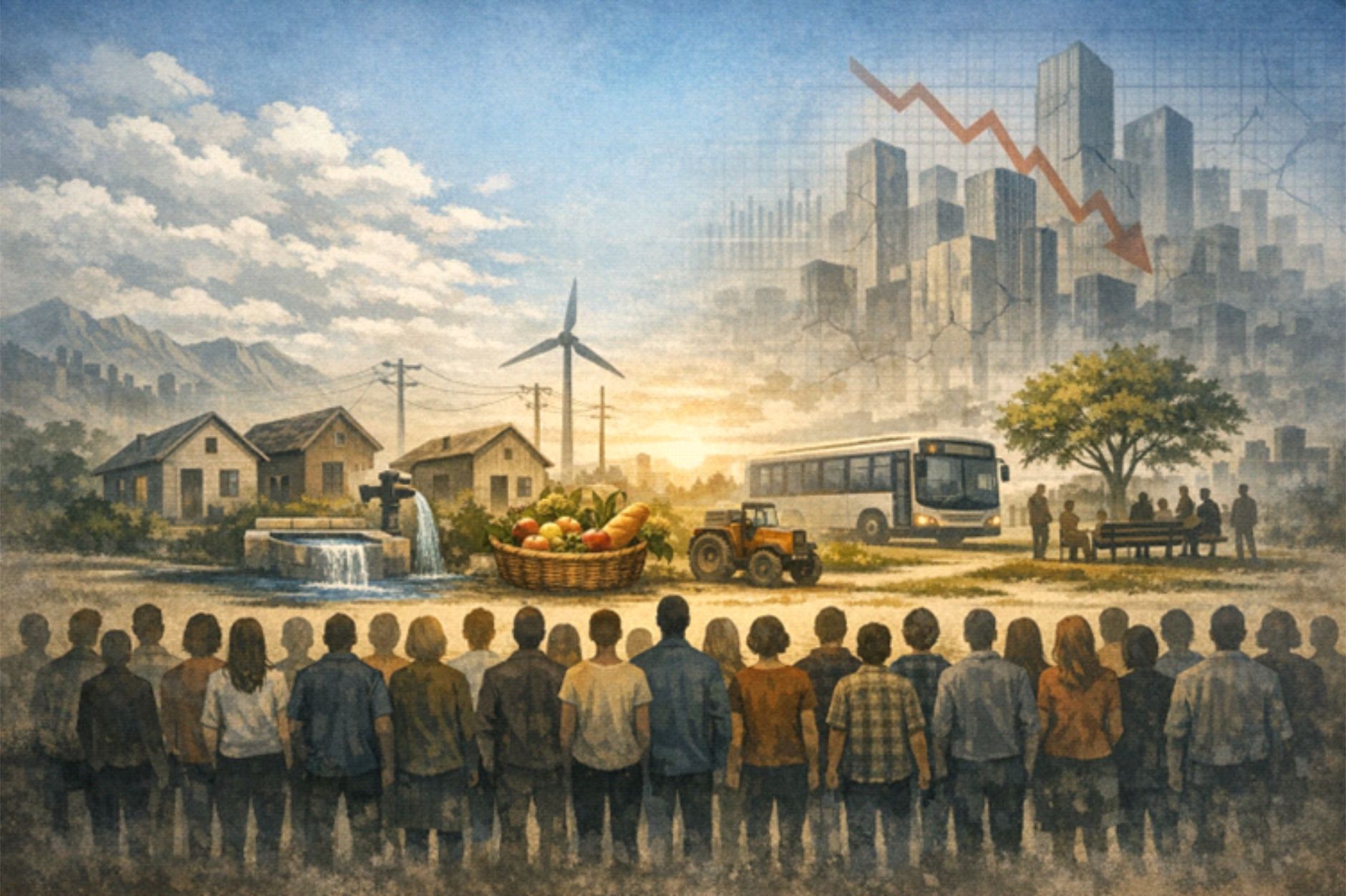

This essay is not a policy proposal, nor a prediction. It is an attempt to describe the direction our systems are moving in, to examine why that direction is increasingly unstable, and to outline the minimum foundation required if we are to avoid recreating the same failures under new labels. It is an exploration of what it would mean to build a future around people rather than money – before events force that reckoning upon us.
It is nearly four years since I published Levelling Level, written at a time when “levelling up” dominated public debate. The purpose of that book was not to analyse the policy itself, but to expose how political narratives are used to obscure reality. “Levelling up” was a perfect example: a phrase so elastic it meant something different to everyone, and therefore meant nothing at all.
The Conservatives used it to imply people would be lifted up through public action – a promise that was, at best, disingenuous. Labour and the left, meanwhile, often approached inequality through a lens that effectively levels down. Ironically, these opposing approaches tend toward the same destination: a system in which people have less control over their own lives while centralised authority grows stronger. That is why successive governments have found it so easy to adopt and repurpose the term. Its vagueness is not a flaw; it is a tool.
Levelling Level was my attempt to show how narratives like this mask what is happening beneath the surface. What I did not anticipate was that it would become the starting point for a much larger inquiry: understanding where our system is heading, why it is heading there, and what a future genuinely built around people – not money – might require.
My confidence in the need for change comes from lived experience: a childhood shaped by poverty; early work in farming; later training in management; years spent in corporate services, charities, not‑for‑profits, and my own businesses; alongside time volunteering and serving as a frontline politician. These experiences offered a broad view of how the current system functions – and why its trajectory is increasingly unsustainable.
When our systems are examined honestly, their flaws point toward profound structural change. Ideally, such change would come by choice. In reality, it is more likely to be triggered by events arising from a money‑centric system that has been out of balance with the needs of people, communities, and the environment from its inception.
A system built on extraction and exploitation can only persist for so long before it exhausts the mechanisms designed to sustain it. Eventually, the myths fail, the smokescreens thin, and the underlying mechanics become visible.
It is tempting to explain this moment through conspiracies or shadowy coordination. And while the behaviour of certain global institutions may provide circumstantial evidence that fuels such beliefs, I do not accept that our predicament is the result of a single, unified plot.
The explanation is both simpler and more human: greed, self‑interest, and the misuse of power by those with sufficient influence to shape outcomes – and insufficient moral restraint to stop themselves.
The money‑centric system now sits on a knife edge. Not because of any one leader or institution, but because it was never designed to endure indefinitely. It was always a question of which pressure point would give way first, and what chain reaction would follow.
This system – encompassing globalism, neoliberalism, fiat money, modern monetary theory, centralisation, and the gradual drift toward supranational governance – rests on a single organising principle: the concentration of power, freedom, wealth, and resources in the hands of the few at the expense of the many.
Greed and selfishness are not new. What is new is the extent to which ordinary people are losing the freedom to shape their own lives. The natural lessons that arise from genuine choice – including the freedom to fail – have been replaced by frameworks that quietly dictate outcomes. Often, this happens without people fully realising it.
When decisions made by distant others constrain our ability to live freely and to make the choices that determine our own direction – for better or worse – fundamental natural laws are broken.
To say the system is out of balance is an understatement. Human life was never meant to revolve around the accumulation of material wealth or the pursuit of externally imposed values. Yet this is precisely what the money‑centric world demands.
As the old system falters, another dynamic is emerging – one that must be addressed with equal clarity.
People and groups are already forming new “bubbles”, each convinced they have found the answer: political movements, spiritual communities, ideological tribes, eco‑centric visions, decentralisation evangelists, and countless others. Many of these arise from genuine care and real harm. They offer belonging, meaning, and direction at a time of uncertainty.
The problem is not intent. It is structure.
These bubbles present themselves as new beginnings, but they often become new routes back to the same value system.
Any framework that requires qualification – whether political, religious, spiritual, environmental, or ideological – inevitably recreates hierarchy. It divides people into those who belong and those who do not. It rewards conformity and punishes difference. It produces insiders and outsiders. Once this happens, the conditions are in place for power to concentrate again, for value to be externally measured again, and for the money‑centric mindset to re‑emerge under a different name.
This is why the Basic Living Standard matters so profoundly.
The Basic Living Standard is not compatible with a money‑centric system.
They cannot coexist without one undermining the other.
One is built on extraction, hierarchy, and conditional value.
The other is built on universality, integrity, and unconditional human worth.
In practical terms, the Basic Living Standard means that no person’s survival, dignity, or basic participation in society is conditional on productivity, compliance, belief, or alignment. It is the floor beneath which no one can fall – not as charity, not as reward, but as a structural guarantee embedded in how the system operates.
But the BLS is also incompatible with agenda‑driven futures that seek to define the world in their own image.
It requires no qualification.
It does not ask you to be spiritual, religious, political, green, or ideologically aligned.
It does not demand belief, membership, or adherence to a worldview.
The only qualification is that you are a human being.
That universality is not an abstract ideal. It is the integrity upon which any future system must rest if it is to avoid manipulation, coercion, and the slow drift back into the very structures we claim to be leaving behind.
A people‑centric world cannot be built on agendas, however well‑intentioned.
It cannot be built on tribes, identities, or movements that claim to speak for everyone.
It cannot be built on frameworks that elevate some while excluding others.
It must be built on a foundation that treats every person the same – not rhetorically, not aspirationally, but in the actual mechanics of how the system functions.
The Basic Living Standard is that foundation.
It is the pivot that prevents the future from being bent to the will of the few.
It is the safeguard against the return of the money‑centric mindset.
It is the universal benchmark that keeps the system grounded in people, not agendas.
We are approaching a point where the old system can no longer hide its failures. Change is becoming unavoidable. That is why we must think clearly now – before events dictate the terms for us.
If we can let go of inherited assumptions, follow the implications of a people‑centric system to their full conclusion, and imagine life beyond the money‑centric lens, we may begin to see what the Basic Living Standard truly offers.
Not agreement.
Not conformity.
But a future in which no one’s humanity is conditional.
A world built around people, not money.

