There’s Nothing Wrong With Wealth, As Long As It Isn’t Built on Harm

We live in a culture where money has quietly become the central organising principle of almost everything. It shapes our choices, our opportunities, our identities, and even our sense of self‑worth – often without us realising it.

We walk through life believing we are making free decisions, when in reality many of those decisions are filtered through a deeply conditioned relationship with money: what we fear losing, what we believe we deserve, and what we think we must accumulate to feel secure.

This isn’t accidental. The systems we live within – from neoliberal economics to globalisation, from centralised governance to fiat‑based monetary policy – are built on extractive logic.

They rely on continual growth, continual consumption, and continual financialisation of life.

Tools like markets, GDP, and monetary expansion aren’t neutral; they infuse every corner of society with the assumption that more is always better, that profit is natural, and that accumulation is a sign of success.

Centralisation plays a major role in this. It creates distance between action and consequence, between producer and consumer, between decision‑maker and those affected by the decision.

That distance dehumanises. It makes it easier not to see the harm. It allows people and institutions to believe that if something is legal, it must also be right. And it enables a kind of collective blindness to the impact of financialising everything – from housing to healthcare, from education to the environment.

But the national‑level systems are only half the story. The other half is personal.

Because the system’s logic doesn’t just operate “out there”; it operates through us.

The belief that profit is a right – that we are entitled to charge not what we need, but whatever the market will tolerate – has become normalised.

Businesses do it. Individuals do it. And every time we take more than we need simply because we can, we reinforce the very dynamics we claim to oppose.

The evidence is everywhere. Owning multiple houses when you can only live in one. Collecting cars you can only drive one at a time. Choosing extravagance not because it nourishes you, but because it signals status.

None of these things are inherently immoral – but they are symptoms of a culture that confuses abundance with excess, and wealth with accumulation.

True abundance is something different.

It’s having enough – enough to live, enough to thrive, enough to contribute – without taking from others or from the world more than you genuinely need.

It recognises that legality is not the same as morality. Just because the system allows accumulation that harms people or the planet doesn’t mean it is right.

Nobody has an inherent right to profit when that profit is built on someone else’s loss, someone else’s struggle, or the degradation of something irreplaceable.

There’s nothing wrong with wealth. But there is something deeply wrong with harm disguised as success, extraction disguised as enterprise, and excess disguised as freedom.

If we want a healthier relationship with money – individually and collectively – we have to start by recognising the difference between wealth that enriches life and wealth that drains it.

And that begins with a simple truth:

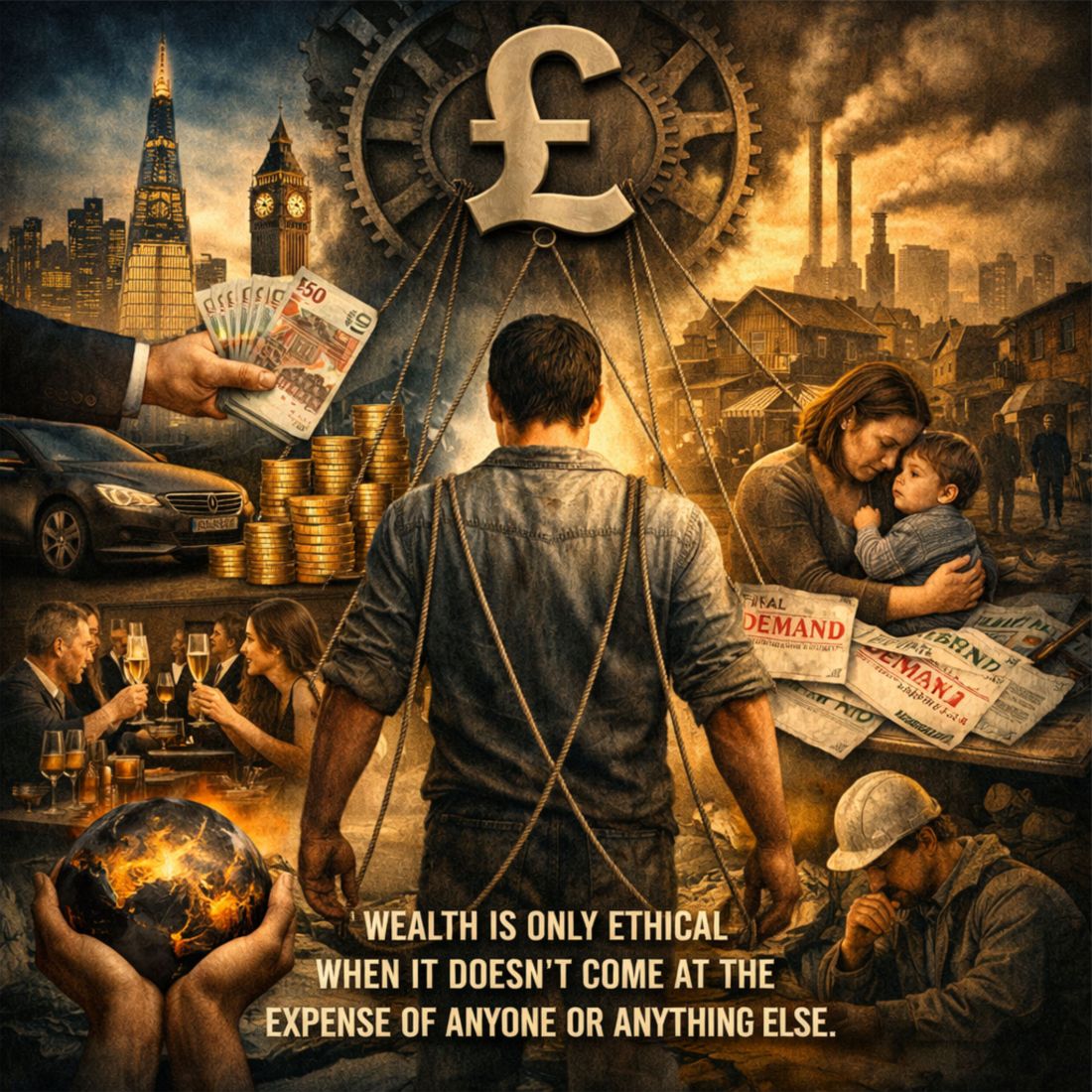
Wealth is only ethical when it doesn’t come at the expense of anyone or anything else.

Wherever we begin – in privilege or in struggle – success should be earned despite it, not granted because of it

We are living through a moment where the meaning of meritocracy has become confused. What was once a principle designed to ensure fairness – that people rise according to their ability, character, and contribution – has been reshaped into something far more superficial.

Today, success is often granted not because someone has demonstrated competence, but because their story fits a narrative the culture wants to tell.

This shift is not progress. It is misalignment. And it is taking us in a dangerous direction – one where people are placed in roles for the wrong reasons, where organisations are weakened by symbolic appointments, and where society as a whole becomes less stable, less effective, and less fair.

Beginnings are not merit

Where someone begins in life – in privilege or in struggle – is a matter of circumstance, not achievement. Yet modern society has developed a habit of treating beginnings as qualifications in themselves.

On one side, privilege still acts as a silent elevator, lifting people into positions they have not earned simply because they were born into the right networks.

On the other side, hardship has become a symbolic credential. A difficult backstory is treated as evidence of capability, even when capability has not been demonstrated.

Both distortions replace merit with something else. Both undermine fairness. And both ultimately harm the very people they claim to help.

The misuse of social mobility

Social mobility was meant to remove barriers, not erase standards.

It was designed to ensure that those with talent, drive, and potential could rise – not to guarantee that everyone would.

But somewhere along the way, the concept was repurposed into a banner under which almost any elevation can be justified. The assumption seems to be that if someone from a disadvantaged background is not succeeding, prejudice must be the reason. And if prejudice is the reason, then the solution is to elevate them – regardless of whether the role fits their abilities, temperament, or aspirations.

This is not equality. It is overcorrection. And overcorrection is simply bias in the opposite direction.

But these distortions are symptoms, not causes.

To understand why this keeps happening, we need to look deeper.

The system values the wrong things – and conditions us to do the same

We have built a society that is not designed around people, communities, or human flourishing. It is designed around money, power, centralisation, and control. And because the system values these things, it conditions us to value them too.

People are encouraged to believe that their worth depends on having high‑status, high‑paid, influential jobs. The cultural narrative suggests that unless you are climbing toward prestige, you are falling behind. The extractive nature of the system reinforces this: it rewards visibility, not contribution; status, not service.

Yet the truth is very different.

The person who empties the bins each morning, the barista who hands us a coffee, the mechanic who keeps us on the road – these people support our daily lives in ways that are immediate, essential, and irreplaceable. Their contribution is not less important than that of a doctor or a CEO. In many ways, it is more constant, more tangible, and more foundational.

A humane meritocracy would recognise this. It would value contribution, not status. It would understand that importance is not measured by salary or spotlight, but by the role a person plays in the wellbeing of others.

Potential is real – but timing is uneven

If meritocracy is to mean anything, it must recognise that potential cannot flourish without stability.

Some young people face circumstances that consume their emotional capacity simply to survive:

  • chaotic home lives
  • caring responsibilities
  • trauma
  • instability
  • poverty
  • violence
  • neglect
  • mental health struggles

In those conditions, emotional capacity is not available for self‑development. Their potential is not absent – it is deferred.

Yet our system mistakes delayed readiness for lack of ability, and punishes those who cannot perform on schedule.

This is not a failure of the individual. It is a failure of a system that expects everyone to mature at the same pace, in the same way, under the same conditions.

Recognising delayed readiness is not lowering standards. It is understanding that merit develops through time, support, and opportunity.

The academic myth: a prejudice disguised as aspiration

One of the most damaging assumptions in modern culture is that academic achievement is the only legitimate route to success.

We funnel young people – especially those from disadvantaged backgrounds – into A‑levels and university, regardless of whether these paths suit their strengths or their stage of development.

This is not equality of opportunity. It is a failure of imagination.

Some young people are practically minded. Some are gifted with their hands. Some are natural problem‑solvers, builders, makers, technicians, creators. Some simply need more time before academic study becomes meaningful.

But instead of offering an equally respected vocational route from 14 to 21 – one that is rigorous, structured, and valued – we push everyone through the same narrow gate.

And when they struggle, we blame prejudice rather than the system that forced them into the wrong shape.

This is how we fail the disadvantaged:

Not by denying them opportunity, but by denying them the right opportunity.

The jigsaw puzzle of human worth

Recognising the equal worth of every person does not mean pretending we are all the same. We are not.

We bring different strengths, different temperaments, different capacities.

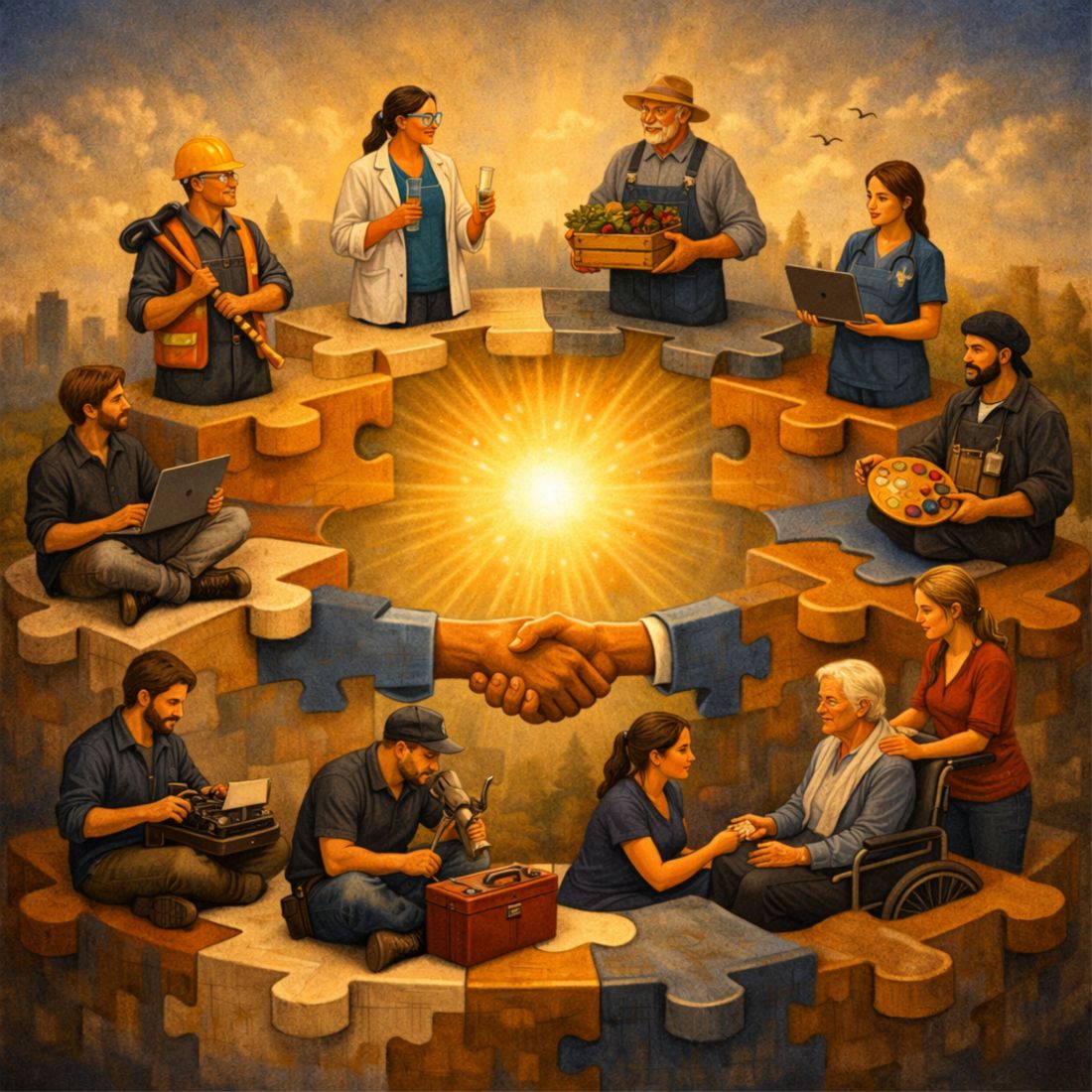
We are the pieces of a vast jigsaw puzzle – each shaped differently, each fulfilling a role no other piece can fill.

A healthy society does not force every piece into the same space, nor does it elevate one shape above another.

It values each for what it contributes. It understands that the picture only appears when the pieces fit together.

Equality is not sameness. It is belonging.

And merit is not about ranking human worth – it is about placing people where their abilities allow them to serve the whole.

Why leadership matters most

Leadership is one piece of the puzzle – not more valuable, but more consequential.

It requires a specific shape: competence, clarity, courage, and the ability to act for the good of others.

These qualities do not come from privilege, nor from hardship. They come from character and capability.

We do not honour people by placing them in roles they cannot fulfil.

We do not help society by elevating individuals because their story is inspiring.

And we do not strengthen institutions by choosing leaders for symbolic reasons.

A leader should rise because they can carry the weight of responsibility – not because their background makes for a compelling narrative.

The cost of abandoning merit

When we abandon merit, we do not create fairness.

We create fragility.

Institutions weaken.

Public trust erodes.

Progress stalls.

And the people who most need competent leadership – the vulnerable, the marginalised, the unheard – suffer the most.

A society that elevates people for the wrong reasons is not compassionate.

It is negligent.

A call to return to what works

If we want a society that is fair, functional, and genuinely equal, we must return to a simple principle:

Wherever you begin – in privilege or in struggle – success should be earned despite it, not granted because of it.

This is not harsh. It is humane.

It recognises the dignity of every person, the diversity of human strengths, and the necessity of placing people where they can truly contribute.

Merit is not elitism. It is responsibility.

It is the recognition that a complex world requires competence.

It is the belief that every person has value – but not every person has the same role.

Rebuilding meritocracy begins not with systems, but with how we choose to see one another.

And it is the only foundation on which a fair and flourishing society can stand.

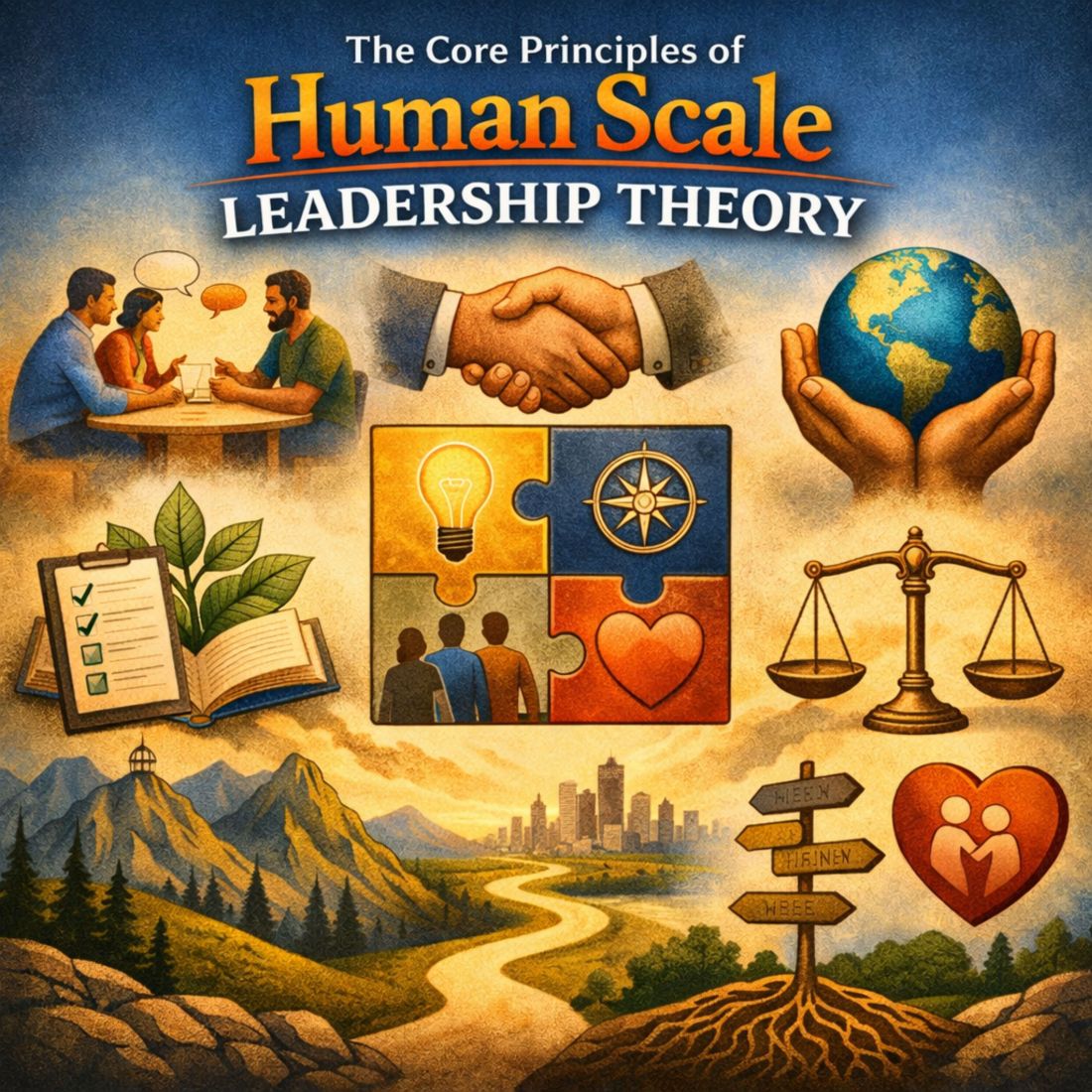
The Core Principles of Human‑Scale Leadership Theory

1. Leadership is a Human Phenomenon, Not a Structural Role

Leadership arises from human qualities – empathy, courage, responsibility, and service – not from titles, hierarchy, or authority.

A system cannot manufacture leaders; it can only create positions.

Leadership exists only where human relationships and accountability are real.

2. Systems Shape Behaviour More Than Individuals Do

People behave according to the incentives, pressures, and structures around them.

When a system rewards compliance, it produces compliant people.

When a system punishes leadership, it eliminates leaders.

The behaviour of those in power is a reflection of the system, not their personal morality.

3. Centralised Systems Inevitably Produce Managers, Not Leaders

As systems grow in size and complexity, decision‑makers become distant from the people affected by their actions.

This distance forces them to rely on rules, processes, and abstractions – the tools of management.

Leadership becomes impossible at this scale because it requires proximity, understanding, and direct accountability.

4. Real Leadership Can Only Function at Human Scale

Human scale means environments where people know one another, consequences are visible, and accountability is direct.

Leadership thrives where relationships are real, not abstract.

When systems exceed human scale, leadership collapses and managerialism fills the void.

5. The Political Party System Manufactures Non‑Leaders

Parties pre‑select candidates long before voters see them, filtering for malleability, compliance, and predictability.

Insecure non‑leaders then select even weaker successors, creating a downward spiral of capability.

This ensures that those who rise to positions requiring leadership are the least equipped to lead.

6. Managerialism Is Self‑Reinforcing and Self‑Protecting

Once managers dominate a system, they reshape it to reward their own traits: caution, conformity, and self‑interest.

They use rules, procedures, and centralised control to avoid responsibility and suppress challenge.

The system becomes designed to preserve itself, not to serve the public.

7. Wealth and Centralised Power Form a Symbiotic Relationship

Centralised political systems depend on wealth for influence, stability, and survival.

Wealth depends on centralised systems to maintain access and control.

This alliance shapes priorities, incentives, and behaviour – and excludes genuine leadership, which threatens both sides.

8. The Public Has Forgotten What Leadership Looks Like

Because managerialism has replaced leadership for generations, people now mistake authority for leadership, hierarchy for competence, and compliance for responsibility.

The absence of real leadership has normalised dysfunction and lowered expectations of public life.

9. Decentralisation Is Essential for Restoring Leadership

Leadership cannot be imposed from above; it must emerge from below.

Decentralised, community‑rooted systems restore proximity, accountability, and human connection – the conditions leadership requires.

Power must return to the smallest viable unit where real relationships exist.

10. The Purpose of Governance Is Service, Not Control

Governance should enable communities to thrive, not manage them into compliance.

Systems must be designed around human needs, not institutional preservation.

Leadership is the act of serving others; managerialism is the act of preserving the system.

What These Principles Achieve

Together, these principles:

  • explain why leadership has collapsed
  • show how systems produce behaviour
  • reveal why centralisation fails
  • expose the mechanics of the party system
  • define the conditions leadership requires
  • offer a path toward renewal through decentralisation

They form a complete philosophical foundation – coherent, original, and deeply aligned with the essay you’ve developed.

Human Scale Leadership Theory

A Simple Explanation for Why Leadership Has Disappeared – and How We Get It Back

Modern society feels leaderless. Institutions don’t work the way they should. Decisions seem distant, slow, and disconnected from real life.

People sense something is wrong, but they’re told it’s just “politics,” “complexity,” or “the modern world.”

Human‑Scale Leadership Theory offers a different explanation.

It says the problem isn’t people – it’s the scale of the systems we’ve built.

We’ve created political and organisational structures so large and centralised that real leadership can’t survive inside them.

These systems don’t reward courage, responsibility, or service. They reward compliance, caution, and self‑preservation. They produce managers, not leaders.

And because the system keeps selecting the same kind of people, generation after generation, leadership has quietly disappeared.

1. Leadership Is a Human Thing – Not a Job Title

Real leadership happens when someone takes responsibility for others and acts in their interests.

It requires:

  • being close enough to understand people’s lives
  • being accountable for the consequences of decisions
  • having the courage to do what’s right, not what’s easy
  • serving others, not yourself

Leadership is something people recognise – not something an organisation can assign.

2. Centralised Systems Make Leadership Impossible

When systems get too big:

  • leaders become distant from the people they serve
  • decisions become abstract
  • responsibility becomes blurred
  • processes replace judgement
  • self‑protection becomes rational

In these conditions, leadership can’t survive. The system forces people to behave like managers, not leaders.

3. Political Parties Don’t Select Leaders – They Select Compliant People

Most voters believe they choose their representatives. In reality, political parties choose them first.

Parties filter for:

  • loyalty
  • predictability
  • willingness to follow orders
  • lack of threat to the hierarchy

Strong, independent leaders rarely make it through this process. Those who do are often pushed out or neutralised.

Over time, insecure non‑leaders select even weaker successors. The result is a political class that cannot lead – because the system never wanted leaders in the first place.

4. A Management Class Has Taken Over Public Life

Across government, business, and institutions, a management class has emerged.

These individuals are not chosen for wisdom or courage, but for their ability to maintain systems, avoid risk, and protect the organisation.

They are rewarded for:

  • following procedure
  • avoiding controversy
  • keeping the system stable
  • suppressing challenge

This class is self‑reinforcing. It reshapes the system to reward its own traits.

5. Leadership Only Works at Human Scale

Leadership requires proximity, trust, and direct accountability.

It can only function in environments where:

  • people know one another
  • consequences are visible
  • responsibility cannot be avoided
  • relationships are real

When systems exceed human scale, leadership collapses and managerialism fills the void.

6. Communities Are Where Leadership Naturally Emerges

Real leadership emerges from the bottom up, not the top down. It appears when a community faces a challenge and someone steps forward to take responsibility.

Leadership is:

  • recognised, not declared
  • earned, not granted
  • sustained by trust, not enforced by rules

This cannot be manufactured by centralised institutions.

7. The Way Forward Is Decentralisation

To restore leadership, we must return power to the smallest viable unit – the level where human relationships exist.

This doesn’t mean chaos or fragmentation. Larger structures still exist, but they serve communities rather than control them. Their role is to support, coordinate, and enable – not to dictate.

A human‑scale society is one where:

  • people are empowered
  • communities are resilient
  • leaders are visible and accountable
  • systems serve people, not the other way around

8. Why This Matters

Human‑Scale Leadership Theory explains:

  • why leadership has disappeared
  • why institutions feel unresponsive
  • why public trust has collapsed
  • why politics feels empty
  • why systems keep producing the wrong people

And it offers a path forward:

Rebuild society around human beings, not systems.

When we design governance around human needs and human limits, leadership reappears – naturally, organically, and reliably.

Human‑Scale Leadership Theory: A Framework

Introduction: The Crisis of Leadership

Modern societies face a profound leadership crisis. Public institutions struggle to act decisively, political systems fail to solve problems, and communities feel increasingly disconnected from the decisions that shape their lives.

This crisis is not caused by a lack of talented individuals, nor by a decline in public virtue. It is caused by systems that elevate managers instead of leaders.

Human‑Scale Leadership Theory offers a different understanding of how leadership works, why it has collapsed, and how it can be restored.

It argues that leadership is a human phenomenon that can only function at human scale – and that centralised, managerial systems make genuine leadership impossible.

Part I: Understanding Leadership

1. Leadership as a Human Act

Leadership is the act of taking responsibility for the wellbeing and direction of others. It is grounded in service, courage, empathy, and accountability.

Leadership is not created by titles or hierarchy; it emerges through action and is recognised by those who benefit from it.

A leader is someone who:

  • accepts responsibility rather than avoiding it
  • acts in the interests of others rather than themselves
  • provides direction rather than merely maintaining the status quo
  • builds trust through consistent, visible behaviour

Leadership is relational. It requires proximity, understanding, and direct accountability.

2. What Leadership Is Not

Leadership is often mistaken for:

  • management (maintaining systems)
  • authority (holding power)
  • charisma (attracting attention)
  • expertise (possessing knowledge)
  • hierarchy (occupying a senior role)

These qualities may support leadership, but they do not constitute it.

When systems confuse these traits with leadership, they elevate individuals who lack the capacity to lead.

Part II: Why Leadership Has Collapsed

3. Systems Shape Behaviour

People behave according to the incentives and pressures around them.

When systems reward compliance, they produce compliant individuals.

When systems punish courage, they eliminate leaders.

The failures of public life are not personal accidents; they are structural outcomes.

4. Centralisation Makes Leadership Impossible

As systems grow in size and complexity:

  • decision‑makers become distant from the people affected
  • consequences become abstract
  • accountability becomes diffused
  • processes replace judgement
  • risk‑avoidance becomes rational
  • self‑preservation becomes necessary

These conditions force individuals into managerial behaviour.

Leadership cannot survive in environments where proximity, visibility, and accountability are absent.

5. The Political Party System Manufactures Non‑Leaders

Political parties pre‑select candidates long before voters see them.

They filter for:

  • malleability
  • predictability
  • loyalty to the party
  • willingness to comply
  • lack of threat to existing power

Insecure non‑leaders then select even weaker successors, creating a downward spiral of capability.

Those who rise to positions requiring leadership are those least able to lead.

6. The Alliance Between Wealth and Centralised Power

Centralised political systems depend on wealth for influence and stability. Wealth depends on centralised systems for access and control.

This alliance shapes priorities and behaviour, reinforcing managerialism and excluding genuine leadership, which threatens both sides.

Part III: The Principles of Human‑Scale Leadership Theory

Human‑Scale Leadership Theory rests on the following principles:

  1. Leadership is a human act, not a structural role.
  2. Systems shape behaviour more than individuals do.
  3. Centralised systems inevitably produce managers, not leaders.
  4. Real leadership can only function at human scale.
  5. The political party system manufactures non‑leaders.
  6. Managerialism is self‑reinforcing and self‑protecting.
  7. Wealth and centralised power form a symbiotic relationship.
  8. The public has forgotten what leadership looks like.
  9. Decentralisation is essential for restoring leadership.
  10. The purpose of governance is service, not control.

These principles form a coherent explanation of why leadership has collapsed and how it can be restored.

Part IV: How Leadership Emerges at Human Scale

7. Leadership Requires Human Scale

Human scale refers to environments where:

  • people know one another
  • consequences are visible
  • accountability is direct
  • relationships are real
  • trust can form
  • responsibility cannot be avoided

Leadership thrives only in such environments.

When systems exceed human scale, leadership collapses and managerialism fills the void.

8. Communities as the Natural Home of Leadership

Leadership emerges naturally in communities facing real challenges. It arises when someone steps forward to take responsibility and others recognise the authenticity of that act.

This process cannot be manufactured by institutions or imposed from above.

Leadership is:

  • recognised, not declared
  • earned, not granted
  • sustained by trust, not enforced by rules

9. Decentralisation as the Path to Renewal

To restore leadership, power must return to the smallest viable unit where human relationships exist.

Decentralised, community‑rooted governance reconnects decision‑makers with the people they serve. It replaces abstraction with understanding and managerialism with responsibility.

Part V: A Vision for Human‑Scale Governance

10. Governance Designed Around People

Human‑scale governance is built on:

  • local decision‑making
  • direct accountability
  • transparent consequences
  • community participation
  • leadership emerging from service

It does not reject organisation or coordination; it rejects centralisation that removes decision‑making from real life.

11. The Role of Larger Structures

Larger structures still exist, but they serve communities rather than control them. Their purpose is to support, coordinate, and enable – not to dictate, manage, or centralise power.

12. A Society Built on Leadership

A society grounded in human‑scale leadership is one where:

  • people are empowered
  • communities are resilient
  • public life is grounded in responsibility
  • leadership is visible and real
  • systems serve people, not the other way around

Reclaiming Leadership

Human‑Scale Leadership Theory offers a clear explanation for the leadership crisis of modern society and a coherent path toward renewal. It argues that leadership is a human act that can only exist at human scale – and that centralised, managerial systems make leadership impossible.

By returning power to communities and designing governance around human needs and human limits, leadership can be restored, and public life can be rebuilt on a foundation of responsibility, trust, and service.