AI is neither magic nor a monster. It is a powerful, fallible tool-and the quality of its impact depends on the judgement of the people and institutions using it.
Last week, someone used AI to improve an email and then joined a conversation in which people criticised colleagues for using AI. Neither part of that scene would feel unusual. That is the strange position we have created for ourselves: artificial intelligence has become ordinary, but admitting to using it can still feel risky.
AI is already woven into daily life. It helps people draft, organise, translate, summarise, explore ideas and make sense of information. Students use it to understand difficult concepts. Workers use it to get started, keep up or communicate more clearly. Families encounter it inside products and services without always noticing.
Yet our public conversation remains trapped between two poles. At one extreme, AI is treated as magic: frictionless, authoritative and ready to replace almost anything. At the other, it is treated as a monster: inherently corrupting, socially ruinous or destined to escape human control. Both stories are seductive. Neither is a sound foundation for judgement.
The more useful position lies in the middle. AI is powerful. It is useful. It is fallible. It can extend human capability, but it can also conceal weak thinking, scale bad decisions and encourage people to surrender responsibility. The central question is therefore not simply whether AI is used. It is whether the person using it can understand, evaluate and stand behind the result.
The strange secret everyone shares
If you have used AI recently, the reason may have been modest. Perhaps a paragraph would not come together. Perhaps a blank slide needed a first outline. Perhaps an unfamiliar idea needed explaining in plain English. These uses are now commonplace, but people often describe them in whispers, if they describe them at all.
The result is a peculiar double standard. Workers quietly use AI to polish reports, then question a colleague who does the same. Managers use it to prepare material, then warn their teams not to depend on it. Students use it to structure their thinking, while assuming any classmate who mentions AI must have cheated. Writers use it to break a creative block, yet worry that disclosure will invalidate the work.
Not all of these uses are equivalent, and that is precisely the point. A student who asks for an explanation of a difficult concept is doing something fundamentally different from a student who submits an unexamined generated essay. An employee who uses AI to create a first draft and then checks every claim is not behaving like someone who presents an output they cannot explain. When all AI use is compressed into one moral category, honest use is discouraged and irresponsible use becomes harder to see.
AI is not the taboo. Transparency is. The person who discloses thoughtful use may be judged more harshly than the person who hides careless use. That rewards appearance over competence and secrecy over responsibility.
What we are actually getting wrong
The problem is not that people are using AI. The problem is how they are using it, what they expect from it and whether they remain capable of judging its work.
Imagine two colleagues preparing the same report. One understands the subject, uses AI to organise a rough draft, checks the evidence, challenges weak phrasing and takes responsibility for the final version. The other asks for a finished answer, accepts it because it sounds confident and sends it under their own name. The tool is the same. The intellectual act is not.
The same distinction matters in education. Using AI as a patient tutor can support learning: it can offer another explanation, test understanding or suggest questions to investigate. Using it to bypass the learning process produces the appearance of knowledge without the substance. One strengthens capability; the other hides its absence.
AI becomes dangerous when it replaces human understanding. People who do not understand a domain may use fluent output to fabricate expertise, produce work they cannot evaluate, trust claims they cannot verify or present themselves as competent when they are not. That is not augmentation. It is impersonation.
The deeper incentive is human, not technical. Many workplaces and institutions reward speed, polish and certainty. AI makes it easier to display all three, even when knowledge is shallow. If we reward the appearance of competence at any cost, we should not be surprised when people use new tools to manufacture it.
Technology is rarely dangerous simply because it exists. It becomes dangerous when people stop thinking, checking and accepting responsibility for what they do with it. The risk is not the tool alone. It is the abdication of judgement.
The fear machine
None of this means that AI carries no serious risks. Bias, privacy loss, surveillance, misinformation, concentrated power, insecure deployment and disruption to work all deserve sustained attention. The mistake is to let dramatic speculation crowd out the harms and choices already in front of us.
Two narratives dominate much of the debate. The first imagines AI-driven human extinction. Views on that possibility differ sharply, and uncertainty should invite scrutiny rather than dismissal. But distant scenarios often receive more attention than the immediate questions shaping workplaces, classrooms, public services and democratic trust: Who is accountable? What data was used? Can a decision be challenged? What happens when a confident answer is wrong?
The second narrative is that AI will make human beings redundant. This fear is more immediate, but even here agency matters. Technologies do not restructure organisations by themselves. Leaders choose what to automate, which safeguards to retain, who benefits from productivity gains and whether human expertise is preserved or discarded. AI may enable those choices, but it does not absolve the people making them.
The real threat is not simply replacement. It is devaluation: treating judgement, care, experience and accountability as costs to be removed rather than capabilities to be protected. Institutions can use AI to support people, or they can use it as a convenient explanation for decisions they already wanted to make.
This is why the double standard at the top matters. Some of the loudest warnings about AI coexist with a race to deploy it quickly. Public caution can sit beside private acceleration; calls for safety can sit beside resistance to meaningful scrutiny. That does not make every warning cynical. It does mean we should look beyond rhetoric and ask who holds power, who bears risk and who remains answerable when systems fail.
The real risk
At the individual level, secrecy creates its own damage. Students, workers, managers, writers, recruiters and publishers may all use AI while judging others for doing so. Honest use is punished, hidden use is rewarded, real capability becomes difficult to assess and misuse is pushed further from view.
This is not a coherent ethic. It is a culture that asks people to pretend.
The better boundary is responsibility. Anyone using AI should remain responsible for understanding the domain, evaluating the output, verifying consequential claims, protecting sensitive information, preserving their own capability and communicating honestly about material use. In high-stakes settings, that responsibility should be supported by clear governance, human oversight and a meaningful route to challenge decisions.
Responsibility also means knowing when not to use the tool. Convenience is not the same as appropriateness. A system that is helpful for brainstorming may be unsuitable for a confidential record, a legal conclusion, a medical decision or any task where the user cannot recognise a serious error.
When responsibility collapses, trust and capability follow. People lose confidence in work they cannot trace. Organisations become dependent on systems they cannot question. Knowledge thins out because fewer people practise the craft required to judge the output. AI does not create every one of these weaknesses. It reveals them, and it can scale them.
A workable middle ground
We do not need a ban, a panic or another story in which technology acts and human beings merely watch. We need a cultural reset built on five practical commitments.
Be honest. AI is already part of everyday work and learning. Clear, proportionate disclosure is healthier than ritual denial. The purpose is not to confess to using a tool; it is to make responsibility visible where that use materially affects the work.
Understand before you rely. People should not outsource judgement they do not possess. Domain knowledge, verification and an awareness of limitations are the ethical boundary between assistance and blind dependence.
Keep humans answerable. AI can suggest, organise and generate. It cannot carry moral or professional responsibility. A named person or institution must remain accountable for consequential decisions and outputs.
Distinguish different kinds of use. Augmentation is not automation. Exploration is not impersonation. Professionalising a rough expression is not fabricating expertise. Policies that ignore these differences will be both unfair and ineffective.
Protect capability. A tool should help people think and perform better, not leave them unable to work without it. The test is not only whether AI makes a task faster today, but whether its use strengthens or erodes the judgement needed tomorrow.
These principles do not settle every case. They provide something more useful than a slogan: a way to ask better questions. Did the user understand the subject? Could they detect an error? Was the use appropriate to the risk? Was anything important concealed? Who is accountable for the result? Did the process preserve or weaken human capability?
What happens next is still ours to decide
Every technological era eventually discovers the same truth: tools reveal us. They reveal what we value, what we are willing to overlook and where we prefer convenience to responsibility.
AI is revealing how often we reward appearance over competence, certainty over understanding and speed over care. It is also revealing something more hopeful: used well, it can help people learn, communicate, explore and contribute with greater confidence.
The question is not whether AI will change society. It already has. The question is whether we will use it to strengthen human judgement or gradually replace it with the performance of judgement.
AI did not create our inconsistency, our fragile systems or our temptation to avoid responsibility. It exposed them. The answer is not less thought about AI, but better thought: more honesty, more understanding, clearer accountability and a willingness to distinguish responsible assistance from intellectual surrender.
AI will not decide what happens next. We will-if we remain willing to understand the tools we use, answer for the choices we make and protect the human capabilities that give those tools value.
Further Reading
A wider conversation about AI, responsibility and the systems we build
If this essay has been useful, you may find value in exploring the broader set of ideas that led here. Over the past several years, I’ve written a series of pieces examining how artificial intelligence interacts with human behaviour, organisational incentives and the deeper question of what it means to preserve human capability in a technological age.
These essays approach the subject from different angles – cultural, ethical, economic, philosophical and systemic – but they share a common thread: AI does not decide what happens next. We do. And the choices we make about judgement, responsibility and honesty shape every outcome that follows.
The selection below is ordered to help you explore these themes in a way that builds understanding rather than overwhelm.
Summary: A foundational reflection on how digital tools amplify human intent rather than replace it. It argues that responsibility cannot be outsourced – a principle that underpins all later writing on AI ethics and judgement.
Summary: A critique of the myths surrounding AI. It explains how misunderstanding – not intelligence – creates fear, distortion and poor decision-making.
3. The AI Middle Ground (2026)
(The essay you’ve just read)Summary: A practical exploration of the double standards shaping AI use. It argues for honesty, competence and responsibility as the boundary between augmentation and impersonation.
Summary: A systemic analysis of how AI exposes weaknesses in the structures we built long before AI arrived. It shifts the conversation from individual behaviour to institutional responsibility.
Summary: A philosophical reflection on emerging intelligence. It argues that powerful tools deserve seriousness and respect – not because they are human-like, but because they shape human outcomes.
Summary: A reframing of the “AI will replace us” narrative. It shows that redundancy is not caused by AI itself but by systems that devalue human capability and judgement.
Summary: A macroeconomic exploration of how AI and global systems have become interdependent. It examines how fragility in one amplifies fragility in the other.
8. The Greatest Benefit of AI Today Will Be a New Dark Age of Stupidity and Ignorance (2025)
Summary: A warning about capability erosion. It argues that blind dependence on AI risks thinning out knowledge, weakening judgement and creating a society that performs competence rather than possessing it.
9. AI Won’t Make Life Cheaper for Those Who Cannot Work (2025)
Summary: A socioeconomic critique of the belief that AI-driven productivity will automatically benefit everyone. It argues that inequality is a human choice, not a technological inevitability.
10. The Future of Work: Redefining Value, Meaning and Human-Centric Employment (2025)
Summary: A constructive vision for human-centred employment. It explores how work, value and meaning must evolve in an AI-driven economy – and how society can protect human capability rather than erode it.
11. The Human Sovereignty Charter for Artificial Intelligence (2026)
Summary: A constitutional framework for AI governance. It articulates principles for responsible deployment: human judgement, capability preservation, accountability, transparency and ethical boundaries.
Closing Note
These pieces were written across several years, but they belong to the same conversation. Each one examines a different facet of the same central question: how do we use powerful tools without surrendering the human capabilities that give them value?
If you choose to explore further, you’ll find a progression – from early reflections on digital responsibility, through cultural contradictions and systemic fragility, to governance principles and visions for the future of work. Together, they form a wider argument: AI does not decide what happens next. We do, through the honesty, understanding and responsibility we bring to the tools we use.
Why people and especially young people look at the jobs on offer today and quietly think: “This doesn’t make sense.”
1. When Work Stops Working
If you talk honestly with people about work – not the official line, not the political noise, just the lived reality – you eventually reach the same conclusion: work doesn’t feel like it works anymore. Not in the way it used to. Not in the way it’s supposed to. And young people, more than anyone, can see that. They’re not confused, they’re not entitled, and they’re not disengaged because of screens or attitudes. They’re looking at the deal on the table and recognising that it simply doesn’t make sense.
Work is supposed to be the bridge between effort and life. It’s meant to give you the ability to stand on your own feet and the sense that what you’re doing matters.
But the modern system has quietly stripped both of those things away. And when you boil it down, work only really works when it gives you one of two things: independence or value. Ideally both. But at least one.
2. The First Condition: Financial Independence
Financial Independence is the foundation of adulthood. It’s the ability to rent a place without bankrupting yourself, to buy food without doing mental arithmetic in the aisle, to get around, to have a social life, to save a little, to make choices about your own life. It’s not luxury. It’s not excess. It’s the basic ability to live without relying on parents, welfare, or debt.
But minimum wage doesn’t get you there. It doesn’t even come close. It barely covers the basics, and even then you’re juggling, compromising, cutting corners. You’re working, but you’re not independent. You’re employed, but you’re not free. And young people can see this as clearly as anyone else who is struggling.
They can do the maths. They know that the jobs being pushed at them don’t lead to independence. So when they hesitate or disengage, it’s not because they don’t want to work. It’s because the work on offer doesn’t do the one thing work is supposed to do.
3. The Second Condition: Value
The second condition is just as important, and just as absent.
Work has to give you a sense of value – not corporate “values”, not a mission statement, not a poster in the staff room, but real human value.
The feeling that what you’re doing matters to someone, or something, or even just to yourself. That you’re contributing. That you’re learning. That you’re part of something that isn’t pointless.
Value does not mean enjoying every minute of a job. It means being able to see how your effort contributes to something beyond simply generating revenue.
But look at the jobs the modern economy produces. So many of them exist because the system is built around global supply chains, centralised decision‑making, and profit extraction.
Work becomes a cost to be minimised, not a human activity to be dignified.
You end up with roles that are repetitive, hollow, disconnected from anything real. Jobs that don’t build capability. Jobs that don’t meet human needs. Jobs that don’t connect you to your community. By contrast, the work people most often describe as meaningful lets them see who benefits from their effort: colleagues, customers, patients, neighbours or the wider community.
Older and past generations often had work that produced something tangible. Young people and older lower-paid workers today inherit work that produces output, but not meaning. And they feel that hollowness immediately.
The obvious question is how an economy that depends on work ended up producing so many jobs that deliver neither independence nor value. The answer lies in what the economy has been organised to prioritise.
4. The System That Produces Jobs That Fail Both Conditions
None of this is an accident. It reflects an economy increasingly organised around stimulating wants while making many basic needs harder to secure.
Streaming services, fast fashion, takeaways, processed food, endless digital consumption – these things aren’t needs, but the economy treats them like essentials.
Meanwhile, the actual essentials – housing, healthcare, nutritious food, transport, education – have become luxuries. Hard to access. Hard to afford. Hard to rely on.
The problem is not that services built around wants have no value, or that the people doing those jobs contribute less. It is that the system often rewards the creation and consumption of wants more reliably than the meeting of needs. The result is too many roles that provide neither a secure livelihood nor a visible connection between effort and social value. They fail both conditions.
The lower paid have already been hurt and pushed aside by this. And young people aren’t confused by this either. They’re simply the first generation to see the system clearly at the start.
5. Young People Didn’t Fail – The System Did
For years, society has misdiagnosed youth disengagement. It has blamed smartphones, social media, entitlement, lack of resilience, poor attitudes, apathy, welfare dependency.
But none of that explains what’s actually happening. Young people aren’t disengaged because they’re shallow or distracted. They’re disengaged because the system offers education built on sameness and measurement, social mobility built on narrative rather than capability, governance that is distant and hollow, welfare scapegoating that hides economic failure, and work that doesn’t deliver independence or value.
They’re not rejecting adulthood. They’re rejecting a version of adulthood that doesn’t work.
6. Why People Increasingly Reject Jobs That Fail Both Conditions
When work fails both conditions, rejecting it is not laziness. It’s discernment.
People are not refusing responsibility. They’re refusing exploitation.
They’re not rejecting work. They’re rejecting employment that offers neither independence nor value.
And when you look at the reality of what’s on offer, it’s hard to argue with them.
7. The Path Forward: Locality, Contribution, and Real Value
The way forward isn’t about tearing the whole thing down. It’s about recognising where work actually works – and it’s always the same place: locally.
When decisions are made close to the people they affect, work becomes meaningful again. When value is created and recognised within communities, work becomes human again. When contribution is rewarded instead of consumption, work becomes purposeful again. And when basic living standards are guaranteed – not as luxuries, but as the foundation of life – work becomes a bridge again, not a trap.
This isn’t a utopian idea. It’s simply the conditions under which work has always worked, for everyone.
8. Work Has to Work
Work only works when it gives independence, value or both.
Right now, too many jobs give neither.
Young people aren’t the problem and the low paid and vulnerable in older generations have been struggling too. Young people are just the first to recognise the problem, right ‘out of school’. And they’re right.
Work has to work. It has to mean something. It has to lead somewhere. It has to connect you to life, not drain you from it.
Until the system can offer that again, people of all ages will keep rejecting work that doesn’t work. And honestly, who can blame them.
Further Reading
Exploring the deeper roots of why work doesn’t work for so many – and what a better system could look like.
The ideas in The Two Conditions That Make Work Work don’t exist in isolation. They sit within a wider story about how young people are treated, how our political and economic systems have drifted away from real life, how education has been reshaped around measurement rather than capability, and how meaningful contribution for everyone has been pushed aside by consumption and profit‑centric thinking.
The following pieces expand on those themes. They’re arranged in a way that helps a reader move from understanding why young people feel the way they do, through how the system creates these conditions, and finally toward what a better future could look like for everyone.
I. Understanding Young People’s Experience of the System
The Young People Who Didn’t Fail – And the System That Keeps Pretending They Did
A clear, honest look at how young people are blamed for outcomes created by the system itself. This piece explains why disengagement is not a personal failure but a predictable response to structures that don’t work.
Why Young People and Smartphones Are Not the Problem
A dismantling of the idea that technology is responsible for youth disengagement. It shows how smartphones have become a convenient scapegoat for deeper systemic failures.
This piece explores how political and media narratives about social media distract from the real issues affecting young people – including the erosion of independence, value, and meaningful pathways.
Why these matter: These articles help readers understand that young people aren’t rejecting work, society, or adulthood. They’re responding rationally to a system that has stopped offering the basic conditions required for any of those things to function.
II. Politics, Governance, and Why Young People Disengage
Young People, Politics, and the System That Is Failing All of Us
A deep dive into why young people feel alienated from politics – not because they don’t care, but because governance has become distant, hollow, and disconnected from real life.
Stop Blaming Welfare for Problems This Economic Model Created
This piece explains how welfare is used as a political distraction from the structural failures of the economic model itself – failures that directly shape the work crisis.
A foundational explanation of how local governance and local economies can restore meaning, accountability, and value – themes central to rebuilding work that works.
Why these matter: They show that the crisis in work is inseparable from the crisis in governance. When decision‑making becomes remote and abstract, work becomes remote and abstract too.
III. Education, Capability, and the Myth of Social Mobility
A critique of how social mobility has been reframed around narrative and status rather than real capability – leaving many young people feeling inadequate despite having genuine strengths.
Vocational GCSEs and the Limits of a System Built on Measurement
An exploration of how education has become obsessed with metrics, qualifications, and standardisation – often at the expense of real learning and practical contribution.
A long‑standing argument that equality in education has been misunderstood as sameness, leading to a system that fails to recognise different strengths and pathways.
Equality in Education Has Been Destroyed by the Idea That All Can Make the Best of the Same Opportunities
A clear explanation of how the commercialisation of education created debt, distorted incentives, and pushed young people into pathways that don’t lead to independence or value.
Why these matter: They reveal how the work crisis begins long before a young person enters the labour market. The system shapes expectations, limits capability, and funnels people into roles that fail both conditions.
IV. Contribution, Local Value, and a Better Future
A vision for a future where contribution – not consumption, not credentials, not profit extraction – becomes the foundation of work, business, and governance.
Future Economics Must Be Tied Only to People and Their Contribution
A broader economic argument showing how currency, value, and contribution must be re‑anchored to human needs rather than speculation or global extraction.
A clear, accessible explanation of what a basic living standard is, why it matters, and how it underpins independence – the first condition that makes work work.
Why these matter: These pieces point toward a future where work can once again deliver independence and value – not through abstract policy, but through local contribution, real capability, and systems designed around human needs.
Closing Note
If The Two Conditions That Make Work Work resonates with you, these pieces will help you explore the deeper roots of the problem – and the practical, human‑centred ideas that can guide us toward something better.
They’re not academic papers or political manifestos. They’re reflections on how life actually feels for people navigating a system that has drifted away from what matters.
Taken together, they form a journey: from understanding the crisis, to recognising its causes, to imagining a future where work works again.
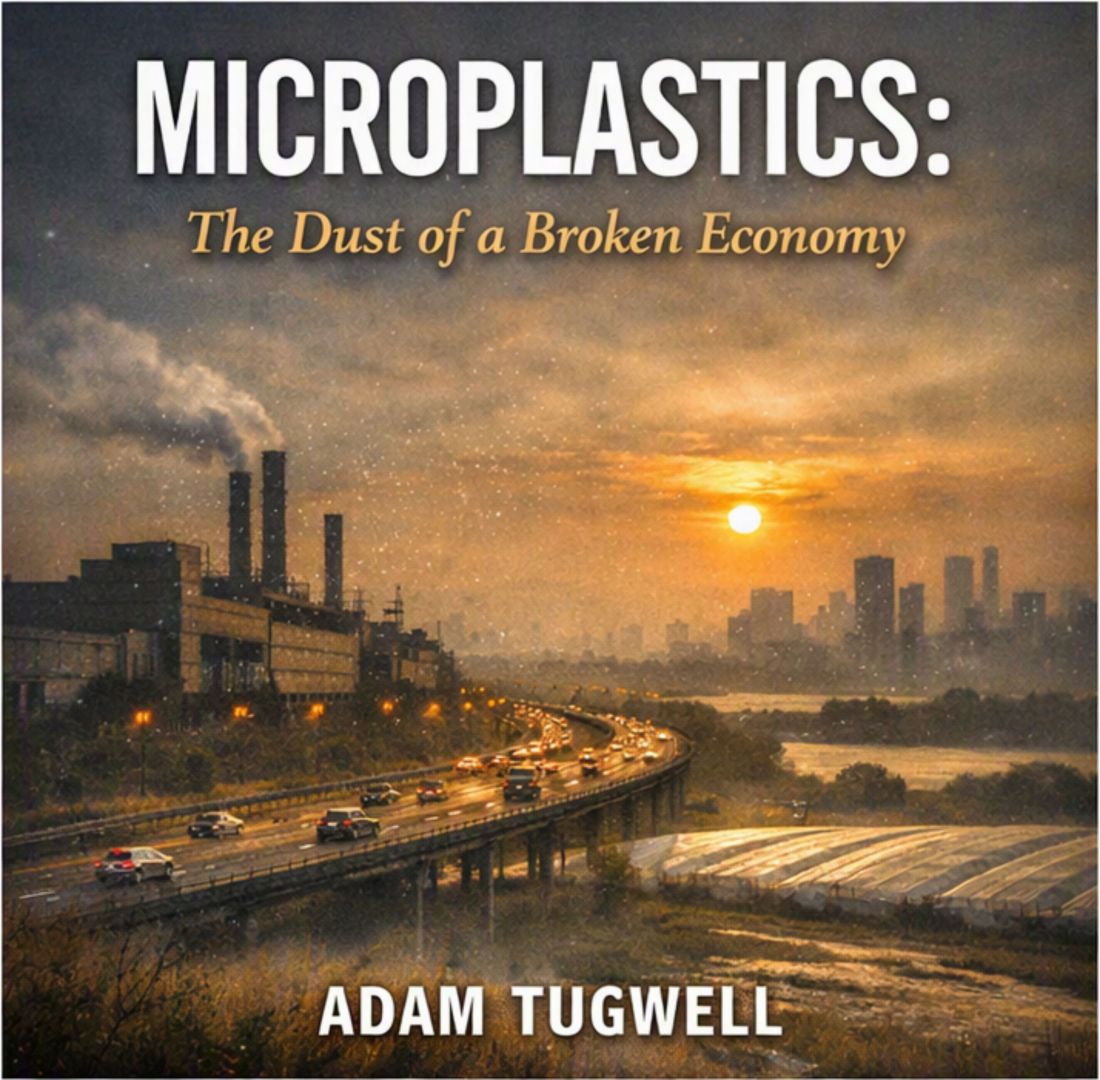
This article summarises current scientific understanding of microplastic release, environmental pathways and potential health effects. Evidence is evolving, and some findings remain under active investigation. All claims are based on publicly available research from recognised scientific and regulatory bodies. Readers are encouraged to consult the cited sources and ongoing studies for the latest developments.
Section 1 – Introduction: The Dust Has a Source
Microplastics are often presented as a waste-management problem or a matter of consumer choice. That framing is convenient, but false. It directs attention towards bottles, bins and personal habits while leaving the machinery of production largely untouched.
Microplastics are the physical residue of costs that a petrochemical economy has externalised for decades. They are the dust of a civilisation that has rebuilt its material world around substances which persist rather than return safely to natural cycles. They are everywhere because the system that creates them is everywhere.
Over the past century, oil has become far more than a fuel. It is the feedstock for fibres, packaging, coatings, tyres, paints, sealants, adhesives, fertilisers and thousands of polymers now woven into ordinary life. These materials may be cheap at the point of sale, but their true cost is dispersed through polluted air, depleted soils, contaminated water, damaged ecosystems and uncertain burdens on human health. The price is not avoided; it is merely transferred to people, places and generations that had no say in the transaction.
Unlike materials that can be metabolised by living systems, most conventional plastics do not simply disappear. They weather, abrade and fragment into smaller particles. Those particles move through air, soil and water; they enter food chains and buildings; and some are small enough to cross biological barriers. What begins as a tyre, a fleece, a coating or a sheet of agricultural film becomes part of the environment-and, increasingly, part of us.
The familiar image of ocean litter therefore captures only a fraction of the problem. Important sources include tyre and road wear, synthetic textiles, industrial pellets and coatings, construction materials, agricultural plastics, sewage sludge and the breakdown of larger plastic waste. These are not marginal products. They are embedded in transport, clothing, farming, housing and trade: the operating systems of the modern economy.
This article follows those particles from production to dispersal and from environmental exposure to possible biological harm. It also asks the harder question: why are we trying to manage the fallout while preserving the economic arrangements that make the fallout inevitable?
The answer is not a fantasy of abandoning every modern material or machine. This is not an argument against medicine, communications, engineering or the measured use of synthetic materials where they clearly serve human need and no safer practicable substitute exists. It is an argument against indiscriminate dependence: against designing whole societies around oil-derived materials because they are cheap to scale, easy to standardise and profitable to sell, while their wider costs are kept off the balance sheet.
The alternative is not retreat. It is reconstruction: more local and regional production; shorter and more visible supply chains; materials chosen for durability, repair and biological compatibility; and communities that retain the skills to make, maintain and adapt what they use. Local systems are not automatically benign, but they make consequences harder to export and responsibility harder to evade. They reconnect production with place.
Microplastics are therefore more than pollutants. They are evidence. They reveal what happens when an economy prizes volume over value, distance over resilience and price over cost. This is not simply a story about plastic. It is a story about the kind of system we have normalised-and whether we are prepared to build one that can endure.
Section 2 – The Synthetic Economy: Why Microplastics Exist
Microplastics did not appear because people failed to recycle carefully enough. They appeared because industrial economies were reorganised around synthetic materials and because those materials were selected for the priorities of scale: low unit cost, uniformity, speed, convenience and market reach.
For most of human history, material production was constrained by place. Wool, linen, hemp, leather, timber, clay, stone and metal came from identifiable landscapes and were worked by people with accumulated local knowledge. These systems were not perfect; no form of production is impact-free. Cotton can consume extraordinary volumes of water, poorly managed grazing can damage land, tanning can pollute and mining is inherently extractive. But material limits were visible. Producers lived closer to the consequences, repair was normal, and many discarded materials could re-enter biological or technical cycles without becoming permanent synthetic dust.
The twentieth century broke much of that relationship between material, maker, user and place. Fossil carbon became clothing, packaging, tyres, paints, sealants, foams, fertiliser inputs and disposable goods. Production was centralised, standardised and stretched across continents. The apparent cheapness of the resulting products rested on three structural advantages.
1. Petrochemical materials scale cheaply
Once oil extraction, refining and polymer manufacturing were established at enormous scale, synthetics could be produced in vast quantities with predictable properties. Natural materials require land, seasons, skill, careful husbandry and time-the very things an economy organised around throughput seeks to compress or remove.
2. Globalisation rewards volume and distance
Long supply chains favour materials that can be made uniformly, packed densely, transported cheaply and processed by automated systems. Profit is increased by selling more units across larger markets, not by making fewer goods that last, remain repairable and circulate within a region. Synthetic materials fit this model exceptionally well.
3. The real costs are externalised
The market price of a synthetic product rarely includes the full cost of extraction, chemical pollution, particle shedding, waste handling, ecosystem damage or long-term health surveillance. Those costs are shifted onto households, public services, workers, landscapes and future generations. The product appears cheap because somebody else pays-and much of the payment never appears in money.
This is the economic logic that created microplastics. When an economy saturates daily life with persistent materials, abrasion and weathering are not accidents at the edge of the system; they are predictable outputs of the system itself. Microplastics are not chiefly a failure of recycling. They are a failure of design, accounting and political choice.
The same transition has weakened local capability. Polyester displaces wool and the networks of grazing, spinning, weaving, repair and reuse that surround it. Plastic-intensive agriculture displaces knowledge rooted in soil, rotation, compost, seed and season. Centralised manufacturing turns communities from makers and maintainers into end-users of goods whose origin, chemistry and repair are beyond their control.
Not every synthetic substitution removes a natural equivalent, and some polymers deliver genuine public value. The issue is proportion and purpose. A sterile medical device is not the same proposition as a disposable fashion garment; an electrical safety component is not the same as unnecessary packaging. A sane material economy would reserve persistent synthetics for applications where their properties are genuinely necessary, design them for long service and safe recovery, and refuse their routine use where durable natural or mineral alternatives can do the job.
Microplastics are the physical evidence of an economy that confuses a low purchase price with low cost. They are what remains when efficiency is measured at the factory gate while consequence is dispersed across the living world.
Section 3 – The Pathways: How Microplastics Move Through the World
Microplastics do not remain where they are released. They circulate between air, water, soil, buildings, food and bodies. That mobility is why end-of-pipe measures cannot solve the problem on their own: by the time a particle reaches a filter or waste facility, many others have already escaped.
The broad pathways below are well documented. Exact exposure levels remain difficult to compare because studies use different sampling and detection methods, especially for the smallest particles. The uncertainty is real-but it concerns scale and effect more than presence.
3.1 Air – the invisible route
Clothing, carpets and upholstery shed synthetic fibres. Tyres and road surfaces abrade under traffic. Construction, coatings and industrial processes generate particles, while wind and sea spray can lift deposited plastics back into the atmosphere. Indoors, particles accumulate in dust; outdoors, they travel on air currents and settle far from their source.
Inhalation is therefore a routine exposure route. Larger particles may be trapped or cleared by the respiratory system, while smaller particles can reach deeper regions of the lung. Studies have detected microplastics in human lung tissue, but the amount retained, the contribution from different sources and the resulting long-term health burden remain active areas of research.
3.2 Water – a distributor, not a disappearance mechanism
Microplastics enter rivers, lakes and seas through wastewater, road runoff, industrial releases, lost pellets, atmospheric deposition and the fragmentation of larger waste. Treatment plants can capture a substantial share of larger particles, but they do not remove everything-particularly the smallest fractions-and captured material may be transferred into sewage sludge that is later spread on land.
Once in water, particles settle into sediments, are resuspended by currents, and are ingested by organisms across food webs. They have been reported in seafood, salt and drinking water. Water does not make them vanish. It moves them.
3.3 Soil and agriculture – the hidden reservoir
Soils receive particles from mulch films, polymer-coated seeds and fertilisers, irrigation equipment, packaging, atmospheric fallout, tyre-contaminated runoff and sewage sludge. Some agricultural plastics are recovered; many weather in place, tear during use or leave residues behind.
Experimental evidence shows that microplastics can alter soil structure, water movement, microbial communities and interactions around plant roots. Effects vary with particle size, shape, polymer, concentration and soil type, and evidence for uptake into edible plant tissues is still developing. What is not in doubt is that repeated application creates a persistent burden in the living system on which food production depends.
3.4 Buildings and homes – exposure by design
People spend much of their lives indoors, surrounded by synthetic textiles, foams, paints, floor coverings, consumer plastics and dust carried in from roads and workplaces. These materials shed through ordinary use. Particles settle on surfaces and food, are resuspended by movement and cleaning, and are inhaled or swallowed.
Children can experience higher contact with floor dust because of hand-to-mouth behaviour. Occupational exposure may be greater in textile work, plastics production, construction, recycling and other dusty settings. The domestic environment is not separate from industrial material choices; it is where those choices become intimate.
3.5 Fragmentation – from microplastics to nanoplastics
Sunlight, heat, oxidation, mechanical abrasion and biological activity weaken plastic. The result is not safe decomposition but continuing fragmentation. As particles become smaller, they become harder to detect and remove and may behave differently in biological systems.
Plastics also contain additives and can carry chemicals or microorganisms on their surfaces. Risk depends on the polymer, additives, absorbed contaminants, particle characteristics, route of exposure and dose. It is therefore misleading to treat every particle as identical-but equally misleading to treat persistence as harmless simply because toxicology has not yet quantified every combination.
3.6 The circulation loop
Air deposits particles on soil and water. Runoff moves them from roads and fields into rivers. Sludge can return captured particles to land. Wind and spray lift them again. Food and drinking water carry a fraction into people; waste streams carry material back into the environment.
This is a circulation problem created by production, not a single stream that can be tidied away. Microplastics connect industrial design to ecological contamination and human exposure in a loop that no consumer can close alone.
Section 4 – Human Health: Presence Is Proven; Harm Is Being Defined
Microplastics are an environmental fact and a human exposure fact. Particles have been reported in blood, lungs, placental tissue and other biological samples. A 2024 scoping review found them across eight of twelve human organ systems examined, while also warning that analytical methods vary and some studies carry a high risk of bias.
That distinction matters. Detection is not the same as proof of disease, and laboratory effects are not automatically evidence of the same outcome in a person at everyday exposure levels. The World Health Organization’s 2022 review concluded that the available evidence was too limited and inconsistent for a confident human risk assessment. It nevertheless called for reduced plastic release and better research, particularly on the smaller particles most relevant to biological uptake.
Scientific caution should prevent exaggeration, not excuse delay. Persistent particles are entering living systems faster than methods, monitoring and regulation can keep pace. The responsible position is neither panic nor complacency: it is precaution grounded in evidence.
4.1 Respiratory effects
Airborne fibres and tyre-related particles are inhaled in homes, cities and workplaces. Research on occupational exposure and experimental models supports plausible pathways involving irritation, oxidative stress and inflammation. Microplastics have been detected in lung tissue, but population-level estimates of ordinary exposure and long-term clinical effects remain uncertain.
4.2 Cardiovascular evidence
Micro- and nanoplastics have been reported in human blood and arterial tissue. In a 2024 observational study of people undergoing surgery for carotid artery disease, particles were detected in a majority of the analysed plaques. Those with detected particles had a higher rate of heart attack, stroke or death during follow-up. This was an association, not proof that the particles caused those outcomes, and it cannot by itself quantify risk for the general population. It is nonetheless a serious signal that exposure may have consequences beyond the lungs and gut.
4.3 Immune and inflammatory pathways
Cells can respond to particles as foreign material. Laboratory and animal studies repeatedly report oxidative stress, inflammatory signalling and altered immune responses. The extent to which these mechanisms translate into chronic human disease at real-world doses remains unresolved. But the mechanisms are biologically credible, and they are among the reasons researchers are asking whether exposure contributes to a wider background burden of inflammation.
4.4 Endocrine and reproductive concerns
Plastics complicate risk assessment because the particle is only part of the exposure. Products may contain plasticisers, bisphenols, flame retardants, stabilisers, pigments and other additives, while environmental particles can acquire contaminants from their surroundings. Some of these chemicals have established endocrine or reproductive hazards independent of the particle itself.
Animal and cell studies report effects on hormone signalling, reproduction and development. Human evidence directly attributing such outcomes to microplastic particles is still emerging. The uncertainty does not make unnecessary exposure desirable; it shows how much of the experiment is taking place after widespread release.
4.5 The gut and microbiome
Food, water and settled dust carry particles into the gastrointestinal tract. Experimental studies report tissue irritation, inflammation and changes in gut microbial communities under some conditions. Human clinical evidence is limited, and results depend heavily on particle size, composition and dose. Even so, the gut is a plausible site of interaction because it is both an entry route and a major interface between the immune system, metabolism and the external environment.
4.6 Neurological questions
Very small particles have crossed biological barriers in animal studies, including barriers protecting the brain. Researchers are investigating whether similar translocation occurs in humans and whether it has neurological consequences. This remains an emerging field and should not be presented as settled human evidence. It should also not be ignored merely because proof is incomplete.
4.7 The combined burden
Real exposure is not to a single, pristine polymer under laboratory conditions. It is to mixtures of sizes, shapes, additives and associated chemicals, alongside air pollution, pesticides, metals and many other stressors. These exposures may interact, yet conventional risk assessment often studies them separately.
The honest conclusion is stark enough: the human health burden has not been fully quantified, but exposure is widespread; particles reach human tissues; biologically plausible mechanisms of harm are documented; and important associations are emerging. Waiting for every causal pathway to be settled while production and dispersal continue would not be scientific restraint. It would be a policy choice to let uncertainty protect the polluter rather than the public.
Section 5 – Reading the Evidence Without Blunting the Warning
The microplastics literature is expanding quickly, but not all findings carry the same weight. Sampling can be contaminated; laboratories use different size thresholds and detection methods; and results from cells or animals cannot simply be translated into human disease. A credible argument must say what is established, what is strongly indicated and what remains open.
5.1 Established
Microplastics are present across marine, freshwater, terrestrial, atmospheric and indoor environments.
Important release routes include tyre wear, synthetic textiles, industrial losses, coatings, agricultural uses and the fragmentation of larger plastics.
People are exposed through inhalation and ingestion.
Particles have been detected in a growing range of human tissues and biological samples.
Plastics can contain additives and can transport other chemicals or biological material on their surfaces.
Once widely dispersed, the smallest particles are exceptionally difficult to recover.
5.2 Strongly indicated
Particle exposure can produce oxidative stress and inflammatory responses in experimental systems.
Smaller particles have greater potential to cross biological barriers and reach tissues beyond the original point of entry.
Tyre and textile particles make substantial contributions to releases in many regions; official bodies including UNEP, the OECD and the European Environment Agency now treat them as priority sources.
Environmental concentrations will continue to rise unless releases are prevented at source.
5.3 Emerging
The scale of long-term human health effects at real-world exposure levels.
Causal links between micro- and nanoplastic exposure and specific cardiovascular, reproductive, metabolic, immune or neurological diseases.
The combined effect of particles, additives and other pollutants across a lifetime.
The behaviour and toxicity of the smallest nanoplastic fractions, which remain the hardest to measure.
This hierarchy does not weaken the argument. It strengthens it. The case for prevention does not require claiming that every suspected effect is already proven. It rests on a more basic reality: persistent synthetic particles are being released continuously into systems from which they cannot realistically be retrieved, while the consequences are still being discovered.
There is a familiar political danger here. Demands for perfect certainty can become a licence for endless delay. In environmental health, the absence of complete evidence is often created by the novelty, complexity and ubiquity of the exposure itself. Communities should not have to prove every future illness before producers are required to reduce preventable emissions.
The proper response is proportionate precaution: phase out unnecessary uses; regulate particle release across product lifecycles; make producers responsible for downstream costs; improve measurement and health research; and prioritise materials and systems that do not create persistent pollution through normal use.
Section 6 – The Systemic Alternative: Local, Durable and Accountable
Microplastics cannot be solved by asking households to sort more carefully while production continues unchanged. Better collection, filtration and waste treatment matter, but they operate after materials have been designed, sold, abraded and dispersed. The decisive intervention is upstream: use fewer persistent materials, reserve them for essential purposes, and rebuild systems around substances that can be repaired, recovered or safely returned to natural cycles.
That requires more than substituting one product for another. It requires a different geography and purpose of production.
6.1 Why locality matters
Local and regional systems shorten the distance between cause and consequence. A community that can see the fields, workshops, waterways, workers and waste behind its goods is better placed to judge whether production is genuinely beneficial. Locality does not guarantee virtue, but it limits the ease with which damage can be exported beyond sight and beyond political accountability.
Shorter supply chains can reduce packaging, freight, tyre wear and dependence on volatile global inputs. They retain practical skills, create diverse livelihoods and make repair and adaptation economically possible. They also increase resilience. A system dependent on distant fuel, fertiliser, feedstocks, factories and shipping routes may appear efficient in stable conditions, yet prove brittle when energy prices rise, trade routes close or geopolitical shocks expose how little capacity remains at home.
Localism is therefore not simply an environmental preference. It is a strategy for material security and democratic agency.
6.2 Natural materials, used honestly
Wool, linen, hemp, timber, clay, stone and responsibly used metals do not create conventional plastic microfibres as they wear. Many can be maintained, repaired, composted, recycled or returned to long-lived technical cycles. Their impacts are real and must be managed-through good husbandry, clean processing, durable design and responsible land use-but those impacts are not an argument for saturating life with substances that persist as microscopic debris.
The correct comparison is not between a perfect natural product and a flawed synthetic one. It is between complete systems: extraction, cultivation, labour, energy, transport, use, repair and end of life. When all of those stages are counted, a locally produced, durable and repairable material may be far cheaper to society than a mass-produced alternative whose pollution and disposal costs have been hidden.
6.3 Rebuild natural-fibre economies
Synthetic textiles shed during manufacture, wear, washing, drying and disposal. The European Environment Agency estimates that textiles contribute a significant share of microplastics entering the marine environment globally, with fast fashion intensifying releases through high throughput and short garment life.
Rebuilding wool, linen, hemp and other regionally appropriate fibre systems would reduce persistent fibre pollution while restoring farming, processing, design, tailoring, repair and reuse. This is not a plea to replace every fabric overnight. It is a demand to reverse the economic bias that makes disposable plastic clothing artificially cheap while natural, durable clothing bears its visible costs.
6.4 Farm without turning soil into a waste sink
Agriculture should build living soil, not load it with fragments from films, coatings, pipes, packaging and contaminated sludge. Regenerative and agroecological methods can reduce dependence on petrochemical inputs by using crop diversity, rotations, composting, biological fertility, integrated pest management and knowledge adapted to local soils and climates.
No serious transition can pretend that every farm can abandon plastic and synthetic inputs immediately. Alternatives must be practical, labour must be valued and farmers must not be forced to absorb transition costs created by the wider system. Public policy should support equipment, training, local processing, research and fair prices that make lower-plastic farming viable.
6.5 Reduce unnecessary movement
Tyre-wear particles are among the most abundant forms of primary microplastic released to the environment. Every road kilometre carries an abrasion cost, including journeys made by electric vehicles; heavier vehicles can increase tyre wear even as they reduce exhaust emissions.
The answer is not merely a new tyre compound. It is fewer unnecessary vehicle kilometres: compact settlements, dependable public transport, walking and cycling, rail freight, regional distribution and production closer to use. Cleaner technology helps, but technology cannot compensate for an economic model that continually increases distance and throughput.
6.6 Use technology with purpose
This is not an argument against technology. Human ingenuity has delivered sanitation, medicine, safe buildings, communication, mobility and tools that reduce suffering and expand possibility. Synthetic materials are justified where they provide clear human benefit, where safer materials cannot perform the task, and where production, use and recovery are tightly controlled.
The question is not whether a technology is modern. It is whom and what it serves. Technology should support human and ecological flourishing; it should not be used to make an extractive system faster, larger and less accountable. Filters, improved wastewater treatment, lower-shedding fabrics and better tyre design all have roles. None removes the need to reduce material throughput and unnecessary synthetic use at source.
6.7 Make producers responsible for the whole cost
If a product sheds persistent particles in normal use, that release is part of the product-not an unforeseeable accident. Regulation should reflect that reality through product standards, disclosure, independent testing, extended producer responsibility and the precautionary phase-out of avoidable high-shedding applications.
Public procurement can create markets for durable, repairable and regionally produced goods. Tax and subsidy systems can stop rewarding virgin fossil feedstocks while penalising skilled labour and maintenance. Right-to-repair rules, reuse infrastructure and long warranties can shift value away from turnover and towards longevity.
6.8 Restore agency through capability
Centralised production does more than move factories. It removes knowledge. People become dependent on products they cannot inspect, repair or influence, supplied through chains they cannot see. Rebuilding local capacity means recovering the ability to grow fibres, process food, maintain tools, repair clothes, manage land, fabricate parts and choose materials with an understanding of their consequences.
This is not self-sufficiency in everything, nor a rejection of trade. Regions will always exchange what climate, geology, skill and culture enable them to produce well. The principle is subsidiarity: produce as close to use as is sensible; trade where it adds genuine value; and do not destroy local capability merely because distant production can temporarily undercut its price by exporting costs.
6.9 A transition measured by life, not throughput
The prevailing economy treats growth in material throughput as success even when the result is fragility, pollution and the erosion of useful work. A healthier measure would ask whether production strengthens soil, water, public health, craft, resilience and community control.
Local, natural-material economies are not a sentimental return to the past. They are a practical response to the limits now confronting an oil-dependent global system. They combine inherited knowledge with appropriate modern science; they use technology selectively rather than worshipping it indiscriminately; and they recognise that efficiency without resilience is merely brittleness waiting for a shock.
The aim is not purity. It is direction: away from extraction, distance and disposability; towards stewardship, proximity, durability and accountability.
Section 7 – Conclusion: A Warning Written in Matter
Microplastics are often treated as a side issue: a problem of litter, poor recycling or careless consumers. They are nothing of the sort. They are a warning written in matter.
They show what happens when an economy builds abundance from materials that persist beyond their useful lives, then calls the product cheap because the damage falls elsewhere. They reveal the physical reality of externalised cost: in dust, runoff, sediment, soil, food and tissue.
The evidence must be stated accurately. We know that microplastics are pervasive and that people inhale and ingest them. We know particles have been detected in human tissues. We know that laboratory studies identify plausible pathways of inflammation, oxidative stress and chemical disruption. We do not yet know the full burden of disease caused by real-world exposure, and some alarming associations are not proof of causation.
But uncertainty is not innocence. It is not a rational basis for continuing unnecessary releases at growing scale. Where pollution is persistent, mobile and effectively irreversible, preventing exposure is wiser than waiting for decades of epidemiology to describe the damage after it has become universal.
The answer cannot be reduced to better bins, individual virtue or another consumer label. Nor can it be handed entirely to technology while the underlying demand for ever more extraction, production, transport and disposal remains untouched. Technical improvements are valuable where they reduce harm; essential synthetic materials should be designed and governed with care. But no filter can make unlimited throughput sustainable.
A serious response begins by rebuilding material economies around life rather than oil: natural and mineral materials where they are suitable; persistent synthetics reserved for genuinely necessary uses; goods made to last and be repaired; producers responsible for what their products shed; farming that protects living soil; transport systems that reduce needless distance; and local and regional capacity strong enough to meet more of society’s real needs.
Local systems matter because they reunite decisions with consequences. They make it more difficult to hide pollution in another watershed, labour exploitation in another jurisdiction or vulnerability in a supply chain on the other side of the world. They allow knowledge, ownership, work and accountability to remain closer to the people and places affected.
This is not nostalgia, isolation or hostility to invention. It is a proposal for maturity: to use technology deliberately, trade selectively and produce within ecological limits; to value resilience more than nominal efficiency; and to recognise that an economy cannot be called successful if it undermines the conditions on which health and freedom depend.
Microplastics are the dust of a broken economy. They are also a map. Follow the particles backwards and they lead from lungs, rivers and fields to choices about materials, scale, ownership and power. Change those choices, and the future need not look like the residue of the present.
Marfella, R., et al. “Microplastics and Nanoplastics in Atheromas and Cardiovascular Events.” New England Journal of Medicine 390 (2024): 900–910. Study summary: American College of Cardiology.
The argument developed here forms part of a wider body of work on how societies can move beyond extractive, money-centred and oil-dependent systems. The following works progress from the economic principles behind that critique, through a framework for local governance and community resilience, to a practical example of how lost productive capability might be rebuilt. They can be read independently, but together they place the microplastics crisis within a broader programme of systemic change.
An Economy for the Common Good Building, enabling and maintaining good governance, self-sufficiency and freedom for all people and our communities. This work establishes the economic foundation for the present article. It challenges the assumption that an economy must be organised around money, growth and private accumulation, and proposes instead that economic life should serve people, community, environmental stewardship and the common good. Its emphasis on localism and self-sufficiency provides the underlying answer to the externalised costs described here.
The Local Economy & Governance System This is the structural blueprint behind the local alternative outlined in this article. It develops a people-, community- and environment-first model of economics and governance, with local democratic accountability, circular value, essential provision and human agency at its core. Where the microplastics argument identifies the failure of distant, centralised systems to account for their consequences, this work sets out how authority, responsibility and productive capacity can be brought back within reach of communities.
A Future of Communities: Building the New World without Oil, Manipulated Money and Centralised Control Building on the LEGS framework, this book turns systemic critique into a practical case for community capability, resilience and sovereignty. It examines how communities can reduce dependence on fragile global supply chains, rebuild local food, energy and resource systems, and create fairer structures based on contribution and shared purpose. It extends this article’s claim that the transition away from oil-dependent centralisation must be built from the ground up rather than delivered from above.
The Capability of Cloth: Reimagining Wool and Clothing Capability for the 21st Century This work applies the wider economic and governance principles to clothing-one of the most direct sources of everyday microfibre release. It explores how wool, natural fibres, practical skills, repair, cooperative enterprise and appropriately used modern technology can be brought together in resilient, human-scale textile systems. Its central proposition-that capability is infrastructure, not nostalgia-offers a concrete model of the local material economy advocated in this article.
Taken together, these works move from principle to structure, from structure to community action, and from community action to a tangible sectoral example. They provide the wider context for the central claim of this article: persistent pollution cannot be separated from the economic system that produces it, and meaningful prevention depends upon restoring local capability, responsibility and stewardship.
Ambient Real Ale, country pubs with roaring log fires, and Labradors in every direction are good for everyone. We should be working to make that kind of reality accessible to all – not wasting the opportunity to do sober, constructive good for everyone by telling those who already enjoy it that they are somehow wrong.
When public figures reach for phrases like warm beer, pubs and black Labradors as shorthand for “right‑wing” Britain, it reflects a wider trend in our politics: cultural point‑scoring that reduces shared experiences to partisan symbols.
It’s not about the individual who said it. It’s about how easily our national conversation now slips into caricature.
The irony, of course, is hard to miss. “Warm beer” is an old Americanism – a cliché used for decades to caricature British culture. But historically, ambient or cellar‑temperature ale was a working‑class staple, not a symbol of privilege. For much of the industrial era, beer was safer to drink than water in many towns, and pubs were the informal meeting places where early trade unionism and the Labour movement itself took root.
The idea that warm ale or country pubs belong to one side of the political spectrum simply doesn’t stand up to history. When these things are casually labelled as partisan, it shows how disconnected our political shorthand has become from the realities that shaped British life.
A few weeks ago, we dropped into Jeremy Clarkson’s Hawkstone Arms for a pint and one of the fantastic burgers from the van. We arrived around midday on a Saturday. The marquee adjoining the array of reutilised shipping containers – now a bar, an outlet for the Diddly Squat shop and a meeting room – added just one more ingredient to the long line of things that have made Clarkson’s post‑motoring‑journalism destiny so much more than anyone expected. And the thing that topped it all off, the detail that made this makeshift bar in the middle of the Cotswolds work even better, was the line of smiling Labrador‑led couples and families emerging through the open flap door.
‘Labradors are Always Welcome’ – Inspired by The Hawkstone Arms
I’ve seen this scene repeated many times before. Not just in Gloucestershire, but across the UK. On an autumn or winter afternoon, the presence of a happy Labrador, a pint of genuine British Real Ale – kept ambient or cellar‑cool because its ingredients demand it – and even a countryside uniform or two, gives a warm and cheery feeling. More importantly, it offers a fitting reminder of what British pubs are really all about.
I’ve written before about the realities beneath the troubles facing the hospitality and pub trade – realities that have far more to do with political decision‑making on all sides than any of our political class might like to admit. (For anyone who wants the deeper dive, the piece is here: The Pub Crisis)
Before going further, I’ll again say that the trade doesn’t always help itself. In an age when normal life is quickly becoming unaffordable, people of all backgrounds know the difference between good and bad value – whether it’s a pint or a basket meal. Being able to discern between a good and bad pint based on who brewed it and where is becoming more important than ever when deciding whether to return somewhere.
Pubs are in trouble. And whilst those who have an issue with alcohol consumption may be quietly thrilled, anyone celebrating the demise of the British pub – and any scene that captures what it represents for community, socialising, enjoying a trip out, or conducting formal and informal business alike – is overlooking something fundamental.
The loss of such places within every community, Labradors and country attire or not, illustrates one of the greatest travesties unfolding across our society. We are having every framework, guardrail and infrastructural rite of passage stripped away.
The outcome is that young people and upcoming generations are losing the opportunity to learn life and social skills through their environment – skills everyone used to absorb naturally.
Whether politicians choose to caricature this as a bucolic dream or rural idyll, whether they see it as a convenient way to talk up division between us in terms of an increasingly misappropriated left and right, the point is being missed.
The problems our legislators may hope to solve in Westminster are effects that all drill down to the same underlying causes. And one of the factors making everything worse is the political desperation to keep our current economic and governance model going – a forlorn attempt to stop it from imploding.
This desperation produces a constant flow of comments, narratives and policies that work in isolation, cherry‑picked to play to certain tastes and audiences. And when set out without any consideration for the interconnectedness of public policy or what’s really happening under the surface, they simply make everything worse.
The role of money, wealth and profit play a significant role in the ills of our society, and we will all have to face up to that before very long. But aspiring to be like others, improving ourselves, and spending time in environments that feel good for us is not always part of that problem.
It’s regrettable that our public conversation so often drifts into framing ordinary parts of British life and culture as symbols of division, when they are anything but. Nobody benefits from that. It distracts from the real issues changing lives and communities across the UK – issues that deserve far more attention than cultural shorthand ever receives.
Warm beer, country pubs, and Labradors aren’t right‑wing. They’re part of a shared cultural inheritance – one that should be protected, expanded, and made accessible to everyone.
The tragedy is not that some people enjoy these things. The tragedy is that fewer and fewer people have the chance.
For the first time in years, vocational education is back in the national conversation. That alone is worth acknowledging.
For too long, the young people who learn through doing – those whose intelligence is practical, embodied, relational – have been quietly sidelined by a system that only knows how to value what it can measure. So when vocational GCSEs are announced, it is right to welcome the fact that the subject is finally being opened.
But when a system is structurally incapable of delivering what young people need, even well‑intentioned reforms risk becoming another layer of false hope. And false hope is not neutral. False hope is harm delayed.
This is not about one Prime Minister, one party, or one administration. It is about a political culture that has, for decades, been shaped by management logic rather than human logic.
Governments of every colour inherit the same constraints, the same economic assumptions, the same accountability structures, and the same narrow toolkit of measurable interventions. They are funnelled into the same kinds of initiatives not because they lack imagination, but because the system itself rewards what can be counted and sidelines what cannot.
Until that paradigm changes, every government-left, right, or centre-will find itself reaching for solutions that look meaningful but cannot reach the root of the problem.
The problem is not the absence of vocational options. It is the mindset that shapes them.
Vocational GCSEs still sit within the academic frame that has dominated British education since the Blair years. They are qualifications. They are measurable. They are inspectable. They are standardised. They can be audited, ranked, compared, and reported.
That is precisely why they are politically attractive.
You cannot monetise or monitor what you cannot measure. And real-world experience cannot be measured remotely by this kind of system.
So instead of giving young people lived experience, responsibility, identity and value, we give them another certificate. Another set of grades. Another way of being judged rather than included.
For some young people, this will help. But for many, it will simply store the problem for another day. It will keep them in classrooms when what they need is contact with the adult world. It will keep them in theory when what they need is practice. It will keep them in a system that has already told them-quietly, repeatedly-that their way of learning is a deviation from the norm rather than a strength in its own right.
Qualifications measure performance. Capability emerges through participation.
One is symbolic. The other is real.
Real vocational education begins with participation, not assessment.
If we truly want to value vocational intelligence, we must stop trying to squeeze it into academic shapes. We must stop pretending that practical capability can be captured by written exams or standardised rubrics. And we must stop designing vocational pathways that keep young people at arm’s length from the very world they are supposed to be preparing for.
Real vocational learning should begin at 14. Not in a classroom, but in the workplace. Not as an observer, but as a participant. Not as a child, but as an emerging contributor. Not unpaid, but paid-because contribution deserves recognition.
A proper apprenticeship at 14 will do something no GCSE can: It tells a young person you are needed. It tells them you matter. It tells them you have a place. It tells them your capability is real. It tells them your contribution is valued.
That is the foundation of dignity. And dignity is the foundation of engagement.
Vocational GCSEs cannot deliver that. They are still school. They are still symbolic. They are still abstract. They are still part of a system that values metrics over people, performance over participation, and qualifications over capability.
“But the opportunities no longer exist.” Yes – and that is the point.
One of the arguments often raised against early apprenticeships is that the kinds of businesses that once provided traditional apprenticeship opportunities – small workshops, local trades, craft‑based industries, and regional industrial specialist employers – simply no longer exist in the way they used to.
And that is true.
But they no longer exist because of the same money‑centric, extractive system that has hollowed out almost everything else: local economies, communities, real‑life opportunities, and any pathway that doesn’t fit the narrow, measurable, standardised model.
For decades, extraction has been the organising principle of our economy. It has pulled value out of communities rather than investing into them. It has prioritised scale, efficiency, and centralisation over locality, craft, and human capability. It has rewarded what can be measured and monetised, and quietly eroded everything that cannot.
The result is predictable:
the disappearance of small employers who once took on young learners
the collapse of trades that relied on time‑served skill
the thinning out of regional industrial specialist employers who once offered structured vocational progression
the loss of community‑based workplaces where capability was formed through participation
the shrinking of real‑world environments where young people could begin contributing at 14
These opportunities didn’t vanish by accident. They were removed by a system that no longer values the kind of real‑life, experiential learning that apprenticeships depend on.
So when people say, “We can’t do apprenticeships at 14 because the opportunities no longer exist,” they are right about the symptom – but wrong about the cause.
The disappearance of those opportunities is not an argument against early apprenticeships. It is the proof of the very system failure that makes them necessary.
A 14–21 apprenticeship pathway would not simply place young people into whatever remains. It would rebuild the opportunities extraction destroyed. It would restore the conditions in which capability can grow. It would recreate the environments where contribution becomes identity.
And it would do so in a way that is good for everyone:
Good for young people, who gain dignity, belonging, and real capability.
Good for employers, including regional industrial specialists, who gain committed, time‑served contributors in a structured, ethical low‑pay developmental model.
Good for society, which gains a workforce at 21 that no textbook or qualification can produce.
The absence of opportunity is not a barrier to this vision. It is the indictment of the current model – and the strongest possible case for change.
The deeper issue is the economic model that shapes every policy decision.
We cannot fix youth disengagement, social mobility, or vocational identity through isolated initiatives.
These problems are symptoms of a deeper structural reality: an economic model that prioritises metrics, money, and measurable outputs over human contribution, human capability, and human value.
As long as the system is built around extraction rather than contribution, young people will continue to disengage-not because they are apathetic, but because they are rational.
They see a world where effort does not guarantee stability, where qualifications do not guarantee opportunity, and where contribution is not rewarded unless it fits a narrow academic mould.
Until we change that mindset-until we build a paradigm where people come first and metrics come second-every reform will be constrained by the same logic that created the problem in the first place.
This is not a call for better initiatives. It is a call for a different way of thinking.
We need a system that values people for what they contribute, not for how they can be measured. A system that recognises capability in all its forms, not just the academic ones. A system that sees young people as emerging adults, not as data points. A system that understands that dignity comes from participation, not performance. A system that is built around locality, responsibility, and lived experience-not centralised metrics and distant oversight.
Vocational GCSEs may be a step toward acknowledging the problem. But they are not the solution.
The solution requires a paradigm shift-a reimagining of what education is for, what contribution means, and what kind of society we are trying to build.
Until we make that shift, every government will be forced to operate within the same narrow constraints. And young people will continue to pay the price for a system that was never designed with them in mind.
The conversation may have finally begun. But the real work – the structural work, the human work – still lies ahead.