

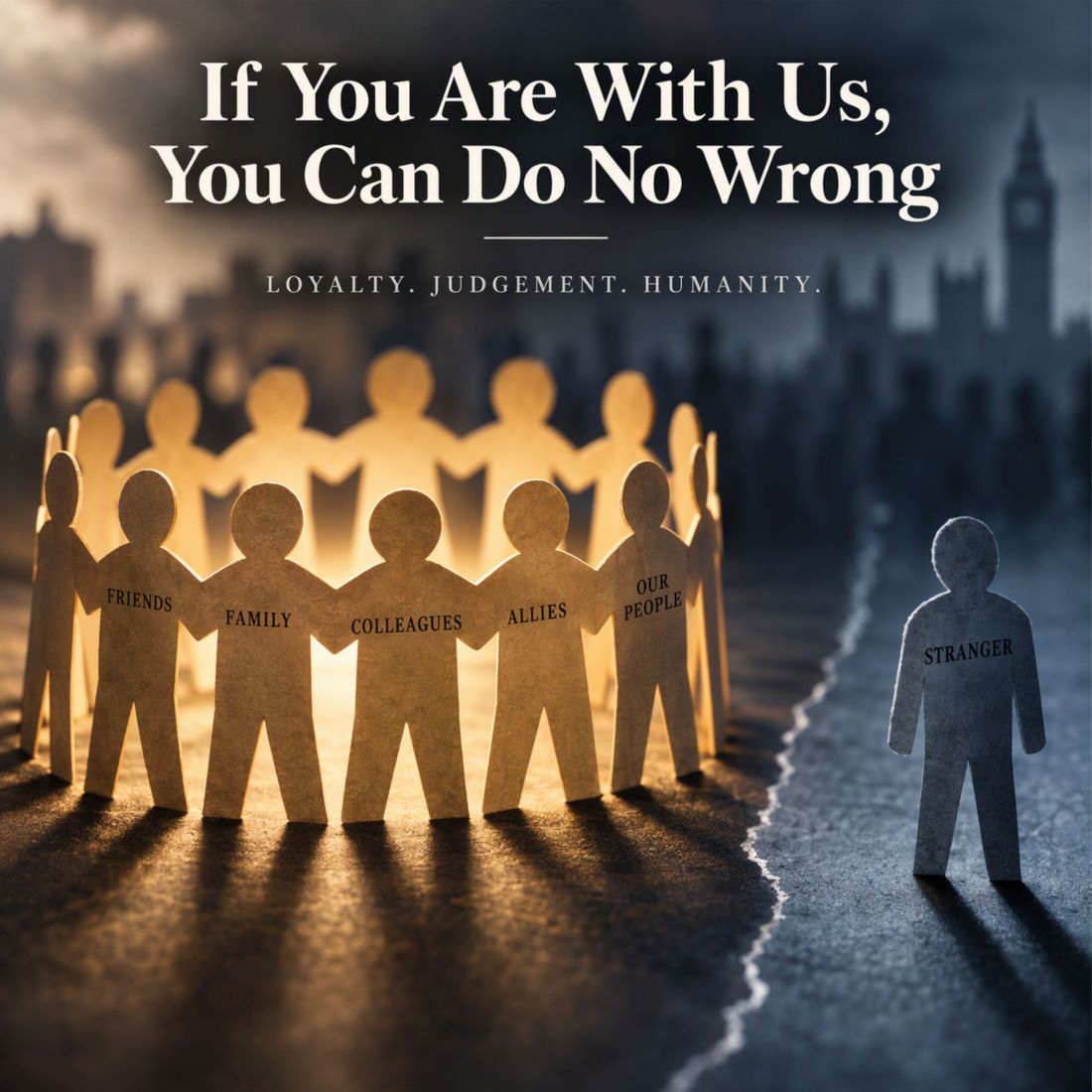
One of the more revealing features of public life is not that people protect their friends. It is that we are repeatedly surprised when they do.
Whenever allegations emerge around a famous figure, particularly one who once occupied a prominent cultural position, a familiar question follows. Why was nothing done earlier? Why did nobody speak up? Why were warning signs ignored? Why did institutions, colleagues or admirers seemingly look the other way?
The question is often posed as if the answer must involve conspiracy, corruption or some uniquely sinister arrangement. Sometimes it does. But much of the time the explanation may be far less dramatic and therefore far more troubling.
Human beings make allowances for people they regard as their own.
The principle operates everywhere. In friendships. In families. In workplaces. In politics. In religion. In social movements. In elite institutions. Most of us recognise it in others. Fewer recognise it in ourselves.
The temptation is to imagine that justice is blind and that our judgements are formed solely by evidence and principle. Reality suggests otherwise. The same behaviour can attract radically different responses depending on who commits it.
When a stranger behaves badly, we see character.
When a friend behaves badly, we see circumstances.
The stranger is irresponsible. The friend is under pressure.
The stranger is dishonest. The friend made a mistake.
The stranger reveals what they are. The friend deserves understanding because we know what they have been through.
In other words, familiarity creates context, and context often softens judgement.
This is not necessarily a moral failing. In fact, there is something profoundly human about it. The more we know someone, the more difficult it becomes to reduce them to their worst act. We know their history. We remember their kindnesses. We understand their struggles. We have seen them at their best as well as their worst. Because we possess a fuller picture, we instinctively resist judgements that seem too simple.
The problem emerges when this instinct collides with accountability.
At that point loyalty begins to exert its influence.
Groups, like individuals, develop protective instincts. Organisations protect valuable employees. Political movements protect useful advocates. Institutions close ranks around important members. Social circles defend insiders. Every group develops an answer to the same question:
What do we do when one of us is accused of wrongdoing?
In theory, the answer is simple. Investigate fairly and follow the evidence.
In practice, another question often slips in ahead of it.
Whose side is this person on?
Once that question enters the room, reasoning changes. Facts become entangled with loyalties. Doubts are exaggerated when allegations threaten someone we value. Generosity expands. Explanations multiply. Standards adjust almost imperceptibly.
Nobody has to be consciously dishonest for this to happen.
Indeed, the most powerful forms of protection rarely involve explicit collusion. They emerge from countless small decisions. A concern is dismissed as gossip. A complaint is interpreted generously. An uncomfortable detail is explained away. A person’s importance to the group is quietly factored into every judgement.
No one decision looks outrageous in isolation. Together they can create something resembling impunity.
This dynamic explains why people are often fascinated by cases involving celebrities, political figures or members of traditional elites. Consider the enduring fascination surrounding the mystery of Lord Lucan. What keeps the story alive is not merely the mystery itself. It is the suspicion that networks of privilege may have altered the course of events.
Whether such suspicions are justified is almost secondary. The story persists because it speaks to a deeper anxiety: that there are circles within society where belonging offers a measure of protection not available to everyone else.
We recognise the possibility because we see smaller versions of it all around us. Yet there is another question lurking beneath this observation, one that is perhaps even more interesting.
If we are capable of extending extraordinary understanding to those we know, why are we so reluctant to extend it beyond the boundaries of our tribe?
The usual critique of loyalty is that it makes us too forgiving. But perhaps that is only half true.
When our friends fail, we instinctively seek context. We remember their humanity. We understand that people are often more than the worst thing they have done.
Why do we not approach strangers in the same way?
Why do we so readily grant complexity to those we love while denying it to those we dislike?
Political opponents become caricatures. Public figures become villains or heroes. Entire groups are judged by their most objectionable representatives. We lose interest in the stories, pressures and contradictions that we effortlessly perceive in ourselves and those close to us.
The irony is striking.
The same person who demands ruthless accountability for an opponent may show immense understanding towards an ally. The same person who insists that a public figure should be defined entirely by a single action would never accept being judged in that way themselves.
Perhaps the deepest problem is not that we are too compassionate towards our own. Perhaps it is that our compassion is distributed so unevenly.
This does not mean abandoning standards or excusing wrongdoing. Accountability matters precisely because human beings are so inclined to overlook faults in people they admire. Justice requires consistency. Friends should not receive exemptions from principles we apply to everyone else.
But there is another principle at stake.
Justice demands that we judge our friends by the same standards as strangers.
Love demands that we view strangers with something of the same humanity we reserve for our friends.
Modern culture often struggles with this balance. Some people possess compassion without accountability. Others possess accountability without compassion. One side excuses everything. The other forgives nothing.
Both approaches misunderstand what is required.
The challenge is not to love our own less. Nor is it to abandon moral standards in favour of endless understanding. The challenge is to widen the circle within which understanding operates, while maintaining a consistent commitment to truth.
Most of us already know how to do this. We practise it every day with the people closest to us.
We know how to forgive. We know how to see complexity. We know how to recognise that a human being cannot be reduced to a single moment.
The question is why we draw the boundary where we do.
Perhaps the real moral test is not whether we can condemn our enemies. Most people can do that. Nor is it whether we can defend our friends. Most people can do that too.
The real test is whether we can hold our friends accountable without withdrawing our affection, and extend to strangers the same measure of humanity that we naturally offer to those we call our own.
For if belonging can make us blind to wrongdoing, it may also reveal something else: our capacity for grace already exists. The tragedy is not that we possess it. The tragedy is how selectively we choose to apply it.

