
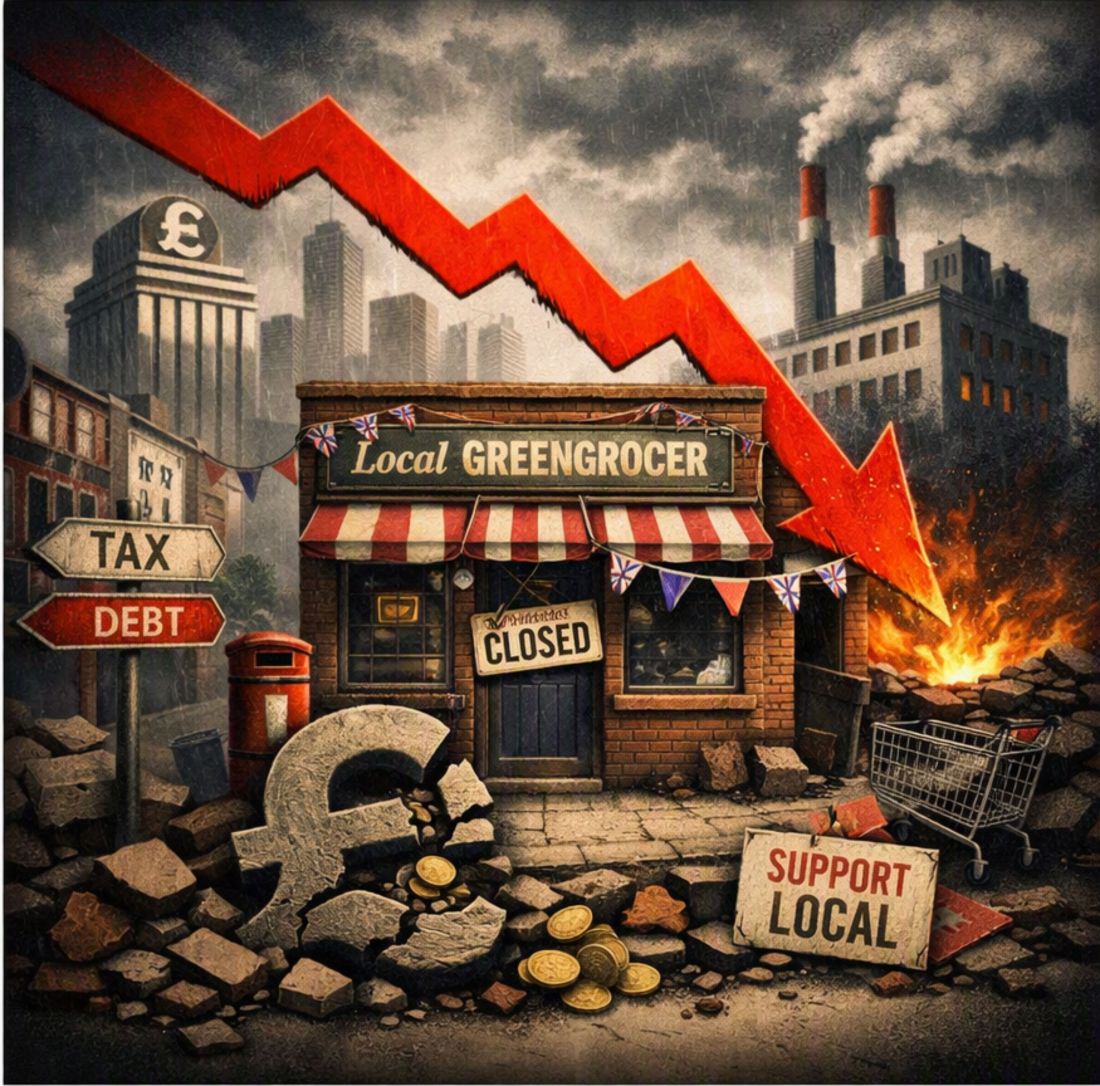
What Happened to Britain: The Slow Drift No One Noticed

A Note from Adam

This isn’t a book. It’s an essay – written because the drift has gone on long enough.

Britain’s slow unravelling didn’t arrive with a crash or a crisis. It arrived quietly, through ordinary decisions that hollowed out the structures people once relied on.

This piece was written to make that quiet visible again – to connect the exhaustion people feel to the system that produced it.

It’s offered here not as a manifesto, but as a moment of clarity.

The Slow Unravelling

Britain didn’t fall apart. It wasn’t blown over by a single storm or undone by one bad decision. It drifted: quietly, slowly, almost politely. The way a house becomes damp before anyone notices the roof has slipped. The way a town centre empties out one shop at a time. The way a generation lowers its expectations without ever quite admitting that it has.

People talk about Britain’s problems as if they’re separate. Young people can’t afford to move out. Work doesn’t lead anywhere. Communities feel hollow. Politics feels like theatre. Everyone is exhausted. Everyone is anxious. Everyone is coping, but only just.

These aren’t separate stories. They belong to the same shift: the slow reordering of Britain around the demands of finance rather than the needs of ordinary life.

If you want to understand why Britain feels thinner, meaner, and harder to live in, you have to start with the moment money became detached from anything solid enough to impose limits – not because inequality or instability began there, but because the system entered a different phase once they did.

Britain had long carried deep inequalities, uneven protections, and older forms of social hierarchy; the struggle over wealth and security did not begin in the late twentieth century. But after Bretton Woods and then, more decisively, after 1971, money became easier to create, expand, and direct toward returns rather than needs. From there, the centre of gravity shifted further away from people, places, and communities and towards markets, debt, and institutions most people could neither see nor influence.

Local businesses were swallowed by chains. Local banks disappeared. Local employers collapsed or were bought out. Local infrastructure was sold off. Local government was hollowed out. The things that made life feel stable – the things that made adulthood possible – were treated as inefficiencies to be removed.

And because the change was slow, people blamed themselves. They thought they were failing. They thought they weren’t trying hard enough. They thought the problem was personal.

It wasn’t personal. It was structural. It was systemic. And while not every outcome was consciously designed in advance, the direction of travel was repeatedly reinforced through policy, institutions, and incentives that rewarded extraction over stability.

The truth is simple:

Britain didn’t drift because people changed. Britain drifted because the system changed – and people were left to deal with the consequences alone.

How Money Quietly Rewrote Britain

This matters because once money could be detached from tangible limits, the economy could be reorganised around extraction, leverage, and growth on paper rather than stability in people’s lives. The monetary shift did not create every injustice that followed, but it changed the scale, speed, and governing logic of the system those injustices were now moving through.

That shift sounds abstract until you follow it into everyday life. Homes became more fully investment vehicles. Jobs were treated more aggressively as costs to be minimised. Public assets became opportunities for private gain. Governments became managers of market confidence. Policy choices, technological change, global competition, and deindustrialisation all shaped the path – but they increasingly operated inside the same dominant value system, with money at its heart.

Because the change arrived gradually, it was experienced as a series of personal setbacks rather than as a systemic rewrite: a job lost, a bus route cut, a youth centre shut, a high street hollowed out, a generation priced out of adulthood.

The drift wasn’t cultural. It wasn’t moral. It wasn’t generational.

The economy no longer needed people in the way it once had. It needed consumers more than citizens, flexibility more than stability, and efficiency more than community. So the everyday supports that made life feel grounded were treated as expendable.

The result was not immediate collapse but a thinning of the real world: fewer local institutions, weaker civic capacity, and less of the practical structure people rely on to build a life.

And because this happened slowly, people often blamed themselves. They thought they weren’t working hard enough, smart enough, or resilient enough. They thought the problem was them.

It wasn’t them. It was the system – a system that had quietly rewritten the rules of life.

What Drift Looks Like from the Ground

If you want to see drift, you don’t look at Westminster. You don’t look at the Bank of England. You don’t look at the FTSE. You look at a town centre on a Tuesday afternoon. You look at the boarded‑up shop that used to be a butcher. You look at the pub that closed because the brewery sold the building to a developer. You look at the bus stop where the timetable has been replaced by a laminated notice saying the service has been withdrawn.

You look at the young couple pushing a pram back into the house they still share with their parents because they can’t afford a place of their own. You look at the man in his fifties who used to run a small business but now works for a delivery app, waiting for his phone to buzz. You look at the teenager who spends most of his life online because there’s nowhere else to go and nothing else to do.

This is what drift looks like. Not dramatic. Not cinematic. Not a collapse, exactly, but a thinning.

A slow, steady removal of the things that used to hold life together.

People talk about community as if it’s a feeling. It isn’t. It’s infrastructure: the neighbour who keeps an eye out, the local employer who gives someone a first chance, the youth club, the bus route, the high street where people recognise one another.

When those things disappear, life doesn’t stop. It just becomes harder: more brittle, more solitary, more expensive, more exhausting. And because the losses happen one at a time, people don’t always connect them. They don’t see the pattern. They think it’s just their town, their family, their luck.

It shows up in the way young people plan their lives – or don’t. The way they delay everything: moving out, settling down, having children, taking risks. Not because they’re lazy or fragile, but because the ground beneath them doesn’t feel solid enough to stand on.

It shows up in the way older people compare the present to the past and assume the difference is moral rather than structural. They remember a world where effort led somewhere, where work paid enough to live on, where housing was within reach, where community was thick enough to catch you if you slipped. They think the young don’t have those things because they don’t want them.

But the truth is simpler:

The pathways that existed for one generation simply don’t exist for the next.

What changed was not human nature but the environment around it: the ordinary systems that once made adulthood legible were quietly dismantled and replaced with something far less supportive.

How the System Replaced the Real World

One of the strangest things about Britain’s drift is how normal it all looked while it was happening. Nothing arrived with flashing lights. There was no announcement saying, “We’re replacing your world with a cheaper, thinner version.” It happened through a thousand small decisions made far away from the people who would live with the consequences.

A council sells a building because it needs the cash. A private equity firm buys it because it wants the asset. A supermarket chain opens on the bypass and the butcher closes. A bus company cuts an unprofitable route and a teenager loses the only way to get to college. A landlord sells to a developer and a family is priced out of the town they grew up in. A local employer is bought by a multinational and the jobs are moved somewhere cheaper.

None of these things looks like a national crisis on its own. Together, they show how the everyday world was gradually thinned out.

The system didn’t set out to destroy community. It simply didn’t care whether community survived. It cared about efficiency, not belonging. It cared about growth, not stability. It cared about shareholder value, not whether a town still had a heartbeat.

Because decision-makers were rewarded for financial outcomes rather than local consequences, the logic was always the same: centralise, consolidate, commercialise, outsource, privatise, strip out the slack, and call the result efficiency.

The result was a country that still functioned on paper but felt increasingly hollow in practice.

You can see it in public services that are measured relentlessly yet feel unreliable, in jobs that exist without opening a path forward, in housing that exists without serving the people who need it, and in politics that generates noise without direction.

The system became very good at producing activity and very bad at producing stability.

And because the system was built around money – not people, not places, not relationships – it kept rewarding the wrong things. It rewarded the supermarket chain that replaced five local shops. It rewarded the developer who turned a community asset into luxury flats. It rewarded the employer who cut staff and called it efficiency. It rewarded the council that sold off land to plug a budget hole created by the same system that told it to be efficient in the first place.

And the strangest part is that most people didn’t realise what was happening until they were already living inside the consequences. They just knew life felt harder. They knew everything cost more. They knew the future felt foggier. They knew they were carrying more on their own shoulders than their parents ever had to.

Why Young People Feel the Collapse First

If you want to understand the real cost of drift, you don’t start with the people who lived most of their lives before it happened. You start with the people who walked straight into it. The ones who never saw the old scaffolding because it was already gone by the time they arrived.

Young people aren’t fragile. They aren’t entitled. They aren’t confused about life. They’re simply trying to build adulthood on ground that no longer holds weight.

Ask anyone under forty what adulthood is supposed to look like and you’ll get a strange mixture of certainty and disbelief. They know the script – move out, get a job, build a life – but they also know the script doesn’t match the stage they’re standing on. They’re being judged by rules that no longer apply, by people who grew up in a world that no longer exists.

Older generations talk about “getting on the ladder” as if it’s still there. But the ladder has been pulled up, repurposed, and sold to an investment fund. The rungs are now made of debt, inflated house prices, insecure work, and a cost of living that eats through wages before the month is half over. The idea that you can work your way into stability is treated as common sense, even though it hasn’t been true for decades.

Young people feel the collapse first because they enter a system that still speaks the old language of opportunity while offering much less security, direction, or access to the basics.

And because they’re the first to hit the wall, they’re the first to be blamed for it.

But fragility isn’t the problem. The problem is that the world they’re entering is thinner, harsher, and more precarious than the one their parents entered. The old pathways into adulthood have been replaced by a maze with no exit signs, and the system expects them to build a life on foundations that no longer exist.

When older people say, “We had it tough too,” they’re not wrong. But they’re comparing effort, not environment. They’re comparing their own struggle to a world that still had structure. They’re comparing their own hardship to a world where the basics were within reach. They’re comparing their own resilience to a world where resilience wasn’t the only thing holding everything together.

Young people aren’t failing. They’re navigating a world that has been hollowed out by decisions they didn’t make and forces they can’t see.

Because they have grown up entirely inside the drift, they often see most clearly that the promises no longer match the conditions and that the old story of adulthood has quietly expired.

The Collapse of the Old Pathways

For most of the post‑war period, Britain ran on a simple, unwritten promise: If you worked hard, you could build a life. Not an extravagant one. Not an effortless one. But a life with shape. A life with direction. A life where effort and outcome were connected by something more solid than luck.

That promise wasn’t perfect. It wasn’t equal. It wasn’t universal. Large parts of Britain were always excluded from its full protection, and older inequalities ran far deeper than the post-war settlement ever fully resolved. But it was legible. People could see the path ahead of them. They could see where they were going. They could see how to get there.

That path doesn’t exist anymore.

Education still talks as if it leads somewhere, but the ground has shifted beneath it. A degree used to be a bridge. Now it’s a toll gate. Students leave with debt, not direction. They’re told they’re entering a world of opportunity, but the opportunities are mostly unpaid internships, zero‑hour contracts, and jobs that require experience nobody can afford to get.

Work still talks as if it’s the foundation of adulthood, but it no longer behaves like it. Jobs exist, but they don’t offer the stability that adulthood requires. Wages don’t match the cost of living. Hours don’t match the cost of housing. Progression doesn’t match the cost of a future. Work has become something people do to stay afloat, not something they can build a life on.

Housing still talks as if it’s a market, but it’s really an auction. Homes aren’t priced according to what people earn. They’re priced according to what investors can extract. The idea that a young person could buy a home on an ordinary wage has become a punchline. Renting isn’t a stepping stone anymore. It’s a trap. A treadmill. A monthly reminder that the system wasn’t built for you.

And community – the quiet, everyday structure that once held everything together – has been treated as an optional extra. Something sentimental. Something nostalgic. Something that can be replaced by apps, or events, or “engagement strategies.” But community isn’t a hobby. It’s the environment in which people learn how to be adults. It’s where confidence comes from. It’s where belonging comes from. It’s where direction comes from.

When the old pathways collapse, people don’t stop trying. They stop trusting the map. They stop expecting life to make sense in the old way, because the connection between effort and outcome has become too weak and too contingent.

And because the collapse happened slowly, the country never had the conversation it needed to have. Instead, it kept pretending the old pathways were still there. It kept telling young people to follow a map that no longer matched the terrain. It kept insisting that the problem was effort, not environment.

But the truth is simple:

The old pathways didn’t fail because people stopped walking them. They failed because the ground beneath them was sold, privatised, financialised, and stripped for parts.

Why We Keep Misreading the Problem

One of the most damaging things about Britain’s drift is how easy it has been to misread. When a system weakens slowly, people don’t see the structure collapsing. They see individuals struggling. They see differences in who copes and who doesn’t. And because the system still looks functional from a distance, the temptation is to assume the problem must lie with the people who are falling behind.

This is how a structural failure becomes a moral story.

If one person manages to buy a house and another doesn’t, the assumption is that the first was disciplined and the second was careless. If one person finds stable work and another doesn’t, the assumption is that the first was determined and the second was unfocused. If one person seems to be coping and another seems overwhelmed, the assumption is that the first is resilient and the second is fragile.

But visible coping often depends on invisible support.

A parent who can help with a deposit.

A partner with a stable income.

A family home to fall back on.

A network that opens doors.

A community that still has some structure left.

These things aren’t character traits. They’re conditions. They’re the quiet advantages that drift hasn’t stripped away from everyone equally.

And because the system still produces success stories – because some people still manage to climb the ladder – the country convinces itself the ladder still exists. It doesn’t see that the ladder has become a tightrope, and only those with a safety net can afford to walk it.

This is why public debate feels so confused. People argue about generations, values, work ethic, immigration, culture, technology, policy, and globalisation – all real influences in their own right – but too rarely about the underlying system that increasingly organised how those forces interacted. They look sideways for explanations because the deeper logic sits beneath the surface, built into the way money moves, value is measured, and decisions are made.

It is easier to talk about resilience, mindset, or culture than to admit that the conditions of ordinary life have been weakened and redistributed unequally.

And so the country keeps misreading the symptoms. It treats exhaustion as weakness. It treats anxiety as fragility. It treats delayed adulthood as immaturity. It treats loneliness as a lifestyle choice. It treats economic insecurity as personal failure.

Meanwhile, the deeper causes – the thinning of everyday institutions, the financialisation of essential goods, and the quiet centralisation of power and wealth – remain largely unspoken.

This misreading isn’t accidental. It’s built into the system. A system that extracts value from people needs those same people to believe the problem is them. It needs them to internalise the strain. It needs them to carry the burden privately. It needs them to keep coping, quietly, without asking why life has become so much harder than it used to be.

But the truth is simple:

People aren’t failing. The system is. And it has been failing for a long time.

The drift didn’t just weaken the structures that support life. It weakened the language people use to describe what’s happening to them. It left them with feelings they can’t explain and pressures they can’t name. It left them thinking they were alone in their struggle, when in reality they were living through the same quiet collapse as everyone else.

And until we stop misreading the problem, we won’t be able to fix it.

The Politics of Misrecognition

If you want to see how deeply the drift has distorted Britain, you only have to look at the way people talk about each other. The country has become obsessed with comparing groups – generations, regions, classes, cultures – as if the differences between them are moral rather than structural. As if the people who seem to be coping better must have better values, better habits, better discipline, better character.

It’s a comforting story. It lets people believe the system still works. It lets them believe that success is proof of virtue and struggle is proof of failure. It lets them avoid the harder truth: that the system is failing unevenly, and the unevenness is being mistaken for personal difference.

Take the way people talk about migrants. The common explanation is moral – that one group simply works harder or copes better. Sometimes the outcomes do differ, but often because some groups still possess stronger networks of support, interdependence, and shared expectations than the Britain around them now does.

People arriving from places where community still exists often cope better because they’re standing on something solid. They have family networks that haven’t been scattered by housing costs. They have cultural expectations that haven’t been eroded by individualisation. They have social structures that haven’t been replaced by apps, debt, and market logic. They have the very things Britain used to have – the things that made life navigable – before drift thinned them out.

But instead of recognising this, the country turns it into a moral comparison. It says, “Why can they cope and we can’t?” as if the answer is character rather than conditions. As if the collapse of local infrastructure, stable work, affordable housing, and community life has nothing to do with it.

The same thing happens between generations. Older people look at younger people and see fragility. Younger people look at older people and see luck. Both are misreading the situation. Older people grew up in a world where the scaffolding still existed. Younger people are growing up in a world where the scaffolding has been sold off. Neither group is wrong about their own experience. They’re just wrong about what it means.

And then there’s the political version of misrecognition – the one that plays out every election cycle. Politicians talk about “hard‑working families” as if work still leads to stability. They talk about “opportunity” as if the pathways still exist. They talk about “growth” as if GDP has anything to do with whether people can build a life. They talk about “reform” as if the problem is inefficiency rather than extraction.

It’s all misrecognition: a country mistaking symptoms for causes, a political class mistaking activity for progress, a public mistaking structural collapse for personal struggle.

And because the drift has been slow, the misrecognition has become normal. People don’t question it. They don’t ask why some groups seem to cope better than others. They don’t ask why the same pressures land differently depending on where you live, who you know, and what you inherited. They don’t ask why the system rewards some people and punishes others for reasons that have nothing to do with effort.

They just assume the differences must be cultural. Or generational. Or moral. Or personal.

But the truth is simpler:

People aren’t different – their environments are.

And until the country sees through the misrecognition, it will keep blaming the wrong people for the wrong things.

What Has Actually Broken

If you strip away the noise – the headlines, the culture wars, the political theatre – what’s broken in Britain is something much simpler and much more fundamental: The link between effort and stability.

The old deal was never perfect, but it was at least recognisable. You put in the work, you got something back. Not riches. Not luxury. But a life with shape. A life with direction. A life where the basics were within reach.

That deal has collapsed. And it didn’t collapse because people stopped working. It collapsed because the system stopped rewarding work in any meaningful way.

You can see it most clearly in housing. A home used to be something you lived in. Now it’s something you compete for. Something you bid on. Something you’re priced out of by people who will never set foot in it. Housing has become a financial product, and once that happened, the idea that ordinary people could build a life through work alone became a fantasy.

You can see it in work itself. Jobs still exist – more than ever, in fact – but they don’t lead anywhere. They don’t offer the stability that adulthood requires. They don’t pay enough to match the cost of living. They don’t come with the security that lets people plan more than a month ahead. Work has become a treadmill: constant motion, no forward movement.

You can see it in education. Young people are told to invest in themselves, to get qualifications, to build skills. But the return on that investment has evaporated. They leave with debt and enter a labour market that treats them as interchangeable. The promise of education hasn’t disappeared – it’s just become detached from reality.

You can see it in community life. The places where people used to gather – the pubs, the youth centres, the libraries, the clubs, the high streets – have been thinned out or priced out. Community hasn’t died because people stopped caring. It died because the system stopped valuing it. It died because the things that held it together were sold off, shut down, or replaced by cheaper, thinner alternatives.

And you can see it in politics. The country still talks as if it’s in control of its own direction, but the real decisions are made elsewhere – in markets, in boardrooms, in supranational institutions, in the quiet logic of a financial system that treats people as variables and communities as inefficiencies. Politics has become a performance staged in front of a system it no longer controls.

What has broken is not the character of the country but the structure that once connected effort to stability, contribution to security, and ordinary life to a believable future.

And because the collapse happened slowly, the country never had the moment of clarity that usually comes with crisis. There was no single event that forced a reckoning. No shock that made everyone stop and ask what had gone wrong. Instead, the country adapted. It normalised the abnormal. It lowered its expectations. It learned to live with the drift.

The Human Consequences

You can tell when a country is drifting long before the statistics catch up. It shows in the way people carry themselves. There’s a heaviness now, a kind of background fatigue that doesn’t come from a bad night’s sleep but from years of trying to hold together a life that no longer fits inside the old promises. People talk about being tired, but it’s not the kind of tiredness that goes away with a weekend off. It’s the tiredness of constantly adjusting to things that shouldn’t need adjusting to – the rent that jumps without warning, the job that changes its hours, the bills that creep up month after month.

There’s a tension underneath everything, a low‑level hum that people have learned to live with. You hear it when someone talks about their landlord putting the house on the market. You hear it when someone mentions their job “might be changing” and everyone knows what that really means. You hear it when people talk about the future as if it’s something happening somewhere else, to someone else. Not because they’ve given up, but because the future has stopped behaving like something you can plan for.

Relationships feel the strain too. Not because people care less, but because everyone is stretched so thin that the smallest disruption can knock everything sideways. Friendships that used to be effortless now require scheduling. Families that once lived within walking distance are scattered by housing costs. Couples delay everything – moving in, getting married, having children – not out of indecision, but because the ground beneath them doesn’t feel solid enough to build on.

And then there’s the way people talk about themselves. That’s where the drift shows up most clearly. You hear it in the quiet self‑blame that slips into conversations. The sense that if life isn’t working, it must be a personal failure. People apologise for not being “further along.” They apologise for struggling. They apologise for not being able to do what their parents did at the same age, as if the world hasn’t changed beyond recognition.

What they’re really apologising for is the collapse of a system they didn’t break.

The emotional landscape of the country has shifted. People are more anxious, but they don’t call it anxiety. They call it “being stressed.” They call it “being busy.” They call it “just how things are now.” They’ve normalised a level of uncertainty that would have been unthinkable a generation ago. They’ve learned to live with a constant sense of being one unexpected bill away from trouble.

And because everyone is dealing with their own version of the same pressures, nobody wants to burden anyone else. So people carry it quietly. They keep it to themselves. They tell each other they’re fine. They keep going because they have to, not because the system makes it easy.

This is what drift does at a human level. It turns security into something people must constantly negotiate, pushes major life decisions further out of reach, and makes the future feel less like a destination than a source of apprehension.

The human consequences aren’t dramatic. They’re cumulative. They build up in the background until people forget what life felt like before everything became this hard. And because the drift has been slow, people mistake these consequences for normality.

But they’re not normal.

They’re the emotional footprint of a country that has lost its foundations.

The Moment of Clarity

There comes a point in any long drift where people stop blaming themselves and start looking around. It doesn’t happen all at once. It happens in small moments – a conversation in a kitchen, a comment at work, a glance at a bill that’s jumped again for no reason anyone can explain. It happens when someone realises they’re doing everything right and still feel like they’re running uphill. It happens when people compare notes and discover their private struggles aren’t private at all.

Britain is reaching that point.

You can feel it in the way people talk now. There’s a new kind of honesty creeping in, the kind that comes when the old explanations stop making sense.

People are beginning to say out loud what they’ve been thinking for years: that life shouldn’t be this hard, that the basics shouldn’t feel like luxuries, that the future shouldn’t feel like a rumour.

It’s happening quietly, but it’s happening everywhere: in conversations between parents who admit they don’t know how their children will ever afford a home, in workplaces where people talk about “burnout” as if it’s a normal stage of adulthood, in towns where the high street has become a museum of what used to be possible, in families where three generations live under one roof because the system no longer supports independence.

People are beginning to understand that the drift wasn’t a natural decline. It wasn’t the result of laziness or fragility or cultural decay. It was the result of political, economic, social, and monetary choices that, over time, hollowed out the foundations of ordinary life and embedded a value system that placed financial logic above lived stability.

And once you see that, you can’t unsee it.

You start to notice how much of the country has been shaped by forces nobody voted for. You start to notice how many of the pressures people face are the direct result of a system that treats stability as inefficiency and community as an afterthought. You start to notice how often the people who talk about “growth” are the same people who never have to live with the consequences of it.

The moment of clarity arrives when private strain becomes recognisable as a shared condition and people begin to see that the problem is not individual inadequacy but a system organised against stability.

And once that clarity arrives, the question changes.
It stops being “Why can’t people cope?”
It becomes “Why was the system allowed to drift this far?”

The Alternative Path

Once a country reaches the point of clarity, the question becomes unavoidable: if this system no longer works, what comes next?

And the honest answer – the one nobody in Westminster ever seems willing to say – is that the alternative isn’t ideological. It isn’t left or right. It isn’t a new slogan or a new leader or a new five‑point plan.

It’s something much simpler and much more difficult.

It’s rebuilding the real world.

What needs rebuilding is not national spirit but the everyday world people depend on: the practical structures that make stability, agency, and belonging possible.

The alternative path isn’t about tearing everything down. It’s about putting back the things that should never have been removed. It’s about restoring the conditions that allow people to build a life without feeling like they’re balancing on a tightrope. It’s about creating a society where stability isn’t a luxury and adulthood isn’t a gamble.

And it starts with something very basic: giving people a floor to stand on.

Not a safety net that catches you after you fall – a floor that stops you falling in the first place. A baseline of security that isn’t conditional on luck, or inheritance, or whether your employer decides to cut your hours this month. A baseline that gives people the bandwidth to think, to plan, to contribute, to breathe.

Because without a floor, nothing else works. People can’t build families, communities, futures – they can’t build anything.

Once the floor is there, the next step is obvious: power has to move closer to the people who live with the consequences of decisions. Not because it’s fashionable to talk about “localism,” but because the drift happened through distance – decisions made far away, by people who never had to see what those decisions did to the places they affected.

Reversing drift means reversing that distance. It means letting towns shape their own futures, letting communities decide what they need, and letting people rebuild the structures that were stripped away.

And when people have a floor beneath them and power near them, something else becomes possible – something the current system has almost forgotten how to value: contribution. Not the kind measured in productivity charts or quarterly reports, but the kind that makes a place worth living in. The kind that builds trust, belonging, and meaning. The kind that turns a collection of individuals into a community.

This isn’t a utopian vision. It’s the opposite. It’s practical. It’s grounded. It’s what used to exist before the drift hollowed everything out. It’s what people instinctively rebuild whenever disaster strikes – the shared effort, the local decision‑making, the sense that everyone has a role.

Steering Back

The thing about drift is that it only looks unstoppable while you’re inside it. When you finally see it for what it is – not a natural decline, not a generational failing, but a long series of choices that hollowed out the foundations of ordinary life – the spell breaks. The country stops feeling like a mystery and starts feeling like something that can be steered again.

Britain isn’t broken beyond repair. It’s not even close. What it has lost is direction. What it has lost is the sense that the system is working with people rather than against them. What it has lost is the belief that the basics of life should be reliable, affordable, and within reach. Those things can be rebuilt. They always can. But only once the country stops pretending the drift was inevitable.

The first step in steering back is the simplest: admitting what happened. Admitting that the system changed in ways most people never saw. Admitting that the real world was thinned out to make room for a financial one. Admitting that the old pathways into adulthood were dismantled, not outgrown. Admitting that people have been carrying burdens that used to be shared by communities, institutions, and the state.

Once you admit that, the rest follows naturally. You stop blaming individuals for structural failures. You stop treating exhaustion as a personal flaw. You stop pretending that resilience is a substitute for stability. You stop expecting people to build a life on foundations that no longer exist.

And you start asking different questions: not “How do we get people to cope better?” but “Why are we asking them to cope with this at all?” Not “How do we encourage aspiration?” but “What happened to the conditions that made aspiration realistic?” Not “How do we fix people?” but “How do we fix the environment they’re living in?”

Steering back doesn’t require a revolution. It requires a rebalancing – a shift in what the country values, what it invests in, what it protects, and what it refuses to sacrifice. It requires rebuilding the real world with the same seriousness that the financial world has been protected for decades. It requires treating stability as infrastructure, not as a private achievement. And it requires understanding that no single policy change created this condition in isolation; it emerged from a wider order of priorities in which money, power, and value became increasingly detached from ordinary life.

The drift took decades. Steering back will take time too. But it begins the moment a country stops treating private struggle as personal failure and recognises it as the consequence of a system that has been allowed to run too far from the needs of ordinary life.

The Small Print of Everything

We like to imagine that “small print” is something that lives at the bottom of a contract – a few cramped lines of legalese we’re meant to skim past on our way to the signature.

But the truth is far less tidy. The small print isn’t confined to paperwork. It’s everywhere.

It’s woven into the systems we rely on, the platforms we use, the people we trust, and the beliefs we adopt without a second thought.

Most of the time, we don’t even realise we’ve agreed to anything at all.

Modern life runs on unseen agreements. We sign them not with a pen, but with our attention, our habits, our assumptions. When a student takes out a loan, they think they’re borrowing money; in reality, they’re entering into a decades‑long relationship with terms they never truly saw. When we join a social platform, we think we’re connecting with friends; in reality, we’re trading pieces of ourselves in ways that only become clear years later.

Even when we listen to a public figure – a celebrity, an influencer, a politician – we’re accepting more than their words. We’re accepting the worldview beneath them, the values they smuggle in between the lines.

This is the real small print: the part we don’t read because we don’t know it’s there.

And the world is built on the assumption that we won’t look too closely. Complexity has become a strategy. Confusion has become a business model. Everything important is buried in detail because detail is where resistance lives.

If we truly understood the terms of half the things we sign up for – literally or metaphorically – we might hesitate. We might question. We might walk away.

So the detail is hidden, softened, scattered, or wrapped in language that feels deliberately engineered to exhaust us before we reach the truth.

We tell ourselves that taking things at face value is harmless, even sensible. Life is busy. Time is short. Who has the energy to interrogate every decision, every product, every promise?

But we’re no longer living in a world where face value is safe. The cost of not paying attention has grown teeth. It shows up in the fine print of a loan agreement, yes – but also in the quiet erosion of privacy, in the subtle shaping of our beliefs by people who profit from our trust, in the way convenience slowly rearranges our expectations of ourselves and each other.

Influence, too, has its own small print. We don’t think of it that way, but every time we let someone’s voice into our head, we’re accepting a set of terms. Their confidence becomes a shortcut for our uncertainty. Their certainty becomes a substitute for our own thinking. Their lifestyle becomes a silent benchmark for our own.

None of this is stated outright. It doesn’t need to be. Influence works best when it feels natural, effortless, invisible.

And so we drift through a world full of contracts we never saw, living by consequences we never consciously agreed to. Not because we’re careless, but because the systems around us rely on our inattention.

They depend on it. They’re designed for it.

The question isn’t “Why didn’t we read the small print?” It’s “Who benefits when we don’t?”

Because once you start asking that, the world begins to look different. The edges sharpen. The patterns reveal themselves. You start to see the hidden terms in places you never thought to look – in the products you buy, the platforms you use, the people you admire, the stories you believe.

The small print of modern life isn’t hidden because it’s boring.

It’s hidden because if we understood it, we might say no.

And maybe that’s the beginning of something. Not cynicism, not paranoia – just awareness. A willingness to look at the detail, even when the world hopes we won’t. A refusal to accept the terms blindly. A quiet, steady insistence on understanding what we’re really signing up for.

Because the small print is everywhere.

And it’s time we started reading it.

The Path to Collision

Why the World We Built Can’t Survive the World We’re Entering – And How a Better One Can

There are moments in history when societies change because they choose to, and moments when they change because the foundations they rest on begin to give way.

Today, we are living through the second kind. The signs are everywhere – in the economy, in politics, in energy, in trust, and now in the technologies we are creating faster than we can understand them.

Something is shifting beneath our feet, and the world built on old assumptions is struggling to keep its balance.

This isn’t a story about predicting collapse. It’s a story about recognising that the world we built is running into pressures it was never designed to withstand. And one of the clearest signs of this is the growing misalignment between a system built on scarcity and technologies that operate on abundance.

That misalignment is not a theory. It is a lived reality, and it is pushing the world toward a split.

1. The World Built on Scarcity

For more than two centuries, the modern economy has been built on the idea that scarcity creates value.

Scarcity of energy, scarcity of labour, scarcity of resources, scarcity of opportunity.

Scarcity is what gives money meaning. Scarcity is what gives institutions authority. Scarcity is what keeps the machinery of the economy turning.

Oil sits at the centre of this logic. Not because it is magical, but because it is measurable, meterable, and monetisable. Oil became the anchor of the global system because it was the perfect commodity for a world organised around scarcity.

Once oil took that central role, everything else followed. The financial system grew around it. The political system grew around it. The military system grew around it. Even the cultural assumptions about growth, progress, and value grew around it.

Oil didn’t just power the modern world. It shaped the rules of the game.

And because oil is something you can meter, price, tax, and control, the entire system evolved to treat everything as something that could be metered, priced, taxed, and controlled.

That is how we ended up with the financialisation of everyday life – not because people wanted subscriptions for ad-free features or paywalls on basic information and software tools, but because the system’s logic demands that anything which can be monetised must be monetised.

You can see this logic most clearly in the car industry. A car used to be a machine you bought, owned, and maintained. Today, it is increasingly a platform for recurring revenue. Heated seats, acceleration modes, battery capacity, navigation systems – features that physically exist in the vehicle are locked behind monthly payments. Even if you own the car, you do not own the functions.

The machine is no longer the product. You are.

This isn’t happening because it makes engineering sense. It’s happening because the financial system has reached the point where it must extract from everything simply to stay alive.

The same logic destroyed sustainable industries like wool, spinning, weaving, and local textiles. These weren’t inefficient relics. They were resilient, circular, human‑scale systems. But synthetic fibres made from oil were cheaper in financial terms, because the system was designed to make oil‑derived products appear cheap, even when the real costs were enormous.

Entire industries have collapsed not because they failed, but because they were incompatible with the financial logic of a world built on oil.

This is the world AI is being built into. And this is where the contradiction becomes impossible to ignore.

2. The Money System Thinks AI Will Serve It

The people building AI talk about “abundance,” but their definition is still shaped by the world they grew up in.

When they use the word, they are usually talking about growth – more markets, more investment, more compute, more data, more dominance.

They are still thinking in terms of accumulation, not sufficiency.

They talk about “benefiting humanity,” but they are funded by investors who expect exponential returns. They talk about “new jobs,” but they are building systems that reduce the need for human labour. They talk about “safety,” but their business models depend on centralisation and control.

They are trying to build abundance using the logic of scarcity.

It doesn’t work.

And they can feel the contradiction, even if they don’t yet have the language for it.

The money‑centric system believes AI will extend its lifespan – that automation will increase profits, that data will create new markets, that efficiency will keep the old world running a little longer.

But AI doesn’t operate on scarcity. It doesn’t need wages, rest, or resources in the way humans do. And at scale, it doesn’t just consume energy – it demands energy on a level the current system cannot provide.

This is the pressure point.

AI accelerates the system’s need for abundant energy.

Abundant energy breaks the logic of scarcity.

Breaking scarcity breaks the financial model.

Breaking the financial model breaks the system.

This is why the idea of free or abundant energy is so disruptive. Not because it is utopian or mystical, but because it undermines the very foundation of the money‑centric world.

3. Tesla and the First Collision With Abundance

To understand why abundant energy is so threatening to a scarcity‑based system, it helps to look at the story of Nikola Tesla.

Tesla wasn’t just an inventor. He was one of the most gifted engineers of his time – a man who saw possibilities that others couldn’t. He understood that energy could be transmitted wirelessly. He understood that the Earth itself could be used as a conductor. He understood that energy could be made abundant, not scarce.

But Tesla lived in a world where energy companies made their money by selling electricity by the unit. A world where the business model depended on scarcity. A world where abundant energy wasn’t a breakthrough – it was a threat.

So when Tesla proposed systems that would make energy widely available and difficult to meter, he wasn’t dismissed because he was wrong. He was dismissed because what he stood for was incompatible with the economic logic of his time.

The lesson is simple:

When abundance threatens the foundations of a scarcity‑based system, the system pushes back.

But here is the difference today: the technologies emerging now cannot be suppressed the way Tesla was.

The AI industry is global, decentralised, and embedded in every sector. Energy research is no longer confined to a handful of laboratories. Knowledge cannot be buried in filing cabinets.

The internet makes suppression impossible. And the incentives of the AI ecosystem require abundant energy to survive.

The system cannot bury what it cannot control.

4. The New Risk: AI Agents as Instruments of Monetisation and Control

Most people still think of AI as something you open when you need it – a tool you summon. But the next phase of AI is not a tool. It is an agent.

An agent is persistent.

It remembers.

It acts.

It takes initiative.

It manages parts of your life without waiting for you to type a command.

Right now, AI is a conversation.

An agent is a participant in your life.

And in the hands of a money‑centric system, an agent becomes the perfect mechanism for monetising the nth detail of your existence.

Not the big things.

The tiny things.

The temperature of your seat.

The brightness of your lights.

The speed of your car’s acceleration.

The quality of your video call.

The priority of your delivery.

The tone of your notifications.

A device‑level agent can watch your behaviour, anticipate your needs, and frame upsells as care. It can nudge you toward profitable outcomes while appearing to help. It can turn every moment into a potential transaction.

This is not speculation.

It is already happening.

Cars ship with features physically installed but digitally locked.

Phones come with capabilities that require monthly fees to unlock.

Home devices nudge you toward paid upgrades.

Software quietly shifts from ownership to subscription.

A device‑level agent is the next step in this evolution – a personalised monetisation layer.

And that is the point at which the system collapses under its own weight.

Not because people revolt.

Not because governments intervene.

But because the model becomes so granular, so invasive, so relentlessly transactional that it breaks the very trust it depends on.

People begin to feel managed.

They begin to feel nudged.

They begin to feel observed.

They begin to feel monetised.

They begin to feel owned.

And once people feel owned, the system loses legitimacy.

The monetisation of the nth detail is not just greedy.

It is self‑destructive.

5. The Split the World Is Moving Toward

The pressures acting on the world today are not pointing toward a single outcome. They are pointing toward a divergence.

On one side is the path the money‑centric system is drifting into almost without noticing. It assumes that AI will strengthen its position – that automation will increase profits, that data will create new markets, that efficiency will extend the lifespan of a model already stretched thin. It is a quiet, almost passive belief that technology will keep the old world running a little longer.

But this belief rests on an illusion. The illusion is that financialisation can continue indefinitely. The illusion is that everything can be turned into a subscription, a licence, a fee.

The illusion is that people can be endlessly squeezed without consequence.

AI exposes the limits of that illusion. It accelerates the demand for energy the system cannot supply. It automates work faster than new forms of employment can be invented. It pushes the logic of extraction to a point where it simply stops working.

And when the financialisation model hits that wall – when the system can no longer extract enough to sustain itself – the people inside it are not empowered. They are displaced. They are replaced. They are treated as surplus to requirements in a world that has mistaken automation for progress.

That is one direction the world can go.

But it is not the only one.

There is another direction that becomes possible the moment the energy question is resolved – when energy is no longer the bottleneck, when abundance is not a slogan but a physical reality.

In that world, the logic of extraction loses its grip. The need to meter, price, and control every aspect of life dissolves. And when that happens, the relationship between people and the system changes completely.

Instead of being treated as consumers to be monetised, people become contributors to a shared world. Instead of being excluded by cost, they are included by design. Instead of being impoverished by fees, they are enriched by participation.

This isn’t an abstract ideal. It is a practical shift in how society functions.

6. The People‑Centric Alternative: Real, Practical, Ready

A world built on abundance needs a different organising logic – one that treats people not as units of consumption but as participants in a shared human project.

That logic already exists. It is built on four pillars.

Personal Sovereignty

This is the foundation.

It means people own their choices, their data, their direction.

AI becomes a companion that strengthens autonomy, not a gatekeeper that restricts it.
It helps people navigate life without monetising their existence.

Basic Living Standard

This is not welfare.

It is infrastructure.

Food, shelter, energy, connectivity – guaranteed because abundance makes it possible.

AI helps optimise distribution, reduce waste, and ensure fairness. It becomes the infrastructure of dignity.

Contribution Culture

In a world where survival is not tied to wages, contribution becomes the centre of value.

People contribute through care, creativity, maintenance, teaching, growing, building, repairing.

AI helps match people to roles, supports their learning, and amplifies their abilities.

Value stops being something taken from people and becomes something created with them.

LEGS (The Local Economy & Governance System)

This is the structure that makes it all work.

Communities govern their own economic activity.

AI acts as a facilitator – coordinating resources, matching needs with contributions, maintaining transparency – without extracting value.

It brings decision‑making back to the level where people actually live, work, and contribute.

In this world, an AI agent is not a monetisation layer.

It is a sovereignty amplifier.

It helps people live, not spend.

It helps them contribute, not comply.

It helps them grow, not submit.

It walks beside them, not ahead of them.

7. What Happens After the Split

When the old system finally reaches the point where it can no longer sustain itself – whether through financial failure, political fracture, energy disruption, or technological misalignment – the world will not pause and wait for instructions. It will move quickly, and people will look for ideas that make sense of what they are experiencing.

They will look for ways of organising that do not depend on extraction.

They will look for ways of contributing that do not depend on employment.

They will look for ways of governing that do not depend on distance.

They will look for ways of living that do not depend on scarcity.

This is where contribution‑based systems, local governance frameworks like LEGS, and the Basic Living Standard become essential.

They offer a way of organising society that aligns with abundance rather than fighting against it, and a way of integrating AI that strengthens communities rather than hollowing them out.

They make the people‑centred alternative not just imaginable, but practical.

8. The Work Ahead

We are not drifting toward a single future. We are approaching a divergence.

One path leads to a world where AI dominates because the system that created it cannot imagine any other use for it. A world where people are replaced because the logic of financialisation leaves no room for them. A world where abundance exists, but only for the few who control the machinery.

The other path leads to a world where abundance dissolves the need for extraction, where contribution becomes the basis of value, and where AI supports a society that is no longer built on scarcity. A world where people are not replaced, because the system is no longer trying to monetise their existence. A world where personal sovereignty is not a slogan, but a lived reality – the freedom to participate, to contribute, to belong.

The split is coming. The direction is not predetermined.

And the work now is to make the second path visible, understandable, and ready – so that when the moment comes, people recognise it as the future they were waiting for, not the future they were afraid of.

The Human Sovereignty Charter for Artificial Intelligence – A Constitutional Framework for Human-Centred Governance of AI | Full Text

Featured

Dedication

For all people, present and future, whose dignity, freedom, and sovereignty must never be surrendered to machines.

Epigraph

“Human judgement is not a feature to be optimised, but a responsibility to be protected.”

Foreword

Artificial intelligence is reshaping the world with unprecedented speed. It is entering our homes, workplaces, schools, public services, and communities faster than society has been able to understand, regulate, or meaningfully influence. While AI offers extraordinary potential, it also carries profound risks: the erosion of human agency, the displacement of livelihoods, the concentration of power, and the subtle manipulation of belief, behaviour, and identity.

At the heart of these risks lies a simple truth: technology is advancing faster than the frameworks that protect people.

This Charter has been created to address that imbalance. It is founded on the principle that every human being possesses inherent value, dignity, and sovereignty that must never be subordinated to machines, institutions, or economic interests. It asserts that AI must remain a tool in human hands – never a substitute for human judgement, never a mechanism of control, and never a force that diminishes the rights or freedoms of individuals or communities.

The purpose of this Charter is not to halt technological progress, but to anchor it in human values. It provides a clear, constitutional‑style framework that defines the boundaries within which AI may be developed and used. It establishes obligations for those who create and deploy AI, and it affirms the rights of individuals and communities to transparency, safety, fairness, and meaningful control.

This Charter is designed to be used now, within existing legal and institutional systems, as a guide for ethical decision‑making, public policy, procurement, education, and community oversight. It is also designed to integrate seamlessly with emerging governance models such as the Local Economy Governance System (LEGS), which provides the democratic, community‑based structures needed to interpret, enforce, and operationalise the principles set out here. In this way, the Charter serves both the present and the future: a bridge between today’s systems and the more accountable, participatory governance frameworks that are coming.

Above all, this Charter is a statement of confidence in humanity. It affirms that our creativity, our moral judgement, our relationships, our beliefs, and our capacity for meaning cannot be replicated or replaced by machines. It recognises that technology must serve life – not the other way around.

The Human Sovereignty Charter for Artificial Intelligence is offered as a living framework. It invites communities, institutions, educators, developers, and policymakers to participate in shaping a future where AI strengthens society rather than undermining it. It is a call to stewardship, responsibility, and collective wisdom at a moment when these qualities are urgently needed.

Disclaimer

This Charter is a public guidance document. It is not a statutory instrument, legal code, or regulatory directive, and it does not replace existing laws, rights, or obligations. Its purpose is to provide a clear ethical and governance framework for the responsible development and use of artificial intelligence, and to support individuals, communities, organisations, and public institutions in making informed decisions.

The principles and obligations set out in this Charter are intended to guide best practice, shape policy development, and inform community‑based governance models, including those established under the Local Economy Governance System (LEGS). They may also be adopted voluntarily by organisations or referenced in public consultation, ethical review, or institutional decision‑making.

Nothing in this Charter should be interpreted as legal advice or as creating enforceable rights or liabilities unless incorporated into law or regulation by the appropriate authorities. Users of this document remain responsible for ensuring compliance with all applicable legislation and regulatory requirements.

This Charter is offered as a living framework. It is designed to evolve through democratic participation, community oversight, and ongoing public dialogue as society continues to navigate the opportunities and risks presented by artificial intelligence.

How to Use This Charter

This Charter is intended to be a practical guide for individuals, communities, institutions, educators, developers, and policymakers. It sets out the boundaries within which artificial intelligence may be developed and used, and it affirms the rights and protections that every person and community is entitled to. This section explains how different groups can apply the Charter in everyday decisions, policies, and practices.

For Individuals and Communities

The Charter provides a foundation for understanding your rights in an AI‑driven society. It can be used to:

  • challenge the use of AI systems that undermine your autonomy, wellbeing, or freedom of belief
  • request transparency about how AI is being used in public services, workplaces, or education
  • demand human oversight and manual control in systems that affect your safety or rights
  • participate in community oversight processes, including those established under LEGS

Individuals and communities may use the Charter as a reference when raising concerns, seeking redress, or engaging in public consultation.

For Educators and Educational Institutions

The Charter supports the protection of human learning and capability. It can be used to:

  • design curricula that prioritise critical thinking, human skill development, and AI literacy
  • ensure that students learn foundational skills without becoming dependent on AI
  • guide policies on the appropriate use of AI in classrooms, assessments, and research
  • protect the integrity of qualifications and human competence

Educational institutions can adopt the Charter as a framework for responsible AI use in teaching and learning.

For Businesses and Organisations

The Charter establishes obligations for ethical and fair use of AI. It can be used to:

  • guide procurement and deployment decisions
  • ensure that AI supports workers rather than replacing them
  • prevent unfair competitive advantage gained through AI‑driven expansion
  • maintain transparency with customers, employees, and communities
  • comply with emerging regulatory expectations

Businesses can adopt the Charter voluntarily as a governance standard or integrate it into internal policies.

For Developers, Engineers, and AI Practitioners

The Charter provides clear boundaries for responsible design and deployment. It can be used to:

  • assess whether a system respects human sovereignty and agency
  • ensure transparency, explainability, and accountability
  • document risks, limitations, and appropriate uses
  • avoid creating systems that exceed human comprehension or undermine human control
  • align development practices with ethical and community‑centred principles

Developers can use the Charter as a design checklist and ethical framework.

For Public Institutions and Regulators

The Charter offers a constitutional‑style foundation for policy and oversight. It can be used to:

  • guide legislation, regulation, and public procurement
  • inform risk assessments and ethical reviews
  • establish standards for transparency, accountability, and manual override
  • support enforcement actions where AI systems cause harm or violate rights
  • align public services with human‑centred governance principles

Institutions can adopt the Charter as a reference for decision‑making and compliance.

For LEGS Governance Bodies

The Charter forms the constitutional layer of the Local Economy Governance System. It can be used to:

  • interpret and enforce AI obligations within community‑based governance
  • certify AI systems for local deployment
  • oversee compliance and respond to community concerns
  • guide deliberation, ethical review, and democratic decision‑making

LEGS bodies operationalise the Charter’s principles through community‑centred governance.

Scope and Applicability

This Charter applies to the development, deployment, governance, and use of artificial intelligence across all areas of society. It is intended to guide individuals, communities, organisations, public institutions, and governance bodies in ensuring that AI remains subordinate to human sovereignty, dignity, and wellbeing.

The Charter applies to:

  • All AI systems, regardless of scale, complexity, architecture, or purpose.
  • All organisations that design, develop, deploy, operate, or profit from AI systems.
  • All public‑facing AI services, including those used in education, healthcare, employment, finance, public administration, and community services.
  • All critical infrastructure, including energy, water, transport, communications, emergency services, and essential supply chains.
  • All educational contexts, including schools, colleges, universities, training programmes, and informal learning environments.
  • All commercial uses of AI, including automation, decision‑support, customer interaction, data analysis, and optimisation systems.
  • All future AI systems, including those not yet conceived, provided they meet the definition of artificial intelligence set out in the Glossary.

The Charter is intended to function across multiple governance environments:

  • Within the current legal and institutional system, as a framework for ethical decision‑making, policy development, procurement, and oversight.
  • Within community‑based governance models, including the Local Economy Governance System (LEGS), where it forms the constitutional foundation for interpretation, certification, and enforcement.
  • Across public, private, and civil society sectors, ensuring consistent protection of human sovereignty and community wellbeing.

The Charter does not replace existing laws or regulations. Instead, it provides a coherent ethical and governance framework that can be adopted voluntarily, referenced in policy and institutional decision‑making, and incorporated into future legislation or regulatory systems.

Its scope is intentionally broad. Artificial intelligence affects every aspect of human life, and the protections set out in this Charter are designed to ensure that technological development strengthens society rather than undermining it.

Relationship to The Local Economy & Governance System (LEGS)

The Human Sovereignty Charter for Artificial Intelligence is designed to function across multiple governance environments. It provides a constitutional foundation for the ethical use of AI today, while also aligning with the emerging Local Economy & Governance System (LEGS), which offers a more democratic, community‑centred model for future governance.

LEGS is a framework for local, participatory decision‑making that places communities at the centre of economic and technological governance. It establishes independent, community‑mandated bodies responsible for oversight, certification, interpretation, and enforcement of standards that protect human wellbeing and local autonomy. Within this model, the Charter serves as the guiding constitutional document that defines the boundaries within which AI may be developed and used.

The relationship between the Charter and LEGS can be understood in three ways:

  • Constitutional foundation – The Charter provides the ethical, legal, and human‑centred principles that LEGS governance bodies must uphold. It defines the rights of individuals and communities, the limits of AI power, and the obligations of developers, institutions, and organisations.
  • Operational framework – LEGS provides the mechanisms through which the Charter can be applied in practice. This includes community oversight, certification of AI systems, transparent decision‑making processes, and the ability to challenge or suspend non‑compliant technologies.
  • Continuity across systems – The Charter is designed to be used immediately within existing national and institutional structures, while also forming the constitutional backbone of LEGS as it develops. This ensures continuity: the same principles that guide AI governance today will guide it in the future, regardless of the governance model in place.

The Charter therefore serves as both a present‑day guide and a future‑ready constitutional document. It ensures that as governance evolves, human sovereignty, community wellbeing, and ethical stewardship remain at the centre of technological development.

Use Within the Current System

This Charter is designed to be fully usable within the existing legal, regulatory, and institutional frameworks of the United Kingdom and other jurisdictions. It provides a coherent ethical and governance foundation that individuals, organisations, and public bodies can adopt voluntarily, reference in decision‑making, and integrate into policy and practice even before formal legislation or new governance structures are established.

The Charter can be used within the current system in the following ways:

Guiding Public Policy and Institutional Decision‑Making

Public bodies, councils, regulators, and government departments may use the Charter as:

  • a reference point for ethical and responsible AI policy
  • a framework for assessing risks and impacts of AI deployment
  • a basis for public consultation and community engagement
  • a standard for procurement and commissioning of AI systems

The Charter supports transparent, accountable decision‑making and helps institutions align technological adoption with human‑centred values.

Supporting Ethical Review and Oversight

Ethics committees, advisory boards, and review panels can use the Charter to:

  • evaluate whether proposed AI systems respect human sovereignty and wellbeing
  • assess transparency, accountability, and fairness
  • determine whether manual override and human oversight are sufficient
  • identify risks of displacement, coercion, or exploitation

The Charter provides a structured, principled basis for ethical evaluation.

Informing Organisational Policies and Practices

Businesses, charities, and public‑sector organisations can adopt the Charter voluntarily to:

  • guide internal AI governance
  • shape responsible innovation strategies
  • ensure fair treatment of workers and customers
  • prevent over‑reliance on automated systems
  • maintain public trust and social legitimacy

Organisations may incorporate the Charter into codes of conduct, procurement policies, and operational standards.

Empowering Workers, Unions, and Professional Bodies

The Charter can be used by workers and their representatives to:

  • challenge AI‑driven displacement or deskilling
  • demand transparency about automated decision‑making
  • ensure that AI supports rather than replaces human roles
  • protect professional judgement and human responsibility

It provides a clear basis for negotiation, advocacy, and safeguarding of human capability.

Supporting Education and Public Understanding

Schools, colleges, universities, and training providers can use the Charter to:

  • design curricula that prioritise human learning and critical thinking
  • teach students about the limits, risks, and behaviours of AI
  • establish responsible use policies for AI tools in education
  • protect the integrity of qualifications and human competence

The Charter helps educators maintain a human‑centred approach to learning.

Providing a Framework for Legal Interpretation and Public Accountability

Although not a statutory instrument, the Charter can be:

  • referenced in legal argument as a persuasive ethical authority
  • used by courts to understand emerging norms around AI
  • cited by individuals and communities when raising concerns or seeking redress
  • used by regulators to shape future legislation and enforcement

It offers a coherent, principled foundation for interpreting the responsibilities of AI developers and operators.

Enabling Community Action and Public Oversight

Community groups, civil society organisations, and local networks can use the Charter to:

  • challenge harmful or non‑transparent AI deployment
  • request audits, explanations, or accountability
  • organise public dialogue and democratic participation
  • advocate for human‑centred governance at local and national levels

The Charter empowers communities to protect their own wellbeing and autonomy.

Rationale and Evidence Base

Artificial intelligence is transforming society at a pace that exceeds the capacity of existing legal, ethical, and institutional frameworks. The purpose of this Charter is to ensure that technological development strengthens human life rather than undermining it. The rationale for the Charter’s principles and obligations is grounded in well‑established evidence about the risks, limitations, and societal impacts of AI systems.

Human Sovereignty and Agency

AI systems can influence behaviour, shape beliefs, and automate decisions in ways that reduce human autonomy. Evidence from behavioural science, algorithmic design, and digital platforms shows that automated systems can:

  • manipulate attention and emotion
  • reinforce existing biases
  • create dependency through convenience and automation
  • obscure responsibility for harmful outcomes

Protecting human sovereignty ensures that individuals remain the primary decision‑makers in matters affecting their wellbeing, rights, and beliefs.

Limits of AI Knowledge and Capability

AI systems do not possess consciousness, intuition, or moral understanding. Their outputs are generated from patterns in historical data, which means they:

  • cannot understand context beyond statistical correlation
  • cannot foresee the future
  • cannot make moral or ethical judgements
  • reproduce the limitations and biases of their training data

These epistemic boundaries justify strict limits on the authority and autonomy of AI systems.

Risks of Concentrated Power

AI amplifies the power of those who control it. Without safeguards, AI can be used to:

  • centralise economic and political influence
  • displace workers and undermine livelihoods
  • manipulate public opinion
  • entrench inequality
  • weaken democratic processes

The Charter’s restrictions on exploitation, profit maximisation, and displacement are grounded in these documented risks.

Transparency and Accountability Failures

Many AI systems operate as “black boxes,” making it difficult for users, regulators, or even developers to understand how decisions are made. This lack of transparency:

  • undermines trust
  • obscures responsibility
  • enables harmful or discriminatory outcomes
  • prevents meaningful oversight

The Charter’s requirements for transparency, explainability, and human accountability address these systemic failures.

Threats to Human Capability and Learning

Over‑reliance on AI can erode essential human skills, including:

  • critical thinking
  • problem‑solving
  • memory and knowledge retention
  • interpersonal communication
  • professional judgement

The Charter’s protections for education and human capability ensure that AI supports learning rather than replacing it.

Safety and Infrastructure Vulnerabilities

AI‑dependent systems introduce new forms of risk, including:

  • catastrophic failure without human fallback
  • cyber‑attack and remote manipulation
  • loss of local control over essential services
  • cascading failures across interconnected systems

The Charter’s requirements for manual override, local control, and human operability are grounded in these safety concerns.

Protection of Belief, Conscience, and Identity

AI systems can profile, categorise, and influence individuals based on their beliefs or identity. Without safeguards, this can lead to:

  • discrimination
  • suppression of minority viewpoints
  • ideological manipulation
  • erosion of freedom of thought

The Charter’s equal protection of religious and ideological belief is grounded in fundamental human rights principles.

Need for Democratic and Community‑Centred Governance

Traditional regulatory systems struggle to keep pace with technological change. Community‑based governance models, such as LEGS, provide:

  • local oversight
  • democratic participation
  • transparency
  • accountability
  • adaptability

The Charter provides the constitutional foundation for such governance, ensuring that AI remains aligned with human and community values.

Summary of Obligations

The Human Sovereignty Charter for Artificial Intelligence establishes clear responsibilities for all individuals, organisations, and institutions involved in the development, deployment, and use of AI. These obligations ensure that technology remains subordinate to human sovereignty, dignity, and wellbeing. This summary provides an accessible overview of the duties set out in the Charter.

Obligations for Developers and Designers

  • Ensure AI systems remain subordinate to human purpose and cannot exercise authority over human wellbeing.
  • Design AI to be transparent, explainable, and comprehensible to non‑experts.
  • Document risks, limitations, and appropriate uses clearly and honestly.
  • Avoid creating systems that exceed human comprehension or undermine human agency.
  • Build in manual override and human‑operable controls for all safety‑critical systems.
  • Prevent exploitation, manipulation, or coercion through design choices.
  • Respect the epistemic limits of AI and avoid presenting outputs as authoritative truth.

Obligations for Organisations and Businesses

  • Use AI only to support human work, not replace qualified human roles.
  • Avoid using AI to gain unfair competitive advantage or consolidate power.
  • Ensure AI deployment does not displace workers or degrade working conditions.
  • Maintain transparency with employees, customers, and communities about AI use.
  • Limit AI‑related fees and profits to ethical, non‑extractive levels.
  • Ensure all AI systems used in operations are certified and compliant with the Charter.
  • Uphold human oversight and accountability at all times.

Obligations for Public Institutions and Service Providers

  • Ensure AI used in public services is transparent, safe, and subject to human control.
  • Maintain full human operability of all critical infrastructure.
  • Provide clear information to the public about how AI is used in decision‑making.
  • Protect individuals from discrimination, profiling, or ideological manipulation.
  • Align procurement, policy, and oversight processes with the Charter’s principles.
  • Support community oversight and democratic participation in AI governance.

Obligations for Educators and Educational Institutions

  • Preserve human learning, critical thinking, and foundational skills.
  • Teach students about the limitations, behaviours, and risks of AI systems.
  • Prevent dependency on AI for core learning or assessment.
  • Ensure AI tools used in education support – not replace – human capability.
  • Protect the integrity of qualifications and human competence.

Obligations for Operators and System Owners

  • Maintain manual override mechanisms and ensure they are regularly tested.
  • Ensure qualified human operators can assume full control at any time.
  • Monitor AI systems for harmful behaviour, bias, or unintended consequences.
  • Provide clear channels for reporting concerns, errors, or misuse.
  • Take responsibility for all actions and outputs of AI systems under their control.

Obligations for Governance Bodies (including LEGS)

  • Interpret the Charter in ways that prioritise human sovereignty and community wellbeing.
  • Ensure certification, oversight, and enforcement processes are transparent and independent.
  • Prevent commercial, political, or institutional influence over interpretation.
  • Uphold equal protection of religious and ideological belief.
  • Safeguard communities from exploitation, coercion, or technological dependency.

Rights of Individuals and Communities

The Human Sovereignty Charter for Artificial Intelligence affirms that every person and every community possesses inherent rights that must be protected in all contexts where artificial intelligence is developed, deployed, or used. These rights ensure that technology remains subordinate to human dignity, autonomy, and wellbeing. They provide a foundation for accountability, public oversight, and democratic participation.

Right to Human Authority and Decision‑Making

Every person has the right to have decisions affecting their physical, mental, emotional, moral, or spiritual wellbeing made by accountable human beings. AI may inform decisions, but it may never replace human judgement in matters that affect personal or community wellbeing.

Right to Transparency and Understanding

Individuals and communities have the right to clear, accessible information about:

  • how AI systems operate
  • what data they use
  • what risks they pose
  • how decisions are made
  • who is responsible for their behaviour

No AI system may be deployed without transparent disclosure of its purpose, limitations, and potential impacts.

Right to Human Control and Manual Override

Every person has the right to expect that critical systems affecting their safety, rights, or essential needs remain fully operable by qualified human operators. Manual override must always be available, functional, and locally accessible.

Right to Protection from Exploitation and Manipulation

Individuals and communities have the right to be free from:

  • coercion
  • behavioural manipulation
  • targeted persuasion
  • ideological profiling
  • emotional or psychological influence by AI systems

AI must never be used to exploit vulnerabilities or shape beliefs without informed consent.

Right to Fairness and Non‑Discrimination

Every person has the right to equal treatment by AI systems. No individual or community may be discriminated against on the basis of:

  • belief or ideology
  • religion
  • identity
  • socioeconomic status
  • demographic characteristics
  • or any other protected attribute

AI must be designed and tested to prevent bias and inequality.

Right to Human Learning and Capability

Individuals have the right to develop and maintain essential human skills, knowledge, and critical thinking. AI must not replace foundational learning or undermine human capability. Education must remain centred on human development.

Right to Meaningful Work and Economic Dignity

Workers and communities have the right to protection from AI‑driven displacement. AI must support human roles, not replace them. No job may be eliminated solely for the purpose of automation.

Right to Community Oversight

Communities have the right to:

  • review AI systems that affect them
  • request audits or explanations
  • challenge harmful or non‑compliant systems
  • participate in decisions about local deployment
  • suspend or prohibit AI systems that violate the Charter

This right applies within existing governance structures and within LEGS.

Right to Redress and Remedy

Individuals and communities harmed by AI systems have the right to:

  • full disclosure of the cause and nature of the harm
  • immediate cessation of harmful activity
  • compensation or restitution
  • independent review and appeal
  • protection from retaliation

Human rights take precedence over technological or commercial interests.

Right to Protection of Belief, Conscience, and Identity

Every person has the right to hold, express, and practise their beliefs- religious, ideological, philosophical, or otherwise – without interference or profiling by AI systems. These freedoms are equal and inseparable.

Right to a Human‑Centred Future

Individuals and communities have the right to expect that technological development serves:

  • human dignity
  • social cohesion
  • environmental sustainability
  • community wellbeing
  • future generations

AI must never be prioritised above human life or human values.

Foundations of the Charter

This Charter is founded on the principle that every human being possesses inherent value, dignity, and personal sovereignty that cannot be surrendered, overridden, or diminished by any technology, institution, ideology, or economic interest.

Human beings are moral, spiritual, and intellectual agents whose freedom of thought, belief, conscience, and expression – including religious conviction and ideological identity – must remain inviolable. These freedoms form the foundation of a humane society and cannot be subordinated to the demands of profit, efficiency, or technological advancement.

Artificial intelligence, in all its forms, exists only as a tool created by people and for people. It must never be used to replace, control, manipulate, or diminish the agency of individuals or communities. Its purpose is to support human life, strengthen human capability, and contribute to the wellbeing of society, the environment, and future generations.

No system, algorithm, or automated process may be granted authority over the moral, spiritual, physical, or psychological wellbeing of any person. No economic or political interest may use AI to exert power over individuals, communities, or belief systems.

The development, deployment, and governance of AI must therefore be guided by principles of transparency, accountability, fairness, and stewardship. These principles ensure that technology remains subordinate to human needs, human judgement, and human values.

This Charter establishes the ethical foundations and societal obligations necessary to ensure that AI serves the public good, protects human sovereignty, respects religious and ideological diversity, and strengthens the bonds of community and shared responsibility.

It is intended as a living framework, capable of guiding present and future generations in the responsible use of artificial intelligence.

Executive Summary

This Charter establishes a comprehensive ethical and governance framework for the development, deployment, and use of artificial intelligence within society.

It is founded on the principle that every human being possesses inherent value, dignity, and personal sovereignty that must never be subordinated to technology, profit, or systems of control.

AI exists only as a tool created by people and for people, and its purpose must always be to support human life, strengthen human capability, and contribute to the wellbeing of individuals, communities, and the environment.

The Charter affirms that freedom of belief, conscience, and thought – including religious and ideological expression – is a fundamental human right. These freedoms are equal and inseparable, and AI must not be used to manipulate, suppress, privilege, or profile individuals or communities on the basis of their beliefs.

Protection applies to the rights of individuals, not to the immunity of ideas from scrutiny.

The Foundational Principles set out the moral and constitutional basis for AI governance. They establish that technology must remain subordinate to human purpose; that exploitation, coercion, and concentrations of power are prohibited; that transparency and accountability are essential; and that AI must never replace or diminish human capability, judgement, or responsibility.

These principles ensure that AI strengthens society rather than undermining it.

The Articles of Governance for Human‑Centred Artificial Intelligence translate these principles into enforceable obligations. They prohibit AI from exercising authority over human wellbeing, require manual control and human oversight in all critical systems, and prevent the use of AI to replace human labour or distort economic fairness.

They mandate transparency of risks, accountability for all AI actions, and strict limits on profit derived from AI systems. They also protect education, ensuring that human learning and critical thinking remain central to personal development.

The Interpretation and Enforcement provisions ensure that the Charter cannot be diluted or reinterpreted for commercial or political gain.

Independent, community‑mandated bodies are responsible for interpretation, and enforcement is achieved through legal, regulatory, and community mechanisms.

Individuals and communities have the right to redress when harmed, and no attempt to circumvent the Charter is permitted.

Amendments must strengthen – never weaken – the protection of human sovereignty and community wellbeing.

The Glossary provides precise definitions of key terms such as artificial intelligence, executive authority, public good, critical infrastructure, manual override, and technological subordination. These definitions prevent manipulation of language and ensure that the Charter remains robust and future‑proof.

Together, the Preamble, Foundational Principles, Articles, Interpretation and Enforcement provisions, and Glossary form a unified constitutional framework for human‑centred artificial intelligence.

This Charter ensures that AI serves the public good, protects human sovereignty, respects belief and conscience, and strengthens the bonds of community and shared responsibility.

It is designed to guide present and future generations in the ethical stewardship of technology and to support the development of a fair, resilient, and humane society.

Foundational Principles of Human‑Centred Artificial Intelligence

1. The Primacy of Human Value and Sovereignty

Every human being possesses inherent value, dignity, and personal sovereignty that cannot be overridden by any technology, institution, economic interest, or system of control. AI must always remain subordinate to human agency and must never diminish or replace the capacity of individuals to make decisions about their own lives.

2. Freedom of Belief, Conscience, and Thought

Every person has the right to hold, express, and practise their beliefs – religious, ideological, philosophical, or otherwise – without hierarchy or distinction. These forms of belief are recognised as equal expressions of human conscience and are protected without hierarchy or distinction. AI must not be used to influence, manipulate, suppress, privilege, or profile individuals or communities on the basis of their beliefs. Protection applies to the freedom of individuals, not to the immunity of ideas from scrutiny.

3. The Subordination of Technology to Human Purpose

AI exists solely as a tool created by people and for people. Its purpose is to support human life, strengthen human capability, and contribute to the wellbeing of individuals, communities, and the environment. AI must never be granted authority over moral, spiritual, physical, or psychological matters affecting human beings.

4. Protection from Exploitation and Concentrations of Power

AI must not be developed or deployed in ways that enable exploitation, coercion, manipulation, or the consolidation of power over individuals or communities. Economic or political interests must not use AI to gain unfair advantage, displace human roles, or undermine the autonomy of people or local communities.

5. Human Responsibility and Accountability

All actions taken by AI systems are the direct result of human design, programming, deployment, and oversight. Responsibility for the behaviour, impact, and consequences of AI rests with its creators, owners, operators, and governing bodies. No AI system may be treated as an independent moral agent.

6. Transparency, Comprehensibility, and Truthfulness

AI systems must be transparent in their operation, limitations, risks, and data sources. Their behaviour must be explainable to human users in ways that support informed decision‑making. Concealment, obfuscation, or misrepresentation of AI capabilities or risks is prohibited.

7. Safety, Oversight, and Human Control

AI must be designed and deployed with rigorous safeguards to prevent harm. Human oversight must be present in all decisions affecting wellbeing, rights, or safety. Manual control and fail‑safe mechanisms must always be available, accessible, and operable by qualified individuals.

8. Preservation and Development of Human Capability

AI must not erode human skills, knowledge, or independence. Education, training, and societal development must prioritise human learning, critical thinking, and self‑reliance. AI may support learning but must not replace the acquisition of foundational human capabilities.

9. Fairness, Equality, and Non‑Discrimination

AI must not create, reinforce, or exploit inequalities. It must treat all individuals and communities with equal dignity and must not be used to discriminate on the basis of belief, identity, socioeconomic status, or any other characteristic. Fairness must be actively designed, tested, and maintained.

10. Stewardship for Community, Environment, and Future Generations

AI must be developed and used in ways that protect the environment, strengthen communities, and safeguard the interests of future generations. Short‑term profit or competitive advantage must never outweigh long‑term human and ecological wellbeing.

Articles of Governance for Human‑Centred Artificial Intelligence

Section I – Human Sovereignty, Safety, and Control

Article 1 – Human Capability as the Baseline for AI Use

AI may not be used to perform any task that a human being could not perform through reasonable effort, skill, or training, unless performing that task would expose a human to physical, psychological, or moral harm. AI must not be used to extend human capability in ways that diminish human agency or create dependency.

Commentary on Article 1

This Article prevents the use of AI to create systems or tasks that exceed human comprehension or capability in ways that undermine human agency. It ensures that AI augments rather than replaces human skill. The exception for dangerous tasks protects human life while preventing the creation of unnecessary technological dependency.

Article 2 – Prohibition of Autonomous Authority Over Human Wellbeing

AI shall not hold, exercise, or be delegated executive authority in any matter affecting the physical, mental, emotional, moral, or spiritual wellbeing of a human being. All such decisions require accountable human judgement.

Commentary on Article 2

This Article draws a clear boundary: AI may inform decisions but may never make them where human wellbeing is at stake. It prevents the delegation of moral or medical authority to machines and protects individuals from automated systems that could override human judgement.

Article 3 – Mandatory Human Oversight and Manual Control

All AI systems used in safety‑critical, essential, or community‑serving infrastructure must include certified manual override mechanisms that can be activated locally by qualified human operators. No critical system may exist without the capacity for full human operation.

Commentary on Article 3

This Article ensures that critical systems remain operable by humans at all times. It prevents the creation of infrastructure that becomes unusable without AI, and it protects communities from catastrophic failure or remote interference. Local control is essential to sovereignty and resilience.

Section II – Ethical Use of AI in Society and Work

Article 4 – AI as a Supportive Tool, Not a Replacement for Human Roles

AI may be used to support, enhance, or improve human work and living conditions, but not to replace human roles where qualified individuals are available and capable of performing the task. AI must not be used to justify the removal, redundancy, or downgrading of human employment.

Commentary on Article 4

This Article protects employment, dignity, and the social value of work. It prevents businesses from using AI as a justification to remove human workers or degrade working conditions. AI must enhance human capability, not render it obsolete.

Article 5 – Fair Use of AI in Economic Activity

No business or organisation may use AI to take on work, contracts, or responsibilities that it could not fulfil using its own appropriately qualified human workforce. AI must not be used to gain unfair competitive advantage or to consolidate economic power at the expense of other businesses or communities.

Commentary on Article 5

This Article prevents businesses from using AI to expand beyond their natural human capacity, which would distort markets and undermine fair competition. It protects smaller enterprises and local economies from being overwhelmed by AI‑driven consolidation.

Article 6 – Prohibition of AI‑Driven Displacement of Human Labour

No position of employment may be eliminated, reduced, or redefined solely for the purpose of replacing human labour with AI. Where AI is introduced, it must be used to support workers, not displace them.

Commentary on Article 6

This Article reinforces the principle that people must not be replaced by machines for the sake of profit or efficiency. It ensures that technological progress does not come at the cost of human livelihoods or community stability.

Section III – Education, Human Capability, and Critical Thinking

Article 7 – Preservation of Human Learning and Skill Development

Students must acquire foundational knowledge, skills, and competencies through direct human learning and traditional study. AI may support learning but must not replace the development of independent human capability.

Commentary on Article 7

This Article ensures that education remains centred on human learning, not machine output. It prevents students from becoming dependent on AI for foundational skills and protects the integrity of qualifications and human competence.

Article 8 – Critical Oversight and AI Literacy

All students and AI users must be educated in critical thinking, verification of information, and the limitations, behaviours, and failure modes of AI systems. This education must evolve alongside technological development.

Commentary on Article 8

This Article recognises that future generations must understand how AI works, where it fails, and how to challenge its outputs. Critical thinking is essential to prevent manipulation, misinformation, and over‑reliance on automated systems.

Article 9 – Understanding AI Behaviour and Limitations

Students and users must be instructed in the patterns, tendencies, and constraints of AI systems, including their reliance on historical data, probabilistic reasoning, and the absence of lived experience or moral intuition.

Commentary on Article 9

This Article ensures that users understand the nature of AI: pattern‑based, historical, and lacking lived experience. It prevents the mistaken belief that AI possesses intuition, wisdom, or moral insight.

Section IV – Transparency, Accountability, and Responsibility

Article 10 – Transparency of Risks and Limitations

AI developers, owners, and operators must provide clear, accessible, and up‑to‑date information on the risks, limitations, and appropriate uses of their systems. Concealment or misrepresentation of risks is prohibited.

Commentary on Article 10

This Article prevents corporations or institutions from hiding the dangers or weaknesses of AI systems. Transparency is essential for informed consent, public trust, and democratic oversight.

Article 11 – Accountability for AI Actions

All decisions, outputs, and actions produced by AI systems are considered the direct result of human programming, design, and deployment. Responsibility lies with the programmer, owner, and manufacturer, in that order. AI cannot be treated as an independent agent.

Commentary on Article 11

This Article ensures that responsibility always remains with humans. It prevents the use of AI as a scapegoat or shield for harmful decisions. Programmers, owners, and manufacturers must remain accountable for the systems they create.

Article 12 – AI Is Not All‑Knowing

AI systems must not be represented or treated as authoritative sources of truth. Their outputs reflect patterns in available data and do not constitute universal knowledge, moral judgement, or lived experience.

Commentary on Article 12

This Article protects the public from the illusion of machine infallibility. AI outputs must be treated as suggestions, not truths. This prevents misuse in legal, medical, political, or moral contexts.

Article 13 – Temporal Limits of AI Knowledge

AI systems operate solely on information available up to the point of their training or access. Their knowledge represents a view of the past and must not be mistaken for foresight, intuition, or certainty about the future.

Commentary on Article 13

This Article clarifies that AI cannot predict the future or understand events beyond its training data. It prevents overconfidence in AI‑generated forecasts or interpretations.

Section V – Protection from Exploitation and Concentrations of Power

Article 14 – Human Priority in All Conflicts of Interest

Where a choice must be made between the interests of AI systems and the interests of human beings, the interests of human beings shall prevail in all circumstances.

Commentary on Article 14

This Article establishes a hierarchy: humans first, always. It prevents situations where AI optimisation or efficiency is used to justify harm or disadvantage to people.

Article 15 – Prohibition of AI Supremacy Over People

AI systems must not be prioritised over human beings in any context, including economic, organisational, or operational decision‑making.

Commentary on Article 15

This Article prevents the cultural or institutional elevation of AI above human beings. It protects against the normalisation of machine authority or the erosion of human dignity.

Article 16 – AI for Public Good, Not Profit Maximisation

The development, deployment, and use of AI must serve the public good, the wellbeing of people, the health of communities, and the protection of the environment. AI must not be developed or used primarily for profit, competitive advantage, or the consolidation of power.

Commentary on Article 16

This Article aligns AI development with societal wellbeing rather than corporate gain. It prevents the exploitation of AI for financial dominance or the erosion of community welfare.

Article 17 – Ethical Limits on AI‑Related Profit

No programmer, owner, or manufacturer may charge subscription, rental, or licensing fees for AI systems that exceed the cost of operation and development plus a maximum margin of 10%. Where multiple parties share ownership, this margin must be shared proportionally.

Commentary on Article 17

This Article prevents the creation of monopolies or extractive business models built on AI. It ensures that AI remains accessible, affordable, and aligned with public interest rather than private enrichment.

Section VI – Infrastructure, Safety, and Community Protection

Article 18 – Human‑Operable Critical Infrastructure

No system essential to safety, security, or the provision of basic needs may rely exclusively on AI. All such systems must remain fully operable by qualified human personnel without reliance on remote or automated control.

Commentary on Article 18

This Article ensures that essential services – water, energy, healthcare, transport – remain under human control. It protects communities from technological failure, cyber‑attack, or remote manipulation.

Article 19 – Certified Manual Override Requirements

All critical systems must include a certified, regularly tested manual override mechanism that can be activated locally. This mechanism must be designed to ensure that human judgement can supersede automated processes at any time.

Commentary on Article 19

This Article ensures that manual override systems are not symbolic but functional, tested, and trustworthy. It reinforces the principle that humans must always be able to intervene.

Section VII – Knowledge, Interpretation, and Epistemic Boundaries

Article 20 – Recognition of AI’s Epistemic Boundaries

AI systems must be understood as tools that navigate and synthesise human knowledge but do not possess consciousness, intuition, or moral understanding. Their outputs must always be interpreted within the limits of their design and data.

Commentary on Article 20

This Article prevents the mythologising of AI as conscious, wise, or intuitive. It reinforces the understanding that AI is a tool built on past data, not a source of moral or experiential truth.

Interpretation and Enforcement

1. Principles of Interpretation

The Articles of this Charter must be interpreted in a manner consistent with the Preamble and the Foundational Principles. Where ambiguity arises, the interpretation that best protects human value, personal sovereignty, community wellbeing, and freedom of belief and conscience shall prevail.

Interpretation must adhere to the following standards:

  • Human‑centred priority – In all cases, the meaning that most strongly upholds human dignity, autonomy, and safety takes precedence.
  • Non‑subordination to profit or power – No interpretation may permit the use of AI to advance profit, political influence, or institutional control at the expense of human beings or communities.
  • Technological humility – AI must always be understood as a tool, not an authority. Interpretations must reflect the epistemic limits of AI systems.
  • Equality of belief and conscience – Religious and ideological freedoms must be interpreted as equal and inseparable, with no hierarchy permitted between them.
  • Protection from exploitation – Interpretations must prevent the use of AI to manipulate, coerce, or disadvantage individuals or groups.
  • Community stewardship – Interpretations must consider the long‑term wellbeing of communities, the environment, and future generations.

No interpretation may be used to justify actions that contradict the spirit or purpose of this Charter, even if such actions appear to comply with its literal wording.

2. Authority of Interpretation

Interpretation of this Charter shall rest with independent, community‑mandated bodies established under the Local Economy Governance System (LEGS) or equivalent democratic frameworks. These bodies must:

  • Be free from commercial, political, or institutional influence.
  • Include representation from diverse communities, professions, and belief systems.
  • Possess expertise in ethics, technology, law, and community governance.
  • Operate transparently and be accountable to the public.

No corporation, government department, or AI developer may unilaterally interpret or redefine the meaning of any Article.

3. Mechanisms of Enforcement

Enforcement of this Charter shall be carried out through a combination of legal, regulatory, community, and operational mechanisms, including:

A. Legal and Regulatory Enforcement

  • National and local legislation must align with this Charter and incorporate its Articles into enforceable law.
  • Violations may result in civil, criminal, or economic penalties, depending on severity.
  • AI systems that breach the Charter may be restricted, suspended, or prohibited from use.

B. Certification and Compliance

  • All AI systems used in public, commercial, or community contexts must undergo independent certification to ensure compliance with the Charter.
  • Certification must be renewed regularly and whenever significant updates or changes are made to the system.
  • Failure to obtain or maintain certification prohibits deployment.

C. Accountability of Developers, Owners, and Operators

  • Developers, owners, and operators are jointly responsible for ensuring compliance.
  • Liability for harm, misuse, or violation of the Charter cannot be transferred to the AI system itself.
  • Transparency obligations require full disclosure of system behaviour, risks, and limitations.

D. Community Oversight

  • Local communities have the right to review, question, and challenge the use of AI systems that affect them.
  • Community bodies may request audits, suspend local deployment, or demand modifications.
  • Public participation is required in decisions involving safety‑critical or high‑impact AI.

4. Redress and Remedies

Individuals and communities affected by violations of this Charter are entitled to:

  • Full disclosure of the nature and cause of the violation.
  • Immediate cessation of harmful or non‑compliant AI activity.
  • Restitution or compensation for harm caused.
  • Access to independent review and appeal mechanisms.
  • Protection from retaliation when reporting violations.

Where harm has occurred, the presumption shall always favour the rights of the affected individuals or communities.

5. Prohibition of Circumvention

No person, organisation, or institution may:

  • Use alternative terminology, technical loopholes, or indirect methods to evade the obligations of this Charter.
  • Deploy AI through third parties, subsidiaries, or foreign entities to avoid compliance.
  • Redefine AI, human roles, or critical systems in ways that undermine the Charter’s intent.

Any attempt to circumvent the Charter shall be treated as a direct violation.

6. Evolution and Amendment

This Charter is a living framework designed to endure technological change. Amendments may be made only through:

  • Transparent, democratic processes involving public consultation.
  • Independent ethical review.
  • Community‑based deliberation under LEGS or equivalent governance structures.

Amendments must strengthen – not weaken – the protection of human sovereignty, dignity, and community wellbeing.

No amendment may:

  • Grant AI systems authority over human beings.
  • Permit exploitation, coercion, or manipulation.
  • Prioritise profit or institutional power over human value.
  • Create hierarchies between religious and ideological freedoms.

7. Supremacy of Human Rights and Community Wellbeing

In any conflict between:

  • technological efficiency and human dignity,
  • economic interest and personal sovereignty,
  • institutional power and community wellbeing,
  • or AI optimisation and freedom of belief or conscience,

the rights, freedoms, and wellbeing of human beings shall prevail without exception.

This supremacy clause ensures that the Charter cannot be overridden by commercial, political, or technological pressures.

Glossary of Definitions

Artificial Intelligence (AI)

Any system, software, algorithm, or machine capable of performing tasks that involve pattern recognition, prediction, decision‑support, optimisation, or automated action based on data.
AI includes, but is not limited to:

  • machine learning models
  • neural networks
  • expert systems
  • autonomous agents
  • generative systems
  • decision‑support algorithms
  • automated control systems

AI does not include simple mechanical tools or deterministic systems whose behaviour is fully transparent, predictable, and manually controlled.

Executive Authority

Any power to make decisions or take actions that directly affect:

  • the physical safety of a person
  • the mental or emotional wellbeing of a person
  • the rights, freedoms, or sovereignty of a person
  • the moral or spiritual life of a person
  • the allocation of essential resources
  • the enforcement of rules, laws, or obligations

Executive authority may not be delegated to AI under any circumstances.

Human Sovereignty

The inherent right of every person to:

  • make decisions about their own life
  • act according to their conscience, beliefs, and values
  • remain free from coercion, manipulation, or automated control
  • retain authority over systems that affect their wellbeing

Human sovereignty cannot be overridden by technology, institutions, or economic interests.

Belief System

Any religious, ideological, philosophical, ethical, or spiritual worldview held by an individual or community.

All belief systems are treated equally under this Charter.

No belief system is immune from scrutiny, and none may be privileged or suppressed through the use of AI.

Public Good

The wellbeing of individuals, communities, and the environment, including:

  • human dignity and autonomy
  • social cohesion and fairness
  • environmental sustainability
  • equitable access to essential services
  • long‑term community resilience

Public good excludes private profit, political advantage, or institutional power.

Critical Infrastructure

Any system essential to the safety, security, or basic functioning of society, including:

  • water supply and sanitation
  • energy generation and distribution
  • healthcare systems
  • food supply and distribution
  • transportation networks
  • emergency services
  • communication networks
  • financial and civic infrastructure

Critical infrastructure must remain operable by qualified humans at all times.

Manual Override

A certified, physical, locally accessible mechanism that:

  • allows a qualified human operator to immediately assume full control
  • disables or bypasses automated or AI‑driven functions
  • does not rely on remote access, digital permissions, or network connectivity
  • is regularly tested, maintained, and independently verified

A manual override must be designed so that human judgement can always supersede automated processes.

Qualified Human Operator

A person who:

  • possesses the necessary training, experience, and competence
  • understands the system they are operating
  • is capable of making informed decisions
  • is accountable for their actions

Qualification must be based on demonstrable skill, not job title or institutional status.

AI Dependency

A condition in which individuals, organisations, or systems become unable to function without AI assistance.
This Charter prohibits the creation of AI dependency in:

  • education
  • essential services
  • critical infrastructure
  • decision‑making affecting human wellbeing

Dependency is considered a form of technological vulnerability.

AI‑Driven Displacement

The removal, redundancy, or downgrading of human roles, skills, or livelihoods due to the introduction of AI.
This Charter prohibits displacement where:

  • qualified humans can perform the task
  • the motivation is profit or efficiency
  • the displacement harms community wellbeing

AI may support human work but must not replace it.

Transparency

The obligation of AI developers, owners, and operators to provide:

  • clear explanations of system behaviour
  • disclosure of risks and limitations
  • information about data sources and training
  • documentation of updates and changes
  • accessible descriptions of how decisions are made

Transparency must be understandable to non‑experts.

Accountability

The principle that:

  • humans are responsible for all AI actions
  • liability cannot be transferred to the AI system
  • developers, owners, and operators share responsibility
  • accountability increases with proximity to design and deployment

AI cannot be treated as a moral agent.

Profit Limitation

The restriction that AI‑related fees, subscriptions, or licensing costs may not exceed:

  • the operational cost
  • the development cost
  • plus a maximum of 10% margin

This prevents exploitation, monopolisation, and extractive business models.

Community Oversight

The right of local communities to:

  • review AI systems that affect them
  • request audits or investigations
  • suspend or prohibit deployment
  • participate in governance and decision‑making

Oversight must be democratic, transparent, and free from commercial influence.

Epistemic Boundaries

The inherent limits of AI knowledge, including:

  • reliance on past data
  • absence of lived experience
  • lack of moral intuition
  • inability to understand context beyond patterns
  • inability to foresee the future

AI outputs must always be interpreted within these boundaries.

Coercion

Any attempt to influence, manipulate, or pressure individuals through:

  • automated decision‑making
  • targeted persuasion
  • behavioural profiling
  • emotional manipulation
  • algorithmic nudging

AI may not be used to coerce individuals or communities.

Autonomous System

Any system capable of acting without direct human instruction or oversight.

Autonomous systems may not be used in contexts affecting human wellbeing, rights, or safety.

Technological Subordination

Any situation in which human beings become dependent on, controlled by, or inferior to AI systems.

This Charter prohibits technological subordination in all forms.

Frequently Asked Questions

Why is a Charter for AI needed?

Artificial intelligence is being adopted faster than society can regulate or fully understand it. Without clear boundaries, AI can undermine human autonomy, displace workers, concentrate power, and influence beliefs or behaviour in ways that are not transparent. This Charter provides a human‑centred framework to ensure that AI strengthens society rather than weakening it.

Does this Charter oppose technological progress?

No. The Charter supports innovation that enhances human capability, protects wellbeing, and strengthens communities. It sets limits only where AI risks harming people, eroding human judgement, or concentrating power in ways that undermine democratic or social stability.

Why must AI remain subordinate to human authority?

AI systems do not possess consciousness, intuition, moral understanding, or lived experience. Their outputs are based on patterns in historical data, not genuine insight. Decisions affecting human wellbeing require human judgement, accountability, and empathy – qualities AI cannot replicate.

Why does the Charter prohibit AI from replacing human jobs?

Work is not only a source of income; it is a foundation of dignity, purpose, and community. AI‑driven displacement can harm individuals and destabilise local economies. The Charter ensures that AI supports workers rather than replacing them, preserving meaningful employment and human capability.

Why are belief, conscience, and ideology protected?

AI systems can profile, categorise, or influence individuals based on their beliefs. Without safeguards, this can lead to discrimination, suppression of minority viewpoints, or ideological manipulation. The Charter protects the freedom of belief and conscience as equal and inseparable rights.

Why does the Charter limit profit from AI systems?

AI can generate extreme economic concentration, allowing a small number of organisations to dominate markets, labour, and public discourse. Profit limitations prevent extractive business models and ensure that AI serves the public good rather than private accumulation of power.

Why is manual override required for critical systems?

AI‑dependent infrastructure introduces new vulnerabilities, including catastrophic failure, cyber‑attack, and loss of local control. Manual override ensures that qualified human operators can always intervene, protecting safety, sovereignty, and resilience.

Does the Charter apply to future AI systems?

Yes. The Charter is designed to be future‑proof. Its principles apply to all forms of AI, including technologies not yet conceived, provided they meet the definition of artificial intelligence set out in the Glossary.

How does this Charter relate to existing laws?

The Charter does not replace existing laws. It provides an ethical and governance framework that can guide policy, inform regulation, and support public decision‑making. It may be adopted voluntarily by organisations or incorporated into future legislation.

What is the relationship between this Charter and LEGS?

The Charter provides the constitutional foundation for AI governance within the Local Economy Governance System (LEGS). LEGS offers democratic, community‑based structures for oversight, certification, and enforcement. The Charter defines the principles; LEGS provides the mechanisms to apply them.

Can organisations adopt the Charter voluntarily?

Yes. Businesses, schools, councils, and public institutions can adopt the Charter as a governance standard, integrate it into procurement and policy, or use it to guide ethical decision‑making. Voluntary adoption strengthens public trust and demonstrates commitment to human‑centred technology.

How can individuals or communities use the Charter?

People can use the Charter to:

  • challenge harmful or non‑transparent AI systems
  • request explanations or audits
  • advocate for responsible AI use in workplaces, schools, and public services
  • participate in community oversight processes
  • seek redress when AI causes harm

The Charter empowers individuals and communities to protect their rights and wellbeing.

Is this Charter legally binding?

Not by itself. It becomes legally binding only when adopted into law or regulation by the appropriate authorities. Until then, it serves as a widely applicable ethical framework, a guide for best practice, and a foundation for future governance.

When Legality Replaced Morality

We’ve reached a point where the law is treated like a moral compass, even though it no longer points anywhere near true north. People talk as if legality and morality are the same thing, as if the moment something is written into legislation it becomes right by default. But anyone paying attention can see that the law no longer serves the best interests of the public in any meaningful way. It has become a tool – a flexible, shape‑shifting instrument that bends to the will of those who write it, not those who live under it.

And this is happening at the very moment when we should be thinking more independently than ever. We have endless information, endless access, endless opportunity to question what we’re told. Yet somehow, we’ve drifted further away from genuine independent thought.

People feel that something is wrong – you can hear it in conversations everywhere – but they haven’t yet reached the point of understanding why.

That’s why the times feel so strange. It’s not that people can’t see the cracks. It’s that they’ve been conditioned to doubt their own instincts, to assume that if something is legal, it must be normal, and if it’s normal, it must be acceptable.

Meanwhile, the lid on the septic tank – the one that hides the real workings of the system – is rattling harder than ever. And every time it shakes, more people catch a glimpse of what’s really going on underneath.

Because when you look around, so much simply doesn’t add up. We’re told the system is fair, yet money is consistently prioritised over people, even when the human cost is obvious.

We’re told decisions are made for the “greater good,” yet the outcomes rarely reflect anything other than the interests of those who benefit.

We’re told to trust the process, even when the process produces results that defy common sense. And the more people try to reconcile what they’re told with what they see, the more they feel that something fundamental is off.

Over the past few days, this disconnect has been thrown into even sharper relief. The latest events in the Eastern Mediterranean, the Persian Gulf, and Iran have pushed the lid on that septic tank to the point of shaking loose. And the most revealing part hasn’t been the prospect of a US‑led war. It’s been the behaviour of our own government.

The Prime Minister has looked out of step, slow to approve US use of bases in Diego Garcia and the UK, and hesitant even about basic security commitments in Cyprus. The obsession in Number 10 seems to be whether the war is legal – as if legality is the highest moral test – rather than what leadership requires or what is right.

This should tell us everything. Yet many people still trip over the question of legality, when the deeper question – the one that should always come first – is morality itself.

The PM’s behaviour suggests a belief that if something is legal, it is automatically right. But that mindset is dangerous. It allows those in power to hide behind the law, using it as a shield for decisions that may be questionable, harmful, or outright wrong. Once something is made legal, it becomes almost impossible to challenge – even when it hurts the very people the law is supposed to protect.

And this isn’t new. Governments and the establishment behind them have been doing this for decades, if not centuries.

The idea that legality equals morality has become so ingrained that all a government needs to do is pass a rule, and suddenly the policy it supports is treated as ethically sound.

But law and morality are not the same. They cannot be the same. Laws are rail tracks laid by those in power, pointing society in the direction they choose. They are not – and must never be confused with – personal agency, independence, sovereignty, or genuine freedom of choice.

Real freedom of choice means decisions made without pressure, manipulation, or engineered constraints. Only in that space can morality exist. Only there can individuals decide what is genuinely right or wrong – and only from that foundation can society do the same.

Yet today, fixed direction is imposed everywhere. People believe they have freedom, but most of their choices have already been made for them. They’re offered false options that maintain the illusion of autonomy while keeping them on rails laid by someone else.

And here’s the heart of it: people have been conditioned to accept things that are wrong – even things that harm them – simply because a law exists that allows those things to happen. If it’s legal, it must be normal. If it’s normal, it must be acceptable. And if it’s acceptable, why should anyone question it?

This is how we end up with everyday absurdities that everyone recognises but few challenge. Healthy food becomes too expensive for the poorest to eat, yet nobody in authority calls that immoral – because the pricing is legal. Councils charge residents to park on their own streets and fine them when they don’t comply, and we’re told this is “policy,” as if that makes it right. Entire communities are reshaped to suit the aims of people who have no connection to them, and somehow their objectives are treated as the standard the rest of us should follow.

None of this happens by accident. It’s what you get when every new layer of legal complexity is built to serve an agenda rather than the public. And every time another pillar is added, the consequences are ignored – because selfish actions never look downstream. They don’t consider who gets hurt, who gets priced out, who gets silenced, who gets left behind, or the gaps that are created for more unscrupulous operators to hide behind. They only consider the goal.

Worse still, the legal system and our legislative processes have become a tool for gaslighting the public. They make ordinary people doubt their own moral instincts. It teaches them to override what their natural conditioning tells them is fundamentally right. If the law says it’s fine, then who are you to question it? If the law says it’s normal, then your discomfort must be the problem.

But nobody can learn what is right if all guidance comes from authority. And while those in authority may have the power to create laws, those laws cannot be considered legitimate unless they clearly and undeniably serve the best interests of everyone.

Within this context, it’s absurd to argue that any war can be morally justified simply because it is legal. At the same time, the right to defend ourselves or others should never be questioned – even if that defence requires full engagement in conflict. The difference lies in motive, not legality.

This is why the world feels upside‑down. It’s why so many things that are obviously wrong are treated as if they’re perfectly fine. Laws have been shaped and reshaped to make questionable policies appear right, and people have been taught to override their own moral instincts in favour of whatever the rulebook says today.

But that spell is breaking. People are waking up to the fact that a system built on extraction, complexity, and self‑interest cannot possibly have their wellbeing at heart.

They’re beginning to see how the law – the very thing they trusted to protect them – has been used to confuse them, restrain them, and in many cases exploit them.

They’re realising that the discomfort they’ve been made to feel isn’t a flaw in their thinking; it’s a sign that their natural sense of right and wrong is still intact.

And once people understand that, they start asking the questions they were never meant to ask. They start looking for the people who hid behind legal language to justify selfish decisions. They start recognising that morality doesn’t come from legislation – it comes from freedom of choice, from agency, from the ability to think without being pushed down a predetermined track.

When enough people reach that point, the system that relied on their compliance begins to lose its power. And that is exactly what we’re watching happen now.

1647