

Why this essay exists
We often look for a moment when everything changed.
A document. A leader. A law. A decision.
History becomes easier to understand when it appears to have a beginning.
Yet the deeper we look, the more difficult beginnings become to find. What seem like origins often turn out to be moments when longer processes become visible.
The question is not simply where something started.
The question is what made it possible.
The illusion of beginnings
The essay makes a distinction between two very different things:
The beginning of an arrangement
and
The beginning of all the conditions that made that arrangement possible.
The two are rarely the same.
A law may come into force on a particular day.
An institution may have a founding date.
A memorandum may propose a new strategy.
Yet the assumptions, interests, habits and circumstances that made those things possible often stretch back decades or centuries.
What we call a beginning is often a point in the middle of a longer story.
How assumptions survive
Ideas do not survive only because people keep repeating them.
Often they become embedded in the world around us.
They appear in:
- systems
- incentives
- measurements
- routines
- institutions
Over time they can stop looking like assumptions and start looking like reality.
One generation establishes them.
The next generation inherits them.
The generation after that may treat them as obvious.
Direction without destiny
The essay rejects two simple explanations of history.
The first is that everything happens according to some hidden master plan.
The second is that everything happens by accident.
Reality is usually more complicated.
People make decisions.
Those decisions create incentives, institutions and expectations.
Future decisions are then made within the world those earlier decisions helped create.
Patterns emerge.
Trajectories develop.
Yet nobody possesses complete knowledge of where they will lead.
A question worth asking
When an arrangement seems inevitable, ask:
Is this genuinely necessary, or have we simply become accustomed to it?
Familiarity is often mistaken for necessity.
History reminds us that they are not the same thing.
The challenge of responsibility
None of us begins with a blank page.
We inherit:
- institutions
- traditions
- debts
- opportunities
- assumptions
Inheritance explains part of the story.
It does not remove responsibility.
We may not have chosen the circumstances we receive, but we still influence the circumstances we leave behind.
Two silences
At the centre of the essay sit two simple observations:
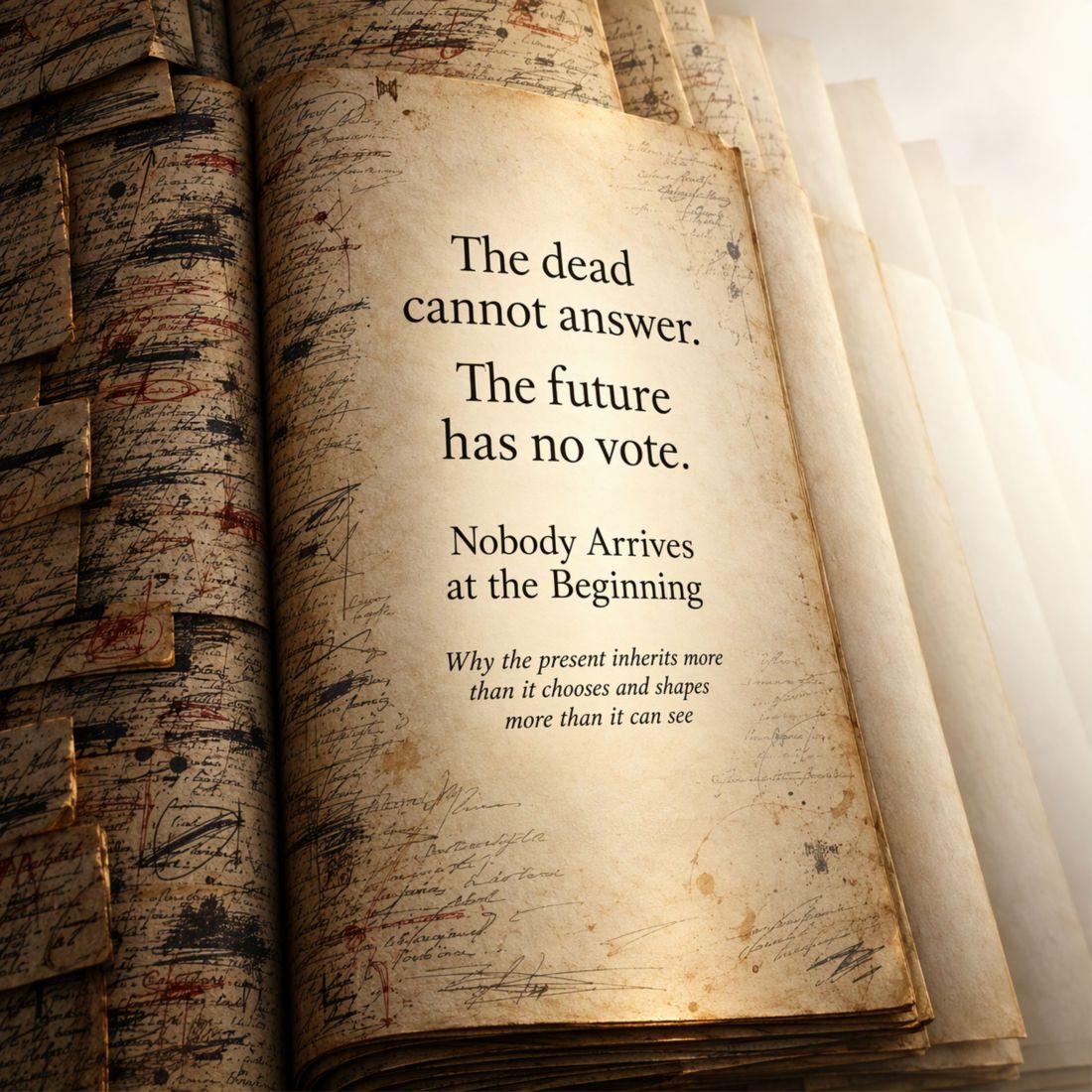
The dead cannot answer.
The future has no vote.
The first reflects a limitation of historical understanding.
We can study the past, but we cannot ask it to respond.
The second reflects a limitation of political responsibility.
Future generations may live with the consequences of today’s decisions, but they cannot participate in making them.
Between those two silences sits the present.
Nobody arrives at the beginning
The deeper the inquiry goes, the harder it becomes to find anyone standing at the start of the road.
The people of the past inherited a world they did not create.
So do we.
Every generation enters the story in the middle.
Every generation mistakes some assumptions for reality.
Every generation leaves something behind.
The challenge is not to find the beginning.
The challenge is to understand our place within the process.
A final reflection
Future generations may look back on some of our assumptions the way we now look back on assumptions held by those who came before us.
The uncomfortable question is not whether this will happen.
The uncomfortable question is:
Which of our own assumptions will seem obvious, unquestioned and mistaken to those who come after us?

