
Glyphosate is back in the headlines, and with it comes a familiar script. Industry spokespeople reassure us. Politicians hedge. Commentators warn that without chemicals like this, farming would grind to a halt.
The result is a picture of modern agriculture as a system so fragile it cannot function without constant industrial intervention.
But glyphosate is not the whole story. It is a symptom of a wider model: a food system built on extraction, dependency and the assumption that living systems must be subdued, corrected and endlessly supplemented rather than understood and supported.
The deeper problem is simple. We have built a system that works against ecological reality, then act surprised when the costs come back as poorer soils, resistant weeds, vulnerable supply chains and food that is plentiful in volume but weaker in trust, resilience and nutritional quality.
Weeds evolve resistance. Soils lose structure and biological richness. Crops come to depend on more inputs just to maintain output. Farmers become exposed to fuel, fertiliser, chemical and freight costs they do not control. And when the system shows its weaknesses, the answer is too often not a rethink but an escalation: more processing, more centralisation, more patents and more distance between people and the land that feeds them.
That is not resilience. It is fragility repackaged as innovation.
And it narrows our choices more than it should.
The Real Problem Isn’t Glyphosate – It’s the Story We’ve Been Sold
For decades we have been told that farming must be industrial, chemical, centralised and input‑heavy or it will not feed the world. But high output alone does not guarantee nourishment, security or health.
A food system should be judged not just by how much it produces, but by whether it delivers reliable access to good food, sustains the land that produces it and supports diets that help people thrive.
Feeding people is not just a transaction. It is a relationship between land, farmer, community, ecology and health.
The industrial model is organised around inputs, outputs, margins and efficiency. It can produce scale, but it can also treat soil as a medium, farmers as operators and food as a commodity first and nourishment second.
Local and shorter food systems offer a different balance, strengthening transparency, community participation and resilience while placing greater value on freshness, seasonality, dietary quality and stewardship.
Nature does not respond well to being treated as a production line. Food is better when it is produced in ways that respect ecological limits rather than deny them.
Soil Isn’t Dirt – It’s a Living World We Barely Understand
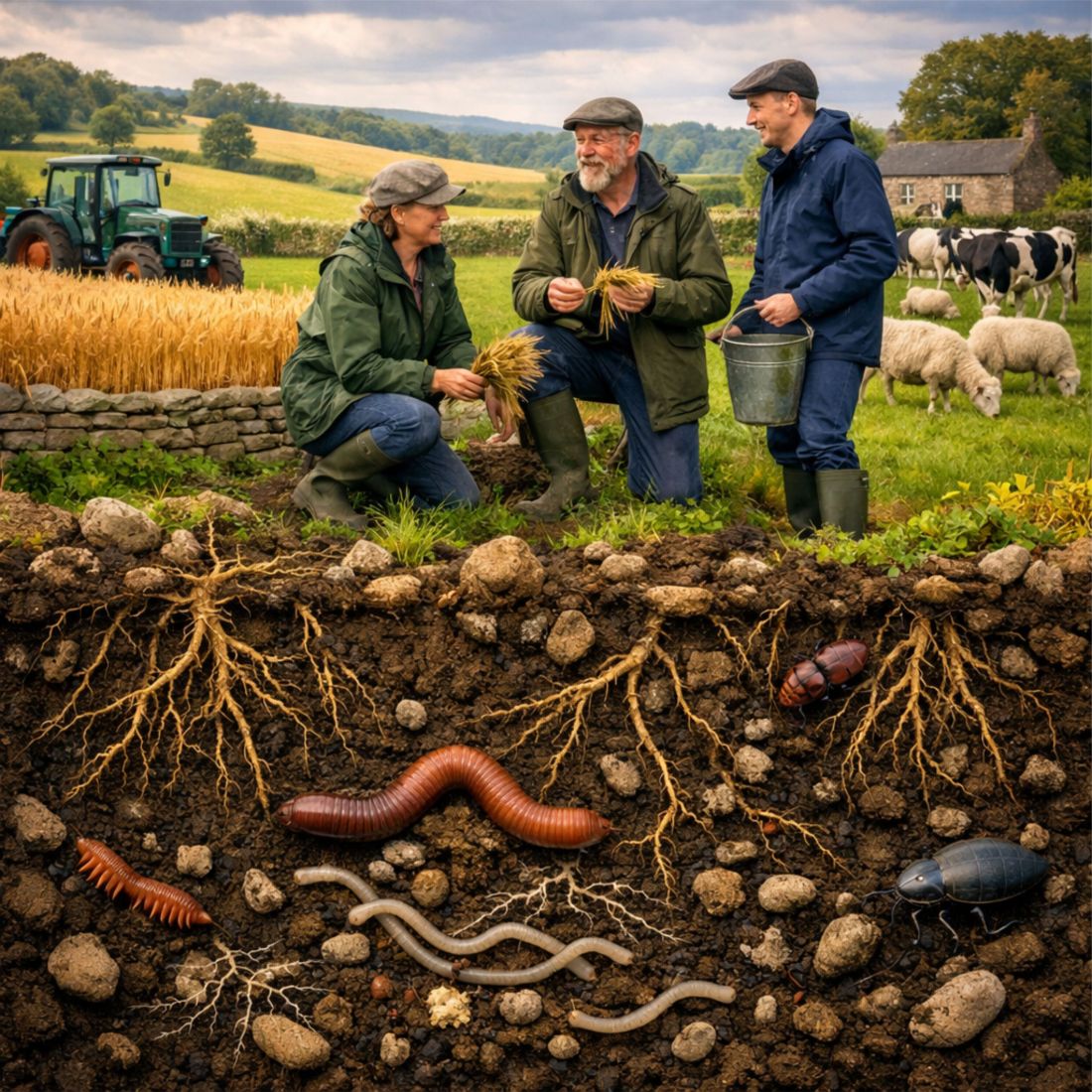
Soil is alive. Healthy soil is a dense biological community, and even a teaspoon can contain more microorganisms than there are people on Earth. That biodiversity underpins food production, water regulation and wider ecosystem function.
Yet we often manage it as if it were an inert surface.
Too often, we plough until structure is damaged, leave ground bare to erosion, rely on interventions that can disrupt soil biology and compact fields until water infiltration falls and roots struggle to penetrate. Then, when fertility and resilience decline, we respond with yet more inputs instead of asking what the land is telling us.
Soil is not simply failing. It is responding to how it is being treated.
That should give us hope. With cover crops, diversity, careful grazing, reduced disturbance and patience, soil can recover function, biological activity and water‑holding capacity.
Regenerative approaches are context‑specific, but when farming systems restore soil health they can also strengthen biodiversity, water cycles and long‑term productivity.
You can see it where cover crops return, where livestock are integrated thoughtfully into rotations and where farmers start reading the land as a living system instead of forcing it like a machine.
Nature is not waiting to be replaced. It is waiting to be worked in partnership with.
Regenerative Farming Isn’t a Trend – It’s What Happens When We Stop Breaking Things
Regenerative agriculture is often dismissed as a trend. A better way to see it is as an effort to restore ecological function to farming: healthier soils, more biodiversity, better water management and stronger resilience over time.
Outcomes vary by crop, place and management, but the core insight is simple: farming works better in the long run when it works with living systems rather than against them.
Many of the principles now described as regenerative are not new. They echo older forms of husbandry and land management shaped over generations by ecological reality: rotation, mixed farming, soil cover, local adaptation, careful grazing and fertility built through living cycles rather than permanent external correction.
Grow different crops in sequence so pests and weeds do not settle into a single pattern. Keep the soil covered so it retains moisture and resists erosion. Use animals well, where appropriate, to graze, fertilise and stimulate regrowth. Let roots, fungi and microbes do more of the work. Build local food systems that can supply fresher food, support seasonal diets, shorten the distance between producer and plate and reconnect nutrition with ecological care.
None of this is quaint. It is agronomy, husbandry and public health seen together instead of in fragments.
What is radical is the assumption that food security, ecological repair and nutritional wellbeing can be achieved by moving ever further away from land, season and biological reality.
Why This Conversation Still Struggles to Break Through
If approaches that rebuild soils, reduce dependency and strengthen local resilience have so much going for them, why are they still treated as marginal? Part of the answer lies in the incentives built into the current system.
Large industrial systems favour scale, standardisation and dependence on traded inputs.
That means continued reliance on chemical products, imported fertiliser, long supply chains and centralised processing and distribution models that reward volume and uniformity.
It also means approaches that return more knowledge, autonomy and adaptive capacity to farmers and communities can look inconvenient to a system organised around throughput rather than resilience.
This is not because local and regenerative systems are beyond criticism, or because they solve every problem. It is because they challenge the idea that dependence is inevitable.
A local, community‑rooted food system can diversify risk, shorten supply lines and strengthen accountability. It can also make it easier for people to know who is producing their food, improve access to fresh seasonal produce and reconnect diets with place, culture and stewardship.
These systems are not automatically perfect, but they should be treated as serious infrastructure for resilience, sustainability and nutrition rather than quaint side projects.
And that is where the real choice comes into view.
This Is Why We Need Foods We Can Trust
Everything I have said so far leads directly to the blueprint I set out in Foods We Can Trust.
The answer to the food crisis is not to swap one industrial dependency for another, but to rebuild the relationship between people, land, health and food in ways that restore trust and reduce extractive pressure on the systems that sustain us.
It means local growers feeding local people where possible. It means communities strengthening their own food capacity instead of relying entirely on distant systems. It means farming that rebuilds soil rather than exhausting it, and food that comes from functioning ecosystems and supports healthier, more balanced diets. It means resilience built from diversity, participation and stewardship rather than dictated from the top down.
We do not need to invent a wholly new food system so much as recover and renew wisdom we were too quick to dismiss as old‑fashioned.
The Future of Food Isn’t Synthetic – It’s Alive
If we want a food system that can survive the shocks ahead – economic, environmental and geopolitical – we should be honest about how brittle the present model can be.
Disruption in major shipping corridors such as the Red Sea and the Strait of Hormuz has underlined how dependent industrial agriculture is on uninterrupted flows of fuel, fertiliser and freight, and how quickly those pressures can feed into food security risks.
We do not need to replace nature. We need to stop mistaking dependence on industrial intervention for progress.
The sooner we accept that, the sooner we can build a food system that is healthier, more trustworthy, more nutritionally grounded, more sustainable and more resilient because it is rooted in living soil, local capacity and a less extractive relationship with the natural world.
That future is not a fantasy or a retreat. It is a practical choice to build food systems that work with nature, support human health and give communities a greater stake in how they are fed.
The question is not whether such a future is possible, but whether we are willing to back it.

