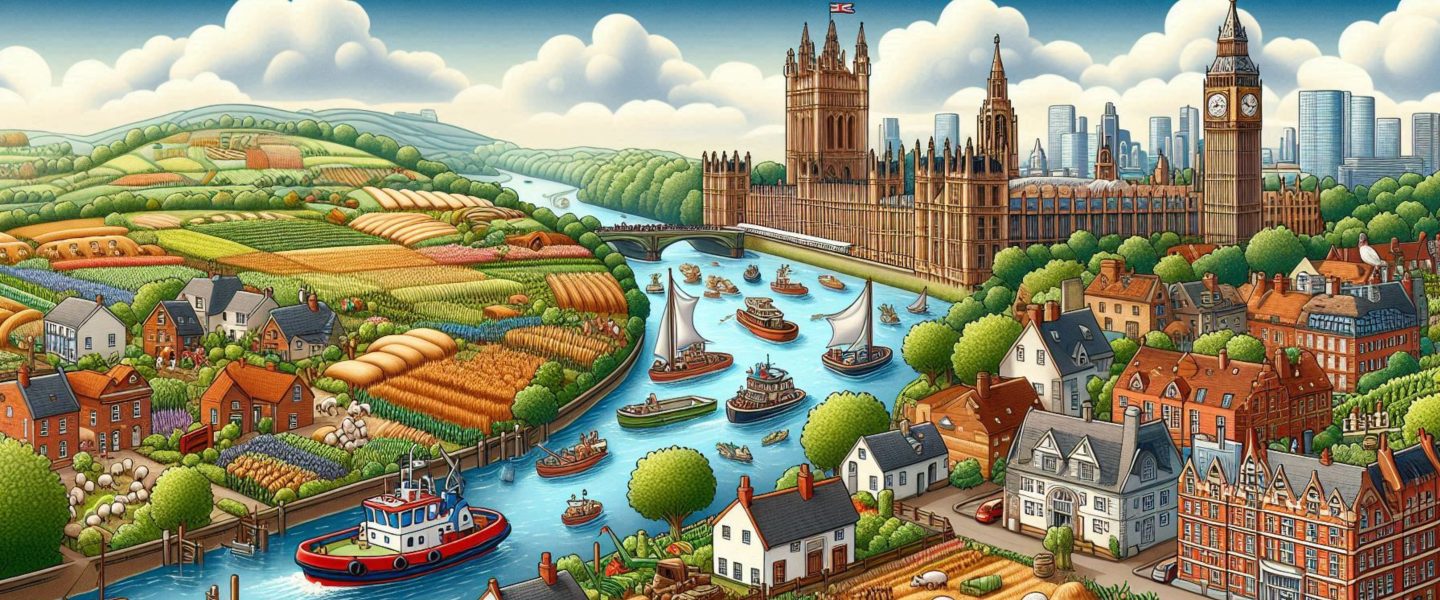
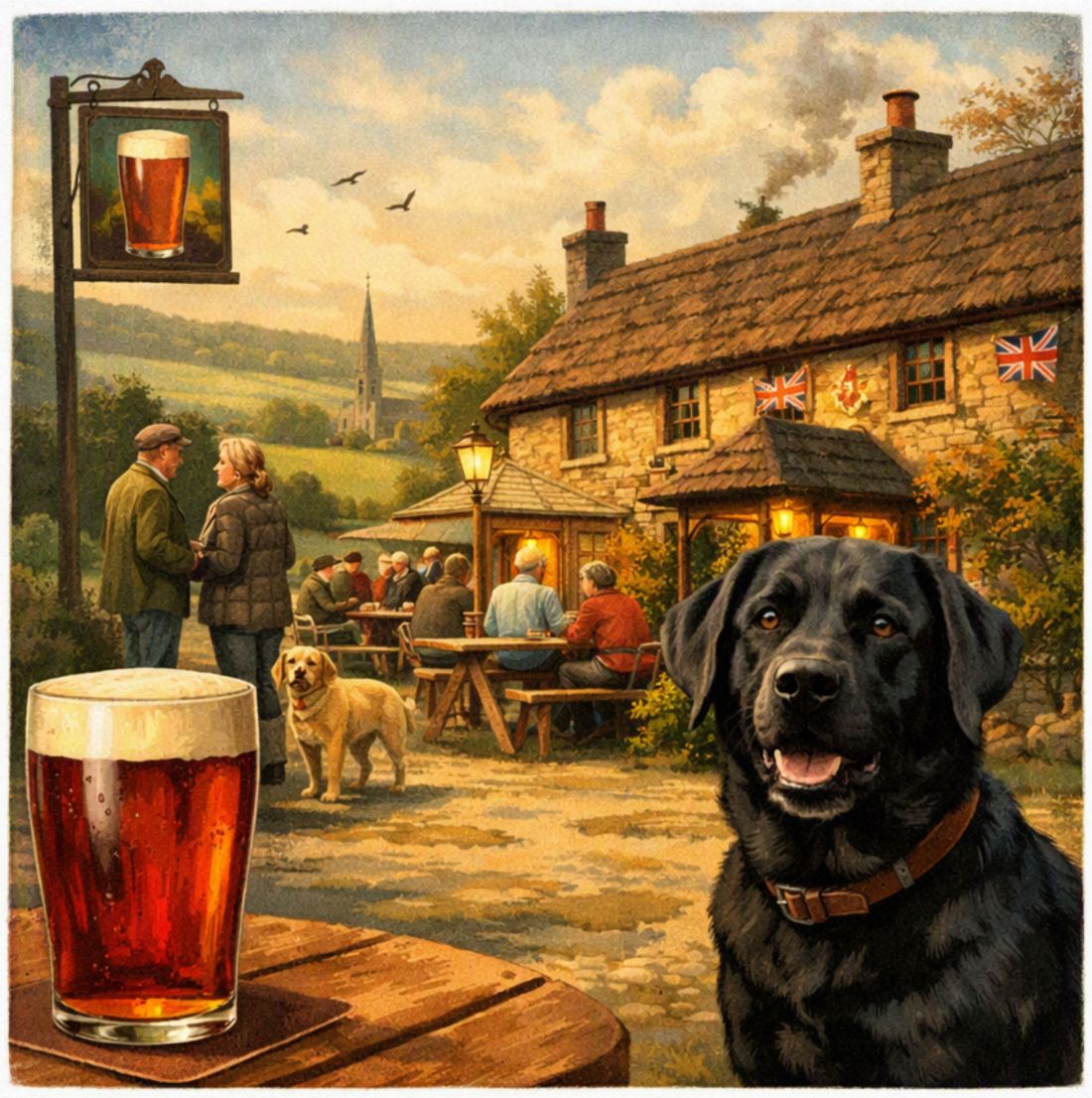
Ambient Real Ale, country pubs with roaring log fires, and Labradors in every direction are good for everyone. We should be working to make that kind of reality accessible to all – not wasting the opportunity to do sober, constructive good for everyone by telling those who already enjoy it that they are somehow wrong.
When public figures reach for phrases like warm beer, pubs and black Labradors as shorthand for “right‑wing” Britain, it reflects a wider trend in our politics: cultural point‑scoring that reduces shared experiences to partisan symbols.
It’s not about the individual who said it. It’s about how easily our national conversation now slips into caricature.
The irony, of course, is hard to miss. “Warm beer” is an old Americanism – a cliché used for decades to caricature British culture. But historically, ambient or cellar‑temperature ale was a working‑class staple, not a symbol of privilege. For much of the industrial era, beer was safer to drink than water in many towns, and pubs were the informal meeting places where early trade unionism and the Labour movement itself took root.
The idea that warm ale or country pubs belong to one side of the political spectrum simply doesn’t stand up to history. When these things are casually labelled as partisan, it shows how disconnected our political shorthand has become from the realities that shaped British life.
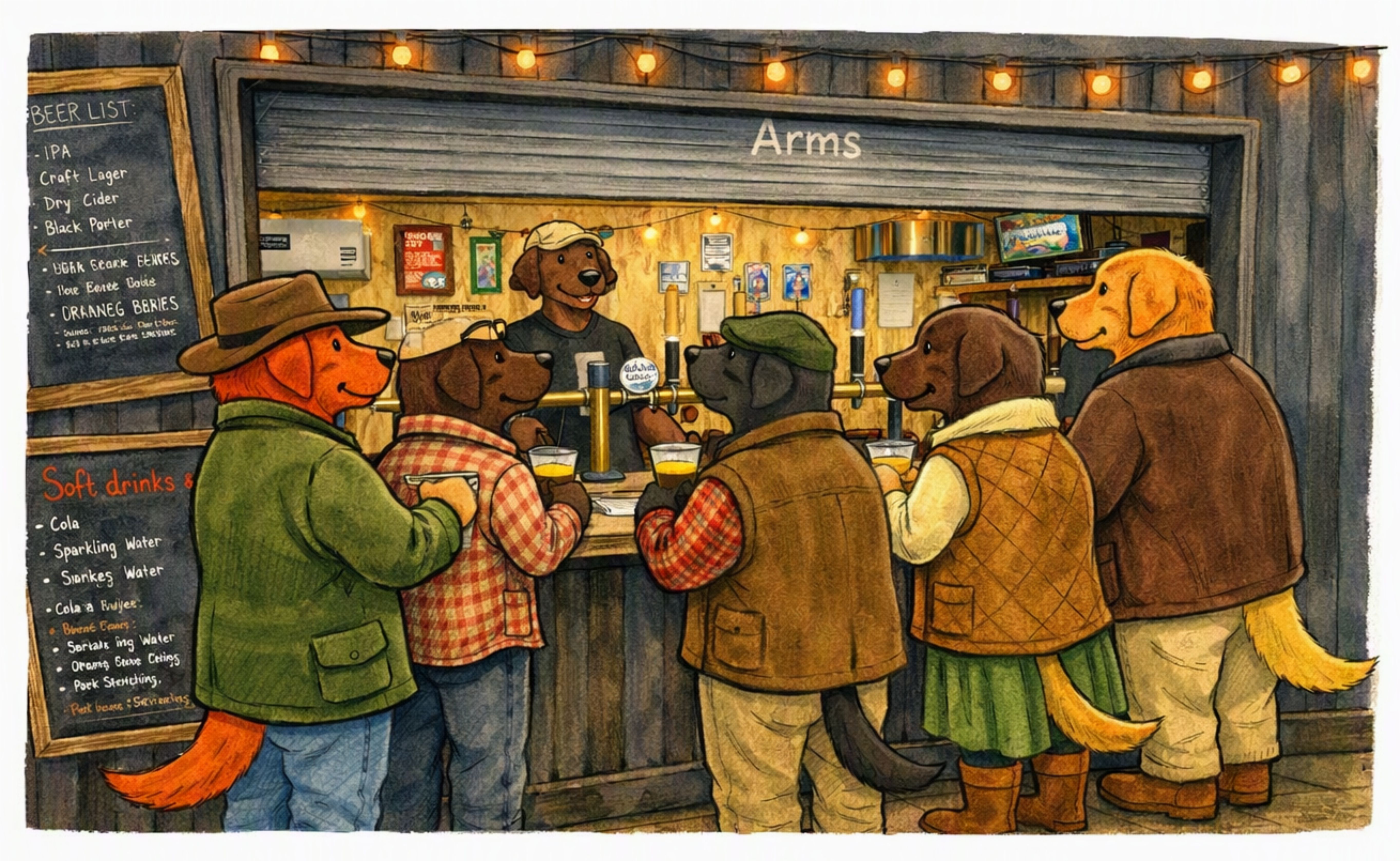
A few weeks ago, we dropped into Jeremy Clarkson’s Hawkstone Arms for a pint and one of the fantastic burgers from the van. We arrived around midday on a Saturday. The marquee adjoining the array of reutilised shipping containers – now a bar, an outlet for the Diddly Squat shop and a meeting room – added just one more ingredient to the long line of things that have made Clarkson’s post‑motoring‑journalism destiny so much more than anyone expected. And the thing that topped it all off, the detail that made this makeshift bar in the middle of the Cotswolds work even better, was the line of smiling Labrador‑led couples and families emerging through the open flap door.
‘Labradors are Always Welcome’ – Inspired by The Hawkstone Arms
I’ve seen this scene repeated many times before. Not just in Gloucestershire, but across the UK. On an autumn or winter afternoon, the presence of a happy Labrador, a pint of genuine British Real Ale – kept ambient or cellar‑cool because its ingredients demand it – and even a countryside uniform or two, gives a warm and cheery feeling. More importantly, it offers a fitting reminder of what British pubs are really all about.
I’ve written before about the realities beneath the troubles facing the hospitality and pub trade – realities that have far more to do with political decision‑making on all sides than any of our political class might like to admit. (For anyone who wants the deeper dive, the piece is here: The Pub Crisis)
Before going further, I’ll again say that the trade doesn’t always help itself. In an age when normal life is quickly becoming unaffordable, people of all backgrounds know the difference between good and bad value – whether it’s a pint or a basket meal. Being able to discern between a good and bad pint based on who brewed it and where is becoming more important than ever when deciding whether to return somewhere.
Pubs are in trouble. And whilst those who have an issue with alcohol consumption may be quietly thrilled, anyone celebrating the demise of the British pub – and any scene that captures what it represents for community, socialising, enjoying a trip out, or conducting formal and informal business alike – is overlooking something fundamental.
The loss of such places within every community, Labradors and country attire or not, illustrates one of the greatest travesties unfolding across our society. We are having every framework, guardrail and infrastructural rite of passage stripped away.
The outcome is that young people and upcoming generations are losing the opportunity to learn life and social skills through their environment – skills everyone used to absorb naturally.
Whether politicians choose to caricature this as a bucolic dream or rural idyll, whether they see it as a convenient way to talk up division between us in terms of an increasingly misappropriated left and right, the point is being missed.
The problems our legislators may hope to solve in Westminster are effects that all drill down to the same underlying causes. And one of the factors making everything worse is the political desperation to keep our current economic and governance model going – a forlorn attempt to stop it from imploding.
This desperation produces a constant flow of comments, narratives and policies that work in isolation, cherry‑picked to play to certain tastes and audiences. And when set out without any consideration for the interconnectedness of public policy or what’s really happening under the surface, they simply make everything worse.
The role of money, wealth and profit play a significant role in the ills of our society, and we will all have to face up to that before very long. But aspiring to be like others, improving ourselves, and spending time in environments that feel good for us is not always part of that problem.
It’s regrettable that our public conversation so often drifts into framing ordinary parts of British life and culture as symbols of division, when they are anything but. Nobody benefits from that. It distracts from the real issues changing lives and communities across the UK – issues that deserve far more attention than cultural shorthand ever receives.
Warm beer, country pubs, and Labradors aren’t right‑wing. They’re part of a shared cultural inheritance – one that should be protected, expanded, and made accessible to everyone.
The tragedy is not that some people enjoy these things. The tragedy is that fewer and fewer people have the chance.
A clear explanation of the real issues behind the narratives and optics – including affordability, access, and the catch‑22 facing farmers
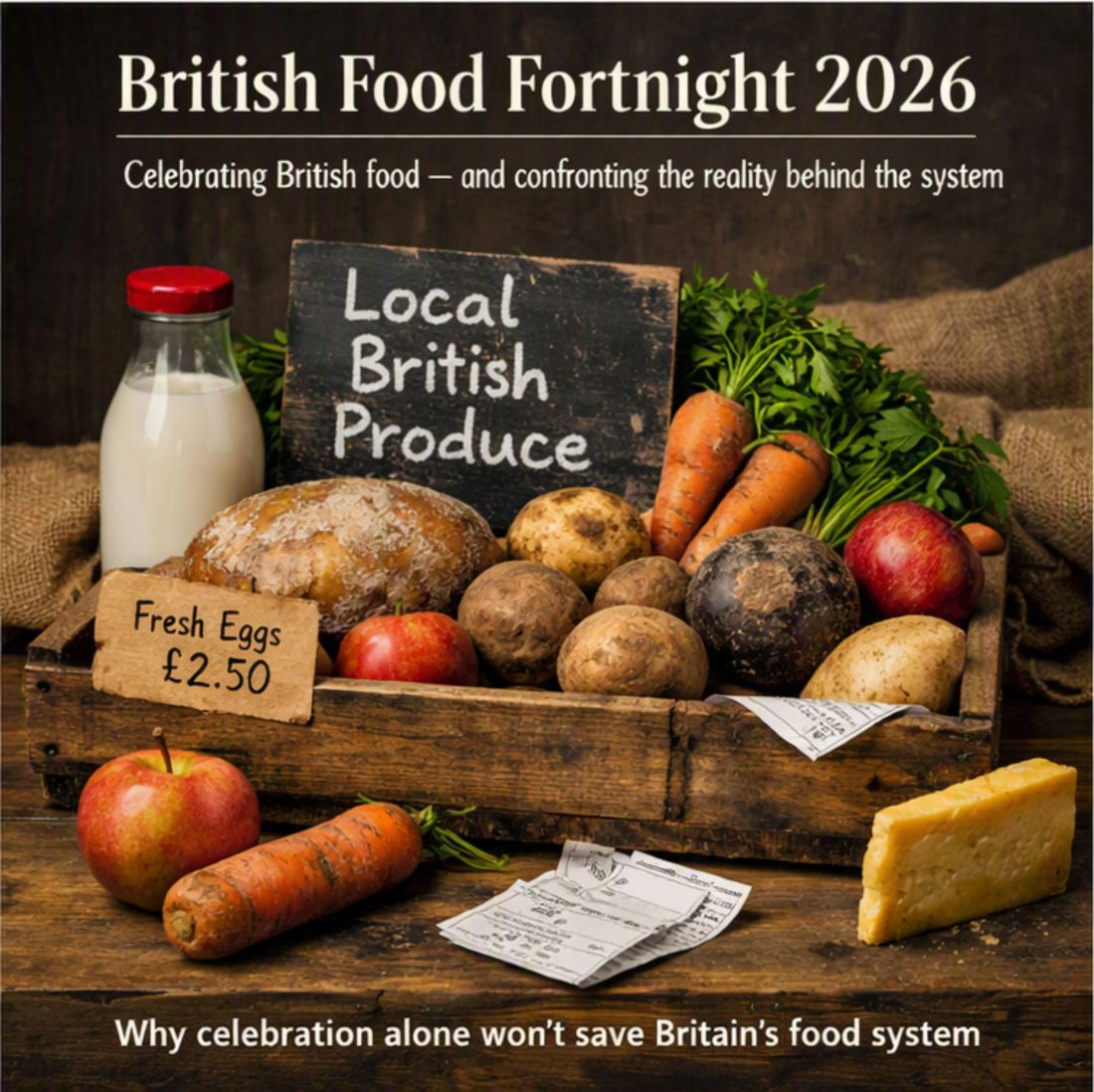
British Food Fortnight is a chance to celebrate the best of British farming, British production, and the local shops that keep our communities fed. And there is a lot to celebrate. British food is produced to some of the highest standards in the world. It’s part of our identity, our culture, and our future.
But celebration alone won’t fix what’s going wrong.
Behind the harvest festivals, seasonal menus, and cheerful messaging, the UK food production and food supply system is becoming more fragile every year. Not in a dramatic, headline‑grabbing way – but in a slow, structural way that most people never see.
And that’s the problem.
We are living with a food system that looks stable on the surface, but underneath it is a ticking time bomb.
UK Food Supply is insecure, NOT because farmers are failing. Not because consumers don’t care. But because the foundations of the system have been quietly weakened over decades.
British Food Fortnight should be the moment we talk about this honestly.
What’s genuinely worth celebrating
British food has real strengths:
Farmers who produce food to world‑leading standards.
Local retailers who keep regional supply chains alive.
Small producers whose craft gives British food its character.
Communities that choose British when they’re given the option.
These strengths deserve recognition. But they also deserve protection – and right now, they’re under threat.
The truth most people never hear
Here is the reality that rarely makes it into public conversation:
Britain is gradually losing the ability to feed itself.
Not because we lack land. Not because we lack farmers. Not because we lack demand.
But because the system has been reshaped around priorities that have nothing to do with food security.
The evidence is clear:
Domestic production is declining.
We rely more on imports every year.
Small producers and local shops are disappearing.
Local infrastructure – abattoirs, cold stores, distribution hubs – has been dismantled.
Supply chains are controlled by fewer, larger players.
Government messaging often paints a picture of stability that doesn’t match reality.
This isn’t a prediction. It’s already happening.
Why the system is fragile – explained simply
Most people assume food arrives in shops because “the system works”.
But the system only works when all the parts work together.
Right now, several of those parts are failing:
Costs are rising faster than farm incomes.
Labour shortages mean crops go unpicked.
Energy volatility makes planning impossible.
Local processing facilities have closed.
Retail price pressure squeezes producers.
Climate instability disrupts yields.
Policy focuses on schemes, not production.
When you add these together, you get a system that looks fine – until something goes wrong. And when it does, there’s no slack, no buffer, no resilience.
That’s the ticking time bomb – and that’s before we even begin thinking about other world events.
The affordability problem: the part nobody wants to talk about
There is another uncomfortable truth:
The small amount of British food that reaches consumers directly is unaffordable and inaccessible for many people.
Not because farmers are greedy. Not because local shops are elitist. Not because consumers don’t care.
It’s because the system forces farmers and local retailers into a corner:
Their costs are higher.
Their margins are thinner.
Their volumes are smaller.
Their infrastructure is weaker.
Their competition is global, industrial, and subsidised elsewhere.
Farmers who sell direct or through very localised chains are often struggling financially. They cannot drop prices without losing money. They cannot scale without infrastructure. They cannot compete with global imports on price. And they receive no structural support to make local food affordable.
This is the catch‑22:
The food people most want to buy – local, British, trustworthy – is the food farmers can least afford to sell cheaply.
Unless the system changes, this will never change.
Why this matters for food security
When local food becomes unaffordable, people turn to cheaper, imported, often processed food which is not as healthy or nutritious. When farmers can’t sell locally, they stop producing locally. When local shops close, communities lose access to British food entirely. When small producers disappear, diversity disappears. When diversity disappears, resilience disappears.
Affordability isn’t a side issue. It’s a structural warning sign.
A food system that cannot provide affordable local food to everyone is a food system that is already failing.
Real collaboration vs policy collaboration
There is a simple but important distinction in the UK food system – and understanding it explains why things keep getting worse instead of better.
Real collaboration
Real collaboration is what happens when farmers work directly with each other, with local businesses, and with the communities they feed.
It looks like:
farmers sharing equipment and knowledge
coordinating production so everyone benefits
rebuilding local infrastructure together
connecting directly with local retailers and consumers
creating practical, ground‑up solutions to real problems
This kind of collaboration strengthens the system because it is built around the people who actually produce and eat the food. It builds resilience. It builds affordability. It builds trust.
Policy collaboration
Policy collaboration is what government, large industry bodies, and many advocacy organisations call “collaboration”.
It looks like:
schemes
metrics
targets
environmental delivery
compliance
reporting
meetings
consultations
It sounds like collaboration, but it isn’t. It doesn’t rebuild infrastructure. It doesn’t reduce costs. It doesn’t strengthen local supply chains. It doesn’t make British food more affordable or accessible.
It organises farmers around policy goals – not food security, not community needs, and not the long‑term health of the food system.
Why this distinction matters
Many farmers are still hoping for help from the same institutions that have shaped the system into its current fragile state. They hope for support from government. They hope for representation from advocacy organisations. They hope for change from industry bodies.
But these organisations often prioritise maintaining good relationships with government and large industry players over representing the people who actually produce the food.
This is not a criticism of individuals – it is a structural reality.
When the priority is “staying at the table”, the people who need the most help – farmers, small producers, local retailers – are the ones whose voices are softened or sidelined.
The missing relationship: farmers and consumers
The most important relationship in the food system – the one that should shape everything – barely exists in any meaningful way.
Farmers and consumers are the two principal stakeholders in the food chain. One produces the food. The other eats it.
Yet they rarely speak to each other. They rarely understand each other’s pressures. They rarely collaborate. They are kept apart by layers of policy, industry, and supply‑chain intermediaries.
This separation is one of the biggest reasons the system is failing.
What real collaboration must look like
Real collaboration must be:
ground‑up, not top‑down
farmer‑led, not policy‑led
community‑facing, not industry‑facing
consumer‑connected, not consumer‑distant
practical, not theoretical
people‑first, not profit‑first
It must work with frameworks and governance – but not be dictated by them.
Policy should support direction, not set it.
Because when profit, metrics, and economic modelling set the agenda, people – farmers, consumers, communities – are pushed to the margins.
And when people are pushed to the margins, resilience disappears.
The bottom line
Britain does not need more schemes, consultations, or policy‑driven “collaboration”. It needs real collaboration – built by farmers, supported by communities, connected to consumers, and strengthened by local businesses.
A food system built around people will always be more resilient than a food system built around profit and policy.
And until we make that shift, the system will continue to weaken, no matter how many times we celebrate it.
The constructive path forward
The solution is clear:
Rebuild local food systems through real, farmer‑led collaboration – and support them so local food becomes affordable.
That means:
Rebuilding local infrastructure
Restoring local processing and distribution
Aligning farmers with local industries
Creating farmer‑employed coordinators
Strengthening business‑level resilience
Supporting local retailers
Making local food affordable through structural support
Reconnecting communities with the people who feed them
This is practical. This is achievable. This is already happening in pockets across the country.
British Food Fortnight should be amplifying this, not distracting from it – however much we need the message about what makes everything good about British Food championed.
A closing thought
British food is worth celebrating. But celebration without honesty is part of the problem.
If British Food Fortnight is going to matter, it must confront reality – not hide it. It must champion British producers while acknowledging the fragility of the system behind them. It must support local retailers while recognising how close many are to disappearing. It must make local British food affordable and accessible – not just admirable. It must celebrate British food while fighting for the ability to keep producing it.
Because if we lose the ability to feed ourselves, everything else becomes negotiation.
Further Reading
A guided collection of articles that explain the UK food system clearly and simply
1. The Fragile Nation: Why Britain Can No Longer Rely on a Global Food System
A long-form, accessible analysis of the UK’s declining food production capacity and rising systemic risk
Introduction: A report that tells the truth without meaning to
The Government’s newly published Farming Evidence Pack: A high-level overview of the UK agricultural industry is, on the surface, exactly what it claims to be: a statistical snapshot of British farming. It lists land use, production volumes, livestock numbers, farm incomes, and environmental indicators. It is calm, neutral, and presented without commentary.
But the timing of this report is extraordinary.
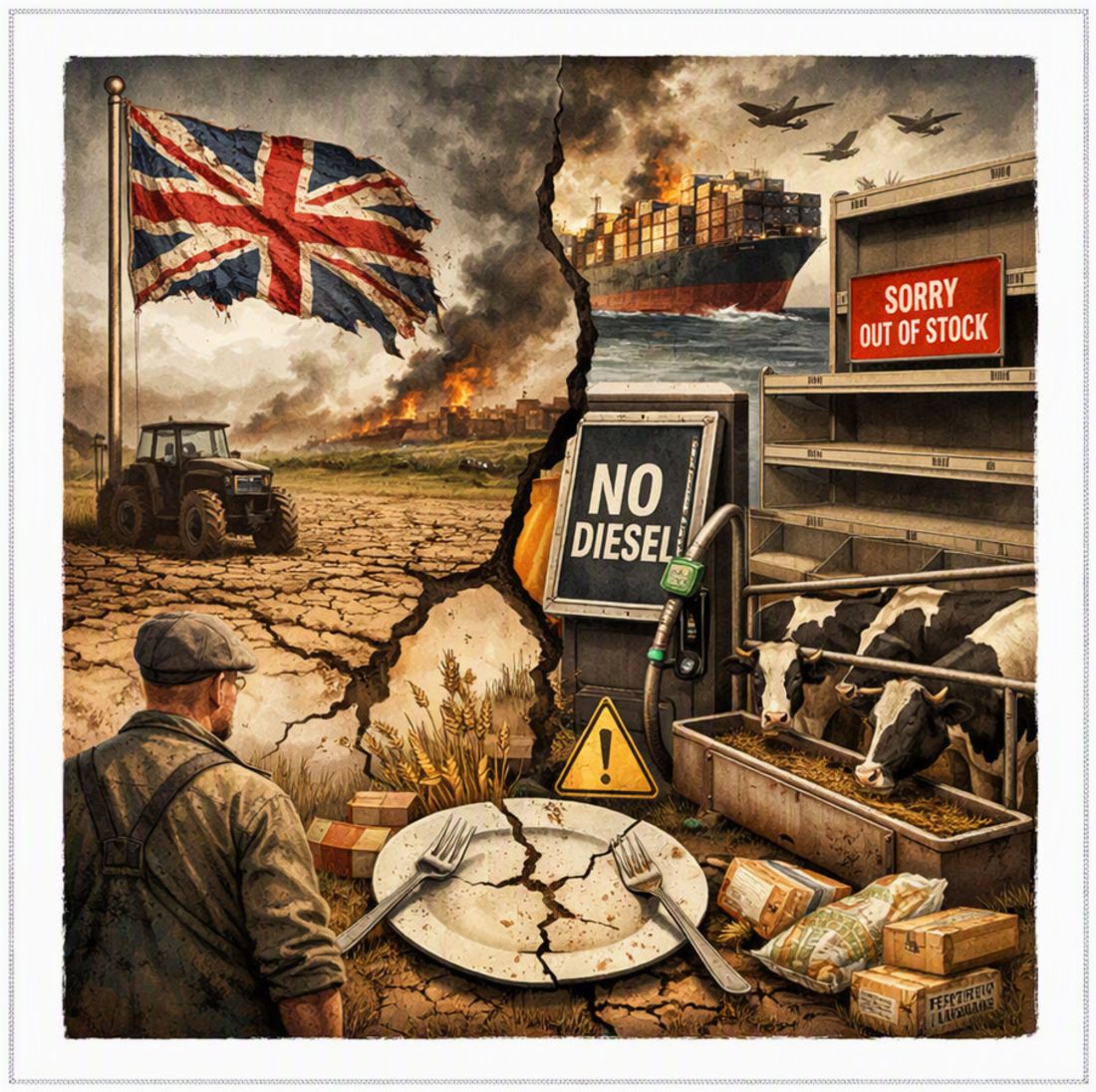
It arrives at the very moment when the global supply chain is showing signs of critical fragility. It arrives as shipping through the Strait of Hormuz is under threat, and as diesel shortages are being openly discussed in industry circles. It arrives when farmers, hauliers, processors and retailers are already dealing with rising costs, shrinking margins, and unpredictable supply.
And it arrives at a time when the UK’s own native food production capacity is going backwards.
The report does not say this directly. It does not frame its numbers as a warning. But when you read the data in context – not the context of government narrative, but the context of how food systems actually work – the message becomes unavoidable:
Britain is producing less of its own food, relying more on large corporate operations, and becoming more dependent on a global supply chain that is itself at risk of failing.
This is the opposite of resilience. This is the opposite of security. And this is happening at the exact moment when we should be building capacity at every level.
1. What the Evidence Pack actually shows – if you read it honestly
The pack is not a policy document. It does not tell you what to think. It simply presents numbers.
But those numbers tell a story that is very different from the one government spokespeople and industry bodies prefer to tell.
1.1 Land used for food production is declining
The total agricultural area may look stable, but the land actually used for food production – especially croppable land – is shrinking.
More land is tied up in schemes, non-food uses, or left uncropped. The UK is producing less food on less land.
1.2 Livestock numbers are falling
Cattle, sheep and pig numbers have all declined. Poultry is volatile. These are not small fluctuations – they are structural reductions in the national herd.
1.3 Small and medium farms are disappearing
The pack shows a clear trend: fewer farms overall, and a growing share of production concentrated in larger, corporate-style operations.
Mixed farms – the most resilient type – continue to decline.
1.4 Crop output is unstable and trending downward
Cereal yields fluctuate wildly. Horticulture remains stagnant or shrinking. Sugar beet, potatoes, oilseeds – all show signs of long-term decline.
1.5 Farm profitability is increasingly dependent on price spikes
Farm Business Income rises only when global prices spike. When prices fall, incomes collapse. This is not stability – it is volatility disguised as success.
1.6 The UK’s food production system is becoming more concentrated, more fragile, and more dependent on external inputs
This is the most important point. And it is the point the report never names.
2. The pack’s biggest omission: dependency
The Evidence Pack measures output. It does not measure dependency.
It counts what we produce. It does not count what we rely on.
It tells us how many tonnes of wheat we grow. It does not tell us how much fertiliser, diesel, machinery, chemicals, packaging, feed and energy we import to grow it.
It tells us how many cattle we have. It does not tell us how dependent those cattle are on imported feed, imported medicines, imported genetics, imported equipment, imported fuel.
It tells us how much land is farmed. It does not tell us how much of that land is viable without global inputs.
It tells us how much food we export. It does not tell us how much of that export value is used to pay for the food we import.
In other words:
The pack describes a system that only works if the global supply chain keeps working.
And right now, that assumption is no longer safe.
3. The global supply chain is becoming critically fragile
This is not speculation. It is observable reality.
3.1 Diesel is the single point of failure
Every part of the UK food system depends on diesel:
tractors
combines
sprayers
feed deliveries
livestock transport
milk tankers
grain haulage
refrigerated distribution
supermarket logistics
emergency response
If diesel becomes scarce or unaffordable, the numbers in the Evidence Pack become meaningless.
3.2 Hormuz is a live stress test
The UK imports most of its diesel. Much of that supply depends on shipping routes that are now under threat.
If shipping slows, reroutes, or becomes more expensive, the UK will face:
rising fuel prices
rationing
delivery delays
reduced haulage capacity
prioritisation of high-margin routes
cold-chain failures
regional shortages
This is not a theoretical risk. It is a real-world scenario unfolding in real time.
3.3 The UK’s food system cannot operate without global inputs
The Evidence Pack does not mention:
imported fertiliser
imported feed
imported chemicals
imported machinery
imported packaging
imported energy
imported labour
imported ingredients
imported logistics capacity
But every one of these is essential.
The UK’s food system is not independent. It is not sovereign. It is not resilient.
It is globalised, corporatised, and critically exposed.
4. The consolidation problem: why corporate-scale farming is a systemic risk
The pack shows a clear trend: production is increasingly concentrated in fewer, larger operations.
Government and industry present this as efficiency.
But efficiency is not resilience.
Large-scale operations:
rely heavily on imported inputs
require stable global markets
depend on just-in-time logistics
cannot easily adapt to fuel shortages
cannot quickly change production models
cannot operate without machinery, chemicals, and energy
cannot feed local communities directly
cannot survive prolonged disruption
Small and medium farms:
are more adaptable
are more diverse
are more locally connected
are more resilient
are more capable of feeding communities
are less dependent on global inputs
are disappearing
This is the opposite of what a country facing food insecurity should be doing.
5. The illusion of self-sufficiency
The pack does not discuss self-sufficiency directly, but its numbers feed into the narrative that the UK is “around 60% self-sufficient”.
This figure is misleading.
It is based on:
value, not calories
production, not availability
exports counted as domestic output
imports assumed to be stable
global inputs ignored
processed food counted as UK production even when ingredients are imported
If you measure:
calories
nutrients
local availability
independence from imported inputs
ability to operate during disruption
The UK’s real independent food production capacity (i.e. Production that goes directly to consumers and would be immediately available in a crisis) is closer to 11%.
The Evidence Pack does not contradict this. It quietly confirms it.
6. What the pack should have said – but didn’t
If the report were honest about the implications of its own data, it would say:
The UK is producing less food.
The UK is losing small and medium farms.
The UK is becoming more dependent on large corporate operations.
The UK is becoming more dependent on global inputs.
The UK is becoming more dependent on imports.
The UK is becoming more vulnerable to global disruption.
The UK is not building capacity at every level.
The UK is not prepared for supply chain shocks.
The UK is not food secure.
But it does not say any of this.
It presents the numbers without context, allowing government and industry to continue telling the story that everything is broadly fine.
Everything is not fine.
7. What we must do now
The Evidence Pack should be a wake-up call. Not because the numbers are shocking, but because they are normalised.
We must:
rebuild small and medium-scale farming
restore mixed farming
increase local food production
shorten supply chains
reduce dependency on imported inputs
strengthen community-level resilience
rethink land use
support farmers directly, not through corporate intermediaries
measure food security honestly
plan for disruption, not assume stability
This is not about nostalgia. It is about survival.
Conclusion: The truth behind the numbers
The Farming Evidence Pack is not wrong. It is incomplete.
It tells us what we grow. It does not tell us what we depend on.
It tells us what we produce. It does not tell us what we can sustain.
It tells us what exists today. It does not tell us what will fail tomorrow.
The overriding message – the message the report never states but cannot hide – is simple:
Britain’s native food production capacity is declining, our dependence on large corporate operations is increasing, and the global supply chain we rely on is becoming critically fragile.
We should be building capacity at every level. Instead, we are dismantling it.
And at the very moment when the world is showing us how fragile the system is – through diesel shortages, shipping disruption, and geopolitical instability – we are doubling down on the model that cannot survive disruption.
The Evidence Pack is not reassurance. It is a warning.
And we ignore it at our peril.
Further Reading
If you’d like to explore the wider context behind Britain’s declining food production capacity, rising dependency, and the fragility of the global supply chain, the following pieces offer deeper insight. Each one expands on a different part of the story – from the illusion of self‑sufficiency to the risks hidden in our national food strategies – and together they build a clearer picture of why the Farming Evidence Pack matters so much right now.
Feeding Britain on Eleven Per Cent: Farming Inflation and the Illusion of Food Security
This piece breaks down the myth that Britain is “around 60% self‑sufficient” and explains why the country’s real independent food production capacity is far lower. It shows how official statistics mask dependency on imported inputs, processed food, and global supply chains – and why this leaves us exposed when disruption hits.
Response to NAO Report: Resilience of the Food Supply Chain to Disruptions (September 2026)
A direct challenge to the official narrative that the UK food system is resilient. This response highlights how fuel shortages, shipping disruption, and logistical fragility are consistently underestimated – making it a vital companion to the diesel and Hormuz concerns raised in the Farming Evidence Pack analysis.
Foods We Can Trust: A Blueprint for Food Security and Community Resilience in the UK
This is a practical vision for what real food security looks like. It focuses on trust, proximity, and community‑level capacity – offering a grounded alternative to the globalised, corporate model that the Evidence Pack quietly reveals as increasingly fragile.
Response to the Farming Roadmap 2050: A Blueprint for Dependency and Why Britain Must Choose a Different Future
A deep dive into how long‑term policy is steering British agriculture toward greater corporatisation and dependency. This piece shows how the trends identified in the Evidence Pack – fewer farms, larger operations, and rising reliance on global inputs – are not accidents, but the result of deliberate strategic choices.
The Real Implications of the UK’s Food Strategy 2025
This piece unpacks how government strategy documents present dependency as innovation and fragility as progress. It’s an essential read for understanding why the Farming Evidence Pack’s silence on systemic risk is part of a much wider pattern.
A Few Thoughts on Minette Batters’ Farming Profitability Review (FPR)
This reflection explores how farming profitability is measured – and mismeasured – in the UK. It reinforces the point that rising Farm Business Income often reflects volatility, not stability, and why headline figures can hide the real pressures facing farmers.
If you’re reading this, something probably doesn’t feel right. The world feels unstable. Life feels harder. The things we used to rely on don’t seem to work anymore.
You’re not imagining it – and you’re not alone.
This space exists to help you make sense of what you’re feeling. Not with jargon. Not with politics. Not with complicated theories. But with clear, honest questions – and answers designed to help you think, not tell you what to think.
When things stop making sense, most of us end up asking the same questions, even if we never say them out loud. These nine questions form a pathway – a sequence that moves from confusion to clarity, from instability to understanding. Each question builds on the one before it, guiding you step by step through what’s happening and what comes next.
How to Use This Booklet
Start at Question 1 and move forward in order. Each question opens the door to the next, helping you see how the pieces fit together.
If one question feels especially relevant, you can begin there – but returning to the sequence will help you see the full picture.
Take your time. Reflect. Pause between questions. This isn’t a race; it’s a process of orientation.
The Nine Questions
Why does everything feel unstable?
Why is government not working?
Why isn’t there enough money?
Why is food supply becoming unstable?
Why are politicians not listening?
What’s actually going on?
What comes next?
What can we do locally?
Who should I trust when everyone is claiming to have the answers?
You don’t need to rush. You don’t need to read everything at once. Start with the question that feels closest to what you’re experiencing. Each page is written to help you think clearly, feel grounded, and see the bigger picture without being overwhelmed.
Once you’ve explored the questions that matter to you, you’ll find links to deeper explanations, ideas, and practical steps. These aren’t theories or political arguments – they’re frameworks for understanding what’s happening, and for building what comes next, together.
Whatever you’re feeling right now, you’re not alone. You’re not imagining it. And you’re not powerless.
The future isn’t something that will be decided for us – it’s something we will shape together.
If you’re ready, begin with Question 1: Why does everything feel unstable?
Why does everything feel unstable?
Let’s jump straight in. Things feel unstable because they are unstable.
You’re not imagining it. You’re not being dramatic. You’re not “doomscrolling yourself into a panic.” Much of what we see in the world outside our homes and communities is breaking down – and the reason so many of us have been questioning ourselves is because the people who have power and responsibility keep speaking and acting as if nothing is wrong.
Government isn’t functioning. Politics isn’t working. The public sector isn’t delivering. The prices of everything are becoming increasingly unaffordable. People sound angrier than they used to. The world outside our doors doesn’t feel safe.
And while there are plenty of loud voices shouting about what’s wrong, very few of them offer ideas or solutions that actually sound like they would work. Most of what we hear either feels too simplistic or too complex to make any sense of.
I’m not going to try to talk you through every reason things have become as unstable as they are – not here. There’s simply too much to cover, and trying to cram it all into one place would overwhelm you rather than help. If you want to understand what’s happening, why it has happened, and what we all need to start thinking about next, I can point you to other pieces that will help you ask the right questions and find your footing.
What you do need right now is space. Space to think. Space to ask questions. Space to connect with people who are putting reason before fear and who want to find a way forward that works for everyone – not just for themselves.
And you shouldn’t feel bad for asking this question. Many others are having the same thoughts and feelings you are.
Mainstream media talks around the edges of what matters, touching the surface but rarely explaining anything in a way that helps. Social media is full of people saying the things we want to hear – confirming that our feelings are real – but that’s usually where it stops.
The time has come to look, ask, read, listen, consider, and act in ways that make sense to you, rather than relying on what someone else says.
You’re not alone in feeling this way. And you’re not wrong to ask.
You might be surprised at how many people are asking this same question. But you probably won’t be surprised at how many people also think they already know the answer – and believe they’re “right.”
Talking about government is tricky because it almost always drags us straight into politics. And once politics is involved, most of us start thinking about whichever party or group we usually support. We judge how government is performing through the lens of who we voted for, who we like, or who we can’t stand.
I’m sure you can relate to feeling more forgiving when the people in charge are the ones you support – and much less forgiving when they’re not.
But here’s the part that’s hard for many of us to get our heads around:
It no longer matters.
The reason government isn’t working today has very little to do with politics in the way we usually think about it. That’s why you’ll hear people say things like “they’re all the same” or talk about a “uniparty.” It’s not that all politicians secretly belong to one big club. It’s that every political party we can choose from today is still part of the same way of thinking.
And that way of thinking – not a group of elites, not a secret organisation, not the banks or big business – is what has shaped every decision that has led us to where we are now.
This is what “the establishment” really means. Not a class. Not a conspiracy. A worldview.
A worldview that every major political party shares, even the ones that claim to be “anti‑establishment.” And once you understand that, you start to see why government feels stuck, confused, or unable to fix anything – no matter who gets elected.
How government works today – how politics works, how elections work, how decisions are made, and how those decisions affect you and me – is far too complex to cram into one message here. And trying to do that would only confuse things further.
Yes, we need to understand what has happened, why it has happened, and where politics is heading now. I’ll give you links that will help you explore those questions and ask new ones too.
But for now, what matters just as much – if not more – is finding others who are looking for direction, who want to put reason before fear, and who are open to working together to take positive steps in the same way.
Whatever difficulties lie ahead, we will be far better able to face them together than alone.
If you’ve been struggling and wondering how you’re supposed to keep going financially, you’re not alone. In fact, growing numbers of people have been struggling for a long time. What almost everyone who’s struggling shares is the feeling that they’re facing it by themselves – that this is somehow only happening to them, or worse, that it’s their own fault.
If this is how you feel, it’s important to understand something clearly: you are not alone, and you have not failed. Yes, a few people struggle because of mistakes they’ve made. But most of the people who are asking how they’re going to buy food, pay bills, or simply keep going haven’t done anything wrong. Prices have kept rising, wages haven’t kept up, and the gap between what life costs and what people earn has become impossible to bridge.
How money works today is far more complicated than most people – and even some economists – realise. There’s a lot to understand about why prices keep going up, why the value of the money in our bank accounts keeps going down at the same time, and why it always feels like we’re the only ones who can’t keep up. If you want to begin understanding what’s really happening with money, I’ll share links that will help you start asking the right questions and make sense of what you’re experiencing.
But right now, the most important thing is not the theory. It’s you – and how you can get help, where you can find it, and how you might be able to help others too. As shortages of food, essentials, and money become more visible, some people will approach solutions in ways that don’t help anyone – least of all themselves. The more we understand what’s happening, the better placed we are to support each other rather than compete with each other.
One thing we can be absolutely sure of is this: the people you see using food banks, claiming benefits, or getting other kinds of support are almost never in that situation by choice. They were simply closer to the edge than others, and it has suited some to suggest that they’re struggling because of something they’ve done wrong.
If you need a clearer picture, consider this: a significant number of people who are already on benefits work full time. They need help because the national minimum wage is no longer enough for anyone to live independently on. That’s not a personal failure. That’s a system failure.
And you’re not imagining it.
If you want to explore the deeper causes behind this, you can look at:
Food is really important. We all need it every day, and it’s as essential as the air we breathe and the water we drink – so please don’t feel bad for looking for answers about what’s happening and what’s going wrong.
The strange thing about food – and why questions about food security feel confusing as well as frightening – is that most of us have grown up assuming supermarkets will always have what we need. We’re used to walking in and finding everything on the shelves, or ordering whatever we want for delivery, without ever thinking about how it gets there. We take it for granted that today will be the same as yesterday, and tomorrow will be the same as today.
Unfortunately, that’s how almost everyone has been treating food – including the people who make decisions about how it’s produced, where it comes from, and how it reaches us. Because food is essential, but can also be processed, modified, and sold in forms we don’t actually need but have been encouraged to want, the industries that produce and sell food have focused on those profitable parts for a very long time.
This has changed the UK’s relationship with food drastically over the past 50 years. Most people don’t think about where food comes from or how it gets to us, but the truth is that a very large amount of the food we eat in the UK comes from outside the UK. Supermarkets, takeaways, restaurants – much of what they sell relies on long, fragile supply chains that stretch across the world.
And the world isn’t a stable place right now. We hear about wars, conflicts, political tensions, and economic shocks – but very little is said about how these events affect the food chain, or the supplies like diesel, fertiliser, and animal feed that farmers rely on. When any part of that chain is disrupted, the effects eventually reach us, even if we don’t see them straight away.
It’s a complicated subject, and understanding the real story about food in the UK will take time, thought, and questions. I’ll add some links below if you’d like to begin exploring it. But the most important question right now is this:
How do we make sure everyone has enough of the food we actually need, rather than just the food we’ve become used to wanting?
Working with others in our communities to meet our shared needs – and to make our long‑term food supplies more resilient – is one of the best steps we can take. It will take time, effort, and patience, especially when some of us are already worried about where the next meal will come from. But it’s possible. And it’s necessary.
The good news is that there are practical steps you can take to begin providing at least some of your own food reasonably quickly – even if you don’t have a garden or outside space. Please take a look at the links below.
People feel ignored, dismissed, patronised, unheard. This is the collapse of trust.
And no – you’re not imagining it. It feels like politicians aren’t listening because they aren’t. Or at least, they’re listening to the noise, but they’re not hearing what people are actually telling them.
We’re living through very difficult times, and politics is always a tricky subject because who we support is tied closely to what we believe and the values we hold. That’s why people get so worked up – sometimes even angry – when the parties or politicians they follow are criticised, or when they’re told that their side might be wrong.
Understanding why politics polarises people is just as important as asking why politicians aren’t listening. Because no matter which party or politician any of us support, almost everyone is feeling the same things. We’re all experiencing the same problems. We’re all living with the same instability. And the ideas, motives, and thinking behind political decisions are basically the same across the board – even if the colours, slogans, and messages look different.
Once you strip away the names, the branding, and the promises, you start to see that the political system is working from one shared worldview. That worldview shapes everything – governance, money, values, priorities – and it’s the same worldview that has led us to where we are now.
This is why politics feels stuck. This is why politicians feel disconnected. This is why nothing seems to change.
It’s not because nobody cares. It’s because the system they’re working within is no longer capable of delivering the outcomes people need.
The reality is that while we’ve been taught to believe that the politicians we see on TV, online, or on the radio can make big decisions that will fix the problems we’re worried about, their hands are tied from the moment anyone walks into Number 10. The way the system works – especially the way money works – limits what they can do long before they ever get the chance to try.
To be fair, the realities of government are hard for any of us to understand today. What we believe happens and how things are supposed to work are very different from what we’re experiencing. What makes it even harder is that politicians often sound like they’re talking about the right things. They say they’re going to act. They promise change. And then everything stays the same.
This isn’t because they’re all being dishonest. It’s because they’re performing – quite literally acting out for the media – in the belief that this is the best way to keep everything running. The public sector is doing much the same. Not because people don’t care, but because there is no longer any real sense of a workable alternative.
There’s a lot to think about. And you might not feel it yet, but what you think, what you say, and the contribution you can make are not only important – they’re vital to where all of this goes next.
You’ll hear more and more voices offering “new approaches” or “different ideas.” Some of them sound credible. Some of them have big followings. But most of them still rely on the same belief: “Things would be different if I – or my group – were in charge.”
That belief is one of the biggest problems we face.
Because the truth is this: The only way things can now be different is if we make them different – by thinking differently, acting differently, and working together differently.
Right now, everything is centralised. People we will never meet are making decisions about places they will never visit. That centralisation is one of the biggest reasons everything feels wrong.
I’ll provide links you can explore if you want to understand how politics and governance reached this point. But moving forward isn’t about blaming any party or politician. It’s about looking ahead and taking the steps that will create the best possible future for everyone – instead of obsessing over what has gone wrong in the past.
Before anything else, you need to hear this clearly: you are not imagining a problem. Things are not working as they should – government, the public sector, politics, public services, utilities, money – and the list goes on. Nothing feels right because it isn’t right. And you are not going mad.
You feel uncertain, and you may even be questioning your own thoughts, because what you’ve learned to expect from “the system” and what you’re actually experiencing are now two very different things. More importantly, there’s no clear explanation coming from anywhere that makes sense. Instead, there are lots of loud voices blaming someone or something – usually the current government – as if that explains everything.
It doesn’t.
We tend to think of politicians and government as being in charge of all this. But they aren’t – even though they insist they are, and continue to behave as if they are. The truth is that their thinking is aligned with the system itself. They see the world through the same lens the system was built on, and that lens shapes every decision they make.
The system is complicated. Too complicated to cram into one message when you’re looking for quick answers that at least help you make sense of what’s happening and decide where you want to look next.
But here’s what you need to know right now:
The system we live in has been in place for a very long time – longer than most of us have been alive. It has been shaped and managed by governments of every political colour. It is built on money and economics, and that’s why every solution you hear from politicians or the media almost always comes back to “growth.” Growth of GDP. Growth of spending. Growth of the economy. Because that’s the only measure they’ve been taught to use to decide whether everything will continue to be “okay.”
If you stop and think about it, you’ll see that money affects almost every decision you make in your relationship with the outside world. It shapes what you can do, what you can’t do, and how you feel about your future. We’ve come to believe this is normal – but it isn’t. And everyone making decisions today thinks the same way too. Money has become the only real benchmark for everything.
Once you see that, the next part may give you an “aha” moment:
People are no longer the priority of government or business.Money – and economics – are.
There’s far too much to cover here, but I can provide links that explain what’s happening and how it affects the decisions that shape every part of life.
For now, the most important thing to understand is this:
The system we have can only keep working by taking more and more from most of us, so that those at the centre can take more money, power, and influence. A system like this cannot keep taking without reaching a point where people no longer have enough – and begin to get hurt. This has been happening for a long time, but only recently have enough of us been pushed to the edges, or over them, for it to become clear that we are reaching a place called stop.
The difficulty is that money – appearing to be as important as we’ve been taught to believe – is intoxicating. It drives everything until the moment we are excluded from the way the system works, and begin to understand what it’s like to not have enough, or to spend every spare moment worrying about where more money will come from.
Putting people first – contributing, taking part, and being involved in how everything works – is the only way we can solve the problems society now has. There are no quick fixes. Anyone who suggests that there are, or who promises that “we can go back to how things were if you just follow me,” is offering a trapdoor back to more pain.
I can provide links that explain how the system works and what it has been doing. But more importantly, I can share ideas and solutions that show what we can all do, the contribution each of us can make, and how we can work together to create a world that is balanced and fair for everyone – not just for the privileged few.
The hardest thing for any of us to get our heads around, as we look at the problems we face, is that the solutions are not going to come from the people or the places we expect.
The problems the UK faces today are all connected. Government, politics, the public sector, money, the cost of living, not having enough, not having work, not feeling valued – it doesn’t matter which part you look at. Everything circles back to the same root cause. And that means the way forward has to be something genuinely different.
Something that leaves all of that behind.
It’s not easy to imagine a new way of living and interacting with the world outside ourselves. But once we begin to remember who we really are – and what actually matters – it becomes much clearer.
What comes next isn’t about abandoning technology or pretending we can go back to some nostalgic version of the past. It’s about putting people, community, and the environment we live in first, instead of money or whatever we can access on a screen.
Some people will automatically assume this means rejecting modern life or living in some kind of bubble. It doesn’t. What comes next is about creating a level playing field where everyone has access to the basic essentials they need for life – without anyone else controlling them.
When people have enough, they are free to think, to breathe, to find peace, and to live the best life they can, without the actions or behaviours of others holding them back.
This isn’t utopian. It isn’t socialist. It isn’t communist. And it isn’t capitalist either.
All of those systems – just like commercialisation – rely on centralisation and hierarchy. They all depend on power being held at the top. The alternative doesn’t hide processes or motives because it can’t. It turns everything on its head and makes what is local – your community, your environment, your relationships – the most important part of life. And it puts you, and the people you care about, right at the centre.
There’s a lot to think about, and I’m not going to try to explain the whole Local Economy and Governance System (LEGS) here. What I will say is that it all begins with a benchmark for life called the Basic Living Standard. This means everyone has enough of what they actually need. And through a Contribution Culture, everyone brings value to life by contributing in the ways that work best for them – without taking more than they need from other people, the community, or the environment.
We approach life as a partnership. We take out, but we also put back. We respect the cycles of life for what they are and what they do.
One of the greatest benefits of embracing what comes next is realising how much of our lives today rely on value and reference points outside of ourselves. That’s why so many of us feel powerless, unheard, and unable to control what we can do – or even what we can think or say.
LEGS – and the system for life and governance it describes – works on a very different principle: each of us should be able, and actively encouraged, to rely on our own thinking, our own consideration, and our own agency before we engage with anything else.
It may sound counterintuitive, but when we can think independently, rely on ourselves, and act with confidence, we have a much healthier and more respectful relationship with the world outside us too. And that leads to a kind of happiness that nobody else can control.
Acting locally affects everything globally – even when we can’t see it or hear it happening.
Just as our habits and way of living have contributed to the problems the world now faces, often without us realising, creating a better, happier world doesn’t require us to fix everything “out there.” It only requires us to focus on what matters locally – in our own lives, our own streets, and our own communities.
Whether the existing structures in our communities survive or not, building new ones that bring people together in a genuinely collaborative way is vital. First, to navigate the difficult times ahead. And then, to begin building the new locally‑based system that can only be created from the grassroots up.
Nobody needs to be a leader. In fact, anyone who immediately thinks about being a leader – and what that might do for them – needs to think very carefully about what leadership really means, and who it is for, especially in the context of locality and what comes next.
Everyone has skills, experience, or contributions they can make to help their community through challenges, and to help shape its role in the people‑centric world we need to build. There is a lot to think about, and while I can share links to materials and ideas that explain the framework of a people‑centric system, it’s important to understand that these are only guardrails.
The real decisions, the real actions, the real motivation, and the real effort have to come from people just like you – people willing to look beyond the differences the old world taught us to focus on, and instead work with the things we all genuinely share. The things that matter. The things that make it possible for all of us to live happy, healthy, meaningful lives.
The links will give you plenty to start with. But the real change begins with being ready to listen, consider, share, discuss, build upon, and develop ideas and solutions that tackle the issues you’re facing together – not because a digital device told you what to think, but because these are the real issues you see and experience every day, face‑to‑face, in the communities where you live.
Who should I trust when everyone is claiming to have the answers?
Before anything else, the fact that you’ve found this page should reassure you that you’re thinking clearly – probably more clearly than many – and that you’re right to be concerned about the number of people claiming to have “the answers,” especially when all those answers seem to be different.
It would be easy to judge or be negative, but most of the people using their platforms, positions, or public access to tell the world “how things really are” aren’t doing anything wrong. The chances are they genuinely believe what they’re saying. They genuinely believe their way is the only way.
These voices come from every angle you can imagine. Some are on social media. Some are influencers. Some are podcasters. Some are celebrities. Some are politicians. Some are ideologues, experts, academics. Some are spiritual or religious voices.
Every one of them has an angle based on their own experience. And just because someone has qualifications, a big following, a title, or a platform doesn’t mean they understand what’s happening any better than you – or the people you see and speak to every day.
People in these roles often find themselves heard by default. That can lead some to believe that their ideas are automatically the right ones, or that their perspective should be shared because it must be correct. But in reality, these same people are having the same experiences as you and I. The difference is that they’re talking about them publicly, and when we hear those messages, we recognise parts of our own experience and can fall into the trap of thinking that this is the same thing as listening to leaders.
If you listen carefully, you’ll soon notice that very few of the “solutions” being offered could actually work. A lot of what’s being said is the kind of thing any of us might talk about over coffee or at the pub – ideas about what we’d do if we were in charge, or what we think should happen next.
The problems we face are complicated. Not just because solutions that work for everyone must consider everyone, but because real solutions depend on understanding all the facts that created the problems in the first place. That makes it far too complex to explain everything here – and it also shines a light on the reality that many of the people claiming to have all the answers are well out of their depth too.
This is what makes many of these voices – these “false prophets” – dangerous. Not because they’re bad people, but because they don’t really know what’s going on, and they certainly don’t know what steps it will take to solve the problems that are making life so difficult for so many right now.
The changes we need begin with thinking differently. That means moving away from the “this is what I’d do with what we understand” mentality, and instead embracing the idea that we need to start again with a clean sheet – one that doesn’t begin from the same place that created all the problems we’re facing.
To do that, we need to value what everyone can bring to the table. And that means you.
No political party, agenda, ideology, religion, philosophy, or system that requires us to follow leaders, speakers, or prophets is going to give us the answers society now needs. The answers, outcomes, and solutions can only come from all of us – together.
To find them, we need to put down the digital devices and start looking to the people around us in our everyday lives. People, community, and the environment where we live and work are where the real answers lie. They don’t come tied to qualifications, rules, or requirements that we behave or serve in any particular way.
It’s the people around us – the ones we see face‑to‑face – who we need to listen to, talk with, and work alongside to navigate the difficulties ahead and help us reach the new world we must now move toward.
Food is really important. We all need it every day, and it’s as essential as the air we breathe and the water we drink – so please don’t feel bad for looking for answers about what’s happening and what’s going wrong.
The strange thing about food – and why questions about food security feel confusing as well as frightening – is that most of us have grown up assuming supermarkets will always have what we need. We’re used to walking in and finding everything on the shelves, or ordering whatever we want for delivery, without ever thinking about how it gets there. We take it for granted that today will be the same as yesterday, and tomorrow will be the same as today.
Unfortunately, that’s how almost everyone has been treating food – including the people who make decisions about how it’s produced, where it comes from, and how it reaches us. Because food is essential, but can also be processed, modified, and sold in forms we don’t actually need but have been encouraged to want, the industries that produce and sell food have focused on those profitable parts for a very long time.
This has changed the UK’s relationship with food drastically over the past 50 years. Most people don’t think about where food comes from or how it gets to us, but the truth is that a very large amount of the food we eat in the UK comes from outside the UK. Supermarkets, takeaways, restaurants – much of what they sell relies on long, fragile supply chains that stretch across the world.
And the world isn’t a stable place right now. We hear about wars, conflicts, political tensions, and economic shocks – but very little is said about how these events affect the food chain, or the supplies like diesel, fertiliser, and animal feed that farmers rely on. When any part of that chain is disrupted, the effects eventually reach us, even if we don’t see them straight away.
It’s a complicated subject, and understanding the real story about food in the UK will take time, thought, and questions. I’ll add some links below if you’d like to begin exploring it. But the most important question right now is this:
How do we make sure everyone has enough of the food we actually need, rather than just the food we’ve become used to wanting?
Working with others in our communities to meet our shared needs – and to make our long‑term food supplies more resilient – is one of the best steps we can take. It will take time, effort, and patience, especially when some of us are already worried about where the next meal will come from. But it’s possible. And it’s necessary.
The good news is that there are practical steps you can take to begin providing at least some of your own food reasonably quickly – even if you don’t have a garden or outside space. Please take a look at the links below.