
Public narratives have increasingly been used to shape how we interpret major events – often subtly, often through fear, and often in ways that encourage us to accept outcomes that might never have emerged if we had been left to form our own conclusions.
Whether it’s the breathless insistence that an AI takeover is inevitable or the framing of political change as something predetermined, narratives have become tools for steering public belief long before reality has settled.
Sometimes these narratives are deliberately crafted. Other times, even those repeating them may not fully understand the consequences of the stories they help spread.
Either way, the effect is the same: they shape how we see the world during a period that is already turbulent and uncertain.
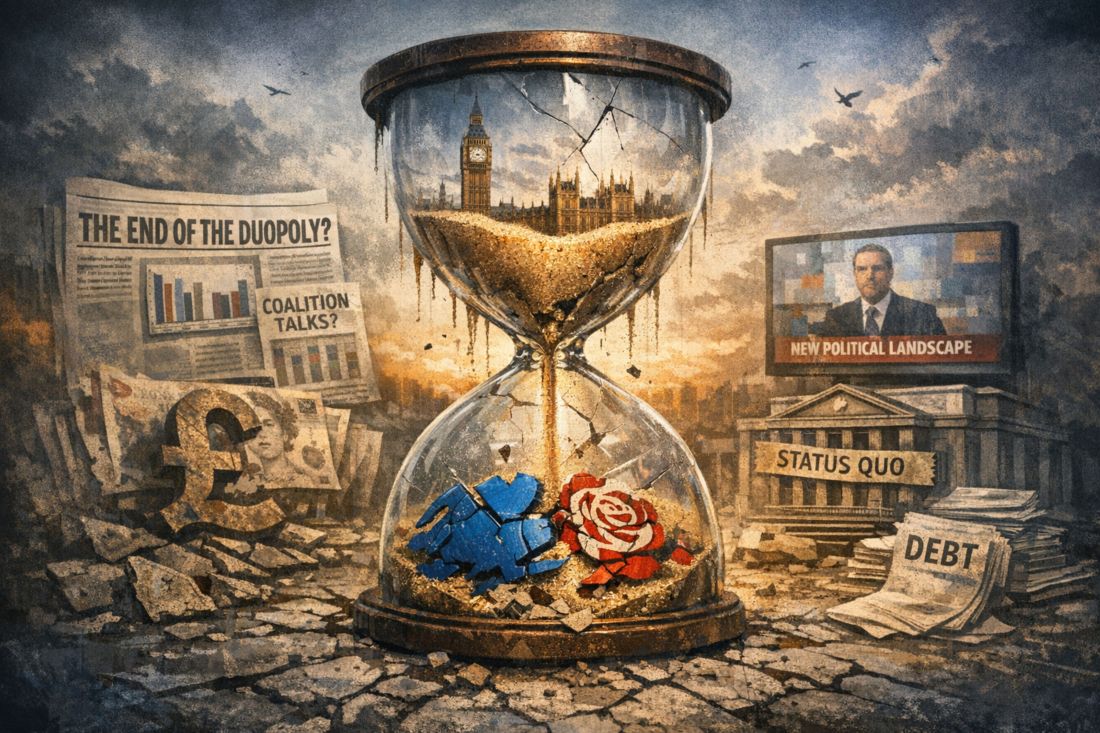
The New Post‑Election Narrative: “The End of the Duopoly”
In the hours following the 2026 UK local election results, a striking uniformity appeared across political commentary. The phrase “end of the duopoly” – referring to the supposed collapse of Labour–Conservative dominance – began appearing everywhere at once.
Even early on Saturday 9 May, with all results declared, the framing had already solidified: the UK is entering a new era of multi‑party politics, with Reform UK positioned as the emerging force.
But what does this narrative actually mean? And more importantly – what does it leave out?
Contextualising the Claim
The UK has never been a strict two‑party system, but the electoral mechanics of First Past the Post have historically produced two dominant blocs.
The new narrative suggests:
- Labour and the Conservatives are losing their structural dominance.
- Reform UK is becoming the largest force in a fragmented landscape.
- A European‑style multi‑party system is emerging.
Specialist pollsters have already produced “like‑for‑like” general‑election projections based on the local‑election vote shares.
These projections – while not predictions – suggest that Reform could become the largest party but still fall short of a majority, requiring cooperation with the Conservatives to govern.
This would conveniently provide an explanation for any undelivered promises: coalition constraints, market pressures, or the need for “stability”.
A Straightforward Interpretation – But an Incomplete One
Yes, the Greens also performed strongly, though not at the levels some earlier polling suggested. Yes, the Conservatives and Labour both suffered significant losses. And yes, this could be read as the new normal for British politics.
But the deeper question is whether this is truly a political realignment – or simply the next step in a much longer, more fundamental breakdown.
The Systemic Problem Beneath the Party Shifts
Most people see politics only at the surface level: parties, personalities, and promises.
But the problems facing the UK today are not primarily the result of individual politicians or even individual parties.
They are the consequences of a system that has been allowed to drift into dysfunction.
The UK’s political‑economic model – neoliberal, globalised, market‑centric, and dependent on fiat‑money expansion – has:
- extracted productivity and resilience from the economy
- created a bloated but underperforming public sector
- generated unsustainable levels of public and private debt
- masked deepening poverty through an ever‑expanding benefits system
- reduced political leadership to managerialism rather than representation
The expected to be outgoing Prime Minister may be an extreme example of the political class at its worst, but he is not an outlier. His behaviour, motivations, and priorities are symptoms of a political culture that has lost its connection to public service.
Different parties may sound different, but they operate within – and are shaped by – the same system.
Their incentives, constraints, and worldview are aligned far more closely than their rhetoric suggests.
Is This Really a “Shift” – or the Last Gasp of a Failing Model?
What is unfolding may not be a realignment at all. It may be the final attempt by political actors to fix systemic problems using the same tools, rules, and assumptions that created those problems in the first place.
Reform UK could, in theory, be a vehicle for genuine change. But the evidence so far suggests they may simply continue the trajectory set by Labour and the Conservatives – not necessarily because they lack intent, but because once confronted with the realities of governing within the existing system, they will face the same constraints.
The brief premiership of Liz Truss is a cautionary tale: the system can eject a government faster than voters can.
The Bigger Picture
The real seismic shift may not be the 2026 local elections or even the next general election. It may be the slow, grinding collapse of a political‑economic system that no longer works – and the emergence of something new that none of the current political class is prepared for.
The “end of the duopoly” may be less a new beginning and more a sign that the old system is running out of road.

