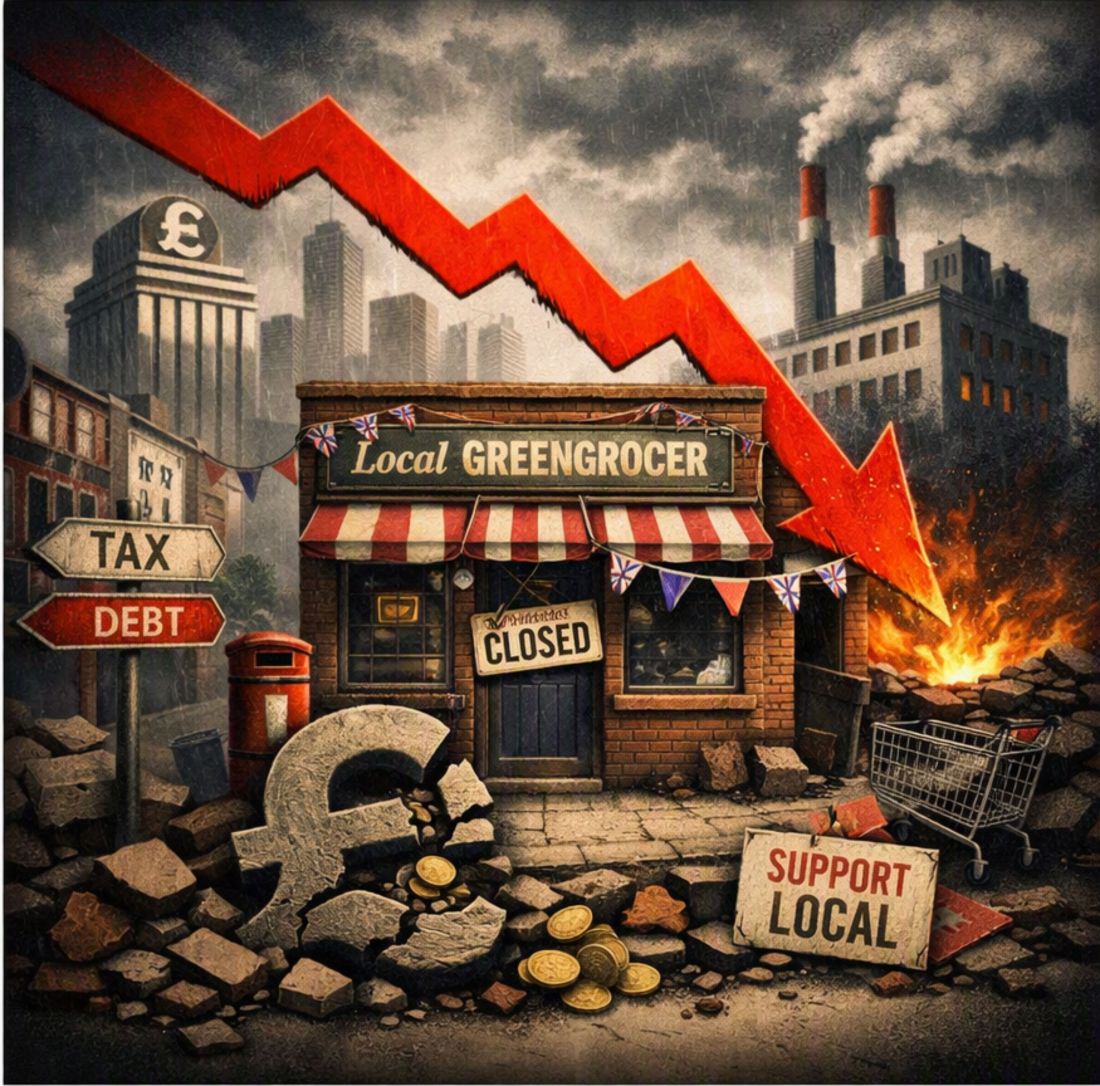
Proportional Representation: The wrong answer to the right frustrations | And why it risks deepening the crisis its champions claim it will solve

Proportional representation has returned to British politics with the confidence of a solution whose moment has finally arrived. It is presented as the modern, fair, mathematically elegant alternative to first‑past‑the‑post – a system that appears increasingly out of step with public expectations and electoral outcomes.

In an age of shrinking majorities, falling turnout, and widespread disillusionment, PR offers a seductive promise: a democracy where every vote counts and every voice is heard.

But the appeal of PR rests on a dangerous assumption:

That the rest of the political system is healthy enough for PR to work.

It isn’t.

And that is why PR risks making everything worse.

Because proportional representation only works in a political culture that doesn’t need it.

And the UK is nowhere near that place.

The Seductive Simplicity of PR

PR’s promise is mathematical fairness: seats that match votes, representation that mirrors the national mood, and a system where no vote is wasted.

Many inside Westminster sincerely believe this would restore legitimacy. They look at the distortions of the current system and conclude that the counting method is the problem.

But fairness in democracy is not a spreadsheet problem.

It is a relationship between voters and power.

And that relationship is already broken.

The Misunderstanding Built into Modern British Politics

Most voters believe they are choosing a party, a leader, or a national agenda. In reality, they are electing a local representative whose influence is tightly constrained by party machinery.

Over decades, the public has been conditioned to see the party as the unit of democracy – not the person, not the community, not the relationship between the two.

This conditioning didn’t happen by accident.

Parties select candidates.

Parties control messaging.

Parties whip votes.

Parties decide careers.

The logical conclusion is that the party is what matters.

PR doesn’t correct this misunderstanding.

It formalises it.

How PR Deepens Party Control

Under most forms of proportional representation, voters do not choose individuals. They choose party lists. The party decides who appears on the list, in what order, and who ultimately enters Parliament.

The voter’s role becomes even more distant.

The party’s control becomes absolute.

What is currently an informal dominance becomes a structural monopoly.

PR does not empower voters.

It empowers parties.

It does not increase accountability.

It removes it.

It does not bring politics closer to the public.

It pushes it further away.

The Technocratic Trap

PR appeals to those who want a technical fix to a cultural and moral problem. It is the kind of solution that emerges when faith in political behaviour has collapsed and the only remaining hope is to adjust the mechanism.

But the problem is not arithmetic.

The problem is behaviour, values, and the absence of genuine leadership – themes explored in The Way of Awakened Politics for Good Government.

Changing the voting system cannot compensate for a political culture that no longer knows how to lead.

Coalitions Without Consent

PR almost always produces coalition governments.

But voters rarely know before the election what coalition they are actually voting for.

This creates a democratic deficit:

  • Voters choose a party
  • Parties choose their partners after the election
  • The resulting government may have no mandate for its combined programme

This is a transparency problem that PR makes worse, not better.

Accountability Diffusion

Under PR, responsibility becomes blurred:

  • Who is responsible when things go wrong?
  • Who deserves credit when things go right?
  • Who can be removed if change is needed?

PR doesn’t just spread power – it spreads blame until it disappears.

This is a governance accountability issue that PR systems struggle with.

Party Cartelisation

Political scientists call it cartelisation:

Parties behave like a closed shop, protecting each other from outside competition.

PR accelerates this because:

  • parties become the only route into Parliament
  • party lists become the gatekeeping mechanism
  • new voices must negotiate with existing parties to gain influence

PR is not pluralistic.

It is cartel‑friendly.

The Collapse of Local Representation

One of the most damaging consequences of PR – and one of the least discussed – is the erosion of local representation.

PR breaks the link between a community and its representative. It replaces geography with ideology.

Local representation becomes symbolic rather than real.

Communities lose their voice.

Parties gain more control.

This is the opposite of what a healthy democracy requires – a theme explored in The Local Economy Governance System.

The Centralisation Paradox

PR is often sold as a way to make politics more pluralistic.

But in practice it centralises power inside party headquarters.

Why?

Because:

  • candidate selection becomes national
  • party lists are controlled centrally
  • coalition negotiations happen at the top
  • local voices are sidelined

PR strengthens the very centralisation people want to escape.

The Public Expectation Mismatch

People expect PR to:

  • reduce corruption
  • increase honesty
  • improve behaviour
  • make politics more collaborative

But none of these outcomes are guaranteed by PR.

They are cultural, not mechanical.

PR cannot deliver the behaviour people want from politics because behaviour is not created by voting systems – it is created by values.

The Legitimacy Illusion

PR creates the appearance of fairness while masking deeper unfairness:

  • party elites choose candidates
  • coalition deals override manifestos
  • voters lose the ability to remove individuals
  • accountability becomes abstract

PR does not fix legitimacy.

It manufactures the illusion of it.

Why Politicians Want PR Now

There is another dimension to this debate – one rarely acknowledged publicly.

The current political class – increasingly managerial, increasingly reactive – is not leading. It is not solving problems. It is not governing with courage or vision.

As explored in A Leadership Void in a Moment That Calls for Far More Than Westminster Politics, the political class is:

  • reactive, not proactive
  • managerial, not visionary
  • dependent on the system, not independent of it

And because it cannot lead, it is desperate for ways to shore up majorities that are wasting away through public disenfranchisement.

PR offers:

  • a way to preserve relevance
  • a way to maintain influence
  • a way to survive declining public trust
  • a way to lock in position even as legitimacy collapses

This is not about fairness.

It is about self‑preservation.

The Money‑Centric System Behind It All

The political system is in sync with a wider problem – the money‑centric, extractive economic model that is running out of road. As explored in Why MPs Can Afford to Give Away Their Salaries and Voters Can’t, the political class is insulated from the consequences of the system it defends. Voters are not.

PR becomes a tool to:

  • stabilise a political class that cannot stabilise the country
  • protect incumbents from the consequences of their own failures
  • maintain a system that benefits them but harms the public

PR is not a democratic reform.

It is a survival strategy.

The Irony at the Heart of the Debate

The uncomfortable truth is this:

If the UK had the political culture required for PR to work, PR wouldn’t feel necessary.

A healthy system would already have:

  • empowered local democracy
  • independent representatives
  • decentralised power
  • transparent institutions
  • civic responsibility
  • accountability mechanisms

In that environment, PR would be a technical detail – not a salvation narrative.

The fact that PR feels like the answer is itself a symptom of how far the system has drifted from genuine representation.

Further Reading: The Deeper Democratic Crisis

These works explore the structural, cultural, and civic issues that PR cannot fix – and that must be addressed before any voting system can deliver genuine representation:

Conclusion: PR Is Not the Answer – It Is the Distraction

The public is right to be frustrated.

The system is failing.

Representation is broken.

Accountability is weak.

Parties have too much power.

Communities have too little.

The political class is out of its depth.

The economic system is running out of road.

But PR is not the solution.

It is the false fix that diverts attention away from the real democratic crisis.

Until the deeper issues are confronted – party dominance, centralised power, establishment alignment, leadership failure, and the erosion of genuine local representation – no voting system will deliver the democracy people believe they are voting for.

PR does not change the game.

It just changes the scoreboard.

End of the ‘Duopoly’ – or the Slow Death of the Entire UK Political System?

Public narratives have increasingly been used to shape how we interpret major events – often subtly, often through fear, and often in ways that encourage us to accept outcomes that might never have emerged if we had been left to form our own conclusions.

Whether it’s the breathless insistence that an AI takeover is inevitable or the framing of political change as something predetermined, narratives have become tools for steering public belief long before reality has settled.

Sometimes these narratives are deliberately crafted. Other times, even those repeating them may not fully understand the consequences of the stories they help spread.

Either way, the effect is the same: they shape how we see the world during a period that is already turbulent and uncertain.

The New Post‑Election Narrative: “The End of the Duopoly”

In the hours following the 2026 UK local election results, a striking uniformity appeared across political commentary. The phrase “end of the duopoly” – referring to the supposed collapse of Labour–Conservative dominance – began appearing everywhere at once.

Even early on Saturday 9 May, with all results declared, the framing had already solidified: the UK is entering a new era of multi‑party politics, with Reform UK positioned as the emerging force.

But what does this narrative actually mean? And more importantly – what does it leave out?

Contextualising the Claim

The UK has never been a strict two‑party system, but the electoral mechanics of First Past the Post have historically produced two dominant blocs.

The new narrative suggests:

  • Labour and the Conservatives are losing their structural dominance.
  • Reform UK is becoming the largest force in a fragmented landscape.
  • A European‑style multi‑party system is emerging.

Specialist pollsters have already produced “like‑for‑like” general‑election projections based on the local‑election vote shares.

These projections – while not predictions – suggest that Reform could become the largest party but still fall short of a majority, requiring cooperation with the Conservatives to govern.

This would conveniently provide an explanation for any undelivered promises: coalition constraints, market pressures, or the need for “stability”.

A Straightforward Interpretation – But an Incomplete One

Yes, the Greens also performed strongly, though not at the levels some earlier polling suggested. Yes, the Conservatives and Labour both suffered significant losses. And yes, this could be read as the new normal for British politics.

But the deeper question is whether this is truly a political realignment – or simply the next step in a much longer, more fundamental breakdown.

The Systemic Problem Beneath the Party Shifts

Most people see politics only at the surface level: parties, personalities, and promises.

But the problems facing the UK today are not primarily the result of individual politicians or even individual parties.

They are the consequences of a system that has been allowed to drift into dysfunction.

The UK’s political‑economic model – neoliberal, globalised, market‑centric, and dependent on fiat‑money expansion – has:

  • extracted productivity and resilience from the economy
  • created a bloated but underperforming public sector
  • generated unsustainable levels of public and private debt
  • masked deepening poverty through an ever‑expanding benefits system
  • reduced political leadership to managerialism rather than representation

The expected to be outgoing Prime Minister may be an extreme example of the political class at its worst, but he is not an outlier. His behaviour, motivations, and priorities are symptoms of a political culture that has lost its connection to public service.

Different parties may sound different, but they operate within – and are shaped by – the same system.

Their incentives, constraints, and worldview are aligned far more closely than their rhetoric suggests.

Is This Really a “Shift” – or the Last Gasp of a Failing Model?

What is unfolding may not be a realignment at all. It may be the final attempt by political actors to fix systemic problems using the same tools, rules, and assumptions that created those problems in the first place.

Reform UK could, in theory, be a vehicle for genuine change. But the evidence so far suggests they may simply continue the trajectory set by Labour and the Conservatives – not necessarily because they lack intent, but because once confronted with the realities of governing within the existing system, they will face the same constraints.

The brief premiership of Liz Truss is a cautionary tale: the system can eject a government faster than voters can.

The Bigger Picture

The real seismic shift may not be the 2026 local elections or even the next general election. It may be the slow, grinding collapse of a political‑economic system that no longer works – and the emergence of something new that none of the current political class is prepared for.

The “end of the duopoly” may be less a new beginning and more a sign that the old system is running out of road.

Strategy or Happenstance? Reform UKs London Mayoral Choice and the Dynamics Left Unspoken

Reform UK’s decision to put forward Laila Cunningham as its candidate for London Mayor marks an unexpected turn in the capital’s political landscape. The announcement immediately drew attention – not only because Cunningham is a relatively new figure in frontline politics, but because her selection comes at a time when both major parties have struggled to understand the unique dynamics of London’s electorate.

For years, the Conservatives have attempted to unseat Sadiq Khan with candidates who, regardless of their individual strengths, were never positioned to succeed. London’s mayoral race is shaped by a distinctive blend of demographics, political culture, and electoral behaviour that the party has repeatedly misread. The result has been a series of campaigns that failed to resonate with the city’s diverse and often unpredictable voter base.

Against this backdrop, Reform UK’s choice of Cunningham raises questions. Ant Middleton, who had openly expressed interest in the role, had long understood that the decision would not fall in his favour. Cunningham’s media visibility may have played a part, but Reform’s leadership appears to believe her candidacy offers something more -perhaps a chance to broaden the party’s appeal or to challenge assumptions about who speaks for London. This is a bold calculation, especially with polling currently placing Reform at 19%, well behind Labour’s 32%.

The reaction to Cunningham’s Muslim background was swift and, in many quarters, hostile. It reflects a broader climate of suspicion that has grown around anything involving Muslims in public life. A counter‑establishment narrative has taken hold in parts of the electorate, one that frames Muslims as central to every perceived societal problem and warns of an imminent cultural takeover. These fears, though unfounded, have become politically potent.

Compounding the issue is the behaviour of public institutions. Across the UK, officials have often responded to sensitive cultural or religious matters with caution bordering on paralysis. This has created the impression – fair or not – that Muslims receive special treatment or are shielded from scrutiny. In such an environment, the emergence of a Muslim woman as a high‑profile political candidate becomes, for some, a symbol of the very anxieties they already hold.

Yet this interpretation overlooks a more grounded reality: many Muslims in Britain want to contribute to a future rooted in the country’s historic values and civic culture.

Cunningham’s candidacy could, if handled well, offer an opportunity to rethink the role of Muslims in public life and to challenge the simplistic narratives that have dominated recent debate.

Understanding the tension between perception and reality requires examining how Britain’s current image of Islam was formed. Over decades, geopolitical events, media coverage, and political rhetoric have shaped a picture that often bears little resemblance to the lived experiences of most Muslims.

The same system that has left many British citizens feeling ignored or exploited has also inflicted deep harm on communities abroad, pushing some toward ideologies that would otherwise hold little appeal.

Commentators such as Douglas Murray have highlighted a central challenge within Islam: its foundational texts were written for a world vastly different from today, and some interpretations insist these texts are immutable.

This creates a tension between traditionalist readings and the expectations of a modern, pluralistic society.

But this challenge is not unique to Islam; all religions grapple with the task of reconciling ancient teachings with contemporary realities.

Historically, religions have served as social frameworks – systems that guide behaviour, shape norms, and maintain order. They have been used to protect communities, but also to control them.

When people look back at periods in which Islamic empires flourished, they often point to eras when religious teachings were applied most literally. For some Muslims, this reinforces the belief that returning to those values is the path to renewal.

However, the rise of Islamic militancy cannot be understood without acknowledging the role of Western intervention. Wars, regime changes, resource extraction, and the installation of compliant leaders have destabilised regions and eroded local cultures.

While Western societies were encouraged to embrace consumerism and individualism, other nations experienced upheaval, corruption, and violence – often with Western support or involvement.

In this context, strict religious frameworks can become appealing to those who feel their societies have been dismantled.

This dynamic has fuelled a misconception in the West: that the conflict is between Muslims and non‑Muslims.

In reality, the tension lies between militant interpretations of Islam and the global systems – economic, political, and military – that have shaped the modern world.

Yet many people struggle to distinguish between extremists and ordinary Muslims, just as they struggle to see how Western policies have contributed to the anger and disillusionment that some now express.

The absence of political leadership on these issues has only deepened the divide. Few leaders are willing to speak openly about the historical and structural forces at play.

Silence has become the norm, not because the issues are too complex, but because acknowledging them would challenge the interests of those who benefit from the status quo.

Meanwhile, the system that created these tensions is showing signs of strain. Economic instability, cultural fragmentation, and declining trust in institutions suggest that a new approach is needed – one rooted in community, shared values, and a commitment to the common good.

Such a future must include Muslims who are willing to reinterpret their faith in ways that align with a modern, secular society.

In this context, Reform UK’s selection of Laila Cunningham may prove more significant than it first appears.

Whether by strategic design or political opportunism, the party has taken a step that could reshape public debate. Whether they are ready for the responsibility – or whether they will ever win the chance to exercise it – is another question entirely.

A Deep‑Dive Guide to The Philosophy of a People First Society

1. How does this philosophy redefine the concept of “human nature”?

Traditional economic and political systems assume humans are primarily self‑interested, competitive, and motivated by scarcity.

This philosophy rejects that framing as a structural artefact, not a biological truth.

It argues that what we call “human nature” is largely a reflection of the systems we live within.

Change the environment → change the behaviour → change the outcomes.

In this view, human nature is:

  • relational
  • adaptive
  • cooperative under conditions of security
  • meaning‑seeking
  • contribution‑driven

This is a foundational departure from neoliberal and classical economic assumptions.

2. Why is security considered the precondition for contribution?

Because fear distorts behaviour.

A person in survival mode cannot:

  • think long‑term
  • act ethically
  • participate meaningfully
  • contribute creatively
  • engage in community life

The Basic Living Standard is therefore not a welfare mechanism – it is a psychological and structural prerequisite for a functioning society.

Security → stability → contribution → community → resilience.

3. How does this philosophy reinterpret the purpose of work?

Work is not a commodity.

Work is not a transaction.

Work is not a mechanism for survival.

Work is participation in the life of the community.

This reframing dissolves the coercive relationship between employer and employee and replaces it with a contribution‑based model where:

  • people work because they are part of a community
  • work is meaningful
  • contribution is voluntary but natural
  • survival is not conditional on employment

This is a profound shift from the industrial and neoliberal worldview.

4. Why is locality the “natural scale” of human systems?

Because human beings evolved in small, relational groups where:

  • accountability was direct
  • decisions were transparent
  • consequences were visible
  • relationships were personal

Large, centralised systems create:

  • abstraction
  • detachment
  • bureaucratic distance
  • moral disengagement
  • power concentration

Locality restores the natural feedback loops that keep systems ethical and functional.

5. How does this philosophy challenge the concept of economic growth?

It argues that growth is not a measure of wellbeing – it is a measure of throughput.

GDP increases when:

  • people get sick
  • disasters occur
  • housing becomes unaffordable
  • debt expands
  • consumption accelerates

Growth is therefore not neutral – it rewards harm.

A People First Society replaces growth with:

  • resilience
  • sufficiency
  • regeneration
  • wellbeing
  • contribution
  • community health

This is a paradigm shift from extractive economics to human‑centred economics.

6. What is the philosophical justification for limiting property ownership?

Property accumulation creates power accumulation.

Power accumulation creates inequality.

Inequality creates dependency and coercion.

The philosophy argues that no person has the moral right to own more than they can use, because unused property becomes a mechanism of control over others.

Housing is therefore a right, not a commodity.

This is not ideological – it is structural ethics.

7. How does this philosophy understand value?

Value is not price.

Value is not profit.

Value is not scarcity.

Value is defined as:

anything that improves the wellbeing, freedom, dignity, or resilience of people, communities, or the environment.

This reframing collapses the entire logic of the money‑centric worldview.

8. Why does the philosophy reject interest, speculation, and financialisation?

Because they allow people to accumulate wealth without contributing anything of value.

Interest and speculation:

  • extract value without creating it
  • distort prices
  • create artificial scarcity
  • concentrate power
  • destabilise communities
  • reward non‑contribution

A People First Society requires that value only flows from contribution, not from ownership or manipulation.

9. How does this philosophy view governance?

Governance is not authority.
Governance is not hierarchy.
Governance is not control.

Governance is collective decision‑making about shared life.

The Circumpunct model reflects this:

  • no permanent power
  • no hierarchy
  • no distance between decision and consequence
  • leadership as service, not status
  • transparency as a moral requirement

This is governance as participation, not governance as rule.

10. What role does The Revaluation play in the transition?

The Revaluation is the psychological and cultural pivot that makes systemic change possible.

It is the moment when people collectively realise:

  • money is not value
  • growth is not progress
  • employment is not contribution
  • hierarchy is not leadership
  • centralisation is not stability
  • scarcity is not natural
  • competition is not inevitable

Without this shift, LEGS would be resisted.

With it, LEGS becomes the obvious next step.

11. How does this philosophy address the problem of power?

By dissolving the mechanisms that create it:

  • property accumulation
  • financial accumulation
  • hierarchical governance
  • centralised decision‑making
  • opaque systems
  • dependency structures

Power is not redistributed – it is deconstructed.

The system is designed so that no individual or organisation can accumulate disproportionate influence.

12. Is this philosophy compatible with modern technology and AI?

Yes – but only under strict conditions:

  • technology must serve human agency
  • AI must never replace essential human roles
  • systems must remain understandable at the human scale
  • digital tools must have non‑digital alternatives
  • local communities must retain control

Technology is a tool, not a trajectory.

13. How does this philosophy define freedom?

Freedom is not the absence of rules.

Freedom is not consumer choice.

Freedom is not individualism.

Freedom is:

the ability to live without fear, contribute without coercion, and participate without exclusion.

This requires:

  • security
  • dignity
  • community
  • transparency
  • meaningful work
  • environmental stability

Freedom is therefore a collective achievement, not an individual possession.

14. What is the ultimate purpose of a People First Society?

To create the conditions in which:

  • every person can live a good life
  • every community can be resilient
  • every environment can regenerate
  • every individual can contribute meaningfully
  • no one is left behind
  • no one is exploited
  • no one is coerced into survival

This is the philosophical north star.

15. What is the biggest misconception about this philosophy?

That it is idealistic.

In reality, the current system is the idealistic one – it assumes:

  • infinite growth
  • infinite resources
  • infinite stability
  • infinite human tolerance for inequality

This philosophy is grounded in lived reality, human psychology, ecological limits, and community logic.

It is not utopian.

It is necessary.

Further Reading:

This “Further Reading” section offers a set of resources that will deepen your understanding of the Local Economy & Governance System (LEGS), the Basic Living Standard, and the broader philosophy of a people-first society.

Each link explores a different facet of the philosophy, from practical implementation to foundational principles. Engaging with these readings will provide you with richer context, practical examples, and a more nuanced grasp of the ideas behind LEGS.

Whether you are new to these concepts or seeking to apply them, these resources will help you connect theory to practice and inspire new ways of thinking about community, governance, and human flourishing.

Ordered List of Further Reading

  1. The Local Economy & Governance System (LEGS) – Online Text
    https://adamtugwell.blog/2025/11/21/the-local-economy-governance-system-online-text/

Summary:

This foundational text introduces the LEGS framework in detail, explaining how local economies and governance can be structured to prioritise human dignity, participation, and sustainability. It’s ideal for readers seeking a comprehensive overview of the system’s mechanics and philosophical underpinnings.

Benefit:

Start here for a solid grounding in the core ideas and practical structure of LEGS.

  1. The Basic Living Standard Explained
    https://adamtugwell.blog/2025/10/24/the-basic-living-standard-explained/

Summary:

This article breaks down the concept of the Basic Living Standard, clarifying what it means in practice and why it is central to a people-first society. It addresses common questions and misconceptions, making it accessible for those new to the idea.

Benefit:

Read this to understand the practical implications and necessity of guaranteeing basic security for all.

  1. The Basic Living Standard: Freedom to Think, Freedom to Do, Freedom to Be – With Personal Sovereignty That Brings Peace to All
    https://adamtugwell.blog/2025/12/15/the-basic-living-standard-freedom-to-think-freedom-to-do-freedom-to-be-with-personal-sovereignty-that-brings-peace-to-all/

Summary:

This piece explores the philosophical and ethical dimensions of the Basic Living Standard, linking it to personal sovereignty and collective peace. It’s a reflective essay that connects individual freedom with societal wellbeing.

Benefit:

Recommended for readers interested in the deeper values and ethical commitments behind the LEGS philosophy.

  1. From Principle to Practice: Bringing the Local Economy & Governance System to Life (Full Text)
    https://adamtugwell.blog/2025/12/27/from-principle-to-practice-bringing-the-local-economy-governance-system-to-life-full-text/

Summary:

This resource provides practical guidance and real-world examples of how to implement the LEGS philosophy. It bridges the gap between theory and action, offering insights for communities and individuals ready to make change.

Benefit:

Essential for those looking to move from understanding to action, with concrete steps and inspiration for local transformation.

  1. Visit the LEGS Ecosystem
    https://adamtugwell.blog/2025/12/31/visit-the-legs-ecosystem/

Summary:

This link offers an overview of the broader LEGS ecosystem, showcasing projects, communities, and ongoing initiatives. It’s a gateway to seeing the philosophy in action and connecting with others on the same journey.

Benefit:

Explore this to find community, resources, and inspiration for your own involvement in the LEGS movement.