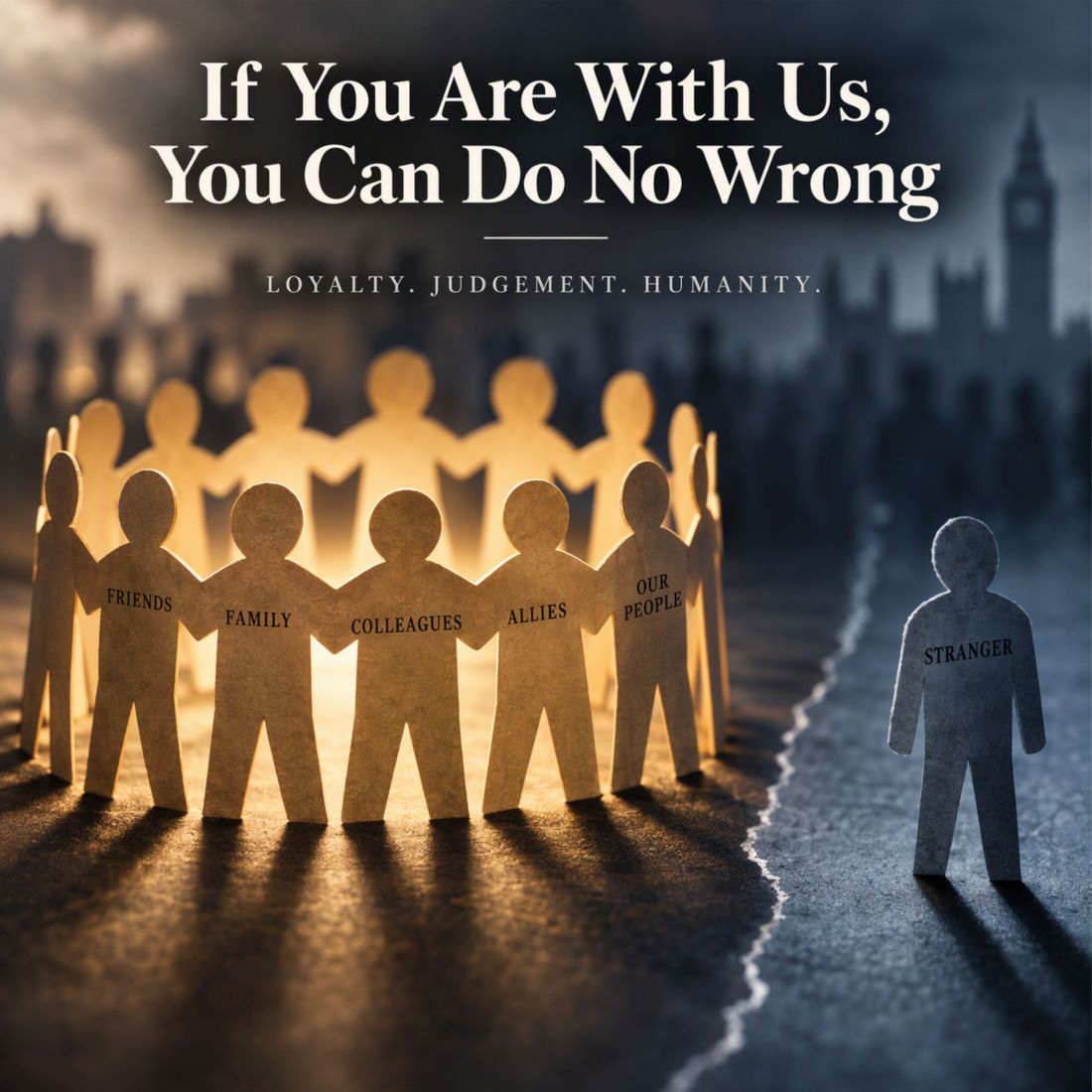
If You Are With Us, You Can Do No Wrong

One of the more revealing features of public life is not that people protect their friends. It is that we are repeatedly surprised when they do.

Whenever allegations emerge around a famous figure, particularly one who once occupied a prominent cultural position, a familiar question follows. Why was nothing done earlier? Why did nobody speak up? Why were warning signs ignored? Why did institutions, colleagues or admirers seemingly look the other way?

The question is often posed as if the answer must involve conspiracy, corruption or some uniquely sinister arrangement. Sometimes it does. But much of the time the explanation may be far less dramatic and therefore far more troubling.

Human beings make allowances for people they regard as their own.

The principle operates everywhere. In friendships. In families. In workplaces. In politics. In religion. In social movements. In elite institutions. Most of us recognise it in others. Fewer recognise it in ourselves.

The temptation is to imagine that justice is blind and that our judgements are formed solely by evidence and principle. Reality suggests otherwise. The same behaviour can attract radically different responses depending on who commits it.

When a stranger behaves badly, we see character.

When a friend behaves badly, we see circumstances.

The stranger is irresponsible. The friend is under pressure.

The stranger is dishonest. The friend made a mistake.

The stranger reveals what they are. The friend deserves understanding because we know what they have been through.

In other words, familiarity creates context, and context often softens judgement.

This is not necessarily a moral failing. In fact, there is something profoundly human about it. The more we know someone, the more difficult it becomes to reduce them to their worst act. We know their history. We remember their kindnesses. We understand their struggles. We have seen them at their best as well as their worst. Because we possess a fuller picture, we instinctively resist judgements that seem too simple.

The problem emerges when this instinct collides with accountability.

At that point loyalty begins to exert its influence.

Groups, like individuals, develop protective instincts. Organisations protect valuable employees. Political movements protect useful advocates. Institutions close ranks around important members. Social circles defend insiders. Every group develops an answer to the same question:

What do we do when one of us is accused of wrongdoing?

In theory, the answer is simple. Investigate fairly and follow the evidence.

In practice, another question often slips in ahead of it.

Whose side is this person on?

Once that question enters the room, reasoning changes. Facts become entangled with loyalties. Doubts are exaggerated when allegations threaten someone we value. Generosity expands. Explanations multiply. Standards adjust almost imperceptibly.

Nobody has to be consciously dishonest for this to happen.

Indeed, the most powerful forms of protection rarely involve explicit collusion. They emerge from countless small decisions. A concern is dismissed as gossip. A complaint is interpreted generously. An uncomfortable detail is explained away. A person’s importance to the group is quietly factored into every judgement.

No one decision looks outrageous in isolation. Together they can create something resembling impunity.

This dynamic explains why people are often fascinated by cases involving celebrities, political figures or members of traditional elites. Consider the enduring fascination surrounding the mystery of Lord Lucan. What keeps the story alive is not merely the mystery itself. It is the suspicion that networks of privilege may have altered the course of events.

Whether such suspicions are justified is almost secondary. The story persists because it speaks to a deeper anxiety: that there are circles within society where belonging offers a measure of protection not available to everyone else.

We recognise the possibility because we see smaller versions of it all around us. Yet there is another question lurking beneath this observation, one that is perhaps even more interesting.

If we are capable of extending extraordinary understanding to those we know, why are we so reluctant to extend it beyond the boundaries of our tribe?

The usual critique of loyalty is that it makes us too forgiving. But perhaps that is only half true.

When our friends fail, we instinctively seek context. We remember their humanity. We understand that people are often more than the worst thing they have done.

Why do we not approach strangers in the same way?

Why do we so readily grant complexity to those we love while denying it to those we dislike?

Political opponents become caricatures. Public figures become villains or heroes. Entire groups are judged by their most objectionable representatives. We lose interest in the stories, pressures and contradictions that we effortlessly perceive in ourselves and those close to us.

The irony is striking.

The same person who demands ruthless accountability for an opponent may show immense understanding towards an ally. The same person who insists that a public figure should be defined entirely by a single action would never accept being judged in that way themselves.

Perhaps the deepest problem is not that we are too compassionate towards our own. Perhaps it is that our compassion is distributed so unevenly.

This does not mean abandoning standards or excusing wrongdoing. Accountability matters precisely because human beings are so inclined to overlook faults in people they admire. Justice requires consistency. Friends should not receive exemptions from principles we apply to everyone else.

But there is another principle at stake.

Justice demands that we judge our friends by the same standards as strangers.

Love demands that we view strangers with something of the same humanity we reserve for our friends.

Modern culture often struggles with this balance. Some people possess compassion without accountability. Others possess accountability without compassion. One side excuses everything. The other forgives nothing.

Both approaches misunderstand what is required.

The challenge is not to love our own less. Nor is it to abandon moral standards in favour of endless understanding. The challenge is to widen the circle within which understanding operates, while maintaining a consistent commitment to truth.

Most of us already know how to do this. We practise it every day with the people closest to us.

We know how to forgive. We know how to see complexity. We know how to recognise that a human being cannot be reduced to a single moment.

The question is why we draw the boundary where we do.

Perhaps the real moral test is not whether we can condemn our enemies. Most people can do that. Nor is it whether we can defend our friends. Most people can do that too.

The real test is whether we can hold our friends accountable without withdrawing our affection, and extend to strangers the same measure of humanity that we naturally offer to those we call our own.

For if belonging can make us blind to wrongdoing, it may also reveal something else: our capacity for grace already exists. The tragedy is not that we possess it. The tragedy is how selectively we choose to apply it.

The Basic Living Standard: How & Why It Works

A deeper exploration of fairness, responsibility, and the true meaning of abundance

Imagine entering this world with no advantages whatsoever. No inherited wealth. No family connections. No safety net. No possessions. No one to call for help.

Imagine seeing and feeling life without the comforts, protections, and privileges you currently rely on—many of which you may not even notice because they have always been there.

Now imagine that from the very beginning, the deck is stacked against you. Your starting point in life is so far behind others that you spend every day running uphill. You chase money, opportunities, and stability – not from a foundation where your essential needs are already secure, but from a position where survival itself is a struggle. You never get to pause. You never get to breathe. You never get to simply be.

Instead, you live under constant pressure:

  • to earn enough
  • to prove yourself
  • to meet standards set by people who have never lived anything like your reality
  • to justify your existence in a system that rewards advantage and punishes disadvantage

And what if, despite all your effort, the distance between you and those ahead of you doesn’t shrink – but grows?

What if it becomes clear that only extraordinary luck – luck comparable to winning the lottery – could ever lift you out of that position?

What if the more you try, the further behind you fall?

For millions of people, this is not a thought experiment. It is daily life. And as economic, technological, and social pressures intensify, many more will find themselves in the same position – not only the poor or vulnerable, but people who once believed they were secure.

This is the context in which the Basic Living Standard becomes not just an idea, but a necessity.

Abundance Is Not Accumulation – That’s Greed

The modern world has elevated money to the centre of everything.

Money defines power, influence, status, and even identity.

We are taught – subtly and explicitly – that success means having more: more money, more possessions, more property, more influence, more everything.

But this is not abundance. This is manufactured scarcity, wrapped in the illusion of abundance.

True abundance is simple:

Abundance is having everything we need – not everything we want.

The desire to take more than we need is easy to justify when:

  • the system rewards accumulation
  • rules can be bent or rewritten
  • distance hides the consequences
  • we believe others would do the same if they could

Throughout history, this behaviour has been common enough to appear normal. But normal does not mean right. And in a world where we now have the knowledge, technology, and capability to ensure that every human being can have their essential needs met, the moral justification for excess collapses.

When we hold more than we need – whether it’s money, property, resources, or influence- we are not simply “fortunate.” We are occupying space that others require to meet their basic needs. We are benefiting from a system that allows some to accumulate while others go without.

This is not a judgement of individuals. It is a recognition of a systemic truth.

Power Is Not a Title – It’s Every Choice We Make

Power is often imagined as something held by leaders, executives, or institutions.

But power exists in every choice we make, because none of us lives in isolation.

Every action has consequences, even when those consequences are invisible to us.

When we buy more than we need, someone else goes without.
When we waste resources, someone else loses access.
When we accumulate wealth, someone else is pushed further into scarcity.
When we treat wants as needs, we distort the entire system.

The greatest danger of modern life is the distance between our actions and their consequences. When harm is invisible, it becomes easy to ignore. When suffering is out of sight, it becomes easy to forget.

This distance is not accidental. It is built into the structure of the system.

A Twisted System Built on Manufactured Abundance

The idea that abundance means accumulating as much as possible – regardless of cost – has warped our values.

Centralisation, globalisation, and digital life have created layers of separation between action and consequence.

The internet age has amplified this distortion.

It has:

  • dehumanised relationships
  • turned people into data points
  • created new forms of exploitation
  • widened the gap between those who “succeed” and those who are treated as disposable

In such a system, it becomes easy to believe that some lives matter more than others.

But this belief is false.

Every human being has universal value, regardless of wealth, status, or circumstance.

Distance does not erase responsibility.
Ignorance does not erase impact.
Comfort does not erase obligation.

The Basic Living Standard: A Universal Guarantee

The Basic Living Standard is a guarantee that every person must both receive and respect.

The Basic Living Standard ensures that every individual has enough to meet their essential needs – food, shelter, energy, water, clothing, healthcare, and the means to participate in society.

But it also requires something deeper:

No person may take, hold, control, or influence anything that is – or could be – used to meet the essential needs of others.

This applies even when it appears there is “more than enough.” Because abundance is not measured by quantity – it is measured by access.

The Basic Living Standard is not charity.

It is not welfare.

It is not a handout.

A Basic Living Standard is a universal right, paired with a universal responsibility.

The Cultural Refocus

To implement the Basic Living Standard, society must undergo a profound cultural shift.

We must move from a system that prioritises money to one that prioritises human needs.

This shift will feel uncomfortable.

Manufactured abundance has conditioned us to believe that happiness comes from accumulation.

But natural abundance – the state of having enough – creates freedom, not fear.

When essential needs are guaranteed for all, something remarkable happens:

  • competition becomes cooperation
  • fear becomes security
  • isolation becomes community
  • profit becomes secondary to purpose

A society built around essential needs becomes a society driven by people, not profit.

The Requirement: Everyone Plays Their Part

A system that guarantees essential needs for all requires participation from all.

This does not mean everyone must earn money. It means everyone who can must also contribute time, skills, and effort to the system that sustains them.

Contribution replaces currency.
Responsibility replaces entitlement.
Community replaces competition.

The rules that uphold the Basic Living Standard are simple:

  1. Every person has the right to everything they need.
  2. Every person who can must contribute to the system that provides it.
  3. No person may take more than they need.
  4. No person may control resources essential to others for their own use or benefit.

This is not restriction.

This is fairness.

A Different Kind of Future

The Basic Living Standard is not just a policy. It is a re‑orientation of society around what truly matters: human wellbeing, shared responsibility, and the recognition that abundance already exists – if we stop hoarding it.

When we stop chasing manufactured abundance, we rediscover natural abundance.

When we stop competing for excess, we rediscover community.

When we stop fearing scarcity, we rediscover freedom.

This is the world the Basic Living Standard makes possible.

Please read The Local Economy & Governance System, to begin.

LEGS: The Human Economy – A Blueprint for Transformation

Introduction

In a world increasingly shaped by the pursuit of economic growth and the dominance of monetary values, our understanding of what truly matters has become distorted.

The language of economics, once intended to serve human wellbeing, now often justifies systems that place money above all other forms of value.

This Local Economy & Governance System (LEGS) challenges the prevailing money-centred worldview, exposing the myths that underpin it and the consequences for individuals and society.

By re-examining the purpose of the economy and redefining value at the level of the individual, we offer a blueprint for transformation – one that places human needs, freedom, and wellbeing at the heart of economic life.

The following pages invite you to reconsider what it means to live well, to recognise the moral costs of excess, and to envision an economy built on natural abundance, justice, and personal sovereignty.

The Rise of a Money‑Centred Worldview

Over time, the words economy, economics, economic policy, and economic theory have been shaped by a money centred worldview.

They became part of a language and narrative designed to justify systems that placed money above all other forms of value.

This worldview gradually embedded itself into culture, until money was positioned at the centre of almost every aspect of life and treated as the primary measure of worth.

How Policy Reinforced the Myth of Economic Growth

Governments, politicians, and established institutions reinforced this belief by placing the economy at the heart of public policy.

They encouraged the idea that a good life was only possible if the economy was considered healthy and growing.

Measures such as GDP were promoted as the ultimate indicators of national wellbeing, and people were led to believe – often without explanation – that their personal success was somehow tied to the financial success of the economy itself.

Reducing Human Value to Economic Data

By turning everything of tangible value into something economic, measurable, and defined only in relation to the economy, society gradually stripped away the inherent value of each person.

Individuals became reduced to data points – digits on a screen – an effect amplified by digital tracking and the rapid development of AI.

The Hidden Myth of External Power

The central myth that upheld this money centric system was not only the false belief that money is inherently valuable.

The deeper, more powerful myth was the idea – never openly stated but widely accepted – that real power lies outside the individual.

Because money appears external to us, it became easy to believe that our worth and our agency also exist outside ourselves.

The Illusion of Money as Value

In truth, money has no intrinsic value. It is simply a tool for exchange.

The belief that money is value created the foundation for many of society’s problems.

The FIAT System and the Concentration of Power

This belief was further exploited through the rise of the modern FIAT monetary system, which used complexity, misplaced trust, and practices that would otherwise be considered unethical or criminal to shift wealth – and therefore power – from the many to the few.

All of this was presented as progress. As the natural direction of a modern world.

The Moral Cost of Excess

Yet in any genuinely civilised society, there is no moral justification for one person to hold more than they need when that excess comes at the expense of others.

When someone accumulates far beyond their needs, someone else – often someone they will never meet – is forced to go without the essentials required for a life free from deprivation.

How Scarcity Is Manufactured

Taking more than we need, in any form, inevitably creates shortage elsewhere.

Possession alone does not justify allowing others to suffer lack.

No individual has the fundamental right to hold more than they require when doing so directly or indirectly harms others.

Economics as a Tool of Justification

In this way, the language of economics became a tool to legitimise imbalance and injustice.

It normalised greed and elevated the pursuit of material wealth and power to something admirable – something to be celebrated above all else.

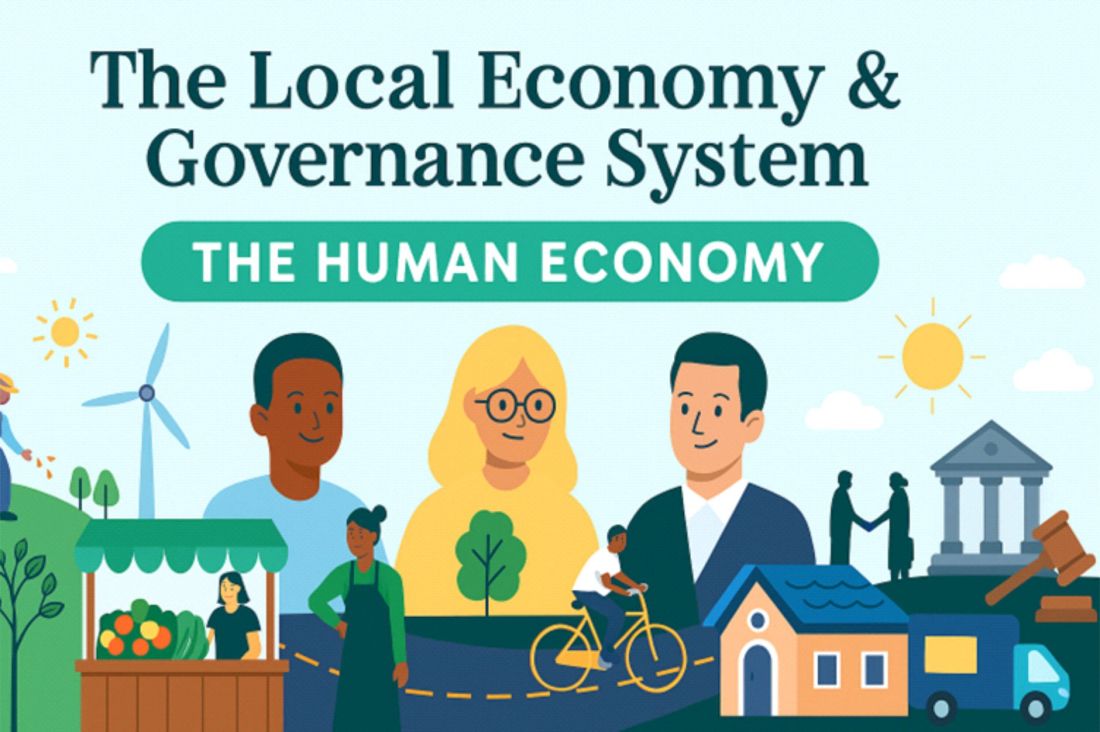
The Local Economy & Governance System: Defining the Economy and Economics for a Humane Existence and Way of Life

Real value does not exist within money itself, nor within the material possessions that money – despite having no intrinsic substance – can be used to persuade others to “buy or sell.”

True value can only be defined at the level of the individual. It arises from the meaning and importance a person attributes to something from within themselves, not from any external price tag or monetary label.

Money is simply a practical tool. Its purpose is to make the exchange of value easier when direct barter or exchange – trading goods, services, or labour – is not possible or convenient.

Money is a facilitator. Not the source of value itself.

In reality, people are the economy.

People are the reason the economy exists, the purpose behind it, and the driving force within it.

Every meaningful economic activity begins and ends with human needs, human choices, and human wellbeing.

With this understanding, the LEGS interpretation of economy can be defined as follows:

Economy is the collective presence, activity, and contribution of people working together to provide and supply all the goods, services, and forms of support that are essential for every individual within a community to live well.

Its purpose is to ensure that no person experiences need or scarcity severe enough to undermine the natural state of abundance – a condition in which all basic and essential needs are reliably met.

In this state of abundance, individuals are freed from the pressures of deprivation or want, allowing them to experience a form of personal freedom that is not compromised by the struggle to secure the necessities of life.

Thus, the economy is not merely a system of production and exchange, but a shared human effort to sustain the conditions that make genuine freedom, well‑being and the experience of Personal Sovereignty possible for all.

Summary

These pages challenge the prevailing money-centred worldview, revealing how economic language and policy have often placed monetary value above human wellbeing.

They expose the myths that underpin this system – especially the illusion that real power and value exist outside the individual – and highlight the moral costs of excess and manufactured scarcity.

The Local Economy & Governance System (LEGS) offers a transformative blueprint: it redefines the economy as a collective human effort, focused on meeting essential needs and fostering abundance, justice, and personal sovereignty.

True value, as argued here, arises from within each person – not from external price tags or monetary labels.

Money is a facilitator, not the source of value itself.

By placing human needs, freedom, and wellbeing at the heart of economic life, The Local Economy & Governance System envisions an economy where no individual suffers deprivation, and everyone is empowered to live well.

The path forward is one of re-examining our assumptions, recognising the moral imperative to share resources fairly, and building systems that sustain genuine freedom and wellbeing for all.

After the Collapse: Who Gets the Blame?

The Crime We Enabled, The Reckoning We Face

The era and system we are leaving behind have inflicted profound harm on countless individuals, communities, and the environment—driven by nothing more than the pursuit of profit.

Exploitation intensified at every available opportunity. Once all legal avenues had been exhausted to enrich and empower those in control, laws, leadership, and even the cultural values of entire nations were reshaped—through corruption, manipulation, or acts of war—to ensure that nothing could obstruct their dominance. This power was sustained by the flow and accumulation of money and material wealth.

There is no crime without consequence. When wrongdoing is legitimised through the manipulation of moral and legislative frameworks, its impact extends far beyond those directly involved. The consequences ripple outward, affecting society at large.

To restrict, obstruct, manipulate, disenfranchise, impoverish, exclude, or punish individuals through a system of governance deliberately designed to criminalise or disadvantage them is among the gravest of injustices. Especially when such a system is constructed to appear not only legal but morally justified—implying that the victims are wrong simply for being victims, while the perpetrators and their enablers remain shielded by the very structure they created.

Few will ever fully grasp the complexity, depth, and reach of this crime against humanity. And while many of its architects and agents may claim ignorance—saying, “we didn’t understand what was happening”—the truth is that their contributions required active consent. At some point, each person involved had to suppress or ignore the moral questions that would have inevitably surfaced in their conscience.

These reflections may seem to call for punishment of every official, politician, or influential figure involved. But before we demand retribution, we must confront a difficult truth: nearly all of us have, in some way, contributed to the perpetuation of this system. Many of us have benefited from its processes and outcomes, even if unknowingly.

Though we may not be innocent, our participation has not always been conscious. The system’s reach and success have made it nearly impossible to function in the world without engaging with it. We must consider that many who enabled its continuation may have genuinely believed they were simply “going along with it” or doing things “the way they’ve always been done.”

In some cases—particularly in junior roles involving routine tasks rather than decision-making—this may warrant forgiveness. But for those who actively sought positions of influence, whose decisions directly affected the lives of others, there is a deeper question: were they truly suited to those roles if they failed to act in the best interests of all?

Seeking power or public office for self-serving reasons, especially in roles meant to serve others, may not be a crime in itself. Yet it reveals a troubling lack of awareness or concern for the consequences of failing to meet the responsibilities those roles demand.

We must recognise that the system has evolved to favour individuals who are malleable—less likely to question their role in perpetuating harm. Their selfishness and moral indifference complicate the question of punishment, especially when victims have also participated, and some perpetrators may themselves be unwitting victims.

Ultimately, the true blame lies with the architects, designers, and strategists who built the mechanisms of exploitation and manipulated others into fulfilling their roles within it. Even then, their actions stem not from empathy or understanding, but from the darker impulses of human nature.

Anger toward those who knowingly or unknowingly participated is understandable. But it cannot justify retaliation.

True accountability lies not in vengeance, but in removing these individuals from positions of influence—ensuring they can never again exploit others, communities, or the environment through their decisions or actions.