

The Author’s Guide to Personal Sovereignty | A companion to Nobody Knows the Story Like the Author

The principles that follow are not rules, instructions or beliefs that need to be adopted. They are simply observations that emerged during the exploration of authorship, awareness and sovereignty.

You may agree with some of them.

You may disagree with others.

The value, if there is any, lies in considering them for yourself.

Principle 1: Nobody Knows the Story Like the Author

Nobody else has lived your life from the inside.

Other people may know parts of your story extraordinarily well. They may offer insights that you would never have reached on your own. They may even understand aspects of you that you have yet to recognise yourself.

Yet there is still only one person who has been present for every moment.

That person is you.

This does not make your perspective perfect.

It simply makes it unique.

Principle 2: We All Begin With Inherited Stories

None of us starts with a blank page.

We inherit ideas about success, failure, work, relationships, responsibility and meaning from the world around us. Much of this inheritance is valuable. Without it, we would struggle to make sense of life at all.

The question is not whether we inherit stories.

The question is whether we ever examine them.

Principle 3: Occupation Consumes Attention

Much of life is spent responding to immediate demands.

Work.

Bills.

Responsibilities.

Relationships.

Worries.

Expectations.

None of these are inherently negative.

Yet the more occupied we become, the less room we have to reflect on the direction of our lives.

A person can be extremely busy whilst never asking whether they are heading where they truly wish to go.

Principle 4: Peace Creates Space

Peace is often confused with happiness, comfort or success.

In this context, peace means something simpler.

Space.

The space to think.

The space to reflect.

The space to observe.

The space to ask questions that urgency normally pushes aside.

Without space, awareness struggles to emerge.

Principle 5: Awareness Is Not Certainty

Many people assume awareness means having answers.

Often it means becoming more comfortable with questions.

Awareness is less about arriving at certainty and more about developing the willingness to look honestly at ourselves, our assumptions and our experiences.

It begins when curiosity becomes more important than certainty.

Principle 6: Other People Are Authors Too

One of the most significant shifts in human understanding occurs when we stop viewing other people as supporting characters in our own story.

Every person is living a life that feels as real to them as yours feels to you.

Every person has experiences you cannot fully see.

Every person carries questions, hopes, fears and assumptions of their own.

Recognising this does not require agreement.

It simply requires respect.

Principle 7: Freedom and Sovereignty Are Not the Same Thing

Freedom concerns options.

Sovereignty concerns authorship.

A person can possess many choices whilst rarely examining why they make them.

Sovereignty begins when we become conscious participants in the direction of our own lives rather than simply moving between available options.

Freedom expands possibility.

Sovereignty explores it.

Principle 8: Not All Constraints Are the Same

Many people imagine freedom as the absence of constraint.

Yet some of the most meaningful parts of life involve commitments that limit our options.

Relationships.

Friendship.

Parenthood.

Responsibility.

Service.

Purpose.

The question is not whether constraints exist.

The question is whether we consciously choose them.

Principle 9: Needs and Wants Are Different

Needs create foundations.

Wants create movement.

Both have a place.

Problems often arise when the distinction between them becomes blurred.

When wants begin to feel like needs, peace becomes harder to find and “enough” becomes increasingly difficult to recognise.

A sovereign life is not a life without desire.

It is a life that understands the difference.

Principle 10: Sovereignty Is the Restoration of Authorship

Personal Sovereignty is not independence, isolation, power or control.

It is the restoration of meaningful authorship over one’s own life.

It is the ongoing process of becoming a conscious participant in the direction of your own journey.

Not perfectly.

Not completely.

But deliberately.

Principle 11: Contribution Is Authorship Made Visible

Human beings often find meaning through participation.

Through creating.

Through teaching.

Through helping.

Through caring.

Through building.

Through improving something beyond themselves.

Contribution is not merely work.

It is one of the ways authorship becomes visible in the shared human experience.

Principle 12: A Flourishing Society Supports Authorship

No society can create awareness on behalf of its citizens.

No system can manufacture sovereignty.

No institution can author another person’s life.

What societies can do is create conditions that make authorship easier to pursue.

Conditions that support dignity.

Security.

Participation.

Contribution.

And the opportunity for people to become the genuine authors of their own lives.

A Final Reflection

Perhaps the simplest way to understand Personal Sovereignty is this:

Life happens to all of us.

Circumstances change.

Unexpected events occur.

Successes arrive.

Difficulties arrive.

Much remains beyond our control.

The question is not whether we control everything.

The question is whether we remain conscious participants in the story we are living.

Because other people may influence your story.

They may challenge it, enrich it and help you understand it.

But nobody can live it for you.

Nobody knows the story like the author.
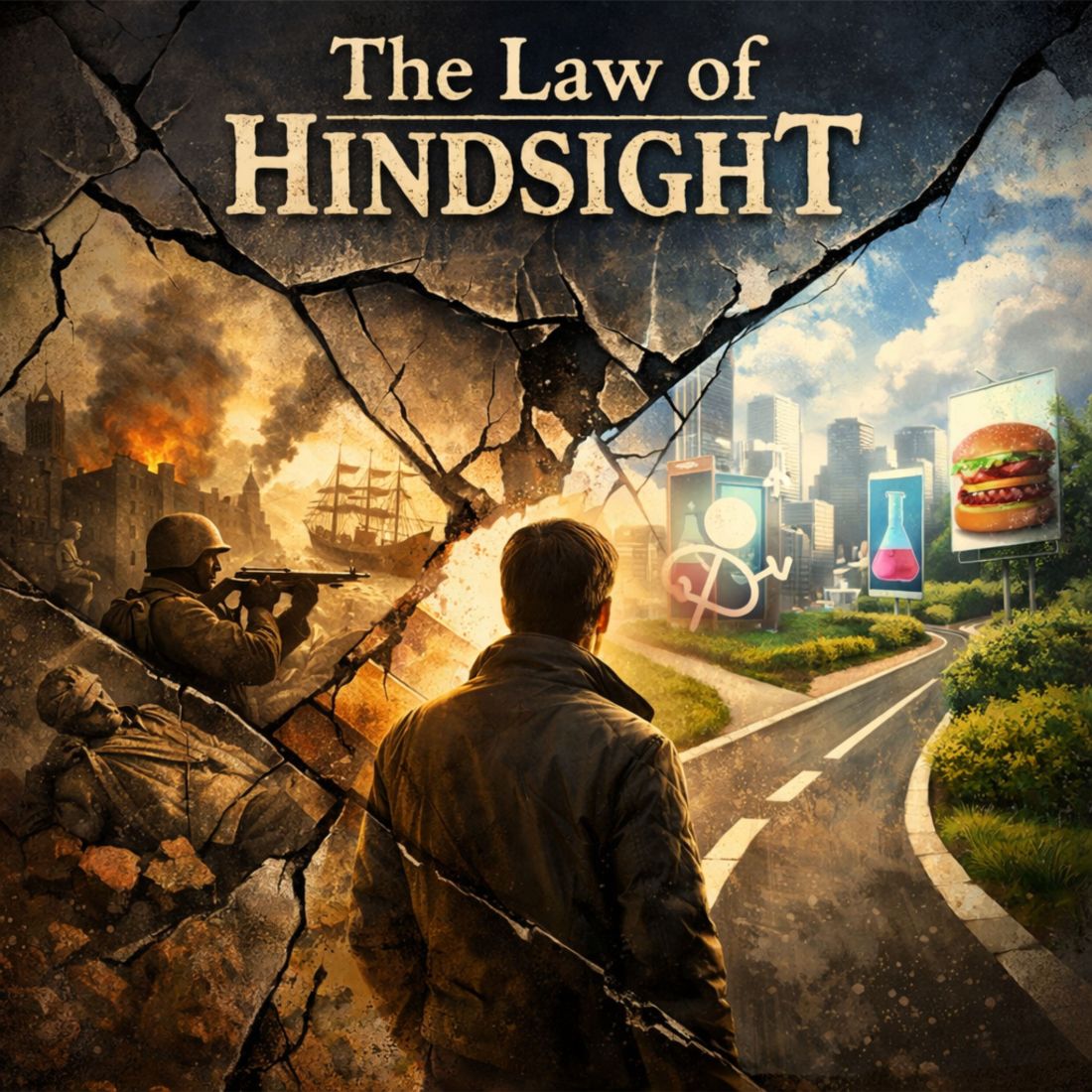
The Law of Hindsight

And Why It’s Becoming a Danger to Us All

We’re living through a strange moment in history. People feel more certain than ever about what happened in the past, even though fewer and fewer of them have actually studied it, lived it, or questioned the narratives they’re repeating.

It’s become a cultural reflex – to judge, to condemn, to rewrite – and it’s happening with a confidence that comes not from understanding, but from repetition.

I’m calling this reflex the law of hindsight. And it’s becoming dangerous not just because leaders misuse it, but because ordinary people now enforce it without realising what they’re doing.

Let’s explore why that matters.

1. When Ordinary People Become Enforcers of Simplified Narratives

Not long ago, rewriting history was something done by governments or institutions. Today, it’s crowdsourced. People scroll through their phones, absorb a ready‑made opinion, and repeat it as if they’ve spent years researching the topic.

It’s not that people are foolish – far from it. It’s that the modern world rewards certainty, not curiosity. It rewards agreement, not understanding. And it rewards the loudest narrative, not the truest one.

So we end up with millions of people confidently enforcing ideas they’ve never examined, often because those ideas came packaged in a video, a meme, or a post from someone they don’t even know.

2. The Northern Ireland Example: When Hindsight Becomes a Weapon

Take the pursuit of veterans who served during the Troubles. Many of these events happened fifty years ago or more, in circumstances that were chaotic, dangerous, and morally complex.

Those who served did so under orders, within a military legal framework, and without the luxury of hindsight.

Yet today, people who know the Troubles only through documentaries or social media clips feel certain about what “should have happened.” They judge the past through the lens of modern narratives and idealist perspectives, not through the reality of the time.

This isn’t justice. It’s retrospective moral absolutism – and it’s deeply unfair.

3. Selective History: Slavery, Erasure, and the Comfort of a Simple Story

We see the same pattern in discussions about slavery.

The West African slave trade is often treated as the only form of slavery that ever existed, and the only one that matters.

The fact that slavery has been a recurring horror throughout human history – and that modern forms of economic coercion and exploitation still exist that harm millions today – is rarely acknowledged.

Equally forgotten is Britain’s enormous role in abolishing the slave trade globally. That part of the story doesn’t fit the preferred narrative, so it gets quietly removed.

Renaming buildings, tearing down statues, and rewriting local history may feel righteous, but it doesn’t change the past. It only obscures it – and obscures the lessons we could learn from it.

4. The Rise of “Narrative Truth” Over Actual Truth

This disregard for reality isn’t limited to history. It’s creeping into areas that directly affect our wellbeing.

Take the food system. For thousands of years, humanity relied on traditional, regenerative methods of producing food. These systems weren’t perfect, but they were grounded in ecological reality.

Now, as the flaws of industrial production become impossible to ignore, the response from many institutions is not to rethink the system but to double down on it – pushing synthetic foods, lab‑grown alternatives, and highly processed substitutes.

These approaches consolidate control in the hands of a few, while ordinary people are encouraged to believe this is “progress.”

And because the narrative is repeated often enough, people accept it without question.

At the same time, we see debates about biological sex – something observable and foundational – becoming arenas where people feel pressured to deny what they can plainly see.

This isn’t about individuals or identity. It’s about the cultural shift toward external narratives overriding internal reality.

When people no longer trust their own senses, their own judgment, or their own experience, they become dependent on whatever authority fills the void.

That’s the real danger.

5. Centralisation, External Validation, and the Erosion of Real Freedom

Underneath all of this is a deeper shift: the centralisation of authority and the surrender of personal agency.

Real freedom isn’t about doing whatever you want. It’s about being able to think independently, trust your own judgment, and take responsibility for your own decisions.

Those qualities only exist when individuals are encouraged to think for themselves and question what they’re told, and are provided with the environment where they can do so and thrive.

But today’s world pushes in the opposite direction. It conditions people to seek validation from external sources – institutions, influencers, algorithms – rather than from within. It teaches people that the “correct” view is the one most widely repeated, not the one most carefully examined.

This is how societies drift into dependency without even noticing it.

6. When Even History Becomes Uncertain

History is supposed to be our collective memory – the record of what we know, what we’ve learned, and how we got here. It’s not perfect, but it’s the closest thing we have to shared truth.

Yet the current climate has taught people to question even this. Not in the healthy sense, where curiosity leads to deeper understanding, but in the corrosive sense, where facts become optional and narratives become truth.

Once we normalise rewriting the past, we lose the ability to trust anything – including the present.

And the people who enthusiastically enforce today’s narratives may one day find themselves judged by new narratives they never saw coming.

7. When Truth Is Imposed, Pressure Builds – And It Eventually Breaks

There’s another part of this story that’s easy to miss: when a society begins to impose “approved truths” and erase uncomfortable ones, it doesn’t just distort history – it distorts people.

At first, many go along with it. Not because they genuinely believe what they’re being told, but because it feels easier, safer, or simply less exhausting than questioning everything.

It’s a bit like someone who enters a relationship for the wrong reasons and slowly compromises who they are to keep the peace. On the surface, things look stable. But underneath, something essential is being suppressed.

And suppressed things don’t disappear. They build pressure.

A system that relies on compliance through confusion, fear, or social pressure may look orderly, but it’s fragile. It’s a pressure cooker. And when the lid eventually blows, it rarely happens in a calm or thoughtful way.

This is where the deeper danger lies.

When people have had a version of reality imposed on them – when they’ve been told what to think, what to say, what to believe – they lose the opportunity to choose morality and ethics for themselves. And when you take away someone’s ability to choose morality, you cannot expect them to behave morally when the pressure finally breaks.

The system assumes that people will respond with reason, ethics, and restraint.

But it is the system itself that has removed the conditions in which reason, ethics, and restraint can grow.

This is the transverse of the law of hindsight:

Imposed narratives eventually rebound on those who impose them.

Not because people are inherently destructive, but because human beings are not designed to live without agency.

When agency is denied, the eventual response is emotional, not rational – and often unpredictable.

This is why the erosion of truth matters. Not because it offends historians, but because it destabilises people. And when enough people feel destabilised, society becomes volatile in ways that no amount of control can contain.

8. The World Works the Same Way We Do

There’s a simple truth that often gets forgotten:

The world works the same way people do.

We are all the sum of our experiences – the good, the bad, the painful, the joyful, the misunderstood, the regretted.

It’s not perfection that shapes us. It’s the mistakes, the missteps, the misunderstandings, and the moments we wish we could redo.

Societies are no different.

Human progress has never come from sanitising the past or pretending mistakes never happened. It has come from learning – sometimes painfully – and using that learning to build something better.

Yet today, instead of embracing this process, we’re falling into the trap of believing we can remove everything “bad” by removing freedom itself.

We’re encouraged to believe that safety comes from control, that improvement comes from restriction, and that progress comes from eliminating uncertainty.

But a world without uncertainty is a world without growth.

A world without mistakes is a world without learning.

A world without freedom is a world without humanity.

When we try to control everything for everyone, we don’t create a better society. We create a fragile one – one that cannot adapt, cannot learn, and cannot withstand the realities of life.

9. A Call for Humility, Curiosity, and Courage

So where does this leave us?

Not in despair – but in responsibility.

We need humility: to recognise that history is complex, that truth is not always fashionable, and that narratives are not the same as facts.

We need curiosity: to look beyond the headlines, beyond the algorithms, beyond the slogans.

And we need courage: the courage to think for ourselves, even when everyone around us seems certain.

If we can do that, we may yet avoid the trap of the law of hindsight.

If we cannot, then the consequences won’t just reshape the past – they’ll reshape our future in ways we may not be able to undo.