

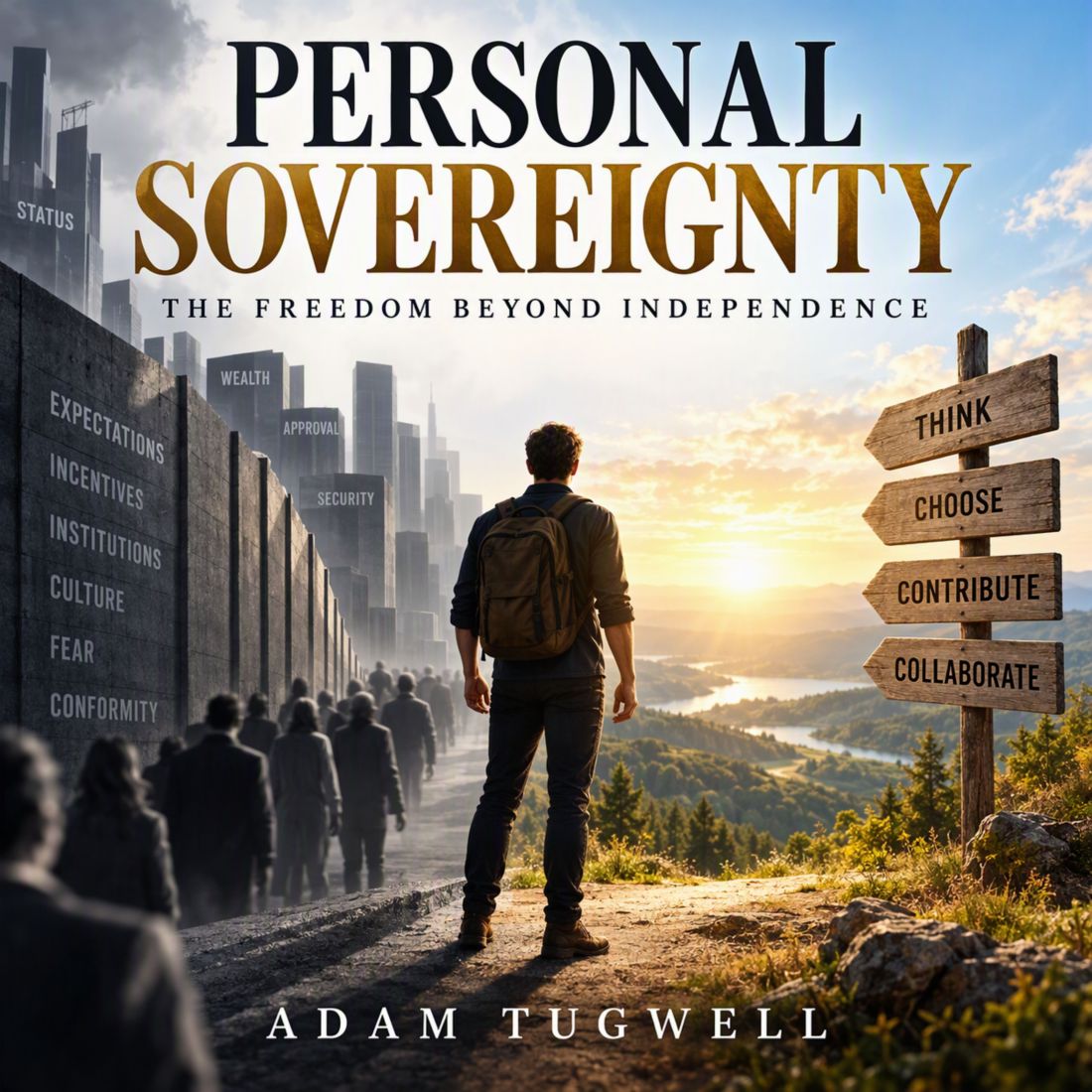
This book explores a simple but profound question:
What does it actually mean to be free?
Most people equate freedom with independence. We assume that if we can support ourselves financially, make our own decisions, and live without relying on others, then we are free.
I argue that independence is only the beginning.
A person can be financially independent and still be constrained by social expectations, economic incentives, institutional pressures, cultural norms, and fears about what might happen if they think or act differently. They may have freedom of movement, freedom of choice, and even considerable wealth, yet still lack the ability to live fully in alignment with their own understanding of reality.
This book introduces the concept of personal sovereignty as the freedom beyond independence.
By sovereignty, I do not mean doing whatever you want. I do not mean rebellion, isolation, self-sufficiency, or withdrawal from society. Nor do I mean freedom at the expense of others.
I define personal sovereignty as:
The ability to act in alignment with your own thinking without being structurally punished for doing so, while respecting the sovereignty of others as equal to your own.
The book explores why this condition is so difficult to achieve in modern society and why so many people mistake comfort, wealth, status, or success for freedom.
A central argument is that today’s system is not primarily maintained through force or conspiracy, but through a shared worldview embedded within institutions, markets, culture, and social expectations. These structures shape not only our choices but also the assumptions through which we interpret the world itself.
As a result, many people are constrained not only by material dependency, but by what I call cognitive capture: the tendency to mistake inherited assumptions for independent thought.
To become sovereign, a person must satisfy three conditions:
- Material independence, where essential needs are securely met.
- Cognitive independence, where they can recognise and question the assumptions that shape their thinking.
- Structural immunity, where they can act on their convictions without risking their livelihood, safety, or stability.
Only when all three conditions exist together does sovereignty become a lived reality rather than an aspiration.
The book also challenges common assumptions about success and freedom. Beyond the point where our needs are met, the pursuit of ever greater comfort, status, and external validation can create new forms of dependency. In some cases, those who appear most free may in fact be among the least sovereign because they have the most to lose from thinking or acting differently.
Ultimately, this is not a book about escaping society. It is a book about understanding the forces that shape our lives and creating the conditions in which people can think, choose, contribute, and collaborate freely.
My argument is that a truly healthy society is not one built upon dependency, fear, competition, or coercion, but one built upon secure, sovereign individuals who are free to participate in community by choice rather than necessity.
Personal sovereignty is not simply a personal ideal. It is the foundation upon which a more human-centred society can be built.
Key Takeaways
1. Independence is the doorway, not the destination
Meeting your essential needs creates the possibility of freedom, but independence alone does not create sovereignty. Freedom begins where dependency ends, but sovereignty requires something more.
2. Sovereignty is not selfishness
True sovereignty depends on recognising that other people’s sovereignty is equal to your own. Freedom without respect becomes domination; sovereignty without reciprocity becomes selfishness.
3. The greatest constraints are often invisible
Many of the forces that shape our behaviour are not laws or commands but incentives, expectations, cultural assumptions, and accepted definitions of what is considered normal, successful, or responsible.
4. We are all shaped by the systems we inhabit
The assumptions we inherit often feel like reality itself. Sovereignty begins when we learn to examine those assumptions consciously rather than unconsciously living through them.
5. Wealth and comfort do not guarantee freedom
A person can possess significant wealth and still be deeply dependent on status, approval, reputation, or material rewards. Comfort can sometimes obscure captivity rather than remove it.
6. Sovereignty requires the ability to act on what you believe
Thinking independently matters, but sovereignty ultimately depends upon whether you can live in accordance with your understanding without fear of losing security, stability, or belonging.
7. Most social problems are symptoms of deeper causes
Housing pressures, inequality, insecurity, and many other challenges emerge from underlying structures and assumptions. Sustainable solutions require addressing root causes rather than symptoms alone.
8. Escaping society is not the same as freedom
Going off-grid or withdrawing from society simply exchanges one set of dependencies for another. Sovereignty is not the absence of constraints; it is the ability to choose your constraints.
9. Freedom is fundamentally about alignment
The closer your life reflects your genuine understanding, values, and convictions, the closer you move toward sovereignty.
10. Sovereignty changes the meaning of community
When people are secure and sovereign, collaboration becomes voluntary, contribution becomes meaningful, and community becomes something chosen rather than imposed.
In One Sentence
Personal Sovereignty argues that true freedom is not merely the ability to survive independently, but the ability to think and act in alignment with your own understanding of reality, without structural punishment, while respecting the equal sovereignty of others.

