

Cheltenham is a town that prides itself on beauty, culture, and a strong sense of civic identity. But over recent months, a series of quiet, unsettling events has revealed something deeper about the way we respond to vulnerability – and about the system that shapes those responses.
Tents outside Cavendish House were removed in the days before the Races. The building wasn’t shuttered at the time, but the doorways where people had been sheltering were boarded up almost immediately afterwards.
Then, an encampment in St Mary’s churchyard was moved on.
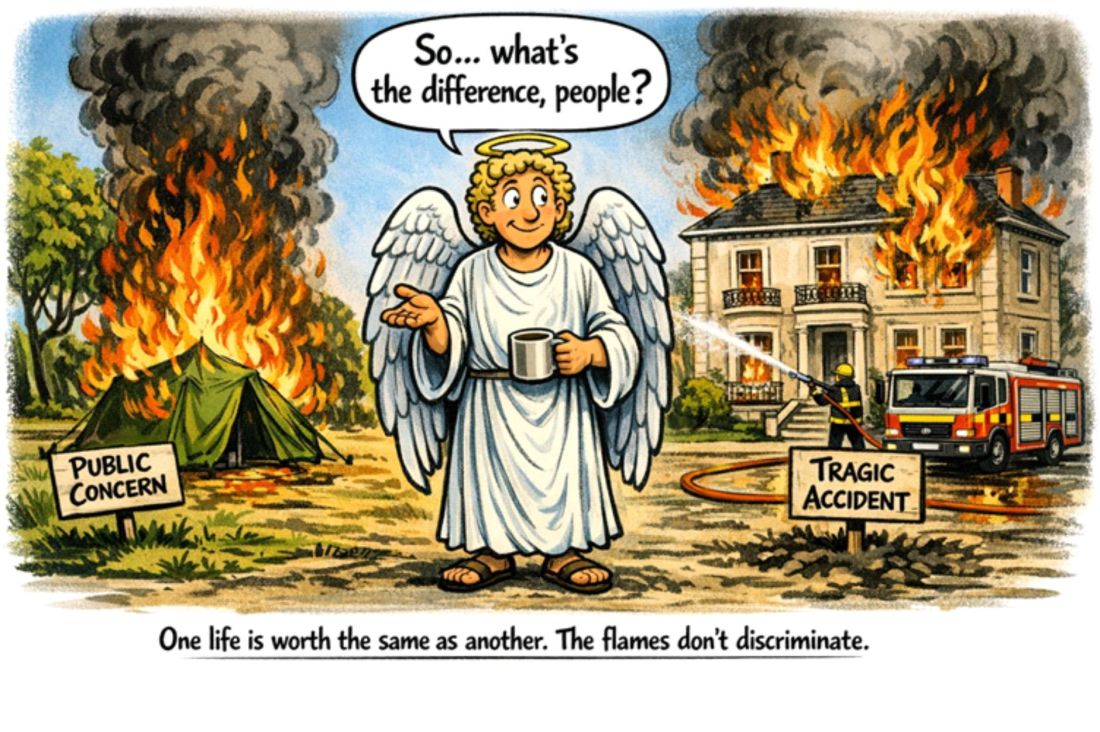
Now, this week, a tent in Clarence Square went up in flames – a fire now thought to have been started deliberately.
Different locations.
Different people.
Same outcome.
And behind each incident sits the same familiar line: support was offered.
But what does that really mean in practice?
A Walk Through Clarence Square
A few days before the fire, I walked past the Clarence Square encampment with my dogs. What I saw wasn’t disorder or disruption – it was quiet, deliberate survival. A couple of tents had been tucked carefully under the bushes and trees, almost hidden from view. The people staying there were clearly trying to minimise their presence – to avoid causing alarm, to keep things tidy, to exist quietly in a space that was never meant to be a home.
It challenged the assumptions many people hold about rough sleepers. Even in the most difficult circumstances, people try to maintain dignity, privacy, and respect for the space around them.
At the same time, it is entirely understandable that any resident would feel concerned or unsettled by a pop‑up encampment in a public square. These are shared spaces – places where children play, where people walk their dogs, where neighbours meet. When something unexpected appears, especially something associated with vulnerability or crisis, it can trigger worry or discomfort.
But the first step toward responding constructively is remembering that behind what may look like an “antisocial” situation is always a human story – a life shaped by circumstances that most of us have never had to face. And recognising that truth is how we give our own humanity another try.
Why People Become Homeless – And Why It’s Not Always What We Assume
Homelessness is often imagined as a single event – a bad decision, a sudden crisis, a moment of collapse. In reality, it is usually a long chain of pressures: rising rents, insecure work, mental health struggles, family breakdown, trauma, or simply not having anyone to fall back on. By the time someone is in a tent, they’ve already run out of options that most of us take for granted.
But there is another reality we rarely talk about, because it sits in a difficult, uncomfortable space.
Some people experience homelessness because they cannot mentally or emotionally conform to the rigid structures that society imposes. The expectations that most people navigate without thinking – appointments, assessments, paperwork, rules, deadlines, forms, compliance – are not just challenging for them. They are overwhelming.
For these individuals, the pressure to fit into systems that feel rigid, impersonal, or punitive becomes too much. And when every avenue of “acceptable” living feels impossible, stepping outside those structures can feel like the only way to breathe.
These are not people who want to harm themselves.
They are people who want to escape.
Escape pressure.
Escape judgement.
Escape systems and expectations they cannot meet.
Most of us don’t see this because cultural conditioning teaches us that the way society works is neutral – that it’s simply “how things are.” But for some, the very fabric of modern life is a constant source of stress, confusion, or fear. And when the system cannot bend to meet them, they fall through it.
Recognising this doesn’t excuse antisocial behaviour, and it doesn’t mean public spaces shouldn’t be safe. But it does mean we need to understand that not all homelessness is the result of poor choices or sudden crises. Sometimes it is the result of a lifetime of being unable to fit into a world that never made space for difference.
Cheltenham’s Services Are Doing What They Can – Within Their Limits
Cheltenham Borough Council, CCP, and other local organisations are not failing through lack of effort or compassion. They are staffed by people who care deeply and who work hard.
They are also operating within strict boundaries:
• funding that dictates what can be offered
• policies that define who qualifies
• safeguarding responsibilities that limit flexibility
• national frameworks that shape local decisions
• the duty of care they owe to staff as well as service users
Gloucestershire Live often reports the official responses:
support offered, referrals made, StreetLink notified, accommodation available if criteria are met.
All of that can be true.
And yet it is also true that the support available is not designed for the people most likely to need it.
This is not a Cheltenham problem.
It is a structural one.
I’ve Seen These Limits First‑Hand
When I ran and developed a Wheels to Work project across the County for our local Rural Community Council, helping people in rural areas access jobs and training, the same pattern appeared again and again:
• We could only do what funders would pay for
• We could only consider what policy allowed
• We could only help people who fit the criteria
• We could only support those who could navigate the system
And the people who needed the most help were often the ones who didn’t fit neatly into any of the boxes that we and many other organisations working with disadvantage had to consider.
That hasn’t changed.
If anything, the gaps have widened.
The System Is the Problem – Not the People Working Within It
Everyone involved – the council, CCP, outreach workers, volunteers – are doing what they can. The issue is that they are all operating inside a system that is fundamentally money‑centric rather than people‑centric.
A system that:
• measures success in budgets and outputs, not lives
• prioritises compliance over compassion
• treats housing as a commodity
• expects people in crisis to behave like people who are stable
• offers help that is conditional, time‑limited, or inaccessible
This isn’t about blaming organisations.
It’s about recognising that they are working within a structure that was never designed to meet the needs of people who fall outside the margins.
A Society That Needs to Re‑Centre People
The presence of tents in a public square is not a sign of individual failure.
It is a sign of systemic strain.
We have built a society that values:
• material wealth over human wellbeing
• external validation over internal resilience
• appearances over understanding
• order over empathy
And the people who fall through the cracks are treated as if they are the cause of the cracks.
But the truth is simpler and more uncomfortable:
Every human being is more important than any bottom line.
Until we build systems that reflect that truth, we will continue to see people pushed to the edges – not because they failed, but because the system did.
This is Not the End of the Story
The cost‑of‑living crisis, global instability, and shrinking public services are pushing more people to the edge. The individuals sleeping in tents today are simply the first to fall.
The line between “us” and “them” is thinner than most residents realise.
One job loss.
One rent increase.
One illness.
One relationship breakdown.
That’s all it takes.
What Cheltenham Needs Now
Not blame.
Not displacement.
Not another round of “support was offered” – followed by silence.
What we need is a shift in mindset:
• from money‑centric to people‑centric
• from managing homelessness to preventing it
• from conditional support to unconditional dignity
• from short‑term fixes to long‑term solutions
• from moving people on to moving people forward
Cheltenham has the resources, the intelligence, and the compassion to lead the way – but only if we stop treating homelessness as an inconvenience and start recognising it as a mirror.
A Final Thought
The people we are moving on are not the problem.
They are the signal.
And the first step toward change is simply remembering that behind every tent, every encampment, every uncomfortable moment in a public space, there is a human story – and a system that needs to be rewritten so that none of us ever has to live it.
If You Need Support – Or Want to Help
If you are experiencing homelessness, supporting someone who is, or want to help in practical ways, the organisations below can offer support, advice, or routes into action.
Cheltenham has several organisations working tirelessly to support people experiencing homelessness or crisis. These include:
• CCP (Caring for Communities and People) – providing supported accommodation, outreach, and practical help.
Tel: 03003658999
Website: Home › CCP
• Cheltenham Borough Council’s Housing & Homelessness Team – offering assessments, prevention support, and referrals.
Tel: 01242 387615
Website: Housing options and homelessness | Cheltenham Borough Council
Email: housing.options@cheltenham.gov.uk
• P3 Charity – supporting people with complex needs across Gloucestershire.
Tel: 01158 508190
Website: Homepage | P3 Charity
Email: info@p3charity.org
• Emmaus Gloucestershire – offering community‑based support and meaningful work opportunities.
Tel: 01452 413095
Website: Emmaus Gloucestershire – Homelessness Charity
• National homelessness charities such as Crisis, Shelter, and St Mungo’s, which offer advice, advocacy, and emergency support.

