Poverty is often described as a lack of money. Governments measure it through income thresholds, commentators discuss it in terms of affordability, and public debate frequently focuses on individual expenses such as housing, food, or energy. While these measures and discussions capture important aspects of economic hardship, they often fail to identify the underlying condition that poverty represents.
The fundamental issue is not simply a shortage of income. It is the loss of independence.
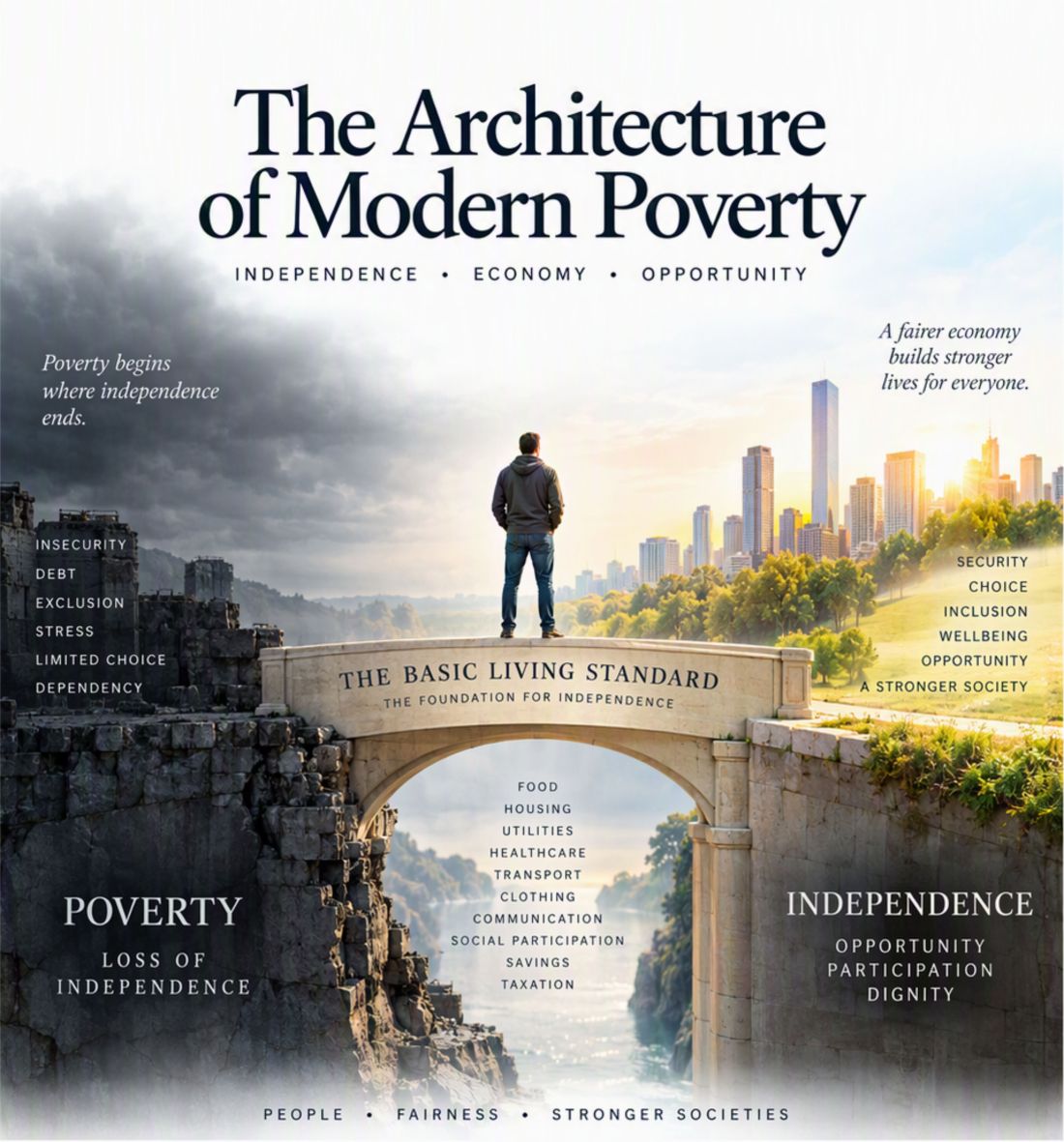
In a modern economy, poverty begins when a person can no longer meet their essential needs through their own resources and must rely on external support to maintain a basic standard of living.
The inability to sustain oneself independently marks the boundary between economic security and economic vulnerability. This point may be described as the Independence Threshold.
Understanding poverty through independence shifts attention away from arbitrary income figures and towards a more meaningful question: can an individual meet the essential requirements of life without falling into debt, relying on welfare, or depending on charity?
If the answer is no, poverty has already begun.
Poverty as the Loss of Independence
Independence is often taken for granted. It is expressed through ordinary activities: paying rent, buying food, travelling to work, heating a home, replacing worn clothing, maintaining communication, and managing unexpected expenses.
These activities appear routine because they are routine for those whose incomes allow them to participate fully in economic life. Yet all depend upon a continuing ability to convert income into essential goods and services.
When that ability is lost, independence begins to erode.
A person who cannot afford housing without assistance is not fully independent. A person who must regularly choose between heating and eating is not fully independent. A person who requires continual borrowing to meet ordinary living costs is not fully independent.
The common feature in each case is not low income itself, but an inability to sustain essential needs through one’s own means.
Poverty is therefore better understood as a condition of dependency rather than simply a condition of low earnings.
Independence Exists Within an Economic Context
No individual becomes independent in isolation. Independence is shaped by the economy in which a person lives.
The resources required to maintain a basic life differ between countries, regions, and periods of history. Modern life carries obligations that did not exist for previous generations and costs that vary considerably between locations.
Housing, transport, energy, communication, healthcare, taxation, childcare, and access to employment all influence the resources required for independent living.
As these costs rise, the income necessary to maintain independence rises with them.
This has important implications for how poverty is understood.
A level of income that provides security in one economy may produce hardship in another. Likewise, an income that supported independence ten years ago may no longer be sufficient today if essential costs have increased.
Poverty cannot therefore be understood solely through absolute measures. It must be understood relative to the economic conditions in which people actually live.
The question is not simply how much money a person has.
The question is whether that money is sufficient to maintain independence within the economic environment that surrounds them.
The Consequences of Falling Below the Threshold
The loss of independence has consequences that extend far beyond finances.
When people cannot reliably meet their essential needs, uncertainty becomes a constant feature of daily life. Long-term planning becomes difficult. Financial shocks become crises. Opportunities are declined because the risks are too great. Immediate necessities take precedence over future ambitions.
Over time, this creates a pattern of exclusion.
Participation in social activities may decline because they can no longer be afforded. Educational opportunities may be deferred. Career progression may be limited by transport costs, childcare costs, or insecure housing. Physical and mental wellbeing may deteriorate as financial pressures intensify.
Poverty therefore affects more than material possessions. It constrains choices, limits participation, and reduces personal agency.
The defining characteristic of poverty is not merely what people lack. It is what they are no longer free to do.
The Limits of Traditional Poverty Measures
Most poverty measures focus primarily on income.
While income remains important, income alone does not determine whether a person is independent.
Two households with identical earnings may experience very different levels of security depending upon their circumstances. Housing costs, debt obligations, family responsibilities, regional price differences, disability-related expenses, transport requirements, and many other factors influence whether income is sufficient to meet essential needs.
As a result, many people who sit above official poverty lines still struggle to maintain independence. They may appear financially secure according to statistical measures while relying on borrowing, family support, charitable assistance, or the continual postponement of essential spending.
Such individuals may not be recognised by conventional poverty measures, yet their independence remains fragile.
A more meaningful understanding of poverty requires identifying the point at which independence becomes unsustainable, rather than merely measuring income against a predetermined percentage or average.
Defining the Requirements of Independence
If poverty begins when independence ends, a practical question emerges.
What is required to remain independent?
The answer cannot be limited to survival alone.
Independence in a modern society requires more than the bare minimum needed to stay alive. It requires access to the goods and services necessary for participation in ordinary economic and social life.
This includes adequate food, secure housing, utilities, transport, healthcare, clothing, communication, and the ability to absorb unexpected expenses. It also requires a modest capacity to participate in society and contribute to the wider community through taxation and civic engagement.
Together, these elements form the basis of a Basic Living Standard.
The Basic Living Standard represents the minimum set of resources required for a person to live independently within a modern economy. It is not a measure of comfort, luxury, or affluence. Nor is it a subsistence model concerned only with physical survival.
Instead, it identifies the economic foundation necessary for stability, dignity, and participation.
The Relationship Between the Independence Threshold and the Basic Living Standard
The Independence Threshold and the Basic Living Standard represent two parts of the same framework.
The Independence Threshold defines the condition of poverty. It identifies the point at which an individual loses the ability to meet essential needs without external support.
The Basic Living Standard defines the resources required to avoid that condition. It establishes the minimum economic foundation necessary to sustain independence.
One identifies the boundary.
The other identifies where that boundary lies.
Together, they provide both a definition and a measurement.
If an individual’s earned income is sufficient to achieve the Basic Living Standard, independence is maintained. If it is insufficient, independence becomes compromised, and poverty emerges.
This relationship transforms poverty from an abstract social concern into a measurable economic reality.
A New Foundation for Economic Policy
Viewing poverty through the lens of independence creates a different basis for public policy.
The central question becomes whether the structures of the economy allow people to maintain independent lives through their own efforts.
Wages, housing policy, taxation, transport infrastructure, energy markets, healthcare provision, and social support systems can all be assessed according to their effect on independence.
A minimum wage, for example, cannot be considered adequate simply because it exists. Its adequacy depends upon whether it enables a worker to achieve the Basic Living Standard without requiring continual supplementation from debt, welfare, or charity.
Similarly, economic growth cannot be evaluated solely through national statistics if increasing living costs simultaneously undermine the independence of large sections of the population.
An economy succeeds not merely when it generates wealth, but when it allows ordinary people to sustain independent lives within it.
Conclusion
Poverty is often treated as a problem of insufficient income. In reality, it is more accurately understood as a loss of independence.
The ability to meet essential needs through one’s own resources represents the foundation of economic security, personal agency, and meaningful participation in society. When that ability is lost, poverty begins, regardless of how it is measured statistically.
The Independence Threshold identifies this critical boundary. The Basic Living Standard identifies the resources required to remain above it.
Together, they provide a framework for understanding poverty that is rooted not in abstract financial measures, but in the practical realities of everyday life. They shift the focus from income alone to the broader question of whether people possess the means to sustain themselves with dignity, stability, and autonomy.
In doing so, they offer a foundation for a more coherent understanding of poverty and a clearer means of addressing it.
Further Reading
The ideas presented in this essay are explored in greater depth across a series of related works. Together, these pieces trace the development of the Basic Living Standard and the Independence Threshold, from the practical question of what people need to live independently, through to a broader philosophy of freedom, autonomy, and economic participation.
This is the foundational statement of the Basic Living Standard. It sets out the principle that anyone working full time at the lowest legal wage should be able to meet all essential living costs without debt, welfare dependency, or charity.
The article defines the components of a basic but dignified life and establishes the standard as a practical benchmark for wages, public policy, and economic justice.
This accessible introduction explains the purpose and mechanics of the Basic Living Standard. It explores why traditional measures such as minimum wage and poverty thresholds often fail to reflect lived reality and demonstrates how a living standard based on genuine economic independence can provide a clearer and more meaningful benchmark.
3. The Basic Living Standard: Freedom to Think, Freedom to Do, Freedom to Be
Moving beyond economics, this essay explores the deeper human implications of financial security. It argues that economic independence creates the conditions for genuine freedom: the freedom to think without constant anxiety, to act with agency and purpose, and to develop one’s identity without the constraints imposed by persistent insecurity.
The piece examines the relationship between personal sovereignty, dignity, wellbeing, and social stability.
4. The Independence Threshold: A New Definition of Poverty for a Modern Economy
This work develops a new definition of poverty based on the concept of independence rather than income alone. It argues that poverty begins at the point where a person can no longer meet their essential needs without external support.
The article introduces the Independence Threshold as a framework for understanding poverty within modern economies and explains its relationship to exclusion, participation, and economic resilience.
Across the past two decades, the UK has experienced repeated systemic failures: the Global Financial Crisis, Brexit, and the COVID‑19 response. Each event exposed the same underlying truths about how the political and administrative system actually functions. These truths are no longer hidden, subtle, or debatable. They are visible, documented, and repeatedly demonstrated. Yet despite this continued exposure, neither government nor the public has meaningfully learned from them.
This paper argues that the core problem is not individual politicians or specific governments, but a persistent structural and cultural pattern within the system itself – and a public tendency to interpret systemic failure as personal failure. As a result, we continue to replace political actors while leaving the underlying machinery unchanged, ensuring that the same mistakes recur across crises.
The analysis identifies three interlinked failures: (1) Systemic fragility – a governance culture that defaults to fear, narrative, and process over judgement. (2) Public misinterpretation – a widespread belief that failures are caused by personalities rather than structures. (3) Credibility fragmentation – the absence of a coherent, trusted, collective voice capable of articulating what the system’s repeated failures actually mean.
The consequence is a cycle in which crises expose the same weaknesses, the public draws the wrong conclusions, and the system continues unchanged. This paper outlines why these patterns persist, why they are becoming more dangerous, and why future crises will produce the same failures unless both system and society confront the truths already revealed.
1. Introduction: Context and Purpose
Over the past two decades, the UK has experienced repeated systemic failures: the Global Financial Crisis, Brexit, and the COVID‑19 response. As the abstract states, “Each event exposed the same underlying truths about how the political and administrative system actually functions.”
These truths were visible, documented, and repeatedly demonstrated.
This paper is the third part of a sequence of work that began during the pandemic. The first two parts – 101: Lockdown Blogs and 202: Another 101 Lockdown Blogs – are collections of the original, unedited blogs written and published in real time throughout the COVID‑19 period. These blogs were published independently on www.adamtugwell.blog as the crisis unfolded, without retrospective adjustment or editorial reinterpretation. Both volumes are publicly available on Amazon.
The vantage point of these books is central to this analysis. The writing was produced contemporaneously by someone with direct experience of how local government and public‑sector systems operate: twelve years as a councillor, four years as a licensing chair, work as a local government officer, regional management for a national health‑related charity, and management of a local charity delivering services funded by and aligned with local authorities and government departments.
This background provided a practical understanding of how public systems behave under pressure, how decisions are made, and how institutional incentives shape outcomes.
The blogs captured the system’s behaviour as events unfolded – its reliance on narrative, its avoidance of responsibility, its inability to manage complexity, and its instinct for self‑preservation. They documented what the system did, how it communicated, and how its weaknesses became visible in real time. This contemporaneous record forms the foundation for the reflective analysis presented in 303.
The earlier crises – the Global Financial Crisis and Brexit – provide essential context.
As the introduction notes, “These events were not isolated. They were not anomalies. They were not unpredictable shocks.” They were sequential demonstrations of the same underlying pattern: a system that consistently fails under pressure, and a public that consistently misinterprets those failures.
Despite this repeated exposure, neither government nor society has meaningfully learned from these events. The abstract states clearly, “Yet despite this continued exposure, neither government nor the public has meaningfully learned from them.” The same assumptions persist, the same behaviours recur, and the same explanations dominate public understanding. We continue to replace political actors while leaving the underlying machinery unchanged.
Purpose of the Paper
This paper begins from a simple premise: “the system has already shown us how it works, repeatedly and unambiguously, yet we continue to behave as if each failure is new, surprising, and personal.”
The purpose of 303 is threefold:
To analyse the structural and cultural patterns that cause the system to fail repeatedly. The abstract identifies three interlinked failures: systemic fragility, public misinterpretation, and credibility fragmentation.
To explain why neither government nor society has learned from the truths already revealed. As the introduction states, “Despite the scale and frequency of these exposures, neither government nor society has meaningfully learned from them.”
To outline why these patterns are becoming more dangerous and why future crises will produce the same failures unless both system and society confront these truths. This purpose is stated directly in the abstract.
Scope of the Paper
303 does not analyse the GFC, Brexit, or COVID‑19 as isolated events. It examines them as milestones that revealed the same structural and cultural weaknesses within the system.
It does not focus on individual politicians or governments. It focuses on the machinery – the incentives, behaviours, and cultural norms that produce predictable failure under pressure.
It does not propose technical reforms or policy adjustments. It identifies the conditions that must change if future crises are to be managed differently.
It is written as a reflection on the real‑time documentation captured in 101 and 202, and as an analysis of why those observations still have not been understood or acted upon.
2. The Pattern of Failure
The systemic failures revealed during the pandemic did not emerge suddenly in 2020. They had already been exposed twice in little more than the decade before.
The Global Financial Crisis demonstrated that when the system is threatened, it protects itself first – even at public expense.
Brexit then demonstrated that when the public issues a democratic instruction that conflicts with institutional preference, the system prioritises its own continuity over the public’s will.
These events form essential context for understanding the failures documented in real time during the pandemic.
COVID did not reveal new weaknesses. It revealed the same weaknesses, but this time with immediate, visible, and unavoidable consequences.
The pattern that emerged – and which 101 captured as it unfolded – can be understood through the following systemic behaviours.
2.1 The System Protects Itself First
The GFC exposed the system’s instinct for self‑preservation. Public money was used to stabilise institutions whose failures had caused the crisis. The priority was not public welfare but institutional continuity.
Brexit reinforced this pattern. The referendum result represented a clear democratic instruction, yet the establishment’s response demonstrated that when public direction conflicts with institutional preference, the system chooses itself.
Rather than treating the referendum as a mandate for a new starting point, Brexit was approached as a managed separation from an existing relationship.
The previous EU framework was treated as the baseline from which any change had to be justified or negotiated.
This approach resembled a divorce in which the history of the relationship determines the terms of separation, rather than a democratic reset defined by the public’s decision.
The consequence was not inherent harm from Brexit itself, but harm arising from the way the system handled it:
reluctance to accept the referendum as a definitive instruction,
attempts to preserve institutional continuity,
negotiation conducted from the perspective of loss rather than opportunity, and
prioritisation of system stability over democratic direction.
COVID then exposed the same instinct again, but with immediate public consequences. Decisions were shaped to avoid blame rather than to achieve outcomes.
Across all three milestones, the system’s priority was its own stability, not the public’s wellbeing.
2.2 The System Cannot Manage Complexity
Brexit revealed the system’s inability to translate a democratic mandate into a coherent administrative plan. The machinery struggled to handle a multi‑dimensional change without reducing it to a narrow, defensive process.
COVID exposed this limitation more starkly. The system collapsed into single‑track thinking, unable to balance multiple variables simultaneously. Complex realities were reduced to simple narratives, and policy was shaped around those narratives rather than the underlying complexity.
2.3 The System Defaults to Narrative Over Competence
This behaviour was visible during Brexit, where political messaging consistently outran administrative capacity.
It became unavoidable during COVID, where narrative became the organising principle of policy. Decisions were made to maintain a story, not to solve a problem.
The real‑time writing in 101 documented this dynamic clearly: narrative coherence was treated as more important than operational competence.
2.4 The System is Managed, Not Led
The pandemic exposed the absence of leadership capacity within the system. There was no strategic leadership, only management: reactive, fearful, and dependent on external validation.
This was not a new behaviour but a continuation of the same pattern visible in earlier crises.
202 expanded this point: the system is structurally incapable of leadership because it does not select, develop, or reward leaders.
It rewards compliance, communication, and continuity.
2.5 The System’s Incompetence Finally Had Immediate Consequences
The GFC harmed the public indirectly. Brexit harmed the public politically and economically through the way it was handled. COVID harmed the public immediately, physically, and visibly.
This is why the pandemic is central to this paper: it was the first time the system’s failures were experienced in real time by everyone, simultaneously.
The incompetence could no longer be absorbed, delayed, or disguised.
2.6 The Pattern is Now Unavoidable
Across all three milestones, the same behaviours recur:
self‑preservation,
avoidance of responsibility,
narrative‑driven decision‑making,
inability to manage complexity,
absence of leadership,
structural fragility.
COVID did not create this pattern. It simply made it impossible to ignore.
This pattern forms the foundation for the analysis that follows: the system has already shown how it works – repeatedly – yet neither government nor society has learned from it.
3. Why the Public Misinterprets System Failure
The repeated exposure of systemic failure across the GFC, Brexit, and COVID has not resulted in a corresponding public understanding of how the system actually works. Instead, public interpretation consistently frames these failures as the result of individual political actors, specific governments, or isolated mistakes.
This misinterpretation is central to why the system continues unchanged and why the same failures recur across crises.
The public’s misunderstanding is not accidental. It is produced by a combination of cultural assumptions, institutional habits, and communication practices that shape how system behaviour is perceived.
3.1 The Assumption of Competence
A foundational public belief is that the system is broadly competent. Titles, roles, and institutional prestige create an expectation that those in positions of authority possess the capability required to manage complex events.
This assumption persists even when evidence contradicts it.
During the pandemic, this belief was visible in the early acceptance of government decisions, the expectation that policies were based on expertise, and the reluctance to question the underlying logic of interventions.
The public interpreted actions as necessary rather than as symptoms of systemic fragility.
3.2 The Personalisation of Failure
Systemic failure is routinely interpreted as personal failure.
The public attributes outcomes to individual politicians rather than to the structure, culture, and incentives of the system.
This personalisation obscures the underlying machinery and reinforces the belief that replacing individuals will produce different outcomes.
This dynamic was evident during COVID, where criticism focused on specific leaders rather than on the systemic behaviours documented in real time in 101 and 202.
The public saw incompetence as a matter of personality rather than as a structural feature.
3.3 The Power of Narrative
Narrative plays a central role in shaping public understanding. Government communication is designed to create coherence, even when coherence does not exist operationally. The public often accepts these narratives because they provide clarity in situations that are otherwise complex and uncertain.
During the pandemic, narrative became the organising principle of policy. The public interpreted narrative as strategy, mistaking communication for competence.
This reinforced the belief that decisions were grounded in expertise rather than in fear, process, or political self‑preservation.
3.4 The Absence of a Credible Collective Voice
One of the most significant factors in public misinterpretation is the absence of a credible, unified voice capable of explaining systemic failure.
Expertise is fragmented, commentary is polarised, and institutional trust is inconsistent.
As a result, no single source is able to articulate the structural nature of the failures or challenge the dominant narratives effectively.
This fragmentation allows the system’s preferred explanations to dominate public understanding.
Without a coherent alternative, the public defaults to familiar interpretations: individual blame, party politics, and short‑term explanations.
3.5 The Cultural Avoidance of Systemic Critique
There is a cultural reluctance to confront systemic failure. Critiquing the system requires acknowledging that the machinery is not what it appears to be – that competence is not guaranteed, that leadership is not assured, and that institutional stability is not inherent.
This is uncomfortable, and the public often avoids it by focusing on more accessible explanations.
COVID made systemic failure visible, but the cultural habit of avoiding structural critique meant that many people continued to interpret events through familiar personal and political lenses.
3.6 The Consequence: Repetition
Because the public misinterprets systemic failure, the system remains unchallenged.
The same behaviours recur across crises, the same weaknesses persist, and the same assumptions endure.
The public continues to expect competence, continues to personalise failure, and continues to accept narrative as strategy.
This misinterpretation is not a side issue. It is a central reason why the system continues to fail in predictable ways and why the lessons of past crises remain unlearned.
4. Why the System Continues to Fail
The persistence of systemic failure is not accidental. It is the predictable outcome of a political‑administrative structure that is designed, incentivised, and culturally conditioned to behave in ways that produce failure under pressure.
The system does not fail because it encounters unprecedented events. It fails because its internal characteristics make effective crisis management structurally impossible.
The failures documented in real time during the pandemic were not deviations from normal behaviour. They were expressions of the system’s underlying design.
4.1 Structural Incentives Prioritise Stability Over Outcomes
The system is built to preserve itself. Its incentives reward continuity, risk‑avoidance, and political safety. Effective outcomes are secondary to maintaining institutional stability.
This dynamic was visible during the GFC, Brexit, and COVID, where decisions were shaped by the need to avoid disruption to the system rather than by the need to achieve public benefit.
When stability is the primary goal, competence becomes optional. Failure becomes inevitable.
4.2 Leadership Is Selected for Compliance, Not Capability
The system does not select leaders based on strategic competence, crisis capability, or judgement. It selects them based on loyalty, communication skill, and alignment with institutional norms. This produces a leadership class that is structurally incapable of managing complexity.
During COVID, this limitation became unavoidable. The absence of leadership was not a temporary weakness; it was a structural feature.
The system is managed, not led, and management collapses under pressure.
4.3 Complexity Is Treated as a Threat
The system cannot handle complexity without reducing it to narrative. Complex realities require judgement, flexibility, and strategic thinking – qualities the system does not cultivate. As a result, complexity is treated as a threat to stability.
During the pandemic, this behaviour was visible in the reduction of multi‑dimensional problems to single‑track narratives. The system responded to complexity by simplifying it, and the simplification produced failure.
4.4 Process Replaces Thinking
When competence is uncertain, process becomes a substitute for judgement. The system relies on procedure to justify decisions, even when procedure is inadequate or irrelevant.
This behaviour was evident in regulatory failures before the GFC, in the defensive handling of Brexit, and in the procedural rigidity of the pandemic response.
Process provides political cover. It does not provide effective outcomes.
4.5 Accountability Is Diffuse and Avoidable
The system’s accountability structure is fragmented. Responsibility is distributed across institutions, committees, and advisory bodies. This diffusion allows failure to occur without consequence. When no one is accountable, no one is incentivised to prevent failure.
During COVID, accountability was consistently displaced: onto advisers, onto modelling, onto external bodies, onto public behaviour.
The system avoided responsibility because it is designed to avoid responsibility.
4.6 The System Cannot Learn
The most significant structural weakness is the system’s inability to learn. Learning requires acknowledging failure, analysing causes, and changing behaviour. The system avoids all three.
After the GFC, the system did not reform. After Brexit, the system did not adapt. During COVID, the system repeated the same behaviours in real time.
The absence of learning is not a cultural flaw; it is a structural condition.
A system built to preserve itself cannot learn from its own failures.
4.7 Failure Is the Logical Outcome
When a system:
prioritises stability over outcomes,
selects leaders for compliance rather than capability,
treats complexity as a threat,
replaces judgement with process,
diffuses accountability, and
cannot learn,
failure is not an anomaly. Failure is the expected result.
The pandemic did not expose a temporary weakness. It exposed the system’s operating model.
5. Why We Still Haven’t Learned Anything
Despite repeated exposure of systemic failure across the GFC, Brexit, and COVID, neither government nor society has meaningfully learned from these events. The same assumptions persist, the same behaviours recur, and the same explanations dominate public and institutional understanding.
The absence of learning is not a passive condition; it is an active, structural and cultural phenomenon that shapes how the system and the public respond to failure.
The real‑time analysis captured in 101 and expanded in 202 demonstrated that even as failures unfolded in front of the entire country, the mechanisms required for learning were absent.
The system could not learn, and the public did not learn.
5.1 Learning Requires Acknowledgement of Failure
Learning begins with recognition. The system must acknowledge that failure occurred, identify its causes, and accept responsibility. None of these steps are structurally possible.
The system is designed to preserve its own legitimacy, and acknowledging failure threatens that legitimacy.
During the pandemic, failures were reframed as unavoidable consequences of unprecedented circumstances. Decisions were justified retrospectively. Responsibility was displaced. The system avoided acknowledgement because acknowledgement would require change.
5.2 Learning Requires Capacity for Self‑Reflection
Self‑reflection demands institutional humility, analytical capability, and a willingness to confront uncomfortable truths. The system lacks all three.
Its culture rewards certainty, narrative coherence, and defensive reasoning. Reflection is treated as weakness, and weakness is treated as risk.
The result is a system that cannot examine its own behaviour. It cannot ask why it failed, because asking the question would expose the structural conditions that make failure inevitable.
5.3 Learning Requires Structural Flexibility
To learn, a system must be able to change. It must be able to alter incentives, restructure processes, and adapt behaviours.
The UK system is structurally inflexible. Its incentives are fixed, its culture is entrenched, and its processes are designed to maintain continuity.
During COVID, even when failures were visible in real time, the system continued to behave in the same way. It could not adapt because adaptation would require structural change, and structural change is incompatible with the system’s self‑preserving design.
5.4 Learning Requires Public Pressure
Public understanding plays a critical role in forcing institutional learning.
When the public recognises systemic failure, it can demand change. But as Section 3 outlined, the public consistently misinterprets systemic failure as personal failure. This misinterpretation prevents meaningful pressure from forming.
The public continues to expect competence, continues to personalise failure, and continues to accept narrative as strategy.
Without accurate public understanding, the system faces no demand to learn.
5.5 Learning Requires Credible External Voices
A system learns when credible external voices articulate its failures and propose alternatives.
These voices must be trusted, coherent, and capable of influencing public understanding.
Such voices do not currently exist. Expertise is fragmented, commentary is polarised, and institutional trust is inconsistent.
The absence of a credible collective voice allows the system’s preferred explanations to dominate.
Without external challenge, internal learning cannot occur.
5.6 Learning Requires Consequences
Systems learn when failure produces consequences.
In the UK system, failure rarely produces consequences for those responsible.
Accountability is diffuse, responsibility is avoidable, and institutional continuity is prioritised over reform.
During the pandemic, even severe failures produced limited consequences. The absence of consequence reinforces the absence of learning.
5.7 The Result: A System That Cannot Learn and a Society That Does Not Learn
The combination of structural inflexibility, cultural avoidance, narrative dominance, public misinterpretation, and the absence of credible external pressure produces a system that cannot learn and a society that does not learn.
The failures of the GFC were absorbed. The failures of Brexit were reframed. The failures of COVID were personalised.
None produced structural change. None produced institutional learning. None produced public understanding.
The system continues to fail because it cannot learn. Society continues to accept failure because it does not learn.
This dynamic ensures that the same failures will recur in future crises, regardless of their nature or scale.
6. The Absence of a Credible Combined Voice
The repeated failures of the system – exposed across the GFC, Brexit, and COVID – have not produced a coherent, trusted, collective voice capable of interpreting those failures or demanding structural change.
This absence is one of the most significant reasons why the system continues to fail and why society continues to misinterpret those failures. Without a credible combined voice, systemic failure remains unchallenged, unexamined, and uncorrected.
The real‑time writing in 101 and the expanded analysis in 202 highlighted this gap repeatedly. Even as the pandemic exposed the system’s weaknesses to the entire country, there was no unified source capable of explaining what those weaknesses meant or how they connected to earlier failures.
6.1 Fragmentation of Expertise
Expertise exists, but it is fragmented. Specialists operate within narrow domains, each focused on their own area of knowledge.
During the pandemic, epidemiologists, behavioural scientists, economists, public health officials, and policy analysts all provided commentary, but their perspectives were isolated rather than integrated.
This fragmentation prevents the formation of a coherent narrative about systemic failure. Each expert sees part of the problem, but no single voice articulates the whole.
6.2 Polarisation of Commentary
Public commentary is polarised. Analysts, commentators, and institutions interpret events through ideological, political, or cultural lenses. This polarisation reduces credibility, as each perspective is seen as partial, biased, or aligned with a particular constituency.
During COVID, commentary often reinforced existing divisions rather than providing clarity. Polarisation prevented the emergence of a unified explanation of systemic failure.
6.3 Institutional Voices Lack Independence
Institutions that could provide authoritative analysis are constrained by political, cultural, or organisational pressures. Their commentary is shaped by the need to maintain relationships, preserve legitimacy, or avoid conflict with the system.
As a result, institutional voices rarely articulate systemic failure directly. They focus on procedural issues, technical details, or incremental improvements rather than confronting the structural conditions that produce failure.
6.4 Public Trust is Inconsistent
A credible combined voice requires public trust. Trust must be broad, stable, and independent of political alignment. In the UK, public trust is inconsistent and often conditional. Different groups trust different sources, and no single voice commands universal credibility.
During the pandemic, this inconsistency was visible in the varied responses to government communication, expert commentary, and media reporting. Without a trusted central voice, public understanding remained fragmented.
6.5 No Mechanism for Collective Interpretation
There is no mechanism within the system or society for collective interpretation of failure. Crises are analysed retrospectively, through inquiries or reports, but these processes are slow, procedural, and disconnected from real‑time understanding. They do not produce a unified explanation or a shared understanding of systemic behaviour.
The absence of such a mechanism means that even when failure is visible, it is not collectively understood.
6.6 The Consequence: Silence Where Clarity Is Needed
The absence of a credible combined voice creates a vacuum.
Into that vacuum flow:
political narratives,
media simplifications,
personalised blame,
fragmented expertise,
polarised commentary, and
institutional defensiveness.
This vacuum ensures that systemic failure is never articulated clearly enough to force change. The public does not receive a coherent explanation. The system does not face unified pressure. The failures documented in 101 and 202 remain unconnected in public understanding.
6.7 Why This Matters for 303
303 exists because this absence is the central unresolved problem. The system has already shown how it works. The failures are visible, documented, and repeated. But without a credible combined voice, those failures cannot be understood collectively, and therefore cannot be addressed.
The absence of such a voice is not a communication problem. It is a structural problem. It is a cultural problem. It is a societal problem.
And it is one of the primary reasons why the system continues to fail and why society continues to accept those failures.
7. The Consequences of Repeating the Same Mistakes
The repeated failures of the UK’s political‑administrative system are not isolated events. They form a pattern that has persisted across multiple crises.
When a system behaves in the same way under pressure, produces the same failures, and avoids the same lessons, the consequences accumulate. These consequences are structural, cultural, and societal. They shape the country’s resilience, its governance capacity, and its ability to respond to future crises.
The real‑time analysis captured in 101 and expanded in 202 demonstrated that the consequences of systemic failure are not theoretical.
They are immediate, visible, and increasingly severe.
7.1 Erosion of Institutional Credibility
Repeated failure without learning erodes institutional credibility. When the system protects itself, avoids responsibility, and relies on narrative rather than competence, public trust declines.
This erosion is gradual but cumulative. Each crisis reduces the system’s legitimacy, making future crises harder to manage.
During the pandemic, credibility was damaged in real time. Conflicting messages, inconsistent decisions, and visible incompetence undermined trust. This erosion did not begin with COVID, but COVID accelerated it.
7.2 Decline in Public Confidence
Public confidence in governance depends on the belief that the system is capable of managing complex events. When failures recur, this belief weakens. The public becomes sceptical, disengaged, or polarised.
Confidence declines not because of political disagreement, but because of repeated exposure to systemic fragility.
The decline in confidence affects compliance, cooperation, and social cohesion. During COVID, public behaviour was shaped by trust – and trust was shaped by competence. When competence was absent, confidence declined.
7.3 Increased Vulnerability to Future Crises
A system that cannot learn becomes increasingly vulnerable. Each failure exposes weaknesses that remain unaddressed.
Over time, these weaknesses accumulate, reducing the system’s resilience. Future crises become harder to manage because the underlying conditions have deteriorated.
The pandemic revealed vulnerabilities that had been present for years. These vulnerabilities were not created by COVID; they were exposed by it.
Without learning, they remain.
7.4 Normalisation of Failure
When failure recurs, it becomes normalised. The public begins to expect incompetence. The system begins to accept failure as inevitable. This normalisation reduces the urgency of reform and reinforces the behaviours that produce failure.
During COVID, failures that would once have been shocking became routine. The system adapted to failure rather than correcting it.
7.5 Fragmentation of Public Discourse
Repeated failure without explanation fragments public discourse. Without a credible combined voice, interpretations diverge. Polarisation increases. The absence of shared understanding prevents collective action and undermines the possibility of structural change.
This fragmentation was visible during the pandemic, where competing narratives replaced coherent analysis. The public lacked a unified explanation, and the system lacked unified pressure.
7.6 Loss of Strategic Capacity
A system that cannot learn loses strategic capacity. It becomes reactive, short‑term, and defensive.
Strategic thinking requires stability, competence, and the ability to integrate lessons from past events. When these conditions are absent, strategy collapses.
During COVID, strategic capacity was absent. Decisions were reactive, narrative‑driven, and shaped by fear.
This was not a temporary condition; it was the result of long‑term systemic behaviour.
7.7 Reinforcement of Systemic Fragility
Each failure reinforces the system’s fragility. The system becomes more dependent on narrative, more reliant on process, and more resistant to change. Fragility becomes a defining characteristic.
COVID exposed this fragility in real time. The system struggled to manage complexity, coordinate institutions, or maintain coherence.
This fragility was not created by the pandemic; it was revealed by it.
7.8 The Consequence: Predictable Future Failure
The most significant consequence of repeating the same mistakes is that future failure becomes predictable.
When a system behaves in the same way under pressure, produces the same outcomes, and avoids the same lessons, future crises will produce the same failures.
This is not speculation. It is the logical outcome of the system’s design.
The failures of the GFC, Brexit, and COVID were not anomalies. They were demonstrations of how the system works.
Without learning, without structural change, and without a credible combined voice, the consequences of systemic failure will continue to accumulate – and future crises will expose the same weaknesses again.
8. What Needs to Change
The repeated failures of the UK’s political‑administrative system are not the result of isolated mistakes or individual shortcomings. They are the predictable outcome of structural incentives, cultural habits, and institutional behaviours that make effective crisis management impossible.
For the system to stop failing in the same way, fundamental changes are required. These changes are not technical adjustments or procedural reforms. They are structural, cultural, and conceptual shifts that redefine how the system operates.
The real‑time analysis captured in 101 and expanded in 202 demonstrated that without such changes, future crises will produce the same failures, regardless of their nature or scale.
8.1 A Shift from Self‑Preservation to Public Purpose
The system must redefine its primary incentive. As long as institutional stability is prioritised over public outcomes, failure will remain inevitable.
A system designed to protect itself cannot serve the public effectively. Changing this incentive requires altering how institutions are evaluated, how leaders are selected, and how accountability is enforced.
Without a shift in purpose, structural change is impossible.
8.2 A Redefinition of Leadership
Leadership must be understood as a capability, not a title.
The system must select leaders based on judgement, competence, and the ability to manage complexity.
This requires abandoning the cultural preference for loyalty, communication skill, and alignment with institutional norms.
During the pandemic, the absence of leadership was not a temporary weakness; it was a structural condition.
Changing this condition requires redefining what leadership means and how it is identified.
8.3 The Development of Strategic Capacity
The system must build strategic capacity. This requires institutions capable of integrating information, managing complexity, and making decisions based on judgement rather than narrative.
Strategic capacity cannot be created through process or procedure. It requires cultural change, institutional redesign, and the development of genuine expertise.
Without strategic capacity, the system will remain reactive, defensive, and fragile.
8.4 The Creation of Mechanisms for Learning
Learning must become a structural function. The system must be able to analyse failure, identify causes, and adapt behaviour.
This requires mechanisms that are independent of political pressure, insulated from institutional defensiveness, and capable of confronting uncomfortable truths.
The absence of learning is one of the system’s most significant weaknesses. Without mechanisms for learning, failure will continue.
8.5 The Establishment of Clear Accountability
Accountability must be direct, meaningful, and unavoidable. The current structure diffuses responsibility, allowing failure to occur without consequence.
Clear accountability requires redefining institutional roles, clarifying lines of responsibility, and ensuring that failure produces change.
Without accountability, incentives remain misaligned, and behaviour remains unchanged.
8.6 The Emergence of a Credible Combined Voice
A credible combined voice is essential for public understanding and institutional pressure.
This voice must be independent, coherent, and trusted. It must be capable of articulating systemic failure, challenging narrative, and providing clarity during crises.
The absence of such a voice is one of the central reasons why the system continues to fail and why society continues to misinterpret those failures.
Without a credible combined voice, structural change cannot occur.
8.7 A Cultural Shift Toward Systemic Understanding
The public must develop a systemic understanding of failure. As long as failure is personalised, misinterpreted, or absorbed into narrative, the system will face no pressure to change. This requires cultural shifts in how the public interprets crisis, how media presents failure, and how institutions communicate.
Without public understanding, structural change will lack legitimacy and momentum.
8.8 Recognition of the System’s Current Limits
The system must recognise its own limits. It must acknowledge that it cannot manage complexity, cannot lead effectively, and cannot learn without structural change.
This recognition is not a weakness; it is a prerequisite for reform.
The pandemic exposed these limits in real time. Ignoring them ensures that future crises will produce the same failures.
8.9 The Consequence of Inaction
If these changes do not occur, the system will continue to fail in predictable ways. Future crises will expose the same weaknesses, produce the same outcomes, and reinforce the same fragility. The consequences will accumulate, and the system’s resilience will continue to decline.
Change is not optional. It is necessary for the system to function.
9. The Risks of Continuing Without Change
The failures exposed across the GFC, Brexit, and COVID demonstrate that the UK’s political‑administrative system is structurally incapable of managing complex crises.
The absence of learning, the persistence of self‑preservation, and the lack of strategic capacity ensure that future crises will produce the same failures.
Continuing without change carries significant risks. These risks are not hypothetical. They are the logical outcomes of a system that behaves predictably under pressure.
The real‑time analysis captured in 101 and expanded in 202 showed that these risks were already visible during the pandemic.
Without structural change, they will intensify.
9.1 Increasing System Fragility
Each crisis exposes weaknesses that remain unaddressed. Over time, these weaknesses accumulate, reducing the system’s resilience. Fragility becomes a defining characteristic.
A fragile system cannot absorb shocks, manage complexity, or maintain coherence under pressure.
COVID revealed this fragility in real time. The system struggled to coordinate institutions, integrate information, or maintain operational stability.
Without change, fragility will increase.
9.2 Declining Public Trust
Repeated failure without learning erodes public trust. Trust is essential for effective governance, particularly during crises. When trust declines, compliance decreases, cooperation weakens, and social cohesion deteriorates.
During the pandemic, trust was damaged by inconsistent decisions, conflicting messages, and visible incompetence.
Continuing without change will accelerate this decline, making future crises harder to manage.
9.3 Reduced Crisis Response Capacity
A system that cannot learn becomes increasingly incapable of responding to crises.
Each failure reduces capacity, undermines confidence, and reinforces reactive behaviour. Crisis response becomes slower, less coherent, and more dependent on narrative.
COVID demonstrated the limits of the system’s crisis response capacity.
Without change, these limits will become more severe.
9.4 Escalation of Policy Errors
When a system relies on narrative rather than competence, policy errors become more frequent and more severe. Errors are not corrected because the system cannot acknowledge them. They accumulate, producing long‑term consequences.
During the pandemic, policy errors were visible in real time. Continuing without change ensures that future crises will produce similar errors, with potentially greater impact.
9.5 Loss of International Credibility
Repeated failure affects international credibility. Other countries observe systemic behaviour, assess competence, and adjust their expectations accordingly.
Loss of credibility reduces influence, weakens partnerships, and limits strategic options.
Brexit and COVID both affected international perceptions of the UK’s governance capacity.
Without change, credibility will continue to decline.
9.6 Increased Social and Economic Vulnerability
Systemic failure has social and economic consequences. When governance is inconsistent, reactive, or incompetent, economic stability is undermined, social cohesion weakens, and public wellbeing declines.
COVID exposed these vulnerabilities. Continuing without change will deepen them, making society more susceptible to future shocks.
9.7 Entrenchment of Systemic Failure
The most significant risk is the entrenchment of systemic failure. When failure becomes normalised, expectations adjust. The public expects incompetence. The system accepts fragility. Failure becomes part of the political landscape.
Entrenchment ensures that future crises will produce the same outcomes. It prevents reform, undermines resilience, and accelerates decline.
9.8 Predictable Future Crises
A system that cannot learn, cannot lead, and cannot manage complexity will fail in future crises. These failures are not speculative. They are predictable. The nature of the crisis may change, but the system’s behaviour will remain the same.
The risks of continuing without change are therefore structural, cumulative, and unavoidable. Without reform, the system will continue to fail, and the consequences will intensify.
10. Conclusion: Confronting What the System Has Already Shown
Across the Global Financial Crisis, Brexit, and the COVID‑19 response, the UK’s political‑administrative system has repeatedly demonstrated how it behaves under pressure.
These events were not anomalies or unpredictable shocks. They were sequential exposures of the same structural and cultural weaknesses: systemic fragility, an inability to manage complexity, a reliance on narrative over competence, and a persistent instinct for self‑preservation.
The real‑time documentation captured in 101: Lockdown Blogs and 202: Another 101 Lockdown Blogs recorded these behaviours as they occurred. Written independently, published contemporaneously on www.adamtugwell.blog, and grounded in practical experience across local government and public‑sector service delivery, those blogs provided a vantage point that removed the distortions of hindsight. They showed the system’s failures as they happened, without retrospective justification or political reframing.
This paper reflects on that record and places it within the wider pattern of systemic behaviour across two decades. The analysis demonstrates that the core problem is not individual politicians or specific governments, but the structure, culture, and incentives of the system itself – and a public tendency to interpret systemic failure as personal failure.
As long as failures are personalised, the underlying machinery remains unchanged, and the same mistakes recur across crises.
The absence of a credible combined voice capable of articulating what these failures mean ensures that public understanding remains fragmented. Expertise is divided, commentary is polarised, and institutional voices lack independence.
Without a coherent explanation, the public defaults to familiar narratives, and the system continues without pressure to learn or change.
The consequence is a cycle in which crises expose the same weaknesses, the public draws the wrong conclusions, and the system remains structurally incapable of improvement.
Each failure erodes credibility, reduces resilience, and increases vulnerability to future shocks. Without confronting the truths already revealed, future crises will produce the same outcomes, regardless of their nature or scale.
303 therefore serves a single purpose: to make explicit what the system has already shown. The failures are visible, documented, and repeated. The lessons are available, but unlearned. The risks are increasing, not diminishing.
Unless both system and society recognise the structural nature of these failures – and the conditions that allow them to persist – the pattern will continue, and the consequences will intensify.
The system has already demonstrated how it works. The question now is whether we are willing to accept what we have already seen.
Britain is living through an economic crisis, but not one that can be captured by a single explanation. It is not simply a matter of weak growth, low productivity, strained public finances or sluggish investment. Nor is it just about regulation, state capacity or political leadership.
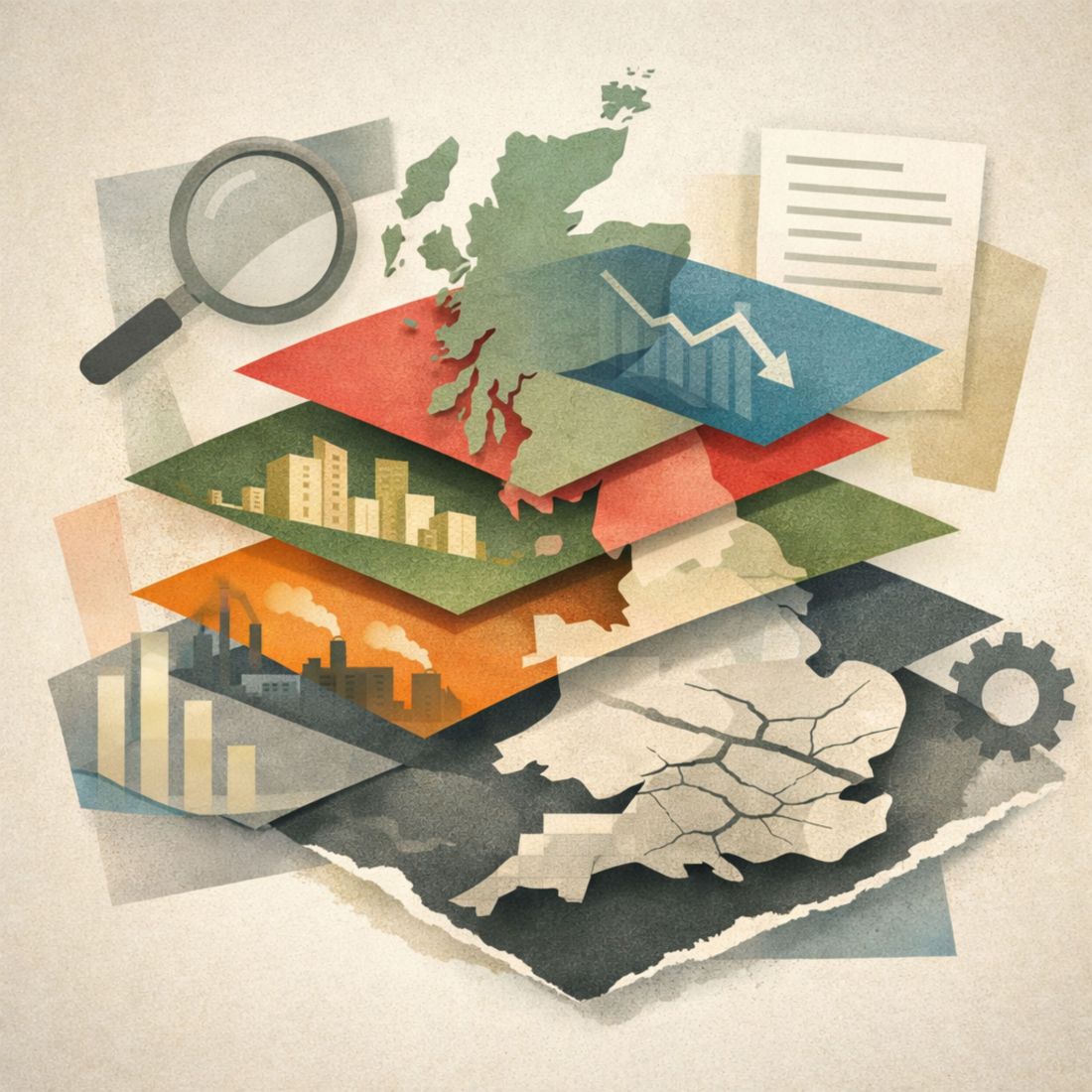
It is all of these at once – a dense web of pressures that interact and reinforce one another, making each problem harder to solve.
Yet the national conversation rarely reflects this. Instead, it breaks the crisis into fragments.
Each group sees the part that touches its world most directly and builds a story around it.
The stories differ not because people are careless, but because the system itself pushes everyone into narrow ways of seeing.
The result is a country trying to understand a complex, interconnected crisis through a series of partial truths.
A Country of Partial Truths
Listen to Britain talk about its economy and you hear a set of diagnoses that rarely meet. A macroeconomist describes a nation hemmed in by debt dynamics and the discipline of global markets. A business owner describes a country where it has become almost impossible to build, hire or expand. A civil servant describes institutions stretched to breaking point. A community worker describes the lived consequences of systems that no longer function.
Each perspective is grounded in something real.
None of them is sufficient on its own.
The British economy is not failing in one place. It is failing in many places at once, and the failures bleed into each other.
A weak state makes micro‑reforms harder. Failed micro‑reforms worsen macro pressures. Macro pressures shrink political space. Shrinking political space leads to short‑term decisions. Short‑term decisions weaken the state further.
The country keeps trying to fix one part of the machine without noticing that the rest of the machine is pulling in the opposite direction.
The Illusion of Separate Problems
One of the most persistent illusions in British politics is the idea that macro and micro are separate worlds. They are not. They are two expressions of the same underlying model – a model shaped by decades of financialisation, under‑investment and a political culture that rewards short‑term performance over long‑term resilience.
When the state cannot deliver, micro reforms fail.
When micro reforms fail, macro pressures grow.
When macro pressures grow, political space contracts.
When political space contracts, long‑term investment is postponed.
And when investment is postponed, the state becomes weaker still.
This is not a cycle that can be broken by focusing on one part of the system. It requires seeing the system as a whole – something Britain has become remarkably poor at doing.
A Political System Built for Narrow Vision
The fragmentation of understanding is not accidental. It is produced by the way Britain governs itself.
Government departments defend their turf.
Parties defend their narratives.
Experts defend their disciplines.
Media outlets defend their angles.
Communities defend their lived experience.
Everyone is rewarded for clarity within their own domain. Almost no one is rewarded for connecting the domains together.
The incentives of the system push people toward specialisation, not synthesis. Toward certainty, not curiosity. Toward defending a position, not understanding a problem.
The result is a political culture that keeps mistaking symptoms for causes, and causes for inevitabilities.
This is how a country walks into crises it does not understand – not because it lacks intelligence, but because it lacks integration.
The Cost of Not Seeing the Whole
When a country cannot see its problems whole, it cannot solve them.
Policies that look sensible in isolation collapse when they collide with realities elsewhere in the system. A housing plan fails because planning capacity was never considered. A labour policy fails because the structure of low‑wage business models was ignored. A fiscal plan fails because the state no longer has the capacity to deliver what is promised. A productivity strategy fails because it never reaches the people it is meant to help.
The country drifts not because it lacks ideas, but because it lacks coherence.
The First Step Is a Way of Seeing
Britain does not suffer from a shortage of proposals. It suffers from a shortage of synthesis.
The first step toward recovery is not a new policy. It is a new perspective – one that sees the system as it is, not as any one group prefers to imagine it. A perspective that can hold the macro and the micro together, the economic and the social, the national and the local, the structural and the lived.
This is not a small thing.
It is the rarest thing in public life.
Working Across Perspectives in a System That Depends on Narrowness
The British system is not built for people who see the whole. It is built for specialists, advocates and defenders of narrow domains.
Anyone who tries to work across perspectives quickly discovers how strong the gravitational pull of those domains can be. Professional identity tugs you back toward your own corner. Institutional incentives reward staying in your lane. Political pressures favour simplicity over accuracy. Even well‑intentioned colleagues can find it easier to treat complexity as a distraction rather than the substance of the problem.
To navigate this landscape, you need a kind of internal independence – the ability to recognise constraints without being defined by them, to understand incentives without being captured by them, and to keep hold of the wider picture even when the system around you is urging you to narrow it.
It is demanding work. It rarely comes with recognition. And it often requires standing in a place the system does not quite know how to value.
But without people who can do this, the country remains trapped in partial explanations and partial solutions.
Britain’s Path Out of Decline
The country cannot rebuild itself through single‑lens thinking. It needs people who can see the system whole – people who can work across perspectives without being captured by any of them, who can hold complexity without retreating into simplicity, who can operate inside constraints without being defined by them.
Until Britain develops this capacity, it will remain caught in a fragmented understanding of its own reality – and unable to chart a path out of decline.
As a writer, commentator, and former local councillor, I witness the frustration, anger, and despair felt by individuals and groups – such as our farmers – who struggle with a system where politics and government no longer work for them.
I share some of these feelings myself, not simply because their experiences are clearly unjust. But because of the persistent, unwritten expectation from people who are being hurt by all this, that these problems are only temporary.
Too often the problems are dismissed as misunderstandings or assumed to be issues that will resolve once new politicians are elected. Yet very recent history has shown us that changing politicians changes nothing: the downward trajectory of growing unfairness and imbalance continues, remaining at best unchanged.
It is fair to say there is a widespread disconnect between what the public rightly expects from the system and what we actually receive. This gap exists in part because we have been conditioned to believe that government, politics, and the public sector operate in a very black‑and‑white way – clear, predictable, and straightforward in how they function.
Public Perceptions vs. Reality
Whilst this view should be one that we could all rely upon, the reality is very different.
The complexity and mechanics of policymaking and delivery are extraordinarily difficult to navigate – well beyond what most people imagine. And this is before we even begin to confront the thorny issue of corrupt or self‑serving behaviour, whether by a single individual, multiple actors, or indeed by politicians, executives, managers, and officers across a nebulous hierarchy that stretches through many levels and points of influence.
Most people believe that power in Parliament works like this:
An election is called.
We vote for the person we think will best represent us in our constituency (though in practice, most people base this choice almost entirely on political party affiliation).
That representative then decides how to act when a policy comes up for a decision, guided by what is best for us.
If our chosen political party forms the government, the policy is enacted.
And we believe that everything necessary happens as a result of this, because all the public servants working in government departments, quangos, NGOs, and any other service funded – and therefore led – by the government (in other words, paid for by us) simply follow the instructions of politicians. After all, it is the politicians who are the legislators, elected to make those decisions on behalf of us all – isn’t it.
That, in principle, is how public policymaking and implementation across the UK should work. Yet the reality is that it rarely does, largely because:
The hierarchical structures and systems reaching across the public sector are simply too vast – too much “big government.”
Most importantly, very few politicians or public servants actually see it this way.
Barriers to Effective Policy Implementation
Regrettably, the vast and convoluted structure of the public sector, with its top‑down nature and multiple ‘decision makers,’ often distorts the process.
Commands that reach them are reinterpreted, repackaged, and passed along in ways that suit the direction they wish those instructions to take.
As a result, the action at the point of implementation can look very different from the original decision – not because that decision was unclear, but because countless influences and policies, each carrying their own interpretations, reshape and redirect almost everything along the way.
This happens even before the protectionist prejudices of public servants add further obstacles.
The outcome is that two very different results – the one envisaged and the one delivered – can exist under exactly the same name.
And that, of course, is how it works – assuming that what government says it is doing, and has done, truly matches the actions it takes.
Yet the clever use of words and interpretation often means that, even before a decision leaves Westminster, the outcome we expect and the outcome intended are already heading in completely opposite directions.
If this already sounds complicated and conflicted enough, we must also consider what influences our politicians, and how those influences shape their decisions.
We should ask whether the people we see on TV and hear on the radio – the very individuals we elected – are truly the ones sitting at the top, occupying the seats where the ultimate responsibility rests.
The Mechanics of Power in UK Politics
Political parties select candidates to run in elections for Parliament, local councils, and mayoralties (typically only where local decisions reflect the interpretation of national policy once local policy is adopted). More often than not, his is also where elected politicians receive an allowance or salary.
Parties choose candidates who will follow instructions from the party – or more specifically, from senior politicians within it – regardless of the constituency they represent after a successful election.
The area or location itself doesn’t matter. It’s a numbers game: just as the first‑past‑the‑post system (FPTP) elects the candidate (and therefore the party) with the most votes in a given area, Parliament and councils also make decisions based on majority votes. This is why the party with the most seats after an election forms the government or administration – it is assumed that the result of all votes thereafter will fall in line with them and whatever decisions they make.
Locally and nationally, leaders of councils, mayors, and the prime minister become the de facto decision‑makers of their administration, mayoralty, or Parliament, because there is an expectation that members of the party holding power or the majority will always vote the same way and do as instructed.
Any party aligned politician who fails to vote as required by the party risks losing favour. Depending on the importance of the vote, they may be excluded from the party (have the whip removed), fail to be reselected as a candidate, or at the very least be sidelined until they are seen to be behaving as expected.
Whips act as party enforcers, pressuring and often bullying sitting politicians into remembering who put them in their “job” and what they are really there to do and who they are there to do it for.
Leaders and mayors are typically expected to follow whatever the party leadership or prime minister in London demands in relation to national policy, though they retain some flexibility where decisions are entirely local.
Prime ministers are seen to hold the ultimate executive authority over what happens in Parliament. This is why they can appear to function like a president—unless they take deliberate steps to remind everyone that we have a parliamentary system, where things do not always work in that way.
That is how most people working in or around politics and the machinery of government interpret the power structure today.
The prevailing assumption is that whatever Parliament, the prime minister, or cabinet ministers say the government is doing – and why – is usually how everything will unfold, once public servants play their part and make it happen as expected.
However, beyond the reality that political parties typically decide who represents us – even though we perceive the list of party candidates on our ballot papers as offering what a genuine choice – there is also an assumption that anyone elected as a politician, and therefore as a public representative, is automatically qualified, experienced, and possesses the knowledge, understanding, and capability required to carry out the responsibilities of the ‘job’ they have been ‘chosen’ to do.
In reality, while some individuals put themselves forward as political candidates with genuine public service in mind – and possess both the background and, most importantly, the integrity required to carry out the role of being a public representative properly – the majority of those who reach political office, appearing on TV and speaking publicly, do not.
The majority of our politicians sought the ‘job’ rather than the responsibility – even though some have never seen it this way. But they were willing to say yes to anything and do whatever was necessary to secure a position of control, allowing them to appear as though they were leading, when all the time, they have been led.
Yes‑men or yes‑women—it makes no difference. Anyone who advances by saying “yes” to those who hold power over their progress, and never pauses to say “no” when decisions affect the lives of the people they are meant to represent, does not truly understand what it takes to lead.
And any politician who claims they merely “played along” until they were in charge, promising they would then do the right thing, cannot credibly be believed.
Leaders who cannot truly lead depend on those around them. The people with ‘supportive’ jobs offering ideas, suggestions, or solutions that give the illusion they can.
When politicians, especially very senior figures or those ‘singled out for great things,’ have to rely upon others to supply the words that are later seen to come from their own mouths, they become highly vulnerable to anyone with influence who can reach them and exert control in a seemingly ‘helpful’ way.
Influence of External Actors
Unfortunately, the system we live within today is money‑centric, and our entire framework of values is shaped in the same way.
It follows, then, that money, big business, and those who control or are sanctioned by them have become the people – or influencers – that politicians increasingly turn to for guidance and solutions.
This reliance grows stronger as they approach power. Because it is the only way that out-of-their-depth politicians can identify solutions that appear to work within the very system they are supposed to control.
Politicians are just as captivated – if not more so – by big names and high‑profile figures in business, finance, and global governance organisations – entities that are closely aligned and working together with them because of what is perceived to be the symbiotic relationship between government and money.
The same relationship plays out between the most senior public servants and the policy teams for all of the organisations that have real influence. Much of their time is spent behind the scenes collaborating with counterparts who represent the real interests that set government direction.
At this stage, it should be clear that the real forces driving and controlling central government – and shaping both what it appears to do and what it actually does from Westminster – are those who advise, ‘support,’ and influence the government and its subservient politicians.
What we see is little more than a carefully staged performance: a well‑developed display of theatrics and political cosplay delivered by the political classes, rolled out in every direction where real power is supposed to reside, designed to make it seem as though that is how the system truly works.
Remember that the imposters are usually the ones who believe they should be there.
They don’t work for us. They work for them.
Some politicians are certainly honest. Yet even among those, many are either naïve or fail to grasp how the bigger picture operates within a system that is fundamentally corrupt.
This silent corruption stems from the way individuals act. Whether in their own interests, in service of their party, or according to personal beliefs.
In more extreme cases however, there is plenty of anecdotal evidence to suggest politicians have been compromised by their own actions or bought off with promises of post‑parliamentary jobs, directorships, speaking fees, or an endless array of sweeteners.
These incentives encourage them to vote in ways that align with the company they keep in London, rather than prioritising what truly needs to happen to benefit the local people in the constituencies they are meant to represent – That’s people like you and me.
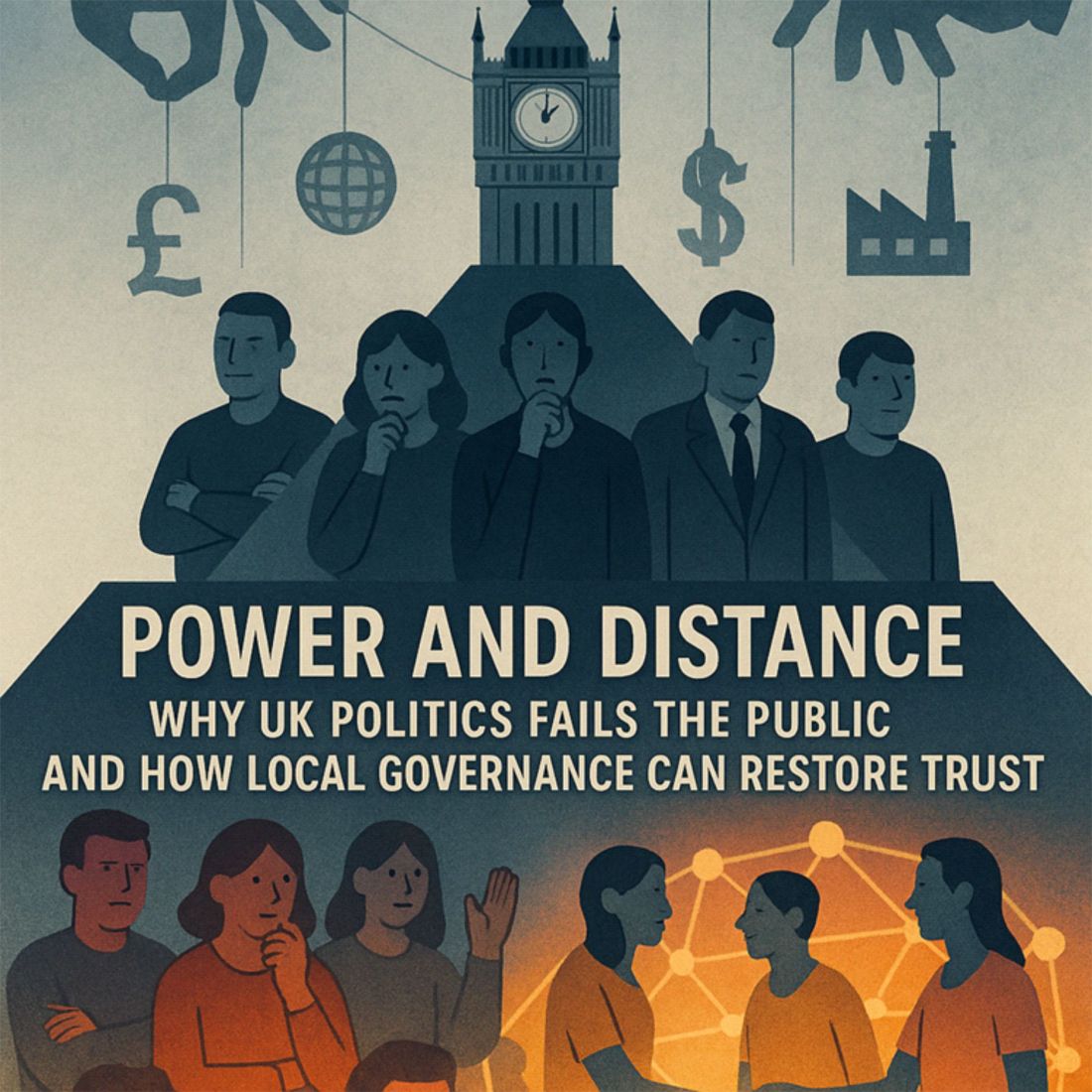
Regrettably, it is not only politicians who are distorted by the distance created by the current system and structure of government across the UK.
Public servants, working across the many organisations and tiers of government funded by the taxpayer, primarily focus on and prioritise the agendas and practices handed down by their employers. Employers who have long forgotten what it truly means to be public service organisations.
Instead, they have fostered a protectionist culture that encourages risk avoidance and discourages anything that might compromise career paths, gold‑plated pensions, or the safety of sticking rigidly to tick‑box processes.
As a result, public servants often shy away from tailoring their workload to meet the specific needs of the very members of the public they are appointed to serve.
Consequences of Leadership Gaps
The simplest interpretation of the events that have led to this system‑wide malaise might be to conclude that no public servant works for anyone other than themselves.
Yet the reality is more complex: institutional factors have long created an environment in which protectionism thrives. Chief among these is the absence of genuine leadership in Parliament and across key public sector organisations – institutions filled with individuals beholden to agendas other than those of the people they are meant to represent.
As a result, the public sector has effectively been on autopilot for a very long time, propelled by inertia and sustained by the convenient myth that everything continues exactly as it always has.
Limits of Leadership Change in Westminster
Many people hope that another change in government will be enough to resolve the problems now facing the country – issues that just as many seem to accept as having been caused by the current Labour government, and in only the 17 months it has been in power.
Sadly, while it would be great for there to be a quick, overnight solution – or a set of solutions – that could be easily implemented and pushed through under some new scheme such as Reform UK’s proposed ‘DOGE,’ the reality is different.
As you may already have gathered from what you’ve read above, the problems are now beyond systemic.
Believing that simply cutting budgets and arbitrarily slashing costs will be enough for the public sector to regain balance and correct itself is, like so many politicians who fail to see the bigger picture, dangerously naïve.
Beyond the rot we have already discussed, one of the truly colossal problems in fixing public services is the influence that money, markets, and big business already exert.
Added to this are external power-centric players such as the EU and global governance bodies like the WHO, UN, and WEF, whose policies and power have become inextricably intertwined with almost everything the UK public sector currently does.
In reality, if Reform were to begin slicing and dicing across the public sphere without coordinating – and thereby subjugating – its policies to the demands of today’s ‘key’ influencers, the strategy it proposes would quickly resemble a game of Jenga. The players might believe they have steady enough hands to start by removing the foundational layers, but the structure would inevitably become unstable very quickly indeed.
The leaders of Reform may yet prove themselves to be the “Jenga Boys” of public policy, As bringing the whole house of cards down almost as quickly as they take power—if that is what happens at the next General Election, is the outcome their rhetoric currently indicates will be most likely if they lead the next government.
Without exception, all of our politicians are currently tied into the system that is backed and pushed by the establishment.
If all they intend to do is reach for sticking plasters and offer superficial fixes, the result will inevitably be the same, and their suggested approach will merely speed the process of collapse up – if it isn’t already complete by then.
Systemic Breakdown: Causes and Implications
The reason attempts to ‘fix’ the public sector as we know it will not succeed is the inseparable relationship it has with everything else beyond government and controlled by the elites – relationships that revolve around money and a financial system that is fundamentally flawed and now destroying everything.
Put bluntly, everything harming people today is a direct consequence of how the entire money centric system operates, and how it has been operating for a very long time.
Whether the collapse comes from factors seemingly beyond politicians’ control, or directly from actions the next government and its leaders are knowingly prepared and brave enough to take, the reality remains the same: the only way to restore balance, fairness, and justice for everyone across all areas of life is if the current money‑centric system is either deliberately brought down or allowed to collapse on its own.
Then – and only then – will the majority of us be ready to embrace the kinds of changes that must take place across every part of the economy, governance, and daily life, so that, in time, something recognisable as genuine sanity can be restored.
If those in power act only in ways that serve their own local interests, why shouldn’t your power remain local and stay with you?
It would be easy to stop here – having laid out the detail of what is wrong – and leave it at that.
Yet if you are reading this, the chances are you already sense that something much bigger and more profound is wrong, even if it defies logic and is difficult to grasp in terms of what exactly those wrongs are. Or rather what the true causes of the problems have been.
The reality is that there is nothing easy to accept about how government and the public sector operate, especially when measured against what any of us should reasonably expect – and what our lived experience increasingly shows us instead.
Members of the public are not alone in their disbelief. The reality we face is that many of those perpetuating the problems within government, politics, and the public sector are acting as they do simply because they are told that this is how everything gets done.
That excuse only goes so far.
Institutional Failure
For many, the real implications of institutionalised failure to take responsibility for those you serve are far from victimless.
They manifest in scandals such as Rotherham, the Grooming Gangs, and the Post Office cases. Stories brought into the light only because many different people, through their lived experiences which they effectively share, revealed events that can ultimately be understood and summarised as being the same thing.
Individuals are being failed by our system of government every single day. Not only structurally and institutionally, but also by the politicians and public representatives who hold local seats across every tier of government.
Too often, they act in ways that serve themselves, rather than doing what is right for the people they are meant to represent.
The damage of distance
The dangerous myth of the digital age – one we have been encouraged to believe – is that every kind of information and guidance we need for life can be trusted to appear on the nearest screen.
While this may feel intimate in nature, it is in fact a remote interface that creates distance not only between us and the sources we too readily trust but also erodes the value of genuine relationships and social interactions that once filled the space in between.
The irony is that politicians and decision‑makers continue to keep everything local when it comes to their own sources of information and guidance.
While this is no excuse for the consequences of their actions – or for the harm caused by the system they have enabled- it does reveal something important.
When people recognise that power rests with them, they naturally turn to local resources and relationships. Face‑to‑face interaction fosters trust in ways that distant sources never can, making it both sensible and effective to rely on what is close at hand rather than on remote influences.
The difference between us and the politicians – and those truly in power– is that they exploit the distance they have created between themselves and the public for their own benefit, all while constructing a narrative that insists whatever they do, and whatever harm they inflict, there is simply no alternative.
They can only do this because we have forgotten that the power they abuse is, in fact, ours.
If we were to recover, restore, and remember the true nature of our own power, we must return to relying on the people and communities around us – those who we can genuinely trust.
After all, the individuals you can look in the eye and interact with every day rarely have the opportunity to abuse that trust, and the behaviour such relationships foster and require makes exploitation far less possible.
A Vision for Local Governance and Economic Reform
Recognising how things could be different – and what it means to embrace an alternative system with all that comes with it – is an essential starting point for us all.
It will help shape or identify both the choices we will make and the responsibilities we must accept when the most obvious signs of collapse begin to appear.
When that moment comes, we will face a choice: to take a different path that restores power to ourselves, or to become fully enslaved and captive to a system that survives only because the power of each individual has been taken away and concentrated in the hands of one—or a few.
Be assured that once you realise you are there, those in control will have already put in place the safeguards necessary to ensure it can never be any other way again.
By now, everyone has heard of Orwell’s 1984 and the dystopian hell it depicts – a reality awaiting those who embrace and continue on the current path, only to discover, when it is already too late, that they have been stripped of all meaningful value.
The alternative is to reject the money‑centric, top‑down, hierarchical, and patriarchal system, that has long concealed the fact it has not only failed us. But has also enabled little more than sanitised or legalised criminal behaviour against us all.
Instead, we must embrace a system that places the dignity and freedom of every individual – rooted in people, community, and the environment – at the forefront of everything that we do.
The Local Economy & Governance System offers a new and alternative perspective, presenting the frameworks and rules that would shape a localised model of democracy and public policy‑making.
This system places what is right at the heart of every decision.
Decisions made by, or on behalf of, the people in each community, whose fates and destinies are inevitably and permanently intertwined.
Key Takeaways
Before exploring further reading and resources, it’s important to reflect on the central insights that we have shared.
The following key takeaways highlight the underlying causes of public distrust in UK politics, the influence of power structure and external actors, and the urgent need for reforms that refocus towards local governance.
These points offer a foundation for understanding both the challenges and the potential pathways toward restoring trust and accountability in public life.
Systemic Disconnect: There is a persistent gap between public expectations and the actual workings of UK politics and government. The complexity and hierarchical nature of the public sector often distort policy implementation, leaving many feeling unrepresented and frustrated.
Power Structures: Political parties and senior figures exert significant control over elected representatives, often prioritising party interests and external influences over genuine public service. This results in a system where decisions are shaped by those with power, rather than by the needs of local communities.
Influence of Money and External Actors: The increasing reliance on big business, financial interests, and global organisations has further distanced politicians and public servants from the people they are meant to serve. This money-centric system perpetuates unfairness and undermines trust.
Leadership Gaps: The absence of genuine leadership and accountability in both Parliament and the public sector has led to institutional inertia and protectionism, with public servants often prioritizing self-interest over public good.
Local Governance as a Solution: Restoring trust and balance requires a shift toward local governance, where decisions are made by and for communities. Face-to-face relationships and local accountability are essential for rebuilding trust and ensuring that power serves the public.
Call to Action: This work urges readers to recognise their own power, reject the current top-down, money-driven system, and embrace local, community-focused models of democracy and public policy-making.
Further Reading & Resources
To dive deeper into the challenges of governance, economics, and reform — and to explore practical ideas for change — these selected readings from Adam’s Archives provide context, critique, and pathways forward.