
Introduction
Britain is living through a moment that feels familiar on the surface but strangely hollow underneath. The routines still run, the language still sounds steady, and the noise of certainty still fills the air – yet something essential has slipped out of view.
This work is an attempt to see that reality honestly: the fragility behind the performance, the worldview that has run out of road, and the quiet point the country has reached where the old logic no longer works.
It’s a guide to noticing what we’ve been taught not to notice, and to imagining how we might begin again once we can finally see clearly.
Chapter One – Learning to See
If we’re going to talk honestly about where Britain is right now, we have to start with something simple that nobody ever admits: most of us aren’t really seeing what’s going on. Not because we’re stupid or distracted or unwilling – but because the world we’re living in makes it incredibly hard to see anything clearly.
Every day, we’re surrounded by noise. Not just the obvious stuff – the headlines, the outrage, the endless commentary – but the subtler kind too. The kind that comes from people talking with absolute certainty about things that are far more complicated than they sound. The kind that fills the space where quiet thinking used to be.
Noise isn’t the opposite of truth. It’s what happens when truth becomes too quiet to hear.
And the problem is, we’ve all grown used to it. We’ve grown used to mistaking volume for clarity, confidence for competence, and narrative for reality. It’s not a moral failing. It’s just the environment we’ve been living in for a long time.
But underneath all that noise, something else is happening – something quieter, something more important. The system we’ve been relying on for decades is creaking. The worldview that shaped everything from our politics to our public services is running out of road. And if we’re going to understand what comes next, we have to learn how to see past the noise and into the structure.
That’s harder than it sounds, because none of us see the world directly. We see it through a kind of mental lens – a worldview – that tells us what’s normal, what’s credible, what’s possible. Most of the time, that lens is useful. It helps us make sense of things quickly. But when a system reaches its limits, the same lens that once helped us can suddenly stop us seeing what’s right in front of us.
It’s like trying to spot cracks in a wall while wearing glasses that blur anything uncomfortable.
So the first step – before talking about collapse, or fragility, or reconstruction – is learning to notice when we’re being shown a story rather than the thing itself. Not because stories are bad. Stories help us cope. But when the story becomes louder than the reality, we lose the ability to understand what’s actually happening.
This is what I mean when I talk about “myth‑catching”. It’s not about cynicism. It’s not about assuming everyone is lying. It’s simply the ability to pause and ask: Is this explanation helping me understand the world, or is it helping someone else avoid telling me how complicated it really is?
That idea is explored more fully in The Myth-Catcher, which sits behind this chapter as a kind of practical companion: not a theory of politics, but a method for staying clear-headed when politics becomes noisy, theatrical and overconfident.
It’s a quiet skill. It’s a personal skill. And it’s the only way to make sense of a moment like the one Britain is in now.
Because if we can’t see clearly, we can’t understand clearly. And if we can’t understand clearly, we can’t act clearly. And if we can’t act clearly, someone else will act for us.
This chapter is about learning to see – not perfectly, not completely, but honestly. Everything else in this essay depends on that.
Chapter Two – The Inversion
If you really want to understand why Britain feels so strange right now – why things don’t quite add up, why problems seem to multiply faster than solutions, why every promise sounds thinner than the last – you have to look at something that almost nobody talks about directly.
It’s the quiet inversion that’s taken place between the public and the system.
For most of us, the assumption has always been simple: government exists to serve the public. That’s the basic democratic contract. We elect people, they run things on our behalf, and the whole arrangement only works because the direction of service is clear.
But over time – slowly, subtly, and without any dramatic announcement – that direction has flipped. Government still talks as if it serves the public, but in practice, the public now serves the system. We serve its processes, its priorities, its limitations, its fears. We serve its need to appear stable, even when it isn’t. We serve its need to avoid admitting fragility, even when fragility is everywhere.
Nobody designed this inversion. It wasn’t a conspiracy. It wasn’t a single decision. It was drift – decades of it – until one day the purpose of government quietly became government itself.
And once that happens, something very strange follows: people stop expecting honesty. Not because they’re cynical, but because they’ve learned that honesty is no longer part of the system’s job. The system’s job is to maintain the appearance of continuity. To reassure. To perform stability. To keep the lights on and the language familiar, even when the underlying machinery is grinding.
This is why so many people struggle to see fragility. It’s not that they’re blind. It’s that the system they rely on is performing strength even when it’s weak.
When a government’s first priority becomes protecting its own credibility, it can’t admit when it’s out of road. It can’t say, “We don’t know how to fix this.” It can’t say, “The tools we’ve used for forty years don’t work anymore.” It can’t say, “The worldview we’ve been living inside is exhausted.”
So instead, it keeps talking in the language of continuity – the language of plans, frameworks, strategies, announcements, consultations, reviews. The language of “we’ve got this”, even when it hasn’t.
And because that language is familiar, people assume the underlying reality must still be familiar too.
This is how the inversion hides fragility. It hides it behind routine.
People see the routine and assume the system is fine. They see the announcements and assume the capacity is there. They see the confidence and assume the competence is real.
But underneath all that, the system is struggling. Not because the wrong people are in charge, but because the worldview that shaped the system has reached its limits.
This is why Chapter One matters so much. If you can’t see clearly, you can’t see the inversion. And if you can’t see the inversion, you can’t understand why everything feels stuck.
The truth is simple, but uncomfortable:
Britain hasn’t just run out of money or ideas. It has run out of worldview. And the system built on that worldview is now performing stability instead of delivering it.
This is the question behind Do We Exist Only to Serve Government, or Does Government Exist to Serve Us?, which takes the inversion seriously not as a slogan, but as a structural problem: a reversal in the assumed direction of service between citizen and state.
Once you see that, everything else in this essay will start to make sense.
Chapter Three – Fragility
Before we get to Stop, we have to be clear about one thing: fragility is not the same as weakness.
A weak system may look obviously broken. A fragile system may still look normal. It may still have offices, uniforms, websites, procedures, meetings, targets, announcements, and all the outward signs of competence. The trains may still run. The schools may still open. The bins may still be collected. But the difference is what happens when pressure arrives.
A strong system absorbs pressure. A fragile system transmits it. A strong system can take a mistake, a shock, a bad decision, a winter crisis, a strike, a scandal, a flood, a market wobble, and still keep enough slack in the machinery to recover. A fragile system has no slack left. It can keep going only if everything else behaves.
That is the crucial point. Fragility is sensitivity to disruption. It is not collapse. It is the condition that makes collapse, panic, overreaction, and sudden political change more possible than they used to be.
This is why fragile systems are so difficult to talk about honestly. If you point to them on an ordinary day, people can say, quite reasonably, “But look, it’s still working.” And they’re right. It is still working. But it is working in the same way an overstretched bridge is still standing. The question is not whether it is standing now. The question is what happens when the weight changes.
This is where the argument turns. The danger is not that everything fails at once. The danger is that the system loses its ability to absorb surprise. And once that happens, history starts to behave differently. Processes matter less than they used to. Moments matter more.
In a resilient country, a bad decision is corrected, a failure is contained, a foolish leader is limited by institutions, and public anger has somewhere to go. In a fragile country, the same things can cascade. A bad decision becomes a legitimacy crisis. A failure becomes a symbol. A foolish leader becomes a danger. Public anger stops moving through institutions and starts looking for a way around them.
That is why learning to see fragility matters. Not because it means disaster is inevitable. It does not. Fragility is a warning, not a prophecy. But it tells us that the old assumptions are no longer safe. It tells us that the system may still look familiar while behaving in unfamiliar ways. And it tells us that when the moment comes, it may arrive faster than the people inside the old worldview are able to understand.
And once systems become fragile, history stops behaving like a process and starts behaving like a series of moments.
Chapter Four – A Place Called Stop
If you’ve ever pushed something too far – a car, a relationship, a job, even your own patience – you’ll know there’s a moment when it doesn’t matter how much effort you put in, it just won’t go any further. You can press the accelerator, you can try to reason with it, you can pretend it’s fine, but deep down you know you’ve reached the limit.
Britain feels like that now.
Not in a dramatic, apocalyptic way. More in the sense of a system that’s been stretched, patched, repurposed, and talked‑up for so long that it’s quietly run out of road.
We’re still going through the motions – elections, budgets, announcements, promises – but the underlying machinery isn’t responding the way it used to.
It’s as if the country has arrived at a place called Stop. Not because someone slammed on the brakes, but because the engine simply can’t push any harder.
For decades, we built everything around the idea that you could squeeze more out of less. More productivity from fewer workers. More public services from smaller budgets. More growth from thinner foundations. And for a while, it looked like it worked. Britain became very good at appearing efficient.
But efficiency has a habit of turning into extraction when you keep pushing it. You start pulling capacity out of institutions faster than you replace it. You start relying on goodwill instead of structure. You start assuming resilience instead of building it. And eventually, you end up with systems that look intact from the outside but are hollowed out on the inside.
That’s where the dependency creeps in. Not the kind people talk about in political slogans – the real kind. The kind where hospitals depend on staff doing unpaid overtime just to keep the doors open. The kind where councils depend on volunteers to run services that used to be funded. The kind where government depends on narrative because it no longer has the tools to deliver what it promises.
And once a system becomes dependent, it becomes fragile. Not fragile in the sense of imminent collapse – fragile in the sense that everything works only if nothing unexpected happens.
But unexpected things always happen.
The problem is, most people don’t see this fragility because the surface still looks familiar. The trains still run. The schools still open. The bins still get collected. The news still talks about “plans” and “strategies” and “frameworks” as if the underlying capacity is still there.
It’s like living in a house where the walls have quietly rotted behind the paint. You don’t notice until you lean on one.
This is what I mean by Stop. It’s not collapse. It’s not even crisis, at least not at first. Stop is the point at which a system can no longer solve its problems using the assumptions that created them.
It’s the moment when the old logic – the logic of efficiency, extraction, and dependency – stops working, but the system keeps pretending it does. It’s the moment when the public starts feeling that something is wrong but can’t quite explain it. It’s the moment when politics becomes more about performance than problem‑solving because the tools backstage don’t work anymore.
And it’s the moment when people start looking for voices that sound confident. Not because confidence is the answer, but because confidence is the only thing the system still knows how to produce.
This is the landscape the false prophets walk into. Not because they caused it. Not because they’re malicious. But because the system has reached Stop, and the public is desperate for someone – anyone – who sounds like they know the way forward.
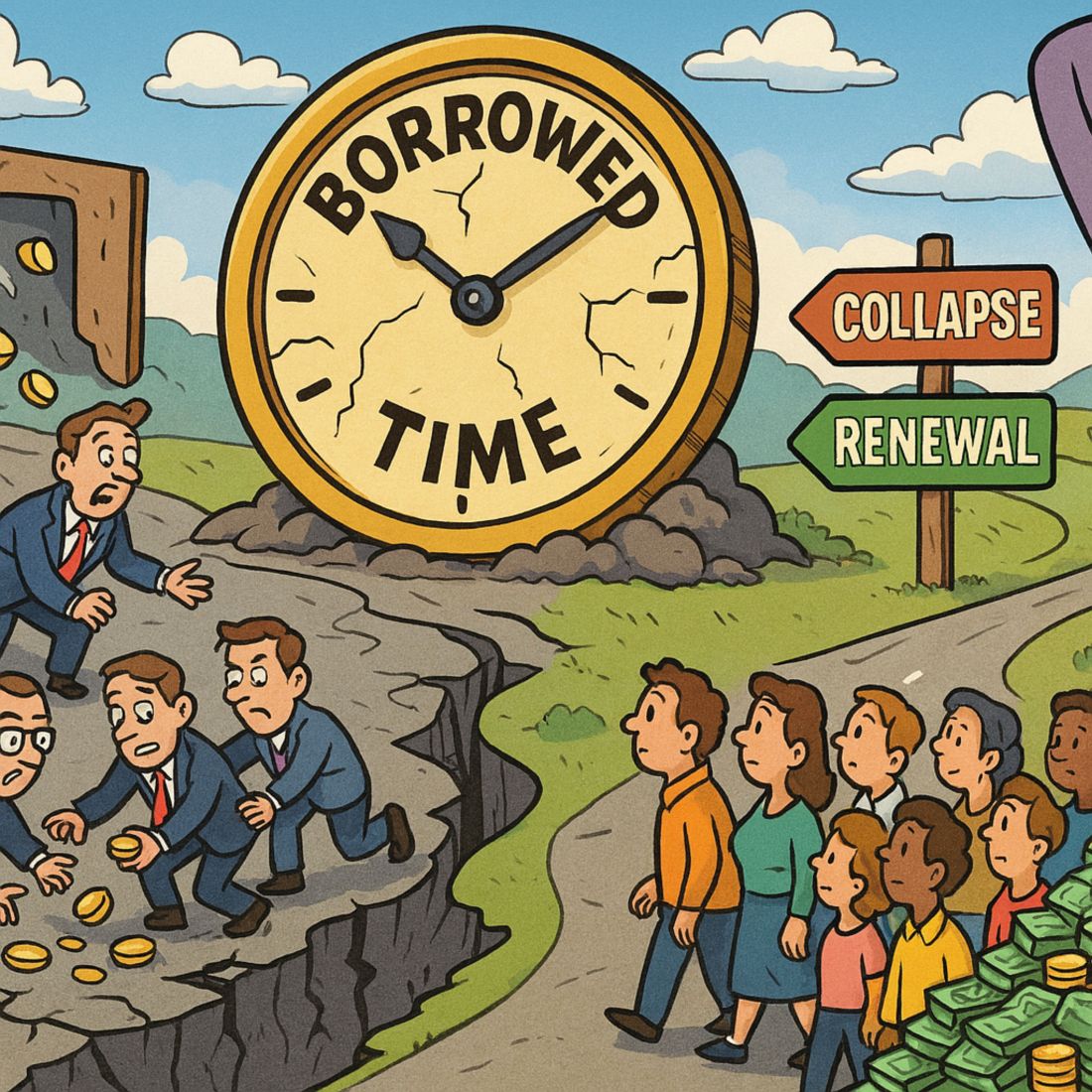
But Stop isn’t a place you escape by following the old map. It’s a place you leave by admitting you need a new one.
The longer essay A Place Called Stop develops this diagnosis in more detail, especially the way efficiency can become extraction, extraction can become dependency, and dependency can leave institutions unable to absorb the shocks they were created to withstand.
Chapter Five – The Moment
If you’ve ever watched something go wrong in real time – a fight breaking out, a car losing control, a crowd suddenly shifting – you’ll know how strange those moments feel.
Everything seems normal right up until the second it isn’t. There’s no warning. No countdown. No neat chain of events. Just a sudden change when things go sideways that nobody saw coming until it was already happening.
History works like that more often than people realise.
We’re taught to think of big changes as the result of long processes: debates, movements, elections, negotiations. And sometimes they are. But just as often, the real turning point is a moment – a single moment – when someone acts while others hesitate.
That does not mean history is made only by great individuals. It means something more unsettling. Structures create the conditions. Moments decide which of the possible futures becomes real.
Most of the time, individual actions are absorbed by the system. Speeches fade. Decisions are delayed. Errors are corrected. Crowds disperse. Institutions bend and then return to shape. But when the system is fragile, absorption fails. A gesture, a refusal, a speech, a rumour, a resignation, a police decision, a vote, a march, or a single act of courage can suddenly carry more weight than it would have carried the day before.
The moment is not the cause of everything. It is the point at which everything that has been building becomes visible.
The Russian Revolution is the classic example. It wasn’t inevitable. It wasn’t planned in the way people imagine. It wasn’t the logical end of a tidy sequence of events.
The real ‘moment’ hinged on Lenin deciding to move when others were still arguing about what to do. That decision did not create the whole crisis. War, hunger, exhaustion, legitimacy, organisation, fear and hope were already there. But his significance was that he recognised a moment had arrived and acted while others hesitated.
And this is the part false prophets never see.
They think in terms of order. They think in terms of steps. They think in terms of “first this, then that”. They think in terms of plans unfolding the way plans are supposed to unfold.
They believe the system will behave the way it used to. They believe institutions will respond predictably. They believe people will stay calm. They believe collapse, if it comes, will be rational and wait for everything to catch up – as their experience suggests that it should.
But when a system reaches Stop, it doesn’t behave like that anymore. It behaves like something under strain – brittle, unpredictable, sensitive to pressure. And when something brittle is under pressure, it doesn’t crack gradually. It cracks suddenly.
That’s the moment.
The moment when public order shifts. The moment when institutions freeze. The moment when people look around for someone who seems to know what to do. The moment when hesitation becomes dangerous. The moment when confidence – any confidence – becomes magnetic.
And the person who steps forward in that moment isn’t always the one who’s been talking the loudest beforehand. It’s often someone who wasn’t even part of the conversation. Someone who sees an opening. Someone who acts quickly. Someone who understands that the system is too fragile to resist.
False prophets don’t see that possibility. They’re too busy believing they’ll be the ones leading when the moment arrives. They’re too busy believing the moment will wait for them. They’re too busy believing the moment will unfold in a way that makes sense.
But moments don’t care about sense. Moments care about timing.
And this is why the danger isn’t always the false prophets themselves. It’s the space they create – the space where people stop thinking for themselves because someone else sounds certain. The space where public imagination narrows. The space where, when the moment arrives, people are unprepared to question whoever steps forward.
That person might not be the confident voice they’ve been listening to. It might be someone far less benign. It might even be someone already in power, offering safety in exchange for freedoms because the public is frightened and the system is out of road.
Moments don’t reward sincerity. Moments reward decisiveness.
And that’s why understanding this matters. Not to scare anyone. Not to predict anything. But to recognise that when a system reaches Stop, the future doesn’t unfold gradually. It arrives suddenly – in moments – and those moments are shaped by whoever is ready and able to act.
Chapter Six – The False Prophets
When a country reaches a point like this – a kind of national pause where nothing quite works but everything still pretends it does – certain voices start to stand out. You’ve probably noticed them. They’re the ones who sound absolutely sure of themselves when everyone else is quietly wondering what on earth is going on.
And the thing is, most of these people aren’t charlatans. They’re not trying to manipulate anyone. They genuinely believe they’ve seen something others haven’t. They look at the mess, they look at the frustration, and they think, almost instinctively, “I could sort this out. I know what’s wrong. I know what to do.”
It’s a very human reaction. But it’s also where the trouble begins.
Because when a system has reached its limit – when it’s running on fumes and habit rather than capacity – the people who sound confident become incredibly appealing. Not because confidence is the answer, but because confidence is the only thing the system still knows how to produce.
The problem is that these voices almost always see the situation as a matter of personnel. To them, the issue isn’t structural. It isn’t about the worldview running out of road. It isn’t about fragility or exhaustion or the quiet hollowing‑out of institutions. It’s simply that the wrong people are in charge, and if the right people were in charge – usually meaning themselves – everything would start working again.
That is why they are so compelling. They are often right about the feeling and wrong about the cause. They sense exhaustion. They sense drift. They sense that the country is no longer being governed by a living idea. But they translate all of that into a simpler story: bad people, bad choices, weak leadership, betrayal, incompetence. Sometimes those things are real. But they are not enough to explain what is happening.
They’re not lying. They really believe this.
And because they believe it, they stop noticing the deeper reality. They stop seeing how thin the system has become. They stop recognising how quickly public order can shift when pressure builds. They stop imagining how fast things can unravel when the old logic stops working. They stop seeing how fragile everything really is.
They think in terms of steps and sequences. They think in terms of plans. They think in terms of “if we do this, then that will happen.”
They believe the system will behave the way it used to. They believe institutions will respond predictably. They believe people will stay calm. They believe collapse, if it comes, will be orderly.
And that’s exactly why they can’t see the danger.
Because when a system reaches Stop, things don’t unfold in order anymore. They don’t wait for the right leader to take charge. They don’t follow neat chains of events. They hinge on moments – sudden, unpredictable moments where hesitation matters, where confidence matters, where someone steps forward while everyone else freezes.
History is full of these moments. They’re rarely planned. They’re rarely expected. They’re rarely rational.
They are moments where the entire direction of a country can shift because a fragile system has made individual action unusually consequential.
False prophets don’t see those moments coming. Not because they’re foolish, but because their worldview doesn’t contain the possibility that everything could change in an instant.
They assume they’ll be the ones leading when the moment arrives. But moments don’t reward sincerity. Moments reward whoever acts first.
And that’s the danger.
Not the false prophets themselves – but the vacuum they unintentionally create. A vacuum where people stop thinking for themselves because someone else sounds certain. A vacuum where public imagination narrows. A vacuum where, when the moment comes, people are unprepared to question whoever steps forward.
And that person might not be the confident voice they’ve been listening to. It might be someone far less benign. It might even be someone already in power, offering safety in exchange for freedoms because the public is frightened and the system is out of road.
False prophets don’t see that possibility. They’re too busy believing they’re the answer.
And that’s why being able to identify false prophets matters. Not to criticise them. Not to attack them. But to understand the role they play in a system that has quietly reached Stop – and the risks that come with mistaking confidence for clarity.
The next chapter is about those moments themselves – the ones that change history not because they were planned, but because someone acted while others hesitated. It’s about what people can do before those moments arrive – not to control them, but to be ready for them.
Chapter Seven – The Preparation
When a system is under strain, people often assume the important decisions will be made somewhere far away – in government buildings, in boardrooms, in institutions that still look solid from the outside.
But when change arrives in moments rather than processes, the most important decisions aren’t made by systems at all. They’re made by individuals, in the way they think, the way they react, and the way they interpret what’s happening around them.
That’s why preparation, in a moment like this, doesn’t look like stockpiling or strategising or waiting for instructions. It looks like clarity. It looks like learning to see the world without the filters that used to make sense. It looks like recognising that the old logic has run out of road and that the new logic hasn’t yet arrived.
Most people don’t realise how much of their understanding of the world comes from habit. They assume institutions will behave the way they used to. They assume public order will hold the way it always has. They assume the future will unfold in roughly the same shape as the past. And when those assumptions stop being reliable, the first instinct is often to cling to them even harder.
But preparation begins with letting go of the idea that continuity is guaranteed.
It means noticing when explanations feel too neat. It means recognising when confidence is being performed rather than earned. It means understanding that fragility isn’t a prediction – it’s a condition. It means accepting that moments, not processes, shape turning points.
And it means thinking independently, especially when the noise becomes overwhelming.
That’s harder than it sounds. Noise is comforting. It gives people something to hold onto. It offers certainty at the exact moment certainty becomes impossible. It fills the space where quiet thinking should be. And when false prophets step into that space – with their simple stories and their confident tones – it becomes even harder to resist the pull.
But preparation is the opposite of that pull. It’s the willingness to pause. To question. To notice. To think.
It’s the ability to look at a situation and ask whether the explanation being offered is actually connected to the structure underneath, or whether it’s just a story designed to make the moment feel less frightening.
Preparation isn’t dramatic. It isn’t heroic. It isn’t loud.
It’s quiet. It’s personal. It’s internal.
It’s the kind of preparation that makes someone less vulnerable when the moment arrives – not because they can control it, but because they can see it clearly.
They’re not paralysed by surprise. They’re not swept along by someone else’s certainty. They’re not caught in the vacuum created by voices who sound confident but don’t understand the fragility of the system they’re speaking into.
They’re simply ready to think.
And that matters, because when a system reaches Stop, the people who can think clearly become the anchor points for everyone around them. They’re the ones who don’t panic when the ground shifts. They’re the ones who don’t mistake confidence for competence. They’re the ones who can tell the difference between a moment that needs action and a moment that needs calm.
They’re the ones who help others stay steady.
Preparation, in the end, is about imagination – the ability to imagine that the future might not look like the past, and to stay grounded anyway. It’s about seeing the system as it is, not as the worldview insists it must be. It’s about recognising that fragility doesn’t mean inevitability, and that moments don’t have to lead to chaos if people are able to think clearly when they arrive.
The system may be out of road. But people aren’t.
And that’s where reconstruction begins – not with institutions, not with plans, but with individuals who have learned to see clearly in a world that no longer behaves the way it used to.
Chapter Eight – Reconstruction
If preparation is personal, reconstruction is collective. It begins inside individuals, but it cannot end there. Seeing clearly matters because people who see clearly can begin to build differently.
Reconstruction does not mean returning to the old normal. That is the temptation whenever a system reaches its limit: to imagine that the task is simply to restore what has been lost. But the old normal is part of the problem. It is the worldview that taught us to confuse efficiency with resilience, management with government, activity with purpose, and continuity with health.
So reconstruction has to begin with different questions. Not “How do we make the old system work again?” but “What kind of system can survive reality?” Not “How do we preserve the appearance of stability?” but “What would genuine resilience look like?” Not “Who can fix this for us?” but “What habits, institutions, responsibilities and forms of trust would make us less dependent on someone else’s certainty?”
That will not come from slogans. It will not come from another strategy document written in the old language. It will come from the slow rebuilding of capacity: in public services, in local institutions, in democratic habits, in the willingness to tell the truth about limits, and in the courage to stop pretending that every problem can be solved by one more announcement.
This is also where questions of future governance become unavoidable. If the old model has reached its limit, then reconstruction cannot simply mean better management of the same assumptions. It has to mean designing forms of local, civic and economic governance that are capable of learning, adapting and holding trust under pressure.
The point of seeing clearly, then, is not to become detached or superior. It is to become useful. Useful to your family, your community, your workplace, your town, your country. Useful because you are less easily panicked. Useful because you can recognise false certainty when it appears. Useful because you know that a fragile moment does not have to become a destructive one if enough people remain capable of thinking.
This is the hopeful part, although it is not an easy hope. Systems can run out of road. Worldviews can exhaust themselves. Institutions can hollow out. But people can learn. They can notice what they have been taught not to notice. They can stop mistaking performance for strength. They can build new habits before new institutions fully exist.
That is where reconstruction begins: not with a master plan, but with a different kind of attention. The ability to see the cracks without worshipping collapse. The ability to recognise fragility without surrendering to fear. The ability to prepare for moments without longing for them.
And perhaps that is the real task now. Not to predict the moment. Not to wait for the prophet. Not to demand that the old map become true again. But to learn to see clearly enough that, when the ground shifts, we are not merely frightened by it. We are ready to build.
Conclusion – The Work Ahead
There’s a point in any honest look at a country where the conversation stops being about diagnosis and starts being about direction. Not in the sense of a plan, or a programme, or a list of things that need to happen, but in the quieter sense of recognising what the moment asks of people.
Britain is fragile. Not because it is doomed, and not because it is weak, but because the worldview that carried it for forty years has reached its limit. The system built on that worldview is still performing stability, but performance isn’t the same as capacity. And when capacity thins, moments matter more than they used to.
That’s the landscape we’re in.
The point of seeing clearly isn’t to predict what comes next. It isn’t to panic. It isn’t to wait for collapse or to assume it. It’s simply to understand the shape of the moment we’re living through – a moment where the old logic has stopped working and the new logic hasn’t yet arrived.
Reconstruction won’t begin with a manifesto. It won’t begin with a speech. It won’t begin with a leader who claims to know the way forward. It will begin wherever people stop mistaking noise for clarity and start paying attention to the structure underneath.
That’s not a call to action. It’s just the reality of how fragile systems recover: slowly, locally, through people who have learned to see the world without the filters that used to make sense.
The system may be out of road. But people aren’t.
And that’s where the work ahead begins – not with certainty, not with confidence, but with the quiet recognition that clarity is the first form of resilience, and that resilience is the first form of reconstruction.
Further Reading
The following pieces develop the argument from different angles. They are best read not as separate essays, but as companion works: one explains how to see clearly, one examines the inversion between public and system, one develops the idea of Stop, and one points towards the question of future governance and reconstruction.
1. Do We Exist Only to Serve Government, or Does Government Exist to Serve Us?
https://adamtugwell.blog/2026/07/17/do-we-exist-only-to-serve-government-or-does-government-exist-to-serve-us/
This piece expands the argument in Chapter Two. It explores the inversion at the centre of the democratic contract: the slow drift from government serving the public to the public being expected to serve the system’s needs, processes and limitations. It gives the reader a deeper route into the essay’s claim that modern governance often protects the appearance of stability before it protects the public purpose that justified it.
2. A Place Called Stop: How Britain Reached the Limits of a System Built on Efficiency, Extraction and Dependency – and Why Reconstruction Begins with Honesty
https://adamtugwell.blog/2026/07/18/a-place-called-stop-how-britain-reached-the-limits-of-a-system-built-on-efficiency-extraction-and-dependency-and-why-reconstruction-begins-with-honesty/
This is the closest companion to Chapters Three and Four. It develops the essay’s central diagnosis: that Britain has reached a limit point created by efficiency turning into extraction, extraction becoming dependency, and dependency producing fragility. It is the bridge between the conceptual argument about seeing clearly and the political argument about what happens when a system can no longer solve problems using the assumptions that created them.
3. The Local Economy & Governance System
https://adamtugwell.blog/2025/11/21/the-local-economy-governance-system-online-text/
This work points beyond diagnosis towards reconstruction. It is most relevant to the final chapter because it asks what future governance might look like when old assumptions about central control, efficiency and institutional capacity are no longer enough. It helps move the argument from seeing the failure of the old map towards imagining the first outlines of a new one.
4. The Myth-Catcher: A Quiet Guide to Discovering Clarity in an Age of Noise
https://adamtugwell.blog/2026/07/02/the-myth-catcher-a-quiet-guide-to-discovering-clarity-in-an-age-of-noise-full-text/
This is the practical foundation for Chapter One. It develops the habit of noticing when a public explanation has become too neat, too confident, or too useful to the people offering it. In the context of this essay, myth-catching is the first discipline of preparation: the ability to stay mentally independent when noise, certainty and narrative are doing the thinking for everyone else.
Disclaimer
This book offers analysis and interpretation of political, institutional and cultural conditions in Britain. It is not intended as professional advice, legal guidance, financial instruction or a prediction of future events. The arguments and observations reflect the author’s own examination of public systems and the pressures acting upon them.
Readers should apply their own judgement when considering the ideas presented here. Nothing in this work should be taken as a call for specific political action, nor as an endorsement of any party, candidate or policy. All examples and descriptions of institutions are used to illustrate structural dynamics, not to make claims about individual actors.