Writing about people, systems and the realities that shape our lives
Category: Wealth Inequality
Discussing the wealth divide, wealth inequality, the cost of living, the cost of living crisis, poverty, hunger, disadvantage, social exclusion, social mobility issues, being underpaid, unemployment,
For years, Britain’s debate about welfare has been framed as if it were a moral failing, a partisan indulgence, or a political choice. But the truth is far more uncomfortable for Westminster than any of the slogans they trade across the despatch box.
Welfare is no longer a safety net. It is the last structural support holding up an economic system that no longer pays people enough to live.
And now, with recently surfaced comments from a Labour figure – remarks clearly never intended for public release – we have a rare glimpse of what politicians say behind closed doors.
The suggestion that they are exploring “ways to tax people to pay for the rising cost of benefits” is not just politically clumsy. It is revealing.
It suggests a political mindset that treats welfare as a fiscal burden to be funded, rather than as a symptom of a broken economic model.
A System Built on Dependency – But Not the Kind Politicians Talk About
Across successive governments, the UK has drifted into an economic model that no longer makes people self‑sufficient.
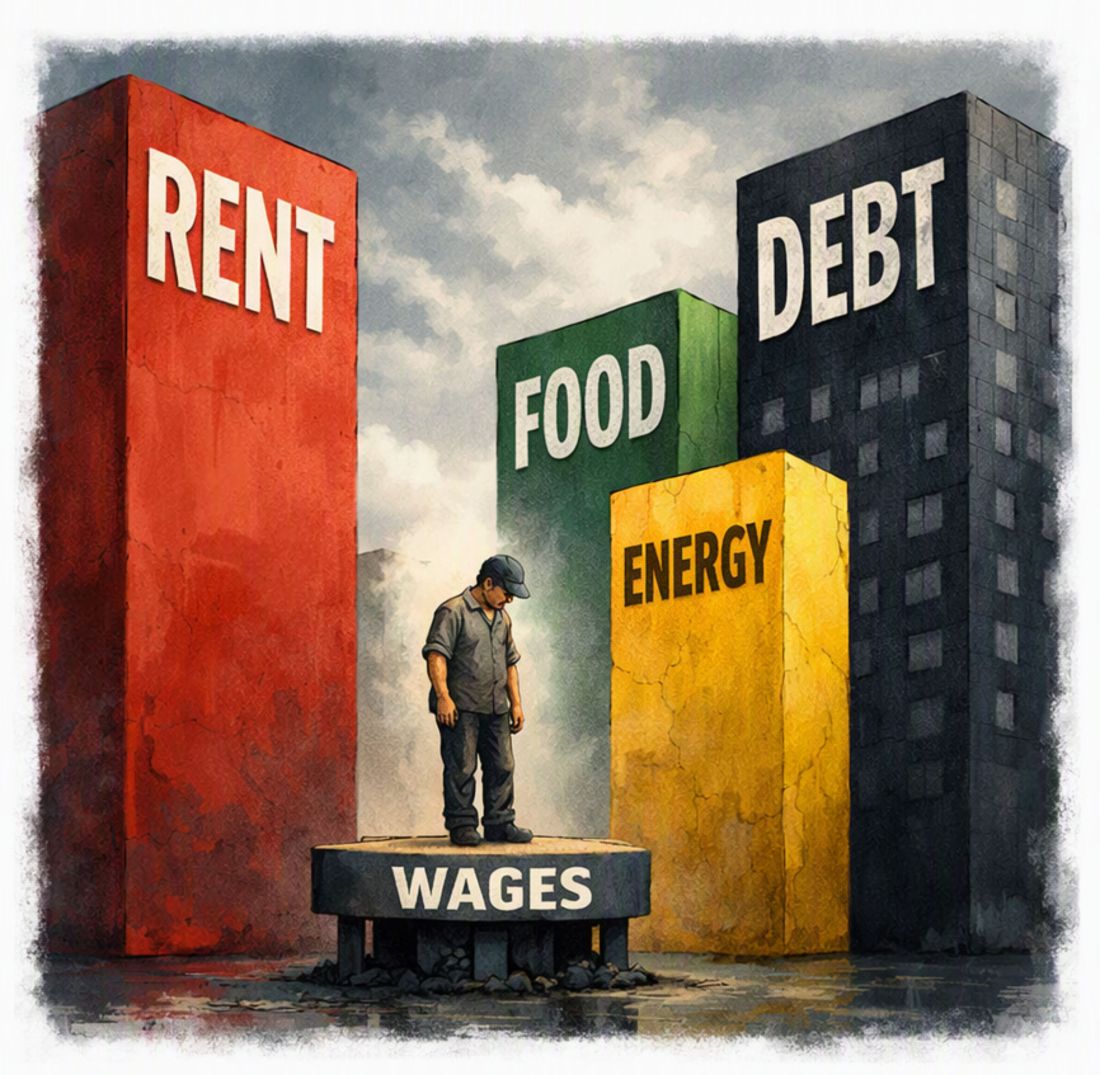
Instead, it makes them dependent – on low wages, high living costs, debt, corporate landlords, and ultimately the state.
This did not happen by accident. It emerged from decades of policy choices that:
suppressed wages
inflated housing costs
centralised supply chains
financialised essentials
hollowed out local economies
The result is a country where millions of people in full‑time work cannot meet basic living costs without state support. Not because they are failing – but because the system is.
Yet the political class still talks about welfare as if it were a behavioural tool or a lifestyle subsidy. Too often, they appear to misunderstand both the system they inherited and the one they have helped to create.
Welfare Has Become Structural Infrastructure
The rising cost of welfare is not a sign of moral decline. It is a sign of economic decline.
For some, welfare now performs the function wages used to perform.
For many more, it fills the gap between what people earn and what it costs to live.
It is not optional.
It is not a luxury.
It is not a political indulgence.
It is the pressure valve preventing a system built on extraction and unaffordable living from blowing itself apart.
The Right is Painting Itself into a Dangerous Corner
The rhetoric from the political right has become increasingly absolutist:
“Cut benefits.”
“End dependency.”
“Make work pay.”
“Shrink the state.”
But work often does not pay enough to cover basic living costs, even on full-time hours.
So when the right promises to slash welfare, it risks removing one of the only things preventing:
mass arrears
mass evictions
mass hunger
mass debt defaults
and, ultimately, mass unrest
That is a dangerous gamble with the dam already under strain.
Labour’s Problem is Different – But Just as Dangerous
Labour’s instinct is to preserve welfare, but not to fix the system that makes welfare necessary.
Instead of confronting the structural drivers – rent extraction, corporate pricing power, broken local economies, and wages that lag far behind living costs – Labour reaches for the language of “responsibility” and “funding the welfare state.”
To many readers, this can sound like political code for:
“We will ask the public to pay more to sustain a broken system we remain reluctant to reform.”
The recently surfaced comments suggest that Labour recognises the system is under strain, yet still stops short of confronting its root causes. The approach can look less like structural repair and more like plugging holes in the dam.
The fact these words were not meant to be public does not make them better.
If anything, it makes them more revealing.
It suggests that even behind closed doors, the focus may be less on fixing the system than on finding ways to fund its dysfunction.
What Politicians Say Privately vs What They Tell the Public
One of the most revealing aspects of this moment is the gap between the public narrative and the private conversation.
Publicly, politicians talk about:
“supporting working families”
“making work pay”
“responsible public finances”
“helping people into good jobs”
Privately, the conversation is probably far blunter:
the welfare bill is rising faster than they can politically justify
wages are not keeping up with living costs
the housing market depends on high rents and high benefits
the economy cannot function without topping up millions of low incomes
and they have no plan to fix the underlying system
This is the part the public rarely sees – not necessarily because it is hidden maliciously, but because political language often obscures more than it reveals.
Those who follow politics closely, or who understand the context behind internal documents, leaks, and strategic briefings, can see the real picture clearly:
Britain’s welfare system is not a moral debate. It is a structural necessity created by decades of political choices.
The truth appears in fragments:
internal memos
off-record briefings
think-tank papers
leaked strategy documents
and the occasional unguarded remark
It is all there for anyone who knows how to read it.
But much of this remains obscure to the public, partly because political language can hide the scale of the crisis as much as explain it.
The leaked Labour comment matters not because it is shocking, but because it appears to confirm what many observers have long suspected:
Behind the scenes, politicians may be less focused on fixing the system than on containing its pressures.
In practice, that can amount to managing decline.
The Dam is Cracking
The human reality of life on benefits is not the caricature pushed by commentators or culture warriors. For many, it is a bureaucratic maze, a financial trap, and a constant source of stress and humiliation.
But too often, the political class responds to the numbers more readily than to the lives behind them.
They see rising welfare spending and conclude that the solution is to cut.
They see rising housing benefit and conclude that the solution is to “incentivise work.”
They see rising Universal Credit rolls and conclude that the solution is to tighten sanctions.
Too often, they treat the symptom while leaving the disease untouched.
If They Cut Welfare Without Structural Reform, the System Will Break
This is the central risk.
If politicians cut welfare without rebuilding the economic foundations that make welfare necessary, the consequences could be immediate and severe.
Because welfare is not the problem.
Welfare is the compensation mechanism for the problem.
Remove it, and the underlying crisis is exposed instantly.
The Finger in the Dam
Welfare is the little boy’s finger in the dam.
For too many, it is what stands between today’s fragile equilibrium and:
homelessness
hunger
civil disorder
political extremism
and systemic collapse
Politicians who promise to cut benefits without rebuilding the economic foundations are not necessarily offering “tough love.”
They may instead be inviting structural failure.
That is a serious gamble.
And they may be underestimating the forces they are about to unleash.
Conclusion
Welfare is not the cause of Britain’s crisis. It is the last fragile barrier preventing that crisis from becoming visible.
The political class – left and right – has spent decades misdiagnosing the problem, blaming the people caught in the system rather than the system itself.
But if they continue down the path of cutting benefits without rebuilding the economic foundations that make benefits necessary, they will not be saving the country money.
They will be breaking the dam.
And when it breaks, it will not be the poor alone who are swept away.
It will be the entire political order that created this mess and refused to understand it.
Further Reading
To understand how Britain reached the point where welfare has become the last structural support holding up a broken economic system, the following pieces explore the deeper causes, consequences, and interconnected failures that have shaped this crisis.
Each article builds on the last, tracing the slow drift from economic balance to systemic fragility.
Explores how decades of incremental policy decisions – none catastrophic on their own – collectively hollowed out Britain’s economic resilience. It sets the stage for understanding why welfare became structural rather than temporary.
Examines how political and economic fragmentation led to short‑term thinking, siloed policymaking, and a failure to see the economy as a connected system – a key reason reform efforts keep missing the mark.
2. The Economic Mechanics Behind Welfare Dependency
Deconstructs the illusion of wealth creation in modern Britain – showing how asset inflation and debt have replaced genuine productivity, leaving households dependent on welfare to bridge the gap.
Connects the dots between stagnant wages, rising living costs, and the structural need for welfare. It explains why welfare spending keeps rising even when employment figures look strong.
Shows how the “working poor” have become the backbone of the welfare system – not through choice, but through necessity. It highlights the mismatch between official narratives about work and the lived reality of millions.
Explores the widening divide between those insulated from economic shocks and those living permanently on the edge. It argues that this split is now cultural as much as financial.
Analyses how populist and establishment politics alike have become trapped in a cycle of blame and short‑term fixes. It warns that cutting welfare without reforming the underlying system will trigger social and economic instability.
Suggested Reading Order
What Happened to Britain – the long view of decline
Britain’s Hidden Problem – how fragmentation deepened the crisis
Why Wealth Isn’t What You Think It Is – the illusion of prosperity
The Exploding Cost of Welfare – the structural inevitability
When Work Isn’t Enough – the lived reality of working poverty
The Real Two‑Tier Britain – the social divide
Being on Benefits Isn’t a Culture – the human cost
Benefits Culture, and System‑Locked Politics – the political consequences
Closing Note
Together, these pieces form a coherent narrative: Britain’s welfare system didn’t fail because people became dependent – it became essential because the economy did.
Understanding this progression is key to seeing why welfare is not the problem, but the last fragile barrier preventing the system itself from collapse.
This isn’t a book. It’s an essay – written because the drift has gone on long enough.
Britain’s slow unravelling didn’t arrive with a crash or a crisis. It arrived quietly, through ordinary decisions that hollowed out the structures people once relied on.
This piece was written to make that quiet visible again – to connect the exhaustion people feel to the system that produced it.
It’s offered here not as a manifesto, but as a moment of clarity.
The Slow Unravelling
Britain didn’t fall apart. It wasn’t blown over by a single storm or undone by one bad decision. It drifted: quietly, slowly, almost politely. The way a house becomes damp before anyone notices the roof has slipped. The way a town centre empties out one shop at a time. The way a generation lowers its expectations without ever quite admitting that it has.
People talk about Britain’s problems as if they’re separate. Young people can’t afford to move out. Work doesn’t lead anywhere. Communities feel hollow. Politics feels like theatre. Everyone is exhausted. Everyone is anxious. Everyone is coping, but only just.
These aren’t separate stories. They belong to the same shift: the slow reordering of Britain around the demands of finance rather than the needs of ordinary life.
If you want to understand why Britain feels thinner, meaner, and harder to live in, you have to start with the moment money became detached from anything solid enough to impose limits – not because inequality or instability began there, but because the system entered a different phase once they did.
Britain had long carried deep inequalities, uneven protections, and older forms of social hierarchy; the struggle over wealth and security did not begin in the late twentieth century. But after Bretton Woods and then, more decisively, after 1971, money became easier to create, expand, and direct toward returns rather than needs. From there, the centre of gravity shifted further away from people, places, and communities and towards markets, debt, and institutions most people could neither see nor influence.
Local businesses were swallowed by chains. Local banks disappeared. Local employers collapsed or were bought out. Local infrastructure was sold off. Local government was hollowed out. The things that made life feel stable – the things that made adulthood possible – were treated as inefficiencies to be removed.
And because the change was slow, people blamed themselves. They thought they were failing. They thought they weren’t trying hard enough. They thought the problem was personal.
It wasn’t personal. It was structural. It was systemic. And while not every outcome was consciously designed in advance, the direction of travel was repeatedly reinforced through policy, institutions, and incentives that rewarded extraction over stability.
The truth is simple:
Britain didn’t drift because people changed. Britain drifted because the system changed – and people were left to deal with the consequences alone.
How Money Quietly Rewrote Britain
This matters because once money could be detached from tangible limits, the economy could be reorganised around extraction, leverage, and growth on paper rather than stability in people’s lives. The monetary shift did not create every injustice that followed, but it changed the scale, speed, and governing logic of the system those injustices were now moving through.
That shift sounds abstract until you follow it into everyday life. Homes became more fully investment vehicles. Jobs were treated more aggressively as costs to be minimised. Public assets became opportunities for private gain. Governments became managers of market confidence. Policy choices, technological change, global competition, and deindustrialisation all shaped the path – but they increasingly operated inside the same dominant value system, with money at its heart.
Because the change arrived gradually, it was experienced as a series of personal setbacks rather than as a systemic rewrite: a job lost, a bus route cut, a youth centre shut, a high street hollowed out, a generation priced out of adulthood.
The drift wasn’t cultural. It wasn’t moral. It wasn’t generational.
The economy no longer needed people in the way it once had. It needed consumers more than citizens, flexibility more than stability, and efficiency more than community. So the everyday supports that made life feel grounded were treated as expendable.
The result was not immediate collapse but a thinning of the real world: fewer local institutions, weaker civic capacity, and less of the practical structure people rely on to build a life.
And because this happened slowly, people often blamed themselves. They thought they weren’t working hard enough, smart enough, or resilient enough. They thought the problem was them.
It wasn’t them. It was the system – a system that had quietly rewritten the rules of life.
What Drift Looks Like from the Ground
If you want to see drift, you don’t look at Westminster. You don’t look at the Bank of England. You don’t look at the FTSE. You look at a town centre on a Tuesday afternoon. You look at the boarded‑up shop that used to be a butcher. You look at the pub that closed because the brewery sold the building to a developer. You look at the bus stop where the timetable has been replaced by a laminated notice saying the service has been withdrawn.
You look at the young couple pushing a pram back into the house they still share with their parents because they can’t afford a place of their own. You look at the man in his fifties who used to run a small business but now works for a delivery app, waiting for his phone to buzz. You look at the teenager who spends most of his life online because there’s nowhere else to go and nothing else to do.
This is what drift looks like. Not dramatic. Not cinematic. Not a collapse, exactly, but a thinning.
A slow, steady removal of the things that used to hold life together.
People talk about community as if it’s a feeling. It isn’t. It’s infrastructure: the neighbour who keeps an eye out, the local employer who gives someone a first chance, the youth club, the bus route, the high street where people recognise one another.
When those things disappear, life doesn’t stop. It just becomes harder: more brittle, more solitary, more expensive, more exhausting. And because the losses happen one at a time, people don’t always connect them. They don’t see the pattern. They think it’s just their town, their family, their luck.
It shows up in the way young people plan their lives – or don’t. The way they delay everything: moving out, settling down, having children, taking risks. Not because they’re lazy or fragile, but because the ground beneath them doesn’t feel solid enough to stand on.
It shows up in the way older people compare the present to the past and assume the difference is moral rather than structural. They remember a world where effort led somewhere, where work paid enough to live on, where housing was within reach, where community was thick enough to catch you if you slipped. They think the young don’t have those things because they don’t want them.
But the truth is simpler:
The pathways that existed for one generation simply don’t exist for the next.
What changed was not human nature but the environment around it: the ordinary systems that once made adulthood legible were quietly dismantled and replaced with something far less supportive.
How the System Replaced the Real World
One of the strangest things about Britain’s drift is how normal it all looked while it was happening. Nothing arrived with flashing lights. There was no announcement saying, “We’re replacing your world with a cheaper, thinner version.” It happened through a thousand small decisions made far away from the people who would live with the consequences.
A council sells a building because it needs the cash. A private equity firm buys it because it wants the asset. A supermarket chain opens on the bypass and the butcher closes. A bus company cuts an unprofitable route and a teenager loses the only way to get to college. A landlord sells to a developer and a family is priced out of the town they grew up in. A local employer is bought by a multinational and the jobs are moved somewhere cheaper.
None of these things looks like a national crisis on its own. Together, they show how the everyday world was gradually thinned out.
The system didn’t set out to destroy community. It simply didn’t care whether community survived. It cared about efficiency, not belonging. It cared about growth, not stability. It cared about shareholder value, not whether a town still had a heartbeat.
Because decision-makers were rewarded for financial outcomes rather than local consequences, the logic was always the same: centralise, consolidate, commercialise, outsource, privatise, strip out the slack, and call the result efficiency.
The result was a country that still functioned on paper but felt increasingly hollow in practice.
You can see it in public services that are measured relentlessly yet feel unreliable, in jobs that exist without opening a path forward, in housing that exists without serving the people who need it, and in politics that generates noise without direction.
The system became very good at producing activity and very bad at producing stability.
And because the system was built around money – not people, not places, not relationships – it kept rewarding the wrong things. It rewarded the supermarket chain that replaced five local shops. It rewarded the developer who turned a community asset into luxury flats. It rewarded the employer who cut staff and called it efficiency. It rewarded the council that sold off land to plug a budget hole created by the same system that told it to be efficient in the first place.
And the strangest part is that most people didn’t realise what was happening until they were already living inside the consequences. They just knew life felt harder. They knew everything cost more. They knew the future felt foggier. They knew they were carrying more on their own shoulders than their parents ever had to.
Why Young People Feel the Collapse First
If you want to understand the real cost of drift, you don’t start with the people who lived most of their lives before it happened. You start with the people who walked straight into it. The ones who never saw the old scaffolding because it was already gone by the time they arrived.
Young people aren’t fragile. They aren’t entitled. They aren’t confused about life. They’re simply trying to build adulthood on ground that no longer holds weight.
Ask anyone under forty what adulthood is supposed to look like and you’ll get a strange mixture of certainty and disbelief. They know the script – move out, get a job, build a life – but they also know the script doesn’t match the stage they’re standing on. They’re being judged by rules that no longer apply, by people who grew up in a world that no longer exists.
Older generations talk about “getting on the ladder” as if it’s still there. But the ladder has been pulled up, repurposed, and sold to an investment fund. The rungs are now made of debt, inflated house prices, insecure work, and a cost of living that eats through wages before the month is half over. The idea that you can work your way into stability is treated as common sense, even though it hasn’t been true for decades.
Young people feel the collapse first because they enter a system that still speaks the old language of opportunity while offering much less security, direction, or access to the basics.
And because they’re the first to hit the wall, they’re the first to be blamed for it.
But fragility isn’t the problem. The problem is that the world they’re entering is thinner, harsher, and more precarious than the one their parents entered. The old pathways into adulthood have been replaced by a maze with no exit signs, and the system expects them to build a life on foundations that no longer exist.
When older people say, “We had it tough too,” they’re not wrong. But they’re comparing effort, not environment. They’re comparing their own struggle to a world that still had structure. They’re comparing their own hardship to a world where the basics were within reach. They’re comparing their own resilience to a world where resilience wasn’t the only thing holding everything together.
Young people aren’t failing. They’re navigating a world that has been hollowed out by decisions they didn’t make and forces they can’t see.
Because they have grown up entirely inside the drift, they often see most clearly that the promises no longer match the conditions and that the old story of adulthood has quietly expired.
The Collapse of the Old Pathways
For most of the post‑war period, Britain ran on a simple, unwritten promise: If you worked hard, you could build a life. Not an extravagant one. Not an effortless one. But a life with shape. A life with direction. A life where effort and outcome were connected by something more solid than luck.
That promise wasn’t perfect. It wasn’t equal. It wasn’t universal. Large parts of Britain were always excluded from its full protection, and older inequalities ran far deeper than the post-war settlement ever fully resolved. But it was legible. People could see the path ahead of them. They could see where they were going. They could see how to get there.
That path doesn’t exist anymore.
Education still talks as if it leads somewhere, but the ground has shifted beneath it. A degree used to be a bridge. Now it’s a toll gate. Students leave with debt, not direction. They’re told they’re entering a world of opportunity, but the opportunities are mostly unpaid internships, zero‑hour contracts, and jobs that require experience nobody can afford to get.
Work still talks as if it’s the foundation of adulthood, but it no longer behaves like it. Jobs exist, but they don’t offer the stability that adulthood requires. Wages don’t match the cost of living. Hours don’t match the cost of housing. Progression doesn’t match the cost of a future. Work has become something people do to stay afloat, not something they can build a life on.
Housing still talks as if it’s a market, but it’s really an auction. Homes aren’t priced according to what people earn. They’re priced according to what investors can extract. The idea that a young person could buy a home on an ordinary wage has become a punchline. Renting isn’t a stepping stone anymore. It’s a trap. A treadmill. A monthly reminder that the system wasn’t built for you.
And community – the quiet, everyday structure that once held everything together – has been treated as an optional extra. Something sentimental. Something nostalgic. Something that can be replaced by apps, or events, or “engagement strategies.” But community isn’t a hobby. It’s the environment in which people learn how to be adults. It’s where confidence comes from. It’s where belonging comes from. It’s where direction comes from.
When the old pathways collapse, people don’t stop trying. They stop trusting the map. They stop expecting life to make sense in the old way, because the connection between effort and outcome has become too weak and too contingent.
And because the collapse happened slowly, the country never had the conversation it needed to have. Instead, it kept pretending the old pathways were still there. It kept telling young people to follow a map that no longer matched the terrain. It kept insisting that the problem was effort, not environment.
But the truth is simple:
The old pathways didn’t fail because people stopped walking them. They failed because the ground beneath them was sold, privatised, financialised, and stripped for parts.
Why We Keep Misreading the Problem
One of the most damaging things about Britain’s drift is how easy it has been to misread. When a system weakens slowly, people don’t see the structure collapsing. They see individuals struggling. They see differences in who copes and who doesn’t. And because the system still looks functional from a distance, the temptation is to assume the problem must lie with the people who are falling behind.
This is how a structural failure becomes a moral story.
If one person manages to buy a house and another doesn’t, the assumption is that the first was disciplined and the second was careless. If one person finds stable work and another doesn’t, the assumption is that the first was determined and the second was unfocused. If one person seems to be coping and another seems overwhelmed, the assumption is that the first is resilient and the second is fragile.
But visible coping often depends on invisible support.
A parent who can help with a deposit.
A partner with a stable income.
A family home to fall back on.
A network that opens doors.
A community that still has some structure left.
These things aren’t character traits. They’re conditions. They’re the quiet advantages that drift hasn’t stripped away from everyone equally.
And because the system still produces success stories – because some people still manage to climb the ladder – the country convinces itself the ladder still exists. It doesn’t see that the ladder has become a tightrope, and only those with a safety net can afford to walk it.
This is why public debate feels so confused. People argue about generations, values, work ethic, immigration, culture, technology, policy, and globalisation – all real influences in their own right – but too rarely about the underlying system that increasingly organised how those forces interacted. They look sideways for explanations because the deeper logic sits beneath the surface, built into the way money moves, value is measured, and decisions are made.
It is easier to talk about resilience, mindset, or culture than to admit that the conditions of ordinary life have been weakened and redistributed unequally.
And so the country keeps misreading the symptoms. It treats exhaustion as weakness. It treats anxiety as fragility. It treats delayed adulthood as immaturity. It treats loneliness as a lifestyle choice. It treats economic insecurity as personal failure.
Meanwhile, the deeper causes – the thinning of everyday institutions, the financialisation of essential goods, and the quiet centralisation of power and wealth – remain largely unspoken.
This misreading isn’t accidental. It’s built into the system. A system that extracts value from people needs those same people to believe the problem is them. It needs them to internalise the strain. It needs them to carry the burden privately. It needs them to keep coping, quietly, without asking why life has become so much harder than it used to be.
But the truth is simple:
People aren’t failing. The system is. And it has been failing for a long time.
The drift didn’t just weaken the structures that support life. It weakened the language people use to describe what’s happening to them. It left them with feelings they can’t explain and pressures they can’t name. It left them thinking they were alone in their struggle, when in reality they were living through the same quiet collapse as everyone else.
And until we stop misreading the problem, we won’t be able to fix it.
The Politics of Misrecognition
If you want to see how deeply the drift has distorted Britain, you only have to look at the way people talk about each other. The country has become obsessed with comparing groups – generations, regions, classes, cultures – as if the differences between them are moral rather than structural. As if the people who seem to be coping better must have better values, better habits, better discipline, better character.
It’s a comforting story. It lets people believe the system still works. It lets them believe that success is proof of virtue and struggle is proof of failure. It lets them avoid the harder truth: that the system is failing unevenly, and the unevenness is being mistaken for personal difference.
Take the way people talk about migrants. The common explanation is moral – that one group simply works harder or copes better. Sometimes the outcomes do differ, but often because some groups still possess stronger networks of support, interdependence, and shared expectations than the Britain around them now does.
People arriving from places where community still exists often cope better because they’re standing on something solid. They have family networks that haven’t been scattered by housing costs. They have cultural expectations that haven’t been eroded by individualisation. They have social structures that haven’t been replaced by apps, debt, and market logic. They have the very things Britain used to have – the things that made life navigable – before drift thinned them out.
But instead of recognising this, the country turns it into a moral comparison. It says, “Why can they cope and we can’t?” as if the answer is character rather than conditions. As if the collapse of local infrastructure, stable work, affordable housing, and community life has nothing to do with it.
The same thing happens between generations. Older people look at younger people and see fragility. Younger people look at older people and see luck. Both are misreading the situation. Older people grew up in a world where the scaffolding still existed. Younger people are growing up in a world where the scaffolding has been sold off. Neither group is wrong about their own experience. They’re just wrong about what it means.
And then there’s the political version of misrecognition – the one that plays out every election cycle. Politicians talk about “hard‑working families” as if work still leads to stability. They talk about “opportunity” as if the pathways still exist. They talk about “growth” as if GDP has anything to do with whether people can build a life. They talk about “reform” as if the problem is inefficiency rather than extraction.
It’s all misrecognition: a country mistaking symptoms for causes, a political class mistaking activity for progress, a public mistaking structural collapse for personal struggle.
And because the drift has been slow, the misrecognition has become normal. People don’t question it. They don’t ask why some groups seem to cope better than others. They don’t ask why the same pressures land differently depending on where you live, who you know, and what you inherited. They don’t ask why the system rewards some people and punishes others for reasons that have nothing to do with effort.
They just assume the differences must be cultural. Or generational. Or moral. Or personal.
But the truth is simpler:
People aren’t different – their environments are.
And until the country sees through the misrecognition, it will keep blaming the wrong people for the wrong things.
What Has Actually Broken
If you strip away the noise – the headlines, the culture wars, the political theatre – what’s broken in Britain is something much simpler and much more fundamental: The link between effort and stability.
The old deal was never perfect, but it was at least recognisable. You put in the work, you got something back. Not riches. Not luxury. But a life with shape. A life with direction. A life where the basics were within reach.
That deal has collapsed. And it didn’t collapse because people stopped working. It collapsed because the system stopped rewarding work in any meaningful way.
You can see it most clearly in housing. A home used to be something you lived in. Now it’s something you compete for. Something you bid on. Something you’re priced out of by people who will never set foot in it. Housing has become a financial product, and once that happened, the idea that ordinary people could build a life through work alone became a fantasy.
You can see it in work itself. Jobs still exist – more than ever, in fact – but they don’t lead anywhere. They don’t offer the stability that adulthood requires. They don’t pay enough to match the cost of living. They don’t come with the security that lets people plan more than a month ahead. Work has become a treadmill: constant motion, no forward movement.
You can see it in education. Young people are told to invest in themselves, to get qualifications, to build skills. But the return on that investment has evaporated. They leave with debt and enter a labour market that treats them as interchangeable. The promise of education hasn’t disappeared – it’s just become detached from reality.
You can see it in community life. The places where people used to gather – the pubs, the youth centres, the libraries, the clubs, the high streets – have been thinned out or priced out. Community hasn’t died because people stopped caring. It died because the system stopped valuing it. It died because the things that held it together were sold off, shut down, or replaced by cheaper, thinner alternatives.
And you can see it in politics. The country still talks as if it’s in control of its own direction, but the real decisions are made elsewhere – in markets, in boardrooms, in supranational institutions, in the quiet logic of a financial system that treats people as variables and communities as inefficiencies. Politics has become a performance staged in front of a system it no longer controls.
What has broken is not the character of the country but the structure that once connected effort to stability, contribution to security, and ordinary life to a believable future.
And because the collapse happened slowly, the country never had the moment of clarity that usually comes with crisis. There was no single event that forced a reckoning. No shock that made everyone stop and ask what had gone wrong. Instead, the country adapted. It normalised the abnormal. It lowered its expectations. It learned to live with the drift.
The Human Consequences
You can tell when a country is drifting long before the statistics catch up. It shows in the way people carry themselves. There’s a heaviness now, a kind of background fatigue that doesn’t come from a bad night’s sleep but from years of trying to hold together a life that no longer fits inside the old promises. People talk about being tired, but it’s not the kind of tiredness that goes away with a weekend off. It’s the tiredness of constantly adjusting to things that shouldn’t need adjusting to – the rent that jumps without warning, the job that changes its hours, the bills that creep up month after month.
There’s a tension underneath everything, a low‑level hum that people have learned to live with. You hear it when someone talks about their landlord putting the house on the market. You hear it when someone mentions their job “might be changing” and everyone knows what that really means. You hear it when people talk about the future as if it’s something happening somewhere else, to someone else. Not because they’ve given up, but because the future has stopped behaving like something you can plan for.
Relationships feel the strain too. Not because people care less, but because everyone is stretched so thin that the smallest disruption can knock everything sideways. Friendships that used to be effortless now require scheduling. Families that once lived within walking distance are scattered by housing costs. Couples delay everything – moving in, getting married, having children – not out of indecision, but because the ground beneath them doesn’t feel solid enough to build on.
And then there’s the way people talk about themselves. That’s where the drift shows up most clearly. You hear it in the quiet self‑blame that slips into conversations. The sense that if life isn’t working, it must be a personal failure. People apologise for not being “further along.” They apologise for struggling. They apologise for not being able to do what their parents did at the same age, as if the world hasn’t changed beyond recognition.
What they’re really apologising for is the collapse of a system they didn’t break.
The emotional landscape of the country has shifted. People are more anxious, but they don’t call it anxiety. They call it “being stressed.” They call it “being busy.” They call it “just how things are now.” They’ve normalised a level of uncertainty that would have been unthinkable a generation ago. They’ve learned to live with a constant sense of being one unexpected bill away from trouble.
And because everyone is dealing with their own version of the same pressures, nobody wants to burden anyone else. So people carry it quietly. They keep it to themselves. They tell each other they’re fine. They keep going because they have to, not because the system makes it easy.
This is what drift does at a human level. It turns security into something people must constantly negotiate, pushes major life decisions further out of reach, and makes the future feel less like a destination than a source of apprehension.
The human consequences aren’t dramatic. They’re cumulative. They build up in the background until people forget what life felt like before everything became this hard. And because the drift has been slow, people mistake these consequences for normality.
But they’re not normal.
They’re the emotional footprint of a country that has lost its foundations.
The Moment of Clarity
There comes a point in any long drift where people stop blaming themselves and start looking around. It doesn’t happen all at once. It happens in small moments – a conversation in a kitchen, a comment at work, a glance at a bill that’s jumped again for no reason anyone can explain. It happens when someone realises they’re doing everything right and still feel like they’re running uphill. It happens when people compare notes and discover their private struggles aren’t private at all.
Britain is reaching that point.
You can feel it in the way people talk now. There’s a new kind of honesty creeping in, the kind that comes when the old explanations stop making sense.
People are beginning to say out loud what they’ve been thinking for years: that life shouldn’t be this hard, that the basics shouldn’t feel like luxuries, that the future shouldn’t feel like a rumour.
It’s happening quietly, but it’s happening everywhere: in conversations between parents who admit they don’t know how their children will ever afford a home, in workplaces where people talk about “burnout” as if it’s a normal stage of adulthood, in towns where the high street has become a museum of what used to be possible, in families where three generations live under one roof because the system no longer supports independence.
People are beginning to understand that the drift wasn’t a natural decline. It wasn’t the result of laziness or fragility or cultural decay. It was the result of political, economic, social, and monetary choices that, over time, hollowed out the foundations of ordinary life and embedded a value system that placed financial logic above lived stability.
And once you see that, you can’t unsee it.
You start to notice how much of the country has been shaped by forces nobody voted for. You start to notice how many of the pressures people face are the direct result of a system that treats stability as inefficiency and community as an afterthought. You start to notice how often the people who talk about “growth” are the same people who never have to live with the consequences of it.
The moment of clarity arrives when private strain becomes recognisable as a shared condition and people begin to see that the problem is not individual inadequacy but a system organised against stability.
And once that clarity arrives, the question changes. It stops being “Why can’t people cope?” It becomes “Why was the system allowed to drift this far?”
The Alternative Path
Once a country reaches the point of clarity, the question becomes unavoidable: if this system no longer works, what comes next?
And the honest answer – the one nobody in Westminster ever seems willing to say – is that the alternative isn’t ideological. It isn’t left or right. It isn’t a new slogan or a new leader or a new five‑point plan.
It’s something much simpler and much more difficult.
It’s rebuilding the real world.
What needs rebuilding is not national spirit but the everyday world people depend on: the practical structures that make stability, agency, and belonging possible.
The alternative path isn’t about tearing everything down. It’s about putting back the things that should never have been removed. It’s about restoring the conditions that allow people to build a life without feeling like they’re balancing on a tightrope. It’s about creating a society where stability isn’t a luxury and adulthood isn’t a gamble.
And it starts with something very basic: giving people a floor to stand on.
Not a safety net that catches you after you fall – a floor that stops you falling in the first place. A baseline of security that isn’t conditional on luck, or inheritance, or whether your employer decides to cut your hours this month. A baseline that gives people the bandwidth to think, to plan, to contribute, to breathe.
Because without a floor, nothing else works. People can’t build families, communities, futures – they can’t build anything.
Once the floor is there, the next step is obvious: power has to move closer to the people who live with the consequences of decisions. Not because it’s fashionable to talk about “localism,” but because the drift happened through distance – decisions made far away, by people who never had to see what those decisions did to the places they affected.
Reversing drift means reversing that distance. It means letting towns shape their own futures, letting communities decide what they need, and letting people rebuild the structures that were stripped away.
And when people have a floor beneath them and power near them, something else becomes possible – something the current system has almost forgotten how to value: contribution. Not the kind measured in productivity charts or quarterly reports, but the kind that makes a place worth living in. The kind that builds trust, belonging, and meaning. The kind that turns a collection of individuals into a community.
This isn’t a utopian vision. It’s the opposite. It’s practical. It’s grounded. It’s what used to exist before the drift hollowed everything out. It’s what people instinctively rebuild whenever disaster strikes – the shared effort, the local decision‑making, the sense that everyone has a role.
Steering Back
The thing about drift is that it only looks unstoppable while you’re inside it. When you finally see it for what it is – not a natural decline, not a generational failing, but a long series of choices that hollowed out the foundations of ordinary life – the spell breaks. The country stops feeling like a mystery and starts feeling like something that can be steered again.
Britain isn’t broken beyond repair. It’s not even close. What it has lost is direction. What it has lost is the sense that the system is working with people rather than against them. What it has lost is the belief that the basics of life should be reliable, affordable, and within reach. Those things can be rebuilt. They always can. But only once the country stops pretending the drift was inevitable.
The first step in steering back is the simplest: admitting what happened. Admitting that the system changed in ways most people never saw. Admitting that the real world was thinned out to make room for a financial one. Admitting that the old pathways into adulthood were dismantled, not outgrown. Admitting that people have been carrying burdens that used to be shared by communities, institutions, and the state.
Once you admit that, the rest follows naturally. You stop blaming individuals for structural failures. You stop treating exhaustion as a personal flaw. You stop pretending that resilience is a substitute for stability. You stop expecting people to build a life on foundations that no longer exist.
And you start asking different questions: not “How do we get people to cope better?” but “Why are we asking them to cope with this at all?” Not “How do we encourage aspiration?” but “What happened to the conditions that made aspiration realistic?” Not “How do we fix people?” but “How do we fix the environment they’re living in?”
Steering back doesn’t require a revolution. It requires a rebalancing – a shift in what the country values, what it invests in, what it protects, and what it refuses to sacrifice. It requires rebuilding the real world with the same seriousness that the financial world has been protected for decades. It requires treating stability as infrastructure, not as a private achievement. And it requires understanding that no single policy change created this condition in isolation; it emerged from a wider order of priorities in which money, power, and value became increasingly detached from ordinary life.
The drift took decades. Steering back will take time too. But it begins the moment a country stops treating private struggle as personal failure and recognises it as the consequence of a system that has been allowed to run too far from the needs of ordinary life.
The Impoverishment Index is a new analytical measure designed to capture what traditional economic indicators fail to show: the real‑world erosion of living standards experienced by ordinary people, even during periods of reported economic growth.
Where metrics such as GDP, CPI, and average wages describe the economy from above, the Impoverishment Index measures it from the ground – from the perspective of households whose purchasing power, security, and prospects are quietly shrinking. It provides a way to quantify the widening gap between the story the economy tells and the reality people live.
At its core, the Impoverishment Index asks a simple question:
How much poorer do people become as the economy “grows”?
The answer reveals a structural pattern of decline that has been largely overlooked.
Definition
The Impoverishment Index A measure of the rate at which individuals or households lose real economic value – in earnings, savings, and purchasing power – relative to the rate of national economic growth.
It captures the difference between economic performance and lived experience, highlighting the extent to which growth no longer translates into shared prosperity.
Purpose of the Impoverishment Index
To provide a clear, accessible measure of real‑world economic decline.
To expose the disconnect between official narratives and everyday experience.
To help explain why the current system feels increasingly unstable and unsustainable.
To support wider systems analysis focused on understanding collapse dynamics and structural inequality.
To create a foundation for future reform by making the underlying processes visible.
Why the Index Matters
Traditional indicators increasingly fail to reflect the pressures people face:
GDP can rise while households become poorer.
Inflation measures often understate the real cost of essentials.
Wage averages can mask stagnation or decline for most workers.
Employment figures can hide insecurity, underemployment, and falling job quality.
The Impoverishment Index cuts through these distortions by focusing on net outcomes for people, not abstract aggregates.
Key Takeaways
1. The UK is experiencing systemic impoverishment
A slow, cumulative erosion of living standards is underway, compounding year after year.
2. Economic growth no longer guarantees prosperity
The economy can expand while households contract – and this has become normal.
3. The gap between narrative and reality is widening
Official data suggests stability; lived experience suggests decline.
4. Impoverishment is structural, not accidental
It is the predictable outcome of a system that concentrates gains at the top while distributing costs downward.
5. The lack of public discussion is itself revealing
Impoverishment is rarely measured or debated, even as it becomes a defining feature of everyday life.
6. The Index is a tool for clarity
It does not tell people what to think; it helps them see what is happening.
7. Understanding the process is the first step toward change
You cannot fix what you cannot measure. The Index provides the missing measurement.
There is a growing sense that the world is not functioning in the way people were taught to expect. The assumptions that once underpinned ordinary life – that stability follows effort, that progress is broadly accessible, that the basics remain within reach – no longer align with the conditions many now encounter.
This shift is not dramatic in the way crises are dramatic. It is quieter, more structural, and visible in the practical details of daily living.
The usual explanations focus on individual behaviour: better planning, greater discipline, improved decision‑making. But these explanations do not account for the scale or consistency of the change. Something broader is at work, something embedded in the way modern societies define value and organise their priorities.
At the centre of this is the modern idea of wealth.
Not wealth as in resources or wellbeing, but wealth as a comparative measure – a ranking system based on accumulation.
This definition is so familiar that it is rarely questioned. It is treated as a natural feature of the world rather than a human construction. Yet it shapes almost every aspect of economic and social life.
Wealth, in this form, is not about having enough. It is about having more.
Its value depends on scarcity.
Its meaning depends on hierarchy.
Its logic depends on comparison.
Once this definition becomes the organising principle of a society, the consequences extend far beyond finance. The essentials of life – housing, food, energy, time – are gradually drawn into the same competitive framework. They become assets rather than foundations. Their stability becomes tied to market incentives rather than human needs.
This shift explains much of the tension present in modern life. When the basics behave like financial instruments, they fluctuate in ways that do not reflect the realities of ordinary living. The traditional expectation that effort leads to security becomes harder to sustain when the essentials themselves are unstable.
This instability is not the result of personal shortcomings. It is the predictable outcome of a system that has redefined value in a way that prioritises accumulation over sufficiency.
Contribution and Reward
As the essentials become more volatile, another shift becomes visible: the weakening connection between contribution and reward.
Work that is essential to society does not necessarily provide stability. Work that extracts value rather than creating it can be rewarded disproportionately.
The link between effort and outcome – once a central assumption of modern life – has become inconsistent.
This is not a matter of declining work ethic or changing attitudes. It is a structural feature of a system that allocates reward according to the logic of accumulation rather than the logic of contribution.
Activities that generate profit within the competitive framework are prioritised, even when their social value is limited. Activities that sustain communities or support wellbeing may be undervalued, even when they are indispensable.
The result is a form of dissonance.
The story society tells about how value is created no longer matches the way value is distributed. The assurances that once guided expectations – that hard work leads to stability, that contribution is recognised, that progress is attainable – no longer align with the outcomes many experience.
This disconnection is not a temporary distortion.
It is a sign that the system has drifted away from the needs of the people living within it.
How wealth became a proxy for human value, and why that creates systemic instability.
When wealth becomes the dominant measure of value, it gradually takes on a role it was never designed for.
It begins to stand in for qualities it cannot meaningfully represent: capability, contribution, character, intelligence, even moral worth. The number becomes a proxy for the person.
This shift happens quietly, not through explicit statements but through the way institutions operate and the way society responds to those who have more and those who have less.
The problem is not that wealth exists, or that it plays a role in organising economic life. The problem is that it has expanded beyond its practical function and begun to shape perceptions of human value.
A person’s position within the hierarchy of accumulation becomes a shorthand for their place in the social order.
This is not a reflection of reality; it is a reflection of the system’s priorities.
Wealth, as currently defined, measures access to resources, not the qualities of the individual who holds them.
It reflects structural advantages, historical conditions, and the mechanics of accumulation far more than it reflects personal merit. Yet the system treats it as if it were a reliable indicator of worth.
This creates a distortion that affects both those who have wealth and those who do not.
For those with significant wealth, the system often attributes abilities or insights that may or may not exist. For those without it, the system can imply a lack of capability or effort, even when neither is true.
In both cases, the measure obscures more than it reveals. It reduces complex human lives to a single metric that was never intended to carry such weight.
This distortion becomes particularly visible when the essentials of life are unstable.
When housing, food, and energy behave like financial assets, access to them becomes a function of position within the hierarchy rather than a reflection of contribution or need.
The system begins to treat the basics of human existence as rewards rather than rights.
This is not a moral argument; it is a structural observation.
Once wealth is used as a proxy for human value, the system’s instability becomes self‑reinforcing. Those with greater access to resources are better positioned to accumulate more, while those with less face increasing difficulty securing the basics.
The hierarchy deepens, not because of differences in ability or effort, but because the structure channels value upward.
This is the point at which the illusion becomes clear.
Wealth appears to measure worth, but it measures position.
It appears to reflect contribution, but it reflects access.
It appears to reward effort, but it rewards alignment with the logic of accumulation.
Understanding this does not diminish the importance of resources in practical terms. It simply clarifies that the system’s definition of wealth is not a reliable guide to human value. It is a mechanism of organisation, not a measure of worth.
How the pressures people experience emerge from the system’s design rather than individual shortcomings.
When the system uses wealth as a proxy for value, the pressures that emerge are not random or personal. They are structural.
They arise from the way the system allocates resources, rewards certain forms of activity, and interprets worth.
The strain many experience is not a sign of individual inadequacy; it is a reflection of the gap between human needs and the incentives that drive the economic framework.
A system organised around accumulation naturally concentrates advantage. Those positioned to benefit from the mechanics of growth gain access to stability, while those outside that position face increasing volatility.
This pattern is not the result of personal decisions. It is the outcome of rules that channel value toward those who already hold the means to capture it.
As this dynamic intensifies, the essentials of life become more sensitive to market forces. Housing responds to investment trends rather than demographic need. Food supply chains prioritise efficiency over resilience. Energy markets fluctuate according to global speculation. Time – once a basic condition of living – becomes something that must be purchased back through services designed to offset the demands of work.
These pressures accumulate quietly. They do not announce themselves as crises. They appear in the form of narrowing margins, reduced buffers, and the sense that ordinary life requires more calculation than it once did.
The system continues to function, but it functions in a way that places increasing strain on those who are not positioned to benefit from the logic of accumulation.
This strain is often interpreted through the lens of personal responsibility, but that interpretation does not align with the scale or consistency of the pattern.
When the same pressures appear across different regions, professions, and demographics, the explanation cannot reasonably be individual. It must be structural.
Recognising this does not diminish the importance of personal agency. It simply clarifies the context in which that agency operates.
A person can make sound decisions and still encounter instability if the foundations of the system are shifting beneath them. The presence of individual effort does not negate the influence of structural forces.
Understanding the structural nature of the strain allows for a clearer view of the system itself. It becomes possible to see that the pressures are not anomalies or temporary distortions. They are features of a model that has prioritised comparative wealth over collective stability.
And once this is understood, the illusion that wealth reflects human value begins to lose its authority.
What becomes visible once the illusion is seen clearly – and how that shifts the understanding of human value.
When the illusion surrounding wealth begins to lose its authority, certain patterns become easier to see.
The system’s behaviour becomes more legible. The pressures that once felt inexplicable start to align with the logic that produced them. What previously appeared as a series of disconnected difficulties reveals itself as the predictable outcome of a model built on comparative value.
One of the first things that becomes visible is the extent to which instability is embedded in the structure.
The volatility in housing, food, energy, and time is not a malfunction; it is a consequence of treating these essentials as assets within a competitive framework.
Their behaviour reflects the incentives of the system rather than the needs of the population. Once this is understood, the fluctuations that shape daily life no longer appear random. They follow the logic of accumulation.
Another pattern that becomes clearer is the widening gap between contribution and reward.
The system does not distribute stability according to the importance of a person’s work or the effort they expend. It distributes stability according to alignment with the mechanisms that generate comparative wealth.
This explains why essential roles can be undervalued while speculative activities can be disproportionately rewarded.
The system is not measuring contribution; it is measuring position.
A further insight emerges when examining how the hierarchy sustains itself. Those with access to assets that appreciate under the logic of accumulation are positioned to benefit from the system’s design. Those without such access face increasing difficulty securing the basics.
This is not a reflection of personal merit or capability. It is a reflection of structural placement.
The hierarchy deepens because the system channels value upward by design.
Once these patterns are visible, the narrative that attributes instability to individual behaviour becomes harder to sustain. The pressures are too consistent, too widespread, and too closely aligned with the system’s incentives to be explained by personal shortcomings.
The strain is structural, not personal.
This clarity does not resolve the challenges, but it does change the frame through which they are understood.
It becomes possible to separate human value from economic position, and to recognise that the system’s definition of worth is not a reliable guide to the qualities of the individuals living within it.
Wealth measures access, not character. It measures position, not contribution. It measures alignment with a particular set of incentives, not the inherent value of a human life.
Seeing this distinction clearly is a turning point. It allows for a more accurate understanding of the world as it is, rather than the world as the narrative describes it. And it opens the way to a more grounded conception of human value – one that is not dependent on the mechanics of accumulation.
A return to human value, and the distinction between structural metrics and inherent worth.
When the mechanics of the system are separated from the qualities of the people living within it, a different picture of value begins to emerge.
Human worth does not fluctuate with markets. It does not rise and fall with asset prices. It does not depend on alignment with the logic of accumulation.
These are structural metrics, not measures of the individual.
A person’s value is not determined by their position within an economic hierarchy. It is not defined by purchasing power, by the ability to acquire assets, or by the capacity to participate in competitive accumulation.
These indicators describe access to resources, not the substance of a human life.
They reflect the structure, not the person.
This distinction matters because it clarifies the nature of the pressures many experience. The strain is not a verdict on individual capability. It is a consequence of a system that has elevated a narrow definition of wealth to a position it cannot meaningfully occupy.
Wealth can organise transactions. It can allocate resources. It can signal economic position. But it cannot measure character, contribution, or inherent worth.
Once this is understood, the narrative that equates wealth with value begins to lose coherence. The hierarchy remains, but its authority weakens. The system continues to function, but its claims about what it represents become less persuasive. The gap between structural metrics and human reality becomes visible.
This visibility does not resolve the structural issues, but it does restore clarity. It allows for an understanding of the world that is not distorted by the assumptions built into the economic framework. It makes it possible to see that the instability in the essentials of life is not a reflection of personal failure, but of a system that has prioritised comparative wealth over collective stability.
And in that clarity, a simple truth becomes evident:
human value is inherent.
It does not need to be earned.
It does not depend on accumulation.
It is not granted by the system and cannot be withdrawn by it.
The system measures position.
It measures access.
It measures alignment with its own incentives.
But it does not, and cannot, measure worth.
Recognising this distinction is not an act of optimism or defiance. It is an act of accuracy. It allows the world to be seen as it is, without the distortions created by a metric that was never designed to carry the weight it has been given.
And once that distinction is clear, the illusion of wealth loses its power to define the individual. The system remains, but its claims about value no longer stand unchallenged.
What remains is a more grounded understanding of human worth – one that exists independently of the structures built around it.
For years, the UK has lived inside a comforting story about how the economy works.
We tell ourselves that if people work hard, they can stand on their own two feet. That welfare is a safety net for the few who fall through the cracks. That public spending is funded by taxpayers in a neat, linear way. And that the system, though imperfect, broadly functions.
But the cost of welfare has become the wedge that splits this story apart. It exposes a truth that has been hiding in plain sight:
Our economic model no longer provides enough people with the means to live independently.
The divide is already here. On one side are those who remain ahead of the system; on the other, those who are falling behind or have already been left behind.
The dividing line is not ideology or effort. It is simply whether your income covers the cost of living.
For millions, it doesn’t.
The Myth of Benefits Abuse vs the Reality of Dependency
Much of the public debate focuses on the tiny minority who abuse benefits. They are held up as if they represent the whole.
But the reality is that the majority of people receiving welfare are in work. They are doing exactly what society asks of them – and still cannot afford to live without support.
This is not a moral failure of individuals. It is a structural failure of the system.
Wages have not kept pace with the cost of living. Housing costs have soared. Childcare is among the most expensive in the world. Energy, transport, food, and basic essentials have all risen faster than incomes.
The welfare bill is not rising because people have become lazier. It is rising because work no longer pays enough to live.
The Extractive Logic Beneath the Surface
The UK’s economic model is built on extraction. It rewards those who own assets and penalises those who rely on wages. It funnels wealth upward through high rents, inflated house prices, low pay, insecure work, and a financial system that treats debt as a product.
This is not the result of a single policy or government. It is the cumulative effect of decades of decisions that prioritised markets over people, growth over resilience, and asset values over living standards.
The cost of our welfare system is the sticking plaster that keeps this model functioning.
Without it, the gap between wages and living costs would be unbridgeable for millions.
The Hidden Architecture of Wage‑Top‑Ups
Most people don’t realise how many different forms of support working households rely on. The system is not designed to support the unemployed – it is designed to subsidise low wages.
Universal Credit tops up earnings when wages fall short.
Housing support covers rents that have outpaced incomes for decades.
Council Tax Support prevents a regressive tax from pushing families into arrears.
Child Benefit fills the gap between what children cost and what wages cover.
Childcare support attempts to offset some of the highest childcare costs in the developed world.
Disability‑related payments cover essential needs that work alone cannot meet.
Free school meals and cost‑of‑living schemes exist because wages do not cover the basics.
Individually, each form of support looks modest. Together, they reveal a system that is quietly propping up millions of working households.
This is not generosity. It is necessity.
The Irony at the Heart of the System
Here is the part almost no one talks about.
The government is only able to keep paying this enormous welfare bill because of the very system that created the need for it.
The UK does not fund welfare through a simple pot of “public money.” It funds it through borrowing – through issuing gilts, rolling over old debt with new debt, and servicing interest payments that now exceed the education budget.
We talk about welfare as if taxpayers are footing the bill. But the truth is more uncomfortable:
The government is borrowing money into existence to subsidise an economic model that creates the very poverty it then has to fund.
And yet nobody asks the obvious questions:
Where does the interest on this debt actually go?
Who receives the payments that now exceed what we spend on educating our children?
Where did the original money come from?
How can a country “owe” money that only exists because it issued the debt in the first place?
The system sustains itself by expanding the very mechanisms that created the crisis. It is a loop – one that grows more fragile every year.
Why Politicians Keep Paying a Bill They Know Is Unsustainable
Politicians in opposition promise reform. In government, they all hit the same wall.
They cannot cut the welfare bill without triggering a social crisis.
They cannot raise wages without confronting the corporate interests that underpin the system.
They cannot fix housing without destabilising the asset‑based economy that governments rely on to maintain confidence.
So they do the only thing they can:
Keep paying.
But the bill is becoming unaffordable. And when it becomes impossible to pay, the reckoning begins.
What Happens When the Music Stops
If benefits are cut or fail to keep pace with rising costs, the consequences are immediate:
People cannot physically or mentally work the hours required to survive.
Many jobs simply do not pay enough to live on.
There are not enough jobs for everyone, even before automation.
AI and technological change will remove even more roles.
Social cohesion fractures when basic needs go unmet.
This is not ideology. It is arithmetic.
The welfare bill is the last barrier between a fragile society and a crisis of legitimacy.
A System Built for Management, Not Renewal
One of the most uncomfortable truths in all of this is that the limitations we face are not really about politicians at all. They are about the system they inherit.
The people who rise through today’s political structures are selected, shaped, and rewarded for their ability to manage what already exists – not to question it, and certainly not to rebuild it. They are administrators of a model that predates them, not architects of a new one. Their job, as the system defines it, is to keep things stable, keep things calm, and keep things moving. Renewal is not part of the brief.
So they continue paying the welfare bill for as long as the system allows, not because they believe it is the right long‑term answer, but because the alternative would expose the reality that has been avoided for decades. They are not choosing between good and bad options. They are choosing between what the system can tolerate and what it cannot.
This isn’t a criticism of individuals or parties. It is simply the nature of a structure designed for continuity rather than change. A structure that treats questioning its foundations as a threat rather than a responsibility.
But systems have limits. And this one is reaching them. When it finally breaks – whether through economic strain, political paralysis, or technological disruption – change will arrive whether anyone is prepared for it or not. The pressure building beneath the surface will not wait for permission.
The challenge ahead is not to replace one set of politicians with another. It is to recognise that the system they operate within was never built to handle the world we now live in. And until we confront that, we will keep mistaking management for leadership, and drift for direction.
The Truth We Can No Longer Avoid
The welfare bill is not the problem. It is the evidence of a system that no longer works.
It reveals the gap between the economic myths we cling to and the lived experience of millions. It shows us a society where work no longer guarantees security, where independence is slipping out of reach, and where the state is forced to subsidise a system that no longer sustains its people.
We can continue pretending that welfare is the issue.
Or we can confront the truth:
The system itself is broken.
And when the music stops, the truth will no longer be optional.