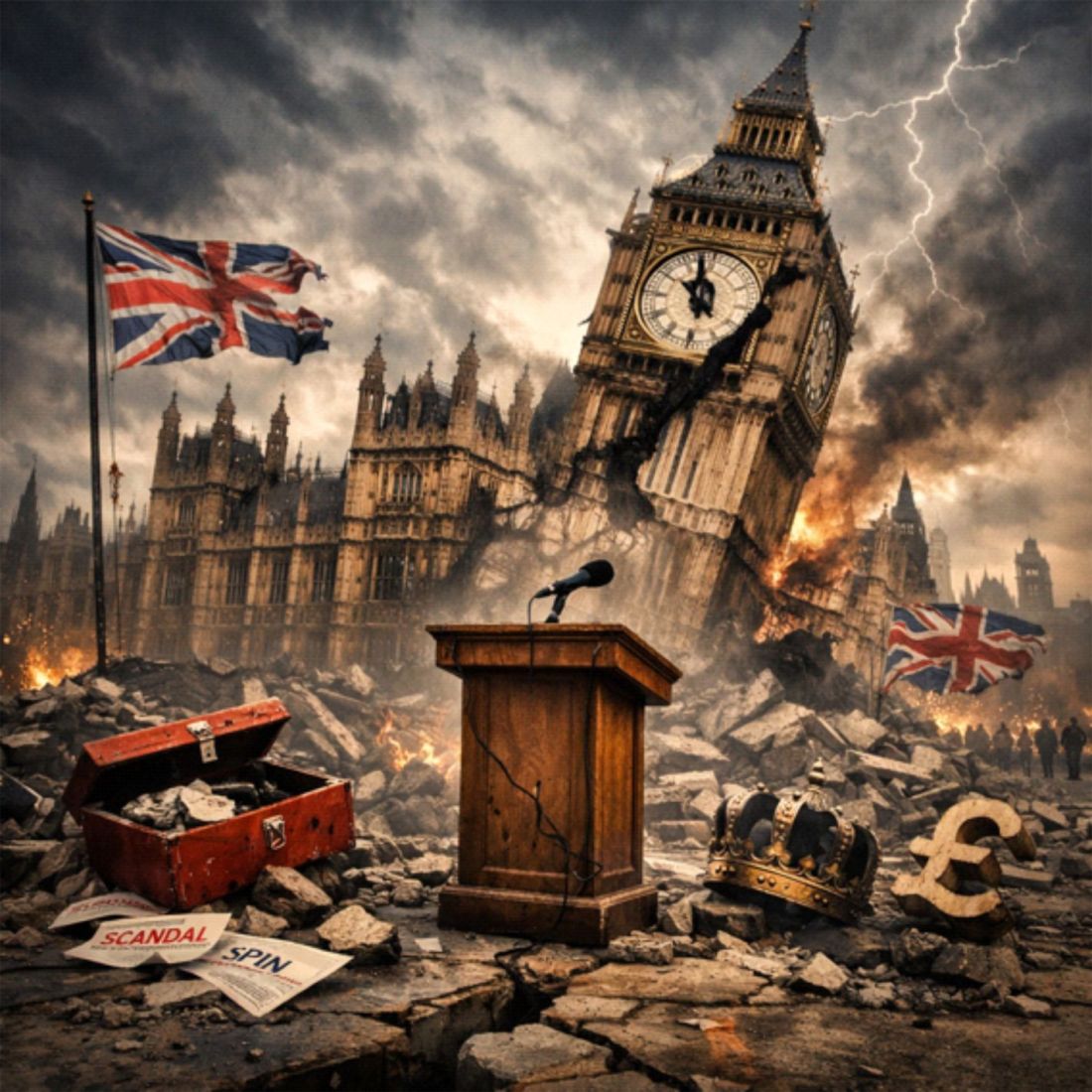


There is a particular sound British politics makes when it is running out of road. It is the sound of people reaching once again for the language of grip, delivery, seriousness, experience and competence, as though the right combination of better managers and sterner faces might somehow make the old machinery work as it once appeared to.
That search is understandable. When services deteriorate, living standards stall, housing becomes unreachable, debt rises and trust drains away, people naturally look for someone capable of restoring order. They ask who has the experience, who understands the markets, who can command the machine, who can finally make government work.
But the question itself may already be too narrow. If the machine is misfiring because the wrong people are operating it, then better operators might help. If the machine is misfiring because its assumptions no longer match reality, then the search for better operators becomes part of the problem.
The wrong question
Much of the current debate still assumes that Britain’s difficulties are failures of competence. The state needs to be run better. Budgets need to be managed more tightly. Growth needs to be revived. Productivity needs to improve. Departments need sharper leadership. Public services need reform. Markets need reassurance. Voters need confidence.
None of that is necessarily wrong. Competence matters. Money matters. Institutions matter. A government that cannot manage basic administration will not guide a country through anything more difficult. But competence inside a failing model is not the same as leadership capable of recognising that the model itself may be failing.
That is the possibility British politics keeps circling without quite naming. The country may not simply be suffering from a temporary downturn, a poor fiscal rule, a succession of disappointing governments or another bad phase in the electoral cycle. The fact that leaders with very different personalities, priorities and political traditions keep encountering similar limits should itself prompt a deeper question: are we looking at failures of individuals, or failures of the system within which those individuals are operating?
For decades, public assets have been sold and called efficiency. Value has been extracted from communities and called growth. Productive capacity has been hollowed out and replaced with financial engineering. Promises have been funded through debt, asset inflation and claims on the future. Success has been measured in ways that often fail to describe whether ordinary people can afford homes, raise families, access care, build security or live in communities that still function.
So when politicians talk about investment, fiscal space, renewed growth or national renewal, they often sound as though they are describing fresh capacity. Too often, they are doing something more limited: relabelling existing spending, moving costs into future years, borrowing more expensively, hoping growth returns, or trusting that markets will tolerate one more round of improvisation.
That does not mean money has literally disappeared. It means the real economic surplus, institutional resilience and productive base needed to sustain the promises of the existing model have been dangerously weakened. There is still money in circulation. There is less real capacity behind many of the promises attached to it.
Two mistakes, not one
This is where the leadership debate becomes confused. The failure is usually described as though the political class suffers from one shared defect. In reality, there are at least two, and they point in opposite directions.
One group knows the machinery but cannot imagine a future beyond it. The other does not understand the machinery and still imagines that power simply stops at No.10.
The first might be called the paradigm-blind managers. They speak the language of debt, markets, fiscal rules, productivity, investment and economic credibility. They understand how the existing system is supposed to work. Their failure is not that they know nothing. Their failure is that they know the current grammar so well that they struggle to imagine another language.
For them, every problem eventually returns to the same family of answers: more growth, better productivity, tighter management, smarter investment, stronger fiscal discipline, market credibility, business experience and technocratic competence. These things are not irrelevant. But if the model itself is producing the outcomes, fluency in that model is not enough.
The second group suffers from almost the opposite problem. These are the institutional romantics: people who speak as though the Prime Minister can simply decide, Parliament can vote away financial constraints, borrowing is only a matter of courage, and market reality can be dismissed as ideological pressure.
They imagine government as a command structure with No.10 at the top. But modern Britain is not arranged so simply. Government sits inside a dense web of Treasury rules, central bank decisions, debt markets, international capital, existing obligations, public expectations, legal commitments and real economic capacity. Political authority still matters, but it does not float above these constraints.
Both groups are dangerous, but for different reasons. The managers mistake system failure for poor administration. The romantics mistake structural constraint for cowardice or betrayal. One cannot imagine a future beyond the existing model. The other cannot understand the model they are already inside.
Why governments keep disappointing people
This distinction matters because it explains why successive governments so often disappoint people once they enter office. Campaigns take place in abstraction. Government takes place inside systems. Some of the people who have occupied No.10 in recent years might have been better suited to a different political moment. The point is not that every individual has been uniquely inadequate. The point is that very different people have repeatedly collided with similar institutional and economic realities.
The rhetoric of opposition, leadership contests and party conferences is full of choice, courage and renewal. But once inside government, ministers confront the hard edges of the state: debt servicing, spending commitments, market reactions, departmental fragility, contractual obligations, institutional inertia and the gap between what the country has been promised and what the system can actually deliver.
What looks like betrayal is therefore not always betrayal. Sometimes it is the moment when rhetoric collides with reality. Sometimes it is the discovery that the money imagined during the campaign does not exist in the form assumed, that the choices described to voters are narrower than claimed, and that the levers of power do not move the machinery in the way politicians implied. In that sense, politicians are not only agents of the system. They can also become its prisoners.
This does not absolve them of responsibility. They choose to seek power. They choose the promises they make. They choose the stories they tell about what power can achieve. They should know more before they obtain the roles they seek. But the repeated pattern also reflects the system that selects, rewards and promotes them: a system that often prizes confidence over understanding, fluency over wisdom and the appearance of control over an honest account of constraint.
This is not simply a failure of character. It is a failure of diagnosis. If people enter power believing the crisis is mainly political, they will be unprepared for an institutional and economic crisis. If they enter power believing the existing model only needs better management, they will be unprepared for the possibility that the model itself is the problem.
What leadership actually means
That is why the leadership question matters. But leadership is often misunderstood. It is confused with expertise, business experience, technical fluency, personal conviction, rhetorical force or the ability to dominate a room. None of these things is leadership.
No Prime Minister can be the country’s best economist, accountant, engineer, scientist, military strategist, financier, social worker and historian at the same time. No Chancellor can personally understand every consequence of every decision. No government can function if leadership means knowing everything.
Leadership means something else. It means bringing together people with different forms of expertise, understanding the realities they identify, recognising the limits of their assumptions, asking questions that fall between disciplines, and making decisions in the public interest even when those decisions are difficult, unpopular or hard to communicate.
- expertise is necessary, but not sufficient
- financial knowledge is necessary, but not sufficient
- political authority is necessary, but not sufficient
- conviction is necessary, but not sufficient
- process is necessary, but not sufficient
Managers optimise within a system. Leaders make judgements when the system itself is in question.
This is not an argument against expertise. Economists matter. Financial specialists matter. Engineers, scientists, business leaders, local government officers, community organisations and public service professionals all matter. The problem begins when expertise is mistaken for leadership, or when one form of expertise becomes the only lens through which every public problem is viewed.
A leader must be able to listen without becoming captured, decide without pretending certainty, and act without reducing society to a spreadsheet. The defining feature of leadership is not avoiding difficult choices. It is accepting responsibility for choices where every available option carries a cost.
The danger of confusing leadership with control
There is another danger here. When institutions lose credibility, living standards decline and familiar solutions stop working, people understandably begin to hunger for clarity and action. The attraction of the decisive individual grows stronger. The argument becomes that Britain does not need more consultation, more process or more excuses. It needs someone who will take control.
That temptation should not be dismissed lightly. A theoretical case can always be made for a wise, selfless and temporary crisis leader: someone capable of seeing the whole system, gathering the right minds, making hard decisions and relinquishing power when the work is done. The problem is not the theory. The problem is the real world.
How would such a person be found? How would the country know they were genuinely selfless rather than merely claiming to be? How would power be limited once concentrated? How would dissent be protected? How would succession work? How would the person remain the same after acquiring the authority that changes almost everyone who holds it?
The answer to managerial paralysis is not authoritarian certainty. The manager says, “The process will save us.” The strongman says, “I will save us.” A leader says, “Show me what is real, tell me what I am missing, let the strongest arguments be heard, and then I will decide.”
The distinction matters because desperation changes political judgement. Once people stop believing that ordinary politics can respond to reality, they often stop looking for leadership and start looking for saviours. That is when the void becomes dangerous, especially if some of those already close to power exhibit the habits of certainty, grievance, domination or contempt for constraint before they have even acquired it.
The lucid moment has to come before desperation
What Britain needs, then, is not simply another leader, another party, another slogan or another economic forecast. It needs a lucid moment: a collective recognition that the old model is no longer producing the outcomes promised, that changing personnel is not the same as changing assumptions, and that preserving social cohesion during transition matters more than defending the credibility of a failing worldview.
The danger is that such recognition arrives too late. Systems can continue long after their underlying assumptions have weakened because admitting the scale of the problem is professionally, politically and psychologically difficult. The people most rewarded by the existing paradigm are rarely the first to acknowledge that it has reached its limits.
That is why the question of leadership cannot be reduced to personality. Britain does not need people who merely know how to operate the machinery, nor people who imagine they can command it by will alone. It needs leaders capable of understanding the machinery, recognising when it is failing, gathering knowledge beyond their own worldview, and making decisions that serve people rather than the abstractions of the system.
That means rebuilding productive local economies, reconnecting institutions with lived reality, asking how value is created and circulated in communities, and developing forms of governance that serve people rather than forcing people to serve markets, models and metrics.
The greatest danger is not decline itself. It is that decline remains misunderstood until frustration turns into desperation. If that happens, the search for leadership can become a search for certainty, and the search for certainty can become the path to something far worse.
The lucid moment needs to come before that. Britain needs real leadership not because one person can save it, but because only real leadership can help a society understand reality before reality forces the lesson on harsher terms.