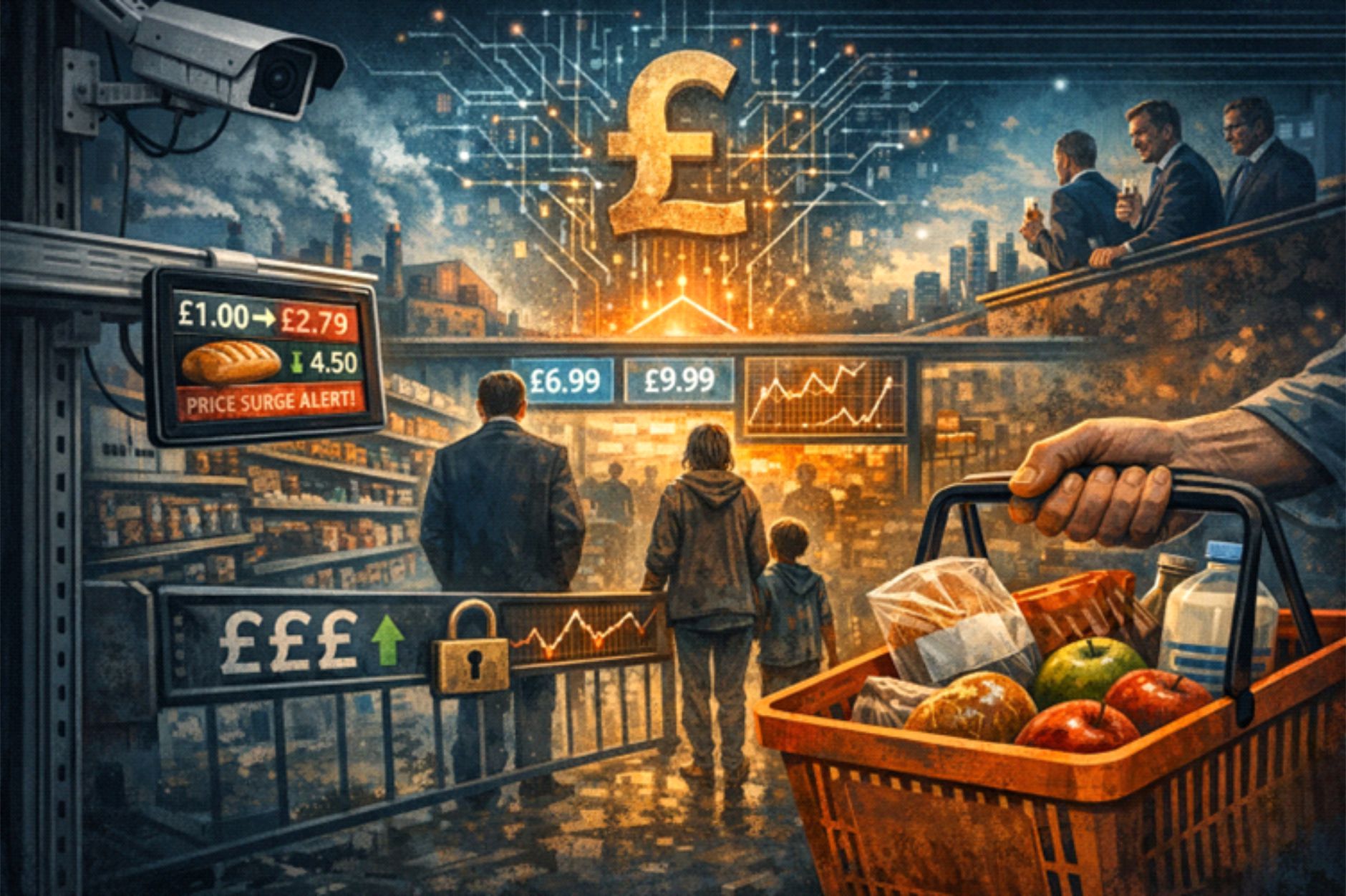

There’s a shift taking place in the way food pricing is being discussed in the UK, and it’s happening at a moment when people are already under pressure.
Supplies are tightening, costs are rising, and households are having to make decisions they shouldn’t have to make about the basics.
Against that backdrop, the idea of dynamic food pricing has begun to surface – not as a distant concept, but as something the system is quietly preparing for.
Supermarkets are not using dynamic pricing yet. That matters.
But the steps being taken now – by both retailers and institutions – show a direction of travel that deserves attention.
Because when food becomes scarce, pricing becomes a mechanism of control.
And when pricing becomes dynamic, access becomes selective.
The Bank of England Has Already Opened the Door
The clearest sign that this isn’t just a technical upgrade came from the Bank of England.
In recent comments, the Bank’s deputy governor explained that digitalisation has “radically reduced” the cost of changing prices, making rapid, algorithm‑driven pricing far more viable. The Bank also expects a significant share of UK businesses to adopt algorithmic pricing tools over the next few years.
This isn’t a supermarket experiment.
It’s being framed as the natural evolution of retail by the institution responsible for overseeing the economy.
When the central bank normalises a practice, it sets the tone for the entire system.
It tells businesses: this is acceptable.
It tells regulators: this is expected.
And it quietly signals to the public that the rules are changing.
Supermarkets Are Installing the Infrastructure
While supermarkets insist they are not using dynamic pricing, they are installing the technology that would make it possible.
Digital shelf labels – the small electronic screens replacing paper price tags – are being rolled out across the major chains. Morrisons is fitting them in every store. ASDA has installed them in hundreds of Express branches. Co‑op has already fitted more than 700 stores and plans to expand to over 2,300. Tesco, Sainsbury’s and Lidl are all trialling or testing the same systems.
Digital labels are not dynamic pricing. But they are the mechanism through which dynamic pricing can be implemented instantly, centrally, and without fanfare.
When asked directly whether they intend to use dynamic pricing in future, most supermarkets simply refuse to answer.
That silence is more revealing than any denial.
The Petrol‑Price Pattern: A Real‑World Example of What Dynamic Pricing Looks Like
If you want to understand how dynamic pricing behaves in practice, you don’t need to imagine futuristic scenarios. You only need to look at petrol.
When the price of crude oil rises, petrol prices at the pump rise almost immediately.
When crude oil falls, the price at the pump drops slowly – sometimes painfully slowly.
That difference between how fast prices rise and how slowly they fall is profit. And it’s a perfect example of how dynamic pricing works in the real world.
It responds instantly when it benefits the retailer.
It responds slowly when it doesn’t.
Now apply that logic to food – not in the extreme sense of prices changing while something is in your trolley, but in the far more realistic sense of prices changing at different times of the day, or rising during peak demand, or increasing when shortages make certain items more sought‑after.
This is the real concern.
Not science‑fiction scenarios, but the everyday reality of prices shifting in ways that quietly push the most vulnerable out of affordability.
Shortages Change the Meaning of Dynamic Pricing
Dynamic pricing during abundance is one thing.
Dynamic pricing during scarcity is something else entirely.
When food is limited, prices that move with demand don’t protect people – they prioritise those who can afford to absorb the rises.
The people who need the basics the most are the ones most likely to be priced out, not because there isn’t enough food to meet need, but because meeting the wants of those who can pay more is more profitable.
This is the heart of the issue.
Dynamic pricing doesn’t ration food.
It rations access.
And it does so based on wealth, not need.
The Context: How We Reached This Point
Dynamic pricing isn’t appearing in a vacuum. It’s emerging after years of subtle shifts in how food is priced and presented – shifts that have already eroded trust and stability.
Shrinkflation has quietly reduced the size of products while prices stay the same or rise. A 250g block of butter becomes 200g, and the packaging barely changes. People notice, but the explanation is always the same: inflation, supply chains, global events.
Loyalty‑card‑only pricing has created a two‑tier system where the “real” price is only available if you hand over your data. If a supermarket can afford to sell something at the loyalty price, that’s the price – with their profit margin. The higher price is simply a penalty for not participating in the data‑collection model – a form of everyday surveillance capitalism.
And then there are the offers that aren’t really offers, the discounts that only apply to certain sizes, the prices that seem to shift more often than they used to. All of this creates a sense of instability that people feel long before they can articulate it.
Recognising all of this isn’t about treating people like they can’t or don’t understand what’s happening.
It’s about acknowledging that they’ve been living through these changes for years – often without anyone naming them plainly.
Where Things Actually Stand
Regrettably, it would be easy to jump to many conclusions with the evidence that is already unfolding in plain sight. However, the picture to day is as follows:
- Dynamic pricing is not currently being used on food in UK supermarkets.
- The technology that would allow it is being rolled out.
- The Bank of England has framed algorithmic pricing as part of the future.
- Supermarkets have not ruled out using it.
- Oversight and regulation are unclear.
And all of this is happening as we head into what is likely to become a period of shortages too.
This isn’t speculation.
It’s the landscape.
This Is About Awareness, Not Alarm
People don’t need to be told how to think about this.
They simply deserve to know what’s happening – and what could happen next.
Dynamic pricing isn’t here yet.
But the system is being shaped around it.
And in a time of shortages, that shift has consequences that go far beyond technology.
It affects access, fairness, and the basic principle that essential goods should not become a bidding war.
Further Reading:
The themes explored in this article – food access, control, systemic fragility, and community resilience – sit within a wider body of work examining how power, scarcity, and stability are managed during periods of transition.
The pieces below are ordered to take the reader from structural analysis, through systemic alternatives, to practical personal and community responses. Together, they provide political, philosophical, and lived‑reality context for why dynamic food pricing matters – and what can be done instead.
1. Who Controls Our Food Controls Our Future
Link: https://adamtugwell.blog/2024/11/14/who-controls-our-food-controls-our-future-full-text/
What it is:
A foundational essay examining food as a lever of social and political power rather than a neutral commodity.
What it covers:
This piece explores how control over food systems – production, distribution, pricing, and access – has historically been used to shape populations, enforce compliance, and concentrate power. It looks at corporate consolidation, supply‑chain fragility, and the quiet erosion of food sovereignty, framing food control as a central pillar of modern governance and social stability.
Why read it first:
It establishes the core argument that underpins concerns about dynamic pricing: that access to food is never just economic – it is fundamentally political.
2. Foods We Can Trust: A Blueprint for Food Security and Community Resilience in the UK
What it is:
A systems‑level proposal for rebuilding food security outside fragile, opaque, and extractive corporate models.
What it covers:
This work outlines how trust has been eroded within the UK food system through long supply chains, farmer pressure, profit‑driven practices, and lack of transparency. It then sets out principles for a more resilient alternative – rooted in local production, shorter supply chains, fairness, and community participation.
Why it follows:
After identifying the problem of control, this piece begins to articulate what a healthier food system could look like.
3. A Future of Communities: Building the New World Without Oil, Manipulated Money, and Centralised Control
What it is:
A broader societal vision that situates food systems within energy, finance, governance, and community resilience.
What it covers:
This article examines how over‑centralisation, financial abstraction, and energy dependency create systemic fragility – and argues for decentralised, human‑scale alternatives. Food, alongside energy and local production, is treated as a cornerstone of resilient communities rather than a profit‑optimised commodity.
Why it matters here:
It places the issue of dynamic pricing within a much wider pattern of centralised control and automation, showing that food pricing is one symptom of a larger structural trajectory.
4. A Practical Guide to Surviving and Thriving Through Uncertain Times: Staying Calm, Prepared, and Connected
What it is:
A grounded, accessible guide focused on personal and community resilience during periods of instability.
What it covers:
Rather than analysing systems, this piece addresses how individuals and communities can respond emotionally, socially, and practically to volatility. It explores preparedness without panic, the importance of social connection, and how to maintain agency when external systems become unpredictable.
Why it comes last:
After understanding the systems and the alternatives, this piece brings the discussion back to lived reality – what people can do now to remain stable, connected, and resilient.

