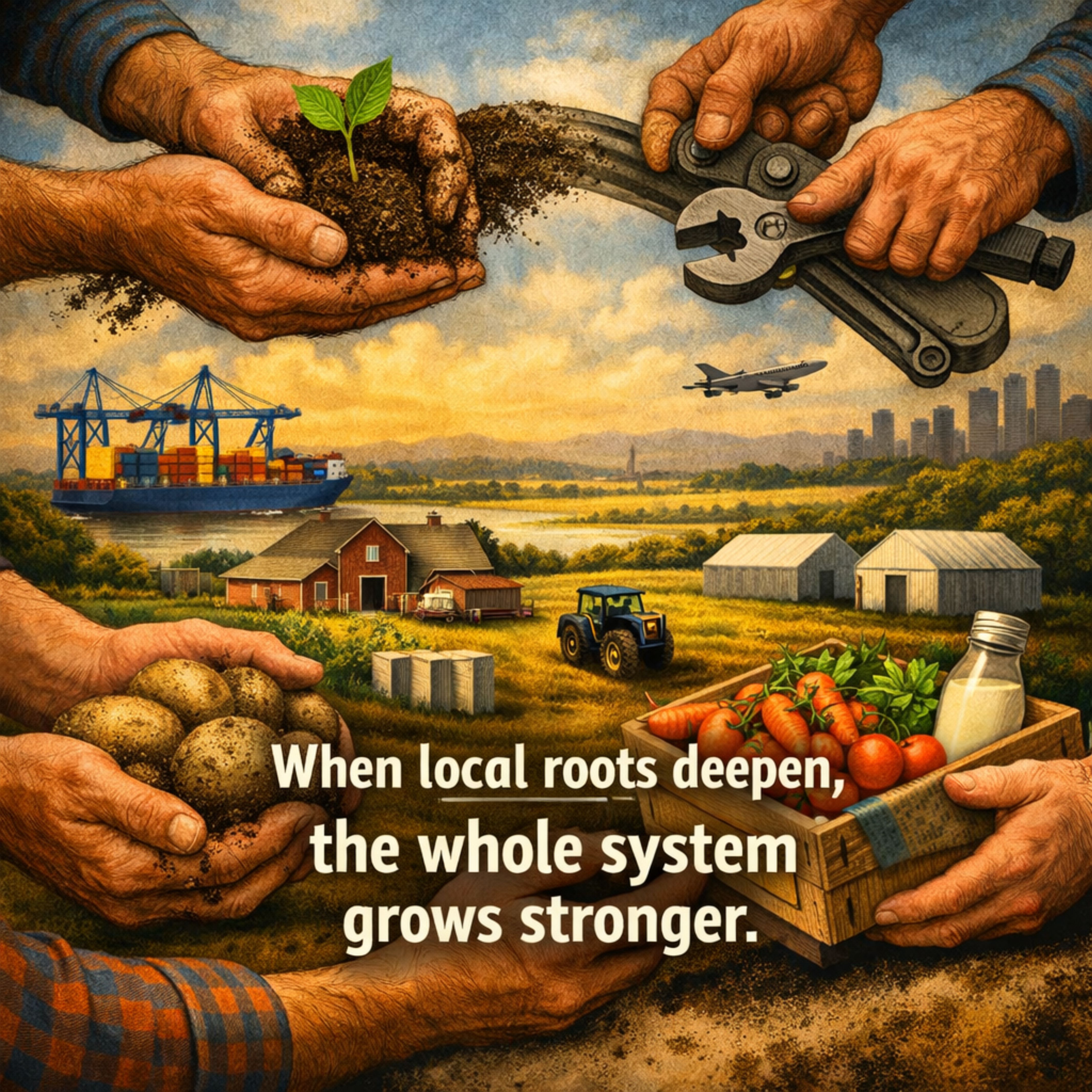

An open conversation about what’s happening, why it matters, and what we can do next.
1. A Quiet Reality We Haven’t Been Shown
Most people in the UK don’t spend much time thinking about where their food comes from. Why would they? The shelves are full, the lorries keep moving, and the news rarely touches on food unless it’s a supermarket promotion or a celebrity chef.
The quiet assumption is that the system works – and that it will keep working.
But if you look a little closer, you start to see a different picture. Not a dramatic one, not a crisis‑headline one, but a real one: a food system that functions beautifully when everything around it is stable, yet is built on foundations that are far more fragile than most people realise. And because the public conversation rarely touches on these foundations, most people simply don’t know they exist.
This isn’t about blame. It’s about visibility. It’s about saying, “Here is what’s actually happening beneath the surface – calmly, clearly, and without sensationalism.” And it’s about recognising that once you understand the system, you also start to see the things we can do, both now and over time, to make it stronger.
So let’s walk through it together.
2. How the UK Food System Really Works Beneath the Surface
If you want to understand the fragility of the UK food chain, fertiliser is a surprisingly good place to start. It’s not glamorous, but it’s essential. Without it, UK yields drop sharply. And the UK no longer produces enough of it. We import most of what we use, and those imports depend on global gas markets, global shipping, and global political stability.
When gas prices spike, fertiliser prices spike.
When shipping routes are disrupted, fertiliser availability tightens.
When fertiliser plants shut down – as we’ve seen – CO₂ supplies collapse too, because CO₂ is a by‑product of fertiliser manufacturing. And CO₂ is needed for slaughterhouses, packaging, and parts of food processing.
This is the kind of quiet interdependence most people never see. But it matters, because fertiliser shocks don’t hit immediately. They hit next season, when farmers plant less or apply less. And right now, instability in the Gulf is already affecting global fertiliser markets.
That’s not a prediction – it’s simply what’s happening.
Then there’s the question of how much food the UK actually produces. You’ll often hear that the UK is “60% self‑sufficient in food.”
It sounds reassuring. It’s also misleading.
That number includes feed wheat, barley for whisky, oilseed rape for biodiesel, sugar beet for industrial processing, livestock fed on imported soya, food that is exported, and food that cannot reach consumers without fragile processing.
It’s a production statistic, not a resilience statistic.
When you strip all that out and look only at food that is directly edible and immediately available to UK consumers, the picture changes dramatically.
The real figure is closer to 11%.
That doesn’t mean the UK is about to run out of food. But it does mean the UK is far more dependent on global stability than most people realise. And it means that when global systems wobble – fertiliser, shipping, climate, conflict – the UK feels it quickly.
The UK also relies heavily on imported fruit, vegetables, salad crops, grains, ingredients, fertiliser, and animal feed.
A quarter of our food imports come from the Mediterranean – a region experiencing increasing climate stress. And the UK has no meaningful national food reserves.
This isn’t about fear. It’s about understanding the reality: when weather in Spain or Morocco is extreme, UK shelves feel it.
When shipping routes are disrupted, UK availability tightens.
When other countries restrict exports – as they often do during stress – the UK cannot assume it will simply be able to “buy its way out.”
We are not the only ones shopping on the global market.
The UK food system is also one of the most time‑sensitive in Europe. It relies on fast, predictable movement through a small number of ports and distribution hubs. There is very little storage. The system has days of buffer, not months. This is efficient – until something interrupts it.
Fuel shortages, haulage strikes, cyber incidents, or port delays ripple through the system quickly. Not because anyone has done anything wrong, but because the system was designed for speed, not resilience.
And then there’s the shrinking middle – the processing bottlenecks. Over decades, the UK has closed many of its small abattoirs, dairies, mills, and packhouses.
We now rely on fewer, larger facilities. This is efficient, but it creates single‑point failures. When a major abattoir closes, an entire region can be affected. When CO₂ runs short, slaughterhouses slow or stop. When energy prices spike, some processors simply can’t operate.
These aren’t dramatic events. They’re quiet, practical disruptions that ripple outward.
Perhaps the least discussed vulnerability is the decline of UK horticulture. Energy costs, labour shortages, tight margins, and competition from imports have all contributed to a steady reduction in domestic fruit and vegetable production.
The UK now produces only a fraction of its own salad crops and winter vegetables. This matters because these foods are the ones that keep people healthy. They’re also the foods most sensitive to import disruption.
All of this forms the foundation of the UK food system – and it’s a foundation that is thinner than most people realise.
3. The Global Picture: Why What Happens Elsewhere Matters Here
If the UK’s food system feels fragile when you look closely, the global picture adds another layer entirely. Not because the UK is about to face famine – it isn’t – but because the world we rely on is becoming more unstable, and that instability feeds directly into the UK’s already‑thin domestic resilience.
This is the part of the conversation that rarely reaches the public. News coverage tends to focus on domestic politics, supermarket prices, or the occasional weather‑related shortage. But the real story – the one that explains why the UK is so exposed – is happening across oceans, across continents, and across supply chains that most people never see.
The fertiliser map is one example. A handful of countries dominate global production. When any of them experience disruption – political, economic, or military – the effects ripple across the world.
Instability in the Gulf is already affecting fertiliser markets. Shipping insurance costs are rising. Transit routes are being disrupted. Some producers are prioritising domestic supply. Others are quietly reducing exports.
None of this makes headlines, but all of it affects the price and availability of fertiliser everywhere else.
And because fertiliser is the foundation of modern agriculture, a shock in one region becomes a shock in many. Farmers in East Africa, South Asia, and parts of Latin America are already reducing application rates or switching to lower‑input crops. Lower fertiliser use means lower yields. Lower yields mean tighter global markets. And tighter markets mean higher prices for everyone – including the UK.
Shipping chokepoints matter too. The UK relies on the Red Sea, the Suez Canal, the Strait of Hormuz, and the Mediterranean. Disruptions in any of these routes affect fertiliser, grain, fruit, vegetables, animal feed, and ingredients. This is not hypothetical. It’s happening now.
Climate stress is another pressure. Many of the countries the UK relies on for fruit, vegetables, and salad crops are facing increasing climate stress. Spain, Italy, and Morocco – which supply a large share of the UK’s fresh produce – have all experienced severe droughts, heatwaves, and storms in recent years. When harvests fail in these regions, the UK feels it almost immediately.
Export bans are becoming more common too. When countries face domestic shortages, they restrict exports. India has restricted rice exports. Russia and Ukraine have restricted wheat and sunflower oil at various points. Morocco has restricted tomato exports. Egypt has restricted onions. Dozens of countries have restricted sugar, grains, or vegetables in the past few years.
These bans rarely make UK headlines. But they matter, because they signal a shift in global behaviour: countries are prioritising their own populations first. And in a world where the UK relies heavily on imports, that shift is significant.
Rising famine risk in multiple regions – East Africa, the Sahel, Yemen, Afghanistan, parts of the Middle East – is another sign that the global food system is under strain.
When multiple regions face shortages at the same time, global markets tighten. Prices rise. Competition for imports increases. Export bans become more common.
The UK is not at risk of famine. But it is deeply dependent on a global system that is becoming more volatile. When fertiliser prices rise, UK farmers feel it. When shipping routes are disrupted, UK importers feel it. When climate stress hits Spain or Morocco, UK consumers feel it. When export bans ripple across the world, UK availability tightens.
This isn’t a reason for fear. It’s a reason for awareness. Because once you see the global picture, the UK’s vulnerabilities make more sense – and the path toward resilience becomes clearer.
4. How Stress Moves Through a System Like Ours
When you put all these pieces together, you start to see how stress cascades.
A fertiliser shock leads to reduced planting, which leads to lower yields, which leads to higher prices. A CO₂ shortage slows slaughterhouses, which disrupts meat supply. A shipping delay empties shelves of fresh produce. An energy spike shuts glasshouses, which increases import dependence. A processing closure creates regional supply gaps. Retail concentration means any stress is transmitted quickly to consumers.
None of this is dramatic.
None of it is sensational.
It’s simply how the system behaves.
Food systems don’t fail all at once. They fail in stages, through predictable chain reactions. And because the UK system is so tightly coupled – so dependent on speed, imports, and centralised processing – those chain reactions move quickly.
Understanding this isn’t about predicting collapse. It’s about recognising patterns so we can respond early, thoughtfully, and effectively.
5. The Power Dimension: Who Controls Food, Controls the Future
There is another layer to all of this – one that rarely enters public conversation, yet quietly shapes everything else.
It’s the question of power. Not power in the dramatic sense, but power in the everyday, structural sense: who gets to decide what is grown, how it is grown, how it is processed, how it is moved, and who gets access to it.
It’s easy, when you first begin to understand the fragility of the food system, to feel anger. To look at the concentration of control and think, “How could anyone allow this to happen?”
But the truth is more complicated, and far more human. The centralisation we see today didn’t happen because a group of people set out to weaken resilience or undermine communities. It happened because of decades of decisions – each one rational in isolation – that accumulated into something no one fully intended.
Efficiency was rewarded. Scale was rewarded. Cost‑cutting was rewarded. Globalisation was rewarded. And over time, the system reorganised itself around those incentives. Not because anyone wanted to create fragility, but because fragility is the natural by‑product of a system optimised for efficiency above all else.
This is important to say clearly:
Most of the people working within this system are not acting with malice.
They are not sitting in boardrooms plotting to undermine food security.
They are responding to the pressures, incentives, and expectations of the structures they operate within.
But structures have consequences, even when intentions do not.
As control over land, inputs, processing, logistics, and retail has become concentrated in fewer hands, something subtle but significant has happened: distance has grown between decision‑makers and the people affected by those decisions.
Distance changes how we see each other.
It dulls empathy.
It narrows perspective.
It makes it easier to think in terms of numbers, not lives.
This isn’t a moral failing. It’s a human one.
When decisions are made far from the communities they affect, the lived experience of those communities becomes abstract. When a spreadsheet says a small abattoir is “inefficient,” the spreadsheet doesn’t see the farmers who rely on it, the local economy it supports, or the resilience it provides. When a global corporation decides to consolidate seed production, it doesn’t see the growers who lose access to diversity. When a shipping company reroutes vessels to maximise profit, it doesn’t see the supermarket shelves that will empty weeks later.
This is what centralisation does.
It doesn’t just concentrate power.
It dehumanises the consequences of power.
Over the past few decades, a small number of corporations have come to dominate seeds, fertiliser, chemicals, processing, logistics, and retail. A small number of geopolitical actors control key shipping routes, energy supplies, and fertiliser production. A small number of financial institutions influence land ownership, commodity markets, and investment flows.
This didn’t happen overnight. It happened through mergers, policies, market pressures, trade agreements, and technological systems that rewarded scale and efficiency.
Each step was rationalised.
Each step was justified.
Each step was incremental.
And yet, taken together, they created a system where a handful of actors – none of whom see the whole picture – now hold extraordinary influence over something as fundamental as food.
Most people in positions of power do not see the full implications of their decisions. They see cost, efficiency, margins, budgets, returns, market share. Very few see the whole system. Even fewer see the human consequences. And almost none are rewarded for thinking about resilience, community wellbeing, or long‑term stability.
This is why blame is unhelpful.
Not because harm hasn’t been done – it has – but because the harm is systemic, not personal.
A food system controlled by a few is efficient – until something goes wrong.
A food system shaped by many is resilient – because it can adapt, absorb shocks, and respond to local needs.
Centralisation creates vulnerability.
Distributed agency creates strength.
This is why local governance matters.
This is why regional processing matters.
This is why community capacity matters.
This is why transparency matters.
This is why diversity – of crops, of producers, of infrastructure – matters.
A resilient food system is not built on the assumption that those in power will always make the right decisions.
It is built on the understanding that power must be shared, because shared power creates shared responsibility – and shared responsibility creates systems that value people, not just efficiency.
6. So What Can We Do? The Direction of Travel That Makes Sense
If everything up to this point has been about understanding the vulnerabilities – the thin foundations, the global pressures, the way stress moves, and the structural realities of power – then this part is about something far more important: what we can actually do.
Because awareness without agency is just anxiety.
And this conversation is not about anxiety.
It’s about clarity, and the choices that clarity makes possible.
The truth is that resilience doesn’t come from waiting for someone else to fix things. It comes from the quiet, steady work of communities, farmers, local authorities, small businesses, and ordinary people who decide that the system they depend on should be one they can trust.
So let’s talk about what that looks like – not as a list of tasks, but as a direction of travel.
Rebuilding local capacity means growing more food that people can eat directly – vegetables, pulses, grains, fruit – and supporting mixed farming systems that build soil and reduce dependence on imported fertiliser. It means backing small and medium‑scale growers who supply local markets. This isn’t nostalgia. It’s strategy.
Rebuilding the missing middle means restoring regional processing – abattoirs, dairies, mills, packhouses – so the system isn’t dependent on a handful of large facilities. Distributed processing creates distributed resilience. It keeps value in local economies and gives farmers more options.
Strengthening local governance means empowering local authorities and communities to shape their own food systems – through procurement, planning, partnerships, and shared infrastructure. It means decisions made closer to home, by people who understand local needs.
Creating strategic buffers means building breathing room into the system – grain reserves, seed libraries, community storage, cold chains – so that short‑term disruptions don’t become immediate crises.
Shifting the economic logic means valuing resilience over pure efficiency. It means treating food as a public good, not just a commodity. It means designing systems around human need, not market convenience. It means aligning economic activity with community wellbeing.
None of this requires panic.
None of it requires waiting for permission.
It simply requires seeing the system clearly and choosing to build something stronger.
7. Why This Matters Now
There is a moment, when you begin to see the food system clearly, where everything suddenly feels more urgent. Not frightening – just clearer.
You realise that the vulnerabilities we’ve talked about aren’t abstract. They’re not theoretical. They’re not “for someone else to worry about.”
They’re here, now, woven into the everyday reality of how the UK feeds itself.
This matters now because the world around us is changing faster than the systems we depend on.
Climate patterns are shifting. Global supply chains are under strain. Fertiliser markets are tightening. Shipping routes are becoming less predictable. Export bans are becoming more common. And the UK’s domestic resilience – already thin – is being tested by pressures that are outside our control.
This isn’t a crisis.
It’s a crossroads.
And the choices we make now – as communities, as local authorities, as farmers, as citizens – will shape the food system we inherit in the years ahead.
8. What This Is Not
Before going any further, it’s important to be clear about what this conversation is not.
It is not a prediction of collapse.
It is not a call to panic.
It is not an argument against global trade.
It is not an attack on farmers, retailers, corporations, or policymakers.
It is not a conspiracy theory.
It is not an attempt to assign blame.
It is simply an attempt to see the system as it really is – with honesty, clarity, and compassion.
Most of the people working within the food system are doing their best within the constraints they face. Most are not aware of the full implications of their decisions. Most are responding to pressures they did not create. And most are not rewarded for thinking about resilience, community wellbeing, or long‑term stability.
This is not about pointing fingers.
It is about understanding the structures that shape behaviour – and choosing to build something better.
9. Where This Leads
The UK food system is not broken.
It is not doomed.
It is not beyond repair.
It is simply stretched – thinner than most people realise – and operating in a world that is becoming more volatile.
That combination creates risk, but it also creates opportunity. Because once you see the vulnerabilities clearly, you can begin to strengthen them.
Once you understand how stress moves through the system, you can begin to design buffers.
Once you recognise the role of power and centralisation, you can begin to rebuild agency at the local level.
In some of my other work, Foods We Can Trust, the Local Economy & Governance System, and An Economy for the Common Good, I have written extensively about our relationship with food, the opportunities for change that we have and the kind of system that we now need to embrace that will place food and food production at the heart of everything – as it should be, along with all the basic essentials for life.
These are not abstract ideas. They are practical frameworks for building a food system that is:
- more local
- more resilient
- more humane
- more transparent
- more accountable
- more aligned with the wellbeing of people and the land
A food system we can trust is not built overnight.
It is built through thousands of small decisions – to grow differently, to buy differently, to organise differently, to govern differently.
And the good news is this:
Every step in the right direction strengthens the whole.
This is not a call to alarm.
It is a call to awareness – and to the quiet, steady work of building a future where our food system serves people, communities, and the land on which we all depend.


5 thoughts on “Understanding the Fragile Foundations of the UK Food Chain”