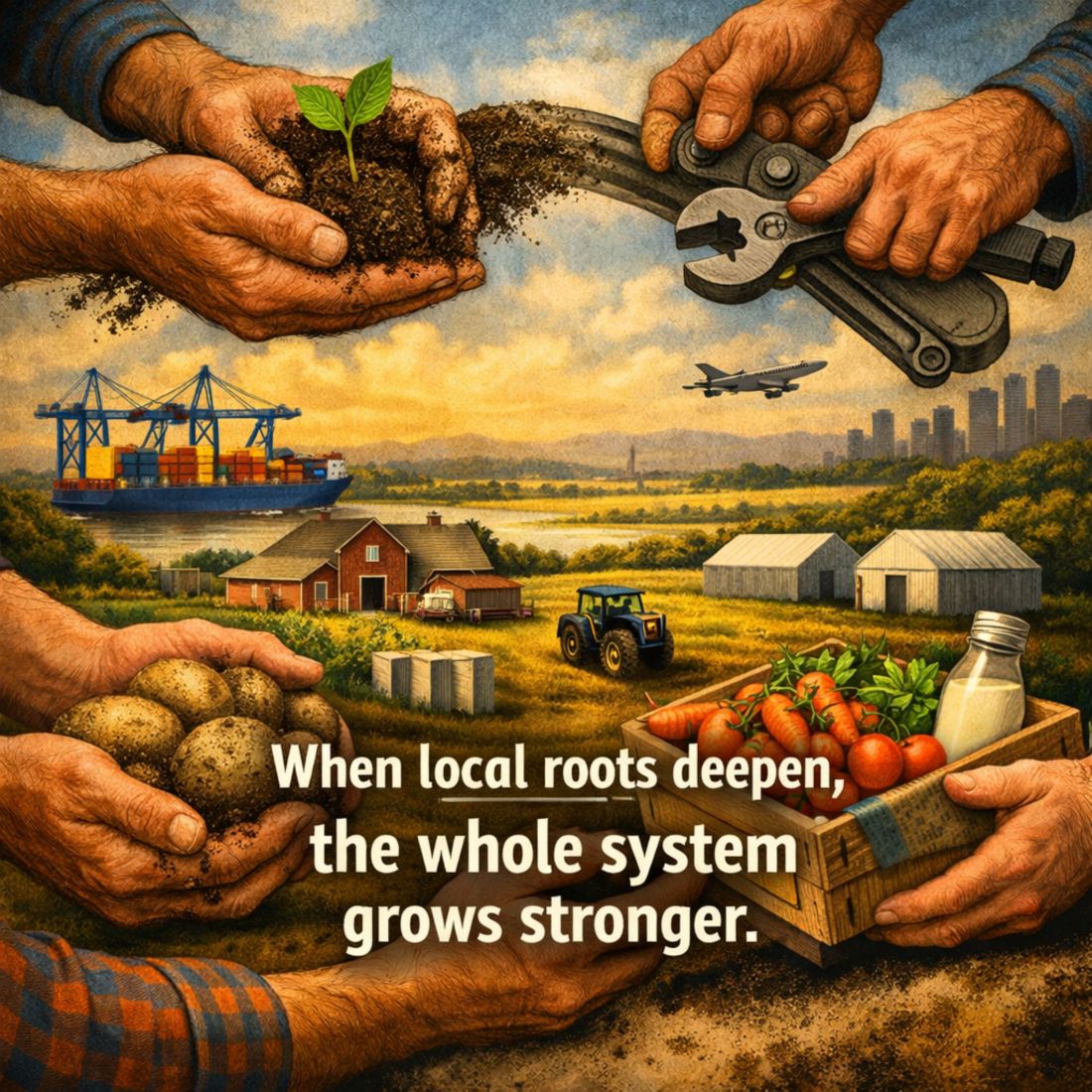

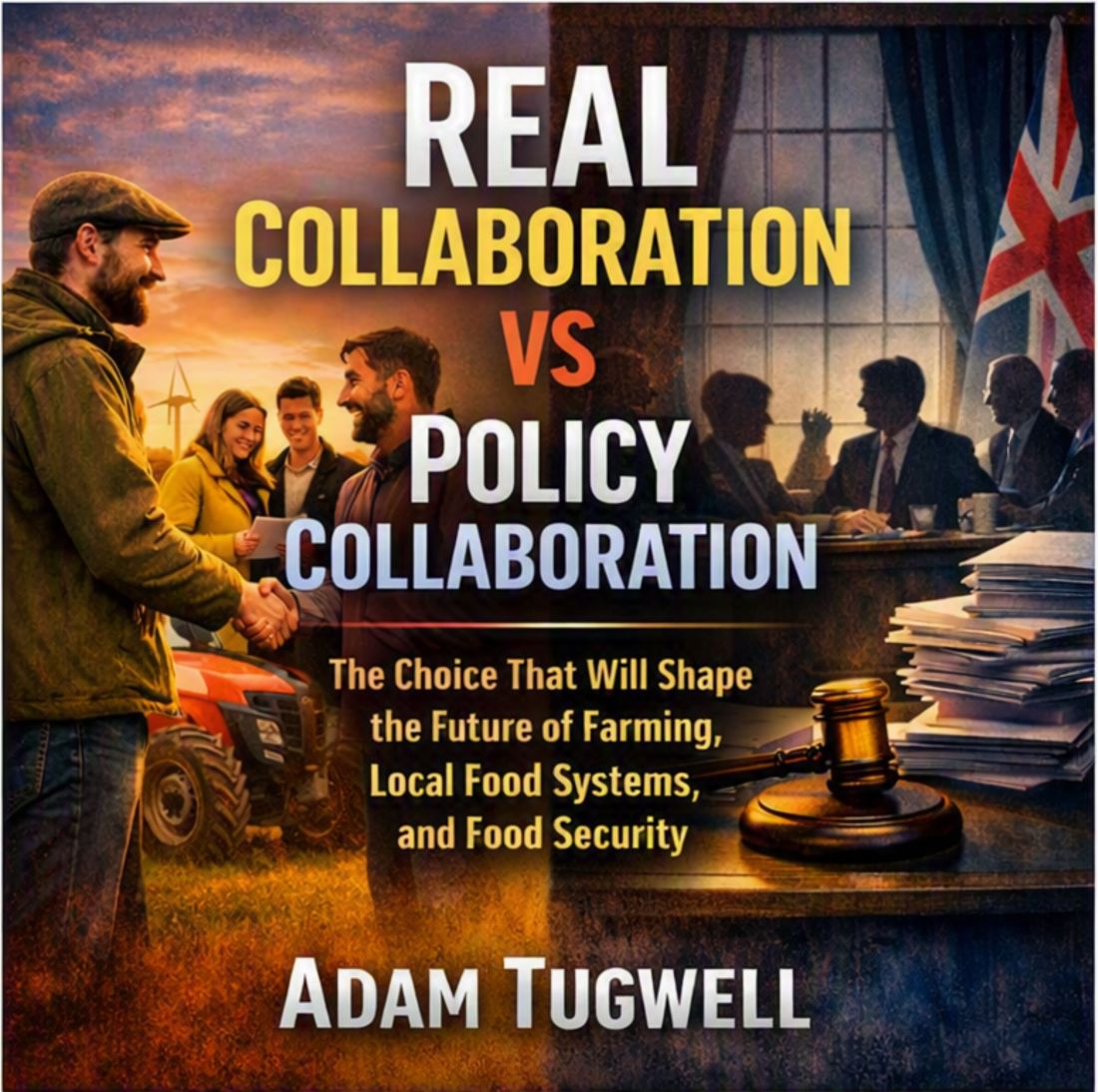
If we lose the ability to feed ourselves, everything else becomes negotiation
Foreword
This piece was written because something fundamental has gone wrong in the way collaboration is being discussed in farming. The word is used constantly in policy, guidance, and funding frameworks, yet the meaning behind it has drifted far from what farmers recognise or need. Over time, collaboration has become a tool for alignment rather than a way for farmers to strengthen their businesses, rebuild local infrastructure, and support the communities they feed.
I have watched the impact of this shift for years. I have seen how regulation has hollowed out local food systems, how policy has prioritised metrics over production, and how farmers have been encouraged to collaborate in ways that serve external agendas rather than their own. At the same time, I have seen the quiet, practical, farmer‑led collaboration that still exists – the version that works, the version that protects livelihoods, and the version that could rebuild what has been lost if it were recognised for what it is.
This piece is an attempt to draw a clear line between these two meanings of collaboration, to explain why the difference matters, and to show how farmers can reclaim the version that belongs to them. It is written for farmers, but also for anyone who cares about the future of local food, rural communities, and national food security.
The choice between these two versions of collaboration will shape the future of farming. My hope is that this piece helps make that choice clearer.
Executive Summary
Farming is being reshaped by a version of collaboration that does not belong to farmers. Policy collaboration – the model promoted through schemes, frameworks, and regulatory agendas – organises farmers around environmental delivery, land‑use change, and measurable outcomes that serve government priorities rather than farm business needs. It has become a mechanism for alignment, not a tool for resilience.
At the same time, decades of legislation and regulation have dismantled the local infrastructure farmers once relied on. Small abattoirs, processors, distributors, and rural food businesses have been priced out or regulated out of existence. The result is a food system that is increasingly centralised, fragile, and disconnected from the communities it is meant to serve. This erosion has weakened production, undermined local markets, and reduced national food security.
Against this backdrop, real collaboration – the practical, cooperative, farmer‑led version – has become essential. Real collaboration strengthens production, rebuilds local infrastructure, aligns farmers with other local industries, and restores the economic connections that make farming viable. It is grounded in shared problems, shared investment, and shared benefit. It is the only version of collaboration capable of rebuilding local food systems and protecting long‑term food security.
Farmers now face a choice between two fundamentally different paths: policy collaboration, which aligns them with external agendas, or real collaboration, which restores production, infrastructure, and local markets.
The future of farming – and the country’s food security – depends on choosing the version that belongs to farmers.
Part 1 – Introduction
Collaboration has become one of the most repeated words in UK farming policy. It appears in every strategy, every roadmap, every funding scheme – and now in the Farmer Collaboration Fund, which has pushed a growing number of people from the industry back toward the work I’ve been writing on collaboration for years.
The interest in that earlier work tells me something important: farmers are trying to make sense of a version of collaboration that doesn’t feel like the collaboration they know. They can see the word everywhere, but they can’t see themselves in it.
At the same time, farmers are tired, fearful of the future, and understandably disheartened.
They’re being asked again, to trust a system that is already failing them, while they are still looking for answers from the very people and organisations who are causing the problems.
They haven’t yet realised they have the power – or accepted that taking responsibility is safer than staying dependent.
This work exists for one reason: to explain what collaboration really means, why the policy version feels wrong, and why the real version matters now more than ever.
Part 2 – Why My Understanding Of Collaboration Is Different
Farmers already understand collaboration. They’ve lived it for generations – sharing machinery, helping neighbours, solving problems together. That kind of collaboration is natural, practical, and rooted in community.
But the understanding I reached in 2023, while developing the Gloucestershire Community Project – the model that became the foundation for An Economy For The Common Good (EFCG) – was something different. It wasn’t about collaboration as farmers already practice it. It was about collaboration as the foundation of how local systems actually function or rather should function.
That project forced me to look at the whole picture: how communities work, how local economies break down, and how they can be rebuilt.
And at the centre of all of it was food.
Food wasn’t just another sector. It was the anchor point for everything else.
That realisation gave a different depth and dimension to all of my work. It also led me to propose farmer‑led cooperative coordinators within the ECFG context – practical roles designed to connect producers, communities, and supply chains in ways that strengthen independence rather than dependency.
It also led me to the Royal Agricultural University that autumn, where I undertook postgraduate study in sustainable agriculture and food security. The academic grounding didn’t replace what I had already discovered and understood – it confirmed and broadened it.
Everywhere I have looked, the same truth resurfaces: collaboration only works when it belongs to the people doing the work.
This is the foundation of the perspective I’m bringing to this work – and it’s why the Farmer Collaboration Fund has created so much confusion.
Farmers are now being offered a version of collaboration that doesn’t match the reality they live or the role they actually play.
Part 3 – The Emotional Reality Farmers Are Living In
Before we can talk about collaboration in any meaningful way, we have to acknowledge the place farmers find themselves in right now.
Not the place described in policy documents or industry briefings, but the place farmers actually live in – day to day, season to season.
Farmers are carrying a weight that goes far beyond the physical demands of the job. They are dealing with uncertainty that never seems to settle, pressures that never seem to ease, and expectations that never seem to match reality.
They are being asked to change, adapt, and comply at a pace that doesn’t reflect the realities of land, weather, livestock, or markets.
Many farmers are tired. Not tired of farming – tired of fighting a system that keeps shifting the goalposts.
Many farmers are frightened. Not frightened of work or risk – frightened of what happens if the direction of travel doesn’t change.
Many farmers are disheartened. Not because they lack resilience – but because they’ve watched the industry they love become harder to recognise.
And underneath all of this is something deeper: Farmers have been encouraged – even conditioned – to believe that the answers will come from somewhere else. From government. From schemes. From organisations. From people who speak confidently but don’t carry the consequences of being wrong.
This has left many farmers waiting. Waiting for clarity. Waiting for stability. Waiting for someone to fix the problems that keep getting worse.
But waiting has a cost. And farmers can feel that cost rising.
The truth – the difficult truth – is that the system farmers are being asked to trust is already failing them. It is already undermining domestic production. It is already reshaping land use in ways that weaken food security. It is already creating dependency where independence used to be the norm.
This is why collaboration matters. Not the policy version – the real version.
Because real collaboration is the only thing that gives farmers back the one thing they’ve been losing for years: agency.
And it leads to a choice that is becoming impossible to ignore:
Take the risk now, or wait until there is nothing left to take a risk on.
This isn’t a warning. It isn’t a slogan. It’s simply the reality of where the industry stands.
Farmers don’t need to be told what to think. They don’t need to be lectured. They don’t need to be pushed.
They need clarity. They need honesty. They need to understand the difference between the collaboration they already know – and the collaboration they are being sold.
That difference is where we go next.
Part 4 – The Two Meanings Of Collaboration
Collaboration is being talked about everywhere in farming right now. It appears in policy documents, funding schemes, industry briefings, and every new initiative that claims to support the sector.
But the word has been quietly split into two completely different meanings, and farmers are being asked to trust a version that doesn’t match the reality they know.
Understanding this difference is essential.
1. The Policy Meaning of Collaboration
This is the version promoted through government schemes, delivery partners, and the Farmer Collaboration Fund. In this context, collaboration means:
- joining an approved group
- working under an approved facilitator
- delivering approved objectives
- reporting approved metrics
- aligning with approved strategies
It is collaboration as compliance. Collaboration as management. Collaboration as a way of organising farmers around government priorities.
It feels heavy because it is heavy. It feels like someone else is in charge because someone else is in charge.
This version of collaboration is not about farmers working together. It is about farmers being structured.
And farmers can sense that immediately.
2. The Real Meaning of Collaboration
This is the version farmers recognise from their own lives – the version that has existed in farming communities for generations.
Real collaboration means:
- talking to each other
- deciding together
- sharing risk
- solving problems collectively
- building resilience
- creating something that belongs to the people involved
It is collaboration as strength. Collaboration as independence. Collaboration as responsibility. Collaboration as the foundation of food security.
This version doesn’t drain farmers – it supports them. It doesn’t restrict them – it frees them. It doesn’t take power away – it gives power back.
Farmers know this version instinctively. They’ve lived it for decades.
3. Why the Difference Matters
The confusion farmers feel around collaboration isn’t a misunderstanding. It’s a reaction to being offered a version of collaboration that doesn’t match their experience, their needs, or the realities of running a farm business.
The policy version focuses on areas that serve government agendas. The real version focuses on areas that serve farmers.
That gap is where frustration, uncertainty, and mistrust come from.
Only one of these versions can help farmers address the issues that genuinely matter to them – the issues affecting viability, resilience, and the future of their businesses.
Only one of these versions gives farmers the ability to act before the choice disappears:
Take the risk now, or wait until there is nothing left to take a risk on.
Part 5 – Why The Policy Version Exists (The Establishment Worldview)
The policy version of collaboration didn’t appear by accident. It exists because the system shaping farming policy is built on a worldview that sees farmers not as independent producers, but as participants in a managed landscape.
In that worldview, collaboration is not about people working together – it is about people being aligned.
This worldview explains why the Farmer Collaboration Fund focuses only on certain areas. Every priority within the scheme aligns with existing government agendas: environmental delivery, land‑use change, carbon accounting, biodiversity metrics, and landscape‑scale management.
These are the areas that support the direction government is already travelling.
But none of the areas that would actually help farmers with the real business‑level issues – the ones causing stress, uncertainty, and financial pressure – appear anywhere in the scheme.
There is nothing on:
- production resilience
- market stability
- supply chain fairness
- input costs
- local food infrastructure
- business viability
- succession
- rural economic decline
These are the issues farmers talk about every day. These are the issues that determine whether a farm survives. These are the issues collaboration could genuinely help address.
But they are not included – because they do not serve the government’s agenda.
The establishment worldview prioritises environmental outcomes, land‑use transformation, and measurable metrics. It does not prioritise farmer viability, food production, or rural economic resilience. So the scheme reflects that worldview. It offers collaboration only in the areas that support the system’s goals, not the farmers’ needs.
This is why the policy version of collaboration feels wrong. It is not designed for farmers. It is designed around them.
And this is why the real meaning of collaboration – the farmer‑led meaning – matters so much. It is the only version that addresses the issues farmers actually face, rather than the issues government wants to manage.
Part 6 – How Collaboration Has Been Captured
The policy version of collaboration didn’t just emerge from a worldview. It became dominant because the structures surrounding farming have gradually absorbed the idea of collaboration and reshaped it to fit their own priorities.
Over time, collaboration stopped being something farmers do with each other and became something done to farmers.
This capture happened in three main ways.
1. Through Advocacy Organisations
Many organisations that claim to represent farmers are now more closely aligned with government priorities than with farmer realities. Their access, funding, and influence depend on maintaining that alignment.
This means:
- they speak the language government wants to hear
- they frame collaboration around policy goals
- they act as intermediaries rather than farmer‑led voices
- they promote schemes that fit the system, not the farm business
These organisations often present themselves as farmer‑led, but their incentives pull them toward the establishment worldview.
As a result, the version of collaboration they promote is the policy version – structured, managed, and aligned – rather than the real version farmers recognise.
2. Through Delivery Partners and Facilitators
The Farmer Collaboration Fund makes this dynamic even clearer. Farmers cannot apply directly. Only approved organisations can.
This means collaboration is filtered through institutions before it ever reaches farmers.
Facilitators become the carriers of the policy version of collaboration. They are required to:
- deliver approved outcomes
- report approved metrics
- follow approved frameworks
- maintain alignment with scheme priorities
This creates a situation where collaboration is shaped from above, not built from below.
Farmers are invited to participate, but not to define.
The structure ensures that collaboration serves the system first and farmers second.
3. Through Environmental Policy
Environmental policy has become the dominant force in shaping land use. As a result, collaboration is increasingly framed around:
- biodiversity
- carbon
- landscape recovery
- habitat creation
- environmental contracting
These are important issues – but they are not the issues farmers identify as their most urgent business concerns.
When collaboration is defined through environmental metrics, it becomes a tool for delivering environmental outcomes rather than a way for farmers to strengthen their businesses, communities, or resilience.
This is how collaboration has been captured: it has been absorbed into a system that prioritises environmental delivery, land‑use transformation, and measurable metrics – not farmer viability, food production, or rural economic strength.
Why This Matters
When collaboration is captured, farmers lose ownership of it. They lose the ability to define it. They lose the ability to use it to solve the problems that actually matter to them.
The policy version becomes the only version they are offered. The real version becomes invisible.
And yet, the real version is the only one that can help farmers address the issues that determine whether their businesses survive.
This is why reclaiming collaboration matters – and why the next section focuses on the consequences of letting the captured version dominate.
Part 7 – The Consequences Of False Collaboration
When the policy version of collaboration becomes the dominant version – the version farmers are pushed toward, funded into, and encouraged to accept – it has consequences. Not theoretical consequences, but real ones that farmers can already see in their businesses, their communities, and the wider industry.
These consequences fall into four main areas.
1. Farmers Lose Agency
False collaboration takes decision‑making away from farmers and places it in the hands of organisations, facilitators, and frameworks that do not carry the risks farmers live with.
This means:
- priorities are set externally
- decisions are shaped by policy, not by need
- reporting flows upward, not downward
- farmers become participants, not owners
Agency is replaced by alignment. Independence is replaced by dependency. Responsibility is replaced by compliance.
When farmers lose agency, they lose the ability to shape their own future.
2. Food Security Is Undermined
False collaboration focuses on environmental delivery, land‑use change, and measurable metrics – not on production.
As a result:
- domestic output declines
- land is repurposed away from food
- supply chains weaken
- import dependency increases
Food security becomes a narrative rather than a reality. Availability is mistaken for resilience. Supermarket shelves become the measure of national safety.
But shelves only stay full when farmers stay strong – and false collaboration weakens them.
3. Communities Lose Resilience
When collaboration is shaped around policy rather than people, rural communities lose the structures that once held them together.
This leads to:
- fewer local supply chains
- reduced local processing capacity
- declining rural skills
- shrinking economic activity
- increased vulnerability to shocks
Communities become spectators rather than participants in their own local economy.
The connection between farmers and the people they feed becomes thinner and more fragile.
Real collaboration strengthens communities. False collaboration bypasses them.
4. The Public Is Misled
False collaboration creates a public story that does not match the reality farmers live.
It reframes:
- sustainability as compliance
- environmental delivery as success
- food security as supermarket availability
- collaboration as alignment with government priorities
The public is told that everything is fine because the metrics look good. Farmers know the truth because they live the consequences.
This gap between public perception and farmer reality grows wider every year – and false collaboration is one of the reasons why.
Why These Consequences Matter
These consequences are not small. They are not temporary. They are not manageable.
They shape the future of farming, the future of rural communities, and the future of food security in the UK.
False collaboration weakens farmers. Real collaboration strengthens them.
False collaboration serves the system. Real collaboration serves the people who feed the country.
This is why the next section focuses on what real collaboration actually looks like – not in theory, but in practice.
Part 8 – What Real Collaboration Looks Like
Real collaboration is not just farmers talking to each other. It is farmers working together in ways that strengthen production, reduce vulnerability, and rebuild the local infrastructure that has been lost over decades.
It is cooperative, practical, and rooted in the realities of running a farm business.
Real collaboration has four defining features.
1. It Is Cooperative Working, Not Managed Grouping
Real collaboration is farmers choosing to work together because it makes business sense – not because a scheme requires it.
This can include:
- cooperative purchasing
- shared machinery and labour
- joint marketing or branding
- coordinated production planning
- shared risk and shared reward
This is collaboration as cooperation, not collaboration as compliance.
2. It Strengthens Local Infrastructure
Real collaboration rebuilds the parts of the local food system that have disappeared:
- local processing
- local distribution
- local storage
- local retail partnerships
- local supply chain links
- local logistics and transport
These are the missing pieces that make farming harder and weaken rural economies.
Collaboration can bring them back – not through policy frameworks, but through farmer‑led initiative supported by local businesses and communities.
3. It Aligns Production With Other Industries
Real collaboration recognises that farming does not exist in isolation. It connects farmers with:
- local butchers and processors
- local wholesalers
- local retailers
- hospitality and catering
- schools, hospitals, and institutions
- local manufacturers and service providers
This alignment creates stability, reduces waste, increases value, and strengthens local economies. It turns farming from a vulnerable sector into a central pillar of local resilience.
4. It Builds Business‑Level Resilience
Real collaboration focuses on the issues farmers actually face:
- volatile markets
- rising input costs
- supply chain pressure
- lack of local infrastructure
- production uncertainty
- succession challenges
- business viability
It is not about delivering environmental metrics. It is about strengthening the farm business.
Real collaboration is practical, grounded, and farmer‑led. It is the version that protects livelihoods, communities, and food security.
Part 9 – How Farmers Reclaim Collaboration
Reclaiming collaboration means taking back ownership of the idea – and using it to solve real problems.
It does not require permission, funding, or external approval. It requires farmers recognising that collaboration is already theirs.
Here are the practical steps.
1. Identify Shared Business Problems
Reclaiming collaboration begins with farmers identifying the issues they cannot solve alone:
- processing gaps
- distribution bottlenecks
- market instability
- input costs
- lack of local infrastructure
- production coordination
- supply chain pressure
These shared problems become the foundation for shared solutions.
2. Build Cooperative Structures That Serve Farmers
Once the problems are clear, farmers can create structures that address them:
- cooperative purchasing groups
- shared machinery rings
- joint marketing cooperatives
- local processing partnerships
- farmer‑led distribution networks
- shared storage or cold‑chain facilities
- cooperative coordinators (farmer‑employed, not scheme‑appointed)
These structures strengthen independence, reduce costs, and increase resilience.
3. Align With Local Industries to Rebuild the Food System
Farmers can reclaim collaboration by reconnecting with the industries that depend on them:
- processors
- wholesalers
- retailers
- hospitality
- institutions
- local businesses
This alignment creates:
- stable demand
- predictable supply
- shared investment
- local economic growth
- stronger community ties
It turns collaboration into a local economic engine.
4. Create Farmer‑Led Coordination Roles
One of the most powerful tools farmers can reclaim is coordination – but it must be farmer‑led, not scheme‑led.
A farmer‑employed coordinator can:
- connect producers
- link farmers with local industries
- manage shared infrastructure
- organise cooperative purchasing
- support joint marketing
- build local supply chains
- strengthen community relationships
This role is practical, affordable, and transformative – and it belongs to farmers, not to external organisations.
5. Start Small, Build Momentum, Expand Naturally
Reclaiming collaboration does not require large projects. It can begin with:
- three farmers sharing machinery
- five farmers coordinating production
- a group forming a local supply partnership
- a community supporting local distribution
- a cooperative exploring shared processing
Small steps create momentum. Momentum creates resilience. Resilience creates independence.
Why This Works
Reclaiming collaboration works because it is built around:
- farmer priorities
- farmer ownership
- farmer problems
- farmer solutions
- farmer relationships
- farmer‑led structures
It strengthens production. It rebuilds infrastructure. It aligns industries. It protects livelihoods. It supports communities. It secures food.
This is collaboration as farmers understand it – and as the country needs it.
Part 10 – How Policy Has Eroded The Foundations Farmers Need To Collaborate
For decades, farmers have been told that new laws and regulations are designed to improve standards, increase safety, protect the environment, and modernise the industry.
On paper, these aims sound reasonable. In practice, the cumulative effect has been devastating.
Each new rule, each new compliance requirement, each new standard has added cost, complexity, and pressure. Not in isolation – but layer upon layer, year after year, until the foundations farmers once relied on have been priced out of existence.
This impact has not been limited to farms. It has hit every aligned industry that farmers depend on:
- small abattoirs
- local processors
- independent butchers
- small wholesalers
- local dairies
- local packers
- rural food businesses
These businesses were once the backbone of local food systems. They made it possible for farmers to produce, process, distribute, and sell food within their own communities.
They kept value local. They kept supply chains short. They kept rural economies alive.
But the regulatory burden did not scale with size. It scaled with bureaucracy.
Large corporations absorbed the cost. Small businesses could not.
The result is visible everywhere:
- abattoirs closing
- processors consolidating
- local infrastructure disappearing
- supply chains centralising
- rural economies hollowing out
Farmers did not lose local infrastructure because it was outdated. They lost it because it became unaffordable to comply.
This is why collaboration matters now more than ever. Not because collaboration is fashionable. Not because policy says it is important. But because the infrastructure farmers once relied on has been dismantled by the very system that claims to support them.
Farmers are now expected to operate in a landscape where:
- local processing is scarce
- local distribution is fragmented
- local markets are weakened
- local value chains are broken
- local resilience has been eroded
This is not a failure of farmers. It is a failure of policy.
And it is the reason collaboration – real collaboration – is no longer optional. It is the only practical way to rebuild what has been lost: the local infrastructure, the aligned industries, and the economic connections that make farming viable.
Part 11 – The Role Of Collaboration In Rebuilding Local Food Systems
The dismantling of local infrastructure – through regulation, consolidation, and decades of policy decisions – has left farmers operating in a landscape where the essential parts of the food system no longer exist. Local abattoirs, processors, distributors, and small food businesses have been priced out, regulated out, or absorbed into centralised supply chains.
This has created a gap that no scheme, no policy, and no external organisation is going to fill.
Rebuilding these foundations is now only possible through real, farmer‑led collaboration.
Not collaboration as compliance. Not collaboration as alignment. Collaboration as cooperation, coordination, and local economic rebuilding.
There are four ways collaboration becomes the engine of a new local food system.
1. Collaboration Rebuilds Local Infrastructure
Local infrastructure disappeared because small businesses could not absorb regulatory costs. Rebuilding it requires shared investment, shared use, and shared benefit.
Collaboration can create:
- shared processing facilities
- cooperative cold‑chain storage
- local distribution networks
- shared packing and grading lines
- farmer‑led logistics hubs
- community‑supported retail outlets
These are not theoretical ideas. They are practical, affordable, and achievable when farmers work together.
Infrastructure becomes viable again when it is:
- used collectively
- funded collectively
- managed collectively
- built around farmer needs
This is how collaboration restores what regulation removed.
2. Collaboration Aligns Production With Local Demand
Centralised supply chains require uniformity, scale, and predictability – conditions that often undermine smaller or mixed farms. Local food systems work differently. They thrive on diversity, seasonality, and proximity.
Collaboration allows farmers to:
- coordinate production
- plan supply collectively
- meet local demand reliably
- reduce waste
- stabilise prices
- create consistent volumes for local buyers
This alignment makes local markets viable again. It also gives farmers leverage they cannot achieve alone.
3. Collaboration Reconnects Farmers With Other Local Industries
A functioning local food system depends on more than farmers. It depends on:
- butchers
- processors
- wholesalers
- retailers
- hospitality
- institutions
- local businesses
- community organisations
These industries have been weakened by the same regulatory pressures that hit farming. Collaboration reconnects them.
Farmers can:
- form supply partnerships with local businesses
- co‑invest in shared facilities
- create joint marketing or branding
- develop local procurement agreements
- build relationships with schools, hospitals, and councils
This alignment strengthens every part of the local economy. It turns farming into a central driver of local resilience.
4. Collaboration Creates Local Economic Security
When farmers rebuild infrastructure, align production, and reconnect with local industries, something important happens: local economic security returns.
This means:
- more value stays in the community
- more jobs are created locally
- more businesses become viable
- more money circulates within the local economy
- more resilience develops against national or global shocks
Food becomes a local asset again – not just a commodity in a national supply chain.
This is the deeper purpose of real collaboration. It is not simply about working together. It is about rebuilding the economic and social foundations that make farming viable.
Why This Matters
Farmers are being asked to operate in a system that has removed the very infrastructure they need to succeed. Waiting for that system to rebuild what it dismantled is not realistic.
Real collaboration is the only practical way to:
- restore local infrastructure
- reconnect aligned industries
- stabilise production
- strengthen communities
- rebuild local economies
- secure food resilience
It is not a policy tool. It is not a scheme requirement. It is not a managed process.
It is farmers reclaiming the ability to shape the future of food in their own communities.
Part 12 – Conclusion
Farming has reached a point where the gap between what the system offers and what farmers actually need is no longer possible to ignore.
Collaboration has been promoted as a solution, but the version farmers are being asked to accept is not the version that will protect their businesses, rebuild their communities, or secure the country’s food future.
The policy version of collaboration is shaped by a worldview that prioritises environmental delivery, land‑use change, and measurable metrics. It focuses on areas that serve government agendas, not the issues farmers identify as urgent or essential.
It is collaboration as alignment, collaboration as management, collaboration as a way of organising farmers around external priorities.
Farmers feel uneasy about this version because it does not belong to them.
The real meaning of collaboration – the meaning farmers recognise instinctively – is something entirely different. It is cooperative, practical, and rooted in shared experience. It strengthens independence, rebuilds infrastructure, aligns production with local industries, and reconnects farmers to the communities that rely on them. It addresses the problems that determine whether a farm survives: production, markets, supply chains, costs, infrastructure, continuity, and viability.
This version of collaboration belongs to farmers. It always has.
The dismantling of local infrastructure – through regulation, consolidation, and decades of policy decisions – has left farmers operating in a landscape where the essential parts of the food system no longer exist. Small abattoirs, processors, distributors, and rural food businesses have been priced out, regulated out, or absorbed into centralised supply chains. The foundations farmers once relied on have been eroded by the very system that claims to support them.
Waiting for that system to rebuild what it dismantled is not realistic.
Real collaboration is now the only practical way to restore what has been lost: the infrastructure, the aligned industries, the local supply chains, and the economic connections that make farming viable.
Reclaiming collaboration does not require permission. It does not require a scheme. It does not require an approved facilitator.
It begins with farmers identifying shared problems. It grows through cooperative working and shared structures. It becomes powerful when farmers rebuild local infrastructure and reconnect with other local industries. It becomes transformative when communities and local businesses join in.
Real collaboration is not a risk. It is protection. It is resilience. It is leadership.
And it is the only version of collaboration that gives farmers the ability to act before the choice disappears.
The future of farming will not be shaped by the version of collaboration written into policy documents. It will be shaped by the version farmers choose to reclaim – the version that strengthens their businesses, their communities, and the country they feed.
That version is already in their hands.
Further Reading
A curated selection of related work exploring food security, farming policy, local food systems, and the future of Britain’s food economy.
These pieces expand on the themes explored in this article: the conflict between policy‑driven collaboration and real collaboration, the erosion of local food infrastructure, the fragility of Britain’s food security, and the urgent need for farmer‑led rebuilding.
They are organised to help readers move from core food security issues, through policy failures, into local food system rebuilding, and finally into broader structural and economic thinking.
I. Food Security, Fragility, and National Risk
Feeding Britain on Eleven Per Cent: Farming Inflation and the Illusion of Food Security
Explores how rising costs in farming are masked by supermarket pricing and global supply chains, creating a false sense of national food security while domestic production becomes increasingly fragile.
The Fragile Nation: Why Britain Can No Longer Rely on a Global Food System
Examines the geopolitical, economic, and logistical vulnerabilities of global food supply chains, and why Britain must rebuild domestic capacity to avoid systemic shocks.
The Government’s Biodiversity National Security Report Misses the Real Threat: Our Food System Is Already on the Brink
A critique of government national security thinking, highlighting how biodiversity narratives are overshadowing the immediate crisis in food production and supply chain resilience.
Understanding the Fragile Foundations of the UK Food Chain
Breaks down the structural weaknesses in the UK food chain – from processing capacity to distribution – and explains why these vulnerabilities are worsening.
II. Policy Failure, Misalignment, and Systemic Blind Spots
The Real Implications of the UK’s Food Strategy 2025
Analyses the 2025 Food Strategy and exposes how its priorities undermine domestic production, local markets, and long‑term food security.
The Organisations Involved in Food Policy Today Are All About the Interests of Those Organisations
A deep dive into the institutional landscape of UK food policy, showing how organisational self‑interest shapes decisions more than national need.
Farm Inheritance Tax Was Always About Wrecking Independent UK Food Production – That’s Why It Defies Common Sense
Explains how inheritance tax policy has long undermined farm succession, land continuity, and independent food production.
Response to the Farming Roadmap 2050: A Blueprint for Dependency – And Why Britain Must Choose a Different Future
A critical response to the 2050 roadmap, arguing that its vision entrenches dependency on external systems rather than rebuilding domestic resilience.
The Glyphosate Era Is a Warning – Not the Future of Agriculture
Uses glyphosate as a case study to show how technological dependency and regulatory capture distort agricultural priorities.
III. Rebuilding Local Food Systems, Infrastructure, and Farmer‑Led Solutions
The Need for a Collaborative Approach to the UK Farming and Food Security Problem
Sets out why farmer‑led collaboration – not policy‑driven collaboration – is essential for restoring production, infrastructure, and food security.
Beyond the Farm Gate
Explores how regulation and consolidation have dismantled local food infrastructure, and why rebuilding it is central to any meaningful food security strategy.
Food, Land and Power: Why the Future of Britain Depends on Rebuilding Local Food Economies (Thoughts on the Land Use Framework)
Examines the Land Use Framework and argues for a shift toward localised food economies that strengthen communities and national resilience.
Foods We Can Farm, Catch, Harvest and Grow Locally in and Around the UK
A practical exploration of what Britain can produce locally, and how localised production strengthens food security.
Food From Farms: Guaranteed (Full Text)
A foundational argument for rebuilding domestic food production as the core of national security and community resilience.
Foods We Can Trust: A Blueprint for Food Security and Community Resilience in the UK
Sets out a comprehensive model for community‑based food systems built on trust, transparency, and local production.
Risk and Responsibility: Why Farmers Must Choose to Rebuild the UK Food System Before It’s Too Late
A call to action for farmers to lead the rebuilding of local food systems before external pressures make the choice impossible.
The Role of British Farmers Has Been Neglected at Our Peril
A prescient early warning that farmers would eventually need to take responsibility for rebuilding localised food systems.
IV. Broader Structural, Economic, and Cultural Context
An Economy for the Common Good (Full Text)
Explores how economic systems can be redesigned around community benefit, local production, and shared responsibility.
The Capability of Cloth: Reimagining Wool and Clothing Capability for the 21st Century
Connects farming, textiles, and local manufacturing, showing how wool could anchor a new localised economic model.
The Establishment Is Not What You Think It Is: Why the Modern Establishment Is a Worldview, Not a Class
Explains how modern establishment thinking shapes policy, regulation, and food system priorities – often at the expense of local resilience.
The AI Age of Heavy Horse: Hybrid Horse‑Powered Mechanisation for a Connected, Human‑Centred Localised Economy
A visionary exploration of how technology and traditional capability can combine to support localised, human‑centred economies.
Adam’s Food and Farming Portfolio: A Guide to Books, Blogs and Solutions
A curated overview of your wider work, offering readers a structured entry point into your thinking on food, farming, and resilience.
Closing Note
Taken together, these pieces form a coherent body of work that traces the collapse of Britain’s local food infrastructure, the policy and regulatory pressures that accelerated it, and the farmer‑led solutions capable of rebuilding resilience, restoring production, and protecting national food security.
They offer readers a deeper understanding of the system as it is – and a clearer vision of the system that must replace it.
References & Policy Sources
Agricultural Policy & Collaboration Frameworks
Environmental Land Management Schemes (ELMS) – DEFRA
Government framework rewarding environmental public goods through the Sustainable Farming Incentive (SFI), Local Nature Recovery, and Landscape Recovery schemes. This paper argues that these programmes place greater emphasis on environmental outcomes than on production resilience, local infrastructure, or local food system development.
Agricultural Transition Plan (2021–2028) – DEFRA
Sets out the transition from Direct Payments to a public goods approach and establishes the policy framework within which new collaborative and environmental programmes operate.
Farming Investment Fund (FETF & FTF) – DEFRA
Provides support for capital investment in agricultural businesses. This paper argues that the fund offers limited support for farmer-led cooperative infrastructure and collaborative local food system projects.
Animal Health & Welfare Pathway – DEFRA
Introduces animal health and welfare planning, veterinary engagement, and welfare improvement measures. Some stakeholders argue that implementation costs may be proportionately greater for smaller livestock enterprises.
Regulations Affecting Small Abattoirs, Processors, and Local Food Infrastructure
Food Hygiene Regulations (Retained EU Law) – Food Standards Agency
Establish food hygiene requirements for food processing businesses. Industry organisations have argued that compliance costs may be proportionately more challenging for smaller operators than for larger businesses.
Official Controls Regulation (EU 2017/625, Retained) – Food Standards Agency
Provides the framework for inspection, monitoring, and enforcement within the food system. Inspection and enforcement requirements have been cited by some industry bodies as contributing to operating cost pressures in the small abattoir sector.
Environmental Permitting Regulations (EPR 2016) – Environment Agency
Create environmental compliance requirements relating to waste, water, and emissions. Smaller businesses may face proportionately higher compliance costs than larger operators.
Water Framework Directive (Retained EU Law)
Influences water quality standards, nutrient management, and environmental compliance requirements affecting agricultural businesses and rural infrastructure projects.
Market, Supply Chain, and Economic Context
Groceries Supply Code of Practice (GSCOP) – Competition and Markets Authority
Regulates relationships between major supermarkets and their direct suppliers. Coverage does not generally extend to many smaller producers operating outside these supply relationships.
Agriculture Act 2020
Introduced fair dealing powers intended to improve contractual relationships within agricultural supply chains. Implementation has been gradual and remains incomplete across much of the sector.
Competition and Markets Authority (CMA) Reports on Food Retail Markets
Examine market structure and competition within UK food retailing. This paper argues that retail concentration can reduce opportunities for local and regional supply chains.
Food Security & National Strategy
UK Food Security Reports (2021, 2024) – DEFRA
Assess risks and vulnerabilities within the UK’s food system. This paper argues that greater attention should be given to the role of local infrastructure and regulatory pressures in creating or exacerbating those vulnerabilities.
National Food Strategy (2021) – Henry Dimbleby
Places significant emphasis on environmental sustainability, land use, dietary change, and public health outcomes. This paper argues that greater focus should also be given to rebuilding local food system resilience and infrastructure.
Local Food Systems & Rural Economy
Levelling Up White Paper (2022)
Identifies economic and social challenges affecting rural communities and regional development. This paper argues that practical outcomes for local food system development and infrastructure have been limited.
Public Sector Procurement Frameworks – Local Authorities and Public Bodies
Provide mechanisms for the procurement of food and services by public institutions. This paper argues that procurement processes can favour larger suppliers, limiting access for smaller local producers.
Additional Sources
Cooperative and Farmer-Led Collaboration
Co-operatives UK
Research and policy papers on cooperative ownership models, shared infrastructure, and community wealth building.
Plunkett Foundation
Research into rural enterprises, community ownership, and local economic resilience.
International Cooperative Alliance (ICA)
Global cooperative principles and evidence relating to cooperative economic development.
Small Abattoirs and Processing Infrastructure
Association of Independent Meat Suppliers (AIMS)
Industry reports and policy submissions relating to the viability of small abattoirs and local meat processing infrastructure.
National Craft Butchers
Evidence and commentary on local meat supply chains and processing capacity.
Food Standards Agency Reports on Small Abattoirs
Data and regulatory assessments affecting the slaughter and processing sector.
Food Security, Resilience, and Rural Economy
UK Food Security Reports
DEFRA’s recurring assessment of food system resilience and domestic production capacity.
National Preparedness Commission
Research relating to resilience, supply chains, and national preparedness.