Iran and the Prospect of Food Shortages: Ask the Farmers – Go Local

We woke up today to headlines warning that the UK could face shortages of chicken and pork this summer because of a carbon dioxide shortage – a shortage being linked, in part, to the wider economic shockwaves created by the war in Iran.

It’s the kind of story that instantly triggers anxiety, because we’ve all become used to the idea that when something goes wrong, the government will somehow step in and keep the music playing.

But the truth is more complicated.

Yes, government has a role in managing disruption. Yet the assumption that shortages will be “temporary”, that “temporary” means weeks rather than years, and that everything will eventually return to the version of “normal” we’ve known for decades – that assumption is part of the problem.

To understand why, we need to look more closely at what is actually in short supply. In this case, it isn’t food itself. It’s carbon dioxide – a gas used throughout the modern food chain for processing, packaging, preserving, and even carbonating drinks.

The anticipated shortages being discussed relate not to the food we need, but to the industrial processes we’ve grown used to relying on to make food look, feel, and behave the way we’ve been taught to expect.

This distinction matters. It shows how fragile our food system has become – not because we lack the ability to grow food, but because we’ve built a system that depends on layers of technology, chemicals, and global logistics to deliver food in a particular form.

As I’ve explored in What Is Food Security?, this dependence is not accidental. It is the result of decades of centralisation, consolidation, and the steady removal of local, traditional, and small‑scale ways of producing and supplying food.

Over time, the UK’s food chain has been reshaped to serve global supply networks rather than local communities. Regulations, business models, and infrastructure have all pushed in the same direction: away from local autonomy and towards a system where a handful of large processors, distributors, and retailers sit between the farmer and the consumer.

In Foods We Can Trust and Food From Farms Guaranteed, I’ve written about how this shift has made the system appear “cheap” while hiding the real costs – costs we are now beginning to see in full colour.

Moving away from systems that sustained human life for millennia was never progress, no matter how persuasive the narratives or financial incentives may have been. The money‑centric philosophies that shaped this shift – from neoliberalism to the more extractive forms of capitalism – have encouraged us to believe that the flow of goods and money is endless, that convenience is the same as security, and that problems don’t exist as long as we keep consuming.

At the individual level, those who can’t keep up with this system are blamed for their own exclusion. At the community level, small businesses, farmers, and local producers have been pushed out. And at the national level, countries have been slotted into global roles that only work as long as every part of the system behaves exactly as expected.

The war in Iran has exposed just how brittle that arrangement really is – not just in terms of oil supply, but in the monetary and economic turbulence that follows.

This turbulence isn’t temporary. It was built into the system from the start. The conflict has simply accelerated a collapse that was already underway, as I’ve discussed in An Economy for the Common Good and The Local Economy & Governance System.

Food is the first and most visible casualty because it is the one thing we all need, even though we’ve been encouraged to treat it as something we merely want.

Government figures often claim the UK produces 50–60% of the food we eat. But this headline number is not even the real net figure and it hides the reality that much of what we produce is exported or processed into global supply chains, never reaching UK consumers in anything like its original form.

When you strip away the spin, the amount of food grown here that actually ends up on UK plates directly is closer to 11% – roughly enough for one in ten people.

In The Need for a Collaborative Approach to the UK Farming and Food Security Problem, I’ve explained why this gap matters and why it leaves us dangerously exposed if global supply chains falter.

We must be honest: the UK cannot transform its food system overnight. The local infrastructures, skills, and supply chains that once fed this country have been dismantled over decades.

But change can happen quickly if we ask the right questions, listen to the right people, and remove the barriers that stop farmers and growers from doing what they do best.

The UK must become self‑sufficient in producing the foods we need – not the fashionable, processed, or ultra‑convenient products we’ve been conditioned to want, but the basic, nutritious staples that sustain life.

In Foods We Can Farm, Catch, Harvest and Grow Locally, I’ve outlined exactly what those foods are and how achievable this shift could be.

Our Farmers are some of the most creative and entrepreneurial people in the country. They don’t need micromanagement from government or direction from advocacy and membership organisations whose priorities are tied to centralised policy rather than local reality. They need freedom – freedom to grow food for local people, to supply it fresh, and to rebuild short, simple supply chains that keep food close to where it is produced.

This is the essence of a contribution‑based, community‑driven system, something I’ve explored in The Contribution Culture.

But farmers cannot do it alone. Even with the best rationing system, shortages will be unavoidable unless people also begin to grow food themselves. Gardens, allotments, grow bags, window boxes – all of these can make a difference. In Grow Your Own and Rationing & Health, I’ve shown how home growing not only boosts resilience but improves health and reconnects people with the food they eat.

This is where we are. The situation we are facing is serious. But it is not hopeless.

If we think differently – if we rebuild local systems, trust farmers, grow what we can, and focus on what we truly need – we can create a food system that is resilient, fair, and rooted in community rather than global fragility.

The shortages being discussed today are a warning. But they are also an opportunity.

Ask the farmers. Go local. And start rebuilding the food security we should never have allowed ourselves to lose.

Reclaiming Food

Taking it Back

Reclaiming Food means taking it back – not just what we eat, but everything food really is.

Food is nutrition, health, energy, power, independence, and the flavour of life. It’s the foundation of our existence and the thread that ties us to land, community, and each other.

Over time, all of that has been replaced by substitutes that answer shallow questions of cost, convenience, and speed, while quietly stripping away the deeper value we still assume is there.

We feel the loss instinctively – the sums don’t add up – and when we look closer, we see how our modern health crises began the moment food stopped being food and became a consumer product.

There’s a strange thing happening in the world today. We talk about food all the time – what we like, what we don’t, what’s healthy, what’s cheap, what’s convenient – yet very few of us ever stop to ask the most basic question of all: what is food, really?

It sounds almost ridiculous to ask. Food is food, isn’t it? It’s what we eat. It’s what fills the shelves. It’s what keeps us alive.

But if you sit with that thought for even a moment, you start to realise that the word “food” has been stretched so far that it no longer tells us anything useful. It’s used to describe a carrot pulled from the ground and a fluorescent, ultra‑processed edible product that contains ingredients you’d never recognise. It’s used to describe something nourishing and something harmful. Something grown and something engineered. Something that supports life and something that slowly undermines it.

We’ve allowed one word to cover two completely different realities. And that confusion isn’t harmless. It’s shaping our health, our communities, our economy, and our future in ways most people never see.

This essay is about reclaiming that word – not inventing a new one, not moralising, not lecturing, but simply restoring clarity to something that should never have been allowed to become so muddled.

Because once you understand what food really is, everything else begins to make sense.

The moment the meaning slipped

For most of human history, food was simple. It came from the land, the sea, the seasons, and the hands of people who understood how to grow, raise, catch, preserve, and prepare it.

Food was local because it had to be. It was recognisable because it couldn’t be anything else. It nourished because that was its purpose – to sustain life, vitality, and community.

Then, slowly at first and then all at once, food became something else.

It became a product.

A commodity.

A brand.

A profit centre.

A tool of influence.

A vehicle for additives, preservatives, enhancers, stabilisers, colourings, and chemicals that no home kitchen has ever needed.

And as this shift happened, the meaning of the word “food” didn’t change – but the reality behind it did.

We still call everything “food,” even when much of what fills our supermarkets and our diets no longer behaves like food at all.

It doesn’t nourish.

It doesn’t support health.

It doesn’t come from a transparent or resilient supply chain.

It doesn’t strengthen communities.

It doesn’t resemble its original form.

It doesn’t even need to be grown in the traditional sense.

Yet it sits on the same shelves, carries the same labels, and is spoken about in the same breath as the things that do.

That’s where the trouble begins.

Why the meaning matters more than we think

When governments talk about food security, they often mean something very narrow: if people can eat something – anything – then the job is done.

It doesn’t matter where it comes from.

It doesn’t matter what’s in it.

It doesn’t matter whether it’s nourishing or harmful.

It doesn’t matter whether the supply chain is fragile or resilient.

It doesn’t matter whether the ingredients have crossed ten borders or been through five factories.

If the shelves aren’t empty, the system is considered to be working.

But this definition hides more than it reveals.

It hides the fact that the UK relies on overseas imports for a huge proportion of what we eat.

It hides the fact that much of the food produced in the UK isn’t actually edible in its raw form and must be processed elsewhere before it returns to us.

It hides the fact that if the borders closed tomorrow, we would have only days before shortages became unavoidable.

It hides the fact that millions of people can only access food that is cheap because it is ultra‑processed, not because it is nutritious or sustainable.

And it hides the most uncomfortable truth of all: that a population can be fed without being nourished, supplied without being secure, and full without being healthy.

When the meaning of food collapses, everything built on top of it becomes unstable.

The system behind the confusion

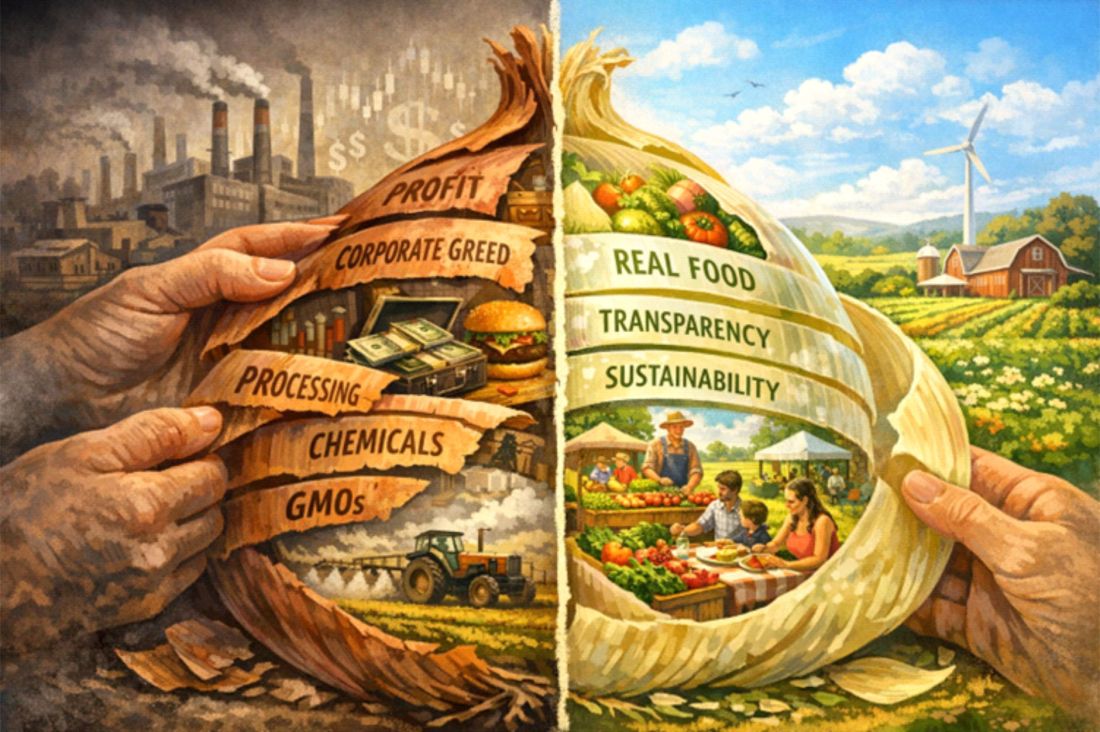
If you peel back the layers of the modern food system – and there are many – you find something that looks less like a chain and more like an onion. Each layer has its own priorities, its own incentives, and its own version of the truth.

Consumers sit at one end, often unaware of how little influence they actually have.

Farmers sit at the other, squeezed by contracts, pricing structures, and data‑driven demands that leave many earning less than the minimum wage.

Between them sit supermarkets, processors, manufacturers, financiers, corporations, lobbyists, and policymakers – each shaping what food becomes long before it reaches a plate.

The deeper you go, the clearer it becomes that the system isn’t designed around nourishment or resilience. It’s designed around profit, efficiency, and control. It rewards scale, not quality. It rewards processing, not simplicity. It rewards long supply chains, not local ones. It rewards products that can be standardised, preserved, transported, and marketed, not foods that come from soil, seasons, and skilled hands.

And because the system is so complex, so opaque, and so normalised, most people never question it. They assume that what’s available must be what’s best. They assume that if something is on a shelf, it must be safe. They assume that if it’s cheap, it must be efficient. They assume that if it’s everywhere, it must be food.

But assumptions are exactly what this system depends on.

A clearer way to understand what we eat

To reclaim the meaning of food, we need a way to talk about it that reflects reality rather than marketing. We need a simple, honest framework that anyone can understand – something that cuts through the confusion without judging or shaming.

Here is that framework.

1. Food

Food is something grown, raised, caught, or harvested. It resembles its original form when you eat it. It can be prepared in a home kitchen without needing industrial processes. It nourishes because it contains the nutrients nature intended. It comes from supply chains that can, in principle, be local, transparent, and accountable.

Food is vegetables, fruits, grains, pulses, fish, meat, eggs, milk, herbs, and the things made from them using traditional or minimally mechanised methods. It is bread made from flour, water, yeast, and salt. It is cheese made from milk and cultures. It is butter churned from cream. It is food that your great‑grandparents would recognise.

Food is the foundation of health, resilience, and vitality.

2. Food Products

Food products begin as food but go through processing that changes their form while still keeping them recognisable. They are the things that make everyday life easier: pasta, tinned tomatoes, yoghurt, cured meats, jams, pickles, and many baked goods.

They are processed, but in ways that could be done by hand, even if machines now do the work. They are not inherently harmful. They are part of a balanced, practical diet. They sit in the middle ground – not raw, not engineered, but still fundamentally food.

3. Edible Products

Edible products are not food in any meaningful sense, even though they are sold as if they are. They are engineered combinations of extracted ingredients, additives, preservatives, colourings, stabilisers, and chemicals that have been broken down, reassembled, and enhanced to create something that tastes good, lasts long, and maximises profit.

They are designed for shelf life, not health. For convenience, not nourishment. For addiction, not wellbeing.

They are the products that dominate the modern diet not because they are better, but because they are more profitable.

Once you see the difference between these three categories, you can’t unsee it. And once you understand it, you begin to understand why so many of the problems we face – from chronic disease to supply chain fragility – make perfect sense.

How edible products replaced food

This shift didn’t happen overnight. It happened slowly, through a series of small, seemingly harmless changes.

Supermarkets began to dominate the food landscape, offering convenience and choice while quietly reshaping the entire supply chain.

Processors and manufacturers expanded their influence, turning raw ingredients into products that could travel further and last longer.

Globalisation made it possible to source ingredients from anywhere, often at the expense of local producers.

Marketing convinced us that convenience was the same as value.

And as prices were squeezed, farmers were pushed into contracts that left them with little control over what they grew or how they grew it.

At the same time, the rise of ultra‑processing introduced a new kind of “food” – one that didn’t need seasons, soil, or skilled hands. One that could be made anywhere, from anything, as long as the final product tasted good and cost little.

The result is a food system where the most profitable products are the least nourishing, and the most nourishing foods are often the hardest to access.

This isn’t a conspiracy. It’s a consequence of incentives. But the effect is the same: edible products have crowded out food, and most people haven’t noticed.

The consequences we can no longer ignore

When a population eats mostly edible products, the consequences show up everywhere.

They show up in rising rates of obesity, diabetes, heart disease, inflammation, and chronic illness.

They show up in the strain on the NHS.

They show up in the loss of local farms, the decline of rural communities, and the erosion of food skills.

They show up in the fragility of supply chains that depend on global stability in a world that is anything but stable.

They show up in the growing number of people who rely on foodbanks, not because they mismanage money, but because wages no longer match the cost of living.

And they show up in the quiet, creeping loss of control over something as fundamental as what we eat – and therefore over our health, our independence, and our future.

A country that cannot feed itself is not secure.

A population that cannot access nourishing food is not healthy.

A society that cannot distinguish food from edible products is not informed.

And a system that treats food as a commodity rather than a necessity is not sustainable.

These are not abstract concerns. They are immediate, personal, and deeply human.

Reclaiming food: where change begins

Reclaiming food doesn’t mean rejecting modern life or romanticising the past. It means restoring clarity to a word that has been stretched beyond recognition. It means understanding the difference between food, food products, and edible products so that we can make informed choices. It means supporting local producers not out of nostalgia, but because they are essential to resilience. It means recognising that food security is not just about calories, but about nourishment, access, affordability, and independence.

It means asking better questions.

Where did this come from?

Who made it?

Could I make it myself?

Does it resemble its original form?

Is it nourishing?

Is it part of a resilient system, or a fragile one?

And it means accepting that the power to change the food system doesn’t lie only with governments or corporations.

It lies with communities, with growers, with families, with individuals who choose to understand what they are eating and why.

Reclaiming food is not a campaign. It’s a shift in perspective. Once you see the difference, you can’t go back.

The future we choose

We don’t need a new word for good food. We need to reclaim the word “food” and stop using it to describe edible products that undermine our health, our communities, and our future.

Food should mean nourishment.

Food should mean trust.

Food should mean resilience.

Food should mean independence.

Food should mean the flavour of life.

Once we reclaim the meaning, everything else becomes possible.
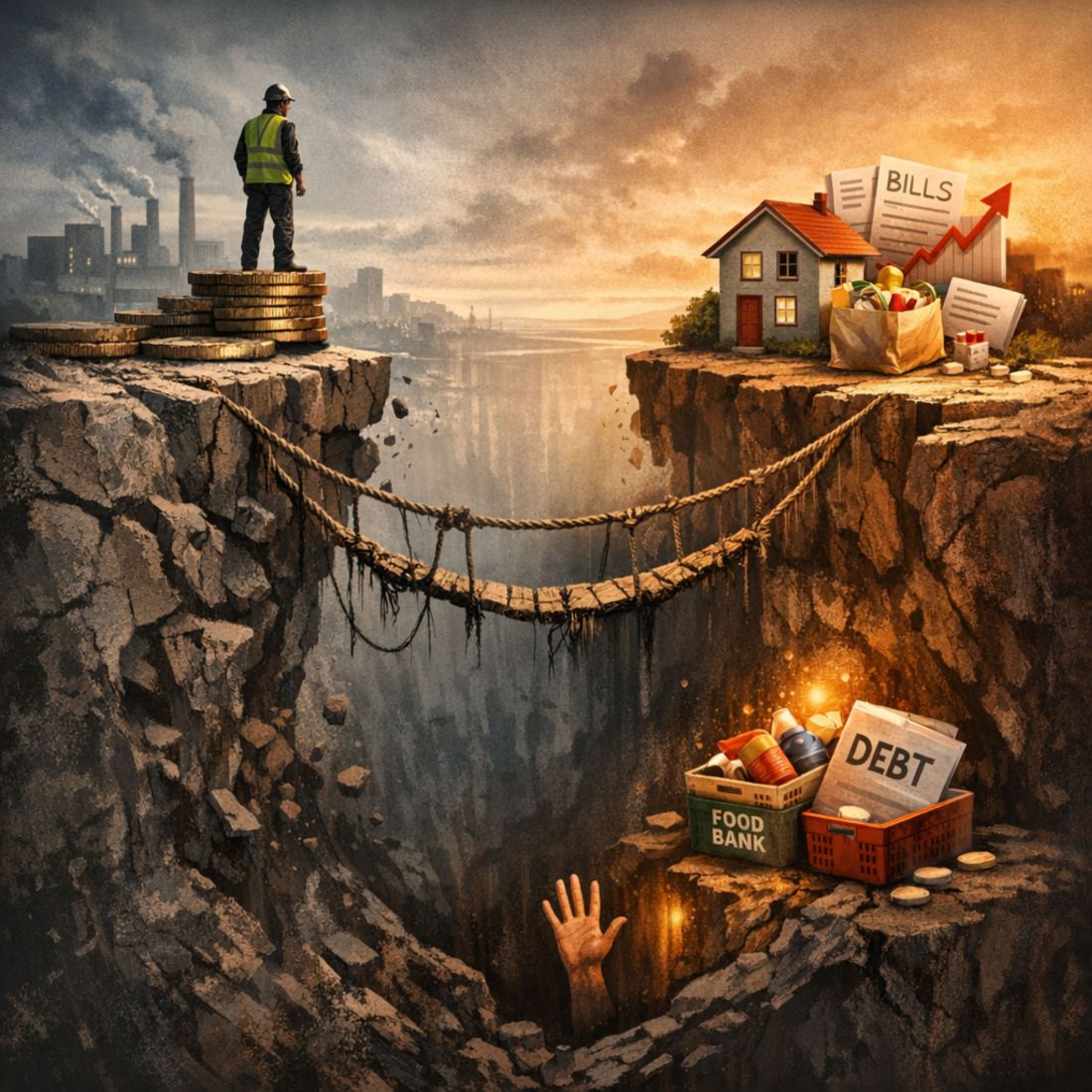
The Hidden Gap Driving Britain’s Benefits Crisis

The benefits crisis isn’t driven by idleness but by a widening gap between what work pays and what life costs. Until that hidden shortfall is acknowledged, the system will keep producing dependency – and blaming the people trapped in it.

Every few months, a familiar headline resurfaces: the benefits bill is spiralling. It’s costing more than defence, more than policing, more than many of the things politicians like to invoke when they want to sound serious about national priorities.

And the explanation offered to the public is always the same. Too many people aren’t working. Too many people are “choosing benefits”. Too many people are “economically inactive”.

It’s a simple story. It’s also the wrong one.

Because beneath the political theatre lies a far more uncomfortable truth:

Millions of people in Britain are working – often in demanding, low‑paid jobs – and still cannot afford to live without benefits, charity, or debt.

This isn’t a moral failure. It isn’t a behavioural problem. It’s a structural one. And until we acknowledge that, the benefits bill will keep rising no matter who occupies Downing Street.

The real cost of independence – and the myth of the minimum wage

The national minimum wage is often presented as a kind of moral floor: the lowest amount a person can legally be paid while still supposedly being able to live a basic, independent life.

But when you calculate the actual cost of living independently – rent, utilities, food, transport, clothing, and the unavoidable basics of modern life – the picture changes dramatically.

In a blog I published in October 2023, I calculated the Real Cost of Living Wage at £14 per hour for a 40‑hour working week. Updating that same calculation for today’s prices – driven primarily by rising rent, utilities, food, and transport costs – puts the figure at £14.92 per hour.

That’s the real price of independence within the money‑centric system we have today.

Not comfort. Not luxury. Just the ability to live without relying on benefits, charity, or debt.

Now compare that to the legal minimum wage – which is today set at £12.71. The gap isn’t a shortfall – it’s a chasm. And that chasm is where millions of people live.

The dependency nobody talks about

Here’s the part the national conversation consistently misses:

If wages don’t reach the Real Cost of Living Wage, then the benefits system isn’t a safety net – it’s a subsidy for low pay.

People in minimum‑wage jobs aren’t failing.

The system is failing them.

Yet the public narrative frames benefit claimants as if they’re all unemployed, unmotivated, or unwilling to work.

In reality, a significant proportion of Universal Credit claimants are already working. Many work full‑time. Many work in physically demanding, emotionally draining roles.

They’re doing everything society asks of them – and still can’t make ends meet.

That’s not a benefits trap.

That’s a wage trap created by the structure of the system itself.

Why people on benefits don’t rush into minimum‑wage jobs

Politicians often ask why someone on benefits doesn’t “just get a job”.
The answer is brutally simple:

Because a minimum‑wage job doesn’t lift them above the Real Cost of Living Wage.

It just changes the type of dependency.

Instead of relying entirely on benefits, they rely on:

  • benefits
  • charity
  • debt
  • and often, going without essentials

All while working in jobs where they’re treated as low‑value by employers and customers alike.

If taking a job doesn’t improve your life – and may even make it harder – the system is broken, not the person.

The political blind spot: the system needs dependency to function

This is the part that rarely gets said out loud.

If every employer were required to pay wages that met the Real Cost of Living Wage:

  • many low‑margin business models would collapse
  • profit extraction would shrink
  • prices would rise
  • the labour market would rebalance in favour of workers

In other words:

The money‑centric system we have today depends on wages being too low to live on.

And because wages are too low, the state steps in to fill the gap – not out of generosity, but out of necessity.

Without benefits, millions of workers simply couldn’t survive.

This is why governments of all colours avoid acknowledging the Real Cost of Living Wage or any term or form of words that would make this reality open and clear.

It exposes the contradiction at the heart of the system.

Why the benefits bill keeps rising

The benefits bill isn’t exploding because people have suddenly become lazy.

It’s rising because:

  • Living costs have surged
  • Wages haven’t kept up
  • More people are working in low‑paid, insecure jobs
  • Health‑related claims have increased sharply
  • The gap between wages and the Real Cost of Living Wage keeps widening

The system produces dependency faster than it reduces it.

And yet the public is encouraged to blame the people trapped in it.

The human cost of a misdiagnosed problem

When politicians misdiagnose a structural problem as a behavioural one, the consequences are predictable:

  • people in poverty are blamed
  • workers are shamed
  • the public is misled
  • the real causes go unaddressed
  • resentment grows
  • the benefits bill keeps rising

Meanwhile, the people stuck beneath the Real Cost of Living Wage – many of whom work incredibly hard – are framed as freeloaders.

It’s not just unfair.

It’s dishonest.

What would happen if everyone earned the Real Cost of Living Wage?

Here’s the irony:

If every job paid at or above the Real Cost of Living Wage:

  • many people on benefits would happily return to work
  • people in high‑pressure jobs might downshift to simpler roles
  • the labour market would stabilise
  • dependency would fall
  • the benefits bill would shrink

People don’t avoid work.

They avoid exploitation.

The truth we need to face

The benefits bill is rising because the economy relies on low wages and then blames the people who can’t survive on them.

Until we acknowledge the gap between the minimum wage and the Real Cost of Living Wage – the hourly rate required for independence in a 40‑hour week – nothing will change. Governments will keep blaming individuals. The public will keep resenting the wrong people. And the benefits bill will keep climbing.

This isn’t a story about laziness.

It’s a story about a system that no longer delivers independence through work.

And until we face that, we’ll keep treating symptoms while ignoring the cause.

The Illusion of Context

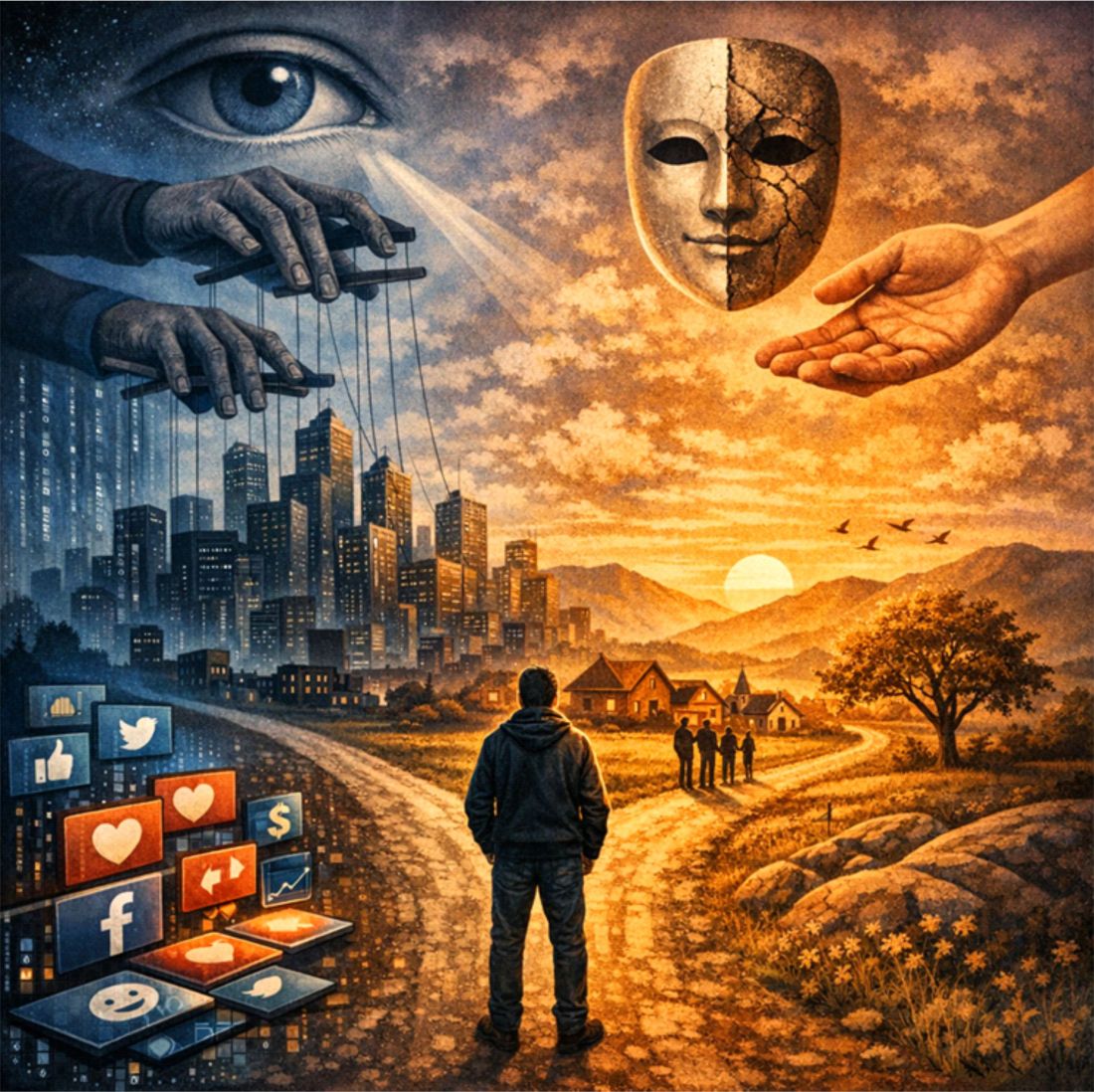
It is a regrettable truth of our age that we have drifted into a way of living where the default setting for life is no longer internal but external – where our sense of worth, direction, and even identity is increasingly determined by validation from sources far removed from our own lived experience.

The digital age has accelerated this shift dramatically. The more connected we appear to be, the more distant we become from our own sovereign power to choose, to interpret, and to understand the world on our own terms.

The consequences of this surrender are profound. By handing over our decision‑making power to systems and individuals we will never meet – people who operate at a distance so great that they cannot possibly understand the realities of our lives – we entangle ourselves in a money‑centric structure that not only encourages but demands this dependency.

Together, these forces shape a culture in which almost every problem we face can be traced back to the same root: we have allowed external systems to define the context of our lives.

The cleverest trick of these systems is the illusion they maintain – the persistent suggestion that we are the ones in control. We move through life believing we are making independent choices, when in reality the options available to us have already been pre‑selected, pre‑framed, and pre‑approved by the very structures we assume we are navigating freely.

We roll forward, unaware that our supposed autonomy is often nothing more than a curated pathway. We feel successful only when we meet criteria defined by others, and we feel like failures when we fall short of expectations we never set.

Worse still, the system punishes us for failing to conform to standards it created – standards that often set us up to fail from the outset. It is the system, and only the system, that defines what is considered “wrong”.

In this arrangement, context itself becomes centralised. The frame through which we are expected to understand life is set by someone – not a specific individual we can see or challenge, but a faceless centre of power that dictates norms, values, and truths.

Because conformity is rewarded and deviation is punished, everyone else becomes an enforcer. We are encouraged to look down on those who fall behind, to participate in the scorn that has become the default punishment for anyone who fails to keep up.

This is how centralised systems maintain control: not only through authority, but through the social pressure they cultivate among the people themselves.

Most people do not realise that in a centralised system, it is only those at the centre who get to decide what is acceptable, what is right, and what is true – even when their decisions are inherently wrong.

Their power is maintained only for as long as they can dictate the truth and prevent the real truth from being exposed: that they are fallible, that they are distant, and that they are often wrong precisely because they are so far removed from the realities they claim to govern. Yet they guard this power jealously, because their position depends on the illusion that their perspective is universal.

But context – real context – should never be defined from afar. Context should always be the immediate situation, the lived circumstances, and the human experiences of the people who are actually there. It should be grounded in the reality of those directly involved, not imposed by those who observe from a distance.

Yes, one could argue that if the centre makes the decisions, then that becomes the context for everyone else. But who in their right mind believes that the lives of millions, perhaps billions, should be shaped by the worldview, preferences, or limited understanding of a tiny number of people who cannot possibly grasp the complexity of every local reality?

The truth is simple: the only people who truly understand any situation are the people who are present within it.

That is what real context means. That is how life should be understood. Context is, and can only ever be, local.

Those who look in from the outside – whether they are policymakers, commentators, or strangers on social media – do not understand the context. They make judgements based on what they see, what they assume, or what they have been told. And because our culture has drifted so far from local understanding, these judgements often carry more weight than the lived experiences of the people directly involved.

This is where the principle of charity becomes essential. Once a foundational ethic in journalism and public discourse, it required us to interpret others’ words and actions in the most reasonable, humane, and generous way possible. It asked us to assume good faith unless proven otherwise. It encouraged us to listen before judging, to understand before condemning. But in the age of social media – an age defined by speed, outrage, and performative correctness – the principle of charity has all but disappeared.

Today, fewer people have the breadth of experience or the patience to give others the benefit of the doubt. Instead, we have entered a cultural moment where it is considered not only acceptable but virtuous to search for fault, to highlight error, and to amplify anything that can be framed as wrong.

We listen less to the human experiences of others and more to the narratives that reward judgement. We prioritise the appearance of correctness over the pursuit of understanding.

And so we find ourselves in a world where context is distorted, where judgement is detached from reality, and where the voices of those who are actually living the experience are drowned out by those who merely comment on it from afar.

If we are to rebuild a society that functions, we must reclaim context from the centre and return it to the people who live it. We must restore the principle of charity so that understanding can replace condemnation. And we must recognise that real truth – the kind that leads to wisdom rather than control – cannot be dictated from a distance.

Real context is local. Real understanding is human. And real agency begins only when we reclaim both.

Dynamic Food Pricing in a Time of Looming Shortages: Why the UK Must Pay Attention Now

There’s a shift taking place in the way food pricing is being discussed in the UK, and it’s happening at a moment when people are already under pressure.

Supplies are tightening, costs are rising, and households are having to make decisions they shouldn’t have to make about the basics.

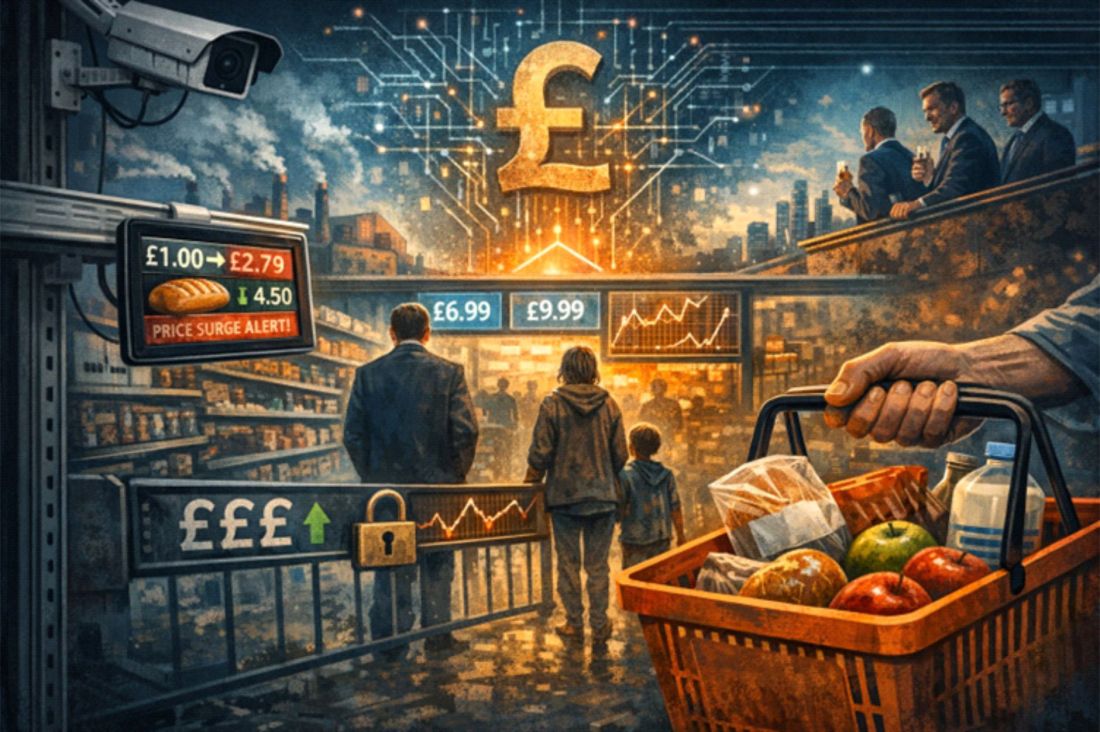
Against that backdrop, the idea of dynamic food pricing has begun to surface – not as a distant concept, but as something the system is quietly preparing for.

Supermarkets are not using dynamic pricing yet. That matters.

But the steps being taken now – by both retailers and institutions – show a direction of travel that deserves attention.

Because when food becomes scarce, pricing becomes a mechanism of control.

And when pricing becomes dynamic, access becomes selective.

The Bank of England Has Already Opened the Door

The clearest sign that this isn’t just a technical upgrade came from the Bank of England.

In recent comments, the Bank’s deputy governor explained that digitalisation has “radically reduced” the cost of changing prices, making rapid, algorithm‑driven pricing far more viable. The Bank also expects a significant share of UK businesses to adopt algorithmic pricing tools over the next few years.

This isn’t a supermarket experiment.

It’s being framed as the natural evolution of retail by the institution responsible for overseeing the economy.

When the central bank normalises a practice, it sets the tone for the entire system.

It tells businesses: this is acceptable.

It tells regulators: this is expected.

And it quietly signals to the public that the rules are changing.

Supermarkets Are Installing the Infrastructure

While supermarkets insist they are not using dynamic pricing, they are installing the technology that would make it possible.

Digital shelf labels – the small electronic screens replacing paper price tags – are being rolled out across the major chains. Morrisons is fitting them in every store. ASDA has installed them in hundreds of Express branches. Co‑op has already fitted more than 700 stores and plans to expand to over 2,300. Tesco, Sainsbury’s and Lidl are all trialling or testing the same systems.

Digital labels are not dynamic pricing. But they are the mechanism through which dynamic pricing can be implemented instantly, centrally, and without fanfare.

When asked directly whether they intend to use dynamic pricing in future, most supermarkets simply refuse to answer.

That silence is more revealing than any denial.

The Petrol‑Price Pattern: A Real‑World Example of What Dynamic Pricing Looks Like

If you want to understand how dynamic pricing behaves in practice, you don’t need to imagine futuristic scenarios. You only need to look at petrol.

When the price of crude oil rises, petrol prices at the pump rise almost immediately.

When crude oil falls, the price at the pump drops slowly – sometimes painfully slowly.

That difference between how fast prices rise and how slowly they fall is profit. And it’s a perfect example of how dynamic pricing works in the real world.

It responds instantly when it benefits the retailer.

It responds slowly when it doesn’t.

Now apply that logic to food – not in the extreme sense of prices changing while something is in your trolley, but in the far more realistic sense of prices changing at different times of the day, or rising during peak demand, or increasing when shortages make certain items more sought‑after.

This is the real concern.

Not science‑fiction scenarios, but the everyday reality of prices shifting in ways that quietly push the most vulnerable out of affordability.

Shortages Change the Meaning of Dynamic Pricing

Dynamic pricing during abundance is one thing.

Dynamic pricing during scarcity is something else entirely.

When food is limited, prices that move with demand don’t protect people – they prioritise those who can afford to absorb the rises.

The people who need the basics the most are the ones most likely to be priced out, not because there isn’t enough food to meet need, but because meeting the wants of those who can pay more is more profitable.

This is the heart of the issue.

Dynamic pricing doesn’t ration food.

It rations access.

And it does so based on wealth, not need.

The Context: How We Reached This Point

Dynamic pricing isn’t appearing in a vacuum. It’s emerging after years of subtle shifts in how food is priced and presented – shifts that have already eroded trust and stability.

Shrinkflation has quietly reduced the size of products while prices stay the same or rise. A 250g block of butter becomes 200g, and the packaging barely changes. People notice, but the explanation is always the same: inflation, supply chains, global events.

Loyalty‑card‑only pricing has created a two‑tier system where the “real” price is only available if you hand over your data. If a supermarket can afford to sell something at the loyalty price, that’s the price – with their profit margin. The higher price is simply a penalty for not participating in the data‑collection model – a form of everyday surveillance capitalism.

And then there are the offers that aren’t really offers, the discounts that only apply to certain sizes, the prices that seem to shift more often than they used to. All of this creates a sense of instability that people feel long before they can articulate it.

Recognising all of this isn’t about treating people like they can’t or don’t understand what’s happening.

It’s about acknowledging that they’ve been living through these changes for years – often without anyone naming them plainly.

Where Things Actually Stand

Regrettably, it would be easy to jump to many conclusions with the evidence that is already unfolding in plain sight. However, the picture to day is as follows:

  • Dynamic pricing is not currently being used on food in UK supermarkets.
  • The technology that would allow it is being rolled out.
  • The Bank of England has framed algorithmic pricing as part of the future.
  • Supermarkets have not ruled out using it.
  • Oversight and regulation are unclear.

And all of this is happening as we head into what is likely to become a period of shortages too.

This isn’t speculation.

It’s the landscape.

This Is About Awareness, Not Alarm

People don’t need to be told how to think about this.

They simply deserve to know what’s happening – and what could happen next.

Dynamic pricing isn’t here yet.

But the system is being shaped around it.

And in a time of shortages, that shift has consequences that go far beyond technology.

It affects access, fairness, and the basic principle that essential goods should not become a bidding war.

Further Reading:

The themes explored in this article – food access, control, systemic fragility, and community resilience – sit within a wider body of work examining how power, scarcity, and stability are managed during periods of transition.

The pieces below are ordered to take the reader from structural analysis, through systemic alternatives, to practical personal and community responses. Together, they provide political, philosophical, and lived‑reality context for why dynamic food pricing matters – and what can be done instead.

1. Who Controls Our Food Controls Our Future

Link: https://adamtugwell.blog/2024/11/14/who-controls-our-food-controls-our-future-full-text/

What it is:
A foundational essay examining food as a lever of social and political power rather than a neutral commodity.

What it covers:
This piece explores how control over food systems – production, distribution, pricing, and access – has historically been used to shape populations, enforce compliance, and concentrate power. It looks at corporate consolidation, supply‑chain fragility, and the quiet erosion of food sovereignty, framing food control as a central pillar of modern governance and social stability.

Why read it first:
It establishes the core argument that underpins concerns about dynamic pricing: that access to food is never just economic – it is fundamentally political.

2. Foods We Can Trust: A Blueprint for Food Security and Community Resilience in the UK

Link: https://adamtugwell.blog/2025/12/15/foods-we-can-trust-a-blueprint-for-food-security-and-community-resilience-in-the-uk-online-text/

What it is:
A systems‑level proposal for rebuilding food security outside fragile, opaque, and extractive corporate models.

What it covers:
This work outlines how trust has been eroded within the UK food system through long supply chains, farmer pressure, profit‑driven practices, and lack of transparency. It then sets out principles for a more resilient alternative – rooted in local production, shorter supply chains, fairness, and community participation.

Why it follows:
After identifying the problem of control, this piece begins to articulate what a healthier food system could look like.

3. A Future of Communities: Building the New World Without Oil, Manipulated Money, and Centralised Control

Link: https://adamtugwell.blog/2026/03/27/a-future-of-communities-building-the-new-world-without-oil-manipulated-money-and-centralised-control-full-text/

What it is:
A broader societal vision that situates food systems within energy, finance, governance, and community resilience.

What it covers:
This article examines how over‑centralisation, financial abstraction, and energy dependency create systemic fragility – and argues for decentralised, human‑scale alternatives. Food, alongside energy and local production, is treated as a cornerstone of resilient communities rather than a profit‑optimised commodity.

Why it matters here:
It places the issue of dynamic pricing within a much wider pattern of centralised control and automation, showing that food pricing is one symptom of a larger structural trajectory.

4. A Practical Guide to Surviving and Thriving Through Uncertain Times: Staying Calm, Prepared, and Connected

Link: https://adamtugwell.blog/2026/03/28/a-practical-guide-to-surviving-and-thriving-through-uncertain-times-staying-calm-prepared-and-connected/

What it is:
A grounded, accessible guide focused on personal and community resilience during periods of instability.

What it covers:
Rather than analysing systems, this piece addresses how individuals and communities can respond emotionally, socially, and practically to volatility. It explores preparedness without panic, the importance of social connection, and how to maintain agency when external systems become unpredictable.

Why it comes last:
After understanding the systems and the alternatives, this piece brings the discussion back to lived reality – what people can do now to remain stable, connected, and resilient.