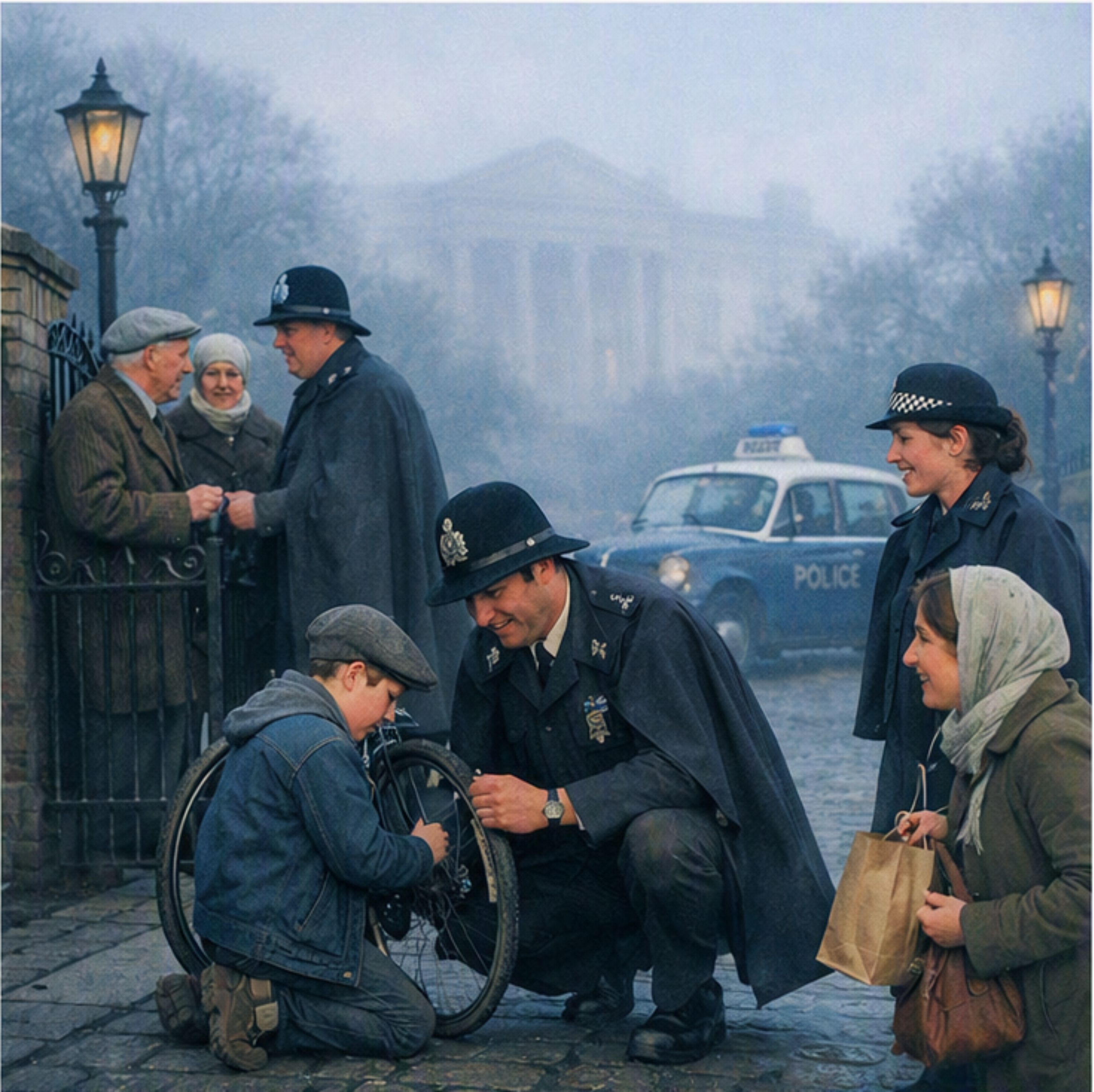

Policing in the United Kingdom has been steadily weakened. Not because officers have lost capability or commitment, but because the system has changed what officers are allowed to be.
The purpose of a police officer is not simply to enforce the law, but to apply it intelligently, ethically, and proportionately within the reality of human situations. Law and order has always depended on that distinction. The existence of a rule may make something legal, but it does not automatically make every possible application of that rule moral, wise, or right.
Over several decades, policing has been reshaped by managerial oversight, academic credentialism, and an increasingly pervasive measurement culture. These forces have stripped away the human foundations of policing: discretion, judgement, lived experience, and the confidence to act in context.
The result is a police service that too often appears hesitant, procedural, and disconnected — not because officers lack courage, but because they are no longer trusted to act as human beings in real situations.
When Policing Was Human
For much of the twentieth century, policing in Britain was built on discretion. A constable was expected to interpret the law in context, using judgement shaped by training, experience, and the realities of what they had actually seen. It was not perfect. No human institution ever is. But it was recognisably human.
My father served as a constable in Gloucestershire through the 1960s and early 1970s. His stories described a policing culture that was firm but fair, disciplined but flexible.
Officers trained in environments closer to military boot camps than modern lecture halls. They were expected to understand both the technical and practical aspects of the law deeply enough to arrest someone one evening and, in some circumstances, prosecute the case in magistrates’ court the next morning.
More importantly, they were trusted. A young person caught doing something foolish might be taken home rather than charged. Parents accepted responsibility. Officers used embarrassment, honesty, and human connection to turn people away from trouble at the very moment when a formal process might have pulled them further into it.
That kind of judgement is difficult to codify because it depends on context: who is involved, what has happened, what harm has been caused, what risk remains, and what response is most likely to restore order rather than simply record a breach.
Communities understood that policing was not merely the enforcement of rules, but the application of judgement. This was policing as a human endeavour — rooted in lived experience, not abstract theory alone.
The Slow Cultural Shift
The shift away from this human-centred model did not happen suddenly. It was not caused by one scandal, one reform, or one generation of policy-makers. It was the cumulative effect of decisions that gradually replaced discretion with oversight and professional trust with managerial control.
One early turning point was the late-1970s corruption investigation known as Operation Countryman. It exposed serious wrongdoing within parts of the Metropolitan Police and City of London Police, and it understandably shook public confidence.
But its deeper significance was cultural. Operation Countryman did not create managerial policing by itself, nor should the response to corruption be dismissed. Accountability matters. The problem was that the lesson gradually drawn from such moments was not simply that wrongdoing must be exposed, but that discretion itself was dangerous.
From there, a managerial instinct hardened. Procedures multiplied. Frameworks expanded. The constable’s traditional independence — the ability to interpret the law in context — was gradually narrowed. By the early 2000s, policing was increasingly shaped by administrative logic rather than operational reality.
Credentialism and the Decline of Experience
The introduction of degree-level entry for all police officers, announced in 2016, marked a decisive moment in this shift. I wrote at the time that the reform was a retrograde step — not because academic education has no value, but because it risked misunderstanding what policing actually is.
Policing is fundamentally a human profession. It can benefit from knowledge, study, and reflection, but it cannot be reduced to an academic pathway or a credentialing exercise.
A good police officer needs more than formal qualification. They need life experience, street sense, emotional intelligence, the ability to read people, the ability to de-escalate, and the ability to understand a community from the inside.
These qualities cannot be fully developed in a lecture theatre alone. They cannot be adequately measured by an instruction. They cannot be captured completely in a competency framework.
The danger of academic credentialism is not simply that it changes recruitment routes. It risks narrowing the idea of who is suitable to police. It may discourage people who would make exceptional officers: people who grew up in the communities they would serve, who understand real-world behaviour, who know what trouble looks like before it happens, and who can speak to people in a way that diffuses tension rather than escalates it.
These are precisely the people policing needs. Yet in a system increasingly governed by measurable credentials, their strengths are too easily overlooked.
The reason is simple: a degree is measurable, but life experience is not. Street judgement, moral courage, human presence, and the ability to calm a situation before it becomes a crime do not fit comfortably into institutional spreadsheets. What cannot be measured is quietly devalued.
Measurement Culture and the Dehumanisation of Policing
Measurement culture, which I wrote about in 2024, has dehumanised public life more broadly. It replaces meaning with metrics, treats human systems as mechanical systems, and prioritises what can be counted over what actually matters.
Applied to policing, measurement culture turns encounters into data, decisions into tick-boxes, officers into operators, and communities into sets of indicators. It does not merely record policing; it begins to shape what policing is allowed to become.
This is anti-human because it treats people as data points. It is anti-life because it treats communities as systems to be managed rather than relationships to be understood. And it is anti-policing because it pushes judgement, empathy, and context to the margins.
Measurement culture is the final stage of bureaucratic policing. It is the point at which a human profession is recast as a performance-managed system, where the safest decision is often the one that best satisfies the process rather than the one that best serves the public.
The Cumulative Effect
The weakening of modern policing is not the result of one decision. It is the cumulative effect of reforms and institutional habits that removed humanity from the system piece by piece.
Oversight expanded after corruption scandals. Managerialism became embedded. Academic credentialism formalised bureaucratic policing. Measurement culture increasingly displaced professional judgement.
The result is a police service that can hesitate when it needs confidence, fear error when it needs judgement, prioritise process over outcome, follow frameworks rather than context, and lose public trust because it no longer feels trusted internally.
This is not primarily the fault of officers. It is the consequence of policy choices that have steadily treated professional agency as a risk to be contained rather than a competency to be cultivated.
Restoring Policing as a Human Institution
If policing is to be restored as an effective public institution, policy must reverse the reforms and assumptions that dehumanised it. Discretion must once again be recognised as a core professional competency. Mandatory degree-level entry should be removed so that policing can draw on the full breadth of human experience, not just academic attainment. Measurement-driven policing must be reduced so that officers are judged by the quality of their decisions, not merely the quantity of their data. Oversight should support officers rather than constrain them. Above all, policing must be re-humanised.
Every policy should be tested against a simple question: does this make policing more human, or less? Does it help an officer apply the law wisely in a real situation, or does it merely make the system easier to audit from a distance?
Policing requires judgement, empathy, courage, restraint, and the ability to interpret the law in real time, in real places, with real people. The weakening we see today is not because officers have changed. It is because the system has changed what officers are allowed to be.
A police service can be accountable without becoming bureaucratic, educated without becoming credentialist, and professional without becoming mechanistic. The challenge now is to recover that balance.
If discretion, judgement, and trust are not restored, policing risks becoming ever more efficient at managing procedures while becoming less effective at serving people.
Agency is not a luxury in policing. It is the foundation.
Further Reading
Tugwell, A. (2016). Degree‑level entry for all police officers is a retrograde step. https://adamtugwell.blog/2016/12/22/degree-level-entry-for-all-police-officers-is-a-retrograde-step-which-will-push-a-common-sense-approach-to-policing-even-further-away-down-the-bureaucratic-queue/
Tugwell, A. (2024). If you can measure it, you can control it. https://adamtugwell.blog/2024/02/05/if-you-can-measure-it-you-can-control-it-has-gdp-been-the-most-dehumanising-tool-that-humanitys-so-called-leaders-have-ever-created/
Background on Operation Countryman (1978–1982), the major corruption inquiry into the Metropolitan Police and City of London Police – a moment often noted by writers such as Peter Hitchens as an early sign of the cultural shift that would later reshape British policing.

