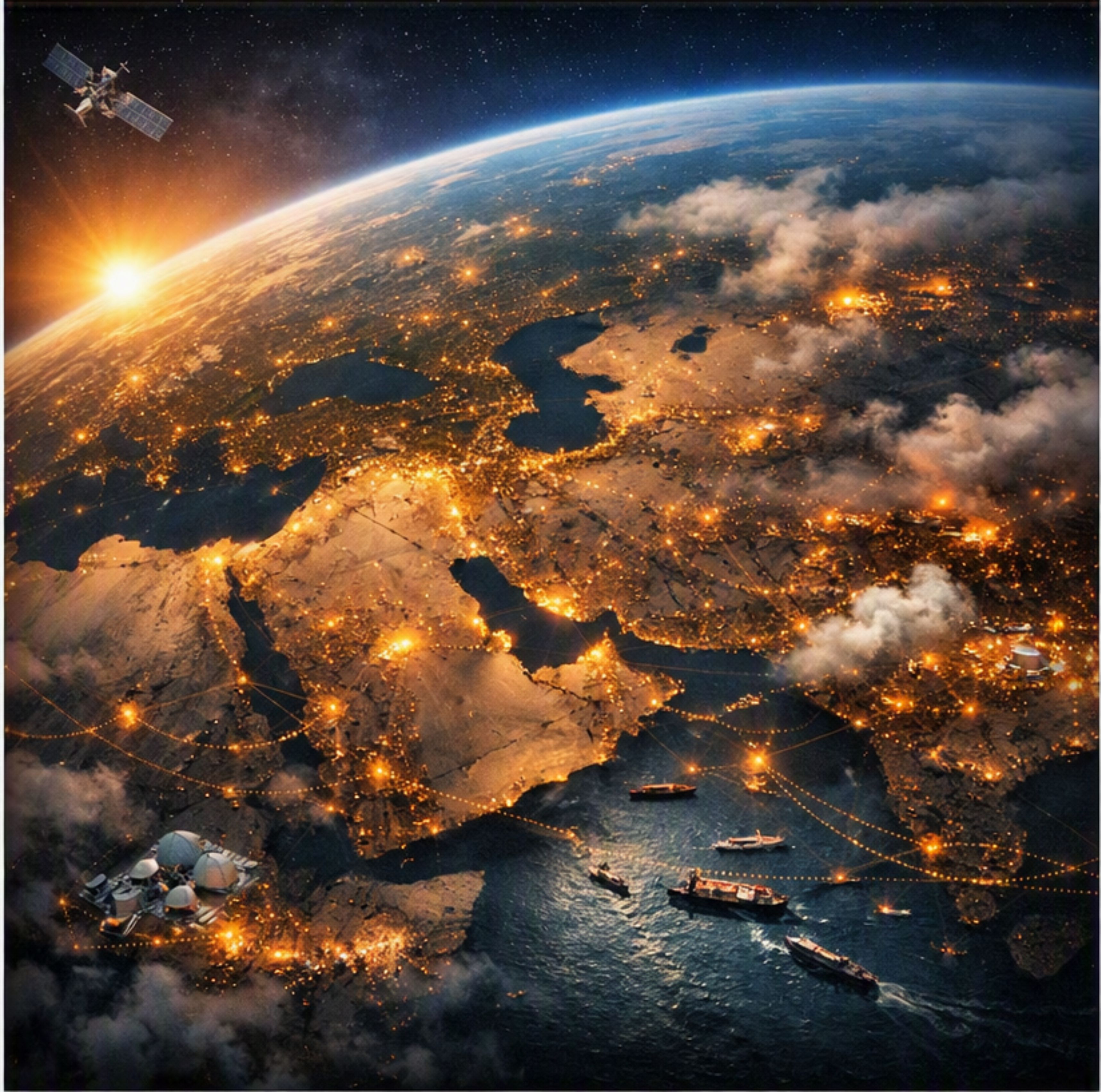

By late August 2026, one uncomfortable reality has become difficult to ignore: artificial intelligence is no longer a separate technological frontier. It has become part of the operating system of the modern world.
AI now helps route goods, price risk, support medical decisions, balance electricity grids, administer public services, and analyse military threats. It is no longer sitting outside society, waiting to be adopted. It is already inside the machinery.
At the same time, the world around it has become more fragile. Energy markets are volatile. Supply chains are stretched. Debt levels are high. Geopolitical tensions are escalating. Climate pressure is increasing. Political trust is weakening.
The result is a new kind of risk. It does not flow in one direction.
AI can be weakened by a breakdown in the world that supports it. The world can also be weakened by a breakdown in the AI systems it has begun to depend on.
This is circular fragility: a situation in which two systems become so dependent on each other that stress in either one can travel back through the other.
This is not a prediction of doom. It is a description of a structural vulnerability that is already taking shape.
The AI Industry Is Built on a Story It Can No Longer Fully Sustain
The public story of AI has been one of unstoppable progress: bigger models, smarter systems, faster adoption, and ever-larger investment.
Underneath that story, however, the economics are far less settled. AI is not software in the old sense: cheap to copy, easy to distribute, and inexpensive to run once built.
Modern AI depends on vast physical infrastructure: specialised chips, data centres, cooling systems, electricity, network capacity, and a continuous pipeline of capital. The International Energy Agency has warned that electricity demand from data centres could more than double by 2030, with AI a major driver of that growth.
That matters because the cost of serving AI does not disappear once a model has been trained. Inference-the everyday process of answering prompts, analysing documents, producing images, writing code, or running agents-continues every hour of every day. As more people use AI for heavier tasks, the running cost compounds.
Yet the price users see is often moving in the opposite direction. Subscription fees are capped. Token prices fall. Free access is used to win market share. Enterprise buyers are becoming more cautious. Open-source competitors are improving rapidly. The gap between what AI costs to provide and what many users are willing or able to pay remains one of the unresolved questions at the heart of the industry.
For now, that gap is being bridged by investment capital, strategic subsidy, government interest, and the expectation that scale will eventually make the whole system profitable. That may prove true. But it is not guaranteed.
The industry is therefore not held together by economics alone. It is held together by a story: that costs will fall, demand will keep rising, investors will remain patient, and infrastructure will arrive quickly enough to support the next wave of use.
Stories can be powerful. They can mobilise money, talent, and political support. But stories are not foundations. When the real-world conditions beneath them change, belief can turn very quickly from fuel into fragility.
The Coming Affordability Crisis
There is another weakness in the AI business model that receives far less attention than energy costs or infrastructure spending: the ability of customers to keep paying for it.
Most discussions of AI economics focus on the supply side. They ask whether providers can continue funding data centres, buying chips, securing energy, and training larger models.
The demand side is discussed far less often.
Yet the same pressures destabilising the wider global economy are also reducing the ability of households, businesses, and governments to spend freely on AI services.
If energy prices rise, disposable income falls.
If food prices rise, discretionary spending falls.
If debt costs rise, corporate investment falls.
If governments face fiscal pressure, technology budgets come under scrutiny.
If businesses enter a recession, experimentation is often one of the first expenditures to be reduced.
AI is frequently presented as a productivity tool that organisations cannot afford to ignore. In many cases that is true. But there is a significant difference between recognising the value of a technology and having the financial capacity to deploy it at scale.
This creates a second economic squeeze.
On one side, AI providers face rising costs from energy, infrastructure, hardware, cooling, and financing.
On the other side, customers face rising costs from food, fuel, housing, wages, debt servicing, insurance, and economic uncertainty.
The result is a narrowing zone in which both sides can remain financially viable.
The assumption underlying much of the current AI boom is that adoption will continue rising quickly enough to compensate for these pressures. That assumption may prove correct. But it depends on a world in which businesses, consumers, and governments retain the financial freedom to spend on new technology even as other essential costs rise.
If that freedom disappears, the consequences for AI could be profound.
A technology that is expensive to provide and increasingly difficult to afford finds itself trapped between two forms of scarcity: the scarcity of capital needed to produce it and the scarcity of money available to consume it.
That is not merely a technology problem.
It is a systemic problem.
AI Has Become Load-Bearing Before Becoming Stable
The deeper problem is not simply that AI is expensive. It is that AI is becoming important before it has become fully resilient.
Across only a few years, AI has moved from experiment to infrastructure. It now supports warehouse scheduling, fraud detection, medical triage, customer service, software development, energy forecasting, military analysis, and government administration. In many places it is not replacing whole systems outright, but it is becoming part of how those systems make decisions and manage pressure.
That distinction matters. A society does not need to hand total control to AI for AI dependency to become dangerous. It only needs to remove enough human capacity, manual fallback, institutional memory, and spare time that operating without AI becomes slower, more expensive, and more chaotic.
AI remains powerful but uneven. It can be brilliant in one moment and unreliable in the next. It still hallucinates. It still depends on enormous computational resources. It still relies on tightly concentrated chip supply chains and cloud infrastructure. It can fail because of model error, power shortage, cyberattack, policy restriction, financial stress, or simple outage.
This creates the first direction of fragility. If AI availability suddenly contracts, the immediate effect may not be dramatic collapse. It may be delay, confusion, degraded service, rising cost, and poor decisions made under pressure. But in highly optimised systems, those small failures can compound quickly.
The danger is not that every system stops at once. The danger is that systems already running with little slack become less able to absorb shock.
The World Around AI Is Now Too Fragile to Support It
The second direction of fragility runs the other way. AI depends on a world that looks increasingly unable to guarantee the conditions AI requires.
AI needs cheap and reliable electricity. It needs specialised chips, servers, fibre networks, water, cooling equipment, skilled technicians, stable regulation, patient investors, and global logistics. It also needs public permission: the willingness of societies to allow such systems into sensitive areas of life.
None of these supports is guaranteed. Energy grids are under pressure. The supply of advanced chips remains geopolitically sensitive. Data centre growth is beginning to compete with other electricity needs. Public trust is fragile. Capital is abundant only as long as investors believe the returns will justify the cost.
This is why AI could falter even without a spectacular technical failure. A spike in energy costs, a shortage of transformers, a restriction on chips, a credit squeeze, a major cyber incident, or a loss of political legitimacy could all limit AI’s availability long before the models themselves stop improving.
AI is therefore fragile in two ways: internally, because it is still technically and economically immature; externally, because it rests on a world whose own foundations are under strain.
Hormuz Is Where the Abstract Becomes Immediate
The Strait of Hormuz is not a theoretical example. It is where the abstract argument about circular fragility becomes immediate. By late August 2026, pressure around this narrow corridor is no longer a distant possibility but an active stress running through energy, transport, food, finance, and politics.
In normal conditions, roughly a fifth of global oil supply moves through or depends on Hormuz. The corridor also matters for liquefied natural gas, fertiliser inputs, shipping insurance, and the confidence that global markets can keep moving even under pressure. When stress builds there, it does not stay there.
The pressure did not suddenly appear at the end of the summer. It has been accumulating since the escalation involving Iran at the end of February 2026. What followed was not a clean, visible rupture, but something harder to read: disruption, adaptation, reserve use, rerouting, higher risk premiums, and gradual depletion of buffers. The absence of an obvious public crisis has encouraged the impression that the danger has passed. That may prove to be a serious misreading.
Markets and governments can absorb shocks for a time. Strategic reserves can be released. Inventories can be drawn down. Traders can reroute supply. Prices can be smoothed by policy, subsidy, hedging, and delayed pass-through. But those mechanisms do not remove the stress. They move it, hide it, or postpone it. That matters because a system can look stable at the surface while becoming less resilient underneath.
Diesel is one of the clearest transmission points. It is not simply another fuel. It powers freight, farming machinery, construction, mining, generators, emergency logistics, and much of the heavy physical economy. When diesel becomes short, goods move more slowly, production costs rise, and prioritisation becomes unavoidable. The effect is not confined to petrol stations. It spreads through everything that has to be grown, mined, built, shipped, refrigerated, or repaired.
Behind that energy story sits an agricultural one. Fertiliser supply has already been under pressure, and Australia is one of the places where that pressure matters visibly. Australian grain growers have been forced to make planting and fertiliser decisions under conditions of high cost, uncertain supply, and strained logistics. Those decisions have long lead times. Reduced fertiliser use or reduced planting today does not fully show up today. It shows up later, in lower yields, lower quality, tighter export markets, and higher food prices.
This is why the threat of El Niño matters so much. Specialists are already watching key breadbasket regions because El Niño can shift rainfall, increase heat, intensify drought, disrupt monsoons, and damage harvests. In ordinary conditions, the global food system might absorb some of that stress. But El Niño arriving on top of high fuel costs, constrained fertiliser, disrupted trade routes, and reduced planting decisions is a different proposition.
The risk is not simply that food becomes more expensive. The risk is that parts of the world face genuine food supply disruption in 2027, including famine conditions in the most vulnerable regions. Wealthier countries are not immune. They are less likely to experience famine, but they can still experience shortages, rationing pressure, panic buying, political backlash, and sharp cost-of-living shocks. In a tightly connected food system, scarcity does not respect the old distinction between stable and unstable regions as neatly as many people assume.
For AI, this matters profoundly. AI cannot be separated from the price of electricity, the availability of diesel, the delivery of hardware, the stability of agricultural systems, or the spending power of households, firms, and governments. A food and energy shock does not merely make daily life harder. It compresses the economic space in which AI companies can operate and in which customers can afford to use them.
Hormuz may not be the first domino to fall visibly, and it may not be the decisive one. But it shows the shape of the danger. A geopolitical shock becomes an energy shock. An energy shock becomes a fertiliser shock. A fertiliser shock becomes a food shock. A food shock becomes an inflation, debt, budget, legitimacy, and demand shock. By the time the pressure reaches AI, it has already passed through the systems AI depends on and the customers AI expects to serve.
The Objection: Would AI Really Matter That Much?
A fair objection is that this argument can sound exaggerated. If major AI services disappeared tomorrow, aircraft would not fall from the sky, hospitals would not instantly close, and governments would not cease to exist. Most important institutions still have people, procedures, and legacy systems.
That is true. The issue is not instant collapse. The issue is declining resilience. As organisations design workflows around AI, they may quietly reduce the human capacity needed to operate without it.
Manual processes atrophy. Expertise leaves. Teams shrink. Decisions accelerate. Expectations rise. The fallback still exists on paper, but becomes weaker in practice.
That is how dependency forms: not through one dramatic handover, but through a thousand small conveniences that become assumptions.
Collapse Can Now Flow Both Ways
This is the key point. The risk is no longer simply that AI might fail, or that the world might become unstable. The risk is that each now makes the other more vulnerable.
A global shock can weaken AI by disrupting energy, capital, hardware, logistics, or political support. An AI shock can weaken the global system by degrading the tools now used to manage complexity, reduce cost, allocate resources, and make decisions at speed.
This is what makes circular fragility different from ordinary risk. Ordinary risk asks what happens if one part breaks. Circular fragility asks what happens when the backup system is also dependent on the thing that is breaking.
In that kind of environment, capability is not enough. Resilience matters more.
What We Can Still Save
The good news is that protecting AI does not mean defending the current model at all costs. It may mean letting go of the most fragile version of AI: the centralised, high-compute, high-energy, heavily subsidised model that has dominated the public imagination.
What survives under stress will be the AI that can keep working when conditions are imperfect.
If energy is constrained, the useful model is low-energy and local. If finance tightens, the useful model is smaller and cheaper to maintain. If geopolitics fractures supply chains, the useful model is open, sovereign, and repairable. If public trust declines, the useful model is transparent, accountable, and clearly subordinate to human judgement.
In every scenario, the direction is the same: less centralisation, less dependence on endless scale, more local capacity, more human oversight, and more attention to the conditions under which technology can continue to function during stress.
This is not a smaller vision of AI. It is a stronger one. A tool that communities can understand, govern, repair, and afford is more valuable in a crisis than a spectacular system that only works when everything else is stable.
A Wake‑Up Call, Not a Warning
This is not an argument against AI. It is an argument for saving the parts of AI worth having.
The current AI boom is built on scale, speed, and belief. Those forces have produced remarkable progress. But they have also encouraged a dangerous assumption: that the world will remain stable enough to support ever-larger systems, and that those systems will remain available enough for the world to depend on them.
That assumption no longer looks safe. The future of AI should not be measured only by model size, benchmark scores, or computing power. It should be measured by whether AI can make societies more capable when energy is expensive, supply chains are disrupted, institutions are under pressure, and people need tools they can trust.
The key question is no longer whether AI is powerful. It is whether the systems that depend on AI can remain resilient when AI itself depends on increasingly fragile energy, financial, political, and logistical foundations.
Once dependence runs both ways, resilience becomes more important than capability.
The future will belong not to the biggest systems, but to the systems that can survive shock.


5 thoughts on “The Age of Circular Fragility | Why AI and the World Economy May Now Rise and Fall Together”