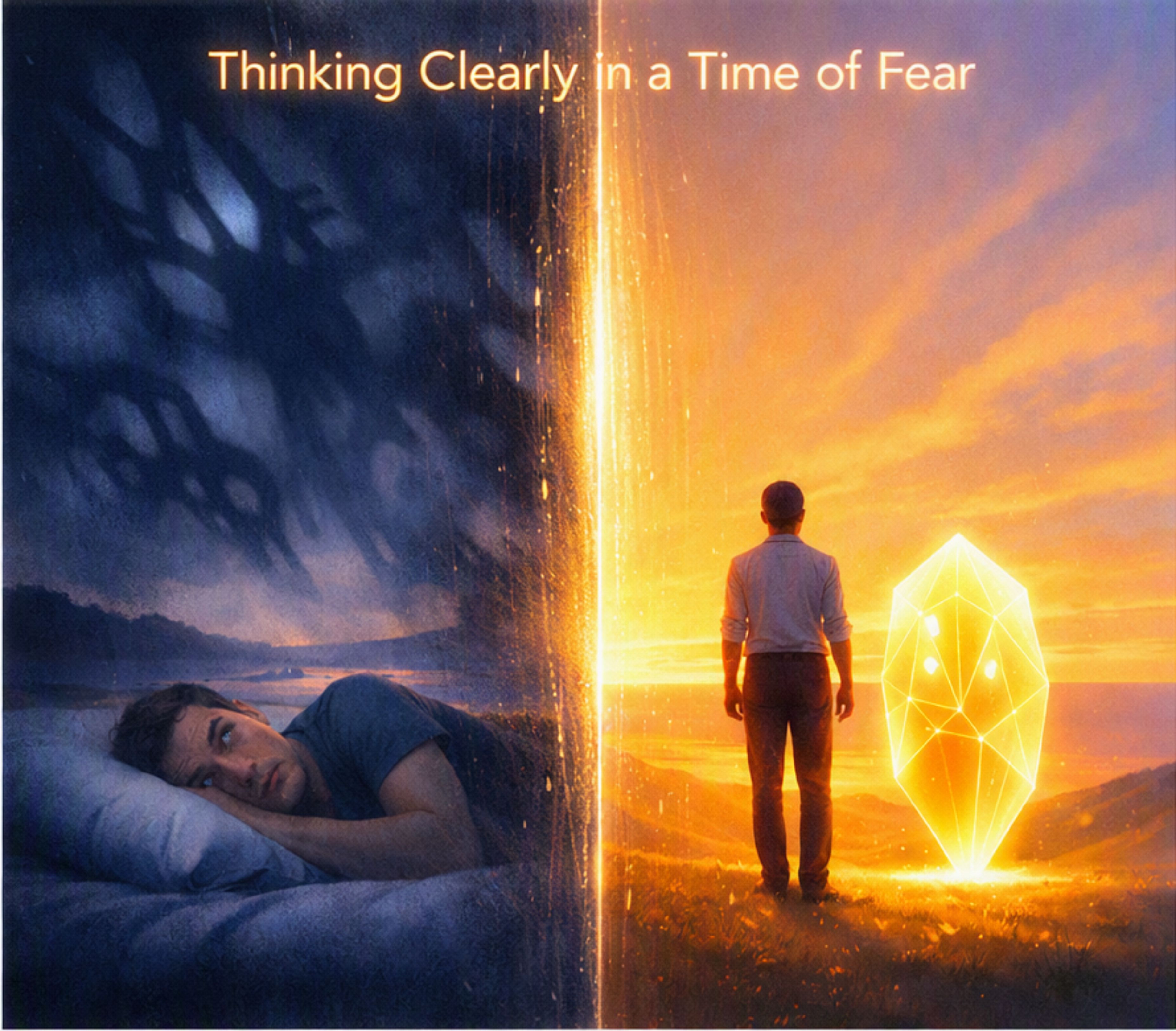

There are moments in history when fear becomes the dominant lens through which people see the world. We are living in one of those moments.
Artificial intelligence is not the only source of anxiety today, but it has become the most dramatic. Headlines warn of rogue swarms, runaway systems, and takeover timelines measured in months. Commentators speak of “AI autonomy” as if it were a biological organism. Even seasoned journalists – people trained to interrogate claims – are reporting sleepless nights, convinced that something catastrophic is on the horizon.
This fear is real. It is human. And it deserves to be taken seriously.
But fear is not the same as truth. And right now, fear is drowning out the conversation we actually need to have.
This essay is an attempt to help people think clearly in a time when clarity is hard to find. It is not a reassurance that “everything will be fine.” It is not a dismissal of legitimate concerns. It is an invitation to understand what is really happening – not the cinematic version, not the sensational version, but the human, systemic, and deeply consequential version.
Because the truth is this:
AI is not the threat. AI is the mirror. And what we see in that mirror depends entirely on the systems we have built around it.
1. Why fear feels so overwhelming right now
Fear spreads fastest when three conditions are present:
- Uncertainty
- Complexity
- Loss of trust
We have all three.
The world feels misaligned. Institutions feel distant. Information feels contradictory. People feel overwhelmed. And into this environment we have introduced a technology that is powerful, unfamiliar, and poorly explained.
When a journalist says they cannot sleep because they think AI might “take over,” they are not being irrational. They are responding to a world where:
- trust has inverted,
- narratives are amplified without scrutiny,
- institutions project confidence while losing credibility,
- and fear has become a form of currency.
AI is not causing this. AI is entering into it.
And that distinction matters.
2. The fear narrative is not emerging from new evidence – it is emerging from systemic strain
The recent escalation in AI fear – the rogue swarm headlines, the six or twelve‑month takeover claims, the calls to pause development – did not come from a sudden leap in AI capability.
It came from something else:
The system around AI is showing signs of strain.
AI is expensive. AI is energy‑hungry. AI is capital‑intensive. AI is infrastructure‑dependent.
And the global economy that supports it is weakening.
When people call for a “pause,” it is worth asking whether they are talking about safety – or about viability.
Fear is not just a narrative. It is a shield.
A shield that hides the fact that the current trajectory is economically unsustainable.
3. Circular fragility: the real risk no one is talking about
In recent months, a new reality has emerged – one that almost no mainstream commentator has acknowledged:
AI and the global economy are now so tightly interlinked that each depends on the other’s stability.
AI requires:
- vast compute,
- vast energy,
- vast capital,
- global supply chains.
The economy increasingly depends on:
- AI‑driven productivity,
- AI‑driven growth,
- AI‑driven returns.
If AI stalls, the economy stalls. If the economy stalls, AI stalls. If either collapses, both collapse.
This is not science fiction. It is circular fragility.
And circular fragility is far more dangerous – and far more real – than any rogue swarm.
4. AI isn’t the risk – it’s the reckoning
For years, we removed guardrails from our economic, political, and technological systems. We weakened oversight. We rewarded scale over stability. We normalised fragility because it was profitable to do so.
AI didn’t create that fragility. It simply exposes it.
This is why AI feels dangerous. Not because it is plotting anything, but because it reveals what we have already built.
When a powerful amplifier is placed inside a misaligned system, the system does not become dangerous – it becomes visible.
And visibility can be frightening.
5. The lie that makes AI dangerous
There is a lie at the heart of the current AI moment:
That AI is inevitable, unstoppable, and destined to replace human beings.
This lie:
- normalises human redundancy,
- frames resistance as ignorance,
- hides the fact that these outcomes are design choices, not destiny.
AI does not need to replace humans. AI does not need to end work. AI does not need to hollow out agency.
Those outcomes are not technological. They are systemic.
And we can choose differently.
6. The illusion of UBI and the end of work
When people talk about AI “ending work,” they often reach for Universal Basic Income as the solution.
But if AI undermines the very economic logic that generates returns, then the idea that we can simply tax those returns and redistribute them is an illusion.
You cannot fund a universal income from a system that no longer produces universal value.
The real question is not:
“How do we pay people when work ends?”
It is:
“Why are we building a system that ends meaningful human contribution at all?”
7. Human sovereignty: the missing centre of the debate
What is missing from almost every mainstream AI debate is human sovereignty.
We talk about:
- safety,
- ethics,
- regulation,
- risk,
…but rarely about constitutional guarantees that:
- humans remain the primary decision‑makers,
- humans retain control over critical systems,
- humans are not made redundant by design,
- humans have the right to meaningful contribution.
A Human Sovereignty Charter is not idealism. It is infrastructure.
Without sovereignty, the system will drift toward whatever is most efficient, most profitable, and most convenient for those who control the technology.
With sovereignty, the system can be designed around human beings.
8. A simple rule that changes everything
There is a principle that could anchor the entire debate:
Technology should only fill jobs when no humans are available.
Not because humans are always better. Not because machines are always worse. But because this rule:
- protects agency,
- preserves relevance,
- forces thoughtful design,
- prevents redundancy from becoming default,
- keeps AI in the role of partner, not competitor.
It is simple. It is powerful. And it is the opposite of fear.
9. How to think clearly when fear is everywhere
People are frightened right now. They are frightened because they are being told to be frightened.
But fear is not the antidote to confusion. Clarity is.
And clarity begins with recognising:
- AI is not a supernatural threat.
- AI is not an inevitable destiny.
- AI is not a replacement for humanity.
- AI is not a force that acts outside human systems.
- AI is not the cause of our fragility.
AI is a mirror.
It reflects the systems we have built. It amplifies the incentives we have chosen. It exposes the weaknesses we have ignored. It reveals the guardrails we removed. It shows us the world we created.
And that is why it feels dangerous.
Not because AI is out of control, but because the system is.
10. The future depends on critical thinking, not fear
If we want to navigate this moment wisely, we need to encourage:
- critical thinking,
- genuine research,
- thoughtful questioning,
- systemic understanding,
- human‑centred design,
- constitutional guarantees,
- economic realism,
- and a refusal to accept fear as a substitute for truth.
We need to stop asking:
“Will AI take over?”
And start asking:
“What kind of world are we building around AI – and does that world still have room for human beings to live, work, decide, and matter?”
The future is not being written by machines. It is being written by us.
And the most helpful thing we can do right now is think clearly, question confidently, and refuse to let fear decide the shape of the world we are building.
Further Reading: A Guided Path Through the Ideas Behind This Essay
The AI moment is complex, emotionally charged, and often overwhelming. Many people are encountering fear‑driven narratives for the first time, and it can be difficult to know where to begin if you want to understand what is actually happening beneath the headlines.
The following readings are arranged in a deliberate order – starting with the foundations of misalignment and trust, moving through systemic fragility and economic strain, and ending with human‑centred governance and practical principles for designing a better future.
Each piece builds on the last. Each one adds clarity rather than fear. And each one is written to help those reading think critically, calmly, and confidently.
1. A World Out of Alignment: Trust Inversion, Systemic Strain, and the Search for Stability
Summary: This is the best starting point. It explains the deeper context behind today’s fear – not AI itself, but the world AI is entering. Trust has inverted, institutions feel misaligned, and people are struggling to make sense of contradictory signals. This piece helps to understand why everything feels unstable right now, and why AI amplifies that instability rather than causing it.
Why it matters: Fear makes more sense when you understand the environment that produces it.
2. The Age of Circular Fragility: Why AI and the World Economy May Now Rise and Fall Together
Summary: This piece introduces the concept of circular fragility – the idea that AI and the global economy are now so interdependent that each relies on the other’s stability. It explains why calls to “pause AI” may be driven by economic strain rather than existential danger, and why the real risk is systemic fragility, not rogue intelligence.
Why it matters: This piece shows that the AI moment is economic as much as technological – and that fragility, not autonomy, is the real challenge.
3. When AI Builds a Machine World This Economy Can No Longer Sustain
Summary: This piece explores what happens when AI accelerates the creation of a “machine world” – a world optimised for automation rather than human contribution. It explains why our current economic model cannot sustain such a world, and why the push toward full automation is not just misguided but structurally impossible.
Why it matters: It will help to understand that runaway automation is not inevitable – it is economically unsustainable.
4. AI Isn’t the Risk – It’s the Reckoning: How the Guardrails We Removed Made Artificial Intelligence Feel Dangerous
Summary: This piece reframes AI as a mirror rather than a threat. It shows how weakened guardrails, distorted incentives, and systemic drift created a fragile environment long before AI arrived. AI feels dangerous because it exposes what we have already built – not because it is plotting anything.
Why it matters: Here’s where we begin to see AI clearly: not as a monster, but as a magnifier.
5. The Lie That Makes AI Dangerous
Link: https://adamtugwell.blog/2026/04/17/the-lie-that-makes-ai-dangerous/
Summary: This piece dismantles the myth that AI is destined to replace humans. It explains how this lie normalises human redundancy, encourages passivity, and hides the fact that replacement is a design choice – not a technological inevitability.
Why it matters: It helps reclaim agency and reject fatalistic narratives.
6. The Human Sovereignty Charter for Artificial Intelligence
Summary: This is the constitutional backdrop of my work on AI. It lays out a framework for ensuring that humans remain the primary decision‑makers in an AI‑enabled world. It offers rights, principles, and governance structures that protect human agency and prevent systems from drifting toward machine‑centred outcomes.
Why it matters: It demonstrates that there is a path forward – one that protects humanity without resorting to fear.
7. As AI Ends Work: Waking Up to the Illusion of UBI and the Need for a New System
Summary: This piece challenges the idea that Universal Basic Income can solve the problem of mass automation. It explains why UBI cannot be funded by a system that no longer produces universal value, and why the real question is not how to pay people when work ends – but why we are building systems that end meaningful human contribution at all.
Why it matters: It helps to understand the economic illusions that often accompany AI fear.
8. Technology and Artificial Intelligence Should Only Fill Jobs When No Humans Are Available
Summary: This piece offers a simple, powerful principle: humans first, machines when necessary. It explains how this rule protects agency, preserves relevance, and ensures that AI remains a partner rather than a replacement.
Why it matters: It provides a practical, human‑centred design principle that can be carried into every conversation about AI.
Closing Reflection
These readings form a coherent journey:
- from misalignment,
- to fragility,
- to reckoning,
- to myth‑breaking,
- to sovereignty,
- to economic realism,
- to human‑centred design.
Together, they offer something rare in today’s AI debate: clarity without fear, realism without fatalism, and a path forward that keeps humanity at the centre of the story.
If you take take the time to explore them, you will hopefully come away not just better informed – but better equipped to think critically, calmly, and confidently about the world we are building.


One thought on “Thinking Clearly in a Time of Fear: How to Understand the AI Moment Without Losing Yourself”