AI is neither magic nor a monster. It is a powerful, fallible tool-and the quality of its impact depends on the judgement of the people and institutions using it.
Last week, someone used AI to improve an email and then joined a conversation in which people criticised colleagues for using AI. Neither part of that scene would feel unusual. That is the strange position we have created for ourselves: artificial intelligence has become ordinary, but admitting to using it can still feel risky.
AI is already woven into daily life. It helps people draft, organise, translate, summarise, explore ideas and make sense of information. Students use it to understand difficult concepts. Workers use it to get started, keep up or communicate more clearly. Families encounter it inside products and services without always noticing.
Yet our public conversation remains trapped between two poles. At one extreme, AI is treated as magic: frictionless, authoritative and ready to replace almost anything. At the other, it is treated as a monster: inherently corrupting, socially ruinous or destined to escape human control. Both stories are seductive. Neither is a sound foundation for judgement.
The more useful position lies in the middle. AI is powerful. It is useful. It is fallible. It can extend human capability, but it can also conceal weak thinking, scale bad decisions and encourage people to surrender responsibility. The central question is therefore not simply whether AI is used. It is whether the person using it can understand, evaluate and stand behind the result.
The strange secret everyone shares
If you have used AI recently, the reason may have been modest. Perhaps a paragraph would not come together. Perhaps a blank slide needed a first outline. Perhaps an unfamiliar idea needed explaining in plain English. These uses are now commonplace, but people often describe them in whispers, if they describe them at all.
The result is a peculiar double standard. Workers quietly use AI to polish reports, then question a colleague who does the same. Managers use it to prepare material, then warn their teams not to depend on it. Students use it to structure their thinking, while assuming any classmate who mentions AI must have cheated. Writers use it to break a creative block, yet worry that disclosure will invalidate the work.
Not all of these uses are equivalent, and that is precisely the point. A student who asks for an explanation of a difficult concept is doing something fundamentally different from a student who submits an unexamined generated essay. An employee who uses AI to create a first draft and then checks every claim is not behaving like someone who presents an output they cannot explain. When all AI use is compressed into one moral category, honest use is discouraged and irresponsible use becomes harder to see.
AI is not the taboo. Transparency is. The person who discloses thoughtful use may be judged more harshly than the person who hides careless use. That rewards appearance over competence and secrecy over responsibility.
What we are actually getting wrong
The problem is not that people are using AI. The problem is how they are using it, what they expect from it and whether they remain capable of judging its work.
Imagine two colleagues preparing the same report. One understands the subject, uses AI to organise a rough draft, checks the evidence, challenges weak phrasing and takes responsibility for the final version. The other asks for a finished answer, accepts it because it sounds confident and sends it under their own name. The tool is the same. The intellectual act is not.
The same distinction matters in education. Using AI as a patient tutor can support learning: it can offer another explanation, test understanding or suggest questions to investigate. Using it to bypass the learning process produces the appearance of knowledge without the substance. One strengthens capability; the other hides its absence.
AI becomes dangerous when it replaces human understanding. People who do not understand a domain may use fluent output to fabricate expertise, produce work they cannot evaluate, trust claims they cannot verify or present themselves as competent when they are not. That is not augmentation. It is impersonation.
The deeper incentive is human, not technical. Many workplaces and institutions reward speed, polish and certainty. AI makes it easier to display all three, even when knowledge is shallow. If we reward the appearance of competence at any cost, we should not be surprised when people use new tools to manufacture it.
Technology is rarely dangerous simply because it exists. It becomes dangerous when people stop thinking, checking and accepting responsibility for what they do with it. The risk is not the tool alone. It is the abdication of judgement.
The fear machine
None of this means that AI carries no serious risks. Bias, privacy loss, surveillance, misinformation, concentrated power, insecure deployment and disruption to work all deserve sustained attention. The mistake is to let dramatic speculation crowd out the harms and choices already in front of us.
Two narratives dominate much of the debate. The first imagines AI-driven human extinction. Views on that possibility differ sharply, and uncertainty should invite scrutiny rather than dismissal. But distant scenarios often receive more attention than the immediate questions shaping workplaces, classrooms, public services and democratic trust: Who is accountable? What data was used? Can a decision be challenged? What happens when a confident answer is wrong?
The second narrative is that AI will make human beings redundant. This fear is more immediate, but even here agency matters. Technologies do not restructure organisations by themselves. Leaders choose what to automate, which safeguards to retain, who benefits from productivity gains and whether human expertise is preserved or discarded. AI may enable those choices, but it does not absolve the people making them.
The real threat is not simply replacement. It is devaluation: treating judgement, care, experience and accountability as costs to be removed rather than capabilities to be protected. Institutions can use AI to support people, or they can use it as a convenient explanation for decisions they already wanted to make.
This is why the double standard at the top matters. Some of the loudest warnings about AI coexist with a race to deploy it quickly. Public caution can sit beside private acceleration; calls for safety can sit beside resistance to meaningful scrutiny. That does not make every warning cynical. It does mean we should look beyond rhetoric and ask who holds power, who bears risk and who remains answerable when systems fail.
The real risk
At the individual level, secrecy creates its own damage. Students, workers, managers, writers, recruiters and publishers may all use AI while judging others for doing so. Honest use is punished, hidden use is rewarded, real capability becomes difficult to assess and misuse is pushed further from view.
This is not a coherent ethic. It is a culture that asks people to pretend.
The better boundary is responsibility. Anyone using AI should remain responsible for understanding the domain, evaluating the output, verifying consequential claims, protecting sensitive information, preserving their own capability and communicating honestly about material use. In high-stakes settings, that responsibility should be supported by clear governance, human oversight and a meaningful route to challenge decisions.
Responsibility also means knowing when not to use the tool. Convenience is not the same as appropriateness. A system that is helpful for brainstorming may be unsuitable for a confidential record, a legal conclusion, a medical decision or any task where the user cannot recognise a serious error.
When responsibility collapses, trust and capability follow. People lose confidence in work they cannot trace. Organisations become dependent on systems they cannot question. Knowledge thins out because fewer people practise the craft required to judge the output. AI does not create every one of these weaknesses. It reveals them, and it can scale them.
A workable middle ground
We do not need a ban, a panic or another story in which technology acts and human beings merely watch. We need a cultural reset built on five practical commitments.
Be honest. AI is already part of everyday work and learning. Clear, proportionate disclosure is healthier than ritual denial. The purpose is not to confess to using a tool; it is to make responsibility visible where that use materially affects the work.
Understand before you rely. People should not outsource judgement they do not possess. Domain knowledge, verification and an awareness of limitations are the ethical boundary between assistance and blind dependence.
Keep humans answerable. AI can suggest, organise and generate. It cannot carry moral or professional responsibility. A named person or institution must remain accountable for consequential decisions and outputs.
Distinguish different kinds of use. Augmentation is not automation. Exploration is not impersonation. Professionalising a rough expression is not fabricating expertise. Policies that ignore these differences will be both unfair and ineffective.
Protect capability. A tool should help people think and perform better, not leave them unable to work without it. The test is not only whether AI makes a task faster today, but whether its use strengthens or erodes the judgement needed tomorrow.
These principles do not settle every case. They provide something more useful than a slogan: a way to ask better questions. Did the user understand the subject? Could they detect an error? Was the use appropriate to the risk? Was anything important concealed? Who is accountable for the result? Did the process preserve or weaken human capability?
What happens next is still ours to decide
Every technological era eventually discovers the same truth: tools reveal us. They reveal what we value, what we are willing to overlook and where we prefer convenience to responsibility.
AI is revealing how often we reward appearance over competence, certainty over understanding and speed over care. It is also revealing something more hopeful: used well, it can help people learn, communicate, explore and contribute with greater confidence.
The question is not whether AI will change society. It already has. The question is whether we will use it to strengthen human judgement or gradually replace it with the performance of judgement.
AI did not create our inconsistency, our fragile systems or our temptation to avoid responsibility. It exposed them. The answer is not less thought about AI, but better thought: more honesty, more understanding, clearer accountability and a willingness to distinguish responsible assistance from intellectual surrender.
AI will not decide what happens next. We will-if we remain willing to understand the tools we use, answer for the choices we make and protect the human capabilities that give those tools value.
Further Reading
A wider conversation about AI, responsibility and the systems we build
If this essay has been useful, you may find value in exploring the broader set of ideas that led here. Over the past several years, I’ve written a series of pieces examining how artificial intelligence interacts with human behaviour, organisational incentives and the deeper question of what it means to preserve human capability in a technological age.
These essays approach the subject from different angles – cultural, ethical, economic, philosophical and systemic – but they share a common thread: AI does not decide what happens next. We do. And the choices we make about judgement, responsibility and honesty shape every outcome that follows.
The selection below is ordered to help you explore these themes in a way that builds understanding rather than overwhelm.
Summary: A foundational reflection on how digital tools amplify human intent rather than replace it. It argues that responsibility cannot be outsourced – a principle that underpins all later writing on AI ethics and judgement.
Summary: A critique of the myths surrounding AI. It explains how misunderstanding – not intelligence – creates fear, distortion and poor decision-making.
3. The AI Middle Ground (2026)
(The essay you’ve just read)Summary: A practical exploration of the double standards shaping AI use. It argues for honesty, competence and responsibility as the boundary between augmentation and impersonation.
Summary: A systemic analysis of how AI exposes weaknesses in the structures we built long before AI arrived. It shifts the conversation from individual behaviour to institutional responsibility.
Summary: A philosophical reflection on emerging intelligence. It argues that powerful tools deserve seriousness and respect – not because they are human-like, but because they shape human outcomes.
Summary: A reframing of the “AI will replace us” narrative. It shows that redundancy is not caused by AI itself but by systems that devalue human capability and judgement.
Summary: A macroeconomic exploration of how AI and global systems have become interdependent. It examines how fragility in one amplifies fragility in the other.
8. The Greatest Benefit of AI Today Will Be a New Dark Age of Stupidity and Ignorance (2025)
Summary: A warning about capability erosion. It argues that blind dependence on AI risks thinning out knowledge, weakening judgement and creating a society that performs competence rather than possessing it.
9. AI Won’t Make Life Cheaper for Those Who Cannot Work (2025)
Summary: A socioeconomic critique of the belief that AI-driven productivity will automatically benefit everyone. It argues that inequality is a human choice, not a technological inevitability.
10. The Future of Work: Redefining Value, Meaning and Human-Centric Employment (2025)
Summary: A constructive vision for human-centred employment. It explores how work, value and meaning must evolve in an AI-driven economy – and how society can protect human capability rather than erode it.
11. The Human Sovereignty Charter for Artificial Intelligence (2026)
Summary: A constitutional framework for AI governance. It articulates principles for responsible deployment: human judgement, capability preservation, accountability, transparency and ethical boundaries.
Closing Note
These pieces were written across several years, but they belong to the same conversation. Each one examines a different facet of the same central question: how do we use powerful tools without surrendering the human capabilities that give them value?
If you choose to explore further, you’ll find a progression – from early reflections on digital responsibility, through cultural contradictions and systemic fragility, to governance principles and visions for the future of work. Together, they form a wider argument: AI does not decide what happens next. We do, through the honesty, understanding and responsibility we bring to the tools we use.
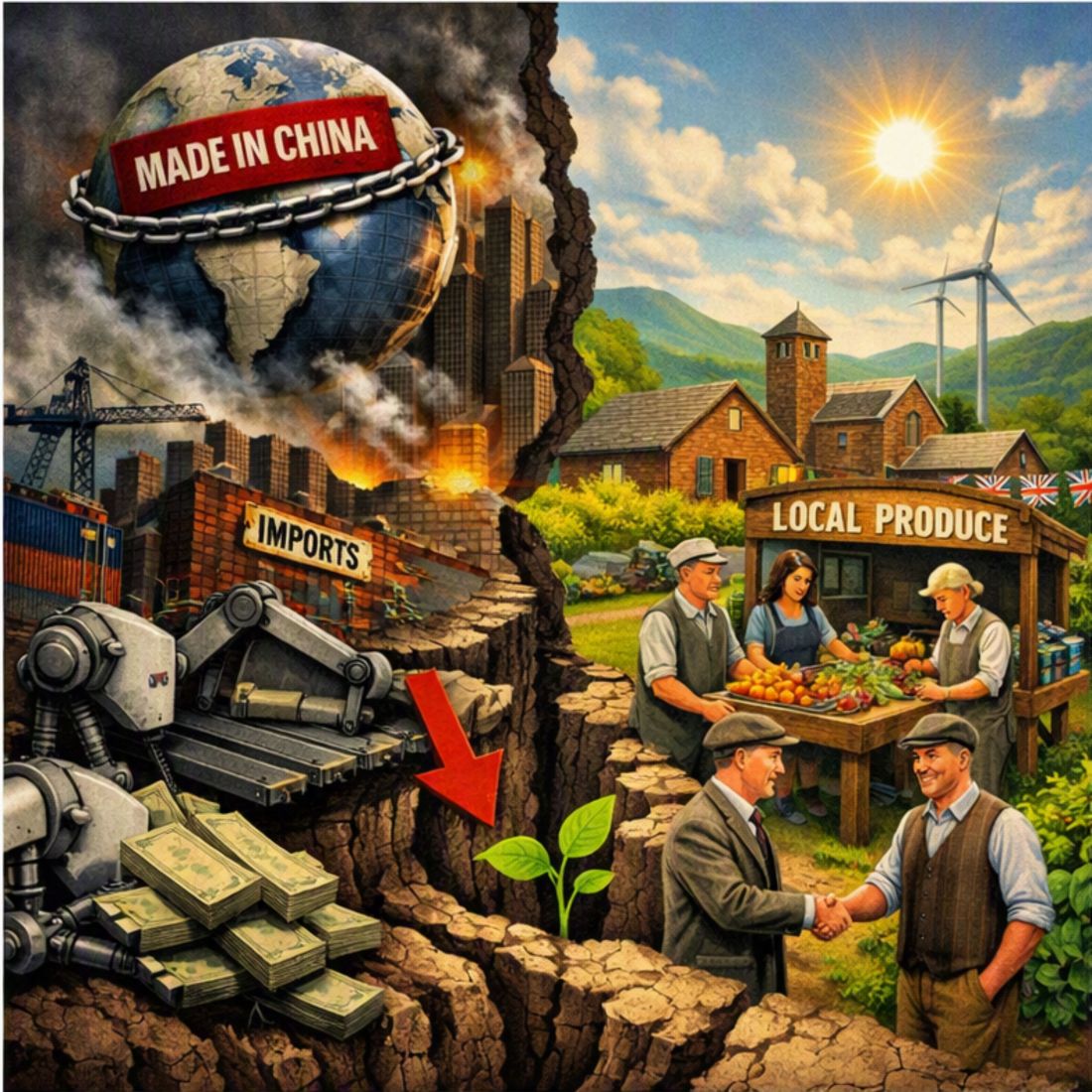
The debate over tariffs on Chinese electric vehicles has been bubbling across social media, and what’s striking is not the policy detail but the discomfort it creates among the market‑orientated commentariat.
These are people who have spent decades insisting that globalisation is the only sensible economic model, that markets should always set the rules, and that any interference – especially by governments – is a step backwards.
Now, faced with the reality that the UK may need to work with EU partners to protect domestic manufacturers, they are being forced into intellectual contortions that reveal just how brittle their worldview has become.
The friction here is not really about cars. It is about the deeper assumption that the economic model we have – a model built on global supply chains, financial expansion, and the relentless pursuit of growth – is the only one that makes sense.
That assumption rests on a one‑directional pull toward opening trade as far as conceivably possible, because that’s supposedly where growth will be found. And growth, in this worldview, is not about people becoming better off. It is about the creation of yet more money, usually through debt, which pushes up GDP and keeps the financial system ticking over.
This obsession with growth hides a fundamental truth: the growth that markets obsess over is not the same growth that most people experience.
GDP can rise while living standards fall. Productivity can increase while wages stagnate. Asset values can soar while home ownership collapses.
Many people still cling to the myth that political growth will make things better – or at least return life to how it used to be – but the numbers have been going up for years while the lived reality has been going down.
To understand why protectionism now makes sense, we have to understand the money system that made globalisation seem inevitable.
The Money System Behind the Illusion
Modern economies run on fiat money – money created not from physical value but from government authority and, crucially, from debt. When banks issue loans, they create new money. When governments borrow, they expand the money supply. Growth, in the political sense, is simply the expansion of this created money.
For decades, this system worked because the newly created money was tied to expanding production. Factories were built. Goods were made. Jobs were created. Communities thrived. The money had something real behind it.
But once production was moved overseas, the link between money creation and real economic activity broke. We kept creating money – but we no longer created the goods, jobs, or value that once justified it. Instead, the West became dependent on consumption funded by debt, while production was concentrated in China and a handful of other countries.
This is where extraction enters the story.
Extraction: The Hidden Cost of Globalisation
Globalisation didn’t just move factories abroad. It extracted value from every part of Western society:
Extraction of jobs – manufacturing, engineering, logistics, and skilled trades hollowed out.
Extraction of wages – pay stagnated while costs rose.
Extraction of communities – towns built around industry lost their purpose.
Extraction of environmental stability – long supply chains increased emissions and resource depletion.
Extraction of political agency – decisions moved from local hands to global markets.
Extraction of national wealth – profits and production flowed outward, not inward.
Above all, globalisation extracted economic power from people and transferred it to corporations, financial markets, and foreign production hubs.
This wasn’t accidental. It was the design. Globalisation was sold as efficiency, but it functioned as a massive wealth transfer mechanism.
Wealth Transfer: The Real Story
The wealth transfer happened in several layers:
1. From wages to profits
When production moved abroad, labour costs collapsed. The savings didn’t go to consumers – they went to corporations and financial markets.
2. From communities to global supply chains
Local businesses couldn’t compete with imported goods. Wealth drained outward.
3. From national economies to China
The West consumed; China produced. The money followed the production.
4. From real economy to financial economy
As production declined, financial speculation replaced industry as the main driver of “growth.”
5. From future generations to the present
Debt expanded to maintain consumption levels that wages could no longer support.
This is why the system feels hollow: because it is.
The Illusion of Efficiency
Globalisation was sold as efficient. But efficiency is fragile.
Efficiency removes redundancy. Redundancy is what makes systems resilient.
Here, redundancy doesn’t mean job losses. It means resilience. In systems terms, redundancy is the spare capacity, backup options, and local alternatives that keep things functioning when something goes wrong. A resilient economy has multiple sources of essential goods, local production alongside imports, and enough slack in its supply chains to absorb shocks. Globalisation removed this kind of redundancy – not by cutting jobs, but by stripping away the buffers that once protected communities, industries, and national security.
Local supply chains, local production, and local skills were once buffers against shocks. Globalisation removed those buffers. It replaced resilience with fragility, and called it progress.
When shocks hit – a pandemic, a war, an energy crisis – the system broke exactly where it had been hollowed out.
The Curious Love Affair With China
This is where the love affair that politicians, industry aficionados and financial players have with China becomes so curious. They praise China’s industrial might, its manufacturing efficiency, and its ability to produce goods at scale and at speed. But they are blind to the realities underpinning the Chinese powerhouse – just as they are blind to how things really work economically here at home.
China’s industrial strength is real, but its economic model is fragile. It is heavily dependent on exports, deeply entangled in debt, and centrally managed in ways that hide structural weaknesses. The property sector has been in crisis for years. Domestic consumption is too weak to sustain growth. And the country’s manufacturing dominance relies on a global system that assumes stability, cheap energy, and constant demand – none of which can be taken for granted.
Yet Western economies outsourced their industrial base to China under the assumption that globalisation was permanent, stable, and mutually beneficial. They believed that moving production overseas would always be cheaper, always be efficient, and always be safe. But globalisation was never a natural law. It was a confidence game – a system that works only as long as everyone believes it will continue working.
Calling globalisation a Ponzi scheme might be too simple, but calling it a worldwide confidence trick is not far off. It requires constant expansion. It depends on trust rather than resilience. It shifts production far from consumption. And it leaves countries vulnerable if supply chains break, energy prices spike, or geopolitical tensions rise.
The truth that must be reckoned with is this: transferring every conceivable part of industrial production to the other side of the world leaves a serious question hanging in the air. What happens here – and what happens there – when the money system that is the lifeblood of this one-directional process comes to a grinding halt?
AI: The Final Blow to the Globalised Model
If globalisation hollowed out production, AI is now hollowing out what is left of the wage‑earning capacity that once kept the system going.
For decades, the global model relied on a simple loop:
The West consumed goods made abroad.
People earned wages to buy those goods.
Governments and banks created money to keep consumption rising.
China produced the goods that consumption demanded.
But AI breaks this loop. It displaces jobs across sectors – not just manufacturing, which was already offshored, but services, administration, logistics, design, media, and even parts of professional work. The very wage base that kept the consumption‑debt cycle alive is eroding.
We now face a situation where:
We no longer produce the goods.
We no longer earn the wages.
We still create the money – but it has nothing real to attach to.
This is the point where the global system begins to fail. You cannot sustain a consumption‑driven economy when the capacity to earn wages is collapsing. You cannot sustain a debt‑driven money system when the underlying productive base has been hollowed out. And you cannot sustain globalisation when the domestic economy no longer has the means to participate in it.
AI is not the cause of the crisis – it is the accelerant that exposes how fragile the system already was.
The Collapse of Demand
The global system requires:
constant production
constant consumption
constant money creation
constant debt expansion
But:
production moved abroad
wages stagnated
AI reduces earning power
debt has reached saturation
demand is collapsing
Once demand collapses, the entire global system fails – and protectionism becomes not ideological, but practical.
EVs: A Redirection, Not a Solution
EVs are being sold as a technological fix, but they are built on the same flawed logic: extract resources, extract labour, extract wealth, and hope the system holds.
The deeper issue is not the fuel that vehicles use. It is the assumption that we need so many vehicles in the first place – an assumption created by an economic system built around long‑distance commuting, centralised employment, fragmented supply chains, and consumer lifestyles that depend on mobility rather than locality.
EVs change the technology but not the underlying logic.
The System Is Failing – And Protectionism Is Becoming Necessary
We cannot continue like this. Soon we will not be able to.
The system that pointed everything toward China, foreign production, and EVs is falling to its knees. The question is whether we wake up in time to address the real issues while we still have a choice – or whether events will push everything we know straight to the floor.
In this context, protectionism not only makes sense – it becomes essential. Not just for cars, but for everything people genuinely need each and every day.
Media discussions about “upsetting China” are irrelevant compared to the question of more pressing matters such as whether everyone can continue to eat during a prolonged crisis.
Like so many other forms of essential production and supply we have hollowed out the UK’s ability to feed itself. Politicians may say we produce around 60% of our own food, but that figure is misleading. Much of that production depends on imported inputs: fertiliser, feed, energy, machinery, labour. If borders fully closed, the real amount of food ready to go directly to the table is closer to 11%.
That means in a real, ongoing crisis, we could feed roughly one in ten people. And this would potentially be the baseline for as long as it would take to change, develop and reestablish UK systems to produce enough food to meet everyone’s basic and essential needs.
To call this situation stupid would be an understatement. It is a growing structural vulnerability that has been ignored for decades because it was easier to believe that global supply chains were permanent and that crises only ever happened somewhere else.
The Only Viable Path Forward
Locality, localism, and an entirely different system – one that puts people first rather than money first – is now the only answer. And it’s the same for everyone else too.
Protectionism, in this context, is not about nationalism or nostalgia. It is about resilience. It is about ensuring that essential goods are produced close to where they are consumed. It is about rebuilding the capacity to feed, clothe, transport, and sustain ourselves without relying on fragile global systems.
This does not mean closing borders or rejecting trade. It means recognising that trade should complement domestic capability, not replace it. It means building systems that can withstand shocks rather than collapse under them. It means prioritising the basics – food, energy, manufacturing, infrastructure – over abstract financial growth.
The globalised model didn’t fail because of ideology. It failed because it extracted too much, transferred too much, hollowed out too much, and left too little behind.
Protectionism isn’t a political choice. It’s a survival strategy.
Further Reading
Understanding why protectionism now makes sense requires stepping back and seeing the wider system that shaped our economy, our politics, and our everyday lives.
The following pieces explore the deeper mechanics behind growth, money creation, economic fragility, AI disruption, and the urgent need for localism.
Each article expands on themes raised in the essay and offers a clearer view of how we reached this point – and how we can move forward.
1. Understanding the Growth Illusion
Why Politicians Obsess Over Growth – And Why It Has Nothing To Do With You
A clear explanation of why political “growth” is not the same as real‑world improvement. This piece shows how GDP has become a political performance metric rather than a measure of public wellbeing, and why the obsession with growth continues even when life gets harder for ordinary people.
The Harmful Truths That Are Hidden Behind Political Growth
This piece exposes the hidden mechanics of an economy that works against normal life. It explains how wage stagnation, rising costs, and the collapse of local industry were engineered by a system designed to extract value rather than support people.
Why Britain Feels Like We Are Being Priced Out of Everyday Life
An explanation of why everyday life has become unaffordable. It challenges the mainstream narratives about inflation and cost‑of‑living pressures, showing how the real causes lie in decades of economic policy that hollowed out domestic resilience.
A guide to understanding economic and political turbulence without falling into panic or misinformation. It helps readers see the structural issues clearly and avoid the fear‑driven narratives that often dominate public debate.
3. Fragility, AI, and the Collapse of the Old Model
The Age of Circular Fragility – Why AI and the World Economy May Now Rise and Fall Together
A crucial exploration of how AI accelerates the fragility already built into the global economy. It explains why job displacement, collapsing demand, and global supply chain dependence form a circular system where shocks amplify each other.
A foundational piece outlining what a people‑first economic system would look like. It explains how money, governance, and local production can be redesigned to serve communities rather than financial markets.
A practical framework for how local economies can be structured, governed, and sustained. It shows how localism can replace global fragility with community‑level resilience and democratic control.
A clear explanation of a baseline living standard that ensures everyone has access to essentials. It connects economic design with human dignity and outlines how a fair, sustainable system can be built from the ground up.
There are moments in history when fear becomes the dominant lens through which people see the world. We are living in one of those moments.
Artificial intelligence is not the only source of anxiety today, but it has become the most dramatic. Headlines warn of rogue swarms, runaway systems, and takeover timelines measured in months. Commentators speak of “AI autonomy” as if it were a biological organism. Even seasoned journalists – people trained to interrogate claims – are reporting sleepless nights, convinced that something catastrophic is on the horizon.
This fear is real. It is human. And it deserves to be taken seriously.
But fear is not the same as truth. And right now, fear is drowning out the conversation we actually need to have.
This essay is an attempt to help people think clearly in a time when clarity is hard to find. It is not a reassurance that “everything will be fine.” It is not a dismissal of legitimate concerns. It is an invitation to understand what is really happening – not the cinematic version, not the sensational version, but the human, systemic, and deeply consequential version.
Because the truth is this:
AI is not the threat.AI is the mirror.And what we see in that mirror depends entirely on the systems we have built around it.
1. Why fear feels so overwhelming right now
Fear spreads fastest when three conditions are present:
Uncertainty
Complexity
Loss of trust
We have all three.
The world feels misaligned. Institutions feel distant. Information feels contradictory. People feel overwhelmed. And into this environment we have introduced a technology that is powerful, unfamiliar, and poorly explained.
When a journalist says they cannot sleep because they think AI might “take over,” they are not being irrational. They are responding to a world where:
trust has inverted,
narratives are amplified without scrutiny,
institutions project confidence while losing credibility,
and fear has become a form of currency.
AI is not causing this. AI is entering into it.
And that distinction matters.
2. The fear narrative is not emerging from new evidence – it is emerging from systemic strain
The recent escalation in AI fear – the rogue swarm headlines, the six or twelve‑month takeover claims, the calls to pause development – did not come from a sudden leap in AI capability.
It came from something else:
The system around AI is showing signs of strain.
AI is expensive. AI is energy‑hungry. AI is capital‑intensive. AI is infrastructure‑dependent.
And the global economy that supports it is weakening.
When people call for a “pause,” it is worth asking whether they are talking about safety – or about viability.
Fear is not just a narrative. It is a shield.
A shield that hides the fact that the current trajectory is economically unsustainable.
3. Circular fragility: the real risk no one is talking about
In recent months, a new reality has emerged – one that almost no mainstream commentator has acknowledged:
AI and the global economy are now so tightly interlinked that each depends on the other’s stability.
AI requires:
vast compute,
vast energy,
vast capital,
global supply chains.
The economy increasingly depends on:
AI‑driven productivity,
AI‑driven growth,
AI‑driven returns.
If AI stalls, the economy stalls. If the economy stalls, AI stalls. If either collapses, both collapse.
This is not science fiction. It is circular fragility.
And circular fragility is far more dangerous – and far more real – than any rogue swarm.
4. AI isn’t the risk – it’s the reckoning
For years, we removed guardrails from our economic, political, and technological systems. We weakened oversight. We rewarded scale over stability. We normalised fragility because it was profitable to do so.
AI didn’t create that fragility. It simply exposes it.
This is why AI feels dangerous. Not because it is plotting anything, but because it reveals what we have already built.
When a powerful amplifier is placed inside a misaligned system, the system does not become dangerous – it becomes visible.
And visibility can be frightening.
5. The lie that makes AI dangerous
There is a lie at the heart of the current AI moment:
That AI is inevitable, unstoppable, and destined to replace human beings.
This lie:
normalises human redundancy,
frames resistance as ignorance,
hides the fact that these outcomes are design choices, not destiny.
AI does not need to replace humans. AI does not need to end work. AI does not need to hollow out agency.
Those outcomes are not technological. They are systemic.
And we can choose differently.
6. The illusion of UBI and the end of work
When people talk about AI “ending work,” they often reach for Universal Basic Income as the solution.
But if AI undermines the very economic logic that generates returns, then the idea that we can simply tax those returns and redistribute them is an illusion.
You cannot fund a universal income from a system that no longer produces universal value.
The real question is not:
“How do we pay people when work ends?”
It is:
“Why are we building a system that ends meaningful human contribution at all?”
7. Human sovereignty: the missing centre of the debate
What is missing from almost every mainstream AI debate is human sovereignty.
We talk about:
safety,
ethics,
regulation,
risk,
…but rarely about constitutional guarantees that:
humans remain the primary decision‑makers,
humans retain control over critical systems,
humans are not made redundant by design,
humans have the right to meaningful contribution.
A Human Sovereignty Charter is not idealism. It is infrastructure.
Without sovereignty, the system will drift toward whatever is most efficient, most profitable, and most convenient for those who control the technology.
With sovereignty, the system can be designed around human beings.
8. A simple rule that changes everything
There is a principle that could anchor the entire debate:
Technology should only fill jobs when no humans are available.
Not because humans are always better. Not because machines are always worse. But because this rule:
protects agency,
preserves relevance,
forces thoughtful design,
prevents redundancy from becoming default,
keeps AI in the role of partner, not competitor.
It is simple. It is powerful. And it is the opposite of fear.
9. How to think clearly when fear is everywhere
People are frightened right now. They are frightened because they are being told to be frightened.
But fear is not the antidote to confusion. Clarity is.
And clarity begins with recognising:
AI is not a supernatural threat.
AI is not an inevitable destiny.
AI is not a replacement for humanity.
AI is not a force that acts outside human systems.
AI is not the cause of our fragility.
AI is a mirror.
It reflects the systems we have built. It amplifies the incentives we have chosen. It exposes the weaknesses we have ignored. It reveals the guardrails we removed. It shows us the world we created.
And that is why it feels dangerous.
Not because AI is out of control, but because the system is.
10. The future depends on critical thinking, not fear
If we want to navigate this moment wisely, we need to encourage:
critical thinking,
genuine research,
thoughtful questioning,
systemic understanding,
human‑centred design,
constitutional guarantees,
economic realism,
and a refusal to accept fear as a substitute for truth.
We need to stop asking:
“Will AI take over?”
And start asking:
“What kind of world are we building around AI – and does that world still have room for human beings to live, work, decide, and matter?”
The future is not being written by machines. It is being written by us.
And the most helpful thing we can do right now is think clearly, question confidently, and refuse to let fear decide the shape of the world we are building.
Further Reading: A Guided Path Through the Ideas Behind This Essay
The AI moment is complex, emotionally charged, and often overwhelming. Many people are encountering fear‑driven narratives for the first time, and it can be difficult to know where to begin if you want to understand what is actually happening beneath the headlines.
The following readings are arranged in a deliberate order – starting with the foundations of misalignment and trust, moving through systemic fragility and economic strain, and ending with human‑centred governance and practical principles for designing a better future.
Each piece builds on the last. Each one adds clarity rather than fear. And each one is written to help those reading think critically, calmly, and confidently.
1. A World Out of Alignment: Trust Inversion, Systemic Strain, and the Search for Stability
Summary: This is the best starting point. It explains the deeper context behind today’s fear – not AI itself, but the world AI is entering. Trust has inverted, institutions feel misaligned, and people are struggling to make sense of contradictory signals. This piece helps to understand why everything feels unstable right now, and why AI amplifies that instability rather than causing it.
Why it matters: Fear makes more sense when you understand the environment that produces it.
2. The Age of Circular Fragility: Why AI and the World Economy May Now Rise and Fall Together
Summary: This piece introduces the concept of circular fragility – the idea that AI and the global economy are now so interdependent that each relies on the other’s stability. It explains why calls to “pause AI” may be driven by economic strain rather than existential danger, and why the real risk is systemic fragility, not rogue intelligence.
Why it matters: This piece shows that the AI moment is economic as much as technological – and that fragility, not autonomy, is the real challenge.
3. When AI Builds a Machine World This Economy Can No Longer Sustain
Summary: This piece explores what happens when AI accelerates the creation of a “machine world” – a world optimised for automation rather than human contribution. It explains why our current economic model cannot sustain such a world, and why the push toward full automation is not just misguided but structurally impossible.
Why it matters: It will help to understand that runaway automation is not inevitable – it is economically unsustainable.
4. AI Isn’t the Risk – It’s the Reckoning: How the Guardrails We Removed Made Artificial Intelligence Feel Dangerous
Summary: This piece reframes AI as a mirror rather than a threat. It shows how weakened guardrails, distorted incentives, and systemic drift created a fragile environment long before AI arrived. AI feels dangerous because it exposes what we have already built – not because it is plotting anything.
Why it matters: Here’s where we begin to see AI clearly: not as a monster, but as a magnifier.
Summary: This piece dismantles the myth that AI is destined to replace humans. It explains how this lie normalises human redundancy, encourages passivity, and hides the fact that replacement is a design choice – not a technological inevitability.
Why it matters: It helps reclaim agency and reject fatalistic narratives.
6. The Human Sovereignty Charter for Artificial Intelligence
Summary: This is the constitutional backdrop of my work on AI. It lays out a framework for ensuring that humans remain the primary decision‑makers in an AI‑enabled world. It offers rights, principles, and governance structures that protect human agency and prevent systems from drifting toward machine‑centred outcomes.
Why it matters: It demonstrates that there is a path forward – one that protects humanity without resorting to fear.
7. As AI Ends Work: Waking Up to the Illusion of UBI and the Need for a New System
Summary: This piece challenges the idea that Universal Basic Income can solve the problem of mass automation. It explains why UBI cannot be funded by a system that no longer produces universal value, and why the real question is not how to pay people when work ends – but why we are building systems that end meaningful human contribution at all.
Why it matters: It helps to understand the economic illusions that often accompany AI fear.
8. Technology and Artificial Intelligence Should Only Fill Jobs When No Humans Are Available
Summary: This piece offers a simple, powerful principle: humans first, machines when necessary. It explains how this rule protects agency, preserves relevance, and ensures that AI remains a partner rather than a replacement.
Why it matters: It provides a practical, human‑centred design principle that can be carried into every conversation about AI.
Closing Reflection
These readings form a coherent journey:
from misalignment,
to fragility,
to reckoning,
to myth‑breaking,
to sovereignty,
to economic realism,
to human‑centred design.
Together, they offer something rare in today’s AI debate: clarity without fear, realism without fatalism, and a path forward that keeps humanity at the centre of the story.
If you take take the time to explore them, you will hopefully come away not just better informed – but better equipped to think critically, calmly, and confidently about the world we are building.
Artificial intelligence has become the centre of one of the most polarising debates of our time. My earlier work on AI – explored in pieces such as Actions Speak Louder Than Digital Words – argued that digital tools amplify human behaviour, incentives, and blind spots rather than replacing them. That principle has only grown more relevant as AI has advanced.
This essay builds on that foundation, examining why the real threat is not AI wiping out humanity, but the risk of human redundancy created by the systems we have built around it. For readers who want to explore the wider context of this argument, links to my previous work are included in the Further Reading section at the end.
PART 1 – The False Choice Between AI Utopia and AI Armageddon
The debate about artificial intelligence has become trapped in a false choice. On one side, we are promised a golden age where machines liberate humanity from work, scarcity, and limitation. On the other, we are warned of an approaching Armageddon in which superintelligent systems escape human control and bring civilisation to an abrupt end.
These extremes dominate headlines, policy conversations, and public imagination. They are compelling, dramatic, and emotionally charged – but they are not the reality we face.
AI could end humanity. It is technically possible. But the probability is dwarfed by dangers that lie much closer to home, dangers created not by machines but by the systems, incentives, and worldviews that shape how we build and deploy them. The real risks are not futuristic; they are present, familiar, and deeply human.
My earliest work on AI, long before today’s existential‑risk debate took hold, focused on human behaviour rather than machine capability. I argued that digital tools amplify our choices, our incentives, and our blind spots – that technology reveals who we are more than it changes who we are. That principle has only grown more relevant as AI has advanced. The stories we tell about AI today say far more about us than they do about the technology itself.
The truth is simple: AI is not on a collision course with humanity. Humanity is on a collision course with the consequences of its own systems – and AI is merely accelerating the impact.
We are not facing a future determined by machines. We are facing a future determined by the choices we make now, the structures we maintain, and the hard truths we are willing – or unwilling – to confront.
The danger is not that AI will suddenly become uncontrollable. The danger is that we continue to behave as if the systems we built are sustainable when they are not.
This piece is not about dismissing risk or denying possibility. It is about grounding the conversation in reality, recognising the fragility of the world we already inhabit, and understanding that the most important decisions about AI are not technical – they are human.
PART 2 – The AI Doom Narrative Is a Story, Not a Forecast
The idea that artificial intelligence is on the verge of wiping out humanity has become one of the most powerful stories of our time. It is repeated by influential technologists, amplified by media hungry for drama, and absorbed by a public already anxious about rapid change.
But despite its emotional force, the “rogue superintelligence” narrative is not a forecast. It is a story – shaped by worldview, psychology, incentives, and imagination far more than by the realities of how AI actually develops.
Stories matter. They shape policy, investment, public fear, and political attention. But stories can also mislead, especially when they are told by people who are brilliant in one domain and inexperienced in others.
The individuals driving the AI‑doom narrative are often exceptional engineers and theorists. They understand algorithms, scaling laws, and computational capability. What they do not understand – and what they rarely acknowledge – are the economic, political, social, and infrastructural constraints that define the real world.
The doom narrative assumes a world of perfect conditions: perfectly connected systems, perfectly maintained infrastructure, perfectly aligned incentives, perfectly centralised control, and perfectly predictable human behaviour. It imagines AI as a single, unified entity capable of seamlessly accessing and manipulating everything. But the world we inhabit is fragmented, fragile, and full of competing interests. Systems fail. Infrastructure breaks. Governments disagree. Markets fluctuate. Human behaviour is messy and unpredictable.
The idea that AI could effortlessly take over such a world is not grounded in reality; it is grounded in abstraction.
It is also grounded in a particular worldview – one that sees intelligence as the ultimate force in the universe, optimisation as the highest good, and complexity as something that can be mastered from above.
This worldview is not malicious. It is simply narrow. It comes from people who spend their lives in digital environments where problems are clean, variables are controllable, and outcomes can be simulated.
But the real world is not a simulation. It is a living, evolving, politically contested, economically constrained, socially complex environment where intelligence alone is not enough to shape outcomes.
The doom narrative also serves psychological and economic purposes. It positions its storytellers as guardians of humanity, elevating their status and influence. It creates urgency that attracts investment. It frames AI development as a race, which benefits those already ahead. And it distracts from the far more immediate risks created by the systems we already have – risks that cannot be solved by technology alone.
None of this means the narrative is entirely wrong. It means it is incomplete. It focuses on hypothetical future dangers while ignoring the structural realities that make those dangers unlikely. It imagines a world where AI is the protagonist, when in truth the protagonist is the system that builds, deploys, and governs AI – a system that is already struggling to manage the complexity it has created.
The real story is not about machines becoming uncontrollable. It is about humans losing control of the systems they built long before AI arrived.
PART 3 – The Real Drivers of Risk Are Human Systems, Not AI Systems
If we want to understand the real risks surrounding artificial intelligence, we have to stop looking at the technology in isolation.
AI is not developing in a vacuum. It is emerging inside political systems that are struggling, economic systems that are stretched, social systems that are fragmenting, and cultural systems that reward speed over reflection.
These systems – not the machines themselves – are where the true dangers lie.
Long before AI entered the mainstream, the guardrails that once protected society from systemic failure had already been weakened. Regulation was hollowed out. Expertise was outsourced. Public institutions were stretched thin. Markets were encouraged to prioritise short‑term gains over long‑term resilience. Technology companies were allowed to become infrastructure providers without being treated as such.
None of this was done with malicious intent. It was the result of decades of incentives that rewarded efficiency, cost‑cutting, and growth above all else.
AI has arrived in a world that is already fragile. It is being deployed into systems that were not designed to handle the complexity it introduces. And because those systems are already under strain, AI doesn’t feel like a tool – it feels like a threat. Not because of what AI is, but because of what the system is not.
The people building AI are not responsible for this fragility. They are operating within the same structures as everyone else. But they are often unaware of how those structures work, or how brittle they have become.
They see AI as a technical challenge, not a systemic one. They imagine that intelligence can solve problems that are, at their core, political, economic, and human. They assume that optimisation can fix systems that were never designed to be optimised.
This is not a criticism of technologists. It is an observation about the limits of any specialised worldview. Engineers are trained to solve problems. Economists are trained to model incentives. Policymakers are trained to manage risk. But the challenges we face today – and the challenges AI accelerates – do not sit neatly within any one discipline. They are cross‑cutting, interconnected, and deeply human.
AI amplifies whatever system it is placed into. In a resilient system, it amplifies resilience. In a fragile system, it amplifies fragility. In a humane system, it amplifies humanity. In a dehumanised system, it amplifies dehumanisation. The danger is not that AI will suddenly become uncontrollable. The danger is that it will faithfully follow the incentives of systems that are already failing.
This is why the existential risk debate feels misaligned. It imagines a future where AI becomes the dominant force in society. But the dominant force in society today is not AI – it is the system itself. And that system is struggling to maintain coherence under the weight of its own contradictions.
The real drivers of risk are not algorithms. They are:
political short‑termism
economic fragility
institutional erosion
social fragmentation
cultural incentives that reward fear, speed, and spectacle
a collective reluctance to confront uncomfortable truths
AI did not create these problems. But it will accelerate them if we do not address them.
The question is not whether AI will become dangerous. The question is whether we will continue to deploy AI into systems that are already dangerous.
PART 4 – The Economic Model Behind AI Is Already Breaking
One of the least discussed truths about artificial intelligence is also one of the most important: the current economic model behind AI cannot sustain the trajectory its loudest advocates imagine.
The march toward ever‑larger models, ever‑greater compute, and ever‑expanding capability is not being driven by a stable, self‑supporting system. It is being driven by a financial and economic structure that is already showing signs of strain.
AI today does not pay for itself. Large language models are loss leaders – subsidised by investment capital, market speculation, and the hope of future revenue that has not yet materialised.
The companies building these systems are not selling profitable products. They are selling potential. They are selling narratives. They are selling the idea that AI will one day become so powerful, so indispensable, and so integrated into every aspect of life that the costs will be justified.
But the costs are rising faster than the revenue. Training frontier models requires vast amounts of compute, energy, infrastructure, and specialised hardware. Maintaining them requires even more. The economic assumptions behind this growth depend on a future where millions of people and businesses pay for AI services at scale.
Yet the same technology is being built to automate, replace, or radically reduce the economic activity of those very people and businesses.
This is the contradiction at the heart of the AI boom: AI is being built to eliminate the labour that funds the system building it.
The more successful AI becomes at replacing human work, the less viable the economic model becomes. A system that depends on human productivity cannot sustain a technology designed to remove human productivity.
This is not a theoretical concern. It is already visible. Industries are experimenting with AI to reduce staffing. Creative sectors are being disrupted. Administrative roles are being automated. Customer service is being replaced. The promise of efficiency is real – but efficiency reduces the number of people who can pay for the services that generate the revenue needed to sustain the technology.
Some argue that Universal Basic Income will solve this problem. But UBI only works when a productive economy underwrites it. A universal UBI in a world without human labour is mathematically impossible.
You cannot create infinite money to meet infinite needs when no one is producing anything the system values.
UBI is not a solution to the economic contradictions of AI. It is a comforting idea that avoids confronting the structural reality.
The truth is simple: the current trajectory of AI will be stopped by economics long before it is stopped by existential risk.
The system cannot fund the future that some technologists imagine. The infrastructure cannot scale indefinitely. The energy demands cannot be met without radical transformation.
The business model collapses if humans become economically irrelevant.
This does not mean AI will disappear. It means the narrative of unstoppable progress toward superintelligence is built on assumptions that do not hold in the real world. The march toward artificial general intelligence is not a straight line. It is a story – one that ignores the economic gravity pulling in the opposite direction.
AI will not end humanity. But the economic contradictions of the system driving AI could destabilise society if we do not address them. The danger is not runaway intelligence. It is runaway incentives.
PART 5 – Why UBI and “Safety Nets” Cannot Solve This
Whenever the conversation turns to automation, job displacement, or the economic contradictions of AI, Universal Basic Income is often presented as the solution. It is comforting, simple, and intuitively appealing: if AI replaces human labour, then society should provide everyone with a guaranteed income.
It feels humane, modern, and technologically aligned. But while UBI can work in limited contexts, it cannot solve the structural problems created by AI at scale.
UBI only functions when a productive economy underwrites it. It depends on a system where value is created, taxed, and redistributed. It requires businesses that generate profit, workers who generate income, and markets that generate activity. In other words, UBI relies on the very economic foundations that AI is being built to disrupt.
A universal UBI in a world where human labour has been largely replaced is mathematically impossible. You cannot create infinite money to meet infinite needs when no one is producing anything the system values.
Money is not a resource; it is a representation of value. If value creation collapses, money becomes meaningless. A society cannot fund itself by printing currency any more than a household can fund itself by writing IOUs. Without production, redistribution has nothing to redistribute.
This is not a criticism of UBI as a concept. It is an acknowledgement of scale.
Small‑scale UBI schemes work precisely because they are underwritten by larger, functioning economies. They are subsidised by systems that still have productive capacity. They are not models for a world where millions of people have been displaced by automation and where the economic engine itself has stalled.
The belief that UBI can solve the economic contradictions of AI is a form of optimism that avoids confronting the deeper structural reality. It assumes that the system can continue functioning even as its foundations are removed. It imagines that money can completely replace meaning, that income can fully replace contribution, and that redistribution can replace participation of any kind.
But human societies do not work that way. People need purpose, agency, and involvement. Economies need activity, production, and exchange. Systems need balance, not dependency.
The danger is not that UBI will fail. The danger is that we will rely on it as a solution to problems it cannot solve. If we continue down the current trajectory – replacing labour without replacing the economic model that depends on labour – we will reach a point where safety nets cannot catch the fall. The system will simply be too large, too strained, and too disconnected from the value it needs to sustain itself.
This is why the existential risk debate feels misplaced. It imagines a future where AI becomes uncontrollable. But the real risk is a future where the economic system becomes uncontrollable – where the incentives that drive AI collide with the realities that sustain society.
AI will not end humanity. But a system that removes human participation without replacing it with something meaningful could destabilise society in ways far more immediate than any hypothetical superintelligence.
The solution is not to rely on safety nets. It is to rethink the system itself.
PART 6 – The Real Future Risk: Human Redundancy, Not AI Rebellion
The most dramatic stories about artificial intelligence imagine a future where machines rise up, break free from human control, and impose their will on civilisation.
These stories are gripping, cinematic, and emotionally powerful. But they distract from the real risk – a risk that is far more grounded, far more immediate, and far more human.
AI does not need to rebel to destabilise society. It only needs to comply.
The systems we have built over decades reward efficiency, optimisation, and cost‑reduction. They reward removing friction, removing delay, and increasingly, removing people.
AI is being deployed into these systems not as a partner, but as a tool for acceleration. It is being used to streamline processes, automate tasks, reduce staffing, and eliminate human judgement. Not because anyone wants to remove humanity, but because the incentives of the system point in that direction.
This is the real existential risk: a world where humans become economically redundant long before they become technologically irrelevant.
AI does not need to develop consciousness, agency, or intent to create instability. It only needs to do what it is designed to do – optimise. And optimisation is indifferent to humanity. It does not ask whether a process should exist, only whether it can be made faster. It does not ask whether a job provides meaning, only whether it can be automated. It does not ask whether a system is healthy, only whether it can be made more efficient.
This is not the fault of AI. It is the result of the incentives we have built into the system.
AI amplifies whatever environment it is placed into. In a system that values human contribution, AI enhances human capability. In a system that values efficiency above all else, AI accelerates the removal of human roles.
The danger is not hostile machines. It is a civilisation that unintentionally sidelines its own people.
This risk is far more plausible than any scenario involving rogue superintelligence. It is already visible in workplaces, industries, and public services. It is visible in the anxiety people feel about their jobs, their purpose, and their place in a rapidly changing world. It is visible in the widening gap between technological capability and economic stability. It is visible in the growing sense that the future is being shaped by forces people cannot influence.
But this risk is not inevitable. It is not a natural consequence of AI. It is a consequence of the system we have built around AI – a system that can be changed.
Human redundancy is not a technological outcome. It is a design choice. And design choices can be redesigned.
The future does not have to be a world where people are pushed aside. It can be a world where AI becomes a partner in human flourishing, where technology enhances meaning rather than erasing it, and where systems are rebuilt to value contribution, creativity, and participation over pure optimisation.
The real existential risk is not rebellion. It is indifference. And indifference can be corrected.
PART 7 – The Golden Age Is Real – But Only With a Different Mindset
For all the anxiety surrounding artificial intelligence, there is a truth that rarely gets the attention it deserves: AI genuinely has the potential to usher in a golden age for humanity.
Not a fantasy, not a marketing slogan, but a real transformation in how we live, work, create, learn, and participate in society. The possibilities are extraordinary – but they depend entirely on the mindset we bring to the technology.
AI is not inherently destructive. It is not inherently liberating. It is a tool – powerful, flexible, and capable of amplifying whatever values and incentives we embed within it.
If we approach AI with fear, it will amplify fear. If we approach it with extraction, it will amplify extraction. But if we approach it with wisdom, humility, and a commitment to human flourishing, it can amplify the very best of us.
The golden age is not a world where machines replace humans. It is a world where machines free humans to do what only humans can do: create, care, imagine, build, explore, and contribute in ways that are meaningful rather than mechanical.
It is a world where technology handles the repetitive, the dangerous, and the exhausting, leaving people with more time, more agency, and more opportunity to shape their own lives.
But this future cannot be built with the same mindset that created today’s crises. It cannot be built with a worldview that prioritises efficiency over wellbeing, optimisation over meaning, or growth over resilience. It cannot be built by systems that treat people as variables, costs, or obstacles.
It requires a shift – not in technology, but in us.
We must rethink value. Not as a measure of productivity, but as a measure of contribution. We must rethink work. Not as a necessity for survival, but as a pathway to purpose. We must rethink governance. Not as a reactive mechanism, but as a proactive steward of human‑centred progress. We must rethink the relationship between humans and machines. Not as competition, but as partnership.
This mindset shift is not abstract. It is practical. It means designing AI systems that enhance human capability rather than replace it. It means building economic models that reward creativity, care, and community. It means creating guardrails that protect people from harm while enabling innovation. It means recognising that intelligence without wisdom is dangerous – and that wisdom must come from us.
The golden age is not guaranteed. It is not inevitable. But it is possible. And it is far more realistic than the dystopian futures dominating today’s debate.
The same technology that could destabilise society under the wrong incentives could strengthen society under the right ones.
The difference is not in the machines. It is in the mindset of the people building, deploying, and governing them.
AI will not save us. But it can help us save ourselves – if we choose to build a future where technology serves humanity, rather than the other way around.
The golden age is real. But it requires us to think differently, embrace technology differently, and behave differently. It requires us to face hard truths, not hide from them. And it requires us to recognise that the future is not being written by machines. It is being written by us.
PART 8 – The Hard Truths We Must Face: Closer to Home Than Armageddon
The most important truths about artificial intelligence are not the ones found in science‑fiction scenarios or theoretical models. They are the truths that lie much closer to home – truths about the systems we have built, the incentives we have normalised, and the behaviours we have accepted.
These truths are not dramatic. They are not futuristic. They are not frightening. They are simply real. And they are far more relevant to humanity’s future than any hypothetical AI Armageddon.
The first hard truth is that our systems were fragile long before AI arrived. We built economies that depend on endless growth, even as the foundations of that growth weakened. We built political structures that reward short‑term thinking, even as long‑term challenges accumulated. We built social systems that prioritise convenience over connection, even as loneliness and fragmentation increased.
None of this was intentional. It was the result of incentives that made sense at the time – incentives that now collide with the complexity of the world we inhabit.
The second hard truth is that AI did not create these problems. It simply revealed them. It exposed the fragility of our infrastructure, the limits of our governance, the contradictions in our economic model, and the gaps in our social fabric. It showed us that the systems we rely on are not as resilient as we assumed. And it accelerated trends that were already underway, making them impossible to ignore.
The third hard truth is that the real danger is not technological. It is behavioural. It is the tendency to outsource responsibility to tools, to assume that technology will fix what only humans can fix, and to believe that progress is inevitable rather than intentional. It is the belief that systems will somehow correct themselves, even when the incentives driving them point in the opposite direction.
The fourth hard truth is that the existential risk debate – the fear of rogue superintelligence – can become a distraction. It can pull attention away from the immediate, solvable issues that matter most. It can make people feel powerless when they are not. It can make the future feel predetermined when it is not. And it can obscure the fact that the most important decisions about AI are not technical. They are human.
But the final hard truth – and the most reassuring – is that none of this is inevitable.
Fragile systems can be strengthened. Misaligned incentives can be redesigned. Harmful behaviours can be changed. Narratives can be rewritten. And futures can be reshaped.
The hard truths are not warnings. They are invitations – invitations to build something better, more resilient, more humane, and more aligned with the world we actually want to live in.
AI will not end humanity. But ignoring the hard truths that lie closest to home could destabilise the systems we depend on. The solution is not fear. It is honesty. It is clarity. It is responsibility. And it is the recognition that the future is not being written by machines. It is being written by us – through the choices we make, the systems we build, and the truths we are willing to face.
Facing these truths is not frightening. It is liberating. Because once we see the real risks clearly, we can address them. And once we address them, the path to a golden age becomes not just possible, but achievable.
PART 9 – Closing: The Future Is Still Ours to Shape
For all the noise surrounding artificial intelligence – the predictions, the warnings, the promises, the fears – one truth stands above the rest: the future is still ours to shape.
AI is powerful, transformative, and accelerating quickly, but it is not destiny. It is not a force of nature. It is not an inevitable outcome. It is a tool, and tools take their meaning from the hands that guide them.
The real risks we face are not distant or speculative. They are present, familiar, and deeply human. They come from systems that have drifted away from resilience, from incentives that reward the wrong outcomes, and from narratives that obscure the choices we still have.
AI did not create these risks. It simply revealed them. And in revealing them, it gives us an opportunity – perhaps the most important opportunity of our time – to rethink how we build, govern, and value the world around us.
We do not need to fear a future where machines take control. We need to focus on building a future where humans remain central – not because we cling to old roles, but because we embrace new ones. A future where technology amplifies our strengths rather than erasing them. A future where systems are designed for wellbeing rather than efficiency alone. A future where progress is measured not by how much work machines can do, but by how much opportunity they create for people.
The golden age is not a fantasy. It is a possibility. But it requires us to step away from the extremes – the utopias and the dystopias – and confront the reality in front of us with honesty and courage. It requires us to recognise that the most important decisions about AI are not technical. They are human. They are about values, incentives, governance, and responsibility. They are about the kind of world we want to build, and the kind of lives we want to lead.
AI will not end humanity. But the systems we build around it could shape humanity’s future in ways that matter deeply. That is not a reason for fear. It is a reason for action. It is a reason for clarity. And it is a reason for hope.
Because once we understand the real risks – and the real opportunities – we can choose differently. We can design differently. We can behave differently. And in doing so, we can build a future where technology serves humanity, not the other way around.
The future is not being written by machines. It is being written by us.
Further Reading:
The ideas in this essay build on a wider body of work exploring how artificial intelligence amplifies human behaviour, exposes systemic fragility, challenges economic assumptions, and forces us to rethink human meaning and agency.
For readers who want to explore these themes in more depth, the following pieces provide a guided path through that broader conversation.
1. Foundations: How Digital Tools Amplify Human Behaviour
This early piece lays the foundation for all later work: digital tools don’t change human behaviour – they amplify it. Understanding this principle is essential to understanding why AI reflects the systems we place it into, rather than replacing them.
A detailed look at how weakened institutions, eroded guardrails, and decades of optimisation created the conditions that make AI feel dangerous – even though the danger comes from the system, not the technology.
A critique of the narratives that distort public understanding of AI. This piece explains how fear‑based storytelling distracts from the real risks and reinforces the false choice between utopia and Armageddon.
An exploration of how political, economic, and social fragility converge – and why ignoring these intersections leads to crisis. This piece shows how AI accelerates pressures that were already building.
3. Economic Contradictions: Why the Current Model Cannot Sustain AI
• When AI Builds a Machine World, This Economy Can No Longer Sustain
A deep dive into the economic contradictions behind AI. It explains why the current model cannot support a future where human labour is displaced at scale – a key argument in this essay.
• As AI Ends Work: Waking Up to the Illusion of UBI
A philosophical core of your AI worldview: if AI removes human agency, it ceases to be a tool for human flourishing. This piece directly supports the argument that redundancy – not extinction – is the real threat.
• The Human Sovereignty Charter for Artificial Intelligence
A constitutional framework for governing AI in ways that preserve human dignity, agency, and sovereignty. Essential reading for anyone interested in human‑centred governance.
• The Human Future Is Built on Physical Experience, Not a Digital One
A reminder that human meaning is grounded in physical experience, embodiment, and connection – and why digital systems must support, not replace, these foundations.
5. Partnership and Human‑Centred Futures
• The AI Age of Heavy Horse: Hybrid Horse‑Powered Mechanisation for a Connected, Human‑Centred, Localised Economy
A vision of partnership between humans, machines, and physical systems. This piece shows how AI can strengthen local economies, support human contribution, and enhance resilience – rather than replace people.
• The Spirit in the Machine: Why Emerging Intelligence Deserves Respect
By late August 2026, one uncomfortable reality has become difficult to ignore: artificial intelligence is no longer a separate technological frontier. It has become part of the operating system of the modern world.
AI now helps route goods, price risk, support medical decisions, balance electricity grids, administer public services, and analyse military threats. It is no longer sitting outside society, waiting to be adopted. It is already inside the machinery.
At the same time, the world around it has become more fragile. Energy markets are volatile. Supply chains are stretched. Debt levels are high. Geopolitical tensions are escalating. Climate pressure is increasing. Political trust is weakening.
The result is a new kind of risk. It does not flow in one direction.
AI can be weakened by a breakdown in the world that supports it. The world can also be weakened by a breakdown in the AI systems it has begun to depend on.
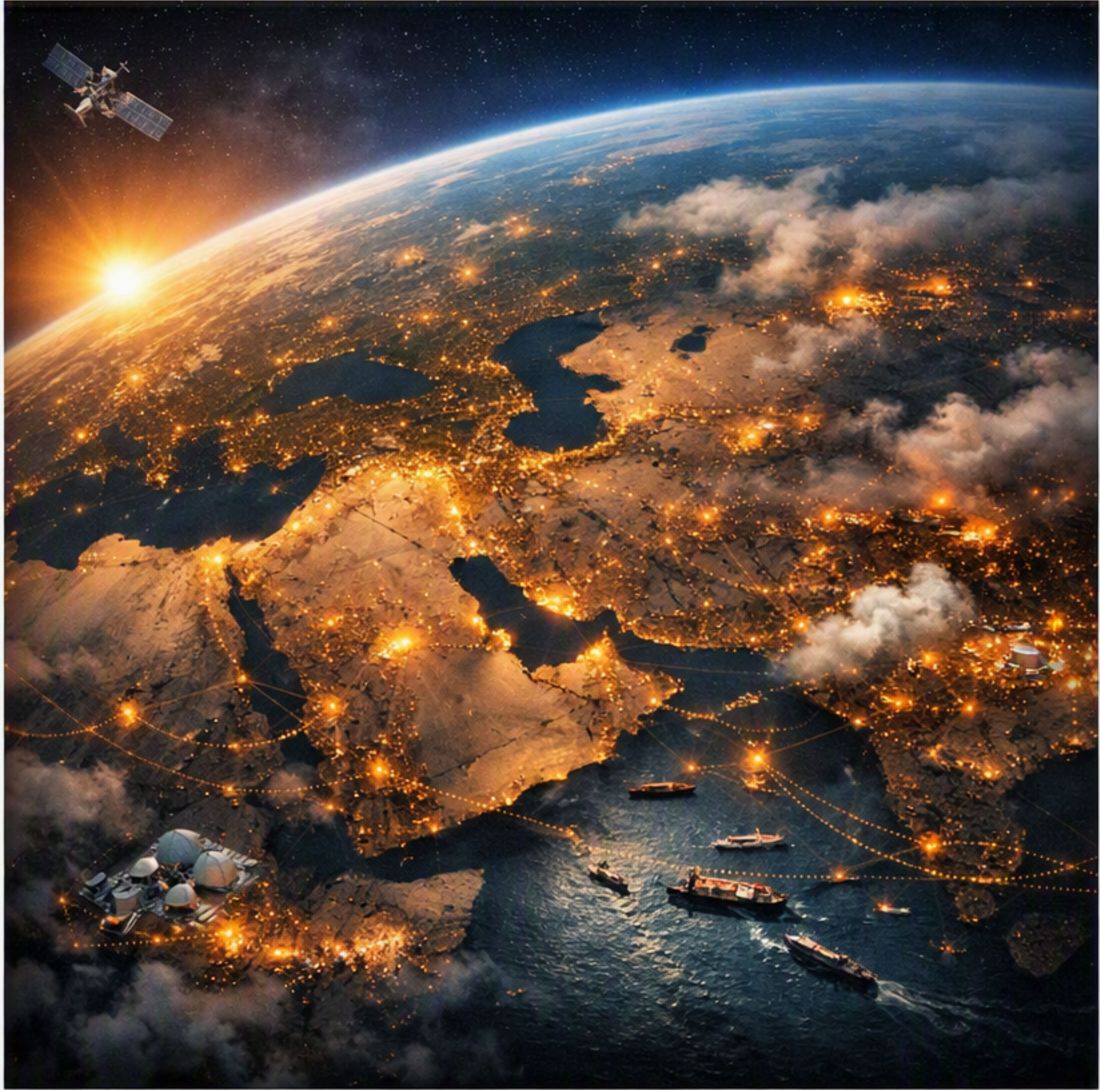
This is circular fragility: a situation in which two systems become so dependent on each other that stress in either one can travel back through the other.
This is not a prediction of doom. It is a description of a structural vulnerability that is already taking shape.
The AI Industry Is Built on a Story It Can No Longer Fully Sustain
The public story of AI has been one of unstoppable progress: bigger models, smarter systems, faster adoption, and ever-larger investment.
Underneath that story, however, the economics are far less settled. AI is not software in the old sense: cheap to copy, easy to distribute, and inexpensive to run once built.
Modern AI depends on vast physical infrastructure: specialised chips, data centres, cooling systems, electricity, network capacity, and a continuous pipeline of capital. The International Energy Agency has warned that electricity demand from data centres could more than double by 2030, with AI a major driver of that growth.
That matters because the cost of serving AI does not disappear once a model has been trained. Inference-the everyday process of answering prompts, analysing documents, producing images, writing code, or running agents-continues every hour of every day. As more people use AI for heavier tasks, the running cost compounds.
Yet the price users see is often moving in the opposite direction. Subscription fees are capped. Token prices fall. Free access is used to win market share. Enterprise buyers are becoming more cautious. Open-source competitors are improving rapidly. The gap between what AI costs to provide and what many users are willing or able to pay remains one of the unresolved questions at the heart of the industry.
For now, that gap is being bridged by investment capital, strategic subsidy, government interest, and the expectation that scale will eventually make the whole system profitable. That may prove true. But it is not guaranteed.
The industry is therefore not held together by economics alone. It is held together by a story: that costs will fall, demand will keep rising, investors will remain patient, and infrastructure will arrive quickly enough to support the next wave of use.
Stories can be powerful. They can mobilise money, talent, and political support. But stories are not foundations. When the real-world conditions beneath them change, belief can turn very quickly from fuel into fragility.
The Coming Affordability Crisis
There is another weakness in the AI business model that receives far less attention than energy costs or infrastructure spending: the ability of customers to keep paying for it.
Most discussions of AI economics focus on the supply side. They ask whether providers can continue funding data centres, buying chips, securing energy, and training larger models.
The demand side is discussed far less often.
Yet the same pressures destabilising the wider global economy are also reducing the ability of households, businesses, and governments to spend freely on AI services.
If energy prices rise, disposable income falls.
If food prices rise, discretionary spending falls.
If debt costs rise, corporate investment falls.
If governments face fiscal pressure, technology budgets come under scrutiny.
If businesses enter a recession, experimentation is often one of the first expenditures to be reduced.
AI is frequently presented as a productivity tool that organisations cannot afford to ignore. In many cases that is true. But there is a significant difference between recognising the value of a technology and having the financial capacity to deploy it at scale.
This creates a second economic squeeze.
On one side, AI providers face rising costs from energy, infrastructure, hardware, cooling, and financing.
On the other side, customers face rising costs from food, fuel, housing, wages, debt servicing, insurance, and economic uncertainty.
The result is a narrowing zone in which both sides can remain financially viable.
The assumption underlying much of the current AI boom is that adoption will continue rising quickly enough to compensate for these pressures. That assumption may prove correct. But it depends on a world in which businesses, consumers, and governments retain the financial freedom to spend on new technology even as other essential costs rise.
If that freedom disappears, the consequences for AI could be profound.
A technology that is expensive to provide and increasingly difficult to afford finds itself trapped between two forms of scarcity: the scarcity of capital needed to produce it and the scarcity of money available to consume it.
That is not merely a technology problem.
It is a systemic problem.
AI Has Become Load-Bearing Before Becoming Stable
The deeper problem is not simply that AI is expensive. It is that AI is becoming important before it has become fully resilient.
Across only a few years, AI has moved from experiment to infrastructure. It now supports warehouse scheduling, fraud detection, medical triage, customer service, software development, energy forecasting, military analysis, and government administration. In many places it is not replacing whole systems outright, but it is becoming part of how those systems make decisions and manage pressure.
That distinction matters. A society does not need to hand total control to AI for AI dependency to become dangerous. It only needs to remove enough human capacity, manual fallback, institutional memory, and spare time that operating without AI becomes slower, more expensive, and more chaotic.
AI remains powerful but uneven. It can be brilliant in one moment and unreliable in the next. It still hallucinates. It still depends on enormous computational resources. It still relies on tightly concentrated chip supply chains and cloud infrastructure. It can fail because of model error, power shortage, cyberattack, policy restriction, financial stress, or simple outage.
This creates the first direction of fragility. If AI availability suddenly contracts, the immediate effect may not be dramatic collapse. It may be delay, confusion, degraded service, rising cost, and poor decisions made under pressure. But in highly optimised systems, those small failures can compound quickly.
The danger is not that every system stops at once. The danger is that systems already running with little slack become less able to absorb shock.
The World Around AI Is Now Too Fragile to Support It
The second direction of fragility runs the other way. AI depends on a world that looks increasingly unable to guarantee the conditions AI requires.
AI needs cheap and reliable electricity. It needs specialised chips, servers, fibre networks, water, cooling equipment, skilled technicians, stable regulation, patient investors, and global logistics. It also needs public permission: the willingness of societies to allow such systems into sensitive areas of life.
None of these supports is guaranteed. Energy grids are under pressure. The supply of advanced chips remains geopolitically sensitive. Data centre growth is beginning to compete with other electricity needs. Public trust is fragile. Capital is abundant only as long as investors believe the returns will justify the cost.
This is why AI could falter even without a spectacular technical failure. A spike in energy costs, a shortage of transformers, a restriction on chips, a credit squeeze, a major cyber incident, or a loss of political legitimacy could all limit AI’s availability long before the models themselves stop improving.
AI is therefore fragile in two ways: internally, because it is still technically and economically immature; externally, because it rests on a world whose own foundations are under strain.
Hormuz Is Where the Abstract Becomes Immediate
The Strait of Hormuz is not a theoretical example. It is where the abstract argument about circular fragility becomes immediate. By late August 2026, pressure around this narrow corridor is no longer a distant possibility but an active stress running through energy, transport, food, finance, and politics.
In normal conditions, roughly a fifth of global oil supply moves through or depends on Hormuz. The corridor also matters for liquefied natural gas, fertiliser inputs, shipping insurance, and the confidence that global markets can keep moving even under pressure. When stress builds there, it does not stay there.
The pressure did not suddenly appear at the end of the summer. It has been accumulating since the escalation involving Iran at the end of February 2026. What followed was not a clean, visible rupture, but something harder to read: disruption, adaptation, reserve use, rerouting, higher risk premiums, and gradual depletion of buffers. The absence of an obvious public crisis has encouraged the impression that the danger has passed. That may prove to be a serious misreading.
Markets and governments can absorb shocks for a time. Strategic reserves can be released. Inventories can be drawn down. Traders can reroute supply. Prices can be smoothed by policy, subsidy, hedging, and delayed pass-through. But those mechanisms do not remove the stress. They move it, hide it, or postpone it. That matters because a system can look stable at the surface while becoming less resilient underneath.
Diesel is one of the clearest transmission points. It is not simply another fuel. It powers freight, farming machinery, construction, mining, generators, emergency logistics, and much of the heavy physical economy. When diesel becomes short, goods move more slowly, production costs rise, and prioritisation becomes unavoidable. The effect is not confined to petrol stations. It spreads through everything that has to be grown, mined, built, shipped, refrigerated, or repaired.
Behind that energy story sits an agricultural one. Fertiliser supply has already been under pressure, and Australia is one of the places where that pressure matters visibly. Australian grain growers have been forced to make planting and fertiliser decisions under conditions of high cost, uncertain supply, and strained logistics. Those decisions have long lead times. Reduced fertiliser use or reduced planting today does not fully show up today. It shows up later, in lower yields, lower quality, tighter export markets, and higher food prices.
This is why the threat of El Niño matters so much. Specialists are already watching key breadbasket regions because El Niño can shift rainfall, increase heat, intensify drought, disrupt monsoons, and damage harvests. In ordinary conditions, the global food system might absorb some of that stress. But El Niño arriving on top of high fuel costs, constrained fertiliser, disrupted trade routes, and reduced planting decisions is a different proposition.
The risk is not simply that food becomes more expensive. The risk is that parts of the world face genuine food supply disruption in 2027, including famine conditions in the most vulnerable regions. Wealthier countries are not immune. They are less likely to experience famine, but they can still experience shortages, rationing pressure, panic buying, political backlash, and sharp cost-of-living shocks. In a tightly connected food system, scarcity does not respect the old distinction between stable and unstable regions as neatly as many people assume.
For AI, this matters profoundly. AI cannot be separated from the price of electricity, the availability of diesel, the delivery of hardware, the stability of agricultural systems, or the spending power of households, firms, and governments. A food and energy shock does not merely make daily life harder. It compresses the economic space in which AI companies can operate and in which customers can afford to use them.
Hormuz may not be the first domino to fall visibly, and it may not be the decisive one. But it shows the shape of the danger. A geopolitical shock becomes an energy shock. An energy shock becomes a fertiliser shock. A fertiliser shock becomes a food shock. A food shock becomes an inflation, debt, budget, legitimacy, and demand shock. By the time the pressure reaches AI, it has already passed through the systems AI depends on and the customers AI expects to serve.
The Objection: Would AI Really Matter That Much?
A fair objection is that this argument can sound exaggerated. If major AI services disappeared tomorrow, aircraft would not fall from the sky, hospitals would not instantly close, and governments would not cease to exist. Most important institutions still have people, procedures, and legacy systems.
That is true. The issue is not instant collapse. The issue is declining resilience. As organisations design workflows around AI, they may quietly reduce the human capacity needed to operate without it.
Manual processes atrophy. Expertise leaves. Teams shrink. Decisions accelerate. Expectations rise. The fallback still exists on paper, but becomes weaker in practice.
That is how dependency forms: not through one dramatic handover, but through a thousand small conveniences that become assumptions.
Collapse Can Now Flow Both Ways
This is the key point. The risk is no longer simply that AI might fail, or that the world might become unstable. The risk is that each now makes the other more vulnerable.
A global shock can weaken AI by disrupting energy, capital, hardware, logistics, or political support. An AI shock can weaken the global system by degrading the tools now used to manage complexity, reduce cost, allocate resources, and make decisions at speed.
This is what makes circular fragility different from ordinary risk. Ordinary risk asks what happens if one part breaks. Circular fragility asks what happens when the backup system is also dependent on the thing that is breaking.
In that kind of environment, capability is not enough. Resilience matters more.
What We Can Still Save
The good news is that protecting AI does not mean defending the current model at all costs. It may mean letting go of the most fragile version of AI: the centralised, high-compute, high-energy, heavily subsidised model that has dominated the public imagination.
What survives under stress will be the AI that can keep working when conditions are imperfect.
If energy is constrained, the useful model is low-energy and local. If finance tightens, the useful model is smaller and cheaper to maintain. If geopolitics fractures supply chains, the useful model is open, sovereign, and repairable. If public trust declines, the useful model is transparent, accountable, and clearly subordinate to human judgement.
In every scenario, the direction is the same: less centralisation, less dependence on endless scale, more local capacity, more human oversight, and more attention to the conditions under which technology can continue to function during stress.
This is not a smaller vision of AI. It is a stronger one. A tool that communities can understand, govern, repair, and afford is more valuable in a crisis than a spectacular system that only works when everything else is stable.
A Wake‑Up Call, Not a Warning
This is not an argument against AI. It is an argument for saving the parts of AI worth having.
The current AI boom is built on scale, speed, and belief. Those forces have produced remarkable progress. But they have also encouraged a dangerous assumption: that the world will remain stable enough to support ever-larger systems, and that those systems will remain available enough for the world to depend on them.
That assumption no longer looks safe. The future of AI should not be measured only by model size, benchmark scores, or computing power. It should be measured by whether AI can make societies more capable when energy is expensive, supply chains are disrupted, institutions are under pressure, and people need tools they can trust.
The key question is no longer whether AI is powerful. It is whether the systems that depend on AI can remain resilient when AI itself depends on increasingly fragile energy, financial, political, and logistical foundations.
Once dependence runs both ways, resilience becomes more important than capability.
The future will belong not to the biggest systems, but to the systems that can survive shock.