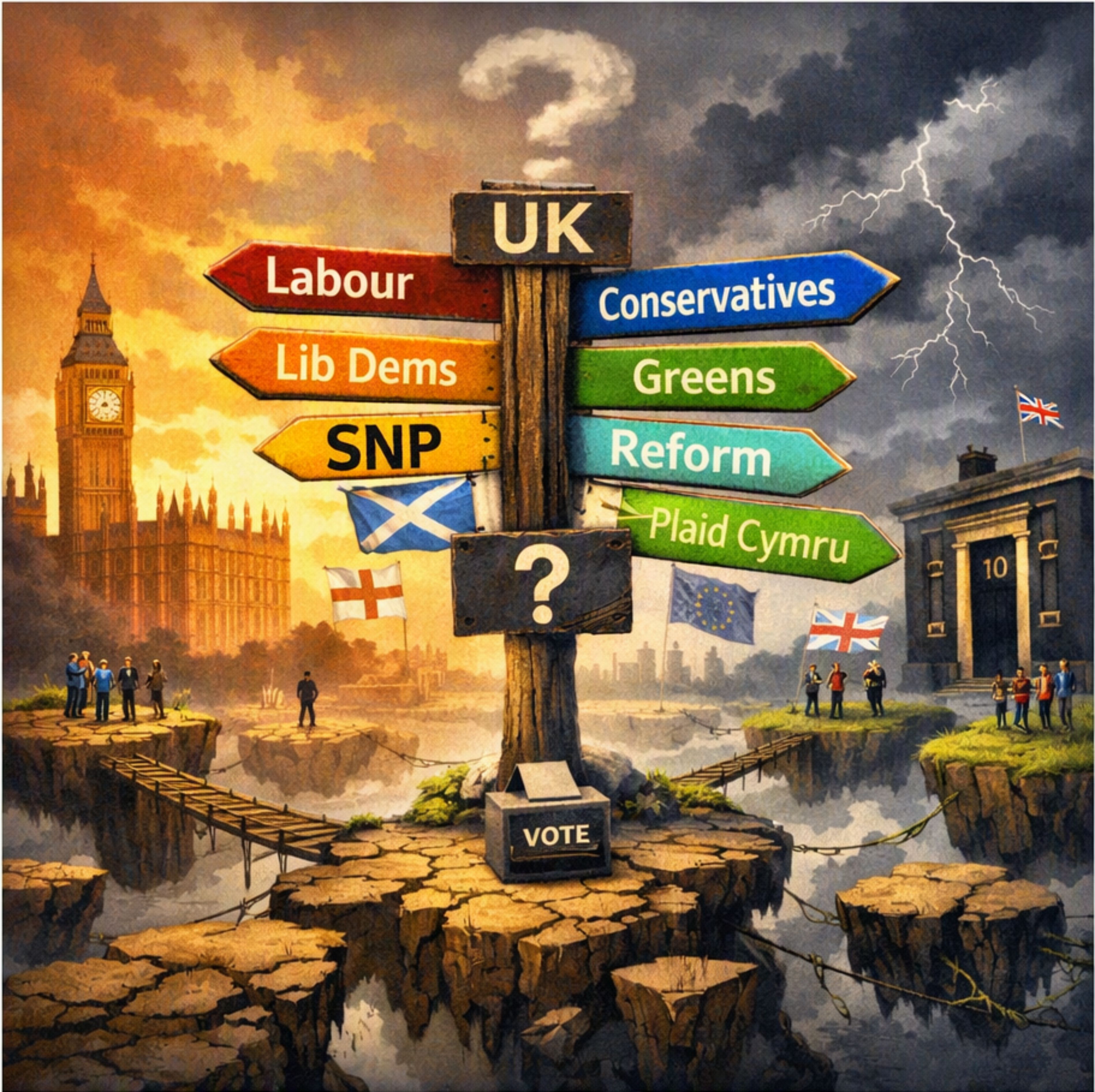

This is not a prediction. It is not an attempt to forecast outcomes, anticipate seat numbers, or claim special insight into what will happen next. It is simply a snapshot of a moment – the moment immediately after the 2026 party conference season and just days after the Holborn and St Pancras by‑election – a moment in which British politics feels unusually fluid, unusually reactive, and unusually susceptible to sudden shifts.
Trying to predict elections at any time other than the moment itself is a fool’s game – especially in the current moment. Everything moves too quickly. Every party is operating inside a system that no longer behaves predictably. And every political actor, from the Prime Minister downwards, is navigating pressures that only become fully visible once they cross the threshold of Number 10.
But even without predictions, it is possible to observe the incentives, the pressures, and the structural realities that shape the choices available to Andy Burnham – and to consider why one of those choices, going to the country early, may make sense for him while simultaneously accelerating the uncertainty facing everyone else.
This is the terrain on which this moment sits.
The Litmus Test Moment
The Holborn and St Pancras by‑election did not take place in isolation. It landed at the end of a conference season in which one of the most striking developments was the sudden and severe collapse of the Green Party’s expected vote – a collapse that now appears to reflect not only a rejection of Zac Polanski’s leadership, but also public discomfort with the party’s newly adopted anti‑Zionist position, formally endorsed at its conference.
The wording of that position matters, and should be considered carefully. The Greens framed it as a stance rooted in human‑rights concerns and solidarity with Palestinian communities. But whatever the internal rationale, the external political effect was clear: a significant portion of the electorate reacted negatively, and the party’s support fell sharply.
For No. 10, this combination – a by‑election result showing Labour strength, a Green collapse that consolidates the progressive vote, and a right‑wing landscape fractured across multiple parties – would have functioned as a litmus test. Not a prediction tool, not a guarantee, but a moment of political clarity: a snapshot of how the electoral weather looks right now.
It is in the days following that result that Burnham’s comments about a possible future EU referendum appeared. Not as a commitment, not as a policy, but as a signal – the kind of signal governments send when they are testing the boundaries of what might be politically possible.
Signals like that do not appear by accident. They appear when a government is assessing its options.
And one of those options, whether or not it is ultimately chosen, is an early election.
Why an Early Election Might Make Sense for Burnham
Again, this is not a prediction. It is simply an examination of the incentives visible in the moment.
1. The Fragmentation of the Right – And Why They Are Not Ready
The political right is not merely divided – it is structurally disoriented. As explored in The Unfolding Tragedy of the UK’s Political Right, The Squandered Moment, and Are the Conservatives Really the Adults in the Room?, the Conservatives, Reform UK, and Restore are not fighting over policy. They are fighting over purpose. And none of them can reach the purpose they are fighting for.
Reform UK has stumbled into institutional crisis. Its attempt to present itself as a government‑in‑waiting collapsed under the weight of its own internal contradictions. The Conservatives, meanwhile, are still searching for a post‑Brexit identity, still divided over direction, and still unable to present a coherent account of what they are for beyond opposition to Labour and the age-old choice between them or us.
Restore remains a movement without a governing theory.
This is not a landscape ready to contest a general election. It is a landscape still trying to work out what it is.
For a governing party, this fragmentation is a strategic gift – especially when elections are less about democratic accountability but rather more a consumer-style choice. It may not last. But it exists for now.
2. The Collapse of the Greens
The Greens’ recent decline removes the last significant vote‑splitter on the progressive side of the spectrum. In a snap election, that consolidation would matter.
3. Burnham’s Own Narrative Architecture
Burnham’s first conference speech as Prime Minister was filled with policies framed for “the next Parliament”. His language around Europe, constitutional reform, and long‑term structural change was arguably not the language of a leader settling in for a full term. It was the language of a leader preparing a manifesto.
This is not evidence of intent. But it is evidence of positioning.
4. The Contemporary Politicians’ Dilemma
As explored in The Contemporary Politicians’ Dilemma, modern Prime Ministers discover very quickly that the system they inherit is already failing. They do not steer it. They are carried by it.
Burnham has already had that briefing. He already knows the constraints. He already knows that meaningful action is limited.
A fresh mandate becomes one of the few forms of agency available to a leader trapped inside a failing system.
5. The Justification Narrative
The comments about Russian interference in the 2016 referendum fit neatly into a broader pattern:
- moral justification (“the public deserves clarity”)
- democratic justification (“the original mandate was compromised”)
- strategic justification (“Britain’s place in Europe must be revisited”)
Governments build justification narratives when they are considering major moves.
A snap election is a major move.
Why an Early Election Might Make Things Worse for Everyone Else
This is where the structural argument becomes unavoidable.
1. Burnham Could Secure Five Years – But Only in Outline
Even if Burnham were returned with a mandate – even if he secured something close to the working majority he inherited from Keir Starmer – he would not inherit a situation in which meaningful forward movement is possible.
The system is too constrained. The crisis is too structural. The machinery is too brittle.
A mandate is not the same as a governing environment.
Burnham could secure five years in outline only – a term on paper, not a term in which the system can deliver what the mandate implies.
2. The Most Likely Outcome Is a Minority Administration
This is not a prediction. It is simply one plausible scenario in a fragmented landscape.
Right now, the confidence inside No. 10 may be misplaced. The Conservatives are not ready. Reform UK is not ready. Restore is not ready. And Labour may not be as secure as it appears.
A minority administration – one that becomes a majority only with the support of the Liberal Democrats or similar – is a realistic possibility.
Kemi Badenoch has been clear that she will not work with Reform UK. Nigel Farage has not ruled out a post‑election agreement with the Conservatives, but it is difficult to imagine him falling in behind Badenoch if the seat numbers are close. At the very least, it is easy to imagine that he would likely want a major office of state – perhaps Chancellor – in order to step in behind.
This is not a stable foundation for governing a structural crisis – even before we think about the realities that would await the next administration – whoever the key players might be who walk through the No.10 door.
3. Elections No Longer Renew the System
In The Next Election Cannot Really Be Won, the argument is clear:
Elections no longer deliver renewal. They deliver exhaustion.
The political system is already strained. Its stabilisers are weakened. Its capacity is diminished. Its ability to absorb another full electoral cycle is questionable.
A snap election would not fix this. It would intensify it.
4. The Suspended State of Brexit
Britain remains trapped in a suspended state – a decision made, a destination never reached. Burnham’s EU comments extend that suspended state rather than resolve it.
A snap election would turn that suspension into turbulence.
5. Political Cuckooism
In Political Cuckooism, the argument is simple:
Cuckoo actors thrive in systems that are already failing.
A snap election would create exactly the kind of narrative vacuum in which cuckoo actors flourish – opportunists, collapse‑narrative merchants, and factions that feed on instability rather than resolve it.
The moment an election is called, more of the cuckoos wake up.
The Starting Gate Moment
The noises emerging from Westminster suggest that the starting gate may open after the Budget on 28 October. This is the moment when No. 10 may hope that a new mandate – even a fragile one – will allow it to leave the current mess behind.
Whether that hope is realistic is another matter entirely.
A Moment That Could Tip Either Way
This article is not an argument for or against an early election. It is not a prediction. It is not a forecast. It is simply a reflection on a moment in which the incentives for the Prime Minister and the risks for the country are moving in opposite directions.
Burnham may go early. He may not. The political weather may shift again next week.
But the structural reality remains:
- an early election may make sense for him
- and accelerate uncertainty for everyone else
This is the paradox of leadership at the end of a system.
And it is why anyone, in any party, would do well to remember that in the current climate, movement is not direction – and confidence is not control.
Further Reading
The following essays explore the deeper structural themes behind this moment – the fragmentation of the right, the exhaustion of the political system, the crisis of leadership, and the emergence of destabilising political behaviours.
Together, they provide a wider context for understanding why an early election might make sense for Andy Burnham, yet accelerate uncertainty for everyone else.
I. The Fragmentation of the Right
1. The Unfolding Tragedy of the UK’s Political Right
Link: https://adamtugwell.blog/2025/01/14/the-unfolding-tragedy-of-the-uks-political-right/
A structural examination of how the political right entered a period of existential disorientation. This piece explains why the Conservatives, Reform UK, and Restore are not divided over policy but over purpose – and why none of them can reach the purpose they are fighting for.
2. What Is the Right Really For? Why Britain’s Conservatives, Reform UK and Restore Are Fighting Over Something None of Them Can Reach
A deeper exploration of the right’s identity crisis. This essay shows how each party is attempting to claim ownership of a political project that no longer exists – and why this leaves the entire right unprepared for government.
3. Are the Conservatives Really the Adults in the Room? A Structural Examination of a Political Myth
A dismantling of the long‑standing myth that the Conservatives represent stability or competence. This piece explains why the party’s internal culture, strategic confusion, and institutional drift make it structurally incapable of providing the leadership it claims to offer.
II. Elections, Exhaustion, and Systemic Failure
4. The Next Election Cannot Really Be Won – And Why What Follows Matters Even More
A foundational essay arguing that elections no longer renew the political system – they exhaust it. This piece explains why the next government, whoever leads it, will inherit a crisis that cannot be solved through electoral politics.
5. Democracy Isn’t a Choice Between Parties – It’s the Revaluation of How We Live Together
A broader reflection on democracy itself. This essay argues that democratic renewal cannot come from party competition, but from a deeper re‑evaluation of how society understands power, responsibility, and collective life.
III. Leadership at the End of a System
6. What Leadership Means When the System Is Failing
Link: https://adamtugwell.blog/2026/09/08/what-leadership-means-when-the-system-is-failing/
A definition of leadership suited to a failing system. This piece distinguishes between real leadership – meaningful action inside constraint – and the performance‑based leadership now dominating Westminster.
7. The Absence of Leadership in a System Built for Managers and Nothing More
An explanation of why modern politicians cannot lead in the traditional sense. The system has been redesigned for managers, not leaders – and this structural reality shapes every decision made inside government.
8. The Performance of Politics: Why Power No Longer Serves People
Link: https://adamtugwell.blog/2026/06/18/the-performance-of-politics-why-power-no-longer-serves-people/
A critique of performance politics. This essay shows how political actors have become performers of power rather than exercisers of it – and why this leaves the public trapped in a cycle of narrative rather than action.
9. The Time for Performance Is Over
Link: https://adamtugwell.blog/2026/08/29/the-time-for-performance-is-over/
A call for political actors to abandon narrative‑driven politics and confront the structural crisis directly. This piece argues that performance has become a barrier to the honesty and realism the moment requires.
10. The Contemporary Politicians’ Dilemma
Link: https://adamtugwell.blog/2024/12/05/the-contemporary-politicians-dilemma/
A foundational essay explaining why modern politicians discover, upon entering office, that the system they inherit is already failing – and why this leaves them with almost no meaningful levers of action.
IV. Destabilising Behaviours in a Failing System
11. Political Cuckooism
Link: https://adamtugwell.blog/2026/10/09/political-cuckooism/
An examination of “cuckoo actors” – political figures and movements that thrive in failing systems by exploiting instability, narrative vacuums, and institutional weakness. This essay explains why such actors multiply the moment an election is called.
Closing Note
Taken together, these essays form a structural map of the political moment Britain now occupies: a fragmented right, an exhausted system, a political class built for performance rather than leadership, and a landscape increasingly shaped by destabilising actors.
They do not predict what will happen next. They simply illuminate why the choices available to political leaders – including the choice to go to the country early – are shaped by forces far larger than any single party or personality.

