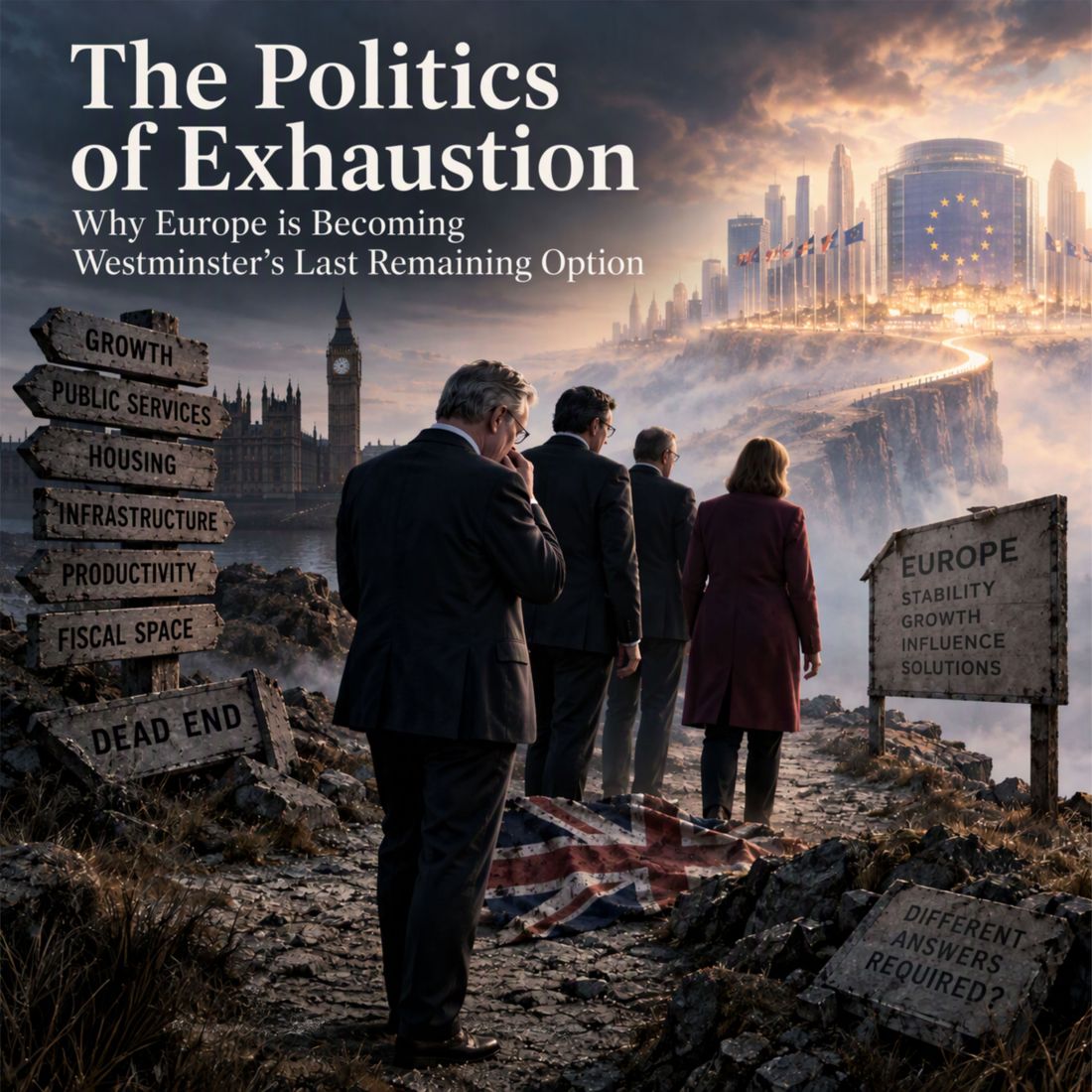
The Politics of Exhaustion | Why Europe is Becoming Westminster’s Last Remaining Option

There are moments in politics when a government appears to be making choices.

And there are moments when it becomes apparent that it is simply running out of them.

Increasingly, Britain feels like the latter.

The significance of the recent interventions by Andy Burnham and Rachel Reeves is not that they have reopened the European question. That process has been creeping forward for years through the language of resets, partnerships, alignment and cooperation.

What has changed is something subtler.

For the first time since Brexit, influential figures are beginning to talk as though Britain’s long-term future may ultimately lie back inside the European project itself. What was once implied is increasingly being stated. What was once political subtext is beginning to look like political direction.

Most commentary has focused on what this says about rejoining The EU.

The more interesting question is what it says about Westminster.

Because the growing attraction of Europe may reveal less about the strength of the European option than the weakness of every other option now visible to Britain’s governing class.

The Halfway House Reaches its Limit

Since leaving the European Union, Britain has existed in an uncomfortable halfway house.

The country formally left the institutional structures of the bloc, yet many of the deeper forces that shaped Britain’s economy remained largely untouched. Financialisation continued. Centralisation continued. Dependence on debt-fuelled growth continued. Productive capacity remained weak. Regional imbalances remained stubbornly entrenched.

The reconstruction that was supposed to follow Brexit never truly arrived.

As a result, Britain has spent much of the last decade trapped in an increasingly peculiar position. Outside enough of The EU to lose some of the advantages of membership, yet without having undertaken the structural reforms necessary to exploit the opportunities of departure.

It is a position that satisfies almost nobody.

And because it satisfies almost nobody, a conclusion has gradually become stronger within parts of the political establishment that ‘leaving’ was the mistake.

But that conclusion rests upon a significant assumption.

It assumes that Britain’s difficulties were created by Brexit rather than revealed by it.

Running Out of Road

The political reality confronting any government today is brutal.

Economic growth remains weak. Public services require resources that governments struggle to provide. Infrastructure demands investment measured in decades while politics increasingly operates in electoral cycles. Housing remains dysfunctional. Productivity remains stagnant. Debt constrains everything.

Every government enters office promising change.

Every government eventually discovers the same limitations.

The result is a political system that increasingly appears trapped.

There is no obvious tax solution.

There is no obvious spending solution.

There is no obvious growth solution.

There is certainly no quick solution.

Eventually a point is reached where governments stop searching for better answers and start searching for larger frameworks.

That is where Europe enters the picture.

Not necessarily as an ideal.

Not necessarily even as a conviction.

But as a mechanism.

A system that appears capable of creating options where none currently exist.

A framework large enough to absorb problems that national governments increasingly struggle to solve.

A route that appears, at least superficially, to lead somewhere.

The Last Remaining Answer

Viewed through this lens, the recent interventions from Burnham and Reeves take on a different significance.

They can be read not simply as endorsements of Europe but as acknowledgements of a deeper reality.

Westminster is running out of ideas.

This is not an accusation of incompetence. Almost any government would likely arrive at a similar position. The constraints are structural rather than personal.

Yet the consequences are profound.

When political systems exhaust their available options, they begin returning to familiar territory. Solutions previously rejected acquire new appeal. Paths once abandoned begin to look attractive again.

EU membership increasingly feels like such a path.

Not because it has suddenly become irresistible.

But because it is increasingly difficult for many within the political establishment to imagine anything else.

The attraction lies not necessarily in EU strength.

It lies in domestic weakness.

The Electoral Calculation

This is why the next general election may prove far more significant than many currently realise.

At present, no government possesses a clear mandate to pursue eventual re-entry into the European Union.

That obstacle remains substantial. But obstacles in politics have a habit of becoming opportunities.

A future manifesto offering a pathway towards deeper integration, closer institutional alignment or eventual membership would solve an immediate political problem.

It would place responsibility back in the hands of voters.

And from the perspective of the governing class, it creates a remarkably attractive outcome regardless of the result.

If such a programme is rejected, the government falls and someone else inherits Britain’s problems. The incoming administration then encounters exactly the same fiscal constraints, infrastructure challenges, demographic pressures and economic limitations as its predecessor.

The reality does not change simply because the occupants of Whitehall do.

If the programme succeeds, however, the government acquires something it presently lacks: democratic legitimacy for a strategic shift towards Europe.

Either way, the dilemma is resolved.

Either the burden is transferred.

Or the mandate is secured.

That is what makes the European question increasingly attractive politically.

The Problem with Desperation

There is, however, a danger in all of this.

Political exhaustion can easily disguise itself as strategic clarity.

When governments become sufficiently constrained, the remaining options inevitably begin to look more attractive than they actually are. Familiarity starts to resemble foresight. Necessity starts to resemble wisdom.

Yet there is remarkably little evidence that the forces constraining Britain are uniquely British.

Many of the pressures visible in the United Kingdom are visible throughout the wider developed world. Weak growth. Demographic strain. Debt burdens. Housing shortages. Growing distrust of institutions. Political fragmentation.

The assumption now quietly emerging within Westminster is that these problems become more manageable inside the European framework.

Perhaps they do. But that remains an assumption rather than a demonstrated fact.

After all, the European Union itself is increasingly confronting profound questions about its own future direction. Debates around fiscal sustainability, economic divergence, governance and political legitimacy are becoming more frequent, not less.

This raises an uncomfortable possibility.

What if Westminster is treating Europe as a solution to pressures that Europe itself is struggling to resolve?

Paradigm Blindness

Perhaps the most important aspect of this debate is not Europe at all. It is the lens through which Britain’s political class sees the world.

Every generation becomes captive to certain assumptions. Over time those assumptions become so deeply embedded that they cease to appear ideological. They simply become reality.

The assumption that larger systems are inherently more stable.

The assumption that deeper integration necessarily produces better outcomes.

The assumption that political problems can ultimately be solved through better administration and larger frameworks.

These assumptions shaped much of the modern political era. They also shaped the generation of politicians currently running it.

This is why the growing movement towards Europe may represent something deeper than policy.

It may represent the limits of political imagination.

Faced with mounting pressures and shrinking room for manoeuvre, Westminster continues searching for solutions inside the framework that produced its understanding of the world.

Europe remains visible because Europe belongs to that framework.

Everything else appears increasingly unimaginable.

Conclusion

The emerging debate about Europe is often presented as a debate about Britain’s future relationship with the European Union.

In reality, it may be a debate about something else entirely.

It may be a debate about what happens when a political class reaches the edge of its available options.

Britain’s governing institutions increasingly appear to believe that Europe represents the last remaining route back towards growth, stability and governability. That belief may yet shape the next general election. It may even become the defining strategic proposition offered to the electorate.

Whether it succeeds is another matter entirely.

Because the central question is not whether rejoining the EU can be presented as an answer.

The central question is whether Britain’s problems are actually the kinds of problems EU membership can solve.

That distinction may determine far more than the next election.

It may determine whether Westminster is identifying a genuine path forward, or simply pursuing the last answer it still knows how to imagine.
The Water Fish Cannot See

Why the debate about ending forty years of neoliberalism may be missing the point

A Curious Reaction

When Andy Burnham first began talking about ending forty years of neoliberalism, I expected disagreement. Political ideas that touch something substantial almost always provoke a reaction.

What surprised me was not the fact that people argued about it, but the way they argued about it. Within a remarkably short period of time, the conversation seemed to settle into familiar territory.

Supporters presented the idea as a long-overdue recognition of Britain’s failures. Critics responded as though they were hearing an argument for returning to the 1970s. The disagreement was immediate, energetic and entirely predictable.

What interested me was something else.

The entire discussion appeared to assume that everybody already knew what the phrase meant. More than that, it assumed that everybody knew where the boundaries of the debate lay.

The disagreement was not over whether the phrase described reality, but over whether leaving that reality would be desirable.

The argument became a choice between continuation and reversal. We were either remaining on the path set in motion during the Thatcher years or attempting to retrace our steps back to an earlier model.

The possibility that neither description accurately captured the moment we are living through barely appeared.

That omission is worth dwelling on because it points toward a question that feels increasingly important.

How would anybody recognise the end of an era while they were still living inside it?

The Strange Journey of Political Language

Political systems are constantly searching for language that captures things people can already feel but struggle to describe. Most books never reach beyond their audience. Most detailed arguments remain where they begin. What tends to travel are phrases.

A phrase can migrate from essays into newspaper columns, from newspaper columns into think-tank reports, from think-tank reports into speeches and from speeches into everyday conversation.

The more successful the phrase, the further it travels.

What is interesting is that understanding rarely travels at the same speed.

By the time a useful phrase reaches the centre of political discourse, it has often become detached from the intellectual framework that produced it. Different people begin using it for different purposes. It stops functioning as an explanation and starts functioning as a signal. It becomes useful because it conveys a mood, a direction of travel or a sense that something important is happening.

That does not mean everybody using the phrase understands the same thing.

In fact, it often means the opposite.

The phrase survives precisely because different groups can pour different meanings into it.

This may be one reason the language of “forty years of neoliberalism” has been so successful. The phrase clearly touches a nerve. It captures a widespread feeling that something about Britain’s trajectory deserves re-examination. What remains far less clear is whether there is equal agreement about what is actually being described.

When Systems Disappear

Part of the difficulty lies in the way successful systems evolve.

Most people think of neoliberalism as a collection of policies. Privatisation. Deregulation. Globalisation. Financialisation. Depending on who is speaking, those developments either saved Britain or hollowed it out. Entire political careers have been built around defending or attacking those changes.

Yet policies are only the visible layer of a system.

The deeper layer is the collection of assumptions that develops around them.

What counts as economic success. What counts as competence. Which institutions matter. Which risks deserve attention. What questions can be asked. Which outcomes are considered realistic.

At first those assumptions are visible because people remember alternatives. Over time they become harder to see. New generations inherit them. Institutions are organised around them. Political careers are built within them. Eventually they stop appearing as assumptions and start appearing as reality.

The system disappears from view precisely because it becomes normal.

That is why I have always preferred thinking in terms of operating systems rather than ideologies.

People know they are choosing between ideologies.

They rarely realise they are working inside an operating system.

The Water Fish Cannot See

The old phrase about fish being unable to see water survives because it captures something profoundly human.

We are very good at adapting to our environment. In fact, we are so good at it that we often stop noticing the environment altogether.

The process is visible everywhere.

People adapt to fragility.

Institutions adapt to constraints.

Political parties adapt to assumptions.

Entire societies adapt to conditions that previous generations might have regarded as extraordinary.

Eventually the adaptation becomes so complete that the thing shaping behaviour vanishes into the background.

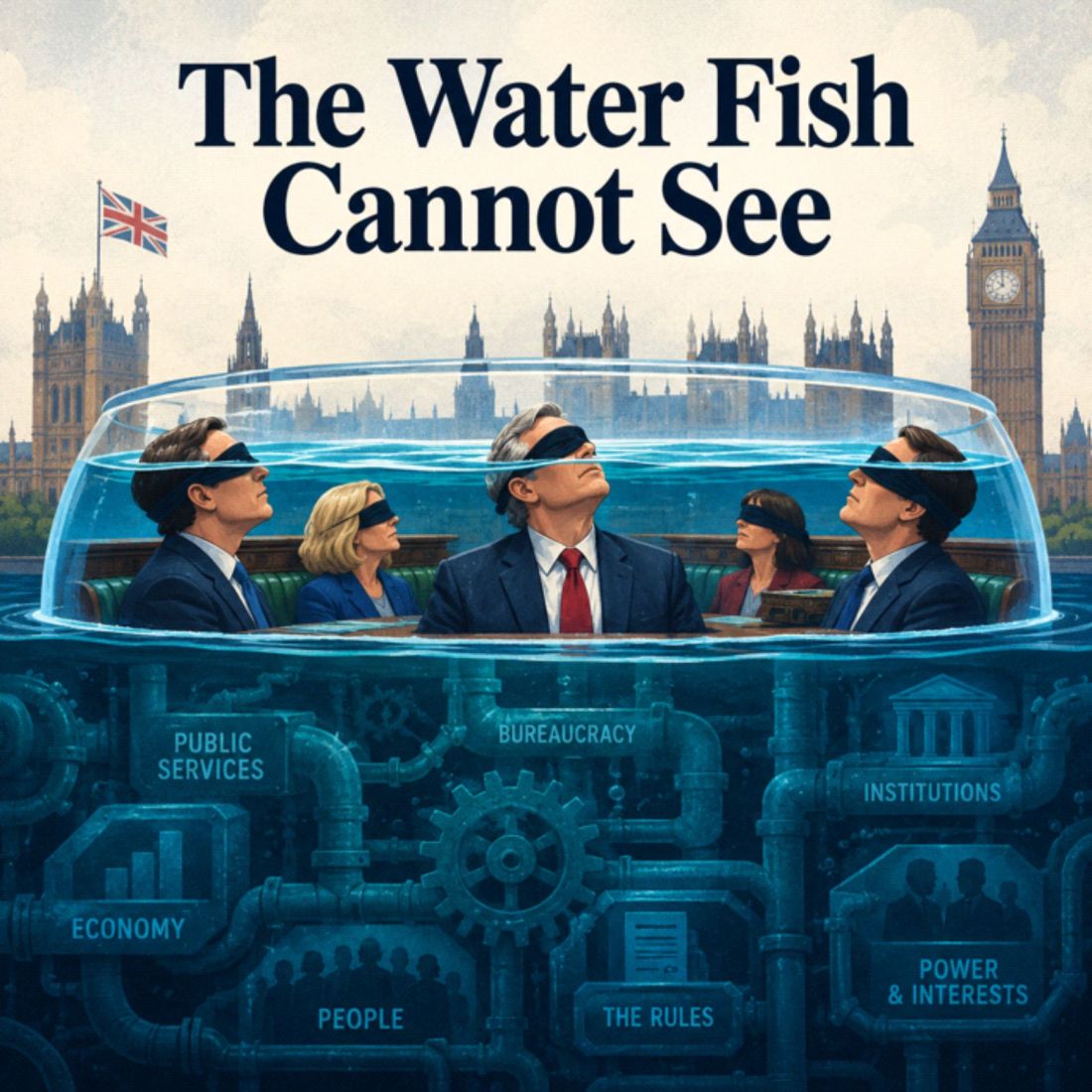
The fish sees the currents, the movement and the consequences. The fish does not see the water.

This is why discussions about political change often feel strangely unsatisfying. Politicians can spend hours arguing about policy while sharing assumptions they no longer recognise as assumptions. Journalists can write thousands of words about reform while accepting the framework within which reform is constrained. Economists can debate outcomes while rarely examining the environment producing them.

This is not evidence of stupidity.

It is evidence of immersion.

Why the Debate Feels Incomplete

The more I listened to the discussion surrounding the end of forty years of neoliberalism, the more I found myself wondering whether the debate was unfolding at the wrong level.

The assumption seemed to be that people stand outside the system, evaluate it and then choose whether to continue it.

But what if that is not how systems work?

What if people are shaped by an operating environment long before they start questioning it?

Viewed through that lens, the interesting question is not whether a political movement wishes to move beyond neoliberalism.

The interesting question is whether anybody can clearly see the assumptions they inherited from it.

That challenge becomes particularly difficult when those assumptions have become embedded within ideas that appear self-evident. Growth. Productivity. Competitiveness. Confidence. Credibility.

These concepts are treated as neutral descriptions of reality. Rarely are they examined as products of a particular way of understanding reality.

The water has become invisible.

Sensing an Ending

This is one reason I find the current moment so fascinating.

For several years I have argued that Britain’s operating model appears to be reaching the end of its natural life. Not because somebody decided it should end, but because the conditions that sustained it are changing. The issue is not morality. It is fit.

Operating systems work because they fit the environment in which they emerge. They begin to struggle when the environment changes faster than the assumptions embedded within them.

What strikes me today is how many institutions appear to be sensing this shift.

The language has changed.

The confidence has changed.

The mood has changed.

People speak increasingly about resilience, security, sovereignty, capability and exposure. Themes that sat comfortably in the background for decades have moved closer to the centre of public debate.

Something is clearly being felt.

Whether it is fully understood is another question.

History suggests that people often experience the sensation of transition before they understand its cause. They feel the edge of an era long before they can describe it.

The Language of Maintenance

This is partly why the recent Budget interested me.

What stood out was not a particular policy but a tone.

Much of the language revolved around creating “breathing space”, managing pressures and helping households navigate difficult circumstances. Even the temporary tax surcharge on banks was presented in terms of short-term support rather than long-term transformation.

The emphasis repeatedly returned to stability, discipline, confidence and the need to navigate a difficult external environment.

None of this is inherently unreasonable. Yet it has a particular flavour.

It is the language of maintenance. The language of holding things together. The language of preserving stability while a system encounters pressures for which it was not originally designed.

That does not mean the people using that language are wrong. It simply raises an interesting possibility.

Perhaps many of the actors discussing the end of an era are simultaneously operating within the assumptions of that era.

Not because they are trapped. But because they have never known anything else.

Missing the Point

This brings us back to the original phrase.

The debate about ending forty years of neoliberalism often assumes that the central question is whether neoliberalism succeeded or failed.

I am increasingly persuaded that a deeper question sits underneath it.

What if the most significant issue is not whether an era is ending, but whether we are capable of recognising the operating system that shaped the era in the first place?

The difference matters.

One debate concerns policies. The other concerns perception.

One asks what should happen next. The other asks whether we fully understand where we are standing now.

Those are not the same thing.

The Ground Beneath Our Feet

The most successful operating systems are not the ones people passionately defend. They are the ones people stop noticing.

The assumptions become common sense. The framework becomes reality. The environment becomes invisible.

At that point, even criticism of the system may continue speaking its language.

That is why I find the current moment so intriguing.

Not because I know what comes next.

Not because I am convinced anybody else does either.

But because more and more people seem to be sensing that something is changing beneath their feet.

The phrase “forty years of neoliberalism” may be evidence of that feeling. The argument surrounding it may be evidence too.

The question is not whether the era is ending.

It is whether we can see the water clearly enough to understand the thing that shaped us before it disappears.

Why Burnham Might Go to the Country – And Why Everyone Else Should Be Careful What They Wish For

This is not a prediction. It is not an attempt to forecast outcomes, anticipate seat numbers, or claim special insight into what will happen next. It is simply a snapshot of a moment – the moment immediately after the 2026 party conference season and just days after the Holborn and St Pancras by‑election – a moment in which British politics feels unusually fluid, unusually reactive, and unusually susceptible to sudden shifts.

Trying to predict elections at any time other than the moment itself is a fool’s game – especially in the current moment. Everything moves too quickly. Every party is operating inside a system that no longer behaves predictably. And every political actor, from the Prime Minister downwards, is navigating pressures that only become fully visible once they cross the threshold of Number 10.

But even without predictions, it is possible to observe the incentives, the pressures, and the structural realities that shape the choices available to Andy Burnham – and to consider why one of those choices, going to the country early, may make sense for him while simultaneously accelerating the uncertainty facing everyone else.

This is the terrain on which this moment sits.

The Litmus Test Moment

The Holborn and St Pancras by‑election did not take place in isolation. It landed at the end of a conference season in which one of the most striking developments was the sudden and severe collapse of the Green Party’s expected vote – a collapse that now appears to reflect not only a rejection of Zac Polanski’s leadership, but also public discomfort with the party’s newly adopted anti‑Zionist position, formally endorsed at its conference.

The wording of that position matters, and should be considered carefully. The Greens framed it as a stance rooted in human‑rights concerns and solidarity with Palestinian communities. But whatever the internal rationale, the external political effect was clear: a significant portion of the electorate reacted negatively, and the party’s support fell sharply.

For No. 10, this combination – a by‑election result showing Labour strength, a Green collapse that consolidates the progressive vote, and a right‑wing landscape fractured across multiple parties – would have functioned as a litmus test. Not a prediction tool, not a guarantee, but a moment of political clarity: a snapshot of how the electoral weather looks right now.

It is in the days following that result that Burnham’s comments about a possible future EU referendum appeared. Not as a commitment, not as a policy, but as a signal – the kind of signal governments send when they are testing the boundaries of what might be politically possible.

Signals like that do not appear by accident. They appear when a government is assessing its options.

And one of those options, whether or not it is ultimately chosen, is an early election.

Why an Early Election Might Make Sense for Burnham

Again, this is not a prediction. It is simply an examination of the incentives visible in the moment.

1. The Fragmentation of the Right – And Why They Are Not Ready

The political right is not merely divided – it is structurally disoriented. As explored in The Unfolding Tragedy of the UK’s Political Right, The Squandered Moment, and Are the Conservatives Really the Adults in the Room?, the Conservatives, Reform UK, and Restore are not fighting over policy. They are fighting over purpose. And none of them can reach the purpose they are fighting for.

Reform UK has stumbled into institutional crisis. Its attempt to present itself as a government‑in‑waiting collapsed under the weight of its own internal contradictions. The Conservatives, meanwhile, are still searching for a post‑Brexit identity, still divided over direction, and still unable to present a coherent account of what they are for beyond opposition to Labour and the age-old choice between them or us.

Restore remains a movement without a governing theory.

This is not a landscape ready to contest a general election. It is a landscape still trying to work out what it is.

For a governing party, this fragmentation is a strategic gift – especially when elections are less about democratic accountability but rather more a consumer-style choice. It may not last. But it exists for now.

2. The Collapse of the Greens

The Greens’ recent decline removes the last significant vote‑splitter on the progressive side of the spectrum. In a snap election, that consolidation would matter.

3. Burnham’s Own Narrative Architecture

Burnham’s first conference speech as Prime Minister was filled with policies framed for “the next Parliament”. His language around Europe, constitutional reform, and long‑term structural change was arguably not the language of a leader settling in for a full term. It was the language of a leader preparing a manifesto.

This is not evidence of intent. But it is evidence of positioning.

4. The Contemporary Politicians’ Dilemma

As explored in The Contemporary Politicians’ Dilemma, modern Prime Ministers discover very quickly that the system they inherit is already failing. They do not steer it. They are carried by it.

Burnham has already had that briefing. He already knows the constraints. He already knows that meaningful action is limited.

A fresh mandate becomes one of the few forms of agency available to a leader trapped inside a failing system.

5. The Justification Narrative

The comments about Russian interference in the 2016 referendum fit neatly into a broader pattern:

  • moral justification (“the public deserves clarity”)
  • democratic justification (“the original mandate was compromised”)
  • strategic justification (“Britain’s place in Europe must be revisited”)

Governments build justification narratives when they are considering major moves.

A snap election is a major move.

Why an Early Election Might Make Things Worse for Everyone Else

This is where the structural argument becomes unavoidable.

1. Burnham Could Secure Five Years – But Only in Outline

Even if Burnham were returned with a mandate – even if he secured something close to the working majority he inherited from Keir Starmer – he would not inherit a situation in which meaningful forward movement is possible.

The system is too constrained. The crisis is too structural. The machinery is too brittle.

A mandate is not the same as a governing environment.

Burnham could secure five years in outline only – a term on paper, not a term in which the system can deliver what the mandate implies.

2. The Most Likely Outcome Is a Minority Administration

This is not a prediction. It is simply one plausible scenario in a fragmented landscape.

Right now, the confidence inside No. 10 may be misplaced. The Conservatives are not ready. Reform UK is not ready. Restore is not ready. And Labour may not be as secure as it appears.

A minority administration – one that becomes a majority only with the support of the Liberal Democrats or similar – is a realistic possibility.

Kemi Badenoch has been clear that she will not work with Reform UK. Nigel Farage has not ruled out a post‑election agreement with the Conservatives, but it is difficult to imagine him falling in behind Badenoch if the seat numbers are close. At the very least, it is easy to imagine that he would likely want a major office of state – perhaps Chancellor – in order to step in behind.

This is not a stable foundation for governing a structural crisis – even before we think about the realities that would await the next administration – whoever the key players might be who walk through the No.10 door.

3. Elections No Longer Renew the System

In The Next Election Cannot Really Be Won, the argument is clear:

Elections no longer deliver renewal. They deliver exhaustion.

The political system is already strained. Its stabilisers are weakened. Its capacity is diminished. Its ability to absorb another full electoral cycle is questionable.

A snap election would not fix this. It would intensify it.

4. The Suspended State of Brexit

Britain remains trapped in a suspended state – a decision made, a destination never reached. Burnham’s EU comments extend that suspended state rather than resolve it.

A snap election would turn that suspension into turbulence.

5. Political Cuckooism

In Political Cuckooism, the argument is simple:

Cuckoo actors thrive in systems that are already failing.

A snap election would create exactly the kind of narrative vacuum in which cuckoo actors flourish – opportunists, collapse‑narrative merchants, and factions that feed on instability rather than resolve it.

The moment an election is called, more of the cuckoos wake up.

The Starting Gate Moment

The noises emerging from Westminster suggest that the starting gate may open after the Budget on 28 October. This is the moment when No. 10 may hope that a new mandate – even a fragile one – will allow it to leave the current mess behind.

Whether that hope is realistic is another matter entirely.

A Moment That Could Tip Either Way

This article is not an argument for or against an early election. It is not a prediction. It is not a forecast. It is simply a reflection on a moment in which the incentives for the Prime Minister and the risks for the country are moving in opposite directions.

Burnham may go early. He may not. The political weather may shift again next week.

But the structural reality remains:

  • an early election may make sense for him
  • and accelerate uncertainty for everyone else

This is the paradox of leadership at the end of a system.

And it is why anyone, in any party, would do well to remember that in the current climate, movement is not direction – and confidence is not control.

Further Reading

The following essays explore the deeper structural themes behind this moment – the fragmentation of the right, the exhaustion of the political system, the crisis of leadership, and the emergence of destabilising political behaviours.

Together, they provide a wider context for understanding why an early election might make sense for Andy Burnham, yet accelerate uncertainty for everyone else.

I. The Fragmentation of the Right

1. The Unfolding Tragedy of the UK’s Political Right

Link: https://adamtugwell.blog/2025/01/14/the-unfolding-tragedy-of-the-uks-political-right/

A structural examination of how the political right entered a period of existential disorientation. This piece explains why the Conservatives, Reform UK, and Restore are not divided over policy but over purpose – and why none of them can reach the purpose they are fighting for.

2. What Is the Right Really For? Why Britain’s Conservatives, Reform UK and Restore Are Fighting Over Something None of Them Can Reach

Link: https://adamtugwell.blog/2026/06/16/what-is-the-right-really-for-why-britains-conservatives-reform-uk-and-restore-are-fighting-over-something-none-of-them-can-reach/

A deeper exploration of the right’s identity crisis. This essay shows how each party is attempting to claim ownership of a political project that no longer exists – and why this leaves the entire right unprepared for government.

3. Are the Conservatives Really the Adults in the Room? A Structural Examination of a Political Myth

Link: https://adamtugwell.blog/2026/10/07/are-the-conservatives-really-the-adults-in-the-room-a-structural-examination-of-a-political-myth/

A dismantling of the long‑standing myth that the Conservatives represent stability or competence. This piece explains why the party’s internal culture, strategic confusion, and institutional drift make it structurally incapable of providing the leadership it claims to offer.

II. Elections, Exhaustion, and Systemic Failure

4. The Next Election Cannot Really Be Won – And Why What Follows Matters Even More

Link: https://adamtugwell.blog/2026/08/23/the-next-election-cannot-really-be-won-and-why-what-follows-matters-even-more/

A foundational essay arguing that elections no longer renew the political system – they exhaust it. This piece explains why the next government, whoever leads it, will inherit a crisis that cannot be solved through electoral politics.

5. Democracy Isn’t a Choice Between Parties – It’s the Revaluation of How We Live Together

Link: https://adamtugwell.blog/2026/10/06/democracy-isnt-a-choice-between-parties-its-the-revaluation-of-how-we-live-together/

A broader reflection on democracy itself. This essay argues that democratic renewal cannot come from party competition, but from a deeper re‑evaluation of how society understands power, responsibility, and collective life.

III. Leadership at the End of a System

6. What Leadership Means When the System Is Failing

Link: https://adamtugwell.blog/2026/09/08/what-leadership-means-when-the-system-is-failing/

A definition of leadership suited to a failing system. This piece distinguishes between real leadership – meaningful action inside constraint – and the performance‑based leadership now dominating Westminster.

7. The Absence of Leadership in a System Built for Managers and Nothing More

Link: https://adamtugwell.blog/2026/04/30/the-absence-of-leadership-in-a-system-built-for-managers-and-nothing-more/

An explanation of why modern politicians cannot lead in the traditional sense. The system has been redesigned for managers, not leaders – and this structural reality shapes every decision made inside government.

8. The Performance of Politics: Why Power No Longer Serves People

Link: https://adamtugwell.blog/2026/06/18/the-performance-of-politics-why-power-no-longer-serves-people/

A critique of performance politics. This essay shows how political actors have become performers of power rather than exercisers of it – and why this leaves the public trapped in a cycle of narrative rather than action.

9. The Time for Performance Is Over

Link: https://adamtugwell.blog/2026/08/29/the-time-for-performance-is-over/

A call for political actors to abandon narrative‑driven politics and confront the structural crisis directly. This piece argues that performance has become a barrier to the honesty and realism the moment requires.

10. The Contemporary Politicians’ Dilemma

Link: https://adamtugwell.blog/2024/12/05/the-contemporary-politicians-dilemma/

A foundational essay explaining why modern politicians discover, upon entering office, that the system they inherit is already failing – and why this leaves them with almost no meaningful levers of action.

IV. Destabilising Behaviours in a Failing System

11. Political Cuckooism

Link: https://adamtugwell.blog/2026/10/09/political-cuckooism/

An examination of “cuckoo actors” – political figures and movements that thrive in failing systems by exploiting instability, narrative vacuums, and institutional weakness. This essay explains why such actors multiply the moment an election is called.

Closing Note

Taken together, these essays form a structural map of the political moment Britain now occupies: a fragmented right, an exhausted system, a political class built for performance rather than leadership, and a landscape increasingly shaped by destabilising actors.

They do not predict what will happen next. They simply illuminate why the choices available to political leaders – including the choice to go to the country early – are shaped by forces far larger than any single party or personality.

Regional Centralisation: The Rewriting of England’s Democracy Without a Mandate

England is undergoing a constitutional transformation of unusual scale and significance. Under the banner of “devolution,” political leaders – most prominently Andy Burnham – are advancing a model that appears to empower regions but may, in practice, centralise authority at a higher tier, away from the most immediate and accessible forms of local democracy.

This is not a partisan project; politicians across the spectrum have expressed interest in similar reforms. But its implications for democratic legitimacy, local representation, and constitutional balance are profound.

What is emerging is not devolution in the traditional sense. It is regional centralisation: the consolidation of power into larger, higher-tier executive bodies that sit above existing councils, accompanied by the quiet removal or hollowing out of the lower tiers of government that citizens interact with most directly.

Crucially, this transformation is proceeding without a clear, direct mandate from the public.

The argument is not for preserving the current system unchanged, but for reform that deepens local accountability rather than bypassing it. Genuine devolution would move authority downward – to parish, town, district, and borough levels – granting councils meaningful fiscal autonomy and policy discretion within broad national frameworks.

The Disappearing Layers of Local Democracy

Most people are unaware of how many layers of local government currently represent them.

In much of England, people have:

• Parish or town councils, handling hyper‑local matters such as parks, community centres, and neighbourhood issues.

• District or borough councils, responsible for housing, planning applications, waste collection, and local services.

• County councils, overseeing education, social care, highways, libraries, and major infrastructure.

This multi‑layered system reflects the principle of subsidiarity: decisions should be made at the lowest possible level, closest to the people they affect. It provides multiple democratic access points, enabling residents to contact representatives who live nearby, understand local issues, and are accountable to small electorates.

Yet these layers are increasingly vulnerable to being reduced, merged, or bypassed. The shift toward unitary authorities and combined regional structures can replace large numbers of locally elected councillors with a smaller number of higher-tier decision-makers.

Accessibility shrinks, accountability thins, and decision-making moves further away from communities.

This is not administrative tidying.

It risks removing some of the most accessible forms of democracy.

Why Local Councils Already Feel Arbitrary – and Why That Matters

This loss is not always immediately visible. One reason it is easy to overlook is that many people already feel disconnected from their local councils.

Planning decisions, licensing rules, and other supposedly “local” policies often feel arbitrary or unresponsive. But this is not because councils are inherently flawed; it is because much of their power has already been stripped away.

Over the past two decades, local authorities have increasingly operated as delivery arms for central policy, rather than as fully autonomous democratic bodies.

In areas such as planning, licensing, housing, and social care, councils frequently:

• interpret national frameworks rather than create their own,

• implement centrally defined targets within strict statutory guidance,

• and make decisions constrained by national funding formulas.

This hollowing-out has helped create the impression that local government is ineffective or irrelevant. In reality, many councils have been significantly constrained by central policy, statutory obligations, and funding arrangements.

Regional centralisation now risks removing what remains.

Some may argue that if councils already feel powerless, their abolition is no great loss. But this misunderstands the problem. England’s democratic malaise stems from too much power already being held at the centre.

The remedy is not to remove even more local autonomy, nor to dismantle the structures that facilitate it. The remedy is to restore genuine local power, not to eliminate it.

Regional Executives: Power Upwards, Not Downwards

The emerging model concentrates authority in large, combined authorities led by regional executives. These bodies already oversee, or are being positioned to oversee, areas such as transport, housing, skills, infrastructure, and potentially wider fiscal powers.

They are designed to be strategic and streamlined – but streamlining comes at a democratic cost.

Where multiple tiers of local representation are replaced or subordinated to a higher regional executive, several consequences may follow:

• People may have fewer directly accessible representatives.

• Decision‑makers become more distant.

• Local dissent may carry less institutional weight.

• Party machinery may gain greater influence over candidate selection.

• Central government may face fewer local veto points.

This is why the term regional centralisation is so important.

Power is not being devolved to neighbourhoods or communities. It is being consolidated into larger units that are easier to manage from the centre.

As governance becomes more distant, electoral participation and civic engagement may weaken further, reinforcing the perception that local democracy is symbolic rather than meaningful.

A Constitutional Change Without Public Consent

The most serious issue is not merely structural; it is constitutional.

Changes of this magnitude alter the relationship between people and the state. They redefine how democracy functions and reshape the architecture of representation.

Yet England’s electorate has not been asked whether it wants:

• the abolition of district and county councils,

• the creation of regional executives with sweeping powers,

• new layers of governance with tax‑raising authority,

• or a restructured democratic system that reduces local access.

These reforms have not been clearly set out as a comprehensive constitutional settlement in recent national manifestos. They have not been subject to sustained public debate or submitted to referendum. Instead, they are largely being advanced through administrative and legislative pathways: secondary legislation, funding agreements, centrally negotiated devolution deals, and institutional restructuring rather than direct electoral mandates.

The constitutional principle is simple:

Consent in this context does not require unanimity, but it does require clear public awareness and an explicit opportunity to approve or reject change.

As a democratic principle, reforms of this scale can only claim legitimacy without a public vote where they clearly return power to people – not where they remove or distance it.

Regional centralisation does the latter while presenting itself as the former.

Historical Context: England Has Rejected This Before

This is not the first attempt to reorganise England into regional units.

During the early 2000s, the Blair government – in which Burnham served as a minister – supported proposals for elected regional assemblies in England. Wales and Scotland accepted their own forms of devolution; England did not follow the same path. In the North East, a referendum was held, and voters decisively rejected an elected regional assembly.

That earlier process, whatever its flaws, respected democratic norms. It asked the public. It held plebiscites. It acknowledged that constitutional change requires consent.

Today’s process does not.

A comparable regional logic is now being revived, but without referendums, without equivalent transparency, and without comparable public debate.

The electorate is being asked to accept institutional change after the fact, even though the principle at stake remains similar: who governs England, and at what level?

Why Policymakers Favour Regionalisation

To remain balanced, it is important to acknowledge why regional centralisation appeals to policymakers, particularly within the constraints of modern governance, fiscal pressure, and fragmented local structures.

Supporters argue that fragmented local governance cannot deliver the scale of planning required for modern transport, housing, skills, and economic development.

Larger regional bodies promise:

• clearer strategic planning,

• simplified negotiation with central government,

• economies of scale,

• more coherent transport and housing systems,

• and the ability to deliver large infrastructure projects.

These aims are understandable. In several areas, existing district and county structures have already or are being replaced by single unitary authorities as a precursor to, or companion of, wider combined regional bodies.

But administrative efficiency does not, by itself, justify reducing democratic access or proceeding without clear public consent. It cannot substitute for legitimacy.

Taxation: Local Powers, Higher Burdens

One of the most consequential elements of regional centralisation is the possible expansion of local or regional tax-raising powers. These are framed as tools for flexibility and investment. But England’s fiscal reality makes additional taxation a plausible and, in many cases, likely outcome.

Regional authorities may be handed responsibilities without matching resources.

Central government is under severe financial pressure. The Treasury is unlikely to provide substantial new funding.

The likely result is that local taxes and levies could rise, often in areas least able to absorb the cost.

This is not empowerment.

It risks downloading fiscal strain onto households already struggling with living costs. Citizens may pay more while having less influence over the bodies that set those taxes.

Party Control and the Rise of Regional Governors

Regional executives are not simply administrative leaders. They are political figures whose authority derives from national party structures.

As regional governance expands, these executives increasingly function as de facto regional governors – each representing a potential “Number 10 of the North” within their region – negotiating directly with central government and overseeing large budgets.

If proportional representation or party-list systems are introduced at the regional level – a possibility discussed in several political circles – party control could intensify. Candidate selection may move further from communities and closer to party headquarters.

Local independents may struggle to compete. Citizens may find themselves voting for party lists rather than individuals they know.

This is not an expansion of democracy.

It risks becoming a consolidation of party power.

Global Governance and Public Distrust

Regional centralisation also sits within a broader global context.

International governance networks often favour larger-scale, technocratic models of administration.

Such frameworks emphasise efficiency, coordination, and strategic planning, but can do so at the expense of local autonomy.

Whether one supports or opposes these trends, the perception that power is drifting upward – toward larger units, distant executives, and global networks – contributes to public distrust.

Citizens may come to feel that decisions are being made far away, by people they did not choose directly, within systems they do not understand.

Regional centralisation amplifies that feeling.

The Manchester Question: Optics Versus Outcomes

Advocates of regional governance often point to Manchester as a success story. The city-region has made visible progress in areas such as transport branding, homelessness initiatives, and cultural identity.

But the deeper metrics are mixed:

• productivity growth has remained challenging,

• inequality remains persistent,

• housing affordability has worsened in many areas,

• transport integration remains incomplete,

• and health outcomes continue to vary sharply across neighbourhoods.

Manchester’s experience is complex. It may demonstrate the power of regional branding and strategic coordination, but it does not justify scaling up a model that simultaneously removes local councils, increases tax powers, and reduces democratic access.

Conclusion: A Democratic Architecture Being Rewritten Without Consent

England’s democratic architecture is being reshaped through regional centralisation.

This process:

• risks removing accessible local councils,

• concentrates power in regional executives,

• may expand party control,

• may introduce new tax burdens,

• proceeds without clear public consent,

• and revives a regional model that England has previously rejected when it was put directly to voters.

The narrative is empowerment.

The reality is consolidation.

The danger is not that regional centralisation might fail.

The greater danger is not failure, but success on these terms: England could wake up with fewer democratic access points, higher taxes, more insulated political elites, and a governance structure it never explicitly agreed to.

The constitutional principle remains clear:

A change of this magnitude can only be considered legitimate without a public vote if it demonstrably returns power to the people – not if it removes or distances it.

Regional centralisation risks doing the latter while presenting itself as the former.