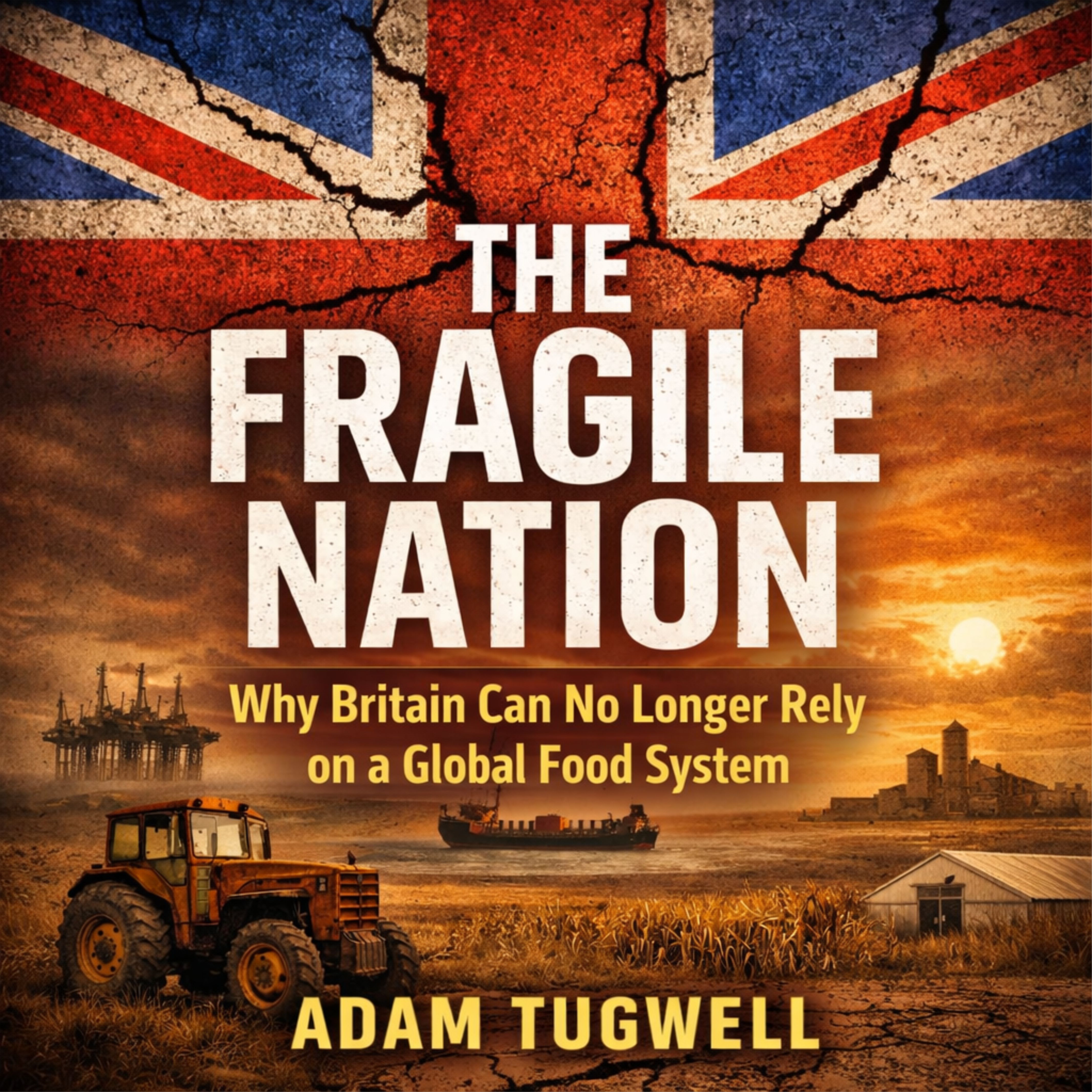

“We are not yet in crisis – but we are no longer in safety.”
A Note from Adam
This essay is a standalone work, written to set out as plainly and transparently as possible the structural realities now shaping Britain’s food security. It sits alongside my broader Foods We Can Trust project – which explores how we rebuild a fair, resilient, community‑rooted food system – but its purpose here is narrower and more urgent.
This piece focuses on the hard question that underpins everything else:
Can the United Kingdom continue to rely on a global food system, and can it feed itself at all in a world that is becoming less predictable?
The pressures described in this article are not speculative. They are already visible in shipping patterns, fertiliser markets, energy flows, climate shocks, and the quiet erosion of domestic infrastructure.
Every fact presented here is drawn from publicly available data, long‑established trends, and observable patterns within the food system itself. Nothing has been exaggerated for effect, and nothing has been softened to make the story more comfortable.
The aim is not to provoke alarm, but to offer clarity – the kind of clarity that becomes harder to ignore with each passing year.
The UK’s food system has been shaped by decades of assumptions: that global trade will always flow, that energy will always be affordable, that fertiliser will always be available, that climate will remain broadly stable, and that other countries will always be willing to export what we no longer produce.
Those assumptions made sense in the world we thought we were living in. They make far less sense in the world we are entering now.
This essay is an attempt to describe that shift honestly. It is not a prediction of collapse, nor a call for panic. It is an invitation to look directly at the system we depend on – before circumstances force that understanding upon us – and to recognise that rebuilding resilience is not a luxury or an ideological project, but a practical necessity for a nation that has allowed its capacity to feed itself to wither.
If Foods We Can Trust is about what a better food future could look like, this piece is about why we need to begin that work now.
Introduction
On a still morning in late summer, the English countryside looks like a promise. Wheat fields ripple in the breeze. Cattle graze on green hillsides. A tractor hums somewhere beyond the hedgerow. If you stand on a harbour wall in Cornwall or Whitby, you’ll see fishing boats unloading crates of silver‑bright catch. Britain looks, to the casual eye, like a country that can feed itself.
And because everything looks normal, we behave as if it is.
We tell ourselves that the shortages we’ve seen in recent years – the missing tomatoes, the empty egg shelves, the sudden price spikes – are temporary. A blip. A weather issue. A supply‑chain hiccup. Something that will sort itself out.
But what if the world has changed, and we haven’t noticed?
What if the disruptions we keep calling “temporary” are actually the early signs of something deeper – something structural?
This isn’t a story about panic. It’s a story about recognition – the moment a country realises that the system it relies on is not as solid as it looks.
And that moment may be closer than we think.
I. THE WORLD TIGHTENS
1. The Red Sea: A Narrow Strait With a Long Shadow
To understand Britain’s food security, you have to begin far from Britain – in a stretch of water most people never think about.
The Red Sea is not just a shipping lane. It is the hinge on which the modern food system turns.
Every year, millions of tonnes of wheat, rice, soy, fertiliser, animal feed, palm oil, citrus, tea, coffee, and industrial chemicals pass through the Suez Canal. It is the shortest route between the farms of the East and the markets of the West.
When that route is stable, the world feels stable.
But the Red Sea is no longer stable.
Ships that once glided through the canal now reroute around Africa, adding weeks to journeys. Insurance costs have soared. Some cargoes simply don’t move. Others arrive late, degraded, or not at all.
For Britain, this is not an inconvenience. It is a structural threat.
Because Britain doesn’t just import food. It imports the things that make food possible.
And those things are far more fragile than most people realise.
2. The Strait of Hormuz: The Valve Beneath the Entire Food System
If the Red Sea is a hinge, the Strait of Hormuz is a valve – and almost everything the modern food system depends on flows through it.
Hormuz is a narrow channel between Iran and Oman, only 21 miles wide at its narrowest point.
Through that channel passes:
- around 20% of the world’s crude oil,
- around 25–30% of the world’s liquefied natural gas (LNG),
- including most of Qatar’s LNG exports, which alone supply roughly 20% of global LNG.
This matters because LNG is not just an energy source.
It is the feedstock for ammonia, which is the feedstock for nitrogen fertiliser, which is the foundation of global food production.
If Hormuz slows, fertiliser slows.
If fertiliser slows, yields fall.
If yields fall, prices rise.
If prices rise, exporting countries stop exporting.
And when exporting stops, importing countries – like Britain – feel the shock.
Even a short disruption creates long‑lasting ripples:
- fertiliser contracts are delayed,
- shipping is rerouted,
- insurance premiums spike,
- LNG cargoes are diverted,
- chemical feedstocks tighten,
- diesel markets react instantly,
- and farmers around the world face higher input costs.
These ripples take months to unwind, even if the geopolitical situation stabilises immediately. And the UK, which imports most of its fertiliser, diesel, and industrial chemicals, feels those ripples acutely.
The Iran situation does not need to “escalate” to cause damage. It already has.
The global system is so tightly coupled that instability in Hormuz becomes instability everywhere – including in British fields, British supermarkets, and British households.
This is not sensationalism. It is the quiet arithmetic of a global system built on a single narrow strait.
3. Fertiliser: The Invisible Foundation of Modern Food
Walk into a supermarket and you’ll see thousands of products. What you won’t see is the thing that makes almost all of them possible: fertiliser.
Modern agriculture is built on three elements:
- Nitrogen
- Phosphorus
- Potassium
Without them, yields collapse.
The world’s population is too large to be fed by natural soil fertility alone.
Britain imports most of its fertiliser.
Nitrogen fertiliser is made from natural gas – much of it from abroad.
Phosphate comes from Morocco, Russia, and China.
Potash comes from Canada, Belarus, and Russia.
When the Gulf is disrupted, fertiliser shipments slow.
When fertiliser slows, yields fall.
When yields fall, prices rise.
When prices rise, the poorest countries suffer first.
And when the poorest countries suffer, exporting countries stop exporting.
This is how a shipping delay becomes a global food crisis.
4. Carbon Dioxide: The Gas Nobody Thinks About
CO₂ is not just a greenhouse gas.
It is a critical industrial input for food.
It is used to:
- stun animals in slaughterhouses
- carbonate drinks
- package meat
- extend shelf life
- chill produce
- store fruit
- keep ready meals safe
Britain produces very little CO₂ domestically.
Most of it is a by‑product of fertiliser production – which we also import.
When fertiliser plants shut down, CO₂ disappears.
When CO₂ disappears, the food system stutters.
In 2021, Britain came within days of a nationwide meat processing shutdown because CO₂ supplies dried up. It was resolved only when the government paid a foreign‑owned fertiliser plant to restart production.
That is how fragile the system is.
5. Industrial Acids and Chemicals: The Hidden Scaffolding
Citric acid, lactic acid, acetic acid, ascorbic acid – the quiet chemistry of modern food.
They:
- preserve
- stabilise
- ferment
- clean
- disinfect
- process
Britain imports almost all of them.
When shipping falters, these chemicals falter.
When they falter, entire categories of food become harder to produce.
The modern food system is not a chain. It is a web – and every strand matters.
6. Diesel: The Bloodstream of the Food Chain
Every stage of the food system – ploughing, planting, harvesting, transporting, chilling, distributing – depends on diesel.
Britain refines little of its own diesel. It imports most of it.
When diesel is scarce, food becomes scarce.
This is not theory. It is physics.
7. Climate Instability and Breadbasket Failures
While shipping lanes tighten, the climate is shifting beneath our feet.
Scientists tracking Pacific Ocean temperatures warn that we may be entering a period of violent El Niño and La Niña swings – the kind that bring drought to one continent and floods to another.
These events don’t just dent harvests. They can wipe them out.
And when they hit multiple regions at once – the American Midwest, the Black Sea, the Indian monsoon belt, the Australian wheat belt – the world enters territory it hasn’t seen in modern times: simultaneous breadbasket failure.
There are places – parts of East Africa, South Asia, the Middle East – where famine is no longer a distant possibility but a near‑term risk. Not because of war or politics, but because the weather itself is becoming hostile to food.
When famine looms, exporting countries stop exporting. And when exporting stops, importing countries – like Britain – feel the shock.
And this is where Britain’s vulnerability becomes clear – because the system we rely on was not built for a world like this.
II. THE UNMAKING OF A FOOD NATION – HOW BRITAIN’S AGRICULTURAL SYSTEM WAS QUIETLY RE‑ENGINEERED
1. The World Britain Entered: 1973 and the European Project
When Britain joined the European Economic Community in 1973, it entered a food system built on a very different logic from the one that had sustained the country through war, rationing, and post‑war reconstruction.
The Common Agricultural Policy (CAP) was designed in the 1950s and 60s to solve a very specific problem: Europe had known hunger within living memory. The goal was to ensure that never happened again.
To do that, the CAP encouraged:
- specialisation
- efficiency
- market integration
- standardisation
- centralisation
It succeeded – spectacularly. Europe went from scarcity to surplus.
But the CAP was built for a continent, not a country. And it was built for a world where globalisation was accelerating, not retreating.
Britain entered this system at a moment when the global economy was beginning to knit itself together. Shipping was cheap. Energy was abundant. Climate was stable. Geopolitics was predictable.
It was the perfect moment to believe that local resilience was no longer necessary.
2. The System Britain Left Behind
To understand what changed, you have to understand what existed before.
Look at a map of Britain in 1970 and you’ll see a food system that was:
- local
- distributed
- redundant
- messy
- resilient
Every county had:
- multiple small abattoirs
- local dairies
- flour mills
- grain stores
- vegetable packers
- fish processors
- seed cleaners
- machinery repair workshops
- local markets and wholesalers
Farms were mixed:
- livestock and crops
- rotations and pasture
- local feed and local fertiliser
- local slaughter and local sale
It wasn’t perfect.
It wasn’t always efficient.
But it was robust.
If a port closed, the region fed itself.
If a crop failed, another filled the gap.
If a processor shut down, a neighbour stepped in.
It was a system with slack – the agricultural equivalent of having many small bridges instead of one giant one.
3. The Great Retooling: 1980s–2000s
CAP Intensification and Specialisation
From the 1980s onwards, CAP reforms encouraged farmers to specialise.
Mixed farms – the kind that once grew cereals, root crops, pasture and kept livestock – were steadily replaced by single‑purpose operations.
- Arable farms stopped keeping cattle or sheep.
- Livestock farms abandoned crop rotations.
- Horticulture retreated into a handful of concentrated regions.
- Pig and poultry units scaled up into intensive, monoculture systems.
This made farms more “efficient” on paper, but it stripped away the diversity that once made the system resilient.
A farm that grows only wheat cannot suddenly grow vegetables.
A farm that raises only poultry cannot suddenly produce beef.
A region that loses its dairy cannot suddenly produce milk.
Specialisation increased output – but it also removed flexibility. And flexibility is the thing you miss most when the world becomes unpredictable.
Hygiene Regulations and the Collapse of Local Processing
EU hygiene regulations were designed to improve safety – and they did. But they also had unintended consequences.
A small abattoir that had operated safely for decades suddenly needed:
- stainless steel walls
- tiled floors
- new drainage
- new chillers
- new paperwork
- new inspections
For a large processor, these were manageable costs. For a small one, they were existential.
Between the 1980s and today, Britain lost more than half of its small abattoirs.
The same happened to:
- small dairies
- local mills
- fish processors
- vegetable packers
The infrastructure of local food was not destroyed by malice. It was priced out of existence.
Supermarket Consolidation and the Rise of the Distribution Hub
In the 1990s, supermarkets became the dominant force in British food.
They built:
- centralised distribution hubs
- national supply chains
- standardised specifications
- just‑in‑time logistics
This made food cheaper. It also made the system fragile.
A supermarket distribution hub is efficient until it isn’t.
A single failure can disrupt supply to millions.
WTO Liberalisation and the Global Market Logic
In the 1990s and 2000s, globalisation accelerated.
The logic was simple:
- grow what you’re “good” at
- import what others produce more cheaply
- eliminate duplication
- optimise for efficiency
Britain was told – repeatedly – that it didn’t need to feed itself.
The world would feed Britain.
Imports were cheaper.
Efficiency was king.
And for a while, it worked.
4. What Was Lost: The Beeching of Food
The Beeching cuts removed railway lines.
Globalisation removed food lines.
Both were done in the name of efficiency
Both left the country exposed when the world changed.
Abattoirs
In 1970, Britain had over 1,000 small abattoirs. Today, fewer than 250 remain.
This matters because:
- animals now travel long distances
- local meat supply has vanished
- small farms struggle to process livestock
- emergency slaughter capacity is gone
Dairies
Local dairies once dotted the country. Most are gone.
Milk now travels hundreds of miles to be processed. If a major dairy plant fails, entire regions lose supply.
Mills
Flour milling has consolidated into a handful of industrial mills.
If one fails, bread supply falters.
If imported wheat stops, industrial mills cannot adapt.
Grain Stores
Local grain stores once provided buffer capacity. Most have been demolished or converted.
Britain now has minimal grain reserves.
Vegetable Packers
Local packers could handle gluts, shortages, and local produce. Supermarket specifications killed them.
Now, vegetables often travel to central packhouses hundreds of miles away.
Fish Processors
Britain lands 78 species of fish. But most processing capacity moved to the continent.
We export what we catch.
We import what we eat.
Seed Cleaners and Machinery Workshops
These were the quiet backbone of resilience. Most are gone.
Farmers now depend on imported seed and imported machinery parts.
5. The Farmer’s Trap: Contracts, Subsidies, and the Illusion of Choice
Most people imagine farmers as rugged individualists. In reality, many are contract growers.
A poultry farmer grows chickens for a processor.
A cereal farmer grows wheat for a miller.
A vegetable grower grows to a supermarket specification.
Contracts dictate:
- what they grow
- how they grow it
- when they harvest
- what chemicals they use
- what varieties they plant
- what price they receive
Subsidies fill the gaps.
Debt shapes decisions.
Risk is offloaded onto farmers.
The idea of “feeding the nation” became quaint – a relic of wartime posters.
Farmers were told – repeatedly – that Britain didn’t need to feed itself.
The world would feed Britain.
Imports were cheaper.
Efficiency was king.
And for a while, it worked.
6. But Now the World That Made This System Possible Is Cracking
The globalised food system Britain depends on was built on assumptions that no longer hold:
- stable shipping lanes
- predictable weather
- cheap energy
- abundant fertiliser
- cooperative geopolitics
- surplus global production
- low transport costs
- reliable exporting nations
Those assumptions are now failing – one by one.
And the British food system, re‑engineered for a world of smooth global flows, is not ready for a world of shocks.
We removed the local bridges.
We built one giant motorway.
Now the motorway is cracking.
And so we arrive at the uncomfortable truth:
Britain did not simply lose self‑sufficiency. It lost the capacity for self‑sufficiency.
III. THE ILLUSION OF ABUNDANCE
1. Wheat Is Not Bread
Drive past a field of wheat and it’s easy to think:
“At least we can always make bread.”
But most British wheat is feed wheat, grown for animals.
Only a fraction is suitable for bread – and even that often doesn’t meet the protein and gluten standards demanded by industrial baking.
Why?
Because the bread most people buy is made using the Chorleywood Bread Process, which requires:
- very strong gluten
- very high protein flour
- specific dough behaviour
- additives and improvers
The UK can grow bread wheat. But not the kind the industry wants.
So we import it.
And here’s the twist:
If we ate healthier, slower‑fermented, wholegrain or mixed‑grain breads, we could grow far more of our own flour. But decades of marketing have taught us to prefer soft, white, bouncy loaves – and the system has bent itself around that preference.
2. Livestock Is Not Guaranteed Food
Animals don’t grow in supermarket portions.
We export the cuts we don’t like.
We import the cuts we do.
We rely on centralised abattoirs and processing plants.
And intensive poultry and pork systems depend heavily on imported soy and maize.
If global feed markets falter, those systems falter with them.
By contrast, cattle and sheep – ruminants – are far more resilient. They eat grass, improve soil, and thrive on land unsuitable for crops. They are not the problem. They are part of the solution – in balance.
3. Fish Landed Is Not Fish Eaten
Britain lands 78 species of fish and seafood.
We eat only a handful.
We export mackerel, herring, langoustine, hake, monkfish.
We import cod, haddock, tuna, warm‑water prawns.
Not because of necessity, but because of taste – taste shaped by decades of habit, marketing, and convenience.
4. The Real Number: 10–20%
When you strip out the illusions – the feed wheat, the imported inputs, the exported fish, the specialised farms, the centralised processors, the just‑in‑time logistics – you’re left with a stark truth:
If imports stopped tomorrow, Britain could immediately feed only around 10–20% of its population with food that is ready to eat.
Not 60%.
Not even close.
This number is not a guess.
It is the arithmetic of a system that has been re‑engineered for globalisation.
Why the number is so low
- Most British wheat is feed wheat, not bread wheat.
- Most livestock depends on imported feed – especially poultry and pork.
- Most fish we land is exported, and most fish we eat is imported.
- Most fruit and vegetables are imported, especially in winter.
- Most fertiliser is imported, and without it yields fall sharply.
- Most processing capacity is centralised, and depends on imported chemicals.
- Most packaging materials are imported, including plastics and CO₂‑dependent modified‑atmosphere systems.
- Most diesel is imported, and diesel is the bloodstream of the food chain.
- Most supply chains are contract‑locked, meaning farmers cannot pivot quickly.
- Most local infrastructure is gone, meaning we cannot scale regional production.
The UK has land.
It has farmers.
It has skills.
But it no longer has the infrastructure, the inputs, or the flexibility to feed itself in a crisis.
And that is the part of the story we rarely tell.
Once you strip away the illusions, the question becomes unavoidable:
What happens if the world stops feeding us?
IV. THE HARD CHOICES AHEAD
There are only two paths.
1. The Planned Path
This is the path of foresight – the path taken before crisis forces our hand.
It means choosing to:
- Rebuild regional processing
Local abattoirs, dairies, mills, packhouses, grain stores. - Support mixed farming
Farms that grow crops and keep livestock, restoring flexibility. - Diversify crops
More pulses, more oats, more barley, more vegetables. - Reduce dependence on imported fertiliser
Through nitrogen‑fixing rotations, composting, anaerobic digestion, and domestic ammonia production. - Encourage healthier, more resilient diets
Less ultra‑processed food, more wholegrain bread, more seasonal produce, more local fish. - Build modest strategic reserves
Grain, fertiliser, diesel, CO₂ – not vast stockpiles, but sensible buffers. - Strengthen local supply chains
Shorter routes, fewer bottlenecks, more redundancy.
This path takes time – five to fifteen years – but it avoids crisis.
It is the path of preparation.
2. The Crisis Path
This is the path taken when preparation fails.
If imports collapse or diesel becomes scarce:
- Intensive livestock systems fail first
Poultry and pork disappear quickly without imported feed. - Emergency cropping begins
Wheat, barley, oats, potatoes – whatever can be planted fast. - Rationing becomes necessary
Not as a political choice, but as a logistical inevitability. - Government directs logistics
Fuel allocation, transport corridors, priority routes. - Diets shift abruptly to staples
Bread, potatoes, oats, brassicas, preserved foods. - Social cohesion depends on fairness
The difference between order and unrest is trust.
This path is fast, disruptive, and painful.
It is the path of reaction.
V. THE AMBIGUITY ZONE
We are living in the space between the old world and the new – a period where the system still functions well enough to disguise its own fragility.
Supermarkets remain full, but only because they are absorbing shocks behind the scenes.
Prices rise and fall unpredictably, but never quite enough to force a reckoning.
Farmers continue to produce, but increasingly on terms they do not control.
Politicians reassure, because the alternative is to admit that the assumptions of the last forty years no longer hold.
Consumers carry on as normal, because nothing in their daily experience tells them not to.
This is the most dangerous phase of all.
Because ambiguity creates complacency.
Complacency delays preparation.
And delay is the one thing a fragile system cannot afford.
We are not yet in crisis – but we are no longer in safety.
We are in the narrowing corridor between the two.
The signs are there for anyone who chooses to look:
- the shipping delays that are becoming routine
- the fertiliser markets that no longer behave predictably
- the climate shocks that hit multiple regions at once
- the price spikes that ripple through the poorest countries first
- the export bans that appear without warning
- the quiet closures of small farms and processors
- the growing dependence on a handful of global suppliers
- the political reluctance to speak plainly about risk
This is the ambiguity zone:
The moment before the moment, when the system still works but the logic that underpins it has already failed.
And it is in this zone that the most important decisions must be made.
VI. THE QUESTION WE CAN NO LONGER AVOID
At some point – and perhaps that point is closer than we think – Britain will have to decide whether to keep pretending or to start preparing.
The question is not whether change is coming. The question is when we choose to face it.
Do we wait until the shelves look different?
Until prices rise again?
Until imports falter?
Until farmers struggle to secure fertiliser or feed?
Until diesel becomes scarce?
Until global harvests fail?
Until famine hits other parts of the world and exporting stops?
Until the public mood shifts from unease to fear?
Or do we choose to act before the hard choices become unavoidable?
Because the truth is simple:
We still have time to choose the easier path –
but not as much time as we think.
The world is tightening.
The buffers are thinning.
The assumptions are failing.
And the system we built for a different era is showing its seams.
Britain is not doomed. But Britain is unprepared.
And the moment we stop pretending – the moment we finally look at the system as it is, not as we wish it to be – is the moment we can begin to rebuild something resilient, fair, and fit for the world we are actually entering.
The question is not whether we can do it. We can.
The question is whether we will choose to do it in time.


5 thoughts on “The Fragile Nation: Why Britain Can No Longer Rely on a Global Food System”