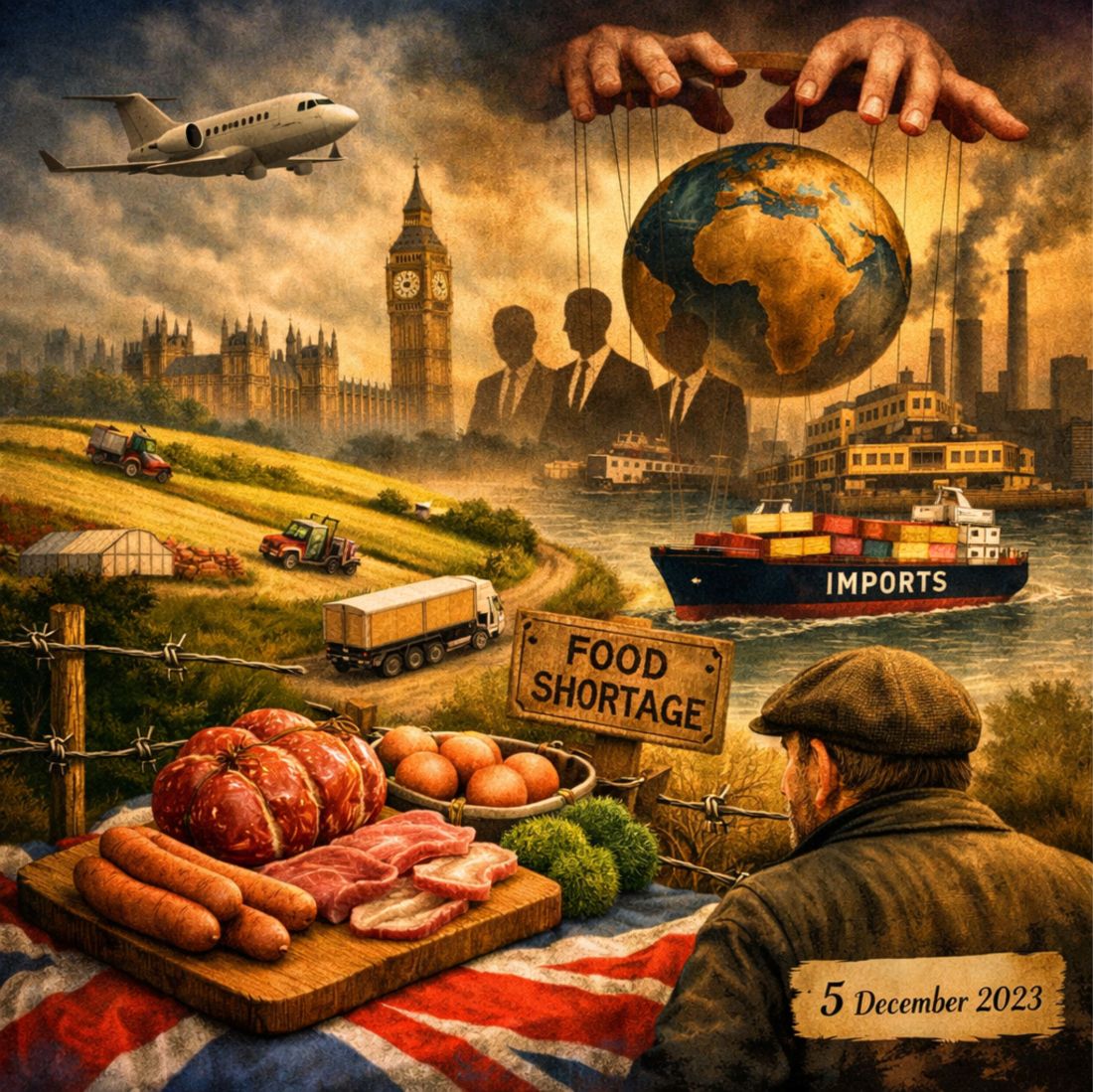
Latest figures suggest that the UK only produces around 52% of the food that we consume. Yet we are increasingly reliant on trading relationships threatened by war and the collapse of global supply chains, making the supply of imported food increasingly vulnerable and insecure.
Despite the risk to UK food security, Politicians and big business keep pushing UK Farms and Food Production towards profit making systems. This approach increases consumer reliance on unhealthy and highly processed foods and manufacturing, is quickly leading to the destruction of Agriculture and our ability to grow food naturally in the UK, and it uses organisations and standards like the Red Tractor scheme to exert ever more influence and control, knowing that significant change can be achieved without question, if the guidance comes from organisations that farmers and growers trust.
The short-, medium- and long-term future of UK farming and food production now hangs in the balance.
If UK Farmers don’t begin to take risks to save their own industry today; there will no longer be anything left of UK Farming worth taking a risk on in just a few tomorrows.
However, the risk taken to secure the future of UK Farming needs to be measured and considerate of all the ingredients necessary to secure permanent change, putting locally grown, healthy and nutritious food back at the centre of consumer and community life.
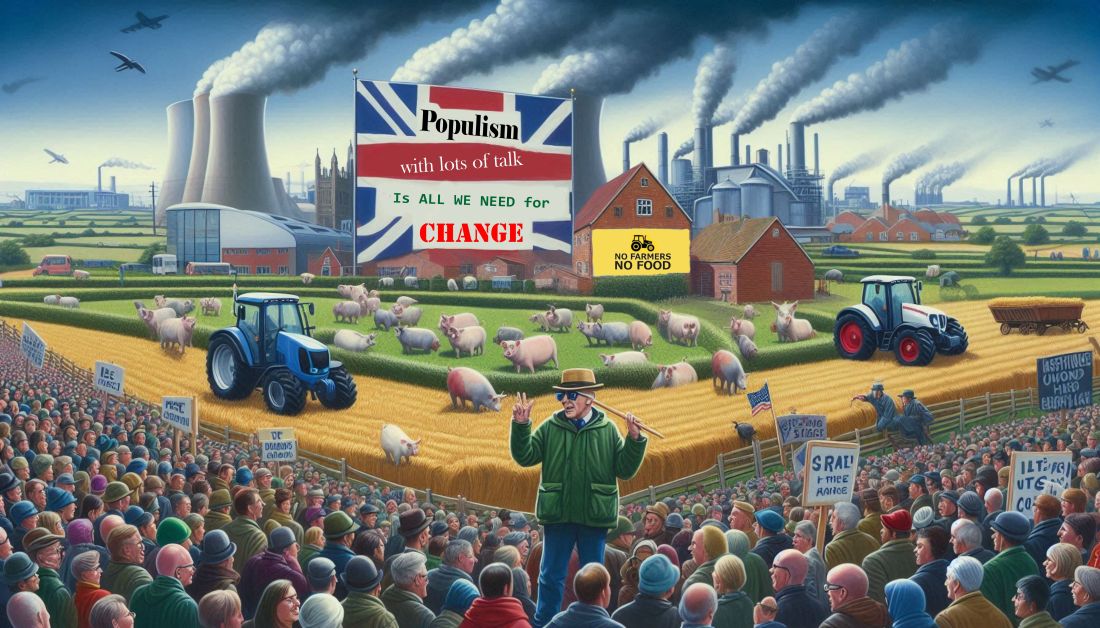
This cannot be achieved through populist protests and civil disruption that will damage the relationships that we now need to cement.
The creation of a new Food Chain Assurance Standard, led by Farmers, with the help of consumers and everyone who genuinely believes in and champions UK Food Production, offers the opportunity to achieve change that will not be possible in any other way.
The one thing that everyone linked to U.K. Agriculture and Food Production will agree on is that the industry is in crisis. But what the crisis is, what caused it, what will fix it and what approach or what thinking must be prioritised to do so are very different things.
The stakes could not be higher. Farming is quickly becoming unviable for growing numbers of farmers. The land they vacate is coming out of production and not being passed to the next generation or anyone fighting to find their way in. Retailers are exhaustively abusing their relationships with farmers and growers, and the establishment remains blithely confident that the U.K. will never be short of supplies.
Because countries as far away as Australia and New Zealand will always be there to step into the gap and meet every shortfall.
All of this whilst the latest figures suggest that the amount of food that the U.K. produces for its own use only reaches around 52-54%.
That the food we all eat just seems to keep on coming gives the lie to what the real food crisis is. And the fragility of our food supply is hiding in plain sight.
The complexity of the issues involved regrettably mean it is increasingly easy for anyone within the industry who is worried about the future, to be looking for a banner or message to get behind. One that relates enough to their own experience and makes sense of whatever they believe everyone else going through the same experience needs to do.
Unfortunately, messages that can become such a point of focus are therefore very dangerous. They deceive people into believing in a shared purpose that isn’t necessarily there.
This means that time, energy and perhaps even risks or gambles are taken on political vehicles or strands of unanchored activism that sound as if they will deliver results and perhaps even become the next big thing.
Some call this populism. It’s happening within farming right now, fuelled in no small part by the growing unrest involving farmers across Europe who have even gone as far as laying a meadow along once of the key routes into Paris.
Ploughing roads, fertilising the walls of ministry offices, shutting down travel or even manning the barricades might sound very attractive to people even beyond the farming and food production community itself. But what would be the purpose? What would U.K. farmers be trying to achieve? What would it all be for?
Everyone has a different perspective on the issues; what is happening and what really needs to happen, to get the result and to sort all the problems out.
By rushing to protest, no matter how inspiring the pictures from Europe might seem, the real opportunity could be so easily lost. The growing power of the frustration, impatience and lack of trust of the establishment, retailers and big money, who are collectively causing so much harm and distress, could too easily be lost. Worse still, misdirection of this untapped potential could too easily be used against what’s left of the power the industry has to influence its own future.
Protests without purpose will also always fail. Wasting a lot of time and probably money that few can really afford. However, the real cost of responding to the dog whistles rarely blown by those with skin in the game, will be the future of UK Farming and Food Production itself.
Any form of protest that isn’t really thought out in terms of what it needs to achieve and then fails, will inevitably be seen as a whimsical exercise by people ‘on the extreme’.
There is a high probability that any form of mass protest implemented without thought will be repurposed by the establishment to fit the narrative that UK Agriculture is archaic in its current form and must adhere to new ways of thinking and practices. Systems and ways of working that in the longer term, don’t feature what you and I recognise as Farming in any relevant form.
I wish that I could say that the alternative way to facilitate change is easy, and just as easy to understand.
There are people working within and supporting the industry who in some cases have overseen massively useful work on the future of farming in the UK and what needs to change.
The evidence is there to demonstrate that a whole range of problems genuinely exists.
Some of the work done is incredibly good and well-informed. But even in the case of those working very closely with Government, politicians and industry leaders every day, there is not enough appreciation of just how complex the political-government-establishment-public sector relationship and the interaction between them has become.
Worse still, there is very little focus on how the massively misled expectations of members of the public as well as industry professionals and small business owners can possibly be met, when the realities of the future we face are now undoubtedly facing in a very different way.
There are barriers to progress everywhere, and the lens of best intentions doesn’t see these for the problem that they really are. Yet we have years of disappointments with public policy to confirm that it is so.
The control of food is power.
Once we are able to understand the role of food in every one of its aspects and forms, we then and only then, have a chance to recognise that the whole direction of farming and the current production and output-based focus it has, is constructed of policies that simply make no economic sense. We can see what they are really there for.
UK Agriculture has no power and no say in its future today. This must change.
Over the past 40-50 years, all that power and influence has been slowly and yes, deliberately been drained away to wherever we think the money still is, and then beyond.
The future of farming that works for us all is one that fits with and interacts closely with the benefits of production and supply to the surrounding community fixed firmly in mind.
Its form more closely resembles the kind of farm structures and sizes that older generations will remember well. It builds upon community, true localism and a healthy relationship with social enterprises or not-for-profit cooperatives in every potential form.
However, the narratives we overwhelmingly hear today tell us that progress can only ever go one way.
Yet the progress the establishment is driving us all towards isn’t focused on humans, on health, on being happy. It’s all about money, and the wealth of an ever smaller few.
But as the friction in the markets, the talk of politicians and the cost-of-living crisis keep warning us, the monetary and financial system that we have, has actually had its day.
The real progress that will keep farmers farming and people healthy and fed adequately with what they need, isn’t based on a direction where money and all the forces that drive it can continue to be in the driving seat for very long.
The future of food and food production is about community, locality, smaller or more tradition scale and about people working in and around food production being remunerated properly for doing proper, fulfilling jobs.
Local Farms and the role they will play in providing many of the foods, drinks and goods that will make that possible, are at the heart of the future of Food Production.
Farmers have the power to influence this change of direction in a very practical way. But government and the big money interests riding off the destruction of UK farming aren’t going to pay for it.
It’s time for the industry to take a worthwhile risk on its future.
Otherwise, it won’t be long before there isn’t anything left taking a risk for.
My focus on Agri politics and the mass of issues that surround UK Food Security, Sustainable Agriculture and the growing problem of Food Poverty in the UK has made the past few months and my time at the Royal Agricultural University highly beneficial. Especially as I have began to look further and further outside my own social and professional circles to see if the troubling patterns that I already recognised, were evident in the same way elsewhere.
I have to be blunt and say that nothing I have experienced has given me any comfort. In all honesty, everything that I have seen has made me realise that the UKs Food Security and self-sustainability issues are significantly worse than I’d already concluded, and they are getting worse the whole time.
As you will have already read, Sustainability and Sustainable Agriculture are issues that are important to what I wish to share. However, the English language, the way that we multipurpose words and the obsession with subtext that most of us have, make communicating difficult issues that need to easily be grasped very difficult. Especially when alternative terms and their meanings can be used as a barrier that allow emotional ties to get in the way of progress and constructive dialogue.
There are very important distinctions to be made about Sustainable Farming in the context of what sustainability really is. Given that terms such as Regenerative Agriculture, Conservation Agriculture and Rewilding have been pushing their way into the Rural, Green, Environmental and Agricultural lexicon. As despite what should be very distinctive threads of commonality running throughout all of them, the differences between them and more importantly what everyone believes to be the most important priorities of each of them, are endlessly getting in the way.
Misunderstanding, misinterpreting and misrepresenting key benefits and issues is preventing everyone coming together to build upon shared commonality to identify and implement ways of working for the future that are meaningful and beneficial for everyone involved.
To add to the complication of addressing these issues, there is also a need to focus on methods and thinking that are likely to seem counterintuitive in a way that requires many of the most logical and business minded people that we could meet, to think about a future that looks very different to how it does today. A comfort zone we are resistant to leaving where every system, policy and story we encounter tell us all that the basics of everything that we accept without thinking, are always set to remain the same.
So, this is a statement that will need some more thought. Surely it’s the case that every business is run to make money, isn’t it?
On the face of it, the argument that all businesses exist to make a profit is very sound. However, it is only sound because of the way that the world currently works and how we think, placing money at the heart of everything. Instead of prioritising the real reasons that any business exists, which are the products or the services that they provide to customers (or end users).
We can take this thought further. The real reason for providing those goods or services are to help, support or enable people to live, in whatever way that product or service will help those people to do so.
At risk of stating what should be obvious to everyone but actually isn’t, UK Agriculture, Food Production and UK Farms are about or should be about providing the UK population with a secure, accessible, ongoing supply of healthy, nutritional basic or essential foods. And they should do this collectively on the basis of providing the UK Population with the widest variety that is available to us from being grown, ideally as local to the end user as possible, but at the very least, from somewhere from within the geography of the nation state that we all share.
I don’t know a farmer who isn’t passionate about what they do.
Farming isn’t just a business. Farming is a vocation and lifestyle choice for all those who are genuinely committed to the industry, in what I will suggest is a healthy way.
However, as we have moved further and further away from subsistence farming the scale of risk has grown at the same pace as the commitment to production growth.
It has naturally followed that the power that Farmers and Food Producers in the UK once had, has progressively been surrendered to whoever will guarantee the greatest longevity of income. Even though it has now been arguably many years since such guarantees have also offered anything like what we would likely agree to be viable prices.
One of the reasons that Clarkson’s Farm on Amazon Prime has been such a good champion for UK Farmers is that it has lifted the lid on just how precarious Farming in the UK has now become. Yet few Farmers have the opportunity to do TV work or lean on the marketing power of celebrity to make a new farm shop or a brewery buy-in an instant hit.
The reality is that for many Farmers, it has been the culture of payments and subsidies that have taken over everything in Agriculture, alongside the ‘deals with the devil’ that have been made with traders and supermarkets, that are the only reason that what should be ridiculously successful food producing businesses stay afloat.
It is impossible for Farmers to stand still at a static or subsistence level as it once was, as ‘growth’ and therefore growing ‘turnover’ is the only way that earnings can be kept static.
The alternative for many being either to sell up or go broke.
Farmers, Food Producers and the entire UK Agricultural Industry are vulnerable to whatever the supermarkets, retailers, traders and the establishment demands of them next. Because they have surrendered their power to money, and forgotten how to do what they really do best.
Current thinking and every message that we hear tells us that big and bigger are the only way that things can now go. That ‘growth’ equals progress. Yet none of this is in any way true.
The future of Farming is the return to being a predominantly local, community-focused industry with emphasis on the production of foods and goods that local people need. Not what some want and only they can afford.
I realise that the immediate argument that will come back from many farmers who are thinking about the situation that they are really now in, will be that the infrastructure, support networks and governance (laws, rules and regulations) simply don’t exist to make anything like this work without financial support, and that just this factor alone, before anything like the economies of scale are considered, make any such move one that would be impossible to work.
It certainly looks that way. But without UK Farmers, Food Producers and Agriculturally aligned industries taking back their own power by taking those risks necessary for themselves now, the reality is that within perhaps only a few years, Farming as we recognise it in the UK today, will simply no longer exist.
So obsessed have we become with tech, the next big thing and the apparent ease with which we can get everything that we want, that we have forgotten what’s actually important in life. And when it comes to the basic essentials for life, there’s likely to be nothing more important than what we eat.
Just like the air that we breathe, it’s easy to take the supply of food for granted. Unless you are already one of the growing number of us who cannot always afford to buy enough.
Yet, it’s not even as simple as having access to the food that we genuinely need.
For half a century and probably more, the food we eat, the systems, the supply chains that provide it and the governance that is supposed to be there in place to maintain supplies of the things that meet our basic needs have been changed, manipulated and replaced from top to bottom and from left to right. For no better reason than to allow someone somewhere to make more and more money, without any regard for consequences or what for us – and for our farmers and growers, is already becoming a very high price.
To really grasp the horror story currently unfolding, there is need to have understanding of our political system, of human nature and how money runs the world and makes everything work. Not in the sense of how we see it or how we talk about it. But in the sense of how it all really is.
This past weekend saw Channel 4 give a platform to yet another attack on meat production and specifically beef farming, leaning very much upon the narrative that to tackle global warming, cutting down and ideally stopping eating meat is the best place for everyone to begin.
Never mind the queues of private jets lining up at the very same time to fly an ‘elite group’ of very rich people to a meeting where they can all work out plans to force more of their green rules on the public, all in the comfort of luxury hotel suites in Dubai.
Regrettably, many of the people gifted high profile platforms to speak passionately about the guilt people trying to eat a balanced diet should experience for eating properly have become the useful idiots of a very cynical strategy. One being pushed by people who were never elected to their roles and so recognise that to have control over everything, they must gain control of any basic essentials for life that everyone seeking to exert their own freedoms and will must automatically prioritise first.
What they forget to mention – even when these same people have responsibility for public health, is that good, healthy and nutritious food, as part of a balanced natural diet, is the essential building block and foundation of a happy life.
So, why would anyone of sound mind want to destroy or kick the foundation of good, healthy and nutritious diets away?
You can be sure that its not anything to do with the methane that animals, humans and just about every natural biological process produces. But it certainly has a lot to do with money and the two things that come with it: power and control.
Yes, it sounds like a conspiracy theory. But everything that the world is doing to itself today is thoroughly unsustainable.
The irony is that it is the same people, businesses and financial minds that created the false ‘need’ we have bought into who are responsible. On one hand, they have normalised unsustainable behaviour that has depleted the planets resources for no good reason. On the other they have systematically destroyed the governance and infrastructure that would make it easier for us to choose and adopt alternative ways of living that would be much healthier, affordable and sustainable too.
It is these same selfish and self-serving minds that are now determined to dictate the solutions to the problems they caused, so that we change and then behave in ways that will work better for them.
Food is power
Whilst it will make uncomfortable reading for farmers, including many great friends that I know, an entire industry populated by some of the most creative and entrepreneurial people imaginable has been reconditioned to accept grants, subsidies and ‘guaranteed’ contracts with big business and retailers as being ‘normal’. Instead of using their own freedom to do all the things that only British farmers and growers know how to do best.
The consequences of what is happening because of greed and self-interest are very serious indeed.
Yes, farms are going out of business and land is being taken out of production at an alarming rate. But the fact the food the U.K. grows or is capable of growing doesn’t often find itself into the mouths of the very people who live closest to the farms where it was grown is both part of the nightmarish reality that people in food poverty are suffering obesity and diabetes, and the accompanying reality that basic healthy fruit, veg and and high quality meat and fish that resembles its origin in an unadulterated form is now for many, simply too expensive to eat.
It shouldn’t be this way. Yet the travesty doesn’t end there.
Whilst we should all be able to depend on the public representatives that we have elected to put our health and the security of UK food production first, the reality we all have to face is that whether it’s the Conservatives this year, Labour or anyone else occupying No. 10 and the green benches to the right of the Speaker, next, none of these politicians have any idea of just how fragile the UK food supply is right now. Nor how serious even a few shortages of outside food supplies could make things get.
U.K. agriculture has reached the point where farmers, growers and the industries that are inextricably linked to U.K. food production will either choose to accept the risk of taking the steps necessary to facilitate its own revival or wait perhaps no more than just a couple of years and see everything that still exists swallowed up by some impractical idealists 2030-based agenda of some kind.
Farmers and the public are the two key stakeholders in U.K. food production and accompanying supply relationship. Yet neither farmers nor consumers have anything like the genuine say and influence that they should have.
It’s money, self interest and other people’s agendas at every step of the way.
The UKs Farmers shouldn’t have to lead the revolution of reality. But the reality is that a meaningful commitment to changing U.K. food supply and recreating the local infrastructure that would be able to make that work, will soon gather growing public support once the work has really begun.
Its then and only then that our hapless politicians will have no option but to follow.