

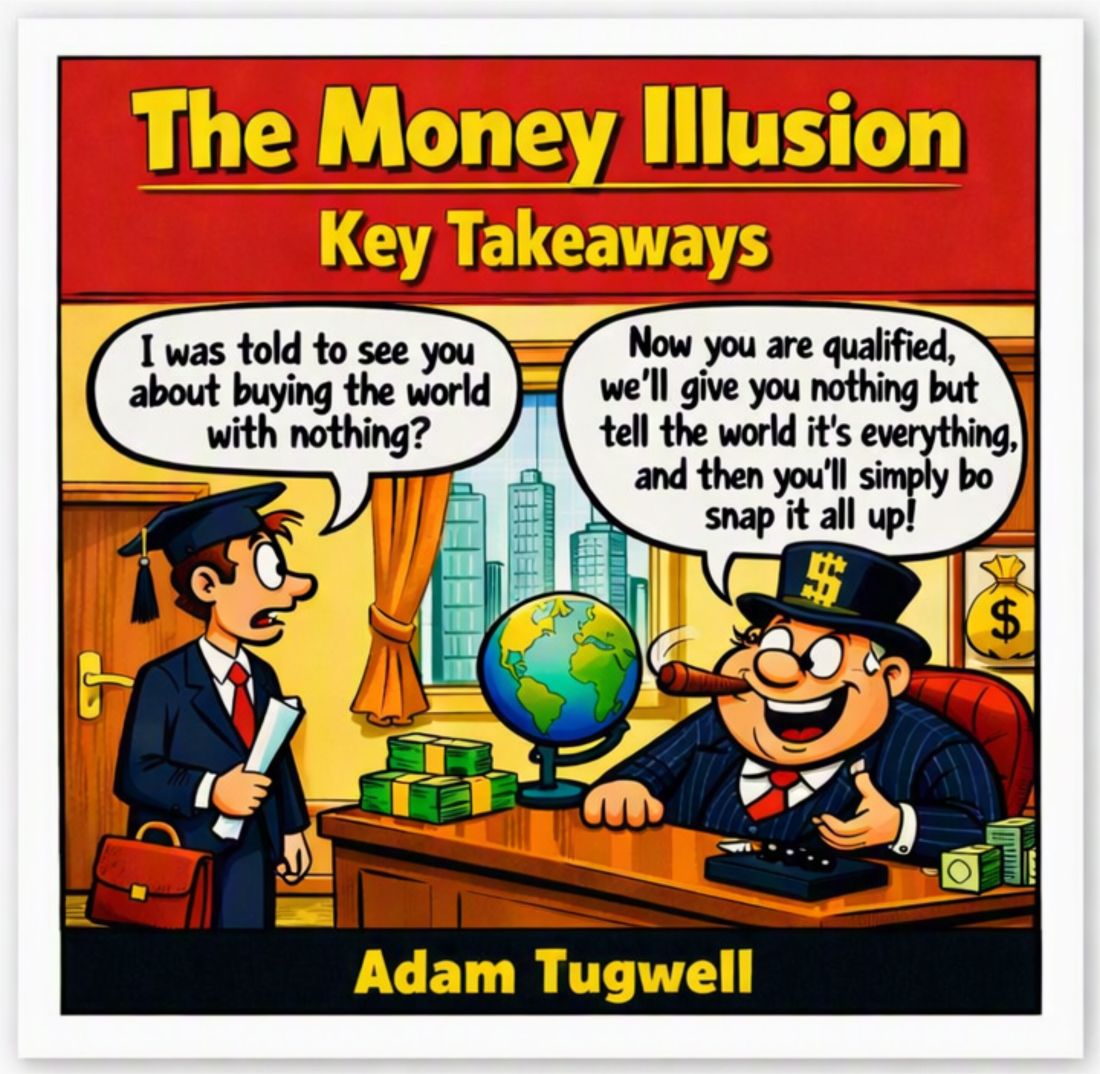
What This Book Ultimately Argues
The central argument of The Money Illusion is not that money is fake.
It is that most people were never taught how the modern monetary, financial and ownership system actually works, and that the consequences of this misunderstanding have shaped nearly every aspect of modern life.
The illusion is not money itself.
The illusion is believing that everyone participates in the system on equal terms.
1. Money Is Not What Most People Think It Is
Most people grow up believing:
- banks lend savings
- investors deploy existing wealth
- governments spend taxes
- money exists before it is spent
Modern banking works differently.
Commercial banks generally create new bank deposits when they make loans.
Money therefore enters circulation primarily through credit.
This does not mean banks can lend without limit.
But it does mean that much of the purchasing power used in the economy did not exist until it was created through lending.
2. Access to Credit Creation Is Unequal
This is the most important insight in the book.
Workers must earn before they spend.
Savers must accumulate before they invest.
Large borrowers can gain access to purchasing power before they have earned or accumulated equivalent sums.
The critical advantage is not that repayment is avoided.
It is that purchasing power can be brought forward in time.
That changes what can be owned.
3. The Creation of Credit Changed Ownership
The book argues that modern concentrations of ownership cannot be understood without understanding credit creation.
Without large-scale access to created credit:
- housing portfolios would have been harder to acquire
- company acquisitions would have been more limited
- infrastructure ownership would have been different
- private equity structures would have been smaller
- ownership would have concentrated differently
Credit creation did not merely expand economic activity.
It expanded the ability to acquire existing assets.
4. Created Purchasing Power Became Real Ownership
This is the point at which money becomes power.
Created purchasing power can be exchanged for:
- homes
- businesses
- utilities
- land
- infrastructure
- essential services
Once acquired, those assets generate income, influence and further opportunities for acquisition.
The result is that a financial mechanism becomes an ownership mechanism.
5. Legal Does Not Mean Fair
The book does not argue that these processes are necessarily illegal.
Quite the opposite.
Most have operated entirely within legal frameworks.
The question raised is not:
“Was the law broken?”
The question is:
“What happens when lawful mechanisms produce outcomes that most people never understood, consented to, or even knew existed?”
Legality establishes permission.
It does not automatically establish justice.
6. Complexity Hides Consequences
Modern systems are highly specialised.
Bankers understand banking.
Regulators understand regulation.
Politicians understand politics.
Economists understand economics.
Very few people understand how all the pieces fit together.
As a result:
- everyone sees part of the system
- few see the whole system
The book argues that complexity often obscures consequences.
7. Debt Can Transfer Risk
One of the most important examples explored is the leveraged acquisition.
In some acquisition structures:
- money is borrowed to buy a company
- debt is placed on the acquired company
- ownership remains with the buyer
- repayment obligations remain with the acquired business
The result can be a transfer of risk from owner to asset.
The book argues that this mechanism helps explain many patterns of decline seen across sectors.
8. Financialisation Reaches Beyond Finance
The argument is not simply about banking.
It is about financialisation.
Financialisation occurs when financial logic begins determining decisions throughout society.
This includes:
- housing
- healthcare
- education
- infrastructure
- utilities
- local services
- employment
Life increasingly becomes organised around what produces measurable financial return.
9. Money Has Become a Value System
Money began as a tool.
The book argues that money increasingly became a value system.
Questions about people are increasingly translated into questions about money:
- What are they worth?
- What can they afford?
- Are they creditworthy?
- Are they productive?
- Are they profitable?
When money becomes the primary measure of value, people themselves become measured through financial metrics.
10. GDP Became More Than a Measurement
GDP was created to measure economic production.
The book argues that it gradually became something more.
When public debt is judged relative to GDP:
- growth becomes politically necessary
- measurable activity becomes more valuable
- monetisation becomes easier to justify
GDP remains useful.
The concern raised is that what cannot easily be measured economically can become increasingly invisible.
11. Monetisation Changes What Society Values
Activities that generate monetary transactions are easily counted.
Many essential aspects of life are not.
Examples include:
- relationships
- community
- trust
- unpaid care
- belonging
- dignity
- social cohesion
- environmental stewardship
The danger is not that these things lose value.
The danger is that institutions begin behaving as if they have less value because they are harder to measure.
12. Many Modern Crises May Share the Same Root
The book suggests that issues often discussed separately may be connected:
- housing affordability
- public debt
- declining public services
- infrastructure deterioration
- rising insecurity
- increasing inequality
- community decline
Rather than viewing them as isolated problems, the book invites readers to consider them as different expressions of the same underlying system.
13. The System Sustains Itself Through Belief
Systems depend on legitimacy.
People continue participating because:
- they trust institutions
- they trust money
- they trust markets
- they trust existing narratives
The book argues that belief acts as a stabilising force even when outcomes appear increasingly strained.
14. People Were Not Necessarily Failing
One of the book’s most important moral points is that many people interpret their struggles as personal failure.
The book challenges this assumption.
Many people followed the rules they were taught:
- work hard
- save
- plan
- behave responsibly
Yet still found security becoming harder to achieve.
The book asks whether people were failing, or whether the system itself had changed.
15. The Current Model Appears to Be Reaching Limits
The argument is not that society is collapsing.
The argument is that certain trends have practical limits.
There are limits to:
- wage suppression
- household indebtedness
- rent extraction
- service reductions
- infrastructure deterioration
- asset inflation
A system can only remove so much value from its foundations before those foundations weaken.
16. The Most Important Insight
The book’s most important insight can be reduced to one sentence:
Credit creation did not merely create money.
It created purchasing power.
Purchasing power created ownership.
Ownership created power.
Power shaped the system that followed.
Everything else in the book flows from that sequence.
17. The Final Thought
The purpose of The Money Illusion is not to tell readers what to do.
It is to help them see.
The book offers no manifesto, party, ideology or programme.
It asks a simpler question:
What changes in our understanding of society when we recognise that money is not merely a thing, but a system of permissions, relationships, claims, obligations and power?

