
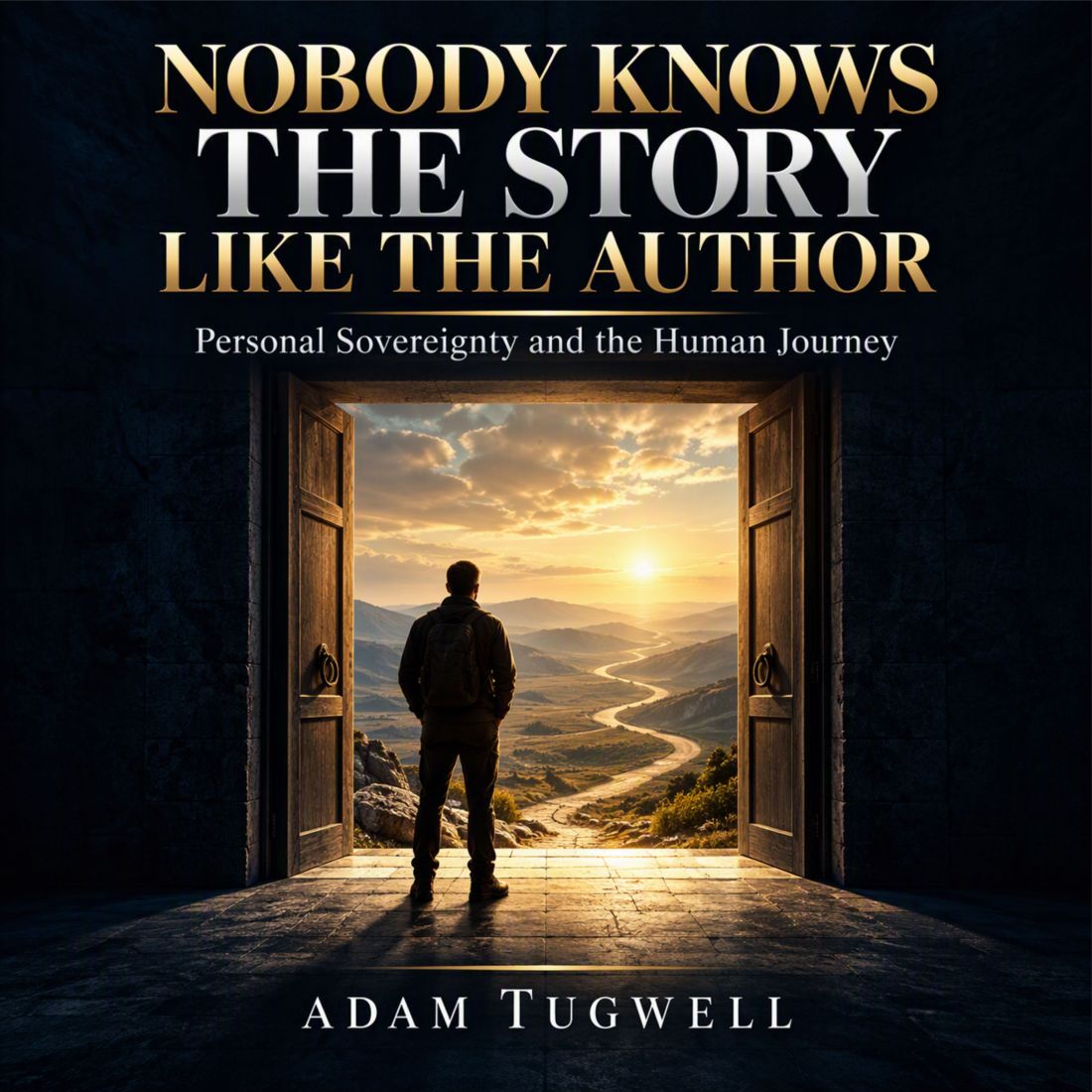
Introduction
Every human being lives a life that nobody else can fully experience.
Others may share parts of it. They may walk alongside us for decades. They may influence us, support us, challenge us, teach us, love us, disappoint us, inspire us, or attempt to direct us.
Yet no one else experiences our life in quite the same way that we do.
No one else carries our memories exactly as we carry them.
No one else experiences our fears before they become actions.
No one else feels our hopes, doubts, ambitions, regrets, convictions, and curiosities from within.
Nobody knows the story like the author.
At first glance, this may seem obvious.
Most people would agree with it immediately.
Yet very few of us stop to consider what it means.
If nobody knows the story like the author, who should ultimately determine its direction?
Who should decide what matters?
Who should decide what constitutes a good life?
Who should decide which risks are worth taking, which sacrifices are worth making, which opportunities are worth pursuing, and which forms of contribution are worth offering?
For most of human history these questions have been answered in many different ways.
Some answers have come from family.
Some from culture.
Some from religion.
Some from tradition.
Some from governments.
Some from communities.
Some from institutions.
Some from markets.
And some from individuals themselves.
Usually, the answers arrive long before the questions.
As children we inherit ways of thinking before we learn to examine them.
We inherit assumptions about success.
Assumptions about responsibility.
Assumptions about work.
Assumptions about money.
Assumptions about status.
Assumptions about purpose.
Assumptions about what is realistic.
Assumptions about what is possible.
Most are not imposed by force.
They are absorbed through participation.
Through family.
Education.
Friendship.
Media.
Workplaces.
Communities.
The wider society surrounding us.
This is neither unusual nor inherently problematic.
No one begins life without influence.
No one develops in isolation.
No one authors their story entirely alone.
The question is not whether we inherit influences.
The question is whether we ever stop to examine them.
Because there is a profound difference between living according to values we have consciously chosen and living according to assumptions we have never questioned.
The fact that something is familiar does not mean it is true.
The fact that something is common does not mean it is right.
The fact that something is rewarded does not mean it serves us.
And the fact that something feels normal does not mean it deserves to remain unexamined.
Most people rarely have time to think about such things.
Life has a habit of demanding attention elsewhere.
There are bills to pay.
Responsibilities to meet.
Problems to solve.
People to care for.
Deadlines to satisfy.
Practical realities that cannot simply be ignored.
As a result, many of the deepest questions remain unexplored.
Not because people lack intelligence.
Not because people lack curiosity.
Not because people are incapable of reflection.
But because life often leaves little space for it.
Some people spend years occupied by circumstances that require immediate attention.
Others eventually find a measure of stability.
A difficult period passes.
A debt is paid.
A crisis ends.
The constant pressure eases.
And suddenly something unexpected becomes possible.
Space.
Space to think.
Space to reflect.
Space to observe.
Space to question.
Space to notice.
This book is, in many ways, about what happens when that space appears.
Not because everyone must use it in the same way.
Not because everyone must arrive at the same conclusions.
And certainly not because anyone should be told what to believe.
Quite the opposite.
The purpose of this book is not to provide answers to life’s ultimate questions.
It is not to define truth.
It is not to determine meaning.
It is not to tell anyone how they should live.
There are already countless people, institutions, ideologies, doctrines, movements, and belief systems willing to do that.
This book has a different purpose.
It asks a simpler question.
A more personal question.
A question that sits beneath almost every other question we can ask.
How much of your life are you genuinely authoring?
Not how successful you are.
Not how wealthy you are.
Not how educated you are.
Not how influential you are.
Not how spiritual you are.
Not how intelligent you are.
How much of your life are you genuinely authoring?
That question turns out to be surprisingly difficult to answer.
Because authorship is not the same as freedom.
Freedom is not the same as peace.
Peace is not the same as sovereignty.
And sovereignty is not the absence of constraints.
Every life contains constraints.
Every meaningful relationship contains constraints.
Every commitment contains constraints.
Every responsibility contains constraints.
The question is not whether constraints exist.
The question is how they arrive.
Are they chosen?
Or merely inherited?
Consciously embraced?
Or unconsciously accepted?
Do they support authorship?
Or replace it?
These questions matter because every human life unfolds within a shared human experience.
We do not live alone.
We influence others and are influenced by them in return.
Our stories intersect constantly.
Which means authorship is never solely about ourselves.
To recognise our own authorship is eventually to recognise something else.
Other people are authors too.
They carry experiences we do not possess.
Perspectives we do not share.
Stories we cannot fully see.
Their conclusions may differ from ours because their journey differs from ours.
Their understanding may differ from ours because their experiences differ from ours.
And their path through life cannot be reduced to our own.
This recognition sits at the heart of everything that follows.
Not because it tells us what to believe.
But because it reminds us what we are.
Authors.
Not of reality itself.
Not of other people’s lives.
But of our own participation within the human experience.
What follows is an exploration of the conditions that make meaningful authorship possible.
The forces that compromise it.
The forms of captivity that often go unnoticed.
The nature of peace.
The role of awareness.
The meaning of sovereignty.
And the relationship between sovereignty, contribution, community, and society itself.
At every stage, the invitation remains the same.
Not to agree.
Not to follow.
Not to adopt a prescribed conclusion.
Simply to consider a question.
Perhaps the most important question of all.
If nobody knows the story like the author,
who is writing yours?
Chapter 1: The Question of Authorship
Every human being arrives in the world with a story that has not yet been written.
The circumstances surrounding that arrival vary enormously.
Some begin life in safety.
Some in uncertainty.
Some in abundance.
Some in hardship.
Some are born into communities that nurture them.
Others into environments that challenge them from the very beginning.
None of us chooses the opening chapter.
Yet every one of us eventually encounters the same reality.
A life is unfolding.
And whether we realise it or not, we are participating in its writing.
Most people spend little time thinking about this.
Life rarely encourages it.
From an early age, attention is directed towards other questions.
What should you study?
What should you do?
What should you achieve?
What should you earn?
What kind of person should you become?
These are not trivial questions.
Many are important.
Some are necessary.
But they all rest upon a deeper question that is rarely asked.
Who is writing?
The Difference Between Living and Authoring
There is a subtle distinction between living a life and authoring one.
Living is unavoidable.
Every person who wakes each morning and moves through the world is living a life.
Authoring is different.
Authoring requires participation.
It involves conscious engagement with direction, values, choices, priorities and meaning.
It involves recognising that our lives are shaped not only by events, but by the way we respond to them.
Many of the most significant moments in a life arrive without invitation.
Loss arrives.
Opportunity arrives.
Success arrives.
Failure arrives.
Love arrives.
Change arrives.
No author controls every event in the story.
Yet authorship was never about controlling every event.
It was always about how those events become part of the story.
A storm may arrive unexpectedly.
The response remains our own.
We Inherit Before We Question
Long before most people begin asking who they are, they have already inherited countless assumptions about what life is supposed to be.
Ideas about success.
Ideas about status.
Ideas about responsibility.
Ideas about work.
Ideas about money.
Ideas about happiness.
Ideas about purpose.
Most arrive quietly.
Not through force.
Not through deliberate manipulation.
Simply through participation in the world around us.
Parents pass on beliefs.
Schools pass on beliefs.
Communities pass on beliefs.
Cultures pass on beliefs.
Institutions pass on beliefs.
Every generation inherits stories from the generation before it.
This is part of being human.
No one begins with a blank page.
The existence of influence is not the problem.
The existence of influence is inevitable.
The question is whether influence eventually becomes conscious.
Whether inherited assumptions remain inherited assumptions, or are examined and understood.
There is an important difference between choosing a value and merely carrying it.
The outcome may appear identical from the outside.
Internally, they are entirely different experiences.
The Human Experience Is Shared
One of the great paradoxes of life is that every story is unique, yet all stories unfold within a shared human experience.
Every human being experiences joy.
Every human being experiences uncertainty.
Every human being experiences limitation.
Every human being experiences hope.
Every human being experiences loss.
The details differ.
The themes remain remarkably familiar.
This shared experience often leads people into a powerful assumption.
Because we recognise parts of ourselves in others, we begin imagining that others experience life in roughly the same way we do.
Nothing could be further from the truth.
The same event can produce entirely different experiences in different people.
The same opportunity can create excitement in one person and fear in another.
The same words can inspire one individual and wound another.
The same circumstances can lead to completely different conclusions.
When we begin examining our own story honestly, this becomes increasingly difficult to ignore.
The deeper we understand our own experiences, the more we recognise how much those experiences have shaped the way we see the world.
Our upbringing.
Our successes.
Our disappointments.
Our relationships.
Our fears.
Our aspirations.
Each leaves an imprint.
Each contributes to the lens through which we interpret reality.
Gradually a realisation emerges.
My story is not the default story.
It is simply my story.
And if that is true for me, it is true for everyone else as well.
Other People Are Authors Too
This may be one of the most important realisations in the entire human experience.
Other people are not supporting characters in our story.
They are authors in their own.
We can never fully see what they carry.
We cannot fully know their experiences.
We cannot fully know how their understanding was formed.
We cannot fully know what led them to believe what they believe.
This does not mean all actions should be accepted.
It does not mean all ideas are equally helpful.
It does not mean judgement becomes impossible.
It means something simpler.
Humility becomes possible.
The recognition that another person may be responding to experiences we have never had.
Just as we respond to experiences they have never had.
This recognition becomes increasingly important later in this book.
Because Personal Sovereignty is not simply about understanding ourselves.
It is also about recognising the equal authorship of others.
A Question Few People Ask
Most people spend their lives answering questions.
What next?
Where next?
How much?
How long?
What if?
What now?
There is nothing wrong with these questions.
They matter.
Yet beneath them sits a question that rarely receives attention.
It is not a question about success.
It is not a question about wealth.
It is not a question about status.
It is not even a question about happiness.
It is a question about authorship.
How much of your life are you genuinely authoring?
Not perfectly.
Not completely.
Not absolutely.
Such things may be impossible.
But meaningfully.
Consciously.
Deliberately.
How much of your story is being written by values you have chosen, rather than assumptions you have inherited?
How much is being shaped by conscious direction rather than unconscious momentum?
How much is being lived rather than merely followed?
This is not a question that requires an immediate answer.
In fact, it may be the sort of question that follows a person for years.
The purpose of this book is not to answer it on your behalf.
Nobody can do that.
Nobody knows the story like the author.
The purpose of this book is to explore the conditions that make meaningful authorship possible.
Before we can understand those conditions, however, we must first understand what so often occupies the space in which authorship takes place.
To do that, we must begin with the stories we inherit before we ever learn to question them.
Chapter 2: The Stories We Inherit
Before we learn who we are, we are told who we are.
Not always directly.
Rarely through instruction.
Most often through participation.
Long before we are capable of examining the world for ourselves, we begin absorbing ideas about how it works and what our place within it should be.
This process is natural.
It is unavoidable.
Every generation inherits stories from the generation before it.
Every child enters a world that already existed before they arrived.
Languages already exist.
Customs already exist.
Beliefs already exist.
Institutions already exist.
Ideas about success, responsibility, work, purpose, status, morality, and meaning already exist.
No one begins with a blank page.
The question is not whether we inherit stories.
The question is what we eventually do with them.
The Invisible Inheritance
Most inheritance is visible.
A house.
A family name.
A piece of land.
A photograph.
An heirloom.
The most influential inheritance is often invisible.
We inherit assumptions.
Assumptions about what makes a person valuable.
Assumptions about what a successful life looks like.
Assumptions about what is possible and what is unrealistic.
Assumptions about how society should work.
Assumptions about what deserves respect.
Assumptions about who should be listened to.
Assumptions about what should be pursued and what should be avoided.
Most of these assumptions are never consciously presented for acceptance.
They simply surround us.
Over time they become familiar.
And what is familiar often becomes invisible.
Eventually we stop seeing these assumptions as stories at all.
They become reality.
The Comfort of Shared Stories
There is a reason inherited stories are powerful.
They simplify life.
A person who never questions the assumptions around them inherits ready-made answers to many difficult questions.
What should I pursue?
What should I value?
What matters?
What should I fear?
What should I admire?
The stories already contain answers.
There is comfort in this.
There is efficiency in this.
There is often community in this.
None of these things should be dismissed.
Human beings need shared stories.
Without them, cooperation becomes difficult.
Communities become fragile.
Culture becomes impossible.
The purpose of this chapter is not to argue against shared stories.
It is to recognise that they exist.
Because a story that is recognised can be examined.
A story that remains invisible often cannot.
The Difference Between Carrying and Choosing
Imagine two people who live almost identical lives.
They share the same values.
The same priorities.
The same commitments.
The same outward behaviour.
From the outside they appear indistinguishable.
Yet there may be one fundamental difference.
One has consciously examined these values and embraced them.
The other simply inherited them.
The outcome appears identical.
The experience is not.
One is carrying a story.
The other is choosing it.
This distinction sits quietly beneath much of what follows.
Personal Sovereignty does not require people to reject inherited values.
It does not require rebellion.
It does not require opposition.
It certainly does not require people to abandon traditions, communities, beliefs, or commitments that bring meaning to their lives.
It asks something simpler.
Have these things become conscious?
Have they ever been examined?
Have they ever genuinely been chosen?
When Stories Become Systems
Individual stories do not remain individual for long.
When millions of people share the same assumptions, those assumptions begin shaping institutions.
They begin shaping economies.
Governments.
Schools.
Businesses.
Communities.
Over time, shared stories become embedded in the structures of society itself.
This is where things become more difficult to see.
A person may believe they are simply making practical decisions.
Yet the range of options they consider practical may already have been shaped by stories absorbed long ago.
What careers appear respectable.
What lifestyles appear successful.
What ambitions appear realistic.
What risks appear sensible.
What sacrifices appear worthwhile.
These judgements rarely emerge from nowhere.
They emerge from stories.
Stories that may have been inherited generations earlier.
Stories that became norms.
Stories that became expectations.
Stories that became systems.
The Assumption That Feels Like Reality
The most influential assumptions are rarely the loudest.
They are the ones that stop feeling like assumptions at all.
Most people can identify ideas they disagree with.
That is relatively easy.
Far harder is identifying the assumptions we never thought to question.
The assumptions we mistake for reality itself.
Every period of history contains them.
Every society contains them.
Every individual contains them.
This is not a flaw.
It is simply part of being human.
None of us stands outside influence.
None of us stands outside culture.
None of us stands outside experience.
The question is not whether we possess assumptions.
The question is whether we remain willing to examine them.
Stories Are Not The Enemy
At this point, it is worth being careful.
It would be easy to mistake examination for rejection.
That is not the argument being made.
A story can survive scrutiny.
A value can survive examination.
A tradition can survive reflection.
A belief can survive questioning.
In many cases they become stronger because they have been consciously chosen rather than unconsciously inherited.
The purpose of self-examination is not destruction.
It is understanding.
The purpose is not to remove every influence.
That would be impossible.
The purpose is to become aware of influences that already exist.
Only then can a person meaningfully determine which stories continue to deserve a place in their life.
The Beginning of Authorship
Many people imagine authorship begins when a person starts writing something new.
Often it begins somewhere far more subtle.
It begins when a person stops and looks at a story they have carried for years and asks:
Why do I believe this?
Where did this come from?
Do I still choose it?
Does it still serve me?
Does it still serve others?
What would remain if nobody expected this of me?
Questions like these do not immediately produce answers.
They are not supposed to.
Their value lies elsewhere.
They create a pause between inheritance and acceptance.
A pause between influence and identification.
A pause between carrying and choosing.
And within that pause, however small, authorship begins to emerge.
The next step is understanding what happens when the space required for authorship becomes occupied.
Not by stories alone.
But by pressures, dependencies, fears, obligations, and demands that consume attention before authorship has the opportunity to develop.
To understand that, we must examine what might be called the invisible occupation of human life.
Chapter 3: The Invisible Occupation
Most people think authorship is limited by a lack of freedom.
Often it is limited long before freedom ever becomes relevant.
A person can possess intelligence, talent, ambition, creativity and potential, yet still struggle to meaningfully author their own life.
Not because they lack capability.
Not because they lack motivation.
Not because they lack character.
But because the space required for authorship is already occupied.
The Space Where Authorship Lives
Every human being possesses a finite amount of attention.
A finite amount of energy.
A finite amount of emotional capacity.
A finite amount of mental space.
This is where reflection happens.
This is where meaning develops.
This is where values are examined.
This is where perspective grows.
And this is where authorship resides.
When this space is available, human beings become capable of asking deeper questions.
What matters to me?
What am I pursuing?
Why am I pursuing it?
What kind of person do I wish to become?
What kind of life do I wish to create?
Yet when this space becomes occupied, such questions often disappear from view.
Not because they no longer matter.
Because other questions become more urgent.
Survival Speaks Loudly
A person worrying about where next month’s rent will come from is thinking about housing.
But not only housing.
A person worrying about debt is thinking about money.
But not only money.
A person worrying about how they will feed their family is thinking about food.
But not only food.
Beneath each concern sits something more fundamental.
Survival.
Human beings are remarkably adaptable.
When survival becomes uncertain, attention naturally turns towards it.
The mind prioritises what appears most important.
The future contracts.
Possibilities narrow.
Reflection becomes difficult.
Not impossible.
But difficult.
A person carrying significant financial pressure may still think deeply.
Still dream.
Still reflect.
Still create.
Yet part of their attention remains occupied elsewhere.
Part of the mind remains on watch.
Calculating.
Preparing.
Anticipating.
Protecting.
This is one of the least understood forms of captivity in modern life.
Not because it is hidden.
Because it is normalised.
The Occupation of Inner Space
Many forms of captivity are visible.
This one often is not.
No chains are required.
No prison walls.
No overt coercion.
Only persistent occupation.
Anxiety occupies.
Debt occupies.
Precarity occupies.
Instability occupies.
Fear occupies.
Uncertainty occupies.
They consume the space in which authorship would otherwise grow.
Someone whose thoughts are dominated by immediate survival has little capacity left for self-examination.
Not because they are incapable of it.
Because the occupation comes first.
Life demands attention before reflection becomes possible.
This is one reason why discussions of freedom so often miss the point.
Many people are technically free.
They are simply too occupied to benefit from it.
Dependency Extends the Occupation
The occupation does not necessarily end once survival becomes secure.
It often changes form.
A person may no longer worry about basic needs.
Yet still find their choices shaped by dependency.
Dependency is not inherently negative.
Human beings depend upon one another.
Families depend upon one another.
Communities depend upon one another.
Societies depend upon cooperation.
The issue is not dependency itself.
The issue is dependency that meaningfully limits authorship.
A person may remain in an unhealthy environment because leaving feels impossible.
A person may continue pursuing a path they no longer believe in because too much depends upon it.
A person may feel unable to challenge assumptions, expectations or circumstances because the consequences appear too great.
Again, none of this requires conspiracy.
It requires only reality.
Responsibilities.
Obligations.
Commitments.
Consequences.
Life is shared, and shared life creates dependencies.
The question is whether those dependencies support authorship or quietly replace it.
The Occupation Nobody Notices
The deepest occupation often appears where life seems to be going well.
This is where the conversation becomes more challenging.
Most people recognise the pressures of survival.
Most people recognise financial insecurity.
Most people recognise dependency.
Far fewer recognise the occupation created by comfort.
A person may achieve success according to the standards of their society.
They may enjoy security.
Comfort.
Status.
Influence.
Financial freedom.
The ability to purchase almost anything they desire.
Their needs may be met many times over.
Their worries may appear few.
Their life may seem enviable to others.
Yet authorship may still be absent.
Not because they are unhappy.
Not because they are trapped.
Not because their experiences are invalid.
Because comfort can occupy space as effectively as hardship.
Just differently.
The Comfortable Captive
One of the most powerful stories in modern society is that success equals freedom.
The idea feels intuitive.
If somebody has wealth, status, options and opportunity, surely they must be free.
Perhaps they are.
But freedom and sovereignty are not the same thing.
A person can move comfortably within a system without ever examining the assumptions on which that system rests.
A person can achieve everything they were taught to pursue without ever questioning whether those pursuits were consciously chosen.
A person can fulfil every expectation placed upon them and still find that much of their story has been inherited rather than authored.
This is not an attack on success.
Nor is it an argument against comfort.
Peace matters.
Security matters.
Prosperity matters.
The issue is not possessing them.
The issue is confusing them with sovereignty.
A person may possess tremendous freedom and still be living inside assumptions they have never examined.
The current carries them comfortably.
The fact that they are floating does not mean they chose the river.
The Difference Between Needs and Wants
Part of this confusion emerges because modern societies often struggle to distinguish between needs and wants.
Needs have boundaries.
Enough food.
Enough shelter.
Enough security.
Enough stability.
Enough dignity.
Enough belonging.
Enough opportunity to participate fully in life.
Wants do not operate in the same way.
Their horizon continually moves.
More wealth.
More status.
More recognition.
More influence.
More success.
More accumulation.
None of these things are inherently wrong.
The difficulty arises when endless wants begin masquerading as needs.
Once that happens, occupation returns through a different door.
The pursuit never ends because the destination never arrives.
A person can spend an entire lifetime chasing more while never discovering what enough actually means.
The Cost of Inattention
The invisible occupation is not merely material.
It is also intellectual and emotional.
Many people inherit assumptions and never examine them.
Many inherit definitions of success and never question them.
Many inherit priorities and never consciously choose them.
Again, this is not a moral failing.
It is simply what tends to happen when life moves quickly.
Reflection requires space.
Examination requires space.
Authorship requires space.
Occupation consumes space.
The result is that many people spend decades responding to life without ever stopping to consider the framework through which they understand it.
Not because they cannot.
Because they have never been given the opportunity.
Or never recognised that the opportunity existed.
The First Opening
Fortunately, occupation is not permanent.
Pressure can ease.
Security can emerge.
Needs can be met.
The mind can become quieter.
Space can return.
This moment is often more significant than people realise.
Because something becomes possible that was previously difficult.
Not certainty.
Not enlightenment.
Not sovereignty.
Something far simpler.
Peace.
And it is there, in the first return of unoccupied inner space, that the next stage of the journey begins.
Chapter 4: The First Taste of Freedom
There are moments in life that are easy to overlook because they arrive quietly.
No celebration accompanies them.
No announcement is made.
No clear boundary is crossed.
And yet everything changes.
For some people, the moment arrives when a long-standing debt is finally repaid.
For others, it arrives when stable housing is secured.
For others still, it comes when a period of uncertainty ends, a difficult chapter closes, or a persistent fear finally releases its grip.
The circumstances differ.
The experience is often remarkably similar.
Something that had been occupying attention is no longer there.
The pressure subsides.
The noise becomes quieter.
And for the first time in a long time, there is space.
Not space around us.
Space within us.
What Peace Feels Like
Peace is one of the most sought-after experiences in human life.
Yet many people struggle to describe it precisely.
Some describe it as happiness.
Others describe it as contentment.
Others describe it as safety, security, comfort, confidence, or fulfilment.
Peace can certainly coexist with all these things.
But they are not the same.
A person can be happy and not peaceful.
A person can be successful and not peaceful.
A person can be comfortable and not peaceful.
A person can even be fulfilled and not peaceful.
The form of peace being explored here is something more structural.
Peace emerges when survival pressure no longer dominates the space within which life is experienced.
The mind no longer needs to remain perpetually alert.
The next bill no longer occupies every quiet moment.
The future no longer appears as a threat requiring constant management.
Attention begins returning to the present.
A person does not merely have more time.
They have more space.
The End of Constant Occupation
Many people underestimate the extent to which occupation shapes their lives until it disappears.
Imagine carrying a heavy weight every day for many years.
At first the weight feels obvious.
Eventually it feels normal.
Eventually it becomes difficult to imagine life without it.
Then one day the weight is removed.
Only then does its presence become fully visible.
The occupation of inner space works in much the same way.
A person may not realise how much attention is consumed by insecurity until security appears.
They may not realise how much energy is devoted to managing uncertainty until uncertainty recedes.
They may not realise how much of their thinking has been directed towards survival until survival is no longer the primary concern.
When this happens, something remarkable becomes possible.
Thought expands.
Reflection expands.
Curiosity expands.
Life becomes larger than the problem that previously dominated it.
This is one of the reasons peace matters so deeply.
Peace restores capacity.
Why Human Beings Seek Peace
Perhaps this explains why peace has occupied such a central place in human thought for thousands of years.
People pursue peace through relationships.
Through security.
Through accomplishment.
Through philosophy.
Through faith.
Through nature.
Through service.
Through achievement.
Through simplicity.
Sometimes through withdrawal.
Sometimes through success.
Sometimes through surrender.
The methods differ enormously.
The desire itself remains remarkably consistent.
People are not merely seeking pleasant experiences.
They are often seeking release from occupation.
They are seeking room to breathe.
Room to think.
Room to exist without being constantly consumed by necessity.
In this sense, peace is one of the most human aspirations imaginable.
And rightly so.
Peace Changes the Horizon
When someone’s needs become secure, the horizon changes.
Questions that once seemed impossible begin to emerge.
What would I like to do?
What matters to me?
What kind of life do I want?
What have I never allowed myself to consider?
What do I actually believe?
These questions may have existed before.
The occupation simply left little room for them.
Now they return.
Sometimes gradually.
Sometimes powerfully.
Sometimes unexpectedly.
For some people, this can be exciting.
For others, unsettling.
Because peace does something many people do not anticipate.
It creates space not only for answers.
It creates space for questions.
The Freedom to Think
One of the least appreciated consequences of peace is the freedom to think.
Not what to think.
Not what should be thought.
Simply the freedom to think.
To sit with an idea.
To explore a possibility.
To reconsider an assumption.
To reflect on an experience.
To examine one’s own reactions.
To become curious.
This may sound insignificant.
It is anything but.
A person whose mind is perpetually occupied rarely has the luxury of sustained reflection.
Peace creates the conditions under which reflection becomes possible.
This becomes increasingly important as the journey continues.
Because authorship grows most naturally where reflection is present.
Why Peace Can Feel Like Freedom
When people first experience genuine peace, they often describe it as freedom.
This is understandable.
The difference between occupation and space can feel transformational.
A person who no longer fears losing everything often experiences life very differently from someone who does.
The contrast can be profound.
For many people it is the first meaningful experience of freedom they have ever known.
And yet something important remains unfinished.
A person can experience peace without understanding the assumptions that shape their life.
A person can experience peace without examining the stories they have inherited.
A person can experience peace whilst moving comfortably along a path they never consciously chose.
Peace removes pressure.
It does not automatically create awareness.
Peace creates possibility.
It does not determine what follows.
The Doorway
This is one of the most important ideas in the entire book.
Peace is not the destination.
Neither is it merely a stepping stone.
Peace stands in a category of its own.
It is precious.
It is valuable.
It is worthy of pursuit in its own right.
Many people spend much of their lives searching for it.
Many never fully experience it.
For those who do, something extraordinary becomes available.
A doorway.
Not a doorway into a predetermined belief system.
Not a doorway into a particular philosophy.
Not a doorway into any prescribed conclusion.
A doorway into possibility.
What lies beyond that doorway belongs to the author.
Some will simply enjoy the peace they have found.
Others will begin questioning assumptions they have carried for years.
Others will examine the stories they inherited.
Others will discover interests, values, passions, and forms of contribution previously hidden beneath occupation.
There is no correct destination.
There is only opportunity.
The important thing is that peace creates the space in which the next stage of the journey becomes possible.
And that stage begins with a question many people have never been encouraged to ask.
What happens when we turn our attention towards ourselves and honestly examine the story we are living?
Chapter 5: The Return of Inner Space
Peace is often discussed as though it were an emotion.
A feeling.
A mood.
A state of mind.
Sometimes it is described as happiness.
Sometimes as contentment.
Sometimes as tranquillity.
Sometimes as the absence of conflict.
All of these descriptions capture part of the experience.
Yet they do not fully explain why peace matters.
To understand its significance, it helps to look beneath the feeling itself.
Because peace is not only something we feel.
It is something that becomes possible when something else is removed.
What Returns When Occupation Ends
In the previous chapter, we explored the idea of occupation.
The continuous demands placed upon attention by survival, insecurity, dependency, uncertainty and fear.
When these pressures dominate, they consume the space in which deeper forms of reflection can occur.
Many people experience this directly.
The mind becomes focused on necessity.
The immediate future becomes all-consuming.
Attention narrows.
Energy narrows.
Possibility narrows.
When this occupation recedes, something returns.
Not because it is newly created.
Because it was there all along.
It simply lacked room to emerge.
The thing that returns is space.
Inner space.
The space in which thought can unfold without urgency.
The space in which observation can occur without immediate pressure.
The space in which experiences can be processed rather than merely endured.
The space in which a person can sit with a question without needing an immediate answer.
For many people, this is the first genuinely transformative experience of adult life.
Not because everything becomes easy.
Because everything is no longer dominated by necessity.
The Independence Threshold
This is where the concept of the Independence Threshold becomes important.
The Independence Threshold is not a measure of wealth.
It is not a measure of success.
It is not a measure of status.
It is not a measure of comfort.
It is the point at which a person’s essential needs can be met without reliance upon dependencies that compromise their ability to direct their own life.
Below this threshold, survival occupies attention.
Above it, space begins to emerge.
The distinction is profound.
Two people may possess very different lifestyles yet share the same threshold.
One may live modestly.
Another more comfortably.
What matters is not the outward appearance of their life.
What matters is whether their essential needs are secure.
Because when needs become secure, something changes inside the human experience itself.
The constant negotiation with survival begins to ease.
Why Needs Matter More Than Wants
Modern societies often blur the distinction between needs and wants.
This confusion creates enormous difficulty when trying to understand peace.
Needs have limits.
Food.
Shelter.
Safety.
Basic healthcare.
Connection.
Participation in community.
The opportunity to live with dignity.
Once these needs are met, something important becomes possible.
Enough.
Wants operate differently.
Their horizon continually moves.
There is always another level.
Another purchase.
Another achievement.
Another upgrade.
Another milestone.
Another success.
Another ambition.
Again, none of these things are inherently wrong.
The problem arises when wants begin occupying the same psychological space as needs.
When they do, peace becomes difficult.
Because the pursuit never reaches completion.
The destination continually relocates.
The person may accumulate more and more while experiencing little sense of enough.
Peace becomes postponed into a future that never arrives.
Why Peace Cannot Be Purchased
This may explain one of the great contradictions of modern life.
Many people spend their lives pursuing peace through accumulation.
More wealth.
More achievement.
More security.
More success.
Yet these things only contribute to peace when they address genuine needs.
Beyond that point, their relationship to peace becomes increasingly uncertain.
A person may double their wealth and experience little additional peace.
They may double it again and experience even less.
Not because wealth is harmful.
Because peace was never waiting at the end of accumulation.
Peace emerges when occupation subsides.
And occupation does not always disappear simply because resources increase.
In some cases the opposite occurs.
The maintenance of success becomes a new source of occupation.
The protection of status becomes a new source of occupation.
The pursuit of more becomes a new source of occupation.
The form changes.
The occupation remains.
The Human Need for Space
There is another reason peace matters.
Human beings appear to possess a natural tendency towards exploration.
Not merely physical exploration.
Mental exploration.
Emotional exploration.
Creative exploration.
Reflective exploration.
The desire to understand.
The desire to grow.
The desire to make sense of experience.
Occupation suppresses these tendencies.
Peace allows them to re-emerge.
A person whose life is no longer dominated by survival often begins asking different questions.
Questions that previously seemed irrelevant.
Questions that previously felt unaffordable.
Questions that previously remained hidden beneath necessity.
This is not because the person has changed.
It is because the conditions surrounding them have changed.
For the first time, there is room.
The Gift and the Responsibility
Peace is sometimes described as a gift.
In many ways it is.
Those who have known prolonged occupation often recognise this immediately.
Yet peace also carries a quiet responsibility.
Not an obligation imposed from outside.
An opportunity created from within.
The return of inner space presents a choice.
A person can enjoy the peace they have found.
There is nothing wrong with this.
Many do.
Others begin exploring what the space makes possible.
They become curious.
Reflective.
Questioning.
Not because they are dissatisfied.
But because something within them responds to the new freedom that peace creates.
This response differs from person to person.
There is no correct destination.
Only possibility.
The Beginning of a Different Journey
This is where many accounts of human development begin to separate.
Some stop at peace.
Some build comfort around it.
Some seek to preserve it.
Others begin asking new questions.
Questions about meaning.
Questions about identity.
Questions about purpose.
Questions about values.
Questions about assumptions.
Questions about themselves.
The appearance of these questions does not mean peace was insufficient.
It means peace succeeded.
Peace created the space in which something else could emerge.
The return of inner space is not the conclusion of the journey.
It is the beginning of a different one.
For many people, this next stage starts with a surprisingly difficult task.
Not understanding the world.
Not understanding society.
Not understanding other people.
Understanding themselves.
Chapter 6: The Deception of Peace
Of all the ideas explored in this book, this chapter may be one of the easiest to misunderstand.
The previous chapters argued that peace matters.
They argued that peace creates space.
They argued that peace allows parts of the human experience to emerge that are otherwise buried beneath survival, uncertainty, insecurity and dependency.
All of this remains true.
Peace is valuable.
Peace is necessary.
Peace is worth protecting.
Yet peace can also be deceptive.
Not because peace itself is false.
Because human beings often mistake it for something else.
When the Occupation Ends
Imagine a person who has spent years worrying about survival.
Perhaps they struggled financially.
Perhaps they lived with insecurity.
Perhaps every major decision carried significant risk.
Then, over time, those conditions change.
They secure stable housing.
Their finances improve.
Their basic needs are no longer in question.
The occupation recedes.
For the first time in years, they experience genuine peace.
This is a profound shift.
It should never be dismissed.
The return of inner space is one of the most significant transitions a person can experience.
Naturally, many people interpret this moment as freedom.
From their perspective, the conclusion makes perfect sense.
Compared to what came before, they feel free.
Compared to what came before, they have options.
Compared to what came before, they can finally breathe.
The experience is real.
The conclusion, however, may not be.
Why Peace Feels Like Freedom
Peace and freedom often arrive together.
When pressure subsides, possibilities expand.
The two experiences become difficult to separate.
A person who no longer worries about next month’s rent feels freer than someone who does.
A person who no longer fears financial collapse feels freer than someone who remains vulnerable.
That perception is valid.
Yet something important sits beneath it.
The absence of pressure does not automatically create authorship.
Pressure may have disappeared.
The assumptions guiding a life may remain entirely unchanged.
The occupation may have ended.
The story may still be inherited.
A person can float peacefully without ever questioning the direction of the current carrying them.
This distinction is subtle.
And it changes everything.
The Comfortable Captive
Modern society often assumes that success and freedom are inseparable.
Someone possesses wealth.
Influence.
Status.
Opportunity.
Choice.
The conclusion seems obvious.
They must be free.
Sometimes they are.
Sometimes they are not.
The reality cannot be determined by observation alone.
Because sovereignty is not measured by possessions.
Nor by status.
Nor by achievement.
Nor by influence.
One person may possess very little and live with profound authorship.
Another may possess almost everything society rewards and possess surprisingly little.
This is uncomfortable to consider because it challenges one of the dominant stories of modern life.
The story that external success automatically produces internal freedom.
Yet once the distinction becomes visible, it becomes difficult to ignore.
A person can be highly successful while remaining deeply dependent upon:
- status
- recognition
- reputation
- wealth
- approval
- achievement
- expectations
These dependencies may not threaten survival.
They can still shape behaviour.
They can still shape decisions.
They can still shape identity.
Most importantly, they can still shape authorship.
When Success Becomes Occupation
Occupation does not disappear simply because conditions improve.
Sometimes it changes form.
The person who once worried about survival may begin worrying about maintaining success.
The person who once pursued security may begin pursuing status.
The person who once sought enough may begin seeking more.
Again, none of this is a moral criticism.
It is simply an observation.
Human beings easily adapt to improved circumstances.
What once felt extraordinary becomes normal.
What once felt sufficient begins feeling inadequate.
New concerns emerge.
New pressures emerge.
New occupations emerge.
The external story changes.
The internal dynamics often remain remarkably familiar.
The occupation has simply moved house.
The Confusion of Needs and Wants
This is one reason the distinction between needs and wants matters so much.
Needs create a foundation.
Wants create a horizon.
A person’s needs can be met.
Their wants rarely can.
This is not because wants are bad.
It is because wants have no natural endpoint.
There is always another version of success available.
Another level of achievement.
Another benchmark.
Another comparison.
Another ambition.
Another acquisition.
If peace depends upon reaching the end of wants, peace becomes impossible.
The finishing line continually moves.
The person runs harder.
The destination retreats.
Modern societies often encourage this confusion.
The result is millions of people pursuing peace through accumulation when peace was never waiting there to begin with.
Peace emerges through enough.
Wants rarely recognise enough.
The Billionaire Problem
At the extreme end of society, this distinction becomes even clearer.
Many people assume that extraordinary wealth must represent extraordinary freedom.
It is easy to understand why.
The individual appears free from many limitations that affect others.
Yet sovereignty asks different questions.
What assumptions remain unexamined?
What values remain inherited?
What dependencies remain invisible?
What constraints continue directing behaviour?
What story is being pursued?
And why?
A person may possess vast resources and still be entirely committed to a worldview they never consciously chose.
They may remain driven by incentives they have never examined.
They may remain dependent upon forms of validation, recognition, competition or achievement that continue directing their life long after material needs were secured.
From a sovereignty perspective, the issue is not how much power a person holds.
The issue is how consciously they hold it.
There is another dimension to this as well.
Actions do not occur in isolation.
Every human life unfolds within a shared experience.
If an individual’s pursuit of wealth, influence, growth or success systematically undermines the conditions that allow others to find peace, independence and authorship, then serious questions emerge.
Not about wealth itself.
About sovereignty.
Because Personal Sovereignty is not merely concerned with the self.
It necessarily includes respect for the equal sovereignty of others.
Without that, sovereignty becomes something else entirely.
Why Peace Matters Anyway
At this point, it would be easy to misunderstand the argument.
The purpose of this chapter is not to diminish peace.
Nor to suggest that comfort, success, wealth or accomplishment lack value.
The opposite is true.
Peace remains precious.
Peace remains necessary.
Peace remains one of the most important conditions in the entire human journey.
The issue is simply this:
Peace creates possibility.
It does not determine what follows.
Two people may experience the same peace and travel in entirely different directions.
One may never question the assumptions supporting their life.
Another may begin a process of reflection that changes everything.
Neither outcome is guaranteed.
Because peace is not the destination.
Peace is the opening.
The Question Beyond Peace
The real significance of peace lies in what it makes possible.
When occupation recedes and inner space returns, something becomes available that was previously difficult.
Attention can turn inward.
Experiences can be examined.
Assumptions can be questioned.
Patterns can be recognised.
The story itself can become visible.
For some people, this is the beginning of a new journey.
Not a journey towards a predetermined belief.
Not a journey towards a prescribed truth.
A journey towards a deeper understanding of themselves.
Because before a person can consciously author their life, they must first learn to see it clearly.
And that begins with the most challenging form of observation many people will ever undertake.
Looking themselves in the eye.
Chapter 7: Looking Yourself in the Eye
For many people, the journey described in the previous chapters begins with a change in circumstance.
Pressure eases.
Space returns.
Life becomes less occupied by immediate necessity.
Peace emerges.
What follows next is far less predictable.
Some people simply enjoy the peace they have found.
There is nothing wrong with this.
Others discover that the return of inner space brings something unexpected with it.
Questions.
Not questions about the world.
Questions about themselves.
The Most Difficult Subject
Human beings are often comfortable examining almost anything except themselves.
We analyse politics.
Economics.
Relationships.
History.
Religion.
Science.
Technology.
Society.
Yet many people spend surprisingly little time examining the person through whom all of those experiences are filtered.
Themselves.
This is understandable.
Looking outward is often easier than looking inward.
The world can be observed from a distance.
The self cannot.
Every attempt to understand ourselves requires honesty.
And honesty has a way of revealing things we may prefer not to see.
Contradictions.
Assumptions.
Fears.
Patterns.
Regrets.
Motivations.
Stories we tell ourselves.
Stories we have inherited.
Stories we may never have questioned.
Self-awareness begins when we become willing to meet these things directly.
Awareness Is Not Knowledge
One of the most misunderstood words in modern culture is awareness.
People speak about becoming aware.
Raising awareness.
Being aware.
Awakening.
Enlightenment.
Consciousness.
Entire industries have formed around these ideas.
The word itself has become so overloaded that it often obscures more than it reveals.
In this book, awareness means something much simpler.
It is not a qualification.
Not a status.
Not a badge.
Not membership of a particular movement, philosophy, religion, ideology or spiritual tradition.
Awareness is a human discipline.
The ongoing practice of examining experience honestly.
Nothing more.
And nothing less.
It does not belong to any group.
It does not require permission.
It cannot be granted by an institution.
It cannot be purchased.
It cannot be inherited.
It can only be practiced.
The Story Behind the Story
Every human experience contains at least two stories.
The first is what happened.
The second is our interpretation of what happened.
The distinction matters.
A person loses a job.
That is an event.
What the event means is another matter entirely.
One person interprets it as failure.
Another interprets it as freedom.
Another interprets it as injustice.
Another experiences relief.
The event remains the same.
The experience does not.
The same pattern appears everywhere.
A criticism.
A success.
A rejection.
An opportunity.
A relationship.
A challenge.
Human beings rarely respond to events alone.
We respond to the meanings attached to them.
And those meanings often emerge from stories we have carried for years.
Sometimes for decades.
Many of them without realising it.
Following the Threads
Self-awareness often begins with a simple act of curiosity.
Why did that affect me so strongly?
Why did I react in that way?
Why does this matter so much to me?
Why do I keep repeating the same pattern?
Why does this particular criticism feel painful?
Why does this success feel important?
Why does this fear remain?
The answers are rarely immediate.
Nor should they be.
What matters is learning to follow the thread.
An experience leads to an emotion.
An emotion leads to a belief.
A belief leads to an assumption.
An assumption leads to a story.
A story leads to a pattern.
Over time a person begins seeing connections that previously remained hidden.
Events that once appeared unrelated start revealing common themes.
The story behind the story begins to emerge.
The Difference Between Judgement and Observation
Many people avoid self-examination because they assume it requires self-criticism.
It does not.
In fact, criticism often interferes with awareness.
Awareness requires observation before judgement.
A scientist observing a phenomenon does not begin with condemnation.
The observation comes first.
The understanding follows.
The same principle applies here.
Many of the assumptions we discover were inherited.
Many of the patterns we uncover developed in response to experiences we did not choose.
Many of our strengths emerged from circumstances just as many of our difficulties did.
The goal is not self-accusation.
It is understanding.
Understanding allows choice.
Choice creates authorship.
Why This Matters
At first, self-awareness can appear self-focused.
Perhaps even self-indulgent.
In reality, the opposite is often true.
A person who has never examined themselves tends to assume that their experience is normal.
Their perspective becomes the reference point against which everything else is measured.
Their reactions seem obvious.
Their conclusions seem self-evident.
Their interpretations feel universal.
This happens naturally.
It is one of the most common human tendencies.
Self-awareness begins weakening this assumption.
Because the more honestly we examine our own experiences, the more we discover how much they have shaped the way we see the world.
Our upbringing.
Our relationships.
Our successes.
Our disappointments.
Our fears.
Our hopes.
Our environment.
Each leaves its mark.
Gradually something important becomes visible.
The world does not simply appear as it is.
It appears through us.
A Necessary Humility
For many people, genuine awareness begins here.
Not with certainty.
Humility.
The recognition that our perspective, however valuable, is incomplete.
The recognition that our experiences are real but not universal.
The recognition that our story is meaningful but not definitive.
This is not weakness.
It is not confusion.
It is not indecision.
It is maturity.
Because awareness does not expand by becoming more certain of everything.
Sometimes it expands by becoming more honest about what we do not know.
The Beginning of Sovereignty
Self-awareness is not sovereignty.
Just as peace is not sovereignty.
Yet both are necessary conditions for it.
A person cannot consciously author a life they have never examined.
They cannot meaningfully choose values they have never explored.
They cannot distinguish inheritance from authorship without first becoming aware that a distinction exists.
This is why looking ourselves in the eye matters.
Not because it produces perfect understanding.
No human being achieves that.
But because it allows us to become participants in our own development rather than passive recipients of it.
And once that process begins, another realisation often follows.
The story we are living is not the only story being lived.
Every person we encounter is carrying a perspective shaped by experiences we cannot fully see.
To understand sovereignty, we must eventually confront that reality as well.
Because if nobody knows the story like the author, then the same is true for everyone else.
Chapter 8: The Limits of Your Story
One of the most significant moments in a person’s development often arrives quietly.
There is no ceremony.
No qualification.
No external recognition.
Sometimes there is not even a clear realisation at the time.
A person simply begins to notice something they had previously overlooked.
Their experience of the world is not the world itself.
It is their experience of it.
At first, this distinction can seem almost meaningless.
Yet few realisations alter the way we relate to ourselves and to others more profoundly.
The Reality of Experience
Every human experience is real.
Pain is real.
Joy is real.
Fear is real.
Love is real.
Disappointment is real.
Hope is real.
No one should be told that their experience is not valid.
That would be absurd.
The challenge emerges somewhere else.
The fact that an experience is real does not mean it is universal.
Something may feel obvious to one person and incomprehensible to another.
Something may feel threatening to one person and exciting to another.
Something may feel meaningful to one person and irrelevant to another.
The difference is not necessarily a matter of intelligence.
Nor morality.
Nor capability.
Often it is simply a reflection of different stories.
Different journeys.
Different experiences.
Different authors.
The Invisible Assumption
Human beings possess a natural tendency to use themselves as a reference point.
This is entirely understandable.
Our own experience is the only one we directly inhabit.
We feel what we feel.
We think what we think.
We see the world through our own eyes.
As a result, we can easily slip into an assumption that operates almost invisibly.
If I see the situation this way, others probably do too.
If I find this meaningful, others probably do as well.
If this conclusion seems obvious to me, it should be obvious to others.
This assumption appears everywhere.
In families.
In workplaces.
In politics.
In friendships.
In communities.
In relationships.
People become frustrated by reactions they did not expect.
Offended by conclusions they did not anticipate.
Confused by perspectives that never occurred to them.
Often the surprise itself reveals the assumption.
The assumption that reality should appear similar from every position.
Yet reality does not work that way.
The Lens Through Which We See
We do not merely observe the world.
We interpret it.
This interpretation is shaped by countless experiences accumulated throughout our lives.
Our upbringing.
Our relationships.
Our successes.
Our failures.
Our education.
Our fears.
Our opportunities.
Our disappointments.
Our culture.
Our environment.
Our circumstances.
Each becomes part of a lens through which future experiences are viewed.
This lens is not inherently problematic.
Without it, understanding would be impossible.
The challenge emerges when we forget it exists.
When we assume we are seeing reality directly rather than through the accumulated influence of our experience.
Awareness begins to grow when the lens itself becomes visible.
When Self-Awareness Deepens
Many people believe self-awareness is primarily about understanding themselves.
In reality, it often has a second effect.
The more honestly a person examines their own life, the more difficult it becomes to assume everyone else arrived where they are in the same way.
A person who has taken apart their own story begins seeing how many influences contributed to it.
How many seemingly small experiences had lasting effects.
How many assumptions arrived from outside.
How many conclusions emerged gradually rather than suddenly.
The process tends to create humility.
Not weakness.
Humility.
Because once we begin understanding how complex our own story is, the stories of other people become harder to reduce to simple explanations.
Beyond Agreement and Disagreement
This does not mean every perspective is equally useful.
Nor does it mean all actions should be accepted.
Nor does it require agreement.
These distinctions matter.
Understanding another person’s story is not the same as approving of it.
Recognising that someone arrived at a conclusion through their own experiences does not require adopting that conclusion ourselves.
Awareness is not the abandonment of judgement.
It is the refinement of judgement.
It asks us to recognise that understanding and agreement are different things.
A person can disagree profoundly whilst still recognising another person’s humanity.
Another person’s experience.
Another person’s authorship.
In many ways, mature disagreement becomes possible only when that recognition exists.
The Limits of Certainty
Something else often happens as awareness develops.
Certainty becomes more complicated.
Not because nothing can be known.
Not because truth becomes meaningless.
But because reality reveals itself to be larger than a single perspective.
The person who sees only their own story often finds certainty easy.
The person who begins recognising many stories usually becomes more careful.
More reflective.
More willing to pause.
More willing to ask additional questions.
This does not make them indecisive.
It makes them honest.
They have begun encountering complexity.
And complexity rarely rewards arrogance.
The Awareness Trap
Ironically, awareness itself contains a potential trap.
The moment a person becomes convinced they have finally understood everything, growth often stops.
This happens in many different places.
Politics.
Religion.
Philosophy.
Spirituality.
Science.
Culture.
Movements.
Ideologies.
The pattern is always similar.
A person mistakes a step on the journey for the end of the journey.
They begin believing they possess a perspective from which reality can finally be explained completely.
The problem is not confidence.
The problem is closure.
Because awareness is not the possession of ultimate answers.
It is the willingness to continue examining the questions.
A person does not become aware by arriving.
They become aware by remaining open.
The Bigger Realisation
Eventually, a larger understanding begins to emerge.
Every person is living within a story they cannot entirely step outside.
Every person sees the world through a lens shaped by experience.
Every person possesses blind spots.
Every person possesses assumptions.
Every person possesses understanding.
Every person possesses limitations.
Including ourselves.
Perhaps especially ourselves.
This is not a reason for despair.
It is a reason for curiosity.
Because once we recognise the limits of our own story, something extraordinary becomes possible.
We become capable of recognising the legitimacy of other stories.
Not because they are identical to ours.
Precisely because they are not.
And it is here that awareness starts revealing one of its most important lessons.
The goal is not to become the central character in reality.
The goal is to recognise that reality contains billions of authors.
The next step is understanding what that recognition means.
Because recognising that other people are authors too has consequences.
For how we relate to them.
For how we judge them.
For how we live alongside them.
And ultimately, for how we understand sovereignty itself.
Chapter 9: Other Authors
One of the most profound shifts in human understanding occurs when we stop seeing ourselves as the centre of every story.
This shift rarely happens all at once.
It emerges gradually.
Often it begins with self-awareness.
A person spends time examining their own life.
Their own experiences.
Their own assumptions.
Their own reactions.
Their own fears, hopes, beliefs and values.
Over time, a pattern becomes visible.
What once appeared simple reveals itself to be complex.
What once appeared obvious reveals itself to be layered.
What once seemed self-evident begins revealing influences, experiences and assumptions that had previously gone unnoticed.
Eventually, a question emerges.
If my own story is more complex than I realised, what about everyone else’s?
Beyond the Supporting Cast
Human beings are natural storytellers.
We organise experience through narrative.
We explain events through narrative.
We understand ourselves through narrative.
There is nothing unusual about this.
Yet narratives contain a subtle danger.
Every story has a central character.
In our own lives, that character is us.
Without noticing, it becomes easy to view other people as secondary figures.
Important, perhaps.
Influential, certainly.
But ultimately supporting characters in the story we happen to be living.
Reality is considerably more complicated.
Every person you encounter is living at the centre of a story that feels just as real as your own.
Every person experiences doubt.
Uncertainty.
Joy.
Loss.
Fear.
Hope.
Meaning.
Confusion.
Every person interprets life through their own experiences.
Every person carries a history you cannot fully see.
Every person is attempting to make sense of existence from a position that nobody else can completely occupy.
They are not supporting characters.
They are authors.
The Unseen Chapters
One of the reasons judgement often comes easily is that we rarely see the chapters that came before.
We encounter a person at a particular moment in time.
We observe a decision.
A reaction.
An opinion.
A behaviour.
A conclusion.
Then we attempt to explain it.
Sometimes our explanation is correct.
Often it is incomplete.
Because the visible moment is rarely the whole story.
Beneath every action sits an accumulation of experiences.
Relationships.
Successes.
Failures.
Influences.
Disappointments.
Lessons.
Assumptions.
Traumas.
Aspirations.
Memories.
None of these excuse harmful behaviour.
None of them remove accountability.
But they do remind us of something important.
Most human beings are responding to realities that remain largely invisible to everyone else.
The person is visible.
The story rarely is.
Understanding Without Agreement
At this point, it is important to draw a distinction.
Recognising another person’s authorship does not require agreement.
This distinction matters.
Perhaps more now than at any other point in modern history.
Many people assume understanding and agreement are the same thing.
They are not.
A person can understand why someone believes something without sharing that belief.
A person can understand how another arrived at a conclusion without reaching the same conclusion themselves.
A person can understand the story without approving of every chapter.
In fact, mature disagreement may depend upon this distinction.
When people stop recognising one another as authors, disagreement quickly becomes something else.
Others become caricatures.
Opponents.
Obstacles.
Enemies.
Categories.
Labels.
Groups.
The individual disappears.
The story disappears.
The author disappears.
And with them disappears much of what makes meaningful understanding possible.
A Shared Human Experience
Although every story is unique, no story exists in isolation.
This is one of the paradoxes at the heart of the human experience.
We are individuals.
Yet we are also participants in something shared.
No one survives alone.
No one develops alone.
No one learns alone.
No one contributes alone.
Every life exists within a network of relationships, communities and influences.
This shared reality creates both opportunity and responsibility.
The opportunity comes through connection.
The responsibility comes through impact.
Every person’s actions affect others.
Every person’s choices influence the conditions in which other people live.
Every author’s story intersects with countless others.
This matters because sovereignty can never be understood purely in individual terms.
To understand ourselves as authors is only half the journey.
The other half is recognising that everyone else possesses authorship too.
The Foundation of Respect
Many systems attempt to create respect through rules.
Others attempt to create it through morality.
Others through social pressure.
All have their place.
Yet there is another path.
One that emerges naturally from awareness.
When a person genuinely recognises that other people are authors of their own lives, respect begins to arise from a different place.
Not from obligation.
From recognition.
The recognition that another person’s life belongs to them in much the same way that your life belongs to you.
That they possess experiences you cannot fully know.
Dreams you cannot fully understand.
Challenges you cannot fully see.
Questions you cannot fully answer.
They remain different from you.
Sometimes profoundly so.
Yet their authorship remains no less real.
This does not eliminate conflict.
It does not eliminate disagreement.
It does not eliminate difficult decisions.
What it does is change the frame through which these things are viewed.
The Sovereignty of Others
At some point, the implications become impossible to ignore.
If nobody knows the story like the author, then nobody knows another person’s story better than they do.
Advice remains valuable.
Guidance remains valuable.
Teaching remains valuable.
Community remains valuable.
All can enrich a person’s life.
None can legitimately replace authorship itself.
This is true in families.
In relationships.
In communities.
In workplaces.
In politics.
In religion.
In culture.
In every area of human life.
The moment one person’s authorship becomes subject to the unquestioned will of another, something important is lost.
The person may comply.
They may even comply willingly.
Yet authorship cannot truly be transferred.
It can only be constrained.
And where authorship is constrained, sovereignty is diminished.
The Next Question
By this point, a new understanding has begun to emerge.
People inherit stories.
People experience occupation.
People find peace.
People develop awareness.
People gradually recognise themselves as authors.
They come to recognise others as authors too.
The natural question that follows is this:
What does awareness itself actually mean?
The word is used constantly.
By institutions.
By activists.
By politicians.
By philosophers.
By religions.
By teachers.
By influencers.
By spiritual movements.
Almost everyone claims to possess it.
Almost everyone encourages others to seek it.
And yet few terms are more misunderstood.
Before we can understand sovereignty, we must first understand awareness itself.
Not as a badge.
Not as a status.
Not as a qualification.
But as a human discipline.
Chapter 10: Awareness Without Certainty
Few words have become more confused than awareness.
The term appears everywhere.
In education.
In politics.
In activism.
In religion.
In philosophy.
In self-help.
In popular culture.
In spirituality.
People speak of raising awareness, becoming aware, awakening, expanding awareness, and countless other variations of the same theme.
Yet the more frequently the word is used, the more difficult it becomes to understand what it actually means.
Part of the difficulty arises because awareness is often presented as a destination.
Something to be achieved.
Something to possess.
Something to attain.
As though awareness were a qualification that could eventually be acquired and displayed.
The reality is more complicated.
The Awareness Trap
One of the most common assumptions people make is that awareness means having the answers.
The belief appears in many different forms.
Sometimes political.
Sometimes religious.
Sometimes philosophical.
Sometimes spiritual.
The language changes.
The pattern remains remarkably similar.
Someone becomes convinced they have seen through the illusion.
Seen the truth.
Found the answer.
Understood what is really happening.
Arrived.
The moment this happens, awareness can begin turning into its opposite.
Curiosity diminishes.
Questioning diminishes.
Exploration diminishes.
The journey ends because the destination is assumed to have been reached.
Yet human experience suggests something different.
The more honestly a person examines life, the larger it often appears.
Not smaller.
The deeper the questions become, the more obvious complexity becomes.
Not less.
Awareness rarely narrows reality.
It tends to expand it.
Awareness Is Not Agreement
This distinction is particularly important.
Many people mistake awareness for arriving at a particular set of conclusions.
They assume awareness means agreeing with a particular philosophy.
A particular ideology.
A particular worldview.
A particular teacher.
A particular movement.
A particular interpretation of reality.
Yet awareness cannot belong to any one group.
The moment awareness becomes owned by a doctrine, it ceases to be awareness and becomes membership.
A person can belong to a religion and be deeply aware.
A person can belong to no religion and be deeply aware.
A person can be politically engaged and deeply aware.
A person can avoid politics entirely and be deeply aware.
Awareness is not determined by conclusions.
Awareness is determined by openness to examination.
The distinction matters.
Because two people can arrive at entirely different conclusions while demonstrating exactly the same commitment to honest self-examination.
Awareness as a Human Discipline
Throughout this book, awareness has been described as a human discipline.
This phrase was chosen carefully.
Many traditions have developed practices intended to increase awareness.
Meditation.
Reflection.
Prayer.
Journalling.
Philosophical enquiry.
Therapy.
Art.
Time in nature.
Silence.
Dialogue.
Countless others.
Any of these may prove valuable.
None of them owns awareness.
They are tools.
Stepping stones.
Approaches.
Possibilities.
Awareness itself remains something deeper.
The willingness to honestly examine experience.
The willingness to question assumptions.
The willingness to learn.
The willingness to remain curious.
The willingness to recognise that understanding is always evolving.
No institution can grant this.
No ideology can monopolise it.
No movement can possess it.
It belongs to the human experience itself.
The Difference Between Confidence and Certainty
There is another distinction worth making.
Awareness does not require uncertainty about everything.
A person can be highly confident about many things.
They can hold strong values.
Strong principles.
Strong convictions.
Strong commitments.
Awareness does not require endless doubt.
It does require humility.
Humility is not the absence of confidence.
Humility is the recognition that no perspective captures the entirety of reality.
A person may be convinced that they are right.
An aware person also remains open to the possibility that there may be something they have not yet considered.
This openness is not weakness.
It is strength.
Because learning becomes impossible the moment curiosity ends.
What Awareness Reveals
Over time, awareness tends to reveal certain patterns.
It reveals the stories we inherited.
The assumptions we absorbed.
The fears that influence us.
The desires that motivate us.
The experiences that shaped us.
The values we consciously chose.
The values we carried unconsciously.
It also reveals something else.
The limits of our own perspective.
This is where awareness often becomes uncomfortable.
Because awareness rarely confirms that we are the centre of reality.
Instead it gradually reveals that we are participants within something larger.
A shared human experience.
One in which countless other people are also attempting to understand themselves, their lives, their relationships, and their place within the world.
The Seduction of Ultimate Answers
Human beings naturally seek certainty.
There is comfort in certainty.
There is safety in certainty.
There is simplicity in certainty.
Life becomes easier when every question appears to have an answer.
This is one reason why systems that promise ultimate explanations often become attractive.
An explanation for everything.
A solution to everything.
A final answer.
A complete truth.
Yet there is a reason many thoughtful people throughout history have expressed caution towards such claims.
The person who claims to possess ultimate truth often stops looking.
The person who stops looking eventually stops learning.
The person who stops learning eventually stops growing.
This does not mean truth does not exist.
It means human beings should approach claims of final certainty with care.
Especially when somebody else claims to possess it on our behalf.
The Author’s Responsibility
Nobody can walk another person’s journey for them.
Teachers can help.
Parents can help.
Friends can help.
Books can help.
Communities can help.
Traditions can help.
Faith can help.
Philosophy can help.
Experience can help.
Yet none of these can substitute for the author’s own encounter with life.
At some point each person must examine their own experiences.
Their own assumptions.
Their own conclusions.
Their own understanding.
Not because someone else demands it.
Because authorship requires it.
A life cannot be consciously authored entirely through borrowed conclusions.
Eventually the author must participate.
A Different Kind of Awareness
Perhaps awareness is not about possessing answers at all.
Perhaps it is about becoming capable of living honestly with questions.
Not because answers do not matter.
Because questions often reveal more than we first imagine.
Who am I?
What matters?
Why do I believe this?
What shaped this conclusion?
What assumptions am I carrying?
What remains unseen?
Some questions may never be fully resolved.
That is not a failure.
It is part of the human experience.
What matters is that the questions remain alive.
That curiosity remains alive.
That examination remains alive.
That authorship remains alive.
The Threshold of Sovereignty
By this point in the journey, a person has recognised the stories they inherited.
The occupations that shaped them.
The peace that creates space.
The assumptions that influence perception.
The existence of other authors.
The importance of awareness.
The limits of certainty.
A different possibility now begins to emerge.
A life that is not merely inherited.
Not merely followed.
Not merely reacted to.
A life that can be consciously authored.
This is where awareness begins giving way to something deeper.
Not freedom.
Not independence.
Not peace.
Something that contains elements of all three.
Personal Sovereignty.
The restoration of meaningful authorship over one’s own life.
Chapter 11: Freedom and Its Limits
Freedom occupies a unique place in the modern imagination.
Few ideas are celebrated more widely.
Few aspirations are shared more broadly.
People seek freedom in countless forms.
Freedom from poverty.
Freedom from oppression.
Freedom from fear.
Freedom from dependency.
Freedom from unnecessary interference.
Freedom to choose.
Freedom to create.
Freedom to speak.
Freedom to live according to their own values.
The desire for freedom is deeply human.
It reflects something important about our nature.
Yet freedom is often discussed as though it were the final destination.
As though freedom and sovereignty were the same thing.
They are not.
The distinction is subtle.
But it changes everything.
Why Freedom Matters
Before exploring its limits, it is important to acknowledge why freedom matters.
Freedom creates possibilities.
A person who possesses options possesses opportunities that would otherwise remain unavailable.
A person who can choose between multiple paths has greater capacity to shape the direction of their life than someone whose choices are severely restricted.
Freedom allows movement.
Experimentation.
Discovery.
Expression.
Growth.
Without freedom, authorship becomes difficult.
A story cannot be meaningfully written if every chapter is dictated in advance.
Freedom therefore remains essential.
Any society that values human flourishing must value freedom.
The question is whether freedom alone is enough.
The Freedom of Options
Many modern understandings of freedom focus primarily on choice.
The more options available, the freer a person appears to be.
The logic feels intuitive.
Someone with one option appears less free than someone with ten.
Someone with ten appears less free than someone with one hundred.
In many cases this is true.
Choice has value.
Opportunity has value.
Options matter.
Yet a curious problem emerges.
A person may possess an extraordinary range of choices and still find themselves living a life they never consciously authored.
The existence of options does not automatically answer the question:
Why am I choosing this?
Nor does it answer:
Whose values am I expressing?
Or:
What assumptions are guiding these decisions?
Freedom may determine how many doors are available.
It does not determine whether we understand why we walk through them.
When Freedom Feels Complete
Many people encounter freedom after a period of occupation.
They achieve stability.
Security.
Independence.
The ability to make meaningful choices.
Compared to what came before, the difference can feel transformative.
Naturally, they conclude that they are free.
And often they are.
At least in important respects.
Yet the feeling of freedom can sometimes obscure deeper questions.
A person may freely pursue goals they never consciously chose.
Freely participate in systems they never examined.
Freely adopt values they inherited without question.
Freely dedicate their life to assumptions that remain invisible.
None of this makes the freedom unreal.
It simply means freedom and authorship remain different things.
The Person in the River
Earlier in the book, we explored the image of a river.
A useful metaphor for understanding the relationship between peace, freedom and sovereignty.
A person struggling to survive is swimming constantly simply to stay above water.
The effort dominates everything.
Peace arrives when the struggle subsides.
The person is no longer fighting the current moment by moment.
They can breathe.
Rest.
Observe.
Freedom often arrives when they gain the ability to move within the river.
They are not entirely at the mercy of immediate circumstances.
They possess options.
They can change position.
Explore different paths.
Choose among alternatives.
This is a meaningful development.
Yet another question remains.
Who chose the river?
Who determined its direction?
Who defined its banks?
The person may move freely within a set of possibilities without ever examining the assumptions that created those possibilities in the first place.
This is where sovereignty begins to diverge from freedom.
The Limits of External Freedom
A person can possess tremendous external freedom while remaining internally constrained.
They may be free to choose a career.
But not free from the need for external validation.
They may be free to travel.
But not free from inherited fears.
They may be free to speak.
But not free from assumptions they have never questioned.
They may be free to accumulate wealth.
But not free from the belief that wealth defines value.
Again, none of these constraints are necessarily imposed by force.
Many operate invisibly.
Many are inherited.
Many are absorbed so gradually that they cease appearing as constraints at all.
This is one reason why freedom alone cannot describe the whole human experience.
A person can be free and still remain largely unaware of the forces shaping their choices.
Freedom From and Freedom For
Another distinction begins to emerge here.
Much discussion of freedom focuses on freedom from.
Freedom from interference.
Freedom from hardship.
Freedom from control.
Freedom from restriction.
These things matter.
They should not be taken lightly.
But there is another kind of freedom.
Freedom for.
Freedom for creativity.
Freedom for contribution.
Freedom for exploration.
Freedom for reflection.
Freedom for growth.
Freedom for authorship.
The difference is subtle.
One removes obstacles.
The other creates possibility.
Both matter.
Neither is sufficient on its own.
Why Freedom Is Not Sovereignty
Perhaps the simplest way to express the distinction is this:
Freedom expands the available choices.
Sovereignty concerns the consciousness with which those choices are made.
A free person can select between options.
A sovereign person understands why they are selecting them.
A free person can move.
A sovereign person can direct.
A free person may possess choice.
A sovereign person authors it.
This is why sovereignty cannot be measured by wealth, status, influence, education, intelligence or success.
All of these may increase freedom.
None of them guarantee authorship.
The two journeys overlap.
They are not identical.
The Responsibility Hidden Within Freedom
Freedom offers possibilities.
It also introduces responsibility.
Every additional choice creates additional questions.
Every path not taken becomes an alternative life that could have been lived.
Every decision shapes future possibilities.
This reality can be uncomfortable.
Which is one reason many people seek certainty.
Certainty reduces responsibility.
If the path is predetermined, authorship becomes less demanding.
If someone else defines the answers, fewer decisions require examination.
Freedom exposes us to uncertainty.
And uncertainty requires participation.
This is not a flaw.
It is part of what makes authorship meaningful.
Towards Sovereignty
By this point in the journey, something important has become clear.
Freedom matters.
Deeply.
It creates possibilities that occupation often suppresses.
It expands horizons.
Creates opportunities.
Enables exploration.
Yet freedom alone does not answer the question that has followed us since the opening pages of this book.
How much of your life are you genuinely authoring?
To answer that question, another distinction must be explored.
Not between freedom and control.
But between two very different kinds of constraint.
Those we consciously choose.
And those that quietly choose for us.
Understanding this distinction takes us one step closer to the heart of Personal Sovereignty.
Chapter 12: Choosing Constraints
One of the most persistent misunderstandings about freedom is the belief that it means the absence of constraints.
The idea is appealing.
The fewer obligations we have, the freer we become.
The fewer responsibilities we carry, the freer we become.
The fewer limitations we face, the freer we become.
Yet a closer look at human life reveals something interesting.
Many of the most meaningful experiences people have involve constraints they willingly embrace.
A parent accepts responsibilities that limit freedom.
A partner accepts commitments that limit freedom.
A craftsperson accepts discipline that limits freedom.
A musician accepts practice.
An athlete accepts training.
A friend accepts obligations.
A member of a community accepts responsibilities.
A person dedicated to a purpose accepts countless constraints along the way.
None of these experiences are usually viewed as forms of captivity.
Why?
Because there is an important distinction between limitations imposed upon us and limitations we consciously choose.
The Myth of the Unconstrained Life
It is tempting to imagine that the ideal human life would contain no constraints at all.
A life in which every possibility remains open.
Every decision remains reversible.
Every option remains available.
At first glance this sounds like freedom.
In practice it quickly becomes something else.
An unconstrained life is not a life with infinite possibility.
It is a life without direction.
Without commitment.
Without depth.
Without meaning.
The musician who never commits to an instrument never learns to play.
The writer who never commits to a page never writes.
The gardener who never commits to the garden never grows anything.
The parent who never commits never becomes a parent.
Meaning often emerges through commitment.
Commitment creates boundaries.
Boundaries create constraints.
The issue, therefore, is not the existence of constraints.
The issue is authorship.
Constraints Are Not the Enemy
Many people spend their lives fighting constraints without ever asking a more important question.
Which constraints are worth choosing?
Not all constraints diminish us.
Some help define us.
A person who chooses honesty accepts constraints.
Certain actions become unavailable.
Certain opportunities become unacceptable.
Certain paths are no longer compatible with their values.
Yet few people would describe honesty as a form of oppression.
The same is true of responsibility.
Integrity.
Loyalty.
Service.
Love.
Contribution.
These things limit possibilities.
At the same time, they expand meaning.
The relationship between freedom and constraint is therefore more complicated than it first appears.
Some constraints restrict authorship.
Some support it.
Understanding the difference is one of the foundations of sovereignty.
When Constraints Choose for Us
Not all constraints arrive through conscious choice.
Many are inherited.
Others are imposed.
Others emerge gradually until they begin directing life without ever being examined.
A person may spend decades pursuing a definition of success they never consciously chose.
A person may shape their life around expectations they never agreed to.
A person may accept assumptions simply because they appeared normal.
In such cases the constraint often remains invisible.
It feels natural.
Self-evident.
Unquestionable.
Yet its influence may be profound.
The person believes they are choosing.
In reality, the framework within which those choices occur has already been selected.
This is one reason awareness matters so much.
Not because awareness removes every influence.
But because it allows influences to become visible.
And what becomes visible can be consciously examined.
The Difference Between Sacrifice and Submission
This distinction becomes particularly important when considering relationships, belief systems, institutions and cultures.
People often make meaningful sacrifices.
A person may dedicate themselves to a family.
A faith.
A community.
A cause.
A profession.
A calling.
These decisions can be expressions of authorship.
Indeed, they often are.
The crucial question is not whether sacrifice exists.
The question is whether the sacrifice remains conscious.
A sovereign person can freely choose to place something above themselves.
What they cannot do is transfer authorship itself.
The moment another person, institution, doctrine or ideology becomes the unquestioned author of their life, sovereignty begins to recede.
Influence is not the problem.
Guidance is not the problem.
Teaching is not the problem.
The replacement of authorship is the problem.
Choosing Is Different From Inheriting
This distinction is sometimes missed because two lives can appear identical from the outside.
Imagine two people following the same path.
They may share the same beliefs.
The same values.
The same commitments.
The same way of life.
To an observer they appear indistinguishable.
Yet one path may be chosen.
The other inherited.
One person understands why they have committed.
The other has never questioned whether commitment occurred at all.
Externally the result may look the same.
Internally the experience is profoundly different.
Sovereignty is not concerned solely with outcomes.
It is concerned with authorship.
Children and Emerging Authorship
This distinction is especially important when thinking about children.
Children begin life dependent.
They rely upon others for survival, guidance and protection.
This dependence is natural.
Necessary.
Healthy.
Yet dependency should never be mistaken for ownership.
Children are not extensions of another person’s sovereignty.
They are developing authors of their own lives.
The role of parents, guardians, families and communities is not to permanently determine a child’s direction.
It is to help create the conditions under which authorship can eventually emerge.
This does not eliminate guidance.
Or boundaries.
Or responsibility.
It simply recognises that sovereignty is not something parents possess on behalf of their children.
It is something children gradually grow into themselves.
The Constraint at the Heart of Sovereignty
There is an irony here.
The deepest constraint within the sovereignty framework may be one that many people never consider.
If other people are authors too, their sovereignty becomes a boundary around our own.
We cannot legitimately pursue authorship by removing it from others.
We cannot claim sovereignty whilst denying it elsewhere.
In this sense, sovereignty contains its own limit.
The recognition that every other person is navigating the same human experience from within their own story.
Their authorship matters as much as ours.
Their dignity matters as much as ours.
Their opportunity to flourish matters as much as ours.
This is not a restriction imposed upon sovereignty.
It is part of sovereignty itself.
The Question Beneath Every Constraint
Eventually, a simple question begins appearing beneath almost every meaningful decision.
Is this constraint one I have consciously chosen?
Or is it choosing for me?
The question applies everywhere.
To careers.
Relationships.
Beliefs.
Communities.
Institutions.
Ambitions.
Expectations.
Traditions.
Values.
The answer is rarely simple.
Nor should it be.
Human lives are complicated.
Stories overlap.
Influences intertwine.
Certainty is uncommon.
What matters is not perfection.
What matters is participation.
The willingness to examine.
The willingness to reflect.
The willingness to choose consciously wherever possible.
Because sovereignty is not freedom from all constraints.
It is the restoration of authorship over the constraints that give shape to a life.
And before authorship can be fully restored, another distinction must become clear.
A distinction that modern societies often struggle to make.
The distinction between what we need and what we want.
Chapter 13: Needs, Wants and Enough
Few distinctions are more important to the human experience than the distinction between needs and wants.
The difficulty is that modern life often encourages us to treat them as the same thing.
What begins as a want gradually comes to feel like a need.
What begins as a preference gradually becomes an expectation.
What begins as an ambition gradually becomes a requirement.
Over time, the boundary becomes difficult to see.
Yet the distinction remains fundamental.
Because peace depends upon it.
Freedom depends upon it.
And sovereignty depends upon understanding the difference.
The Nature of Need
Human beings require certain things in order to flourish.
Food.
Water.
Shelter.
Safety.
Healthcare.
Connection.
The opportunity to participate in the life of a community.
The ability to maintain dignity.
Different societies may meet these needs differently.
Different individuals may experience them differently.
Yet the principle remains remarkably consistent.
Needs are not endless.
They have boundaries.
There comes a point where enough food is enough food.
Enough shelter is enough shelter.
Enough security is enough security.
Enough dignity is enough dignity.
Human beings may desire more.
That is another matter.
Needs create a foundation.
A platform upon which life can unfold.
Without that foundation, much of human energy becomes devoted to obtaining it.
This is why so much of the earlier discussion focused on occupation.
Needs that remain unmet occupy attention.
They demand priority.
Naturally so.
The Nature of Want
Wants are different.
Wants emerge from preference, aspiration, curiosity, ambition, creativity, imagination and desire.
There is nothing inherently wrong with wants.
They are part of what makes human beings dynamic.
Wants inspire exploration.
Innovation.
Achievement.
Discovery.
Art.
Adventure.
Growth.
The difficulty lies elsewhere.
Unlike needs, wants rarely possess a natural endpoint.
There is always a larger house.
A higher income.
A better title.
A newer possession.
A greater achievement.
A larger audience.
A higher status.
A more impressive measure of success.
The horizon remains permanently beyond reach.
Not because something has gone wrong.
Because wants are designed differently.
They point towards possibility rather than sufficiency.
When Wants Become Needs
Many of the tensions within modern society emerge precisely here.
A want gradually acquires the emotional significance of a need.
An inconvenience becomes a hardship.
A preference becomes an entitlement.
An ambition becomes a measure of self-worth.
A lifestyle becomes an identity.
This transformation often occurs so gradually that it goes unnoticed.
Eventually, the absence of something once considered desirable begins feeling like deprivation.
The person no longer asks:
“Would I like this?”
They begin asking:
“How could I possibly live without it?”
This shift has consequences.
Because once wants become psychologically indistinguishable from needs, occupation returns.
The pursuit becomes endless.
Enough becomes impossible to identify.
Peace becomes increasingly difficult to sustain.
The Economy of More
Many modern institutions depend upon this confusion.
Economic systems routinely encourage continual expansion of wants.
Advertising rarely asks whether a need exists.
Its purpose is often to create desire.
Social status frequently attaches itself to acquisition.
Success is commonly measured through accumulation.
Entire industries depend upon convincing people that more is preferable to enough.
This is not a conspiracy.
It is simply how many systems currently function.
The important point is not that wanting more is wrong.
The important point is recognising what is happening.
A person cannot consciously choose their relationship with desire if they cannot distinguish desire from necessity.
Awareness begins with recognising the distinction.
The Sovereignty of Enough
The concept of enough rarely receives much attention.
Yet it may be one of the most transformative ideas in this book.
Enough does not mean settling.
It does not mean abandoning ambition.
It does not mean rejecting achievement.
It does not mean avoiding growth.
Enough simply means understanding what genuinely needs to be secured in order for peace to emerge.
There is something powerful about reaching a point where needs are adequately met and recognising that additional accumulation is no longer solving the same problem.
The person realises they are no longer pursuing security.
They are pursuing something else.
Status.
Recognition.
Achievement.
Influence.
Curiosity.
Expression.
Contribution.
None are inherently better or worse.
The important thing is clarity.
The important thing is authorship.
Knowing what is actually being pursued.
And why.
Why This Matters for Sovereignty
A person who cannot distinguish needs from wants can be directed almost indefinitely.
There is always another incentive.
Another promise.
Another target.
Another reward.
Another fear.
Another benchmark.
The pursuit never ends because the objective never stabilises.
This does not make the person weak.
It makes them human.
The tendency is deeply familiar.
Perhaps universal.
The challenge is not eliminating desire.
It is understanding it.
A sovereign person does not cease wanting things.
A sovereign person becomes conscious of the relationship between wants and needs.
They begin recognising what is necessary.
What is desirable.
What is meaningful.
What is sufficient.
And what is simply momentum.
This understanding creates freedom of a different kind.
Not freedom from desire.
Freedom from being unconsciously directed by it.
What Cannot Be Purchased
There is another reason this distinction matters.
Some of the most important aspects of the human experience do not respond particularly well to accumulation.
Meaning.
Purpose.
Connection.
Belonging.
Integrity.
Contribution.
Understanding.
These things cannot be acquired in the same way that possessions can.
They emerge through participation.
Through relationships.
Through reflection.
Through experience.
Through authorship.
A society that mistakes wants for needs often encourages people to search for these things in places where they cannot be found.
Not because people are foolish.
Because the distinction was never made clear.
The search continues.
The satisfaction remains temporary.
The horizon moves once more.
A Different Measure of Wealth
Perhaps wealth itself becomes easier to understand when viewed through this lens.
A person with abundant possessions but no sense of enough may remain occupied.
A person with relatively modest means and a clear understanding of enough may experience remarkable peace.
Neither circumstance automatically creates sovereignty.
But the contrast reveals something important.
The relationship between wealth and flourishing is more complicated than accumulation alone.
The most valuable resource may not be money.
Or status.
Or influence.
It may be space.
The space created when genuine needs are secure and no longer dominating attention.
The space from which awareness grows.
The space from which authorship emerges.
The space from which sovereignty becomes possible.
Beyond Wants
Eventually, a person who has explored these questions arrives at another realisation.
Needs create foundations.
Wants create movement.
Neither fully explains the human journey.
There is something else.
Something that sits beyond survival and beyond accumulation.
Something that concerns direction rather than possession.
A question not about what we have.
Nor even about what we want.
But about who is deciding.
Who is choosing.
Who is writing.
And it is here that we arrive at the central idea towards which this entire journey has been leading.
The restoration of authorship itself.
Personal Sovereignty.
Chapter 14: The Restoration of Authorship
Every chapter in this book has been moving towards a single idea.
The stories we inherit.
The occupations we carry.
The peace we seek.
The awareness we develop.
The freedom we experience.
The constraints we choose.
The distinction between needs and wants.
Each has led us towards the same question.
How much of your life are you genuinely authoring?
Personal Sovereignty begins where that question becomes more than an idea.
It begins when authorship becomes conscious.
What Sovereignty Is Not
The word sovereignty often arrives carrying baggage.
People hear it and imagine independence without responsibility.
Power without limits.
Control without accountability.
Self-sufficiency.
Dominance.
Individualism.
Isolation.
None of these things describe what is meant here.
Personal Sovereignty is not the absence of influence.
No human being exists outside influence.
It is not the absence of relationships.
Relationships are part of being human.
It is not the absence of commitment.
Commitment often gives life meaning.
It is not the absence of dependence.
Healthy interdependence is part of every community, every family and every society.
Nor is sovereignty wealth.
Status.
Success.
Education.
Intelligence.
Influence.
A person may possess any of these and still possess very little sovereignty.
Just as another person may possess none of them and possess a great deal.
Personal Sovereignty exists on a different axis.
What Sovereignty Is
Personal Sovereignty is the restoration of meaningful authorship over one’s own life.
It is the condition in which a person becomes capable of consciously determining the direction of their life according to their own understanding, values and choices, whilst respecting the equal sovereignty of others.
This definition contains several important ideas.
The first is conscious participation.
A sovereign life is not merely inherited.
Not merely followed.
Not merely reacted to.
The sovereign individual participates in the shaping of their own journey.
The second is understanding.
Not perfect understanding.
No human being achieves that.
But sufficient understanding to recognise influences, assumptions, incentives and pressures that might otherwise direct life unnoticed.
The third is responsibility.
Because authorship and responsibility are inseparable.
A person who wishes to author their own life must also accept ownership of that authorship.
The fourth is reciprocity.
The recognition that every other human being possesses the same claim to authorship.
Without reciprocity, sovereignty becomes domination.
Without reciprocity, freedom becomes power.
Without reciprocity, authorship becomes control.
A Direction, Not a Destination
One of the easiest mistakes to make is imagining sovereignty as a final state.
A place of completion.
A point of arrival.
As though a person eventually becomes sovereign and remains there.
The human experience is rarely that simple.
Life continues changing.
Relationships change.
Responsibilities change.
Circumstances change.
Challenges emerge.
Assumptions reveal themselves.
Understanding evolves.
Personal Sovereignty is better understood as a direction than a destination.
A continual process of restoring authorship wherever it has been surrendered, forgotten, inherited or compromised.
Some periods of life make sovereignty easier.
Others make it more difficult.
The journey remains ongoing.
The invitation remains constant.
To participate consciously.
To continue examining.
To continue choosing.
The Difference Between Agency and Authorship
Many people experience moments of agency.
The ability to influence outcomes.
The ability to make meaningful decisions.
The ability to affect the course of events.
Agency matters.
Yet sovereignty reaches beyond agency.
Agency concerns action.
Authorship concerns direction.
A person may exercise agency while still moving according to assumptions they have never examined.
They may choose effectively from available options whilst remaining unaware of how those options came to define their reality.
Sovereignty asks a deeper question.
Not simply:
What am I choosing?
But:
Why am I choosing it?
Who am I becoming through these choices?
What values are shaping them?
What assumptions remain unexamined?
Agency influences chapters.
Authorship shapes stories.
Why Sovereignty Is Rare
This is not because human beings lack the capacity for sovereignty.
The capacity appears widespread.
Almost universal.
What is rare are the conditions that allow it to emerge fully.
Occupation interferes.
Dependency interferes.
Fear interferes.
Inherited assumptions interfere.
Endless pursuit interferes.
The confusion of wants and needs interferes.
The pressure to conform interferes.
The temptation of certainty interferes.
None of these remove the possibility of sovereignty.
They simply make authorship harder to recognise.
For many people, life passes so quickly that the opportunity never becomes visible.
Others glimpse it briefly.
Others pursue it consciously.
Others discover that they had been moving towards it for years without naming it.
The paths differ.
The capacity remains.
The Courage of Authorship
There is another reason sovereignty remains uncommon.
Authorship requires courage.
Not heroic courage.
Human courage.
The courage to look honestly at oneself.
The courage to question assumptions.
The courage to admit uncertainty.
The courage to accept responsibility.
The courage to choose.
The courage to change direction when understanding changes.
The courage to reject stories that no longer belong.
The courage to embrace stories that genuinely do.
None of this is easy.
Nor should it be.
The alternative is often easier.
To allow others to provide certainty.
To inherit entire identities.
To accept borrowed conclusions.
To follow established paths without examination.
The price of authorship is participation.
Participation requires courage.
The Return of the Author
At its heart, Personal Sovereignty is not the creation of something new.
It is the recovery of something that was always present.
The author.
The person who has travelled through every chapter.
The person who has lived every experience.
The person who has inherited stories, carried occupations, sought peace, developed awareness and wrestled with freedom.
The person who has been present from the beginning.
The author was never absent.
Only distracted.
Occupied.
Directed.
Influenced.
Overwhelmed.
Conditioned.
Constrained.
The journey towards sovereignty is not about becoming someone else.
It is about returning to the person who was always there and consciously accepting the responsibility of authorship.
A Sovereign Life
What does a sovereign life ultimately look like?
There is no single answer.
One person may live quietly.
Another publicly.
One may build a business.
Another a family.
One may pursue knowledge.
Another service.
One may live in a city.
Another in the countryside.
One may follow a faith.
Another may not.
The expression differs because every story differs.
What unifies them is not outcome.
It is authorship.
A sovereign life is a life that belongs to the person living it.
Not because they control everything.
No one does.
But because they participate consciously in determining its direction.
Because they choose their commitments.
Choose their responsibilities.
Choose their values.
Choose the constraints that give shape and meaning to their existence.
And because they recognise that every other person possesses the same right.
The next step in this journey is understanding what that recognition means in practice.
Because if sovereignty applies not only to us but to everyone around us, then a profound question emerges.
How should sovereign people relate to one another?
Chapter 15: Respecting the Sovereignty of Others
Every idea explored so far eventually leads to the same place.
If authorship matters for us, it must matter for everyone else as well.
This sounds obvious.
Yet many of the tensions that run through human history emerge precisely because this simple idea is far harder to live than it is to state.
Most people have experienced what it feels like to be misunderstood.
To have their intentions assumed.
Their motives questioned.
Their experiences dismissed.
Their choices judged by people who do not fully understand the story behind them.
Most people instinctively recognise that something important has been overlooked in those moments.
Something that cannot be captured by observation alone.
Something that belongs to the author.
The Mirror Principle
One of the reasons self-awareness matters is that it eventually becomes a template for understanding others.
The more honestly we examine our own experience, the more difficult it becomes to reduce other people to simple explanations.
We begin noticing how many forces shaped us.
Experiences.
Relationships.
Successes.
Failures.
Fears.
Opportunities.
Circumstances.
Timing.
Luck.
Choice.
Necessity.
The story becomes more complicated than it first appeared.
And once we understand that complexity in ourselves, it becomes increasingly difficult to pretend it does not exist in others.
This does not mean we understand them completely.
Quite the opposite.
It means we become more aware of how much we cannot see.
That awareness creates something valuable.
Respect.
The Difference Between Respect and Agreement
Modern society often confuses these two concepts.
Many people assume that respecting another person requires agreeing with them.
Others assume that disagreement automatically removes respect.
Neither assumption survives careful examination.
Human beings are different.
They hold different values.
Different priorities.
Different beliefs.
Different goals.
Different understandings.
Different experiences.
Disagreement is therefore inevitable.
A world in which billions of authors arrive at identical conclusions would be a deeply strange world indeed.
Respect does not require uniformity.
Respect requires recognition.
The recognition that another human being is the author of a life that does not belong to us.
The Temptation to Author Other People
There is a temptation that appears throughout every level of society.
Parents feel it.
Teachers feel it.
Governments feel it.
Religions feel it.
Movements feel it.
Ideologies feel it.
Partners feel it.
Individuals feel it.
The temptation is simple.
To believe that because we are convinced we know the correct path, we possess the right to determine it for others.
Sometimes this temptation arises from good intentions.
Sometimes from fear.
Sometimes from certainty.
Sometimes from love.
Sometimes from power.
The origin matters less than the outcome.
The result is the same.
The author gradually disappears.
The individual becomes the object of another person’s story.
Sovereignty diminishes.
Influence Is Not the Problem
It is important to be clear about what is being said here.
Human beings influence one another constantly.
And that is not only unavoidable, it is desirable.
Parents guide children.
Teachers share knowledge.
Friends offer advice.
Communities pass on wisdom.
Traditions preserve lessons.
Books influence readers.
Ideas influence societies.
This book itself seeks to influence.
Influence is not the problem.
The replacement of authorship is the problem.
The distinction matters.
Helping someone think is different from telling them what to think.
Helping someone explore is different from determining where they must arrive.
Offering a perspective is different from demanding obedience.
The first supports sovereignty.
The second compromises it.
Voluntary and Inherited
This distinction becomes particularly important when discussing institutions, cultures, traditions and belief systems.
A person may freely choose commitments that others find restrictive.
They may choose a demanding faith.
A particular way of life.
A disciplined practice.
A set of moral principles.
A strong community.
A path of service.
None of these are inherently incompatible with sovereignty.
The question is not whether constraints exist.
The question is whether they remain genuinely voluntary.
Whether authorship survives.
There is a profound difference between consciously choosing a commitment and inheriting one without ever being allowed to question it.
A profound difference between participation and compulsion.
A profound difference between guidance and control.
The distinction is rarely perfect.
Yet the distinction remains real.
And it matters.
The Boundaries of Sovereignty
One of the most important insights within this framework is that sovereignty is not absolute.
No person’s sovereignty exists in isolation.
Every story intersects with countless others.
Every action creates consequences.
Every choice affects conditions beyond ourselves.
This is not a flaw in sovereignty.
It is part of what makes sovereignty meaningful.
We live within a shared human experience.
The sovereignty of others therefore becomes a natural boundary around our own.
Not because someone imposed that boundary.
Because the existence of other authors makes it unavoidable.
A person cannot legitimately pursue sovereignty whilst systematically removing it from others.
The moment authorship becomes something reserved for a select few, it ceases to be sovereignty and becomes domination.
The Hidden Test
Perhaps there is a useful way to test whether a decision, system, institution or idea aligns with sovereignty.
A simple question.
Does it expand or diminish the opportunity for others to become authors of their own lives?
Not whether it makes them agree.
Not whether it makes them conform.
Not whether it makes them adopt a particular worldview.
Whether it expands the possibility of authorship itself.
This question can be asked at every scale.
Within families.
Within communities.
Within organisations.
Within cultures.
Within governments.
Within societies.
The answer is rarely simple.
The question remains valuable.
The Foundation of a Sovereign Society
Up until now, this book has largely focused on the individual.
The stories we inherit.
The occupations we experience.
The peace we seek.
The awareness we develop.
The sovereignty we pursue.
Yet no individual exists alone.
Every sovereign person still lives amongst other people.
Works with other people.
Depends upon other people.
Contributes alongside other people.
The journey towards sovereignty therefore reveals something unexpected.
Sovereignty is not the end of the story.
It is the beginning of a different relationship with the shared human experience.
A relationship built not on control.
Not on dependency.
Not on dominance.
But on participation.
Because once authorship has been restored, an important question naturally emerges.
What do people do with it?
The answer is not found in isolation.
It is found in contribution.
Chapter 16: The Shared Human Experience
Much of this book has focused on the individual.
The stories we inherit.
The occupations we experience.
The peace we seek.
The awareness we develop.
The sovereignty we pursue.
This focus has been necessary.
No person can meaningfully understand sovereignty without first understanding themselves.
Yet there is a danger hidden within this journey.
A person may begin to believe that sovereignty is primarily about independence.
Self-sufficiency.
Personal freedom.
The ability to stand apart from others.
At first glance, this seems reasonable.
After all, authorship sounds like an individual undertaking.
It is our story.
Our life.
Our choices.
Our responsibility.
Yet a closer look reveals something important.
Human beings do not arrive alone.
Do not grow alone.
Do not survive alone.
And do not flourish alone.
No Story Exists in Isolation
Every human story is unique.
Every human story is also connected.
From the moment we are born, our lives become intertwined with others.
We learn language from others.
We receive care from others.
We are shaped by relationships with others.
We depend upon the labour of countless people we will never meet.
The food we eat.
The homes we occupy.
The roads we travel.
The knowledge we inherit.
The healthcare we receive.
The technologies we use.
The communities we participate in.
Every aspect of life reflects the contributions of others.
This is not a weakness.
It is one of the defining characteristics of the human experience.
Individuality exists.
Interdependence exists as well.
The tension between them is not a problem to solve.
It is a reality to understand.
The Illusion of Complete Independence
One of the most persistent myths in modern culture is the image of the fully independent individual.
The person who needs nobody.
Depends upon nobody.
Owes nothing to anyone.
Makes their own way entirely through personal effort.
The image is attractive.
It appeals to pride.
Strength.
Self-reliance.
Yet the reality is difficult to find.
Even the most independent person relies upon countless contributions made by others.
They may not know those people.
They may never meet them.
The dependency remains.
The sovereign person eventually recognises this.
Not with resentment.
With gratitude.
Because genuine authorship does not require pretending we exist alone.
It requires understanding how we exist together.
From Competition to Participation
Many societies encourage people to view themselves primarily as competitors.
Competing for attention.
Competing for opportunities.
Competing for resources.
Competing for success.
Competing for status.
Competition is not inherently harmful.
In many circumstances it can inspire innovation, excellence and development.
Yet competition often obscures another reality.
Most meaningful achievements are collaborative.
Most flourishing communities depend upon cooperation.
Most human progress emerges through participation rather than isolation.
No one person builds a civilisation.
No one person grows an economy.
No one person creates a culture.
No one person sustains a community.
We participate in things larger than ourselves whether we recognise it or not.
The question is not whether participation exists.
The question is whether it is conscious.
What Sovereignty Changes
When sovereignty is misunderstood, it can appear self-focused.
A personal project.
A private achievement.
A journey undertaken for individual benefit.
In reality, sovereignty changes the way a person relates to other people.
The sovereign person no longer needs everyone to be the same.
To think the same.
To believe the same.
To pursue the same path.
They have already discovered that authorship belongs to the author.
This recognition changes relationships.
It creates space for difference.
Space for disagreement.
Space for individuality.
Space for diversity of thought and experience.
Not because differences disappear.
Because they no longer threaten identity.
The sovereign person has less need to control the stories of others.
They are already occupied with consciously writing their own.
The Natural Question
Eventually, a simple question emerges.
If sovereignty restores authorship, what is authorship for?
What do people do with their lives once occupation subsides?
Once peace emerges?
Once awareness develops?
Once authorship becomes conscious?
Different people answer this question differently.
Some pursue learning.
Others build families.
Others create art.
Others develop businesses.
Others explore.
Others teach.
Others serve.
Others simply enjoy the experience of living.
There is no single correct answer.
Yet beneath these differences, a common theme often appears.
Contribution.
The Desire to Matter
Human beings appear to possess a deep desire to matter.
Not necessarily to become famous.
Not necessarily to become powerful.
Not necessarily to become wealthy.
Simply to know that their existence had some value beyond itself.
That their presence improved something.
Helped someone.
Created something.
Protected something.
Built something.
Shared something.
Left something better than they found it.
This desire takes countless forms.
A parent raising a child.
A neighbour helping a neighbour.
A scientist pursuing knowledge.
An artist creating beauty.
A volunteer giving time.
A farmer growing food.
A teacher sharing understanding.
A friend offering support.
Each represents participation in the shared human experience.
Each represents contribution.
Beyond Survival
One of the most significant changes that occurs when needs are secure is that contribution becomes visible in a different light.
When survival dominates life, contribution and necessity often become inseparable.
People work because they must.
Produce because they must.
Participate because they must.
The distinction matters.
Because once survival pressure begins to recede, another possibility emerges.
Contribution as expression.
Contribution as meaning.
Contribution as authorship.
Contribution not merely because a person has to.
Contribution because they choose to.
This distinction becomes central to everything that follows.
A Society of Authors
If every person is an author, and every author exists within a shared human experience, then another question naturally follows.
What would society look like if it were organised around that understanding?
What would work become?
What would contribution become?
What would success become?
What would communities become?
What would economies become?
What would governance become?
These questions take us beyond the individual journey and into something larger.
Because sovereignty does not end with the individual.
It inevitably reaches into the way people live together.
And that journey begins with a simple but transformative idea.
Contribution is not merely something people do to survive.
It may be one of the most natural expressions of authorship itself.
Chapter 17: Contribution as Expression
For much of modern life, contribution and survival have become difficult to separate.
People contribute because they must.
They work because they must.
They produce because they must.
They participate because they must.
This is so familiar that many people rarely question it.
Work and contribution become synonymous.
Employment and contribution become synonymous.
Income and contribution become synonymous.
Over time, it becomes easy to assume that contribution is simply the price of survival.
Yet the human experience suggests something more complex.
Long before money existed, people contributed.
Long before formal economies existed, people contributed.
Long before employment contracts, salaries or institutions existed, people contributed.
Human beings appear to possess a natural tendency to participate in the lives of others.
To create.
To build.
To help.
To teach.
To care.
To improve.
To share.
To leave something behind that did not exist before.
The desire to contribute appears older than the systems through which contribution is currently organised.
The Misunderstanding of Human Nature
Many economic theories begin with the assumption that people contribute primarily because incentives compel them to do so.
Remove the incentive and contribution disappears.
Remove the obligation and participation collapses.
Remove necessity and people become passive.
This assumption has become deeply embedded in modern thinking.
Yet everyday life provides countless examples that challenge it.
Parents care for children without being paid.
Friends support one another without financial reward.
Volunteers give time without compulsion.
People create art, grow gardens, mentor others, maintain community groups, care for neighbours, coach sports teams and contribute to causes they believe in without any requirement to do so.
These activities are often treated as exceptions.
Perhaps they are not.
Perhaps they reveal something fundamental.
Perhaps contribution is not merely an economic behaviour.
Perhaps it is a human one.
Contribution and Authorship
The relationship between contribution and authorship is important.
An author writes because authorship seeks expression.
A musician plays.
A craftsperson creates.
A teacher teaches.
A builder builds.
A grower grows.
A caregiver cares.
The specific activity matters less than the underlying principle.
Something internal seeks expression through participation in the world.
This is where contribution begins to move beyond obligation.
When a person’s life becomes increasingly authored, contribution often changes character.
It becomes less about satisfying external expectations.
Less about survival.
Less about compliance.
More about expression.
Expression of values.
Expression of abilities.
Expression of understanding.
Expression of purpose.
Contribution becomes authorship made visible.
The Difference Between Extraction and Contribution
This distinction has implications far beyond individual fulfilment.
Not all activity contributes equally.
Some activities create value.
Others extract it.
Some strengthen communities.
Others weaken them.
Some nourish life.
Others consume it.
Much of modern economic thinking struggles with this distinction because it often measures value primarily in monetary terms.
If something generates money, it is commonly assumed to generate value.
Yet human experience is more complicated.
A person may earn a great deal whilst contributing very little to human flourishing.
Another may contribute enormously whilst receiving little recognition or reward.
This does not make economics irrelevant.
It simply means money and value are not identical.
Contribution asks a different question.
Not:
How much did this generate?
But:
What did this give?
What did it improve?
What did it strengthen?
What did it make possible?
The Search for Meaning
Many people eventually encounter a peculiar feeling.
They achieve goals they once pursued intensely.
Earn money.
Build careers.
Gain recognition.
Accumulate possessions.
Reach milestones.
And yet something still feels incomplete.
This experience is surprisingly common.
Not because achievement lacks value.
Because human beings appear to seek something beyond achievement alone.
Meaning.
Significance.
Purpose.
Connection.
These are not always found through accumulation.
Often they emerge through contribution.
Not because contribution guarantees happiness.
But because contribution connects the individual story to the shared human experience.
The person recognises that their life affects something beyond themselves.
That their existence participates in something larger.
For many people, this becomes one of the richest forms of fulfilment available.
Contribution Cannot Be Forced
One of the most important distinctions in this book is the difference between genuine authorship and imposed authorship.
The same distinction applies here.
Contribution cannot be genuinely meaningful when it is entirely detached from choice.
People can be compelled to work.
Compelled to comply.
Compelled to produce.
Compelled to participate.
What cannot be compelled is the deeper quality that makes contribution meaningful.
The willingness to give.
To create.
To serve.
To share.
To participate consciously.
These emerge most naturally where authorship exists.
This does not mean obligation disappears.
Every society contains responsibilities.
Every community contains expectations.
Every relationship contains commitments.
The point is subtler.
The richest forms of contribution appear when people are participating as authors rather than simply responding as dependents.
What People Do When They Are Free
A question frequently appears whenever discussions of security, dignity or basic needs take place.
What would people do if survival no longer dominated their lives?
Would they contribute?
Would they participate?
Would they create?
Would they serve?
The question reveals a deeper assumption.
That contribution exists only because necessity demands it.
The sovereignty framework starts from a different possibility.
What if people contribute because contribution is part of being human?
What if occupation suppresses contribution rather than creating it?
What if much of the creativity, care, innovation, stewardship and participation that societies need already exists, waiting for conditions that allow it to emerge?
These questions do not require naive optimism.
Nor do they require idealism.
They simply invite another way of understanding people.
Not primarily as workers.
Not primarily as consumers.
Not primarily as economic units.
But as authors.
Authorship in Action
By this point in the journey, a pattern should be becoming visible.
Occupation constrains authorship.
Peace creates space for authorship.
Awareness helps reveal authorship.
Sovereignty restores authorship.
Contribution expresses authorship.
Each concept builds upon the one before it.
Each forms part of a coherent whole.
A sovereign life is not merely a life of freedom.
It is not merely a life of peace.
It is not merely a life of awareness.
It is a life capable of conscious participation in the shared human experience.
A life capable of contribution.
Not because it must.
Because it chooses to.
A Different Way of Understanding Work
This understanding inevitably leads to another question.
If contribution is more fundamental than work, what happens when we reverse the relationship between them?
What happens when work is no longer understood primarily as a mechanism of survival?
What happens when contribution becomes the starting point instead?
What happens when society measures participation in human terms before economic ones?
These questions take us beyond personal sovereignty and into the structures of society itself.
Because if contribution is a natural expression of authorship, then the systems through which contribution occurs deserve closer examination.
And nowhere is that examination more important than in the world of work.
Chapter 18: From Survival to Contribution
Every society reveals its values through the things it rewards.
Not merely the things it claims to value.
The things it actually rewards.
For much of modern history, work has occupied a special position in this regard.
Work influences income.
Income influences security.
Security influences opportunity.
Opportunity influences many dimensions of life.
As a result, work has become more than an activity.
For many people, it has become a measure.
A measure of value.
A measure of success.
A measure of contribution.
Sometimes even a measure of identity.
Ask people what they do, and they will often answer with their occupation before saying anything about who they are.
This is so familiar that it rarely appears unusual.
Yet the relationship between work and contribution deserves closer examination.
When Work Became Survival
Work has not always been understood in the way it is today.
Throughout history, human beings have contributed in countless forms.
They grew food.
Built homes.
Raised children.
Cared for elders.
Shared knowledge.
Protected communities.
Created tools.
Maintained relationships.
Passed on culture.
Many of these activities remain essential today.
Yet modern systems often recognise contribution only when it passes through a particular channel.
The economic channel.
The result is a subtle shift.
Contribution becomes redefined as employment.
Participation becomes redefined as productivity.
Value becomes redefined as financial value.
The distinction matters.
Because once contribution becomes primarily associated with survival, many people begin contributing for one reason above all others.
Necessity.
The Price of Survival
There is nothing inherently wrong with earning a living.
People need food.
Housing.
Healthcare.
Security.
The practical realities of life cannot be ignored.
The difficulty emerges when survival becomes the dominant organising principle of participation.
When this happens, many people find themselves asking a very different question from the one they might otherwise ask.
Not:
How can I contribute?
But:
How can I survive?
The difference is profound.
One question begins with authorship.
The other begins with necessity.
One explores possibility.
The other manages constraints.
Again, neither should be judged.
A person dealing with survival pressure is responding rationally to reality.
The issue is not the individual.
The issue is the conditions within which the individual is operating.
The Invisible Distortion
When contribution becomes inseparable from survival, several distortions appear.
Activities that sustain human life often become undervalued.
Activities that generate financial returns often become overvalued.
Work that strengthens communities may receive little recognition.
Work that creates dependency may receive enormous reward.
Care can become invisible.
Stewardship can become invisible.
Volunteering can become invisible.
Parenting can become invisible.
Mentoring can become invisible.
Growing food can become invisible.
Protecting natural systems can become invisible.
Not because these things lack value.
Because the system has learned to measure something else.
Over time, people begin confusing price with value.
The two are not always the same.
What Happens When Needs Are Secure?
Earlier chapters introduced an important possibility.
What happens when genuine needs are secure?
What happens when survival no longer dominates attention?
What happens when peace begins to emerge?
A common assumption is that people become passive.
That contribution declines.
That initiative disappears.
That participation weakens.
Yet human experience frequently points elsewhere.
Many people who find security do not stop creating.
They do not stop helping.
They do not stop teaching.
They do not stop building.
They do not stop exploring.
If anything, their contribution often changes character.
It becomes directed less by necessity and more by purpose.
Less by obligation and more by choice.
Less by survival and more by authorship.
The contribution remains.
The motivation evolves.
The Human Desire to Participate
There is a tendency within some models of society to treat contribution as something that must constantly be extracted from people.
A resource to be managed.
A behaviour to be incentivised.
A problem to be solved.
Yet everyday life frequently reveals another possibility.
Human beings often want to participate.
They want to matter.
They want to help.
They want to create.
They want to improve things.
They want to belong.
They want to leave traces of their existence in the lives of others.
This desire appears in every culture.
Every generation.
Every community.
Its expression varies enormously.
Its existence remains remarkably consistent.
Perhaps contribution is not an exception to human nature.
Perhaps it is part of it.
A Different Understanding of Work
If contribution is more fundamental than work, then work begins to look different.
Work becomes one expression of contribution rather than the definition of it.
Employment becomes one pathway rather than the only pathway.
Value becomes broader than money alone.
The question shifts.
Instead of asking:
How can people be made productive?
We begin asking:
What prevents people from contributing meaningfully?
The answers often sound familiar.
Occupation.
Insecurity.
Dependency.
Poor health.
Lack of opportunity.
Lack of connection.
Lack of authorship.
Many of the barriers to contribution turn out to be the same barriers that limit sovereignty.
This should not surprise us.
A person struggling simply to stay afloat rarely has much capacity left for meaningful participation beyond survival.
The Expression of a Sovereign Life
As the pieces begin fitting together, a pattern emerges.
Occupation constrains participation.
Peace creates space.
Awareness creates understanding.
Sovereignty restores authorship.
Contribution becomes the expression of that authorship in the shared human experience.
Not because contribution is mandatory.
Because authorship naturally seeks expression.
A life consciously lived rarely remains entirely inward-facing.
It reaches outward.
Into relationships.
Communities.
Projects.
Ideas.
Care.
Service.
Creation.
Stewardship.
Forms differ.
The impulse remains familiar.
People contribute because they are participating in something larger than themselves.
From the Individual to Society
This brings us to a critical transition in the journey.
Up until now, the discussion has focused primarily on individual development.
The story of a person.
The restoration of authorship.
The emergence of sovereignty.
Yet sovereignty does not exist in a vacuum.
Every author lives amongst other authors.
Every story unfolds within broader social conditions.
The question therefore becomes larger.
If peace supports awareness, and awareness supports sovereignty, and sovereignty supports meaningful contribution, what conditions make this possible at scale?
What kind of society creates the greatest opportunity for people to become the genuine authors of their own lives?
To answer that question, we must move beyond the individual story and examine the foundations upon which societies themselves are built.
We must ask a different question.
Not how sovereign people live.
But what conditions allow sovereignty to emerge in the first place.
Chapter 19: The Conditions for Sovereignty
Throughout this book, sovereignty has been described as a deeply personal journey.
A journey from occupation to peace.
From peace to awareness.
From awareness to authorship.
From authorship to contribution.
At first glance, this might suggest that sovereignty is entirely an individual matter.
A personal achievement.
A private undertaking.
Something that emerges solely through discipline, insight or determination.
There is some truth in this.
No one can walk another person’s journey for them.
No one can think on their behalf.
No one can examine their experiences for them.
No one can consciously author their life in their place.
Yet there is another side to the story.
Because no journey takes place in isolation.
The Myth of Equal Opportunity
Modern societies often speak about opportunity.
The language is familiar.
People are encouraged to work hard.
To pursue education.
To seize opportunities.
To create their own future.
Many of these ideas contain value.
Effort matters.
Responsibility matters.
Initiative matters.
The problem is that opportunity is often discussed as though it exists independently of circumstances.
As though every individual begins the journey from roughly the same position.
As though sovereignty is available equally to all.
Human experience suggests otherwise.
Some people begin life carrying burdens they did not choose.
Others begin life supported by conditions they did not create.
Neither circumstance determines the outcome of a life.
Both influence the possibilities available within it.
The simple reality is that sovereignty becomes easier to pursue when certain conditions are present.
And harder to pursue when they are absent.
Human Potential Requires Conditions
This is true of almost every aspect of life.
A seed contains potential.
Potential alone is insufficient.
Without soil, water, light and time, the potential remains unrealised.
Human beings are no different.
A person may possess extraordinary capacity for awareness.
Capacity for contribution.
Capacity for authorship.
Capacity for sovereignty.
Yet capacity alone does not guarantee opportunity.
A person constantly occupied by survival has less room for reflection.
A person trapped within dependency has fewer opportunities to exercise authorship.
A person denied basic dignity faces obstacles that others may never encounter.
The issue is not capability.
The issue is conditions.
This distinction sits at the heart of the sovereignty framework.
The question is not:
Why are some people sovereign and others not?
The question is:
What conditions make sovereignty easier or harder to pursue?
The Difference Between Possibility and Probability
Almost anything is possible.
History is filled with extraordinary examples of people overcoming immense adversity.
People who found purpose despite hardship.
Awareness despite difficulty.
Authorship despite oppression.
Contribution despite limitation.
Such stories deserve admiration.
Yet they can also create confusion.
The existence of exceptional cases does not remove the importance of conditions.
A flower can sometimes grow through concrete.
That does not mean concrete is the ideal environment for growth.
Similarly, a person can achieve remarkable things despite poor conditions.
That does not mean poor conditions support human flourishing.
Sovereignty concerns neither exceptions nor miracles.
It concerns probabilities.
What conditions increase the likelihood that people can become the conscious authors of their own lives?
The Foundations of Authorship
Throughout the earlier chapters, several foundations have already emerged.
Needs must be secure.
Occupation must be reduced.
Peace must become possible.
Opportunities for participation must exist.
People must possess meaningful room to reflect, choose and contribute.
Without these conditions, sovereignty remains possible but increasingly difficult.
With these conditions, sovereignty becomes more accessible.
Not guaranteed.
Accessible.
The distinction matters.
No system can manufacture sovereignty.
No policy can impose awareness.
No institution can create authorship on someone’s behalf.
These remain deeply personal processes.
What societies can do is create conditions that either support or undermine them.
The Responsibility of Society
This observation introduces a different way of thinking about society itself.
Many systems define success through economic growth.
Productivity.
Consumption.
Wealth accumulation.
Competition.
Market performance.
Political power.
These things may all matter to varying degrees.
Yet from a sovereignty perspective, another question emerges.
What is society actually for?
The answer offered here is simple.
Society exists to create conditions under which human beings can flourish.
Not merely survive.
Flourish.
And flourishing requires more than economic activity.
It requires dignity.
Security.
Participation.
Community.
Opportunity.
Peace.
Awareness.
Authorship.
Contribution.
In other words, the conditions that make sovereignty possible.
A Different Measure of Success
This changes how success itself is understood.
A successful society is not simply one that produces wealth.
Nor one that maximises consumption.
Nor one that concentrates power efficiently.
A successful society is one that expands the opportunity for people to become the genuine authors of their own lives.
One that reduces unnecessary occupation.
One that secures essential needs.
One that enables meaningful participation.
One that respects the sovereignty of future generations as well as current ones.
One that measures progress in human terms rather than purely economic ones.
This is not an argument against economics.
Economics matters.
It always will.
The argument is that economics should support human flourishing rather than replace it as the primary purpose of society.
The Society of Authors
Imagine, for a moment, a society that genuinely accepted the proposition at the heart of this book.
Nobody knows the story like the author.
Such a society would still contain disagreement.
Still contain diversity.
Still contain ambition.
Still contain competition.
Still contain challenge.
Human complexity would not disappear.
What would change is the organising principle.
The goal would no longer be managing people as economic units.
Nor directing them towards predetermined outcomes.
The goal would become creating conditions in which authorship can emerge.
Conditions in which citizens become participants rather than dependents.
Contributors rather than merely consumers.
Authors rather than occupants of inherited roles.
This vision may sound ambitious.
It is.
Yet every idea explored in this book points towards it.
Because sovereignty is not merely an individual concern.
It has social implications.
Once we recognise that authorship matters, the natural question becomes:
What conditions support it?
And once we ask that question seriously, another concept emerges naturally from the discussion.
A threshold.
A point below which occupation dominates and above which peace becomes possible.
Understanding that threshold may be one of the most important steps towards understanding how sovereignty can flourish within society itself.
That threshold is what we will explore next.
Chapter 20: The Independence Threshold
Not all poverty is visible.
This may seem like an unusual statement in a world where material deprivation remains a very real experience for many people.
When most people hear the word poverty, they imagine an absence.
An absence of money.
Food.
Housing.
Security.
Opportunity.
These forms of poverty exist.
They matter.
They deserve serious attention.
Yet there is another form of poverty that often goes unnoticed because it frequently appears in environments that seem successful from the outside.
A person may hold a job.
Pay their bills.
Appear comfortable.
Participate in society.
Maintain the appearance of stability.
And yet remain profoundly dependent upon conditions that could unravel their life remarkably quickly.
From the perspective of sovereignty, this distinction matters.
Because dependency and poverty are not exactly the same thing.
Yet they often overlap in ways that shape the possibility of authorship.
The Line We Rarely Discuss
Modern societies devote enormous attention to income.
Economic growth.
Productivity.
Employment.
Consumption.
These measures certainly tell us something.
What they often fail to reveal is whether people possess genuine independence.
A person may earn a substantial income whilst remaining heavily dependent on circumstances they cannot meaningfully challenge.
Another may have modest means yet possess far greater independence.
The difference does not always show up in conventional statistics.
What matters is not simply how much a person possesses.
What matters is the relationship between their needs and their dependency.
At what point can a person meet their essential needs without constant vulnerability?
At what point does survival cease dominating attention?
At what point does authorship gain room to emerge?
This is where the Independence Threshold becomes useful.
Defining the Threshold
The Independence Threshold is not a number.
It is not a salary.
It is not a level of wealth.
It is not a universal calculation that applies equally across every community and circumstance.
The threshold describes a condition.
The point at which a person’s essential needs can be met without dependency severe enough to compromise meaningful authorship.
Below the threshold, survival remains dominant.
Choices are heavily shaped by necessity.
Options narrow.
Inner space contracts.
Occupation persists.
Above the threshold, something different becomes possible.
The person gains room.
Not unlimited freedom.
Not sovereignty.
Room.
The room in which peace can emerge.
The room in which awareness can develop.
The room in which authorship can begin expanding.
Why the Threshold Matters
Much of modern discussion assumes that poverty ends at the point where a person avoids visible deprivation.
The sovereignty framework suggests a different perspective.
A person whose life remains dominated by insecurity may not be starving.
They may not be homeless.
They may still be experiencing conditions that substantially compromise authorship.
A person who cannot risk losing employment because their housing immediately disappears is operating within a very different reality from someone whose basic needs remain secure regardless of employment status.
This is not a judgement of either person.
It is an observation about conditions.
One possesses greater room for authorship than the other.
The existence of that room changes everything.
The Hidden Cost of Dependency
Dependency is often discussed in economic terms.
Yet its most significant effects frequently appear elsewhere.
It shapes decisions.
Relationships.
Aspirations.
Risk appetite.
Creativity.
Participation.
A person operating below the Independence Threshold may continually make rational decisions that prioritise survival over authorship.
They avoid risks.
Delay ambitions.
Suppress questions.
Remain in situations they would otherwise leave.
Accept conditions they would otherwise challenge.
Again, none of this reflects weakness.
It reflects reality.
The person is responding rationally to their circumstances.
The issue is not character.
The issue is dependency.
This is why reducing dependency is not simply an economic concern.
It is a human one.
Peace Requires Foundations
By this point in the book, peace should appear differently than it did at the beginning.
Peace is not happiness.
Nor comfort.
Nor permanent contentment.
Peace emerges when occupation recedes.
When inner space returns.
When survival ceases demanding constant attention.
This reality has profound implications.
Peace cannot simply be taught.
Encouraged.
Motivated.
Or inspired into existence.
It requires conditions.
Human beings may demonstrate remarkable resilience under difficult circumstances.
That resilience deserves admiration.
But resilience is not a substitute for foundations.
The existence of exceptional individuals does not remove the need for conditions that support flourishing.
The flower that grows through concrete remains remarkable.
The existence of the flower does not make concrete a garden.
The Independence of the Mind
One of the most important aspects of the Independence Threshold is that its ultimate effect is not financial.
It is cognitive.
Emotional.
Psychological.
The threshold matters because it changes what occupies attention.
Below the threshold, much of life becomes reactive.
Above it, life begins creating room for reflection.
The significance lies not in the money itself.
But in the space the money creates.
Or more accurately, the dependency it removes.
This distinction is crucial.
Money is not the destination.
Money is not sovereignty.
Money is not peace.
Money is not authorship.
Money is one possible means through which conditions may be created.
The conditions remain the focus.
Not the instrument.
Why Society Should Care
A society concerned with sovereignty eventually arrives at a difficult question.
How many people possess genuine opportunity to reach and remain above the Independence Threshold?
Not occasionally.
Not temporarily.
Reliably.
Sustainably.
With dignity.
The answer reveals far more than conventional economic measurements.
It tells us how much room exists for peace.
How much room exists for participation.
How much room exists for awareness.
How much room exists for authorship.
The question is no longer merely economic.
It becomes civilisational.
What percentage of a society possesses the conditions necessary to become the genuine authors of their own lives?
Few questions matter more.
Beyond Independence
The Independence Threshold is not the destination.
It is the foundation.
A person may cross the threshold and never pursue awareness.
Never examine inherited assumptions.
Never consciously embrace authorship.
The threshold guarantees none of these things.
Nor should it.
Sovereignty cannot be imposed.
Awareness cannot be mandated.
Authorship cannot be outsourced.
What the threshold provides is opportunity.
The opportunity for peace.
The opportunity for reflection.
The opportunity for growth.
The opportunity to pursue sovereignty, should the person choose to do so.
And if the Independence Threshold describes the condition at which occupation begins to recede, then another question naturally follows.
What exactly should every human being be able to rely upon if such a threshold is to become widely accessible?
Answering that question requires us to examine the foundation itself.
The Basic Living Standard.
Chapter 21: The Basic Living Standard
If sovereignty depends upon authorship, and authorship depends upon conditions that make peace possible, then an obvious question emerges.
What, exactly, should every person be able to rely upon?
Not as a reward.
Not as a privilege.
Not as an outcome reserved for the fortunate.
But as a foundation.
The answer to this question lies at the heart of the Basic Living Standard.
Beginning With a Different Question
Many discussions about living standards begin by asking:
How much?
How much income?
How much support?
How much consumption?
How much growth?
These questions matter.
Yet they often overlook a prior question.
What conditions are necessary for a human being to live with dignity and possess a meaningful opportunity to become the author of their own life?
The answer begins not with wants.
But with needs.
A distinction explored earlier in this book.
Needs are finite.
Needs create foundations.
Without them, occupation dominates.
With them, peace becomes possible.
The Basic Living Standard exists to secure those foundations.
More Than Survival
One of the most common misunderstandings about basic standards of living is the assumption that they are primarily concerned with survival.
Survival matters.
Food matters.
Shelter matters.
Healthcare matters.
Safety matters.
Yet reducing human beings to survival alone misunderstands the nature of human flourishing.
Human beings do not merely survive.
They participate.
They relate.
They contribute.
They develop.
They learn.
They belong.
A genuine Basic Living Standard must therefore address more than biological survival.
It must address dignity.
Because a person who survives without dignity remains constrained in important ways.
And a society that provides survival without dignity has not yet created the conditions for sovereignty.
Dignity as a Foundation
Dignity is often discussed as though it were abstract.
In reality, it is surprisingly practical.
The ability to secure food without humiliation.
The ability to live in safe housing.
The ability to access healthcare when needed.
The ability to participate in community life.
The ability to maintain personal autonomy.
The ability to contribute meaningfully.
These things influence how people experience themselves.
And how they experience themselves influences authorship.
A person constantly reminded of their dependence experiences the world differently from someone whose dignity remains intact.
The difference extends beyond comfort.
It reaches into identity.
Into confidence.
Into participation.
Into possibility.
Security Without Control
One of the fears that often emerges whenever foundational security is discussed is the concern that security creates dependency.
This concern deserves consideration.
Dependency can undermine authorship.
We explored this earlier in the book.
Yet there is a crucial distinction.
A person’s dependence upon a system for survival is not the same thing as a society collectively ensuring that no one falls below a basic standard of dignity.
One creates vulnerability.
The other reduces it.
The purpose of the Basic Living Standard is not to make people dependent.
The purpose is to reduce forms of dependency that compromise authorship.
A person who knows they will eat tomorrow possesses greater freedom than someone who does not.
A person whose healthcare is secure possesses greater room for authorship than someone living in fear of illness.
A person whose housing is stable possesses greater opportunity for peace than someone constantly at risk of losing it.
Security, when designed correctly, expands authorship.
It does not replace it.
The Foundation, Not the Ceiling
Another misunderstanding appears regularly whenever living standards are discussed.
People often assume that a guaranteed foundation somehow limits aspiration.
As though a floor becomes a ceiling.
The sovereignty framework suggests the opposite.
The Basic Living Standard is not intended to define the entirety of life.
It is intended to remove unnecessary occupation.
To create stability.
To create dignity.
To create peace.
What a person chooses to build upon that foundation remains entirely their own.
Some may pursue knowledge.
Some may pursue enterprise.
Some may pursue creativity.
Some may pursue family.
Some may pursue service.
Some may pursue entirely different paths.
The foundation remains common.
The expression remains individual.
The Relationship Between Security and Sovereignty
At first glance, security and sovereignty can appear unrelated.
One sounds practical.
The other philosophical.
In reality they are deeply connected.
Sovereignty cannot be created by providing security.
No institution can manufacture authorship.
No government can create awareness.
No system can impose meaning.
Yet security can create conditions in which these things become more accessible.
The relationship is similar to soil and growth.
The soil does not create the plant.
The soil simply supports the conditions within which growth becomes possible.
The Basic Living Standard performs a similar function.
It does not create sovereign individuals.
It supports the conditions in which sovereignty becomes easier to pursue.
A Different Social Contract
The existence of a Basic Living Standard also changes the relationship between individuals and society.
In many systems today, access to essentials is frequently tied to participation in economic structures that may or may not reflect meaningful contribution.
Survival becomes conditional.
Security becomes conditional.
Dignity becomes conditional.
The sovereignty framework begins from a different premise.
That every human being possesses inherent value as a participant in the shared human experience.
Not because they have earned it.
Not because they are productive enough.
Not because they meet particular conditions.
Because they are human.
The Basic Living Standard therefore becomes less an economic policy and more an expression of societal values.
A statement about what a community believes every person deserves before competition, ambition and individual achievement even begin.
From Scarcity to Possibility
When a society guarantees the foundations of life, it changes the frame through which people view one another.
Instead of asking:
How do we force participation?
The question becomes:
What becomes possible when participation is chosen?
Instead of asking:
How do we manage scarcity?
The question becomes:
How do we cultivate contribution?
Instead of organising society primarily around survival, attention begins shifting towards flourishing.
Not because struggle disappears.
Not because challenges disappear.
But because the baseline changes.
And when the baseline changes, the horizon changes as well.
The Next Step
The Basic Living Standard is not the end of the story.
It is the beginning of a different one.
It creates conditions.
It creates foundations.
It creates the possibility of peace.
What people do with that peace remains their choice.
Many paths remain available.
Many forms of authorship remain possible.
Yet when enough people possess the conditions necessary for authorship to emerge, something larger begins to change.
The culture itself changes.
The relationship between work and value changes.
The meaning of participation changes.
The understanding of contribution changes.
And it is there that we encounter the next stage in the journey.
Not merely a different economy.
Not merely a different social policy.
A different way of understanding human contribution itself.
A Contribution Culture.
Chapter 22: The Contribution Culture
Every society possesses a centre of gravity.
A place where its values become visible.
A place where its assumptions reveal themselves.
A place where its priorities can be observed in practice rather than theory.
In many modern societies, that centre of gravity is work.
Not work as contribution.
Not work as expression.
Not work as participation in the shared human experience.
Work as transaction.
Work as survival.
Work as the mechanism through which people access the foundations of life.
This arrangement has become so familiar that many people struggle to imagine alternatives.
Yet familiarity is not the same as inevitability.
And once sovereignty becomes the lens through which society is viewed, a different possibility begins to emerge.
From Economic Units to Human Beings
Much of modern life is organised around a very particular understanding of people.
People are workers.
Consumers.
Taxpayers.
Customers.
Voters.
Users.
Markets.
Demographics.
Productive units within a larger economic machine.
None of these descriptions are entirely false.
People do work.
People do consume.
People do participate in economies.
The difficulty arises when these descriptions become the primary lens through which people are understood.
Something essential gets lost.
The author.
The person behind the role.
The individual navigating a unique human journey.
The participant in a shared human experience.
The sovereignty framework begins from a different starting point.
People are authors first.
Workers second.
Consumers second.
Everything else follows from there.
A Culture Built Around Contribution
If people are understood primarily as authors, then society begins asking different questions.
Not:
How do we maximise labour?
But:
How do we maximise meaningful participation?
Not:
How do we extract more productivity?
But:
How do we create conditions in which contribution flourishes?
Not:
How do we force engagement?
But:
How do we remove the barriers that prevent it?
The distinction may appear subtle.
Its implications are profound.
Because it changes the purpose of social organisation itself.
People are no longer organised around the needs of systems.
Systems exist to support the flourishing of people.
The Revaluation
Every cultural shift begins with a change in what is valued.
The Contribution Culture requires such a shift.
It asks society to reconsider what genuinely creates value.
For generations, value has increasingly been measured through economic activity.
The outputs are familiar.
Profit.
Growth.
Productivity.
Consumption.
Financial performance.
Again, none of these measures are inherently wrong.
The problem emerges when they become substitutes for value itself.
A contribution culture asks a different question.
What genuinely supports life?
What strengthens communities?
What improves wellbeing?
What develops authorship?
What supports future generations?
What protects the conditions that make flourishing possible?
These questions do not eliminate economics.
They place economics within a broader framework of human value.
The Contributions We Frequently Ignore
One consequence of the current system is that many essential forms of contribution become strangely invisible.
A parent caring for children.
A neighbour supporting an elderly friend.
A volunteer maintaining a community initiative.
A person caring for a relative.
A mentor guiding somebody through difficulty.
A citizen helping to strengthen local life.
These activities create enormous value.
Yet they are often treated as secondary because they rarely appear in conventional economic calculations.
The Contribution Culture restores visibility to these forms of participation.
Not because money becomes irrelevant.
Because human value is larger than money alone.
A healthy society learns to recognise both.
Beyond the Myth of Laziness
There is an assumption that frequently appears whenever alternatives to survival-based systems are discussed.
The assumption is simple.
If people are secure, they will stop contributing.
If pressure disappears, participation disappears.
If survival is guaranteed, effort vanishes.
The sovereignty framework approaches the question differently.
It begins by recognising how often people contribute voluntarily already.
Parents care.
Communities organise.
Volunteers participate.
Artists create.
Citizens support one another.
People teach, mentor, build, maintain, improve and help without direct coercion every day.
This does not mean everyone contributes equally.
Nor does it mean every contribution looks the same.
It simply suggests that contribution may be more deeply rooted in human nature than many systems assume.
Perhaps the problem is not a lack of willingness.
Perhaps the problem is that occupation leaves too little room for contribution to emerge fully.
Participation as an Expression of Sovereignty
Earlier chapters explored the relationship between authorship and contribution.
This relationship becomes even clearer at a societal level.
A sovereign individual naturally seeks expression.
Not because participation is compulsory.
Because participation is part of being human.
People want to matter.
To create.
To care.
To build.
To leave something behind.
To contribute to something larger than themselves.
The forms differ.
The impulse remains remarkably familiar.
Contribution becomes one of the ways authorship enters the world.
One of the ways sovereignty becomes visible.
One of the ways individual stories intersect with the shared human experience.
A Cultural Shift
The Contribution Culture is not merely an economic proposal.
It is a cultural shift.
A shift from extraction to participation.
From survival to contribution.
From occupation to authorship.
From measuring people according to economic outputs alone to recognising them as participants in a broader human story.
Such a shift would influence work.
Education.
Business.
Governance.
Communities.
Relationships.
Even the way people understand themselves.
Because cultures ultimately shape expectations.
And expectations shape possibilities.
A culture that expects contribution through fear creates different outcomes from a culture that encourages contribution through authorship.
A Society of Contributors
Imagine a society in which people’s essential needs are secure.
A society in which the Basic Living Standard exists as a foundation.
A society in which peace becomes more accessible.
A society in which authorship is recognised and respected.
The question would no longer be:
How do we make people contribute?
The question would become:
How do we help people discover the forms of contribution through which they most meaningfully participate in life?
This is a radically different conversation.
One begins with scarcity.
The other begins with possibility.
One begins with managing dependency.
The other begins with supporting authorship.
One begins with survival.
The other begins with flourishing.
The Next Step
By this point, the outline of a different society has begun to emerge.
We have explored the individual journey from occupation to sovereignty.
We have explored the conditions that support that journey.
We have explored the role of peace, awareness and contribution.
What remains is the practical question.
How might these principles be organised into a coherent social framework?
How might a society intentionally support authorship rather than inadvertently undermine it?
How might contribution become central without becoming compulsory?
How might dignity, participation and sovereignty be woven into everyday life?
To explore those questions, we must turn to the wider system itself.
The framework through which these ideas can move from philosophy into practice.
The Local Economy and Governance System.
Chapter 23: The Local Economy & Governance System
Every philosophy eventually encounters the same question.
How does this work in practice?
The question is reasonable.
A society cannot be built from principles alone.
Values matter.
Ideas matter.
Philosophy matters.
Yet people also need food.
Housing.
Healthcare.
Infrastructure.
Education.
Decision-making.
Stewardship.
Cooperation.
The practical realities of everyday life remain.
The purpose of this book has never been to design a complete blueprint for society.
Its purpose has been to explore the conditions that support human flourishing, authorship and sovereignty.
Nevertheless, once those conditions become clear, certain practical implications inevitably follow.
The Local Economy & Governance System, or LEGS, emerges from those implications.
Not as a perfect solution.
Not as a final answer.
But as an attempt to organise society around conditions that support authorship rather than undermine it.
Starting With the Human Being
Most systems begin by asking economic questions.
How should markets work?
How should resources be allocated?
How should growth occur?
How should productivity be maximised?
LEGS begins somewhere else.
With the human being.
Not because economics is unimportant.
Because economics exists to serve people, not the other way around.
The central question becomes:
What conditions allow human beings to flourish?
Everything else follows from that.
The Basic Living Standard.
The Independence Threshold.
Contribution Culture.
Governance.
Stewardship.
Education.
Work.
Participation.
Each becomes part of a coherent effort to support authorship.
A Different Understanding of the Economy
Within many modern systems, the economy is often treated as an end in itself.
Growth becomes the objective.
Markets become the objective.
Productivity becomes the objective.
Success is frequently measured according to how effectively these things expand.
LEGS adopts a different perspective.
The economy becomes a tool.
Nothing more.
Nothing less.
Its purpose is to support life.
To support communities.
To support participation.
To support contribution.
To support future generations.
An economy is successful when it helps create the conditions in which people can flourish.
When viewed from this perspective, growth ceases to be the primary question.
The primary question becomes:
Growth of what?
And for whom?
The Local Dimension
One of the most important aspects of LEGS is contained within a single word.
Local.
This does not mean isolation.
It does not mean rejecting wider cooperation.
It does not mean abandoning broader networks of trade, knowledge or culture.
It means recognising that human beings actually live somewhere.
In communities.
In towns.
In cities.
In regions.
In places where decisions produce visible consequences.
Many of the challenges facing modern societies emerge because decisions are increasingly detached from local reality.
The greater the distance between decision-makers and consequences, the easier it becomes to overlook human experience.
Local systems help reconnect decisions with outcomes.
Participation with responsibility.
Governance with community.
Contribution with visibility.
Governance as Participation
Governance is often understood as something performed by others.
Politicians.
Officials.
Institutions.
Experts.
Administrators.
Citizens are frequently invited to participate periodically and then return to being observers.
The sovereignty framework suggests a different possibility.
Governance is not merely administration.
Governance is collective authorship.
The ongoing process through which communities participate in shaping the conditions of their shared experience.
This does not mean everyone performs every function.
Complex societies still require expertise.
Leadership.
Coordination.
Specialisation.
The difference lies in the relationship.
People become participants rather than spectators.
Authors rather than subjects.
Partners rather than dependents.
The Stewardship Principle
Every generation inherits certain things.
Natural resources.
Culture.
Knowledge.
Infrastructure.
Communities.
Institutions.
The commonly accepted approach often treats inheritance primarily as a resource to be consumed.
LEGS introduces another possibility.
Stewardship.
The recognition that we are temporary participants within a much longer story.
A sovereign society therefore asks different questions.
What are we leaving behind?
What conditions are future generations inheriting?
What opportunities are they receiving?
What constraints are we creating for them?
Authorship, viewed across generations, naturally becomes stewardship.
Because future authors matter too.
Sovereignty Without Isolation
One of the recurring themes throughout this book has been the relationship between individuality and the shared human experience.
LEGS attempts to reflect that balance.
The goal is not radical independence.
Human beings are interdependent.
Always have been.
Always will be.
The goal is not to eliminate systems.
The goal is to create systems that support authorship.
Not systems that replace it.
Not systems that manufacture dependence unnecessarily.
Not systems that reduce human beings to functions.
The challenge is not creating perfect freedom.
The challenge is creating conditions in which meaningful sovereignty becomes more widely accessible.
A System in Service of People
When viewed through the lens of sovereignty, the purpose of a social system becomes surprisingly simple.
Reduce unnecessary occupation.
Secure essential needs.
Protect dignity.
Support participation.
Encourage contribution.
Preserve opportunity.
Respect authorship.
Everything else becomes secondary.
Important, certainly.
But secondary.
Because no economic model, governance structure or social framework possesses value independent of the people it exists to serve.
The system is the instrument.
Human flourishing is the objective.
The Practical Expression of a Philosophy
Ultimately, LEGS is best understood as the practical expression of ideas explored throughout this book.
If occupation limits sovereignty, reduce unnecessary occupation.
If peace supports authorship, create conditions that make peace possible.
If awareness requires space, protect the space in which awareness can emerge.
If contribution is a natural expression of authorship, create opportunities for contribution to flourish.
If sovereignty matters, organise society accordingly.
The logic is neither revolutionary nor complicated.
It simply begins from a different premise.
That society should be designed around people rather than requiring people to adapt endlessly to systems.
Returning to the Author
It may seem unusual that a book about Personal Sovereignty would conclude its exploration of society in this way.
Yet the connection is unavoidable.
No author writes entirely alone.
Every story unfolds within conditions.
Every life unfolds within systems.
Every human being inherits a world they did not create.
The quality of those conditions influences what becomes possible.
This is why sovereignty is both personal and social.
Personal because no one can author a life on behalf of another.
Social because conditions influence the opportunities available to every author.
The two dimensions cannot be fully separated.
They never could.
From Framework to Future
This book has explored the conditions that support authorship.
LEGS represents one possible attempt to organise those conditions at scale.
Not because sovereignty can be engineered.
It cannot.
Not because awareness can be mandated.
It cannot.
Not because contribution can be forced.
It should not be.
Rather, because societies influence the conditions within which people live, grow, contribute and author their lives.
LEGS is therefore not presented as a destination.
It is presented as a framework.
A practical attempt to align the structures of society with the principles explored throughout this book.
Its purpose is not to determine where people should go.
Its purpose is to ensure that more people possess a genuine opportunity to choose.
The journey itself remains theirs.
And that journey is where this book now returns.
Chapter 24: The Open Door
Every journey eventually arrives at a point where further guidance becomes impossible.
Not because there is nothing left to say.
Because what comes next belongs to someone else.
The author.
Throughout this book, we have explored a path from occupation to authorship.
We began by considering a simple proposition.
Nobody knows the story like the author.
At first, the statement appeared almost self-evident.
By now, its implications should feel rather different.
Because the statement contains far more than a simple observation.
It contains a responsibility.
A possibility.
And an invitation.
The Journey We Have Taken
We began with authorship.
Not because life is completely under our control.
It is not.
No one chooses where they are born.
No one chooses the historical moment into which they arrive.
No one chooses every circumstance they encounter.
Yet within these realities exists a space where participation remains possible.
A space where direction can emerge.
A space where authorship can grow.
From there, we explored the stories we inherit.
The assumptions absorbed before we learn to question them.
The narratives that quietly shape the way we see ourselves and the world around us.
We explored the occupations that consume attention.
The pressures that narrow possibility.
The dependencies that influence decisions before decisions are consciously made.
We explored peace.
Not as happiness.
Not as comfort.
But as the return of inner space.
The quieting of occupation.
The emergence of room to breathe, think, reflect and observe.
We explored awareness.
Not as possession of truth.
Not as membership of a group.
Not as enlightenment.
But as the ongoing discipline of examining experience honestly.
The willingness to remain curious.
The willingness to continue looking.
We explored sovereignty.
Not as domination.
Not as independence from everyone else.
Not as the absence of constraints.
But as the restoration of meaningful authorship.
The ability to consciously participate in shaping the direction of a life.
And finally, we explored contribution.
The way authorship reaches beyond itself and enters the shared human experience.
The way individual stories become woven into something larger.
What This Book Has Not Done
There are important questions this book has deliberately avoided answering.
What is the ultimate meaning of life?
Why does consciousness exist?
Is there a purpose behind the universe?
What happens after death?
What lies beyond human experience?
What is ultimate truth?
These questions matter.
Profoundly.
For many people, they may be among the most important questions that can be asked.
Yet they sit beyond the purpose of this work.
Not because they are unimportant.
Because they belong to a different journey.
A journey that cannot be completed by borrowing somebody else’s answers.
A journey that each person must ultimately navigate for themselves.
Some will approach those questions through faith.
Others through philosophy.
Others through science.
Others through contemplation.
Others through service.
Others through experiences that cannot easily be described at all.
The destination may differ.
The journey remains personal.
The Thing No One Can Do For You
Throughout history, countless people have offered answers.
Teachers.
Leaders.
Philosophers.
Religions.
Movements.
Governments.
Writers.
Thinkers.
Some have offered wisdom.
Some have offered guidance.
Some have offered certainty.
Many have offered all three.
Yet there remains a boundary that none of them can cross.
They cannot live your life.
They cannot experience your experiences.
They cannot carry your questions.
They cannot author your story.
They may influence it.
Challenge it.
Inspire it.
Enrich it.
But they cannot replace you.
Nor should they.
Because the moment authorship is surrendered completely, something irreplaceable begins to disappear.
Not freedom.
Something deeper.
Participation.
The active relationship between the individual and their own existence.
The willingness to accept responsibility for the direction of a life.
The willingness to engage consciously with the human experience rather than merely passing through it.
Every teacher eventually reaches a limit.
Every philosophy eventually reaches a limit.
Every book eventually reaches a limit.
Beyond that point, the road belongs to the traveller.
The questions belong to the questioner.
The life belongs to the person living it.
Returning to the Beginning
In the opening pages of this book, a simple question was asked.
How much of your life are you genuinely authoring?
By now, that question may feel somewhat different.
More complicated.
Perhaps more personal.
Perhaps more important.
It is not a question with a final answer.
It is a question that evolves as life evolves.
A question that accompanies the journey rather than concludes it.
And perhaps that is fitting.
Because authorship is not something achieved once and for all.
It is something practiced.
Continually.
Imperfectly.
Consciously.
One choice at a time.
One chapter at a time.
One life at a time.
There may be new questions.
New conclusions.
New directions.
New forms of contribution.
New understandings.
Perhaps some of the ideas in this book will remain useful.
Perhaps others will be challenged.
Perhaps still others will be discarded entirely.
That is as it should be.
Because this book was never intended to become a doctrine.
Nor a blueprint for thought.
Nor a substitute for experience.
It was intended as an exploration of the conditions that allow a person to become the genuine author of their own life.
Nothing more.
And nothing less.
The door is now open.
Where it leads is beyond the scope of this book.
It belongs to the author.
And nobody knows the story like the author.
A Note on Sovereignty
The word sovereignty carries many meanings.
For some, it suggests political authority.
For others, independence.
For others, control, power, autonomy, self-sufficiency, freedom or individualism.
The form of Personal Sovereignty described in this book should not be confused with any of these definitions.
The following clarifications may be helpful.
Sovereignty Is Not Isolation
Human beings exist within relationships, communities and societies.
Personal Sovereignty is not withdrawal from these things.
Nor does it require self-sufficiency.
It concerns authorship, not separation.
A sovereign individual may be deeply connected to others.
Sovereignty Is Not Domination
The ability to control other people is not an expression of Personal Sovereignty.
If the authorship of another person is compromised through force, coercion or dependency, sovereignty is diminished rather than expanded.
Personal Sovereignty includes respect for the equal sovereignty of others.
Sovereignty Is Not Wealth
Wealth may expand options.
It does not automatically create authorship.
A wealthy person may possess little sovereignty.
A person of modest means may possess a great deal.
The two should not be confused.
Sovereignty Is Not Intelligence
Intelligence and sovereignty exist on different axes.
A highly intelligent individual can remain captive to assumptions they have never examined.
A person of ordinary intelligence may possess profound self-awareness and authorship.
Sovereignty Is Not Enlightenment
This book makes no claim regarding enlightenment, ultimate truth, spiritual attainment or metaphysical understanding.
Personal Sovereignty concerns the conscious authorship of a human life.
What lies beyond that remains a matter for each individual to explore.
Sovereignty Is Not Freedom From Constraint
Every meaningful life contains constraints.
Relationships contain constraints.
Responsibility contains constraints.
Commitment contains constraints.
The issue is not whether constraints exist.
The issue is whether they are consciously chosen and whether authorship remains intact.
Sovereignty Is Not A Destination
Personal Sovereignty is not a final state that a person permanently achieves.
It is a continual process of restoring and maintaining meaningful authorship throughout a changing life.
It is a direction rather than an arrival.
Sovereignty Is The Restoration of Authorship
Throughout this work, Personal Sovereignty has been defined as:
The restoration of meaningful authorship over one’s own life.
It concerns the capacity to consciously participate in shaping the direction of a life according to one’s own understanding, values and choices, whilst respecting the equal sovereignty of others.
Every concept explored in this book ultimately returns to that principle.
Because nobody knows the story like the author.
Continuing the Journey
The ideas explored in Nobody Knows the Story Like the Author form part of a wider body of work examining sovereignty, contribution, economics, governance and human flourishing.
Readers interested in exploring specific themes in greater depth may find the following works helpful.
The Independence Threshold
An exploration of poverty, dependency, security and the conditions required for personal independence and authorship.
The Independence Threshold: A New Definition of Poverty for a Modern Economy
The Basic Living Standard
An examination of dignity, security, essential needs and the foundations required for meaningful participation in society.
The Basic Living Standard | Full Text
The Basic Living Standard Explained
The Contribution Culture
A wider exploration of work, contribution, participation and the relationship between human flourishing and meaningful activity.
The Contribution Culture: Transforming Work, Business and Governance for Our Local Future with LEGS
The Local Economy & Governance System (LEGS)
A practical framework exploring how sovereignty, contribution, community and governance can be aligned within a people-centred social system.
The Local Economy & Governance System | Online Text
From Principle to Practice: Bringing the Local Economy & Governance System to Life