

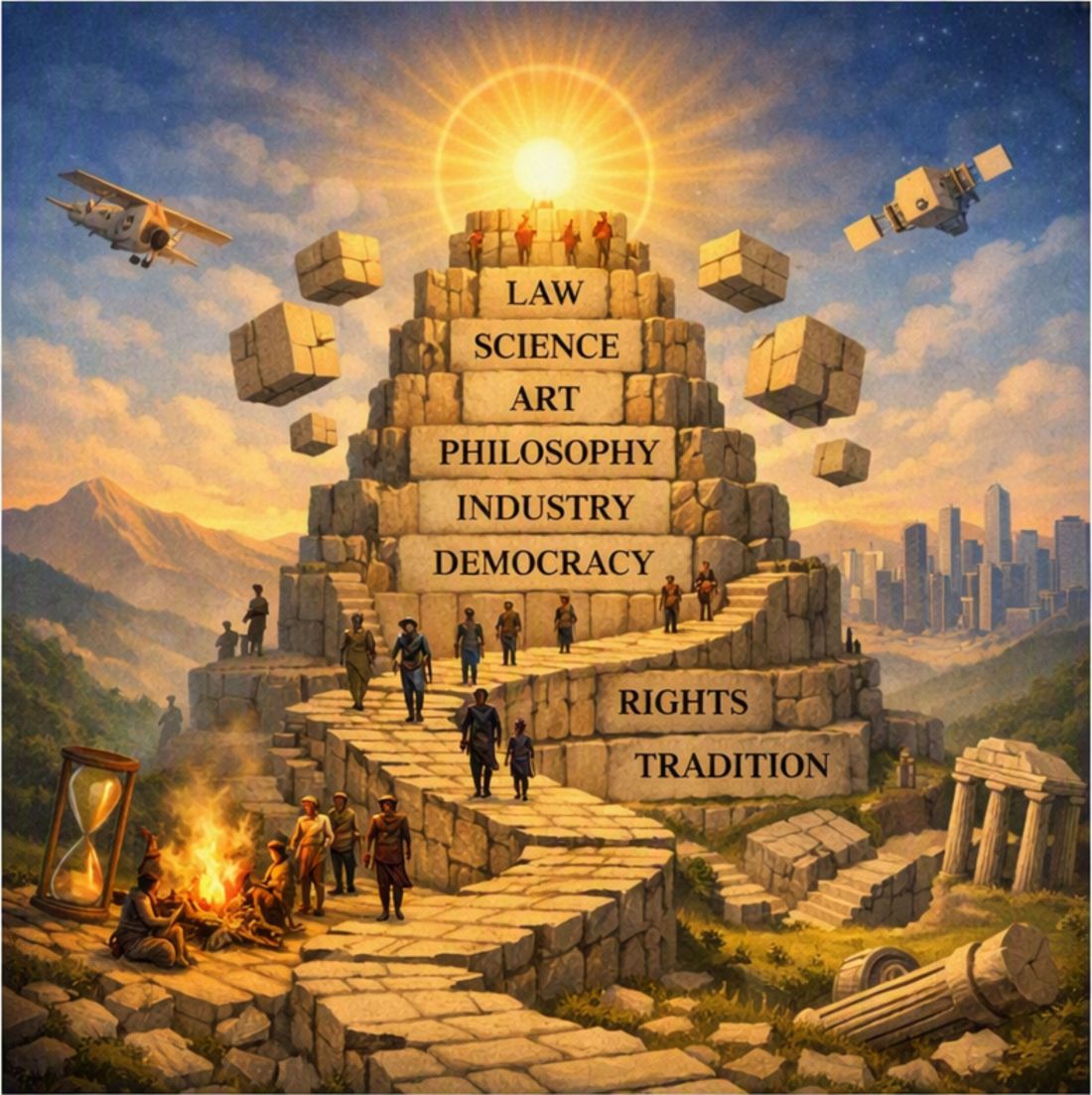
Introduction: The Structure We Stand On
Civilisation is the cumulative pathway to enlightenment – but like a Jenga tower, remove the wrong bricks and the whole structure falls.
This is not simply a metaphor for fragility; it is a description of how human progress actually works.
Civilisation is not a design project or a set of preferences. It is the operating software of society, built layer by layer through the experiences, discoveries, mistakes, conflicts, and moral awakenings of countless generations.
Yet today, we behave as though reality were optional. Ideas detached from lived experience shape political agendas. Cultural movements treat human nature as infinitely editable. Technological elites believe their vantage point is the whole picture.
We stand on the hill of human development, enjoying freedoms previous generations could not imagine, yet we treat the pathway that brought us here as though it were irrelevant or inconvenient.
Civilisation as Cumulative Wisdom
Civilisation is cumulative wisdom – the totality of human experience integrated into a functioning structure. Every discovery, every mistake, every triumph, every horror, every contradiction is a brick in that structure.
Some bricks are beautiful, some are ugly, some are painful to look at, but all are necessary because each one supports another.
A brick is not an endorsement. A brick is an experience. It may be a triumph, a mistake, a discovery, an atrocity, a sacrifice, a reform, a warning, or a moral awakening. Its moral character does not determine whether it belongs in the structure; its place in the accumulated pathway of human learning does.
Most people are not aware of all the steps that built civilisation. They do not see every brick or know every lesson. But that does not change the structure. A person does not need to remember every moment of their childhood for those moments to shape who they are.
Civilisation works the same way. The bricks exist whether we see them or not. The wisdom accumulates whether we recognise it or not.
This is why civilisation cannot be selectively edited. Removing a brick is not a cosmetic change. It is a structural fault – a software virus that deletes key parts of the programme.
Some functions may not be used often, but they are still essential. Some bricks may be removed without visible consequence, but removal is cumulative too. Remove enough of them, and the system behaves unpredictably. Remove the wrong one, or the one too many, and the entire structure collapses.
Historical Bricks and the Danger of Erasure
History makes this clear. The North Atlantic slave trade was a horror, but it was not an isolated aberration; slavery existed in almost every society in human history.
The moral revolution of the 19th century – the recognition of slavery as an indefensible violation of human dignity – did not appear out of nowhere. It was the culmination of centuries of accumulated thought, conflict, religious development, economic change, and philosophical debate.
The brick is not slavery alone. The brick is the suffering slavery caused, the ideas that justified it, the systems that profited from it, the people who opposed it, the philanthropy and moral labour that emerged against it, the institutions that acted to suppress it, and the immense cost of correction when civilisation had clearly gone wrong.
To erase any part of that chain is to weaken the lesson. To erase the lesson is to weaken the progress. And to weaken the progress is to endanger the civilisation that allowed us to condemn slavery in the first place.
Yet modern ideological movements attempt exactly this. They treat civilisation as software that can be rewritten by those who believe they understand it, even though they see only a fraction of the structure.
Awakening and Enlightenment: Seeing the Structure vs Completing It
Awakening is the moment a person becomes aware that there is a structure – that life, society, and civilisation are built from accumulated experience rather than random events.
Awakening is the recognition of pattern, not the completion of it. It is the point at which someone sees beyond the immediate, but cannot yet see the entire architecture.
Awakening feels transformative. It creates perspective and clarity. And because it feels profound, it is easy to mistake awakening for enlightenment – to believe that seeing further is the same as seeing all.
But awakening is only the beginning of wholeness, not wholeness itself. It is the moment when a person realises there are more steps, not the moment when all steps have been taken.
Enlightenment, in contrast, is structural completeness. But enlightenment is not something a person can ever see while they are still becoming it.
A human being cannot stand outside themselves and observe the completed structure of their own development. They are the house being assembled, and a house cannot look at itself.
The moment someone believes they can see the whole, they reveal that they cannot.
Civilisational enlightenment follows the same logic. Civilisation cannot step outside itself and observe the totality of its accumulated wisdom. It is the house being built, brick by brick, through the experiences of billions of people across thousands of years.
Civilisation becomes enlightened only when the whole is present – but the whole is not visible from within the process. It is not something any generation can perceive, any leader can define, or any ideology can claim.
This is why premature declarations of enlightenment – personal or collective – are always misleading, and often dangerous.
False Authority and the Illusion of Completion
In every era, there are people who present themselves as enlightened, or who claim that civilisation has reached a moral or intellectual summit.
Today, many of these voices come from technology, academia, activism, or cultural influence. They speak with confidence and certainty, as though they can see the whole structure.
But they cannot. No one can.
Their authority is based on perspective, not wholeness. Their clarity is based on awakening, not completion. Their confidence is based on height, not depth. And when such voices define enlightenment in their own terms, they mislead others into believing the structure is finished when it is not.
This is how civilisations become vulnerable: not through malice, but through misplaced certainty.
The Modern Error: Mistaking Height for Wholeness
The danger of our time is that those who stand at the summit of human progress – the technologists, the ideologues, the centralised power brokers – believe they have reached enlightenment simply because they have reached height. They believe their vantage point is the whole picture. They believe their tools, reach, and influence give them structural completeness.
But height is not wholeness. Perspective is not completion. Tools are not wisdom. Novelty is not progress. And the view from the summit is not enlightenment.
This confusion is amplified by the last eighty years of centralised power and wealth.
Distance dehumanises. Dehumanisation enables abstraction. Abstraction enables ideology. And ideology enables civilisational vandalism.
The Extractive System and the Hollowing of Foundations
The extractive economic system that has enriched the few while impoverishing the many is another expression of this detachment.
It treats human beings as variables in a model, resources to be mined, obstacles to be managed. It rewards abstraction over reality, centralisation over community, short‑term extraction over long‑term stability. It hollowed out the civilisational structure long before cultural movements began removing bricks.
The same detachment from accumulated reality is now appearing in our most powerful technologies.
Technology and AI: The Final Test of Civilisation
Now, as we stand on the verge of an AI and technological transformation sold as progress, we see the same pattern again.
AI could reinforce civilisation. It could extend human sovereignty. It could be built on accumulated wisdom. It could be the next brick in the structure.
But instead, in its current form, it risks becoming the ultimate instrument of a worldview that has already hollowed out the foundations of civilisation – a worldview that believes civilisation is software, history is optional, and human nature is infinitely editable.
AI amplifies awakening without wholeness. It accelerates perspective without integration. It gives tools to those who have not built the structure beneath them.
This is the real danger.
Structural Humility: The Safeguard Against Collapse
If civilisation has a safeguard, it is not ideology, technology, or power. It is structural humility – the recognition that our understanding is always partial while civilisation itself is cumulative; that we cannot see the whole, cannot declare completion, cannot safely remove bricks, and cannot assume our vantage point is the truth.
Humility is not a moral virtue here; it is a structural necessity. It is the only stance that respects the cumulative nature of civilisation and the unseeable nature of wholeness.
Conclusion: The Pathway to Wholeness
Civilisation is cumulative wisdom. It is the totality of human experience. It is the operating software of society.
Enlightenment – personal and collective – is the state of being whole.
When bricks are removed, whether through ideology, ignorance, or arrogance, the system does not evolve. It destabilises. It becomes unpredictable. It becomes fragile. And eventually, it falls.
If we continue removing bricks, the collapse will not be gradual. It will be sudden, and it will come precisely when those at the top believe the structure is complete.
Enlightenment is not achieved by standing at the summit. Enlightenment is achieved by respecting the entire pathway that made the summit possible. Enlightenment is the state of being whole – and wholeness cannot be chosen, declared, or imposed.
Enlightenment can only be, and will only be, when it is.

