

The Speed of Certainty
Sometimes the most interesting thing about a public controversy is not the controversy itself.
Following the conviction and sentencing of Russell Brand, a separate debate quickly emerged around Jemima Goldsmith. An injunction that many people had never previously heard of suddenly became the subject of widespread discussion.
Within hours of Goldsmith publishing a lengthy statement explaining her involvement in that injunction and the circumstances surrounding it, people appeared remarkably certain about what it all meant.
More strikingly, many appeared remarkably certain about who she was. And the confidence itself caught my attention.
Not because people were necessarily wrong. Public opinion is sometimes right. New information can alter our understanding of people and events. Criticism is often justified. Yet as I read reactions to Goldsmith’s statement, I found myself increasingly interested in something other than the dispute itself. What fascinated me was the apparent gap between the complexity of the chronology and the simplicity of many of the conclusions being drawn from it.
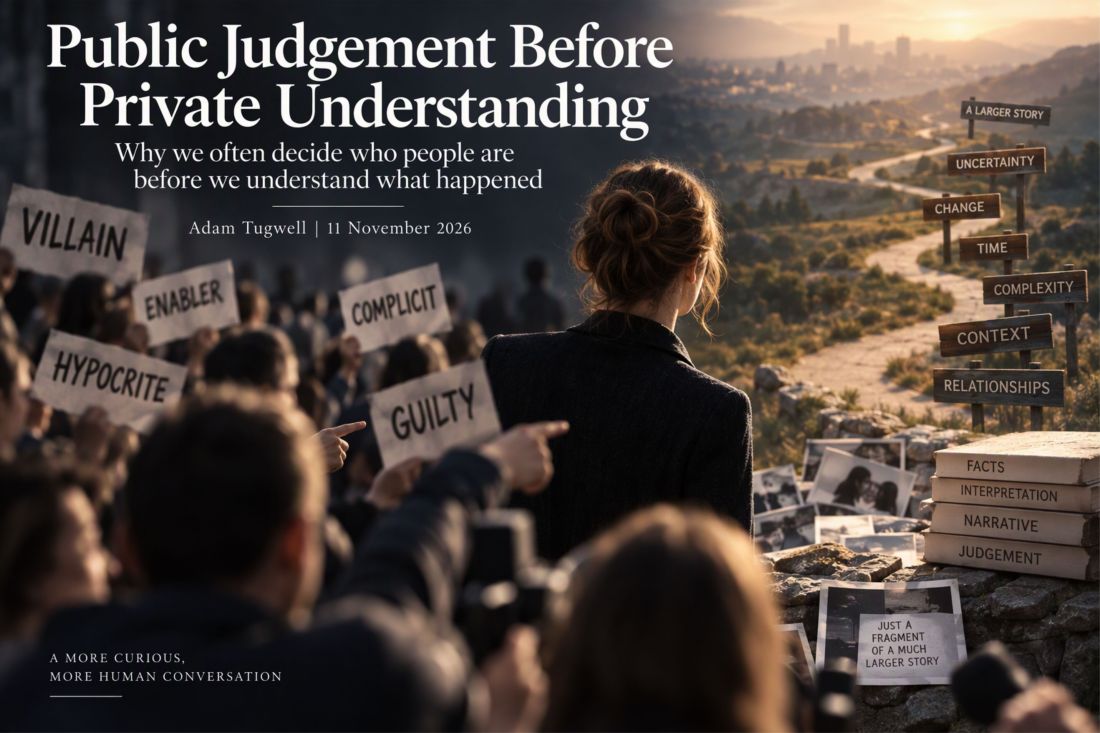
A chronology and a narrative are not the same thing.
Chronologies are messy. They contain false starts, misunderstandings, changing relationships, unforeseen consequences and facts that only become visible later.
Narratives, by contrast, are efficient. They condense complexity into something manageable. They transform a sequence of events into a story with recognisable characters and a comprehensible moral structure.
Human beings are remarkably good at compressing chronology into narrative.
The problem is that narratives are often far easier to inherit than chronologies are to reconstruct.
Living a Reality and Observing One
The more I reflected on the discussion surrounding Goldsmith, the more conscious I became of an asymmetry that appears far beyond celebrity controversies.
When we are living through a difficult reality, objectivity can be extraordinarily difficult. We experience events from the inside. We know what happened before the visible moment. We remember conversations that were never recorded, pressures that were never public, fears that were never spoken aloud and uncertainties that rarely survive into other people’s accounts. We possess so much context that we can struggle to separate ourselves from it.
Our understanding is deeply subjective because we are immersed within the experience itself.
The observer occupies a fundamentally different position.
The observer has distance. The observer is not carrying the emotional weight of the situation. They are not navigating the relationship, surviving the conflict or trying to make sense of events in real time. They possess something the participant largely lacks: the opportunity to be objective.
What strikes me is how often that opportunity goes unused.
The participant frequently recognises complexity because they cannot avoid it. The observer frequently reaches certainty because they can.
This seems backwards.
The person inside the experience is constrained by subjectivity. The observer possesses distance, perspective and time.
If anyone has the opportunity to exercise caution, curiosity and restraint, it is the observer. Yet public discussions often proceed as though distance itself were proof of understanding.
It is not.
Distance creates the opportunity for objectivity. It does not guarantee it.
The Story We Inherit
One of the themes I explored in Nobody Arrives at the Beginning was the tendency to mistake the point at which we encounter a story for the point at which the story began.
The deeper I looked into historical events, the harder genuine beginnings became to find. Every apparent origin led back to an earlier process. Every significant turning point emerged from circumstances that already existed. We inherit far more than we create.
The same observation seems to apply to people.
Almost nobody arrives at the beginning of another person’s story.
We do not arrive at the beginning of their marriage. We do not arrive at the beginning of their friendship. We do not arrive at the beginning of their dispute, their trauma, their mistakes or their private experiences.
Instead, we encounter fragments.
A resignation.
A court case.
A statement.
A rumour.
A reputation.
An allegation.
A public disagreement.
By the time these things reach us, a great deal has already happened.
What reaches us first is rarely the chronology. More often, it is an interpretation of the chronology.
This matters because interpretations have a tendency to disguise themselves as conclusions we reached independently. We inherit a story already underway and gradually forget that we arrived halfway through it.
By the time many people encountered the Goldsmith story, the chronology was already more than a decade old. Relationships had formed and ended. Allegations had been made and investigated. Journalists had become involved. Criminal proceedings had taken place. A conviction had been secured. A sentence had been imposed.
The chronology was long.
The narrative was short.
As so often happens, it was the narrative that travelled furthest.
What People Hear
Years ago, the political strategist Frank Luntz wrote a book called Words That Work, with a subtitle that captured an uncomfortable truth about communication.
It’s Not What You Say. It’s What People Hear.
Whatever one thinks of Luntz or his politics, the observation itself remains very useful.
Information never arrives in a vacuum.
People do not absorb facts in isolation. They interpret them through assumptions, prior beliefs, experiences, emotions and expectations. The meaning of information is often influenced as much by the context in which it is received as by the information itself.
This seems particularly relevant to the role played by the injunction at the centre of the Goldsmith discussion.
The existence of the injunction was discovered and brought into wider public view. Questions were raised. Those questions were legitimate. Yet once the information entered public discourse, something else happened.
The injunction became a story.
The story became a conclusion.
The conclusion became an interpretation of Goldsmith herself.
Notice how different those stages are.
The existence of an injunction is a fact.
What the injunction means is an interpretation.
What that interpretation says about another human being is another step entirely.
Yet public discussion often moves through those stages at remarkable speed.
Before long, the distinction between chronology and narrative begins to disappear.
The Principle We Forgot
There is an old philosophical concept known as the Principle of Charity.
Despite the name, it is not principally about kindness.
It is about understanding.
Before deciding that another person’s position is wrong, the principle suggests that we should first attempt to understand the strongest reasonable version of what they are actually trying to communicate, or what they actually mean. We should not begin with the weakest interpretation. We should begin with the version that a fair-minded observer would recognise as their intended meaning rather than what the precise form of words or the delivery might otherwise say.
This once seemed like a sensible discipline. But increasingly, it feels like a forgotten one.
Reading reactions to Goldsmith’s statement, I wondered how many people were responding to the statement itself and how many were responding to what they believed the statement must mean.
Those are very different things.
One can disagree with Goldsmith completely and still attempt to understand her accurately.
One can reject her account while still engaging with what she is actually saying.
The Principle of Charity does not require agreement.
It requires understanding to precede judgement.
Yet much contemporary discourse seems organised around the reverse sequence.
Judgement first.
Understanding later.
If later comes at all.
The Roles We Assign
Perhaps the most powerful thing any narrative does is assign roles.
Human beings find complexity difficult to carry. Roles help simplify it.
Somebody becomes the victim.
Somebody becomes the perpetrator.
Somebody becomes the enabler.
Somebody becomes the whistle-blower.
Somebody becomes the villain.
The role creates coherence. It tells us where the character belongs within the story.
Yet real people rarely fit such tidy categories.
One of the things that struck me about the reaction to Goldsmiths statement was how resistant many interpretations seemed to be to complexity. The possibility that someone might occupy several positions at different points in a chronology appeared oddly difficult for many people to entertain.
Relationships are rarely static.
People learn things.
Perspectives change.
Circumstances evolve.
Actions that appear contradictory in retrospect can make perfect sense when viewed within the chronology in which they occurred.
The difficulty is that chronology asks more of us than narrative does.
Narrative rewards certainty.
Chronology demands patience.
Narrative assigns roles.
Chronology asks us to understand people.
Narrative simplifies.
Chronology complicates.
One travels much faster than the other.
The Board We Are Standing On
While writing The Board We Are Standing On, I became interested in the difference between observing a system and standing inside one.
When people play Monopoly, they understand immediately that outcomes emerge from an interaction between rules, incentives, opportunities, constraints and individual decisions. They recognise that both the player and the board matter.
Outside the game, that balance often becomes harder to maintain.
When judging other people, we tend to focus on the move rather than the board that produced it.
We see a statement but not the years behind it.
We see a decision but not the circumstances surrounding it.
We see a consequence but not the system from which it emerged.
The same may be true of public judgement itself.
We often treat our understanding of another person as though it emerged independently. Yet it is influenced by narratives, framing, assumptions, expectations and inherited conclusions.
The observer believes they are assessing the individual.
Frequently they are also responding to the invisible system through which information about that individual has arrived.
The board remains hidden.
Only the piece appears visible.
Understanding Before Judgement
The longer I reflected on the reaction, the less interested I became in whether the public had reached the correct conclusion.
Correct conclusions are possible. Sometimes they are even obvious.
The more interesting question seemed to be whether understanding and judgement had occurred in the same order.
Understanding requires chronology.
It requires context.
It requires acknowledging uncertainty while information remains incomplete.
It requires accepting that another person’s lived reality may contain details we cannot see.
Judgement requires none of those things.
Judgement can emerge from fragments.
This is not necessarily a criticism. Human beings construct stories because stories help make complexity manageable. The problem begins when we forget that the story is not the chronology itself.
Perhaps this is what stayed with me about the whole discussion.
Not because Jemima Goldsmith is uniquely important. Not because she is necessarily right.
But because the mechanism became unusually visible.
A chronology spanning more than a decade collided with a narrative that could be understood in seconds.
A statement intended to add complexity entered a discussion increasingly attracted to simplicity.
A person became a role. And once the role existed, much of what followed appeared to be interpreted through it.
The same thing happens far beyond public scandals.
It happens after divorces.
It happens after workplace disputes.
It happens within families.
It happens anywhere people inherit stories about one another.
Most of us know what it feels like to be misunderstood.
Few of us realise how often misunderstanding begins with people who believe they already understand.
The participant is trapped inside the subjectivity of the experience. They cannot easily step outside it.
The observer possesses distance. The observer has the opportunity to pause, to question, to acknowledge uncertainty and to remain curious.
In theory, the observer has the better chance of objectivity.
Yet certainty often appears first among those furthest from the events themselves.
Perhaps that is why public judgement deserves more scrutiny than it usually receives.
Not because judgement is wrong.
Not because every interpretation is equally valid.
But because distance creates a responsibility alongside an opportunity.
The responsibility is to remember that chronology is usually larger than narrative. That the person is usually larger than the role. And that understanding another human being was never supposed to be the easiest part of the process.
The easiest part is deciding who they are.
Further Reading
The Board We Are Standing On
Why it is easier to see systems in a game than in the world around us
Link: https://adamtugwell.blog/2026/11/09/the-board-we-are-standing-on/
Nobody Arrives at the Beginning
Why the present inherits more than it chooses and shapes more than it can see
Link: https://adamtugwell.blog/2026/11/07/nobody-arrives-at-the-beginning/
Personal Sovereignty – The Freedom Beyond Independence
Link: https://adamtugwell.blog/2026/10/23/personal-sovereignty/
The Road We Are On is Broken – And We Built it Ourselves
Link: https://adamtugwell.blog/2026/01/07/the-road-we-are-on-is-broken-and-we-built-it-ourselves/

