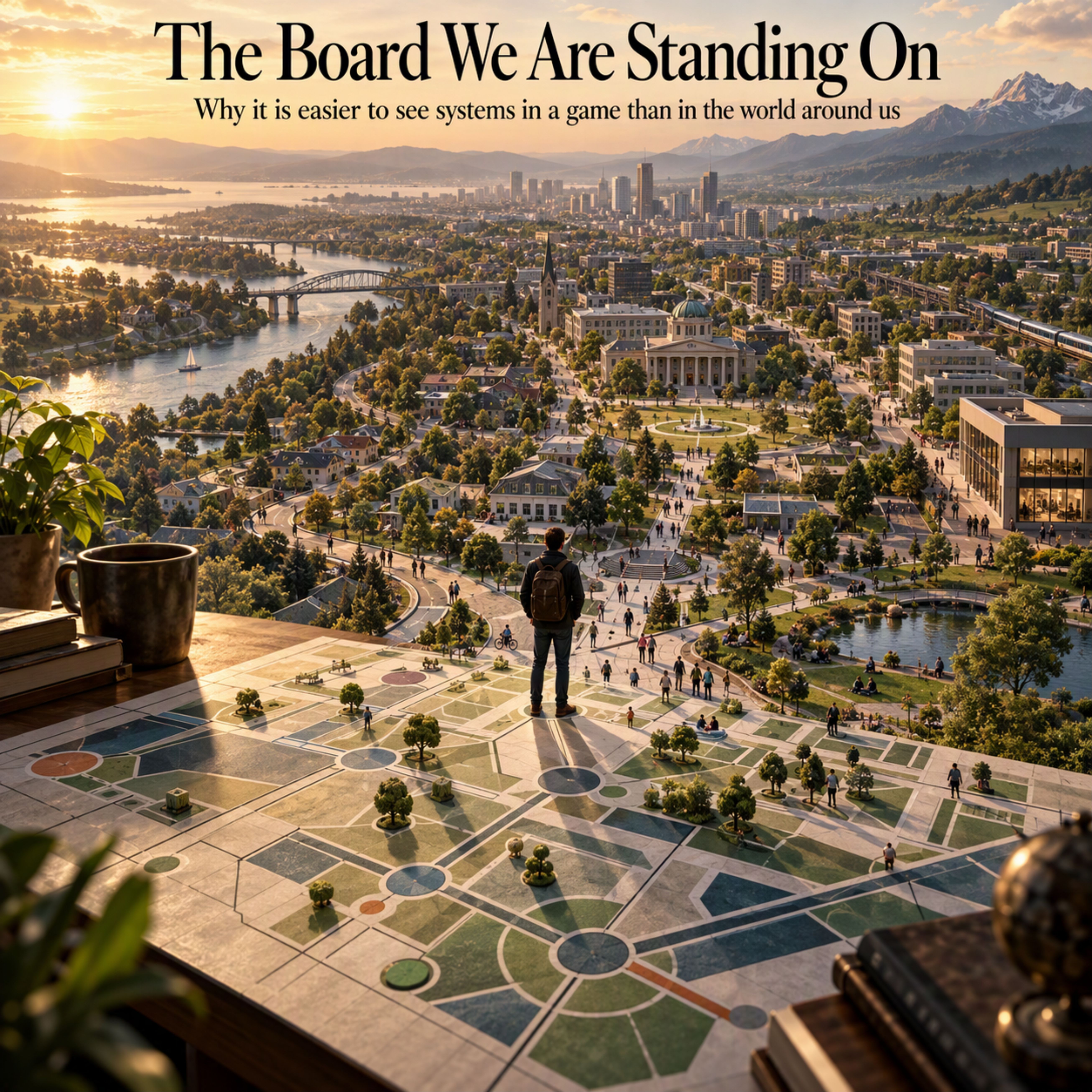

Introduction
There is something curious about Monopoly.
Almost everyone who plays it becomes a systems thinker.
They understand that the rules matter. They understand that incentives matter. They understand that where players start matters. They understand that luck matters. They understand that previous decisions shape future possibilities. They understand that the board itself influences outcomes.
Nobody finds these observations controversial.
In fact, they are so obvious that they barely seem worth saying.
Yet outside the game, many of the same people become far less comfortable with similar ways of thinking.
Discussions about housing, education, work, politics, opportunity, wealth and inequality often collapse into arguments about individuals.
Who worked harder? Who made better decisions? Who deserves success? Who is responsible for failure?
These are reasonable questions. Individual choices matter.
But something interesting happens when people sit around a Monopoly board.
Without needing to be taught, they begin asking a different kind of question.
Not:
What did this player do?
But:
What effect is the board having on the players?
For the duration of the game, they seem perfectly capable of holding both perspectives at once.
The player matters.
The board matters.
The decisions matter.
The rules matter.
Nothing about this feels contradictory.
The question that eventually captured my attention was not whether Monopoly resembles life. It was why people find it so much easier to recognise systems when they are looking at a board game than when they are living inside one.
The Literacy We Didn’t Know We Had
One possibility is that Monopoly reveals a capability most people already possess but rarely recognise.
When discussions turn to systems, institutions, incentives or structures, many people assume these are specialist topics. They sound academic, political or technical. The language alone can make them feel distant from everyday life.
Yet put the same people around a Monopoly board and something quite different happens.
Nobody needs to explain that an early advantage can influence later outcomes. Nobody needs to explain that some decisions create opportunities while others constrain them. Nobody needs to explain that the rules of the game shape what players are likely to do.
Players understand these things instinctively. More importantly, they understand them simultaneously.
A player might observe that someone is winning because they made good decisions. The same player might also recognise that luck played a part, that the timing of property purchases mattered, and that the state of the board created opportunities that were not available to everyone else.
None of these explanations cancels out the others. They coexist naturally.
The interesting thing is not that people can understand these dynamics when they are explained to them. It is that they often see them for themselves.
The game requires no lecture on systems thinking. Players simply watch patterns emerge and begin reasoning about them. In doing so, they demonstrate a form of literacy that often goes unnoticed.
Not literacy in facts.
Not literacy in theory.
A literacy in relationships.
A literacy in incentives.
A literacy in seeing how outcomes emerge from interactions between people, rules, constraints and circumstances.
Most people never describe what they are doing this way. They simply call it understanding the game. And perhaps that is where the puzzle begins.
If people can recognise these patterns so readily around a board game, where does that ability go when the conversation shifts to education, housing, work, politics, money, opportunity or power?
Does it disappear? Or does something else happen?
Perhaps the issue is not that people lack the ability to think systemically.
Perhaps the issue is that the systems we live within are much harder to see than the systems we play.
The Difference Between Seeing the Board and Standing on It
The more I thought about Monopoly, the less interested I became in the game itself.
The interesting part was not the money, the properties or even the outcome.
It was the perspective.
When people play Monopoly, they occupy a position that is strangely difficult to achieve in ordinary life. They are participating in the game while also observing it. They make decisions, pursue opportunities, take risks and experience setbacks, but they can also step back and see how those experiences fit into a wider pattern.
A player knows whether they are doing well or badly, but they can also see who owns which properties, where advantages are beginning to accumulate, and how decisions made earlier in the game continue to influence what is possible later.
They can see the whole board at once.
That ability changes the nature of their understanding.
When a player lands on an expensive property and has to pay rent, they do not experience the event in isolation. They immediately connect it to a larger structure. They understand how the property was acquired, what choices led to its development, and how ownership changes the possibilities available to everyone else. The individual event makes sense because the wider context remains visible.
Life rarely feels like that.
Most of us experience the world from much closer to the action. We experience our rent, our mortgage, our pay cheque, our commute, our career, our opportunities and our frustrations. We experience consequences directly and continuously. What we do not always experience is the larger structure from which those consequences emerge.
Nobody experiences a housing system.
They experience the search for somewhere affordable to live.
Nobody experiences a labour market.
They experience the difficulty of finding work, keeping work, or earning enough from it.
Nobody experiences a monetary system.
They experience prices rising, bills arriving and choices narrowing.
The broader pattern often disappears beneath the immediacy of everyday life.
This is not because people are incapable of understanding systems. In many cases they understand them remarkably well, when they are visible.
The challenge is that the systems which shape our lives are not spread out across a table in front of us. We live inside them. We encounter them one consequence at a time.
The distinction sounds small, but it may explain far more than it first appears to.
Around a Monopoly board, players naturally move between different vantage points. They can think about their own position while simultaneously thinking about the game as a whole. They can ask what move they should make next while also asking what the structure of the board is encouraging everybody else to do.
Neither perspective threatens the other.
In fact, both are necessary to understand what is happening.
Outside the game, however, those vantage points often become separated. People are encouraged to focus on individual experiences, individual decisions and individual outcomes. These things matter enormously. Yet as attention narrows towards the experiences of the piece, the board itself becomes more difficult to see.
Perhaps that is why so many discussions about the world feel as though they are talking past one another.
Some people are describing the experience of the piece.
Others are describing the structure of the board.
Both may be describing something real.
The difficulty lies in recognising that the two perspectives are not enemies. They are views of the same game. And perhaps that is the first clue to the puzzle.
If people are perfectly capable of seeing systems when those systems are visible, why do some systems become so difficult to see at all?
The Hardest Systems to See
The easiest system to examine is one you already know is a system.
Nobody sits down to Monopoly believing its rules are an inevitable feature of reality. Players understand that somebody designed the board, defined the objectives, created the money and decided what winning means.
The entire game is recognised as a constructed environment.
That recognition creates an unusual kind of freedom.
A player can question the rules without feeling as though they are questioning reality itself. They can imagine a different version of the game. They can wonder what would happen if the rules changed. They can even conclude that certain outcomes are being produced less by the players than by the way the game has been designed.
None of this feels threatening because everybody already understands that the game and reality are not the same thing.
Life is different.
The systems we inhabit are not presented to us as systems. We encounter them as normality.
We are born into existing institutions, existing assumptions, existing definitions of success, existing expectations and existing ways of interpreting the world. We learn them gradually, usually without noticing that we are learning them at all. By the time we become aware of them, they often feel less like assumptions and more like facts.
This does not happen because anybody is deceiving us. It happens because inherited assumptions are rarely introduced as assumptions.
They are introduced as common sense.
A child does not usually encounter a lesson entitled The Assumptions of the Society You Live In. They encounter expectations. Incentives. Stories. Definitions of success. Definitions of responsibility. Definitions of what is realistic and unrealistic.
Over time, these things become part of the background.
And background is notoriously difficult to see.
The paradox is that the assumptions that have the greatest influence over us are often the ones we no longer recognise as assumptions at all.
They become the lens through which we interpret everything else.
That is why genuinely new ideas so often feel unrealistic when they are first encountered. The discomfort does not necessarily come from the idea itself. It comes from the fact that the idea conflicts with assumptions that have become invisible.
In Nobody Arrives at the Beginning, I explored the way each generation inherits institutions, narratives and ways of understanding the world that already exist before they arrive. Nobody starts with a blank sheet of paper. Everybody enters a story that is already underway.
Perhaps the same is true of perception itself.
We do not merely inherit systems. We inherit ways of seeing systems. And because we inherit them, we rarely stop to ask where they came from.
Around a Monopoly board, the system remains visible because it never stops feeling separate from reality.
Outside the game, the opposite often happens.
The system becomes so familiar that it starts to look like reality itself. And once that happens, questioning the system can begin to feel like questioning reality.
Perhaps this is why paradigm blindness is so difficult to recognise while it is happening.
The issue is not that people cannot see.
The issue is that we are usually looking through the very thing we are trying to observe.
Both Things Can Be True
One of the strangest things about Monopoly is how easily players accept explanations that would often be treated as contradictory elsewhere.
Imagine a player is winning.
Nobody around the table finds it difficult to say that they made some good decisions. Equally, nobody finds it difficult to notice that they landed on useful properties early in the game, benefited from favourable timing, or took advantage of opportunities that were not available to everyone else.
These explanations do not compete with one another.
They accumulate.
The player may have played well. The circumstances may have helped. The structure of the board may have mattered. The rules may have mattered. Luck may have mattered.
Most people have no difficulty holding all of these possibilities in their minds simultaneously. Understanding the game often requires it.
What is striking is how quickly this changes outside the game.
In public life, discussions frequently become battles between competing explanations. Is a person’s situation the result of their own choices or the circumstances they inherited? Are outcomes produced by individual behaviour or by wider structures? Are people responsible for their decisions or influenced by the systems within which those decisions are made?
Again and again, people are encouraged to choose between explanations that may not actually be in conflict.
Yet around a Monopoly board, they rarely feel the need to choose.
The player acts.
The board influences.
Both things are true.
The player has agency.
The player operates within constraints.
Both things are true.
The outcome emerges from the interaction between decisions, circumstances, rules and opportunities.
All of these things can be true at the same time.
Perhaps this becomes harder in real life because people experience these questions personally.
An observation about the board can feel like a judgement about the piece.
A discussion about incentives can feel like an attack on responsibility.
A discussion about structure can feel like a denial of agency.
As a result, perspectives that might naturally complement one another become treated as rivals.
The irony is that many of the disagreements that dominate public debate are not necessarily disagreements about reality. They are disagreements about vantage point.
One person is describing what it feels like to be the piece.
Another is describing the board.
Both may be observing something real.
Both may be observing the same reality from different positions.
In The Road We Are On Is Broken – And We Built It Ourselves, I explored the idea that perspective shapes perception. What we see depends partly on where we are standing. The same principle may apply here.
The challenge is not choosing the correct perspective. The challenge is recognising that understanding often requires more than one.
Around a Monopoly board, this comes naturally.
Players move effortlessly between their own experience and a wider view of the game.
They can see the move and the board simultaneously.
Perhaps one of the hidden lessons of the game is that reality often works the same way.
The difficulty is not that multiple perspectives exist.
The difficulty is remembering that our own perspective is only one of them.
Nobody Arrives at the Beginning
There is another lesson hidden in Monopoly that is easy to overlook.
Nobody begins by creating the game.
The board already exists. The rules already exist. The money already exists. The objective already exists. Even the meaning of success has already been decided before the first player moves a piece.
The players inherit all of it.
That sounds obvious because it is. It would be strange to imagine a player claiming personal credit for inventing the board, writing the rules or deciding how the game should work. Their role is not to create the game. Their role is to navigate it.
Yet this obvious observation becomes surprisingly difficult to recognise outside the game.
In everyday life, people often speak as though they stand at the beginning of their own story. We talk about choices, achievements, failures, opportunities and responsibilities as though they emerge into an empty space. In reality, none of us start with a blank sheet of paper.
We inherit language before we learn to speak.
We inherit institutions before we begin participating in them.
We inherit markets before we enter them.
We inherit assumptions before we learn to question them.
We inherit measures of success before we decide whether they are worth pursuing.
By the time we become capable of reflecting on the systems around us, we are already immersed within them.
In Nobody Arrives at the Beginning, I explored this idea through history. The deeper I looked for origins, the harder they became to find. Every turning point turned out to have predecessors. Every significant decision emerged from circumstances that already existed. Every generation inherited realities it did not create and passed modified versions of those realities to those who followed.
The same observation applies at the level of individual experience.
Nobody arrives at the beginning.
We arrive in the middle.
We enter a world where rules, assumptions, incentives and expectations are already operating. Some serve us well. Some do not. Some are visible. Others become so familiar that they disappear into the background.
This matters because inherited systems shape more than behaviour. They shape perception.
A player joining a Monopoly game understands immediately that the board was there before them. Because of that, they are capable of questioning it. They can imagine different rules, different objectives and different ways of playing.
Outside the game, inherited assumptions often acquire a different status. They stop appearing as inherited assumptions and start appearing as reality itself.
The distinction is subtle but important.
If something is recognised as a rule, it can be questioned.
If something is recognised as an assumption, it can be examined.
If something is recognised as an incentive, it can be redesigned.
But if those same things are mistaken for reality itself, they become largely invisible.
Perhaps this is one reason meaningful change is so difficult.
People are often trying to solve problems using assumptions they never consciously chose. They are evaluating outcomes using measures they inherited. They are navigating incentives that predate them. They are arguing about moves while taking the board largely for granted.
Not because they are foolish.
Not because they lack awareness.
But because it is extraordinarily difficult to recognise the parts of reality that have become normal.
Around a Monopoly board, nobody mistakes the game for reality.
Outside the game, the distinction becomes much harder to maintain.
And that may be the most important difference of all.
Conclusion: The Board We Cannot See
Perhaps the strangest thing about Monopoly is not what it teaches us about money, ownership or competition.
Perhaps it is what it reveals about ourselves.
For a few hours around a board, people routinely demonstrate an ability that often seems absent elsewhere.
They recognise patterns beyond their own experience. They understand that rules shape behaviour. They understand that incentives matter. They understand that opportunities are not evenly distributed. They understand that outcomes emerge from an interaction between individual choices and larger structures.
Most importantly, they understand that seeing the game requires more than looking at a single piece.
Yet when the game ends, that capability appears to fade from view.
The obvious explanation is that people stop thinking systemically.
I am no longer convinced that is true.
A more interesting possibility is that the capability never disappears at all.
What changes is the visibility of the board.
When the board sits on a table, we can step back from it. We can inspect it. We can argue about it. We can imagine playing differently. We understand instinctively that the rules, incentives and objectives are not reality itself. They are features of a particular game.
The systems we inhabit every day are different. We are born into them rather than sitting down to them. We inherit them rather than choosing them. We learn their assumptions before we are capable of questioning them. Over time, many of those assumptions cease to appear as assumptions at all.
They become simply the way things are.
Perhaps that is why meaningful change so often proves elusive.
The challenge is not necessarily a lack of intelligence, education or awareness. It may be that people are attempting to understand a board upon which they are standing. They are trying to observe a system from within a system. They are trying to examine assumptions that have become part of the background of their own thinking.
That is not impossible. It is simply difficult.
In Nobody Arrives at the Beginning, I argued that every generation inherits a world already in motion. In Personal Sovereignty, I explored the possibility that genuine freedom begins when we become capable of seeing some of the assumptions we have inherited rather than mistaking them for reality itself.
Viewed from that perspective, Monopoly points towards something unexpectedly important.
Not because it explains the world.
Not because the world is secretly a board game.
But because it reveals a capability that many people already possess.
The ability to step back.
The ability to recognise a system.
The ability to see both the piece and the board.
The ability to hold more than one perspective at the same time.
The question, then, is not whether we are capable of systemic thinking.
The question is whether we can learn to apply the same mode of thought to the systems we already inhabit.
Because if we can, a great deal that currently appears inevitable may begin to look very different.
We may discover that some of the things we call reality are, in fact, inherited assumptions.
We may discover that some of the boundaries we regard as fixed are products of particular ways of organising life.
And we may discover that the board has been visible all along.
Not hidden.
Not secret.
Simply mistaken for the ground beneath our feet.
Further Reading
This essay began with an observation about perspective, systems and the strange ease with which people can recognise certain patterns when those patterns are made visible. The pieces below explore many of the same themes from different directions.
Seeing the Board
Nobody Arrives at the Beginning
Explores how every generation inherits assumptions, institutions and ways of understanding the world that already exist before they arrive. It argues that meaningful turning points are rarely true beginnings, and that understanding the present requires recognising the histories embedded within it.
Read: https://adamtugwell.blog/2026/11/07/nobody-arrives-at-the-beginning/
The Road We Are On Is Broken – And We Built It Ourselves
Examines the relationship between perspective, awareness and systemic change. It argues that many modern problems persist because people struggle to see the structures producing them, and that solutions rarely emerge from the same thinking that created the conditions being addressed.
Read: https://adamtugwell.blog/2026/01/07/the-road-we-are-on-is-broken-and-we-built-it-ourselves/
Systems, Assumptions and Cognitive Capture
Personal Sovereignty: The Freedom Beyond Independence
Explores the distinction between independence and sovereignty, introducing the ideas of cognitive capture, inherited assumptions and structural pressure. It argues that genuine freedom begins when we become capable of examining the assumptions we inherited rather than mistaking them for reality itself.
Read: https://adamtugwell.blog/2026/10/23/personal-sovereignty/
The Establishment Is Not What You Think It Is
Presents the argument that the modern Establishment is not primarily a group of people but a worldview: a shared set of assumptions about what is realistic, responsible and possible. It examines how incentives sustain those assumptions and why systems often reproduce themselves without requiring coordination or conspiracy.
The Paradox of Control: How the Things That Could Free Us Are Being Used to Shape Our Dependence
Examines how tools, technologies, institutions and ideas that could increase freedom often end up reinforcing dependency. It explores the relationship between control, incentives, identity and the assumptions that shape modern life.
Understanding the Dynamics Beneath the Symptoms
Can Meaningful Change Still Be Delivered Today?
A concise overview of the wider inquiry from which many of these ideas emerge. It introduces concepts including cost externalisation, human value externalisation, proxy sovereignty, judgement displacement and agency, while asking whether meaningful reform remains possible within the systems we already have.
Read: https://adamtugwell.blog/2026/11/01/can-meaningful-change-still-be-delivered-today/
The Future Is Abstract
Explores why genuinely different futures can be difficult to imagine from within existing systems. It argues that many alternatives appear unrealistic not because they are impossible, but because they sit outside assumptions we have become accustomed to treating as reality.
Independence, Agency and Sovereignty
The Independence Threshold: A New Definition of Poverty for a Modern Economy
Argues that poverty begins where independence ends. Rather than focusing solely on material conditions, it examines whether a person can meet their essential costs of living without reliance on debt, charity, welfare or family support, and why that threshold matters for freedom and agency.
Your Beliefs Today Create Everyone’s Experiences Tomorrow
A broader exploration of worldviews, perception and the relationship between individual beliefs and collective outcomes. It examines how different understandings of reality shape the futures societies create.
The Philosophy of a People-First Society
Sets out the philosophical foundations underlying much of this work, including assumptions about human nature, value, contribution, community and the relationship between systems and human flourishing.
Read: https://adamtugwell.blog/2026/01/02/the-philosophy-of-a-people-first-society/

